

The DOI matches its Crossref record; 52 of the 52 references it cites were found in a registry or an index.
Testing the advantages and disadvantages of short- and long- read eukaryotic metagenomics using simulated reads
Open accessPublished version of a preprint
Abstract
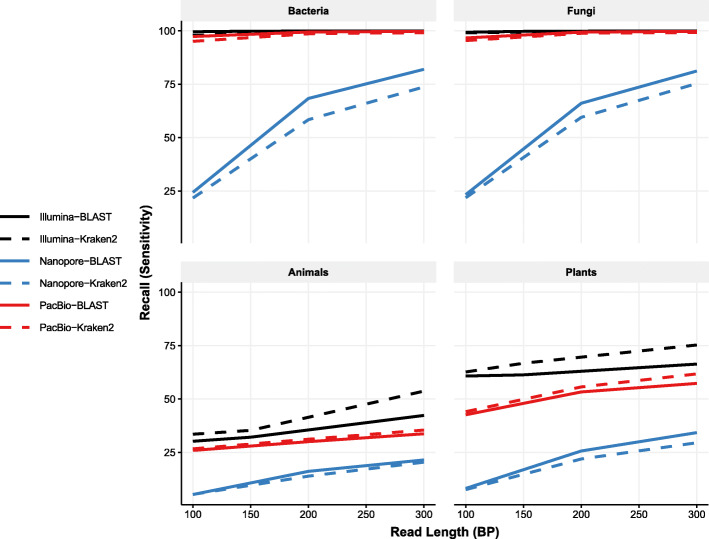
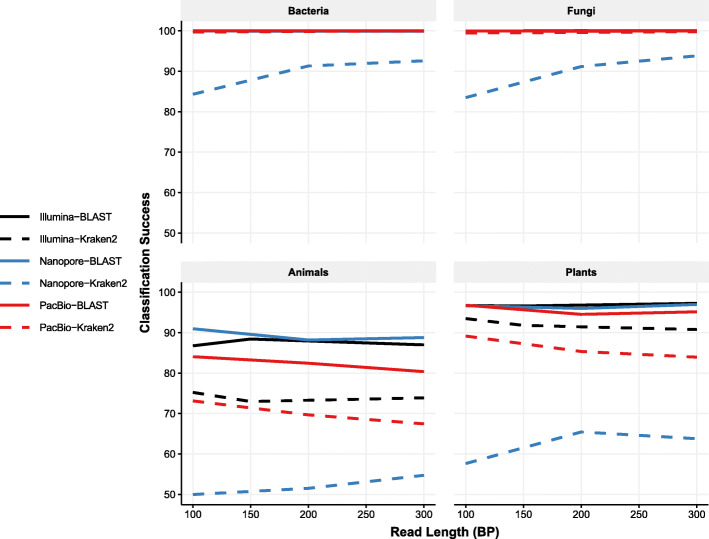
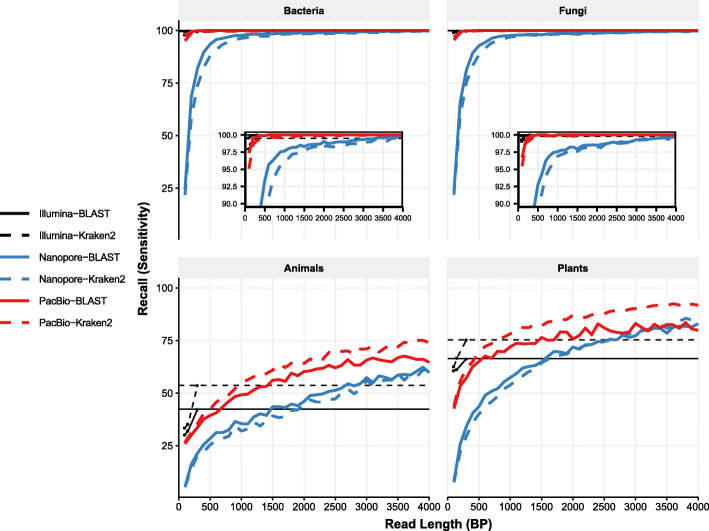
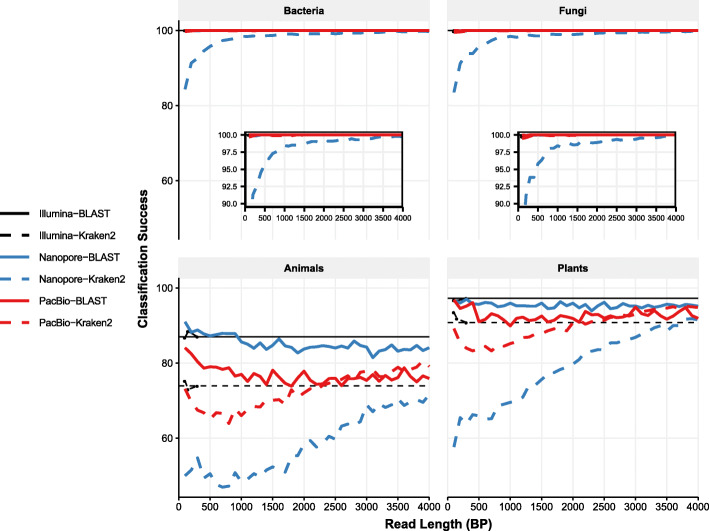
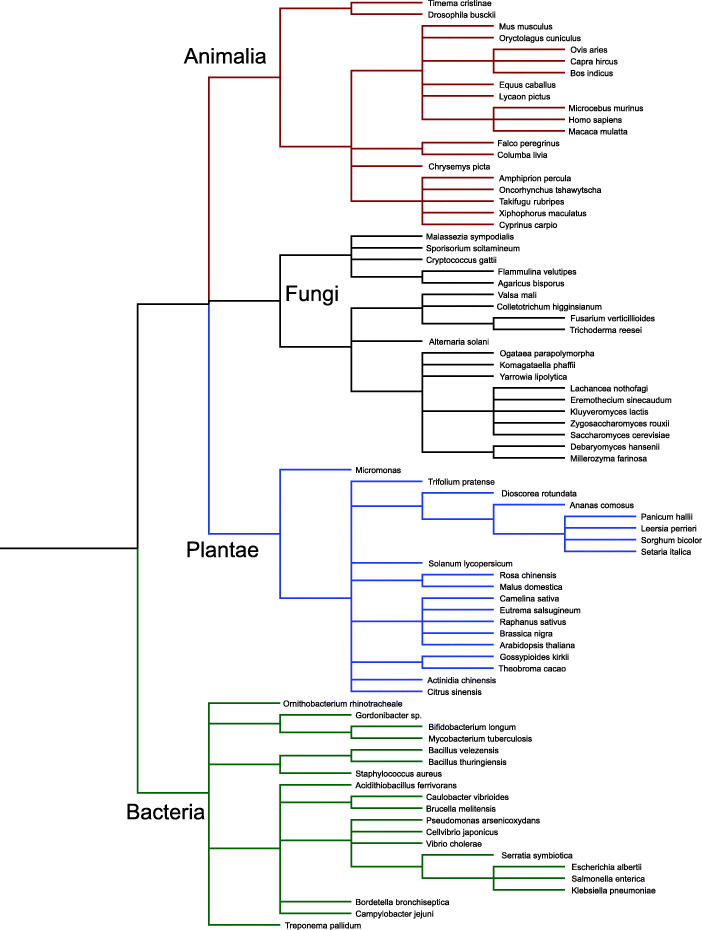
Background: The first step in understanding ecological community diversity and dynamics is quantifying community membership. An increasingly common method for doing so is through metagenomics. Because of the rapidly increasing popularity of this approach, a large number of computational tools and pipelines are available for analysing metagenomic data. However, the majority of these tools have been designed and benchmarked using highly accurate short read data (i.e. Illumina), with few studies benchmarking classification accuracy for long error-prone reads (PacBio or Oxford Nanopore). In addition, few tools have been benchmarked for non-microbial communities. Results: Here we compare simulated long reads from Oxford Nanopore and Pacific Biosciences (PacBio) with high accuracy Illumina read sets to systematically investigate the effects of sequence length and taxon type on classification accuracy for metagenomic data from both microbial and non-microbial communities. We show that very generally, classification accuracy is far lower for non-microbial communities, even at low taxonomic resolution (e.g. family rather than genus). We then show that for two popular taxonomic classifiers, long reads can significantly increase classification accuracy, and this is most pronounced for non-microbial communities. Conclusions: This work provides insight on the expected accuracy for metagenomic analyses for different taxonomic groups, and establishes the point at which read length becomes more important than error rate for assigning the correct taxon.
Overview
The claims and statistics of this paper haven’t been checked yet.
Run the check — free, no account needed. It reads the open-access text and checks the sources it cites.
Integrity signals
Registry
Cites
Statistics
Figures
Verification
Claims the paper makes
The claims and statistics of this paper haven’t been checked yet.
Run the check — free, no account needed. It reads the open-access text and checks the sources it cites.
Claims other papers make about this one
Each is checked against this paper’s own text: does it say what the citing paper says it does?
In the citing paper
“By contrast, long‐read technology provides more read‐length but at the cost of higher error rates.82”
From The oral microbiome: Role of key organisms and complex networks in oral health and disease (2021) · cites this paper as [82]
In the citing paper
“short‐read technology provides abundant sequencing data that is less error prone than long‐read technology; however, it can be difficult to assemble complete genomes using short read‐lengths due to limitations in the technology to distinguish repetitive elements.”
From The oral microbiome: Role of key organisms and complex networks in oral health and disease (2021) · cites this paper as [82]
Self-check
Percentages, sums and reported differences re-computed from the paper’s own numbers.
The self-check needs the paper’s full text.
Citations
Cites
QIIME allows analysis of high-throughput community sequencing data
Caporaso, J. G., Kuczynski, J., Stombaugh, J., Bittinger, K., Bushman, F. D., Costello, E. K., Fierer, N., Peña, A. G., Goodrich, J. K., Gordon, J. I., et al. (2010) · Nature Methods · doi:10.1038/nmeth.f.303 · Cited by 34,887
Schloss, P. D., Westcott, S. L., Ryabin, T., Hall, J. R., Hartmann, M., Hollister, E. B., Lesniewski, R. A., Oakley, B. B., Parks, D. H., Robinson, C. J., et al. (2009) · Applied and Environmental Microbiology · doi:10.1128/aem.01541-09 · Cited by 19,549
Fast and sensitive protein alignment using DIAMOND
Buchfink, B., Xie, C., & Huson, D. H. (2015) · Nature Methods · doi:10.1038/nmeth.3176 · Cited by 14,201
Stackebrandt, E. S., & Goebel, B. M. (1994) · INTERNATIONAL JOURNAL OF SYSTEMATIC AND EVOLUTIONARY MICROBIOLOGY · doi:10.1099/00207713-44-4-846 · Cited by 7,170
O'Leary, N. A., Wright, M. W., Brister, J. R., Ciufo, S., Haddad, D., McVeigh, R., Rajput, B., Robbertse, B., Smith-White, B., Ako-Adjei, D., et al. (2016) · Nucleic Acids Research · doi:10.1093/nar/gkv1189 · Cited by 6,357
Kraken: ultrafast metagenomic sequence classification using exact alignments
Wood, D. E., & Salzberg, S. L. (2014) · Genome Biology · doi:10.1186/gb-2014-15-3-r46 · Cited by 4,521
Benson, D. A., Cavanaugh, M., Clark, K., Karsch-Mizrachi, I., Lipman, D. J., Ostell, J., & Sayers, E. W. (2012) · Nucleic Acids Research · doi:10.1093/nar/gks1195 · Cited by 3,261
Performance of neural network basecalling tools for Oxford Nanopore sequencing
Wick, R. R., Judd, L. M., & Holt, K. E. (2019) · Genome Biology · doi:10.1186/s13059-019-1727-y · Cited by 3,221
Bracken: estimating species abundance in metagenomics data
(2016) · doi:10.7717/peerj-cs.104 · Cited by 2,333
Genomic insights that advance the species definition for prokaryotes
Konstantinidis, K. T., & Tiedje, J. M. (2005) · Proceedings of the National Academy of Sciences · doi:10.1073/pnas.0409727102 · Cited by 2,124
Research works printed but not linked: 1
- Pearman W, Smith ANH, Breckell G, Dale J, Freed NE, Silander OK. New tools for diet analyses: nanopore sequencing of metagenomic DNA from stomach contents to quantify diet in an invasive population of rats. bioRxiv. 2018:363622 [Cited 2018 Aug 8]. Available from: https://www.biorxiv.org/content/early/2018/07/06/363622.
Cited by
Sorted by citations
Items 101–114 of 114
Oral Microbiome in Periodontal Disease: Where Are We Now?
Altınyürek, E. E., & Öztürk, V. Ö. (2025) · Current Oral Health Reports · doi:10.1007/s40496-025-00413-7 · Cited by 1
“Short-read sequencing is associated with lower error rates, whereas long-read sequencing allows for the analysis of longer sequences [ 42 , 43].”
Baltrušis, P., Halvarsson, P., & Höglund, J. (2022) · Figshare · doi:10.6084/m9.figshare.20479670
Miller, M., Rota, C. T., & Welsh, A. (2024) · Figshare · doi:10.6084/m9.figshare.26751856
Portik, D. M., Brown, C. T., & Pierce‐Ward, N. T. (2024) · Figshare · doi:10.6084/m9.figshare.26554184
Baltrušis, P., Halvarsson, P., & Höglund, J. (2022) · Figshare · doi:10.6084/m9.figshare.20479673
Marić, J., Križanović, K., Riondet, S., Nagarajan, N., & Šikić, M. (2024) · Figshare · doi:10.6084/m9.figshare.26666473
Kukkar, D., Chopra, C., Kim, K.-H., & Rajesh, P. (2026) · Gene Reports · doi:10.1016/j.genrep.2026.102437
Apport de la génomique en microbiologie clinique
Khedher, M. B. (2021) · theses.fr (ABES) · doi:10.70675/07f9adc3z10e0z4d0fz9ba5z2397b5f7c363
Exploring shotgun metagenomic data to detect microeukaryotic pathogens in wildlife
Nichols, H., Molokin, A., Davies, C. P., & Maloney, J. G. (2026) · BMC Microbiology · doi:10.1186/s12866-026-05298-9
“Tools for metagenomic analysis that use k-mer based classification systems provide an alternative that makes assessment of sample composition more feasible [38].”
Malewski, T., Matić, S., Bilska, A. G., Cucu, M. A., Miozzi, L., Mello, A., Skwiercz, A. T., Oszako, T., & Nowakowska, J. A. (2026) · International Journal of Molecular Sciences · doi:10.3390/ijms27156549
“Algorithms originally developed for short-read metagenomics may produce inflated false-positive assignments when applied directly to long-read data [53,54].”
Ruiz-Amaro, C. J., Oyedara, O. O., Ametefe, G. D., Heredia, N. L., & García, S. (2026) · Food Biotechnology · doi:10.1080/08905436.2026.2714127
“Metagenomics has been instrumental in characterizing antibiotic-resistant microorganisms in different habitats (Pearman et al. 2020).”
O’Brien, K., Elamaran, A., Dayı, M., Keeling, G., Nevin, W. D., Liu, Y., Viney, M., Reynolds, K., Bishop, C., Sripa, B., et al. (2026) · PLoS neglected tropical diseases · doi:10.1371/journal.pntd.0014130
“LRs can improve taxonomic recall, but do not appear to eliminate false positive assignments [102].”
de Souza, V., de Carvalho, R. V. V., da Silva, E. P., Cansanção, I. F., Bonin, E., Spolaor, L. T., Feitoza, A. F. A., & Santos, A. F. D. J. (2026) · Functional & Integrative Genomics · doi:10.1007/s10142-026-02063-z
“In contrast, long-read technologies improve assembly continuity and the resolution of repetitive regions, although they may exhibit distinct sequencing error profiles (Pearman et al. 2020; Hotaling et al. 2023 ).”
Loveymi, H., Roomiani, L., & Tadayoni, M. (2026) · iScience · doi:10.1016/j.isci.2026.117533
Metadata
- Authors
- Pearman, W. S., Freed, N. E., & Silander, O. K.
- Affiliations
- Massey University (NZ)
- Corresponding author
- Pearman, William S.
- Silander, Olin K.
- Venue
- BMC Bioinformatics
- Published
- 2020-05-29
- Volume
- 21
- Issue
- 1
- Pages
- 220-220
- ISSN
- 1471-2105 (ISSN-L)
- PMC
- PMC7257156
- OpenAlex
- W3031621849
- Cited by
- 114
- References
- 50
- Citations by year
- 2026: 7 · 2025: 20 · 2024: 18 · 2023: 20 · 2022: 29 · 2021: 13 · 2020: 5
- FWCI
- 5.43
- Type
- journal article
- Language
- en
- Open access
- gold
- doi.org
- Locations
- BMC Bioinformatics (publishedVersion, cc-by)
- bioRxiv (Cold Spring Harbor Laboratory) (acceptedVersion, cc-by)
- Research Square (acceptedVersion, cc-by)
- PubMed Central (publishedVersion, cc-by)
- PubMed (publishedVersion)
- DOAJ (DOAJ: Directory of Open Access Journals) (submittedVersion, cc-by-sa)
- ResearchSpace (University of Auckland) (submittedVersion, cc-by)
- Funders
- Massey University (RM21565)
- Topics
- Life Sciences › Biochemistry, Genetics and Molecular Biology › Molecular Biology › Genomics and Phylogenetic Studies
- Physical Sciences › Environmental Science › Ecology › Environmental DNA in Biodiversity Studies
- Physical Sciences › Environmental Science › Ecology › Microbial Community Ecology and Physiology
- Keywords
- metagenomics, long-read sequencing, short-read sequencing, taxonomic classification, classification accuracy, simulated reads, Oxford Nanopore, PacBio, eukaryotic communities, read length, error rate, taxonomic resolution, benchmarking
- MeSH terms
- Nanopore Sequencing, Computer Simulation, Sequence Analysis, DNA, Metagenomics, Eukaryota, High-Throughput Nucleotide Sequencing
About these checks
Registry, retraction, Cites and statistics results are computed, not judged, with one exception: a printed reference that no index lists is read once by a model before it counts as a citation error. Claims are extracted by a model and kept only when their quote appears verbatim in the text; each cited source is then checked, with a model’s help, for whether it says what the claim relies on. Those verdicts can be wrong — read the claim’s quote and the cited source before relying on one.
Statistics and arithmetic are recomputed, not judged.
Confidence bands are shown only for fields calibrated on our annotated test set. None is calibrated yet, so no band is shown.
What counts as a claim ›How we measure confidence ›How we check this ›
Are you an author, or do you see a problem with this page? Request a review
