

The DOI matches its Crossref record; 52 of the 52 references it cites were found in a registry or an index.
Testing the advantages and disadvantages of short- and long- read eukaryotic metagenomics using simulated reads
Open accessPublished version of a preprint
Abstract
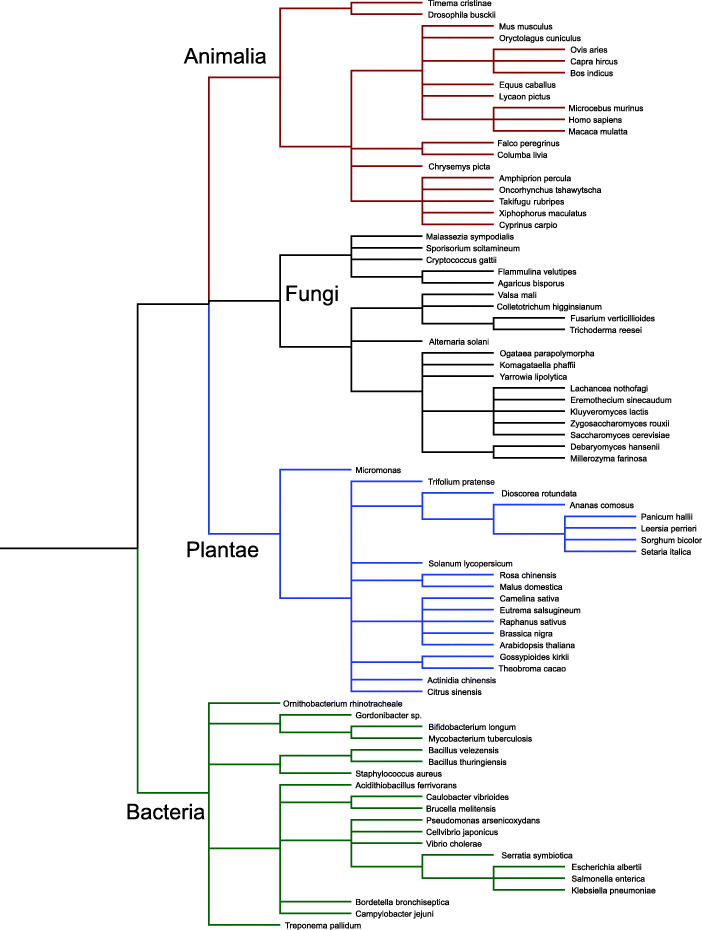
Background: The first step in understanding ecological community diversity and dynamics is quantifying community membership. An increasingly common method for doing so is through metagenomics. Because of the rapidly increasing popularity of this approach, a large number of computational tools and pipelines are available for analysing metagenomic data. However, the majority of these tools have been designed and benchmarked using highly accurate short read data (i.e. Illumina), with few studies benchmarking classification accuracy for long error-prone reads (PacBio or Oxford Nanopore). In addition, few tools have been benchmarked for non-microbial communities. Results: Here we compare simulated long reads from Oxford Nanopore and Pacific Biosciences (PacBio) with high accuracy Illumina read sets to systematically investigate the effects of sequence length and taxon type on classification accuracy for metagenomic data from both microbial and non-microbial communities. We show that very generally, classification accuracy is far lower for non-microbial communities, even at low taxonomic resolution (e.g. family rather than genus). We then show that for two popular taxonomic classifiers, long reads can significantly increase classification accuracy, and this is most pronounced for non-microbial communities. Conclusions: This work provides insight on the expected accuracy for metagenomic analyses for different taxonomic groups, and establishes the point at which read length becomes more important than error rate for assigning the correct taxon.
Overview
The claims and statistics of this paper haven’t been checked yet.
Run the check — free, no account needed. It reads the open-access text and checks the sources it cites.
Integrity signals
Registry
Cites
Statistics
Figures
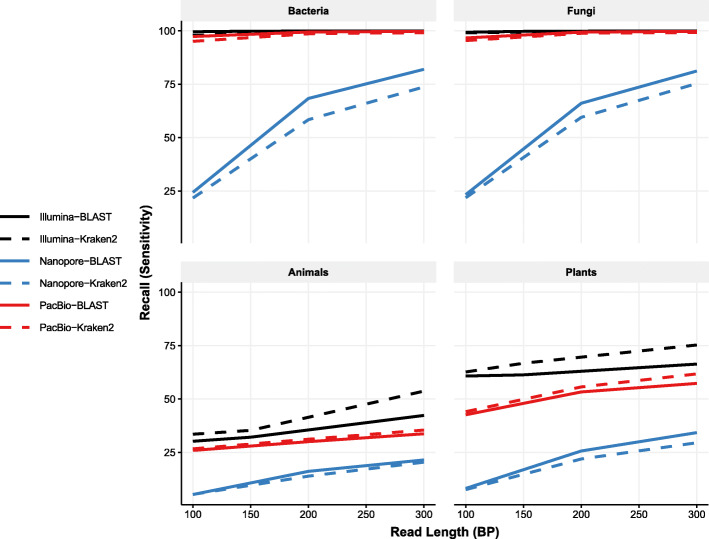
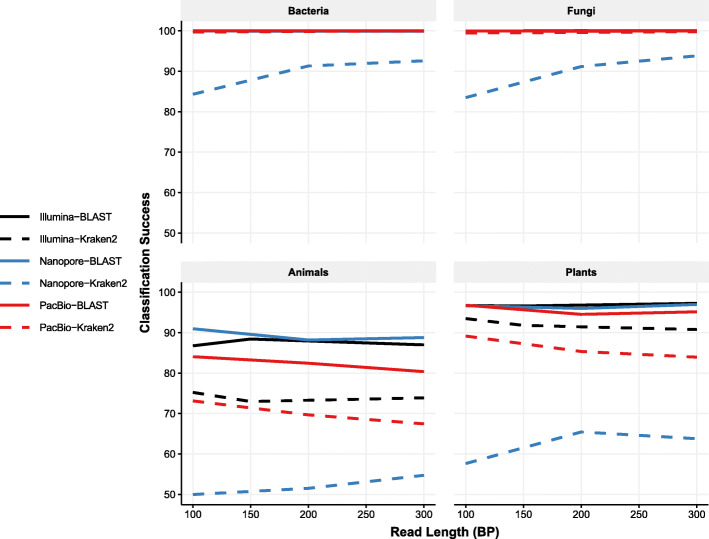
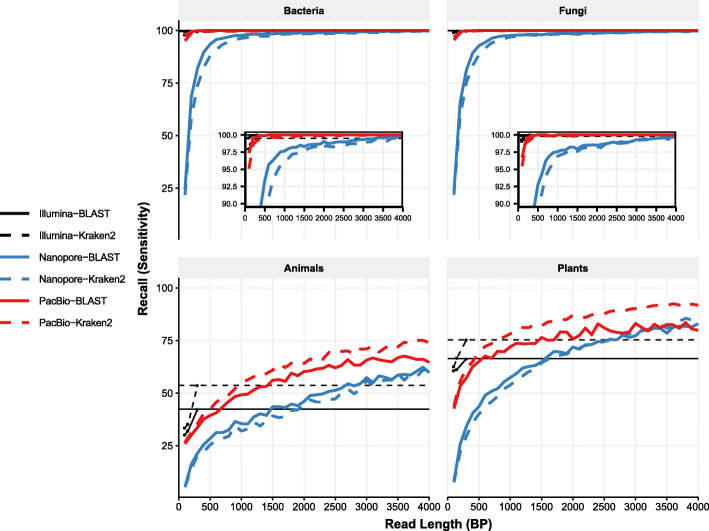
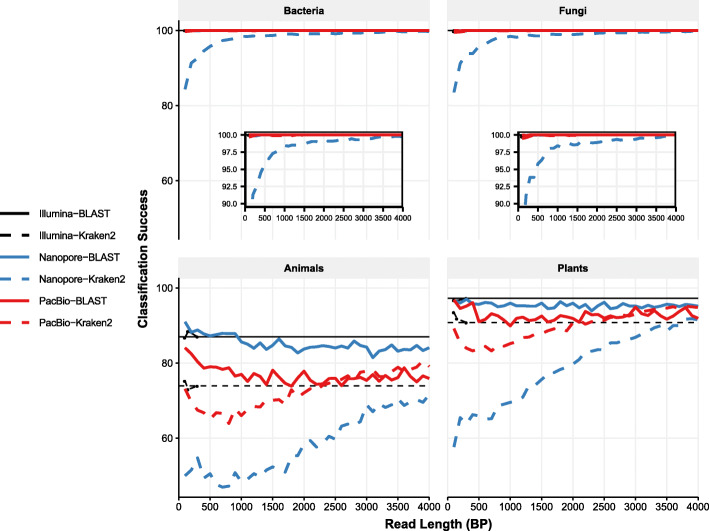
Verification
Claims the paper makes
The claims and statistics of this paper haven’t been checked yet.
Run the check — free, no account needed. It reads the open-access text and checks the sources it cites.
Claims other papers make about this one
Each is checked against this paper’s own text: does it say what the citing paper says it does?
The source backs part of the claim, not all of it — or backs it for a different population, condition or comparison.
In the citing paper
“short‐read technology provides abundant sequencing data that is less error prone than long‐read technology; however, it can be difficult to assemble complete genomes using short read‐lengths due to limitations in the technology to distinguish repetitive elements.”
From The oral microbiome: Role of key organisms and complex networks in oral health and disease (2021) · cites this paper as [82]
Experimental — accuracy not yet measuredIn the citing paper
“By contrast, long‐read technology provides more read‐length but at the cost of higher error rates.82”
From The oral microbiome: Role of key organisms and complex networks in oral health and disease (2021) · cites this paper as [82]
Self-check
Percentages, sums and reported differences re-computed from the paper’s own numbers.
The self-check needs the paper’s full text.
Citations
Cites
QIIME allows analysis of high-throughput community sequencing data
Caporaso, J. G., Kuczynski, J., Stombaugh, J., Bittinger, K., Bushman, F. D., Costello, E. K., Fierer, N., Peña, A. G., Goodrich, J. K., Gordon, J. I., et al. (2010) · Nature Methods · doi:10.1038/nmeth.f.303 · Cited by 34,887
Schloss, P. D., Westcott, S. L., Ryabin, T., Hall, J. R., Hartmann, M., Hollister, E. B., Lesniewski, R. A., Oakley, B. B., Parks, D. H., Robinson, C. J., et al. (2009) · Applied and Environmental Microbiology · doi:10.1128/aem.01541-09 · Cited by 19,549
Fast and sensitive protein alignment using DIAMOND
Buchfink, B., Xie, C., & Huson, D. H. (2015) · Nature Methods · doi:10.1038/nmeth.3176 · Cited by 14,201
Stackebrandt, E. S., & Goebel, B. M. (1994) · INTERNATIONAL JOURNAL OF SYSTEMATIC AND EVOLUTIONARY MICROBIOLOGY · doi:10.1099/00207713-44-4-846 · Cited by 7,170
O'Leary, N. A., Wright, M. W., Brister, J. R., Ciufo, S., Haddad, D., McVeigh, R., Rajput, B., Robbertse, B., Smith-White, B., Ako-Adjei, D., et al. (2016) · Nucleic Acids Research · doi:10.1093/nar/gkv1189 · Cited by 6,357
Kraken: ultrafast metagenomic sequence classification using exact alignments
Wood, D. E., & Salzberg, S. L. (2014) · Genome Biology · doi:10.1186/gb-2014-15-3-r46 · Cited by 4,521
Benson, D. A., Cavanaugh, M., Clark, K., Karsch-Mizrachi, I., Lipman, D. J., Ostell, J., & Sayers, E. W. (2012) · Nucleic Acids Research · doi:10.1093/nar/gks1195 · Cited by 3,261
Performance of neural network basecalling tools for Oxford Nanopore sequencing
Wick, R. R., Judd, L. M., & Holt, K. E. (2019) · Genome Biology · doi:10.1186/s13059-019-1727-y · Cited by 3,221
Bracken: estimating species abundance in metagenomics data
(2016) · doi:10.7717/peerj-cs.104 · Cited by 2,333
Genomic insights that advance the species definition for prokaryotes
Konstantinidis, K. T., & Tiedje, J. M. (2005) · Proceedings of the National Academy of Sciences · doi:10.1073/pnas.0409727102 · Cited by 2,124
Fast and sensitive taxonomic classification for metagenomics with Kaiju
Menzel, P., Ng, K. L., & Krogh, A. (2016) · Nature Communications · doi:10.1038/ncomms11257 · Cited by 2,101
Huson, D. H., Beier, S., Flade, I., Górska, A., El-Hadidi, M., Mitra, S., Ruscheweyh, H.-J., & Tappu, R. (2016) · PLOS Computational Biology · doi:10.1371/journal.pcbi.1004957 · Cited by 1,761
Centrifuge: rapid and sensitive classification of metagenomic sequences
Kim, D., Song, L., Breitwieser, F. P., & Salzberg, S. L. (2016) · Genome Research · doi:10.1101/gr.210641.116 · Cited by 1,438
Federhen, S. (2012) · Nucleic Acids Research · doi:10.1093/nar/gkr1178 · Cited by 1,436
Metagenomics - a guide from sampling to data analysis
Thomas, T., Gilbert, J. A., & Meyer, F. (2012) · Microbial Informatics and Experimentation · doi:10.1186/2042-5783-2-3 · Cited by 1,114
Keeling, P. J., Burki, F., Wilcox, H. M., Allam, B., Allen, E. E., Amaral-Zettler, L. A., Armbrust, E. V., Archibald, J. M., Bharti, A. K., Bell, C. J., et al. (2014) · PLoS Biology · doi:10.1371/journal.pbio.1001889 · Cited by 1,042
Song, H., Buhay, J. E., Whiting, M. F., & Crandall, K. A. (2008) · Proceedings of the National Academy of Sciences · doi:10.1073/pnas.0803076105 · Cited by 1,035
Earth BioGenome Project: Sequencing life for the future of life
Lewin, H. A., Robinson, G. E., Kress, W. J., Baker, W. J., Coddington, J., Crandall, K. A., Durbin, R., Edwards, S. V., Forest, F., Gilbert, M. T. P., et al. (2018) · Proceedings of the National Academy of Sciences · doi:10.1073/pnas.1720115115 · Cited by 962
Estimating the total number of phosphoproteins and phosphorylation sites in eukaryotic proteomes
Vlastaridis, P., Kyriakidou, P., Chaliotis, A., de Peer, Y. V., Oliver, S. G., & Amoutzias, G. D. (2017) · GigaScience · doi:10.1093/gigascience/giw015 · Cited by 746
Ardui, S., Ameur, A., Vermeesch, J. R., & Hestand, M. S. (2018) · Nucleic Acids Research · doi:10.1093/nar/gky066 · Cited by 741
Reliable, verifiable and efficient monitoring of biodiversity via metabarcoding
Ji, Y., Ashton, L., Pedley, S. M., Edwards, D. P., Tang, Y., Nakamura, A., Kitching, R., Dolman, P. M., Woodcock, P., Edwards, F. A., et al. (2013) · Ecology Letters · doi:10.1111/ele.12162 · Cited by 662
Ounit, R., Wanamaker, S. I., Close, T. J., & Lonardi, S. (2015) · BMC Genomics · doi:10.1186/s12864-015-1419-2 · Cited by 647
Accurate phylogenetic classification of variable-length DNA fragments
McHardy, A. C., Martín, H. G., Tsirigos, A., Hugenholtz, P., & Rigoutsos, I. (2006) · Nature Methods · doi:10.1038/nmeth976 · Cited by 564
Genome 10K: A Proposal to Obtain Whole-Genome Sequence for 10 000 Vertebrate Species
Scientists, G. 1. C. O. (2009) · Journal of Heredity · doi:10.1093/jhered/esp086 · Cited by 552
The BLAST Sequence Analysis Tool
Madden, T. (2013) · Cited by 535
Tristan, L., Douady, C. J., Gouy, M., & Gibert, J. (2006) · Molecular Phylogenetics and Evolution · doi:10.1016/j.ympev.2006.03.014 · Cited by 484
Metagenomics for studying unculturable microorganisms: cutting the Gordian knot.
Schloss, P. D., & Handelsman, J. (2005) · Genome biology · doi:10.1186/gb-2005-6-8-229 · Cited by 480
Genome sequencing of the sweetpotato whitefly Bemisia tabaci MED/Q
Xie, W., Chen, C., Yang, Z., Guo, L., Yang, X., Wang, D., Chen, M., Huang, J., Wen, Y., Zeng, Y., et al. (2017) · GigaScience · doi:10.1093/gigascience/gix018 · Cited by 473
The Road to Metagenomics: From Microbiology to DNA Sequencing Technologies and Bioinformatics
Escobar‐Zepeda, A., de León, A. V., & Sánchez‐Flores, A. (2015) · Frontiers in Genetics · doi:10.3389/fgene.2015.00348 · Cited by 397
An evaluation of the accuracy and speed of metagenome analysis tools
Lindgreen, S., Adair, K. L., & Gardner, P. P. (2016) · Scientific Reports · doi:10.1038/srep19233 · Cited by 343
Comprehensive benchmarking and ensemble approaches for metagenomic classifiers
McIntyre, A. B. R., Ounit, R., Afshinnekoo, E., Prill, R. J., Hénaff, E., Alexander, N., Minot, S. S., Danko, D., Foox, J., Ahsanuddin, S., et al. (2017) · Genome Biology · doi:10.1186/s13059-017-1299-7 · Cited by 342
Madissoon, E., Jouhilahti, E., Vesterlund, L., Töhönen, V., Krjutškov, K., Sophie Petropoulos, A., Einarsdóttir, E., Linnarsson, S., Lanner, F., Månsson, R., et al. (2016) · Scientific Reports · doi:10.1038/srep32053 · Cited by 341
Metagenomics: Read Length Matters
Wommack, K. E., Bhavsar, J., & Ravel, J. (2008) · Applied and Environmental Microbiology · doi:10.1128/aem.02181-07 · Cited by 331
Ultra-deep, long-read nanopore sequencing of mock microbial community standards
Nicholls, S. M., Quick, J., Tang, S., & Loman, N. J. (2019) · GigaScience · doi:10.1093/gigascience/giz043 · Cited by 307
NanoSim: nanopore sequence read simulator based on statistical characterization
Yang, C., Chu, J., Warren, R. L., & Birol, İ. (2017) · GigaScience · doi:10.1093/gigascience/gix010 · Cited by 248
Teeling, E. C., Vernes, S. C., Dávalos, L. M., Ray, D. A., Gilbert, M. T. P., & Myers, E. W. (2017) · Annual Review of Animal Biosciences · doi:10.1146/annurev-animal-022516-022811 · Cited by 247
Creating a Buzz About Insect Genomes
Robinson, G. E., Hackett, K. J., Purcell-Miramontes, M., Brown, S. J., Evans, J. D., Goldsmith, M. R., Lawson, D., Okamuro, J. K., Robertson, H. M., & Schneider, D. J. (2011) · Science · doi:10.1126/science.331.6023.1386 · Cited by 208
A Review of bioinformatics tools for bio-prospecting from metagenomic sequence data
Roumpeka, D. D., Wallace, R. J., Escalettes, F., Fotheringham, I., & Watson, M. (2017) · Frontiers in Genetics · doi:10.3389/fgene.2017.00023 · Cited by 199 · cited 1×
“Unsurprisingly, the various advantages and disadvantages of using metagenomic analyses for microbial communities are well-documented (7–9).”
BackgroundGenesis, effects and fates of repeats in prokaryotic genomes
Treangen, T. J., Abraham, A., Touchon, M., & Rocha, E. P. C. (2009) · FEMS Microbiology Reviews · doi:10.1111/j.1574-6976.2009.00169.x · Cited by 182
Nasko, D. J., Koren, S., Phillippy, A. M., & Treangen, T. J. (2018) · Genome Biology · doi:10.1186/s13059-018-1554-6 · Cited by 170
Standard Percent DNA Sequence Difference for Insects Does Not Predict Species Boundaries
Cognato, A. I. (2006) · Journal of Economic Entomology · doi:10.1603/0022-0493-99.4.1037 · Cited by 168
Frank, J. A., Pan, Y., Tooming‐Klunderud, A., Eijsink, V. G. H., McHardy, A. C., Nederbragt, A. J., & Pope, P. B. (2016) · Scientific Reports · doi:10.1038/srep25373 · Cited by 155
MinION™ nanopore sequencing of environmental metagenomes: a synthetic approach
Brown, B. L., Watson, M., Minot, S. S., Rivera, M. C., & Franklin, R. B. (2017) · GigaScience · doi:10.1093/gigascience/gix007 · Cited by 145
Standard Percent DNA Sequence Difference for Insects Does Not Predict Species Boundaries
Cognato, A. I. (2006) · Journal of Economic Entomology · doi:10.1093/jee/99.4.1037 · Cited by 143
Bracken: Estimating species abundance in metagenomics dataPreprint
Lu, J., Breitwieser, F. P., Thielen, P., et al. (2016) · bioRxiv (Cold Spring Harbor Laboratory) · doi:10.1101/051813 · Cited by 129
Metagenomics: microbial diversity through a scratched lens
Temperton, B., & Giovannoni, S. J. (2012) · Current Opinion in Microbiology · doi:10.1016/j.mib.2012.07.001 · Cited by 126
Systematics and the Origin of Species from the Viewpoint of a Zoologist
Mayr, & Fisher, M. C. (1999) · Cited by 124
Invertebrate communities in holdfasts of the kelp Macrocystis pyrifera from southern Chile
Ojeda, F. P., & Santelices, B. (1984) · Marine Ecology Progress Series · doi:10.3354/meps016065 · Cited by 112
Goßner, M. M., Lade, P., Rohland, A., Sichardt, N., Kahl, T., Bauhus, J., Weisser, W. W., & Petermann, J. S. (2015) · Journal of Animal Ecology · doi:10.1111/1365-2656.12437 · Cited by 48
Comparison Of Oxford Nanopore Basecalling Tools
Wick, R. R., Judd, L. M., & Holt, K. E. (2017) · Zenodo (CERN European Organization for Nuclear Research) · doi:10.5281/zenodo.1043611 · Cited by 28
O’Brien, S. J., Haussler, D. H., & Ryder, O. A. (2014) · GigaScience · doi:10.1186/2047-217x-3-32 · Cited by 15
EnSVMB: Metagenomics Fragments Classification using Ensemble SVM and BLAST
Jiang, Y., Wang, J., Xia, D., & Yu, G. (2017) · Scientific Reports · doi:10.1038/s41598-017-09947-y · Cited by 11
Research works printed but not linked: 1
- Pearman W, Smith ANH, Breckell G, Dale J, Freed NE, Silander OK. New tools for diet analyses: nanopore sequencing of metagenomic DNA from stomach contents to quantify diet in an invasive population of rats. bioRxiv. 2018:363622 [Cited 2018 Aug 8]. Available from: https://www.biorxiv.org/content/early/2018/07/06/363622.
Cited by
Sorted by citations
The oral microbiome: Role of key organisms and complex networks in oral health and disease
Sedghi, L., DiMassa, V., Harrington, A., Lynch, S. V., & Kapila, Y. L. (2021) · Periodontology 2000 · doi:10.1111/prd.12393 · Cited by 755
The Skin Microbiome: Current Landscape and Future Opportunities
Smythe, P., & Wilkinson, H. N. (2023) · International Journal of Molecular Sciences · doi:10.3390/ijms24043950 · Cited by 218
Portik, D. M., Brown, C. T., & Pierce‐Ward, N. T. (2022) · BMC Bioinformatics · doi:10.1186/s12859-022-05103-0 · Cited by 148
Rizal, N. S. M., Neoh, H., Ramli, R., Periyasamy, P. R., Hanafiah, A., Samat, M. N. A., Tan, T. L., Wong, K. K., Nathan, S., Chieng, S., et al. (2020) · Diagnostics · doi:10.3390/diagnostics10100816 · Cited by 142
Metagenomic profiling pipelines improve taxonomic classification for 16S amplicon sequencing data
Odom-Mabey, A. R., Faits, T., Castro‐Nallar, E., Crandall, K. A., & Johnson, W. E. (2023) · Scientific Reports · doi:10.1038/s41598-023-40799-x · Cited by 99
Metadata
- Authors
- Pearman, W. S., Freed, N. E., & Silander, O. K.
- Affiliations
- Massey University (NZ)
- Corresponding author
- Pearman, William S.
- Silander, Olin K.
- Venue
- BMC Bioinformatics
- Published
- 2020-05-29
- Volume
- 21
- Issue
- 1
- Pages
- 220-220
- ISSN
- 1471-2105 (ISSN-L)
- PMC
- PMC7257156
- OpenAlex
- W3031621849
- Cited by
- 114
- References
- 50
- Citations by year
- 2026: 7 · 2025: 20 · 2024: 18 · 2023: 20 · 2022: 29 · 2021: 13 · 2020: 5
- FWCI
- 5.43
- Type
- journal article
- Language
- en
- Open access
- gold
- doi.org
- Locations
- BMC Bioinformatics (publishedVersion, cc-by)
- bioRxiv (Cold Spring Harbor Laboratory) (acceptedVersion, cc-by)
- Research Square (acceptedVersion, cc-by)
- PubMed Central (publishedVersion, cc-by)
- PubMed (publishedVersion)
- DOAJ (DOAJ: Directory of Open Access Journals) (submittedVersion, cc-by-sa)
- ResearchSpace (University of Auckland) (submittedVersion, cc-by)
- Funders
- Massey University (RM21565)
- Topics
- Life Sciences › Biochemistry, Genetics and Molecular Biology › Molecular Biology › Genomics and Phylogenetic Studies
- Physical Sciences › Environmental Science › Ecology › Environmental DNA in Biodiversity Studies
- Physical Sciences › Environmental Science › Ecology › Microbial Community Ecology and Physiology
- Keywords
- metagenomics, long-read sequencing, short-read sequencing, taxonomic classification, classification accuracy, simulated reads, Oxford Nanopore, PacBio, eukaryotic communities, read length, error rate, taxonomic resolution, benchmarking
- MeSH terms
- Nanopore Sequencing, Computer Simulation, Sequence Analysis, DNA, Metagenomics, Eukaryota, High-Throughput Nucleotide Sequencing
About these checks
Registry, retraction, Cites and statistics results are computed, not judged, with one exception: a printed reference that no index lists is read once by a model before it counts as a citation error. Claims are extracted by a model and kept only when their quote appears verbatim in the text; each cited source is then checked, with a model’s help, for whether it says what the claim relies on. Those verdicts can be wrong — read the claim’s quote and the cited source before relying on one.
Statistics and arithmetic are recomputed, not judged.
Confidence bands are shown only for fields calibrated on our annotated test set. None is calibrated yet, so no band is shown.
What counts as a claim ›How we measure confidence ›How we check this ›
Are you an author, or do you see a problem with this page? Request a review
