

The DOI matches its Crossref record; 39 of the 39 references it cites were found in a registry or an index; none of the 6 sources its claims cite is checked for support yet.
Genetic polymorphism of Y-chromosome in Kazakh populations from Southern Kazakhstan
Open accessAbstract
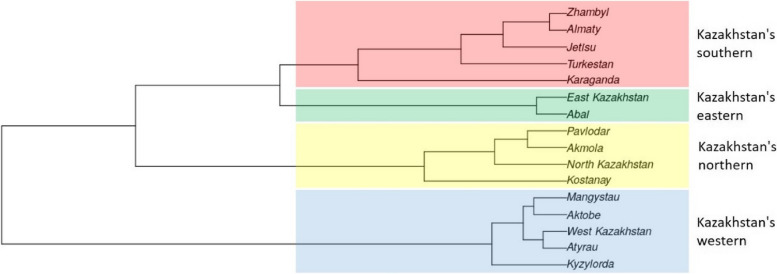
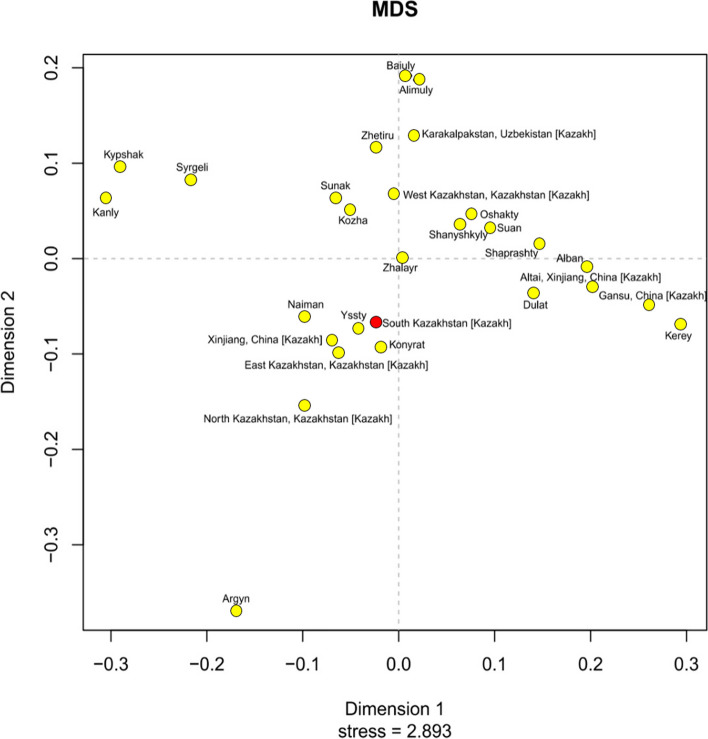
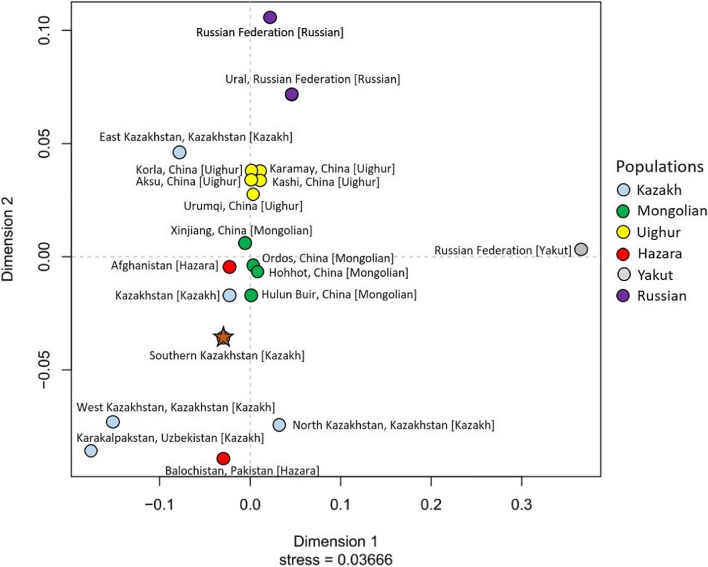
Background: The Kazakhs are one of the biggest Turkic-speaking ethnic groups, controlling vast swaths of land from the Altai to the Caspian Sea. In terms of area, Kazakhstan is ranked ninth in the world. Northern, Eastern, and Western Kazakhstan have already been studied in relation to genetic polymorphism 27 Y-STR. However, current information on the genetic polymorphism of the Y-chromosome of Southern Kazakhstan is limited only by 17 Y-STR and no geographical study of other regions has been studied at this variation. Results: The Kazakhstan Y-chromosome Haplotype Reference Database was expanded with 468 Kazakh males from the Zhambyl and Turkestan regions of South Kazakhstan by having their 27 Y-STR loci and 23 Y-SNP markers analyzed. Discrimination capacity (DC = 91.23%), haplotype match probability (HPM = 0.0029) and haplotype diversity (HD = 0.9992) are defined. Most of this Y-chromosome variability is attributed to haplogroups C2a1a1b1-F1756 (2.1%), C2a1a2-M48 (7.3%), C2a1a3-F1918 (33.3%) and C2b1a1a1a-M407 (6%). Median-joining network analysis was applied to understand the relationship between the haplotypes of the three regions. In three genetic layer can be described the position of the populations of the Southern region of Kazakhstan—the geographic Kazakh populations of Kazakhstan, the Kazakh tribal groups, and the people of bordering Asia. Conclusion: The Kazakhstan Y-chromosome Haplotype Reference Database was formed for 27 Y-STR loci with a total sample of 1796 samples of Kazakhs from 16 regions of Kazakhstan. The variability of the Y-chromosome of the Kazakhs in a geographical context can be divided into four main clusters—south, north, east, west. At the same time, in the genetic space of tribal groups, the population of southern Kazakhs clusters with tribes from the same region, and genetic proximity is determined with the populations of the Hazaras of Afghanistan and the Mongols of China.
Overview
CoChat Summary
Written by AI from the paper’s full text.
TL;DR
This study expands the Kazakhstan Y-chromosome haplotype reference database with 468 Kazakh males from Southern Kazakhstan, analyzing 27 Y-STR loci and 23 Y-SNP markers. It reports high haplotype diversity and regional/tribal genetic structure, with Southern Kazakhs clustering geographically and showing proximity to Hazaras of Afghanistan and Mongols of China.
Key findings
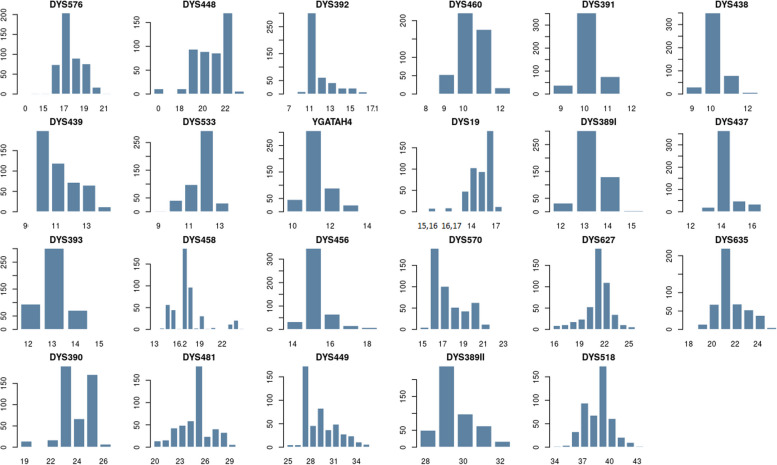
- Among 468 Southern Kazakh males, 427 distinct 27 Y-STR haplotypes were found; forensic parameters were discrimination capacity 91.23%, haplotype match probability 0.0029, and haplotype diversity 0.9992.
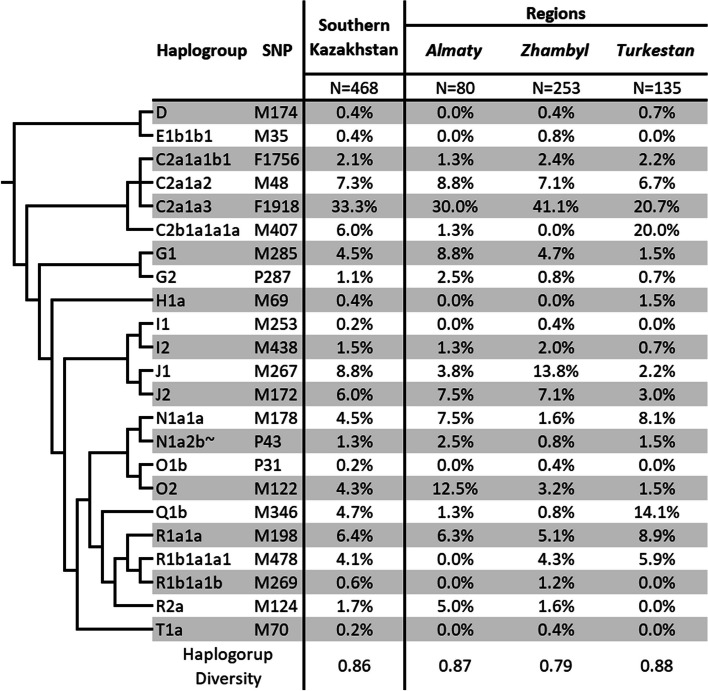
- The major Y-chromosome haplogroups were C2-M217 (48.7%), J1 (8.8%), R1a1a (6.4%), J2 (6%), N1a (5.8%), and G (5.6%); within C2, C2a1a3-F1918 was most common at 33.3%, followed by C2a1a2-M48 at 7.3%, C2b1a1a1a-M407 at 6%, and C2a1a1b1-F1756 at 2.1%.
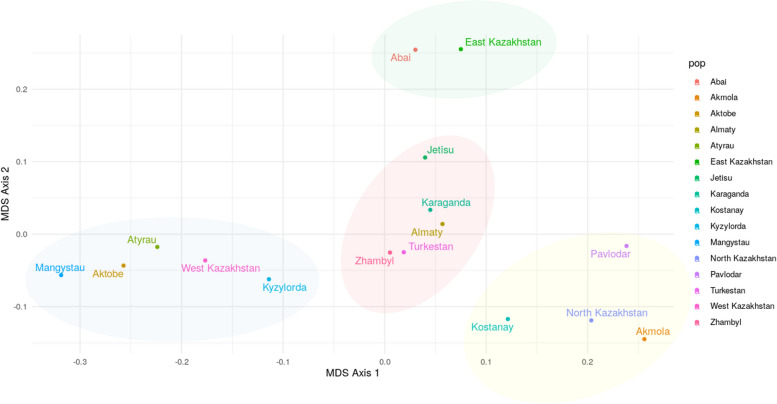
- The Kazakhstan Y-chromosome Haplotype Reference Database was expanded to 1796 samples from 16 regions of Kazakhstan; geographic Y-chromosome variability was divided into four main clusters—south, north, east, and west.
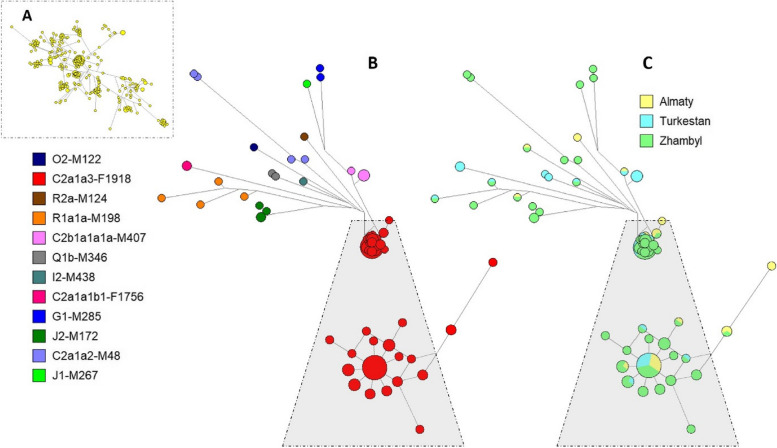
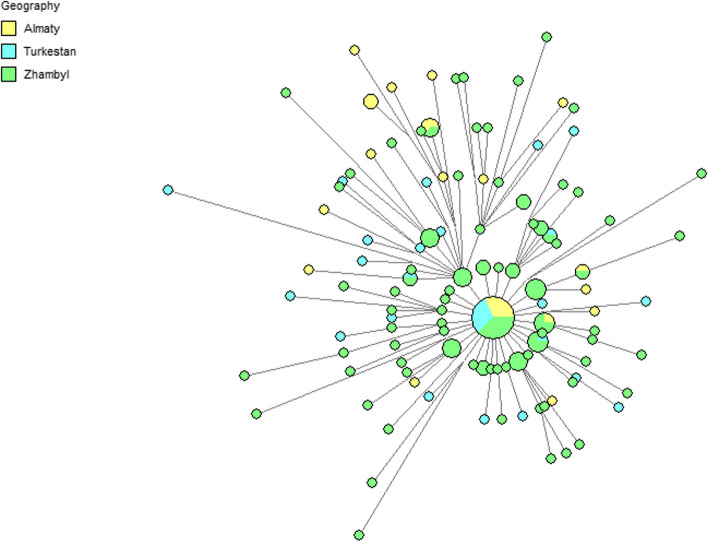
- Median-joining network analysis identified C2a1a3-F1918 as the largest cluster, including 156 haplotypes, with high haplotype diversity in the Zhambyl region; Southern Kazakhs showed genetic proximity to Hazaras of Afghanistan and Mongols of China.
Methods
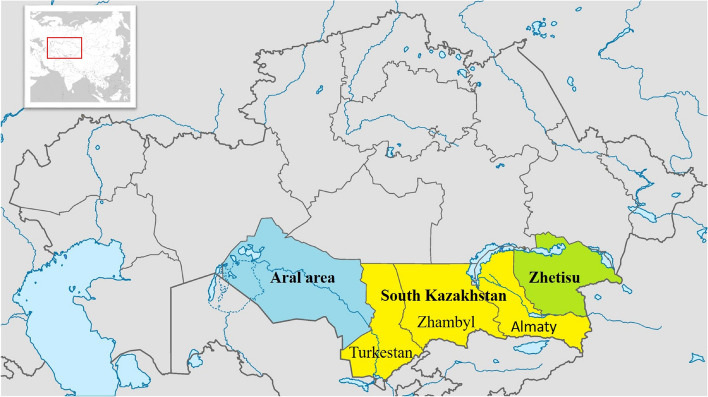
- The study analyzed 468 unrelated male Kazakh volunteers whose ancestors had resided in South Kazakhstan for at least three generations, sampled from the Almaty (N = 80), Zhambyl (N = 253), and Turkestan (N = 135) regions.
- DNA was extracted and quantified, then 27 Y-STR loci were typed by capillary electrophoresis; haplogroups were predicted with Nevgen and genotyped for 23 Y-SNP markers using TaqMan assays.
- Analyses included haplotype frequency and forensic parameter calculations in Arlequin and STRAF, pairwise genetic distances and MDS via YHRD, and median-joining networks in NETWORK.
Limitations
- The paper has no explicit limitations section.
- The text states that tribal-level comparison samples with known affiliations across 20 tribes were limited to 17 Y-STR sites, which are less informative than the 27 Y-STR loci used for the new Southern Kazakh samples.
- The background notes that prior information on Southern Kazakhstan Y-chromosome polymorphism was limited to 17 Y-STR and lacked geographical study at the 27 Y-STR variation.
Model-written summary. Check it against the paper before relying on it.
Integrity signals
Registry
Cites
Statistics
Figures
Verification
Claims the paper makes
32 Own result · 9 Own interpretation · 7 Own method · 1 Check pending · 1 No full text of the sources · 1 Not checked yet · 1 No basis given
A result the paper reports from its own data — it cites no other source for it, so there is none to check. The quote shows it is in the paper.
In the paper
“On average, the gene diversity of rapidly mutating 8 single-copy loci (GD = 0.728) is higher than that of the standard 15 single-copy loci (GD = 0.571).”
§ Genetic polymorphism of Y-chromosome in Kazakh populations from Southern Kazakhstan > Results and discussion > Haplotype/allele frequencies and forensic parameters
plain- Asserted: passes — The authors put it forward as true.
- Checkable: passes — It can be checked against evidence.
- Load-bearing: passes — The paper’s conclusions depend on it.
- Based: passes — The paper gives a reason why it holds.
A result the paper states — it cites no source for it, so there is none to check. The quote shows it is in the paper.
In the paper
“The Kazakhstan Y-chromosome Haplotype Reference Database was formed for 27 Y-STR loci with a total sample of 1796 samples of Kazakhs from 16 regions of Kazakhstan.”
§ Genetic polymorphism of Y-chromosome in Kazakh populations from Southern Kazakhstan > Abstract > Conclusion
plainn = 1,796- Asserted: passes — The authors put it forward as true.
- Checkable: passes — It can be checked against evidence.
- Load-bearing: passes — The paper’s conclusions depend on it.
- Based: passes — The paper gives a reason why it holds.
A result the paper reports from its own data — it cites no other source for it, so there is none to check. The quote shows it is in the paper.
In the paper
“Figure 9 visualizes the strong founder effect of this cluster, which includes 156 haplotypes and shows that derived haplotypes from the founder haplotype are mainly represented by individuals from the Zhambyl region.”
§ Genetic polymorphism of Y-chromosome in Kazakh populations from Southern Kazakhstan > Results and discussion > Median-joining network for Southern Kazakhs
boostedstates an association- Asserted: passes — The authors put it forward as true.
- Checkable: passes — It can be checked against evidence.
- Load-bearing: unclear — It is unclear whether the paper’s conclusions depend on it.
- Based: passes — The paper gives a reason why it holds.
A result the paper reports from its own data — it cites no other source for it, so there is none to check. The quote shows it is in the paper.
In the paper
“Figure 9 visualizes the strong founder effect of this cluster, which includes 156 haplotypes and shows that derived haplotypes from the founder haplotype are mainly represented by individuals from the Zhambyl region.”
§ Genetic polymorphism of Y-chromosome in Kazakh populations from Southern Kazakhstan > Results and discussion > Median-joining network for Southern Kazakhs
plain- Asserted: passes — The authors put it forward as true.
- Checkable: passes — It can be checked against evidence.
- Load-bearing: unclear — It is unclear whether the paper’s conclusions depend on it.
- Based: passes — The paper gives a reason why it holds.
A result the paper reports from its own data — it cites no other source for it, so there is none to check. The quote shows it is in the paper.
In the paper
“There are no differences in terms of population between Kazakhs living in Kazakhstan’s southern area and those living in Kazakhstan generally.”
§ Genetic polymorphism of Y-chromosome in Kazakh populations from Southern Kazakhstan > Results and discussion > Population comparison analysis
plain- Asserted: passes — The authors put it forward as true.
- Checkable: passes — It can be checked against evidence.
- Load-bearing: passes — The paper’s conclusions depend on it.
- Based: passes — The paper gives a reason why it holds.
- It may state two separate claims as one. 10
- The quote only partly states this claim. 2
- Probably not a substantial claim. 9
Create a free account to see these claims.
Create a free account to see these assumptions.
29 more claims
Create a free account to see all 52 claims and to verify the 3 references still open.
Self-check
Percentages, sums and reported differences re-computed from the paper’s own numbers.
Each contradiction between two passages listed here was confirmed by an independent check.
Rated major: it would touch a result — a value a result rests on, reported and recomputed p-values on opposite sides of the significance level, two passages that conflict with no sign which is right, or a cited work retracted before this paper was published.
In the paper
§ Genetic polymorphism of Y-chromosome in Kazakh populations from Southern Kazakhstan > Methods > Sample collection
“In three regions of southern Kazakhstan, blood samples were taken from 468 Kazakh men.”
§ Genetic polymorphism of Y-chromosome in Kazakh populations from Southern Kazakhstan > Methods > DNA extraction and quantification
“DNA was extracted from saliva samples of participants using the Wizard(R) Genomic DNA Purification Kit (Promega, USA).”
Rated minor: it would not touch a result — a value no result rests on, a p-value that stays on the same side of the significance level, or a conflict that is clerical, resolved elsewhere in the paper, or outside its own findings.
In the paper
§ Genetic polymorphism of Y-chromosome in Kazakh populations from Southern Kazakhstan > Methods > Data analysis
“the haplotype and haplogroup data in the present study (N = 184) have been submitted to the YHRD”
§ Genetic polymorphism of Y-chromosome in Kazakh populations from Southern Kazakhstan > Results and discussion > Haplotype/allele frequencies and forensic parameters
“27 Y-STR haplotype distribution in the Kazakh population of the Southern region of Kazakhstan (N = 468) are presented in Additional file 1.”
Citations
Cites
Molecular Evolutionary Genetics
Nei, M. (1987) · Columbia University Press eBooks · doi:10.7312/nei-92038 · Cited by 16,583
Excoffier, L., & Lischer, H. E. L. (2010) · Molecular Ecology Resources · doi:10.1111/j.1755-0998.2010.02847.x · Cited by 16,266
Median-joining networks for inferring intraspecific phylogenies
Bandelt, H. J., Forster, P., & Rohl, A. (1999) · Molecular Biology and Evolution · doi:10.1093/oxfordjournals.molbev.a026036 · Cited by 11,742
On Steiner trees and minimum spanning trees in hypergraphs
Polzin, T., & Daneshmand, S. V. (2002) · Operations Research Letters · doi:10.1016/s0167-6377(02)00185-2 · Cited by 623
The Genetic Legacy of the Mongols
Zerjal, T., Xue, Y., Bertorelle, G., Wells, R. S., Bao, W., Zhu, S., Qamar, R., Ayub, Q., Mohyuddin, A., Fu, S., et al. (2003) · The American Journal of Human Genetics · doi:10.1086/367774 · Cited by 563
GENETIC DRIFT AND ESTIMATION OF EFFECTIVE POPULATION SIZE
Nei, M., & Tajima, F. (1981) · Genetics · doi:10.1093/genetics/98.3.625 · Cited by 550
A recent bottleneck of Y chromosome diversity coincides with a global change in culture
Karmin, M., Saag, L., Vicente, M., Sayres, M. A. W., Järve, M., Talas, U. G., Rootsi, S., Ilumäe, A.-M., Mägi, R., Mitt, M., et al. (2015) · Genome Research · doi:10.1101/gr.186684.114 · Cited by 485
Self-citationForensic use of Y-chromosome DNA: a general overview
Kayser, M. (2017) · Human Genetics · doi:10.1007/s00439-017-1776-9 · Cited by 403
STRAF—A convenient online tool for STR data evaluation in forensic genetics
Gouy, A., & Zieger, M. (2017) · Forensic Science International Genetics · doi:10.1016/j.fsigen.2017.07.007 · Cited by 343
Human Y-chromosome variation in the genome-sequencing era
Jobling, M. A., & Tyler‐Smith, C. (2017) · Nature Reviews Genetics · doi:10.1038/nrg.2017.36 · Cited by 247
Research works printed but not linked: 13
- Alpysbaev KA. Discovery of the Lower Paleolithic in Kazakhstan. Bull Acad Sci KazSSR. 1960;5:59–61.
- Alpysbaev KA. Neolithic camp in the Karaungur cave. News Acad Sci KazSSR. 1969;2:85–7.
- Kuzmina EE. Culture and ethnic attribution of the pastoral tribes of Kazakhstan and Central Asia in the Bronze Age. J Anc Hist. 1988;2:35–59.
- Akishev KA. Issyk Kurgan. The art of the Saks of Kazakhstan. Moscow: Iskusstvo; 1978.
- Tolstov SP. The results of the Khorezm archaeological and ethnographic expedition of the AS USSR in 1953. J Anc Hist. 1955;3(53):192–206.
- Baumer C. The history of Central Asia: the age of the silk roads (Volume 2). London: I.B.Tauris; 2014.
- Temirgaliev RD. The early history of the Kangju people. Global-Turk. 2018;1–2:107–30.
- Baumer C. The history of Central Asia: the age of Islam and the Mongols (Volume 3). London: I.B.Tauris; 2016.
- Baumer C. The history of Central Asia: the age of decline and revival (Volume 4). London: I.B.Tauris; 2018.
- Sarsembayev MA. The Kazakh Khanate as the sovereign state of the medieval epoch. Astana: Institute of Legislation of the Republic of Kazakhstan; 2015.
- Zhabagin M, Dibirova HD, Frolova SA, Sabitov Z, Yusupov YM, Utevska O, et al. The Relation between the Y-chromosomal variation and the clan structure: the gene pool of the steppe aristocracy and the steppe clergy of the Kazakhs. Mosc Univ Anthropol Bull. 2014;1:96–101.
- Zhabagin MK, Sabitov Z, Agdzhoyan A, Yusupov YM, Bogunov Y, Lavryashina MB, et al. Genesis of the largest tribal group of Kazakhs – the Argyns – in the context of population genetics. Mosc Univ Anthropol Bull. 2016;4:59–68.
- Massanov NE. Nomadic civilization of Kazakhs: the basics migratory habits of life of society. Almaty: Nurbolat Masanov Fund; 2011.
Cited by
Genetic polymorphism of 27 Y-STR loci in Kazakh populations from Central Kazakhstan
Ashirbekov, Y., Zhunussova, A., Abaildayev, A., Mailenova, A., Sabitov, Z. M., & Zhabagin, M. K. (2024) · Annals of Human Biology · doi:10.1080/03014460.2024.2377571 · Cited by 6
Self-citationGenomes of the Golden Horde elites and their implications for the rulers of the Mongol Empire
Askapuli, A., Kanzawa-Kiriyama, H., Kakuda, T., Kassenali, A., Yessen, S., Schamiloglu, U., Schrodi, S. J., Hawks, J., & Saitou, N. (2026) · Proceedings of the National Academy of Sciences · doi:10.1073/pnas.2531003123 · Cited by 5
Zhabagin, M., Bukayev, A., Dyussenova, Z., Zhuraliyeva, A., Tashkarayeva, A., Zhunussova, A., Aidarov, B., Darmenov, A., Akilzhanova, A., Schamiloglu, U., et al. (2024) · PLOS ONE · doi:10.1371/journal.pone.0309080 · Cited by 5
Self-citationA Review of Genetic Diversity Based on the Y Chromosome in the Romanian Population
Hodișan, R., Zaha, D. C., Jurcă, M. C., Petcheși, C. D., & Bembea, M. (2024) · Cureus · doi:10.7759/cureus.67593 · Cited by 1
Artifacts of analysis in cell line identification by short tandem repeat profiling
Malchenkova, A. A., & Kosobokova, E. N. (2024) · CARDIOVASCULAR THERAPY AND PREVENTION · doi:10.15829/1728-8800-2024-4121 · Cited by 1
Metadata
- Authors
- Ashirbekov, Y., Seidualy, M., Abaildayev, A., Maxutova, A., Zhunussova, A., Akilzhanova, A., Sharipov, K., Sabitov, Z., & Zhabagin, M.
- Affiliations
- National Center for Biotechnology (KZ)
- Astana International University (KZ)
- L. N. Gumilyov Eurasian National University (KZ)
- Corresponding author
- Zhabagin, Maxat
- ORCID
- Venue
- BMC Genomics
- Published
- 2023-10-27
- Volume
- 24
- Issue
- 1
- Pages
- 649-649
- ISSN
- 1471-2164 (ISSN-L)
- PMC
- PMC10612363
- OpenAlex
- W4387971097
- Semantic Scholar
- f09596c02d052886ce39a02cc84ac6863313aa69
- Cited by
- 12
- References
- 39
- Citations by year
- 2026: 7 · 2025: 1 · 2024: 4
- FWCI
- 1.46
- Type
- journal article
- Language
- en
- Open access
- gold
- doi.org
- Locations
- BMC Genomics (publishedVersion, cc-by)
- PubMed Central (publishedVersion, cc-by)
- PubMed (publishedVersion)
- Nazarbayev University Repository (Nazarbayev University) (submittedVersion, other-oa)
- DOAJ (DOAJ: Directory of Open Access Journals) (submittedVersion, cc-by-sa)
- Funders
- Science Committee of the Ministry of Science and Higer Education of the Republic of Kazakhstan (AP09259560, BR18574101)
- Collaborative Research Program of Nazarbayev University (091019CRP2119)
- Topics
- Life Sciences › Biochemistry, Genetics and Molecular Biology › Genetics › Forensic and Genetic Research
- Life Sciences › Biochemistry, Genetics and Molecular Biology › Genetics › Genetic diversity and population structure
- Life Sciences › Biochemistry, Genetics and Molecular Biology › Genetics › Genetic Associations and Epidemiology
- Keywords
- Y chromosome, Kazakhs, Y-chromosome short tandem repeats, Y-SNPs, haplogroups, discrimination capacity, median-joining network, population structure, southern Kazakhstan, Zhambyl region, Turkestan region, tribal population, Hazara, Mongols
- MeSH terms
- Genetics, Population, Haplotypes, Humans, Kazakhstan, Male, Polymorphism, Genetic, Genetic Variation, Microsatellite Repeats, Chromosomes, Human, Y
About these checks
Registry, retraction, Cites and statistics results are computed, not judged, with one exception: a printed reference that no index lists is read once by a model before it counts as a citation error. Claims are extracted by a model and kept only when their quote appears verbatim in the text; each cited source is then checked, with a model’s help, for whether it says what the claim relies on. Those verdicts can be wrong — read the claim’s quote and the cited source before relying on one.
A language model drew the claims from the paper on 2026-11-12, under version 3 of the claim definition (model deepseek-v4.1-flash, prompt extract-v3).
A second model labelled each claim on 2026-11-12 (model jev-1.13-20260917, definition revision gold-guideline-v0.2).
Statistics and arithmetic are recomputed, not judged.
Confidence bands are shown only for fields calibrated on our annotated test set. None is calibrated yet, so no band is shown.
What counts as a claim ›How we measure confidence ›How we check this ›
Are you an author, or do you see a problem with this page? Request a review
How to cite
Cite CoChat for the checks on this page, and the paper for its own findings.
- This page
- CoChat. (2026). Citation check: Genetic polymorphism of Y-chromosome in Kazakh populations from Southern Kazakhstan. https://app.cochat.ai/papers/10.1186/s12864-023-09753-z
- The paper
- Ashirbekov, Y., Seidualy, M., Abaildayev, A., Maxutova, A., Zhunussova, A., Akilzhanova, A., Sharipov, K., Sabitov, Z., & Zhabagin, M. (2023). Genetic polymorphism of Y-chromosome in Kazakh populations from Southern Kazakhstan. BMC Genomics. https://doi.org/10.1186/s12864-023-09753-z
