

Benchmarking foundation cell models for post-perturbation RNA-seq prediction
Open accessThe DOI matches its Crossref record; 39 of the 39 references it cites were found in a registry or an index; 9 of the 10 sources its claims cite were checked for support.
Abstract
Accurately predicting cellular responses to perturbations is essential for understanding cell behaviour in both healthy and diseased states. While perturbation data is ideal for building such predictive models, its availability is considerably lower than baseline (non-perturbed) cellular data. To address this limitation, several foundation cell models have been developed using large-scale single-cell gene expression data. These models are fine-tuned after pre-training for specific tasks, such as predicting post-perturbation gene expression profiles, and are considered state-of-the-art for these problems. However, proper benchmarking of these models remains an unsolved challenge. In this study, we benchmarked two recently published foundation models, scGPT and scFoundation, against baseline models. Surprisingly, we found that even the simplest baseline model—taking the mean of training examples—outperformed scGPT and scFoundation. Furthermore, basic machine learning models that incorporate biologically meaningful features outperformed scGPT by a large margin. Additionally, we identified that the current Perturb-Seq benchmark datasets exhibit low perturbation-specific variance, making them suboptimal for evaluating such models. Our results highlight important limitations in current benchmarking approaches and provide insights into more effectively evaluating post-perturbation gene expression prediction models.
Overview
CoChat Summary
TL;DR
In a benchmark of scGPT and scFoundation on four Perturb-seq datasets, the trivial Train Mean baseline and a Random Forest using Gene Ontology features outperformed both foundation models on differential-expression correlation metrics. The authors attribute this to low perturbation-specific variance in current benchmark datasets and argue that existing benchmarks are suboptimal for evaluating post-perturbation RNA-seq prediction.
Key findings
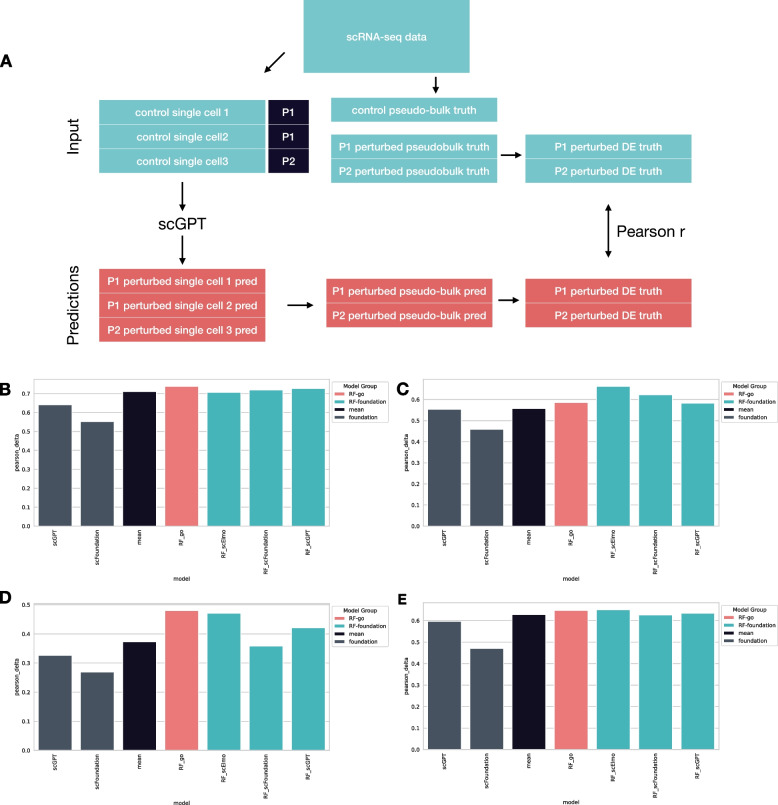
- In differential expression space (Pearson Delta), Train Mean outperformed scGPT and scFoundation across Adamson, Norman, Replogle K562, and Replogle RPE1: Train Mean 0.711, 0.557, 0.373, 0.628; scGPT 0.641, 0.554, 0.327, 0.596; scFoundation 0.552, 0.459, 0.269, 0.471.
- Random Forest with GO features outperformed foundation models by a large margin: 0.739, 0.586, 0.480, 0.648 across the four datasets, respectively.
- Random Forest using pretrained foundation embeddings performed better than the fine-tuned foundation models themselves, especially for scGPT (0.727, 0.583, 0.421, 0.635), but still weaker than RF with GO features; RF with scELMO features was similar to GO-based RF (0.706, 0.663, 0.471, 0.651).
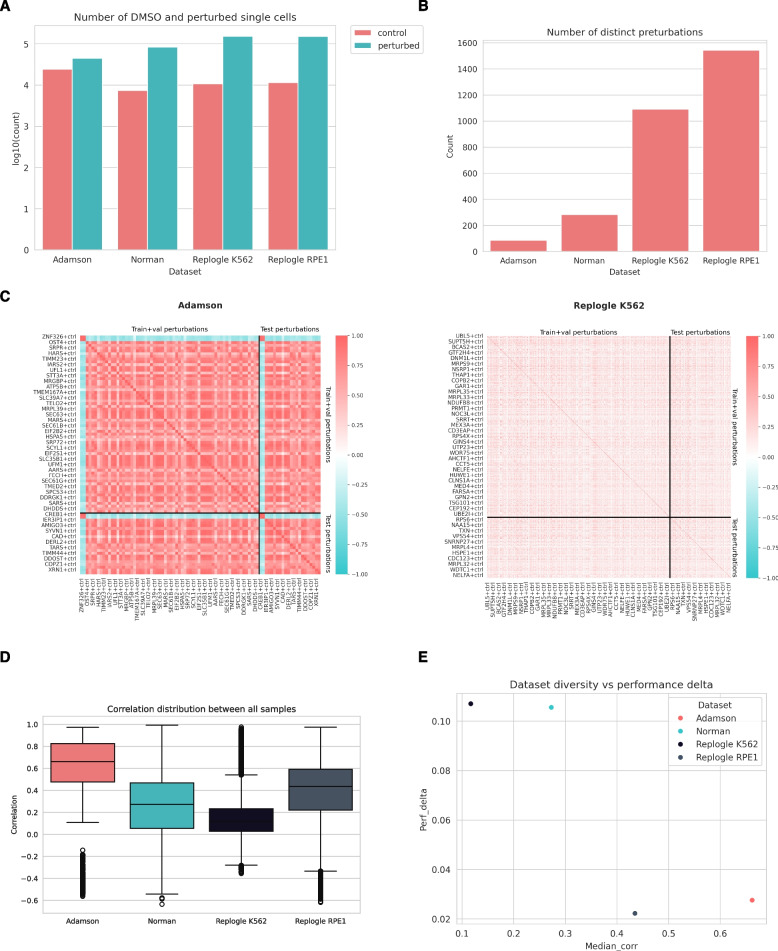
- The benchmark datasets contain many single cells (~70,000 in Adamson to ~160,000 in Replogle datasets) but few distinct perturbations (87 Adamson, 284 Norman, 1,093 Replogle K562, 1,544 Replogle RPE1); Adamson had high median pairwise differential-expression correlation (0.662), while Replogle K562 had lower median correlation (0.117).
Methods
- Benchmark datasets (Adamson, Norman, two Replogle subsets) were downloaded and processed with GEARS’ cell-gears v0.0.1; expression values were normalized to 10,000 reads and log transformed, top 20 DE genes were taken from the original GEARS publication, and splits followed the GEARS Perturbation Exclusive setup.
- scGPT was reproduced using a fork of scGPT v0.2.1 (commit 7301b51) with default hyperparameters and fine-tuned for 15 epochs; scFoundation used repository commit 69b0710 and was fine-tuned for 10 epochs with effective batch size 32; both trained on Nvidia A100 GPUs.
- Baselines included Train Mean, Random Forest Regressor, Elastic Net, and k-Nearest-Neighbors Regressor, using prior-knowledge features (GO PCA to 256 components, scGPT/scFoundation/scELMO embeddings) and pseudo-bulked expression targets; evaluation used Pearson, Pearson Delta, Pearson Delta DE, and Pearson Delta without target genes.
Limitations
- Stated by the paper: current Perturb-seq benchmark datasets exhibit low perturbation-specific variance, making them suboptimal for evaluating models; Adamson and Replogle RPE1 show high similarity between perturbations, and current benchmarks focus exclusively on the PEX problem while neglecting the CEX problem.
- Stated by the paper: single-cell data did not provide an obvious advantage over pseudo-bulked data in this benchmark, and single-cell profiles are subject to technical noise such as dropout events; only scGPT and scFoundation were tested, though other foundation models may face similar limitations.
- Evident from the text: evaluation is limited to four Perturb-seq datasets and PEX splits, and the top-20 DE metric can be influenced by inclusion of the CRISPR target gene, since removing target genes decreased scGPT’s performance in that space.
Model-written summary. Check it against the paper before relying on it.
Integrity signals
Registry
Cites
Statistics
Figures
Verification
Claims the paper makes
6 Valid · 0 Not valid · 1 Not checked · 42 Own results and interpretations
Every source the paper cites for this claim was checked and supports it.
In the paper
“We have previously demonstrated that test set selection and performance metrics can significantly impact benchmarking outcomes in the related problem of post-perturbation viability prediction [13]. Poor test set design or inappropriate metric choice can result in indistinguishable performance between well-performing and trivial models.”
§ Benchmarking foundation cell models for post-perturbation RNA-seq prediction > Introduction
What the sources say
- Supportedcites [13] Szalai B, Gáspár I, Kaszás V, Mérő L, Sztilkovics M, Szalay KZ. The EFFECT benchmark suite: measuring cancer sensitivity prediction performance - without the bias. bioRxiv 2023.10.02.560281. 10.1101/2023.10.02.560281. source
The Introduction states that standard metrics can fail to distinguish simple models using uninformative features from models using biologically informative features. The Discussion reports that, with random train/test splits, models trained on any feature combination achieved comparably good global correlations despite substantial performance drops when evaluated by individual perturbation. (LLM, conf=0.93)
boostedstates a cause- Asserted: passes — The authors put it forward as true.
- Checkable: passes — It can be checked against evidence.
- Load-bearing: passes — The paper’s conclusions depend on it.
- Based: passes — The paper gives a reason why it holds.
- Supported
The cited sources support only part of this claim — read each source’s verdict below.
In the paper
“These models had shown strong performance in post-perturbation RNA-seq prediction tasks using Perturb-seq-based genetic perturbation benchmarks [12].”
§ Benchmarking foundation cell models for post-perturbation RNA-seq prediction > Introduction
What the sources say
- Partly supportedcites [12] Dixit A, Parnas O, Li B, Chen J, Fulco CP, Jerby-Arnon L, et al. Perturb-seq: dissecting molecular circuits with scalable single-cell RNA profiling of pooled genetic screens. Cell. 2016;167:1853-1866.e17. 27984732 PMC5181115 sourceExperimental — accuracy not yet measured
The Results section, “Perturb-seq: pooled, combinatorial CRISPR screens with scRNA-seq readout” (page unavailable), describes genetic perturbation experiments with RNA-seq readouts. The paper does not report foundation-model performance or evaluate those models on post-perturbation prediction benchmarks; its predictive results concern its own linear model. (LLM, conf=0.82)
boostedstates an association- Asserted: passes — The authors put it forward as true.
- Checkable: passes — It can be checked against evidence.
- Load-bearing: passes — The paper’s conclusions depend on it.
- Based: passes — The paper gives a reason why it holds.
- Partly supported
The cited sources support only part of this claim — read each source’s verdict below.
In the paper
“All benchmark datasets were split into train, validation and test sets according to the GEARS publication - corresponding to Perturbation Exclusive split, where new, unseen perturbations (or perturbation combinations) were present in the test set (Supplementary Table 1).”
§ Benchmarking foundation cell models for post-perturbation RNA-seq prediction > Methods > Benchmark datasets
What the sources say
- Partly supportedcites [5] Roohani Y, Huang K, Leskovec J. Predicting transcriptional outcomes of novel multigene perturbations with GEARS. Nat Biotechnol. 2023. 10.1038/s41587-023-01905-6. 37592036 PMC11180609 sourceExperimental — accuracy not yet measured
The Results sections on single- and multigene predictions describe train–test evaluation with perturbations held out from training, including unseen two-gene combinations (Fig. 2a,e). Our copy does not establish a train–validation–test split or use the term “Perturbation Exclusive,” so those details of the attributed splitting scheme are not supported. (LLM, conf=0.84)
plain- Asserted: passes — The authors put it forward as true.
- Checkable: passes — It can be checked against evidence.
- Load-bearing: passes — The paper’s conclusions depend on it.
- Based: passes — The paper gives a reason why it holds.
- Partly supported
A result the paper reports from its own data — it cites no other source for it, so there is none to check. The quote shows it is in the paper.
In the paper
“Our comparison of embedding similarities also demonstrated, that scGPT embeddings show smaller associations with pathway information (KEGG, REACTOME) than Gene Ontology features, or natural language processing based (scELMO) embeddings.”
§ Benchmarking foundation cell models for post-perturbation RNA-seq prediction > Discussion
boostedstates an association- Asserted: passes — The authors put it forward as true.
- Checkable: passes — It can be checked against evidence.
- Load-bearing: passes — The paper’s conclusions depend on it.
- Based: passes — The paper gives a reason why it holds.
A result the paper reports from its own data — it cites no other source for it, so there is none to check. The quote shows it is in the paper.
In the paper
“Interestingly, scGPT embeddings have stronger association with a gene regulatory network (CollecTRI) than scELMO, also underlying that current foundation models trained on unlabelled scRNA-seq data are learning gene regulatory, but not protein interaction networks.”
§ Benchmarking foundation cell models for post-perturbation RNA-seq prediction > Discussion
boostedstates an association- Asserted: passes — The authors put it forward as true.
- Checkable: passes — It can be checked against evidence.
- Load-bearing: unclear — It is unclear whether the paper’s conclusions depend on it.
- Based: passes — The paper gives a reason why it holds.
20 more claims
Create a free account to see all 49 claims and every source verdict.
- Probably not a substantial claim. 8
- It may state two separate claims as one. 17
- The quote only partly states this claim. 1
Claims other papers make about this one
Each is checked against this paper’s own text: does it say what the citing paper says it does?
The cited source says what the claim attributes to it.
In the citing paper
“Since the release of our paper as a preprint, several other benchmarks15,16,22–27 were released that also show that deep learning models struggle to outperform simple baselines.”
From Deep-learning-based gene perturbation effect prediction does not yet outperform simple linear baselines (2025) · cites this paper as [16]
Experimental — accuracy not yet measuredThe cited source says what the claim attributes to it.
In the citing paper
“Two of these preprints15,16 suggested an even simpler baseline than our linear model (equation (1)), namely, to always predict the overall average, and we have included this idea here.”
From Deep-learning-based gene perturbation effect prediction does not yet outperform simple linear baselines (2025) · cites this paper as [16]
Citations
Cites
Scikit-learn: Machine Learning in Python
Pedregosa, F., Varoquaux, G., Gramfort, A., Michel, V., Thirion, B., Grisel, O., Blondel, M., Müller, A., Nothman, J., Louppe, G., et al. (2012) · arXiv · doi:10.48550/arxiv.1201.0490 · Cited by 71,016
SCANPY: large-scale single-cell gene expression data analysis
Wolf, F. A., Angerer, P., & Theis, F. J. (2018) · Genome Biology · doi:10.1186/s13059-017-1382-0 · Cited by 8,881 · cited 1×
“The top 20 DE genes were calculated with the tl.rank_genes_groups() function of Scanpy [30] with default parameters.”
Scikit-learn: Machine Learning in Python
(2011) · Journal of Machine Learning Research · doi:10.5555/1953048.2078195 · Cited by 8,539
The Reactome pathway Knowledgebase
Fabregat, A., Sidiropoulos, K., Garapati, P., Gillespie, M., Hausmann, K., Haw, R., Jassal, B., Jupe, S., Korninger, F., McKay, S., et al. (2016) · Nucleic Acids Research · doi:10.1093/nar/gkv1351 · Cited by 5,605
Lamb, J., Crawford, E. D., Peck, D., Modell, J. W., Blat, I. C., Wrobel, M. J., Lerner, J., Brunet, J.-P., Subramanian, A., Ross, K. N., et al. (2006) · Science · doi:10.1126/science.1132939 · Cited by 5,257 · cited 1×
“Notably, post-perturbation transcriptomics data are particularly suited for training computational models because the causal relationship between known perturbations (cause) and the measured post-perturbation gene expression (effect) allows for the modelling of mechanistic processes [11].”
The Gene Ontology Resource: 20 years and still GOing strong
The Gene Ontology Consortium (2019) · Nucleic Acids Research · doi:10.1093/nar/gky1055 · Cited by 4,747
A Next Generation Connectivity Map: L1000 Platform and the First 1,000,000 Profiles
Subramanian, A., Narayan, R., Corsello, S. M., Peck, D. D., Natoli, T. E., Lu, X., Gould, J., Davis, J. F., Tubelli, A. A., Asiedu, J. K., et al. (2017) · Cell · doi:10.1016/j.cell.2017.10.049 · Cited by 3,515
The reactome pathway knowledgebase
Jassal, B., Matthews, L., Viteri, G., Gong, C., Lorente, P., Fabregat, A., Sidiropoulos, K., Cook, J., Gillespie, M., Haw, R., et al. (2019) · Nucleic Acids Research · doi:10.1093/nar/gkz1031 · Cited by 2,159
Dixit, A., Parnas, O., Li, B., Chen, J., Fulco, C. P., Jerby-Arnon, L., Marjanovic, N. D., Dionne, D., Burks, T., Raychowdhury, R., et al. (2016) · Cell · doi:10.1016/j.cell.2016.11.038 · Cited by 1,863 · cited 1×
“These models had shown strong performance in post-perturbation RNA-seq prediction tasks using Perturb-seq-based genetic perturbation benchmarks [12].”
New approach for understanding genome variations in KEGG
Kanehisa, M., Sato, Y., Furumichi, M., Morishima, K., & Tanabe, M. (2019) · Nucleic Acids Research · doi:10.1093/nar/gky962 · Cited by 1,845 · cited 2×
“…scFoundation, scELMO, and GO gene embeddings was assessed by examining their correlation-based gene similarity networks in relation to well-characterized pathways from the Reactome [20] and KEGG [19] databases, as well as transcription factor-target interactions from the CollecTRI [21] database.”
Cited by
Ahlmann-Eltze, C., Huber, W., & Anders, S. (2025) · Nature Methods · doi:10.1038/s41592-025-02772-6 · Cited by 238
“Two of these preprints 15,16 suggested an even simpler baseline than our linear model (equation (1)), namely, to always predict the overall average, and we have included this idea here.”
Viñas Torné, R., Wiatrak, M., Piran, Z., Fan, S., Jiang, L., Teichmann, S. A., Nitzan, M., & Brbić, M. (2026) · Nature Biotechnology · doi:10.1038/s41587-025-02777-8 · Cited by 58
Methods and applications of in vivo CRISPR screening
Santinha, A. J., Strano, A., & Platt, R. J. (2025) · Nature Reviews Genetics · doi:10.1038/s41576-025-00873-8 · Cited by 34
“One particularly groundbreaking concept is that of the virtual cell, namely artificial intelligence models proposed in multiple studies that aim to predict the behaviour of cells in health and disease contexts 211–213 .”
Deep learning perturbation models can outperform baselines on calibrated metrics
Miller, H. E., Mejia, G. M., Leblanc, F. J. A., Swain, B., Wang, B., & de Lima Camillo, L. P. (2026) · Nature Biotechnology · doi:10.1038/s41587-026-03307-w · Cited by 18
AI agents in drug discovery: applications and case studies
Huynh, D. L., Seal, S., Seal, S., Huynh, D. L., Chelbi, M., Patra, A., Khosravi, S., Kumar, A., Thieme, M., Wilks, I., et al. (2026) · Drug Discovery Today · doi:10.1016/j.drudis.2026.104650 · Cited by 48
A comparison of computational methods for expression forecasting
Kernfeld, E. M., Yang, Y., Weinstock, J. S., Battle, A. J., & Cahan, P. (2025) · Genome biology · doi:10.1186/s13059-025-03840-y · Cited by 51
Multimodal foundation transformer models for multiscale genomics
Khan, S. A., Martinez‐de‐Morentin, X., Alsabbagh, A. R., Maillo, A., Lagani, V., Gómez-Cabrero, D., Lehmann, R., & Tegner, J. N. (2025) · Nature Methods · doi:10.1038/s41592-025-02918-6 · Cited by 31
“Despite recent benchmarking efforts, the performance of unimodal foundation models across domains remains largely unexplored 39,52–56 .”
Can AI build a virtual cell? Scientists race to model life’s smallest unit
Callaway, E. (2025) · Nature · doi:10.1038/d41586-025-02011-0 · Cited by 10
Interpretation, extrapolation and perturbation of single cells
Dimitrov, D., Schrod, S., Rohbeck, M., & Stegle, O. (2026) · Nature Reviews Genetics · doi:10.1038/s41576-025-00920-4 · Cited by 39
Generalist biological artificial intelligence in modeling the language of life
Rao, V. M., Zhang, S., Plosky, B. S., Hsu, P. D., Wang, B., Zou, J., Žitnik, M., Topol, E. J., & Rajpurkar, P. (2026) · Nature Biotechnology · doi:10.1038/s41587-026-03064-w · Cited by 21
“Notably, cellular foundation models are far less effective at accurately predicting gene perturbation effects, with several studies finding that current models do not outperform far simpler methods 172–174 .”
Miller, H. E., Mejia, G., Leblanc, F., Wang, B., Swain, B., & Camillo, L. P. D. L. (2025) · bioRxiv (Cold Spring Harbor Laboratory) · doi:10.1101/2025.10.20.683304 · Cited by 6
“In the Replogle22 K562 benchmarking dataset, similar to others (2, 3, 5, 6, 8), we find that models generally do not out-perform the mean and linear baselines when evaluated with poorly calibrated metrics such as MSE and Pearson (∆ ctrl ) (Fig.”
Counting cells can accurately predict small-molecule bioactivity benchmarks
Seal, S., Dee, W., Shah, A., Cerisier, N., Zhang, A., Miglietta, E. A., Titterton, K., Cabrera, Á. A., Boiko, D., Beatson, A., et al. (2026) · Nature Communications · doi:10.1038/s41467-026-68725-5 · Cited by 14
“For example, Csendes et al. found that simple baselines outperformed state-of-the-art foundation models in predicting post-perturbation gene expression 24 .”
Hasanaj, E., Cole, E., Mohammadi, S., Addagudi, S., Zhang, X., Song, L., & Xing, E. P. (2025) · bioRxiv (Cold Spring Harbor Laboratory) · doi:10.1101/2025.06.26.661186 · Cited by 7
“There are several works that focus on evaluating FMs in the context of perturbation response modeling (Kernfeld et al., 2023; Li et al., 2024b; Ahlmann-Eltze et al., 2024; Li et al., 2024a; Csendes et al., 2025).”
Overcoming barriers to the wide adoption of single-cell large language models in biomedical research
Xie, F., Zhao, B., Xu, S., Wang, Z., Moon, J. J., & Garmire, L. X. (2025) · Nature Biotechnology · doi:10.1038/s41587-025-02846-y · Cited by 8
Conditional Monge Gap enables generalizable single-cell perturbation modelling
Driessen, A., Rajwade, D. A., Harsanyi, B., Rapsomaniki, M., & Born, J. (2026) · Nature Machine Intelligence · doi:10.1038/s42256-026-01242-8 · Cited by 17
“This frugality, grounded in an OT framework tailored to the nature of the perturbation prediction problem, makes CMonge an attractive alternative to emerging foundation models that, despite having 100 million or more parameters 17,18,37 , still face challenges in perturbation prediction 20,21,38 .”
Shang, E., Wei, Y., & Roeder, K. (2025) · Proceedings of the National Academy of Sciences · doi:10.1073/pnas.2525268122 · Cited by 18
Evaluating Single-Cell Perturbation Response Models Is Far from StraightforwardPreprint
Heidari, M., Karimpour, M., Srivatsa, S., & Montazeri, H. (2026) · bioRxiv (Cold Spring Harbor Laboratory) · doi:10.64898/2026.02.14.705879 · Cited by 7
Closing the loop: Teaching single-cell foundation models to learn from perturbationsPreprint
Pershad, Y., Nandi, T., Amburg, J. C. V., Parker, A., Ostrowski, L., Giannini, H. K., Ong, D. E., Heimlich, J. B., Obeng, E. A., Ericson, K. R., et al. (2025) · bioRxiv (Cold Spring Harbor Laboratory) · doi:10.1101/2025.07.08.663754 · Cited by 5
Battiloro, C., & Dominici, F. (2025) · NEJM Evidence · doi:10.1056/evide2500248 · Cited by 2
The cell as a token: high-dimensional geometry in language models and cell embeddings
Gilpin, W. (2025) · Bioinformatics · doi:10.1093/bioinformatics/btaf595 · Cited by 4
“However, these tasks have unclear difficulty compared to language modeling tasks like standardized exams, leading to conflicting results regarding the efficacy of current single-cell foundation models (Kedzierska et al. 2023; Csendes et al. 2025; Ahlmann-Eltze et al. 2025; Wenteler et al. 2024).”
Benchmarking biomedical foundation models
Sáez-Rodríguez, J., Schäfer, P. S. L., Kalavros, N., & Stolovitzky, G. A. (2026) · Nature Methods · doi:10.1038/s41592-026-03182-y · Cited by 7
“For example, a recent study showed that random forest models trained on pretrained single-cell generative pretrained transformer (scGPT) embeddings outperformed fine-tuned scGPT models on perturbation prediction tasks 44 .”
InfluentialMAP: A Knowledge-driven Framework for Predicting Single-cell Responses for Unprofiled DrugsPreprint
Feng, J., Zhao, Z., Zhang, X., Liu, M., Chen, J., Quan, X., Zhang, J., Wang, Y., Zhang, Y. P., & Xie, W. (2026) · bioRxiv (Cold Spring Harbor Laboratory) · doi:10.64898/2026.02.25.708091 · Cited by 1
“We also include a competitive linear baseline, trainMean [22,25], which predicts perturbation effects using mean responses estimated from the training set.”
Evaluating the learnability of single-cell large language models on multiple tasks
Yan, Y., Wang, X., & Song, D. (2026) · BMC Genomics · doi:10.1186/s12864-026-12975-6 · Cited by 1
“…have found scFMs to be inconsistent across datasets, with some models underperforming simpler baselines in certain settings [26, 27], and benchmarks of perturbation prediction have similarly reported that foundation models can be outperformed by straight-forward baseline approaches [28].”
Evaluating the learnability of single-cell large language models on multiple tasks
Yan, Y., Wang, X., & Song, D. (2026) · doi:10.21203/rs.3.rs-8919408/v1 · Cited by 1
Bazac, A. (2025) · Qeios · doi:10.32388/n8ju5j · Cited by 1
scREPA: Predicting single-cell perturbation responses with cycle-consistent representation alignment
Wang, Y., Chen, X., Li, X., & Wong, K. (2025) · Computational Biology and Chemistry · doi:10.1016/j.compbiolchem.2025.108712 · Cited by 5
Adaptive resampling for improved machine learning in imbalanced single-cell datasetsPreprint
Navidi, Z., Thoutam, A., Hughes, M., Raghavan, S., Winter, P. S., Crawford, L. A., & Amini, A. P. (2025) · bioRxiv (Cold Spring Harbor Laboratory) · doi:10.1101/2025.11.04.686583 · Cited by 3
“…improves perturbation response prediction are particu-293 larly noteworthy, as they suggest that adaptive resampling has the potential to strengthen machine learning capabilities for predicting perturbations in rare and unseen cell groups, an outstanding current challenge in the field [32, 48, 49].”
Batch Effects Remain a Fundamental Barrier to Universal Embeddings in Single-Cell Foundation ModelsPreprint
Wang, L., Zhang, C., & Zhang, S. (2025) · bioRxiv (Cold Spring Harbor Laboratory) · doi:10.64898/2025.12.19.695371 · Cited by 3
“…properties of single-cell data, limiting the practical utility of current scFMs. Recent benchmarks reveal that the current scFMs [28-33] often underperform traditional computational methods or even simple baselines in zero-shot batch correction [28, 32, 33] and perturbation prediction [29, 31].”
CausalGRN: deciphering causal gene regulatory networks from single-cell CRISPR screensPreprint
Yu, B., Liu, D., Qi, G., Huangfu, D., Hsu, L.-I., Shojaie, A., & Sun, W. (2025) · bioRxiv (Cold Spring Harbor Laboratory) · doi:10.64898/2025.12.30.692369
“Consequently, the average effect across many training perturbations can often give a reasonable prediction of the perturbation effect from unseen perturbations 16,17 .”
InfluentialWang, X., Tan, R., & Cristea, S. (2026) · bioRxiv (Cold Spring Harbor Laboratory) · doi:10.64898/2026.02.12.705621
Orlov, A. V., Makus, Y. V., Ashniev, G. A., Orlova, N. N., & Nikitin, P. I. (2026) · bioRxiv (Cold Spring Harbor Laboratory) · doi:10.64898/2026.03.04.709491 · Cited by 3
“Evo 2 underperformed relative to one-hot encoding for modeling non-coding regulatory logic [72], while for single-cell perturbation prediction, mean-of-training-examples baselines outperformed scGPT and scFoundation [73].”
Blood-Saliva Barrier: Models of its Reproduction
Dyachenko, E. I., & Bel’skaya, L. V. (2026) · Biomedical Chemistry Research and Methods · doi:10.18097/bmcrm00308
Are Current AI Virtual Cell Models Useful for Scientific Discovery?Preprint
Bereket, M. D., & Leskovec, J. (2026) · bioRxiv (Cold Spring Harbor Laboratory) · doi:10.64898/2026.04.23.719015 · Cited by 2
DoFormer: Causal Transformer for Gene PerturbationPreprint
Karbalayghareh, A., Paull, E., & Califano, A. (2026) · bioRxiv (Cold Spring Harbor Laboratory) · doi:10.64898/2026.05.02.722054
A Multi-modal LLM-Knowledge Fusion Framework for Predicting Single-cell Genetic Perturbation EffectsPreprint
Lu, M., You, N., Zhang, H., Zheng, L., Li, B., Jiang, W., Zhang, Y., Sun, H., & Zhou, Y. (2026) · bioRxiv (Cold Spring Harbor Laboratory) · doi:10.64898/2026.04.24.720560 · Cited by 1
“However, these approaches primarily focus on individual cell state modeling without explicitly incorporating perturbation-specific biological knowledge 40 .”
From unsupervised clustering to atlas-guided annotation in cohort-scale spatial omics with HiCATPreprint
Huang, J., Shen, X., Smith, Y., Harik, L. R., Wang, L., Yu, J. L., Epstein, M. P., & Hu, J. (2026) · bioRxiv (Cold Spring Harbor Laboratory) · doi:10.64898/2026.05.27.728266
“Unlike many pathology FMs 10,11 , where large expert-labeled corpora support supervised pretraining, most genomics FMs are trained in an unsupervised manner, sometimes yielding inferior performance to regression baseline in certain tasks 12,13 .”
Cell-Cell-Seq resolves contact-associated NK cell activation in defined tumor cell dyadsPreprint
Liang, J., Shao, D., Carlo, D. D., & de Rutte, J. M. (2026) · bioRxiv (Cold Spring Harbor Laboratory) · doi:10.64898/2026.06.04.730259
“Most current models are trained primarily on singlet measurements, including CRISPR Perturb-seq datasets 14 , and recent benchmarking studies have highlighted limitations in their predictive performance relative to established bioinformatic approaches 15,16 .”
Charting the computational landscape of single-cell genetic perturbation
Zhang, Y., Huang, J., Li, Y., Liu, T., Ren, L., Huang, J. H., Lin, H., Feng, J., & Zhang, Y. (2026) · Journal of Advanced Research · doi:10.1016/j.jare.2026.06.012 · Cited by 1
Task-adapted biological foundation models uncover perturbation-centric representationsPreprint
Pareja-Lorente, E., & Aloy, P. (2026) · bioRxiv (Cold Spring Harbor Laboratory) · doi:10.64898/2026.06.30.735584
“However, the pre-trained versions of these models are not able to consistently outperform simpler, domain-specific approaches in predictive settings 34–37 , suggesting that their utility may depend on task-specific fine-tuning and objective design.”
Multimodal artificial intelligence for predictive and programmable virtual cells
Ramadurai, K. W., & Banerjee, A. (2026) · Trends Open · doi:10.1016/j.treopn.2026.07.007 · Cited by 2
Reliable single-cell perturbations explain and improve model performancePreprint
Wang, X., Kuipers, J., Hugi, F., Platt, R. J., & Beerenwinkel, N. (2026) · bioRxiv (Cold Spring Harbor Laboratory) · doi:10.64898/2026.08.11.744177 · Cited by 5
“…strongly from the others, reinforcing recent reports that complex architectures do not substantially outperform simple linear baselines on perturbation prediction 20–22,24, We then asked whether the framework also could provide an immediate, actionable improvement to current training pipelines.”
Gao, Z., Wang, S., Qiu, D., Wei, X., Ma, T., Wang, S., Zhang, Y., Cao, W., Deng, W., Yao, L., et al. (2026) · Biosafety and Health · doi:10.1016/j.bsheal.2026.08.003
A knowledge-driven framework for predicting single-cell responses for unprofiled drugs
Feng, J., Zhao, Z., Zhang, X., Liu, M., Chen, J., Quan, X., Fu, B., Zhang, J., Wang, Y., Zhang, Y., et al. (2026) · Nature Machine Intelligence · doi:10.1038/s42256-026-01286-w · Cited by 6
“We also include a competitive linear baseline, trainMean 22,26 , which predicts perturbation effects using mean responses estimated from the training set.”
A transcription factor regulatory atlas for activity inference and perturbation prediction
Sugimoto, H., Tsuyuzaki, K., Zou, Z., Oki, S., Ohta, T., & Kawakami, E. (2026) · Nucleic Acids Research · doi:10.1093/nar/gkag897
Stańczak, M., & Niazi, S. K. (2026) · Cells · doi:10.3390/cells15181711
“PertEval-scFM found limited and inconsistent value from zero-shot foundation-model embeddings under distribution shift, and the peer-reviewed evaluation of post-perturbation RNA sequencing reported a similarly modest advantage over simpler approaches [7–9 , 46 ].”
Yao, S., & Chen, X. (2026) · Frontiers in Pharmacology · doi:10.3389/fphar.2026.1962508
“These predictions may fail when compounds or cell states fall outside the training domain, and recent benchmarks show that complex models do not consistently outperform appropriate simple baselines (Csendes et al., 2025; Ahlmann-Eltze et al., 2025).”
Tiwari, K., Mahajan, G., Bellad, R., Dhruw, N. K., & Jha, A. (2026) · doi:10.64898/2026.10.16.759604
“…two deep learning architectures - against linear baselines and found none outperformed simple alternatives, a finding independently corroborated by other studies showing that PCA-based regression and train-mean baselines match or exceed foundation model performance on perturbation tasks [9, 11].”
Metadata
- Authors
- Csendes, G., Sanz, G., Szalay, K. Z., & Szalai, B.
- Corresponding author
- Szalai, Bence
- Venue
- BMC Genomics
- Published
- 2025-04-23
- Volume
- 26
- Issue
- 1
- Pages
- 393-393
- ISSN
- 1471-2164 (ISSN-L)
- PMC
- PMC12016270
- OpenAlex
- W4409705874
- Cited by
- 47
- References
- 35
- Citations by year
- 2026: 29 · 2025: 18
- FWCI
- 14.03
- Type
- journal article
- Language
- en
- Open access
- gold
- doi.org
- Licence
- cc-by
- creativecommons.org/licenses/by/4.0 (tdm)
- creativecommons.org/licenses/by/4.0 (vor)
- Locations
- BMC Genomics (publishedVersion, cc-by)
- PubMed Central (publishedVersion, cc-by)
- PubMed (publishedVersion)
- DOAJ (DOAJ: Directory of Open Access Journals) (submittedVersion, cc-by-sa)
- Topics
- Life Sciences › Biochemistry, Genetics and Molecular Biology › Molecular Biology › Single-cell and spatial transcriptomics
- Life Sciences › Biochemistry, Genetics and Molecular Biology › Molecular Biology › Gene expression and cancer classification
- Life Sciences › Biochemistry, Genetics and Molecular Biology › Molecular Biology › Gene Regulatory Network Analysis
- Keywords
- benchmarking, scGPT, single-cell RNA sequencing, Perturb-seq, single-cell gene expression, model evaluation, baseline model
- MeSH terms
- Machine Learning, RNA-Seq, Humans, Models, Biological, Sequence Analysis, RNA, Computational Biology, Benchmarking, Gene Expression Profiling, Single-Cell Analysis, Transcriptome
About these checks
Registry, retraction, Cites and statistics results are computed, not judged, with one exception: a printed reference that no index lists is read once by a model before it counts as a citation error. Claims are extracted by a model and kept only when their quote appears verbatim in the text; each cited source is then checked, with a model’s help, for whether it says what the claim relies on. Those verdicts can be wrong — read the claim’s quote and the cited source before relying on one.
The claim verdicts this report counts are experimental: their accuracy is not yet measured.
A language model drew the claims from the paper on 2026-10-10, under version 3 of the claim definition (model deepseek-v4.1-flash, prompt extract-v3).
A second model labelled each claim on 2026-10-10 (model jev-1.13-20260917, definition revision gold-guideline-v0.2).
Cited sources are checked with a language model’s help (gpt-6-sol).
Statistics and arithmetic are recomputed, not judged.
Confidence bands are shown only for fields calibrated on our annotated test set. None is calibrated yet, so no band is shown.
What counts as a claim ›How we measure confidence ›How we check this ›
Are you an author, or do you see a problem with this page? Request a review
Data sources
Bibliographic data: Semantic Scholar, OpenAlex, Crossref.
Contains information from the Semantic Scholar Academic Graph Datasets, made available under the ODC Attribution License (ODC-BY 1.0).
Semantic Scholar’s data is described in: Kinney, R., et al. (2023). The Semantic Scholar Open Data Platform. arXiv:2301.10140.
