

Prospective evaluation of an automated method to identify patients with severe sepsis or septic shock in the emergency department
Open accessThe DOI matches its Crossref record; 16 of the 16 references it cites were found in a registry or an index.
Abstract
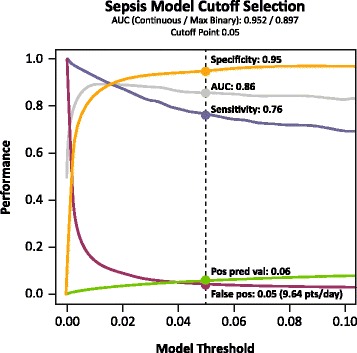
BACKGROUND: Sepsis is an often-fatal syndrome resulting from severe infection. Rapid identification and treatment are critical for septic patients. We therefore developed a probabilistic model to identify septic patients in the emergency department (ED). We aimed to produce a model that identifies 80 % of sepsis patients, with no more than 15 false positive alerts per day, within one hour of ED admission, using routine clinical data. METHODS: We developed the model using retrospective data for 132,748 ED encounters (549 septic), with manual chart review to confirm cases of severe sepsis or septic shock from January 2006 through December 2008. A naïve Bayes model was used to select model features, starting with clinician-proposed candidate variables, which were then used to calculate the probability of sepsis. We evaluated the accuracy of the resulting model in 93,733 ED encounters from April 2009 through June 2010. RESULTS: The final model included mean blood pressure, temperature, age, heart rate, and white blood cell count. The area under the receiver operating characteristic curve (AUC) for the continuous predictor model was 0.953. The binary alert achieved 76.4 % sensitivity with a false positive rate of 4.7 %. CONCLUSIONS: We developed and validated a probabilistic model to identify sepsis early in an ED encounter. Despite changes in process, organizational focus, and the H1N1 influenza pandemic, our model performed adequately in our validation cohort, suggesting that it will be generalizable.
Overview
The claims and statistics of this paper haven’t been checked yet.
Free: it reads the open-access text and checks the first 5 claims that cite a source we can check. Create a free account to check every claim.
Integrity signals
Registry
Cites
Statistics
Figures
Verification
Claims the paper makes
The claims and statistics of this paper haven’t been checked yet.
Free: it reads the open-access text and checks the first 5 claims that cite a source we can check. Create a free account to check every claim.
Claims other papers make about this one
Each is checked against this paper’s own text: does it say what the citing paper says it does?
The source backs part of the claim, not all of it — or backs it for a different population, condition or comparison.
In the citing paper
“there have been well-designed studies where more “complex” ML approaches have outperformed regression-derived clinical risk scores on external validation [7,59,60].”
From Randomized Controlled Trials of Artificial Intelligence in Clinical Practice: Systematic Review (2022) · cites this paper as [60]
Experimental — accuracy not yet measuredThe cited source says what the claim attributes to it.
In the citing paper
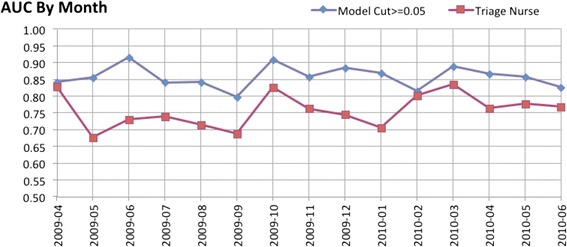
“One clinical validation study in the ED showed the machine learning model outperformed manual scoring by nurses and the SIRS criteria when identifying severe sepsis and septic shock [28], the other study made no comparison [29].”
From Machine learning for the prediction of sepsis: a systematic review and meta-analysis of diagnostic test accuracy (2020) · cites this paper as [28]
The cited source says what the claim attributes to it.
In the citing paper
“Three papers using their own hospital data reported inquiries for data sharing were possible [28, 32, 35], two papers reported data would not be shared [25, 31].”
From Machine learning for the prediction of sepsis: a systematic review and meta-analysis of diagnostic test accuracy (2020) · cites this paper as [28]
The cited source says what the claim attributes to it.
In the citing paper
“very few papers reported they accept data inquiries [32, 35, 47]”
From Machine learning for the prediction of sepsis: a systematic review and meta-analysis of diagnostic test accuracy (2020) · cites this paper as [47]
The cited source says what the claim attributes to it.
In the citing paper
“Only one study clinically validated their model and showed that these models outperformed nurse triaging and SIRS criteria in the emergency room [47].”
From Machine learning for the prediction of sepsis: a systematic review and meta-analysis of diagnostic test accuracy (2020) · cites this paper as [47]
Self-check
Percentages, sums and reported differences re-computed from the paper’s own numbers.
The self-check needs the paper’s full text.
Citations
Cites
R: A Language and Environment for Statistical Computing
R Core Team (2025) · doi:10.32614/r.manuals · Cited by 352,181
Bone, R. C., Balk, R. A., Cerra, F. B., Dellinger, R. P., Fein, A. M., Knaus, W. A., Schein, R. M. H., & Sibbald, W. J. (1992) · Chest · doi:10.1378/chest.101.6.1644 · Cited by 13,198
Early goal-directed therapy in the treatment of severe sepsis and septic shock
Rivers, E., Nguyen, B., Havstad, S., Ressler, J., Muzzin, A., Knoblich, B., Peterson, E., & Tomlanovich, M. (2001) · New England Journal of Medicine · doi:10.1056/nejmoa010307 · Cited by 10,743
Surviving Sepsis Campaign: International Guidelines for Management of Severe Sepsis and Septic Shock
Dellinger, R. P., Levy, M. M., Rhodes, A., Annane, D., Gerlach, H., Opal, S. M., Sevransky, J. E., Sprung, C. L., Douglas, I. S., Jaeschke, R., et al. (2013) · Critical Care Medicine · doi:10.1097/ccm.0b013e31827e83af · Cited by 9,694
Harrell, F. E. (2001) · Springer Series in Statistics · doi:10.1007/978-1-4757-3462-1 · Cited by 9,195
Angus, D. C., Linde-Zwirble, W. T., Lidicker, J., Clermont, G., Carcillo, J., & Pinsky, M. R. (2001) · Critical Care Medicine · doi:10.1097/00003246-200107000-00002 · Cited by 8,503 · cited 1×
“Furthermore, severe sepsis and septic shock are associated with high shortterm mortality (18–40 %) [1, 2].”
BackgroundThe Surviving Sepsis Campaign Guidelines Committee including The Pediatric Subgroup*, Dellinger, R. P., Levy, M. M., Rhodes, A., Annane, D., Gerlach, H., Opal, S. M., Sevransky, J. E., Sprung, C. L., Douglas, I. S., et al. (2013) · Intensive Care Medicine · doi:10.1007/s00134-012-2769-8 · Cited by 7,290
Intravenous Fluids and Acute Kidney Injury
Ding, X., Cheng, Z., & Qian, Q. (2017) · Blood Purification · doi:10.1159/000452702 · Cited by 6,827
The epidemiology of sepsis in the United States from 1979 through 2000
Martin, G. S., Mannino, D. M., Eaton, S., & Moss, M. (2003) · New England Journal of Medicine · doi:10.1056/nejmoa022139 · Cited by 5,841 · cited 1×
“Furthermore, severe sepsis and septic shock are associated with high shortterm mortality (18–40 %) [1, 2].”
BackgroundA randomized trial of protocol-based care for early septic shock.
The ProCESS Investigators (2014) · New England Journal of Medicine · doi:10.1056/nejmoa1401602 · Cited by 2,414
Research works printed but not linked: 1
- 9. Miller 3rd RR, Dong L, Nelson NC, Brown SM, Kuttler KG, Probst DR, Allen TL, Clemmer TP, Intermountain Healthcare Intensive Medicine Clinical P. Multicenter implementation of a severe sepsis and septic shock treatment bundle. Am J Respir Crit Care Med. 2013;188:77-82. · DOI · Paper page
Cited by
An interpretable machine learning model for accurate prediction of sepsis in the ICU
Nemati, S., Holder, A., Razmi, F., Stanley, M. D., Clifford, G. D., & Buchman, T. G. (2018) · Critical Care Medicine · doi:10.1097/ccm.0000000000002936 · Cited by 832
Fleuren, L. M., Klausch, T. L. T., Zwager, C. L., Schoonmade, L. J., Guo, T., Roggeveen, L. F., Swart, E. L., Girbes, A. R. J., Thoral, P., Ercole, A., et al. (2020) · Intensive Care Medicine · doi:10.1007/s00134-019-05872-y · Cited by 755
“Only one study clinically validated their model and showed that these models outperformed nurse triaging and SIRS criteria in the emergency room [47].”
BackgroundMethodAPPRAISE-AI Tool for Quantitative Evaluation of AI Studies for Clinical Decision Support
Kwong, J. C. C., Khondker, A., Lajkosz, K., McDermott, M. B. A., Frigola, X. B., McCradden, M. D., Mamdani, M., Kulkarni, G. S., & Johnson, A. E. W. (2023) · JAMA Network Open · doi:10.1001/jamanetworkopen.2023.35377 · Cited by 142
Artificial intelligence sepsis prediction algorithm learns to say “I don’t know”
Shashikumar, S. P., Wardi, G., Malhotra, A., & Nemati, S. (2021) · npj Digital Medicine · doi:10.1038/s41746-021-00504-6 · Cited by 125
Islam, K. R., Prithula, J., Kumar, J., Tan, T. L., Reaz, M. B. I., Sumon, M. S. I., & Chowdhury, M. E. H. (2023) · Journal of Clinical Medicine · doi:10.3390/jcm12175658 · Cited by 156
“[77] 2016 LDS Hospital and Intermountain Medical Center Sepsis (ICD-9) 132,748 549 0.”
BackgroundDeepAISE – An interpretable and recurrent neural survival model for early prediction of sepsis
Shashikumar, S. P., Josef, C. S., Sharma, A., & Nemati, S. (2021) · Artificial Intelligence in Medicine · doi:10.1016/j.artmed.2021.102036 · Cited by 109
Randomized Controlled Trials of Artificial Intelligence in Clinical Practice: Systematic Review
Lam, T. Y. T., Cheung, M. F. K., Munro, Y. L., Lim, K. M., Shung, D., & Sung, J. J. Y. (2022) · Journal of Medical Internet Research · doi:10.2196/37188 · Cited by 120
“We should also test how machine intelligence and”
Implementation frameworks for end-to-end clinical AI: derivation of the SALIENT framework
van der Vegt, A. H., Scott, I. A., Dermawan, K., Schnetler, R. J., Kalke, V. R., & Lane, P. J. (2023) · Journal of the American Medical Informatics Association · doi:10.1093/jamia/ocad088 · Cited by 109
Automated prediction of sepsis using temporal convolutional network
Kok, C., Jahmunah, V., Oh, S. L., Zhou, X., Gururajan, R., Tao, X., Cheong, K. H., Gururajan, R., Molinari, F., & Acharya, U. R. (2020) · Computers in Biology and Medicine · doi:10.1016/j.compbiomed.2020.103957 · Cited by 105
Schwartz, J. M., Moy, A. J., Rossetti, S. C., Elhadad, N., & Cato, K. D. (2021) · Journal of the American Medical Informatics Association · doi:10.1093/jamia/ocaa296 · Cited by 83
van der Vegt, A. H., Scott, I. A., Dermawan, K., Schnetler, R. J., Kalke, V. R., & Lane, P. J. (2023) · Journal of the American Medical Informatics Association · doi:10.1093/jamia/ocad075 · Cited by 72
Early Detection of Sepsis With Machine Learning Techniques: A Brief Clinical Perspective
Giacobbe, D. R., Signori, A., Del Puente, F., Mora, S., Carmisciano, L., Briano, F., Vena, A., Ball, L., Robba, C., Pelosi, P., et al. (2021) · Frontiers in Medicine · doi:10.3389/fmed.2021.617486 · Cited by 65
“(39) Patients admitted to the ED 226,481 Vital signs, laboratory data, age NB((1)) Severe sepsis according to ICD-9 coding AUROC, sensitivity, specificity, PPV, NPV”
MethodWulff, A., Montag, S., Marschollek, M., & Jack, T. (2019) · Methods of Information in Medicine · doi:10.1055/s-0039-1695717 · Cited by 47
Kim, Y., Jin, Y., Jin, T., & Lee, S. (2020) · Intensive and Critical Care Nursing · doi:10.1016/j.iccn.2020.102844 · Cited by 49
Sepsis Alerts in Emergency Departments: A Systematic Review of Accuracy and Quality Measure Impact
Hwang, M., Bond, W. F., & Powell, E. (2020) · Western Journal of Emergency Medicine · doi:10.5811/westjem.2020.5.46010 · Cited by 51
Ackermann, K., Baker, J., Green, M., Fullick, M., Varinli, H., Westbrook, J. I., & Li, L. (2022) · Journal of Medical Internet Research · doi:10.2196/31083 · Cited by 42
Lin, P.-C., Chen, K.-T., Chen, H.-C., Islam, M. M., & Lin, M. (2021) · Journal of Personalized Medicine · doi:10.3390/jpm11111055 · Cited by 35
Talianu, A., Fraser-Krauss, O., Bolton, W., Ming, D. K. Y., Zhu, N., Hernandez, B., Gilchrist, M. J., Holmes, A. H., Georgiou, P., & Rawson, T. M. (2025) · Journal of Antimicrobial Chemotherapy · doi:10.1093/jac/dkaf470 · Cited by 24
Xiang, L., Wang, H., Fan, S., Zhang, W., Lu, H., Dong, B., Liu, S., Chen, Y., Wang, Y., Zhao, L., et al. (2021) · Frontiers in Oncology · doi:10.3389/fonc.2021.678743 · Cited by 21
Popat, A., Yadav, S., Patel, S. K., Baddevolu, S., Adusumilli, S., Dasari, N. R., Sundarasetty, M., Anand, S., Sankar, J., & Jagtap, Y. G. (2023) · Cureus · doi:10.7759/cureus.50395 · Cited by 19
“Brown et al. (2016) [27], using mean blood pressure, temperature, age, heart rate, and white blood cell count, developed a ML model that could detect sepsis early in the emergency department with an AUC value of 0.95.”
MethodInfluentialAlemán, R., Patel, S., Sleiman, J. R., Navia, J. L., Sheffield, C., & Brozzi, N. A. (2021) · Journal of Cardiac Surgery · doi:10.1111/jocs.15934 · Cited by 21
“40,41 Ultimately, ML predictive models for CS are still in the adolescent phase.”
BackgroundThe role of artificial intelligence in sepsis in the Emergency Department: a narrative review
Chua, M. T., Boon, Y., Lee, Z. Y., Kok, J. J., Lim, C. K. W., Cheung, N. M. T., Yong, L. P. X., & Kuan, W. S. (2025) · Annals of Translational Medicine · doi:10.21037/atm-24-150 · Cited by 21
“These models have a clinically acceptable sensitivity of close to 70% and above, allowing clinicians to identify septic patients early, with aim of translation to early treatment within one hour of ED attendance (29,33).”
Lafon, T., Weingart, M., Vaidie, J., Calfee, C. S., Jacob, S. T., Freund, Y., Shapiro, N. I., Barraud, O., Monneret, G., van der Poll, T., et al. (2026) · EClinicalMedicine · doi:10.1016/j.eclinm.2026.103864 · Cited by 18
“93–95 Finally, the lack of accessible and user-friendly tools impedes clinical uptake.”
Bansal, V., Festić, E., Mangi, M. A., Decicco, N. A., Reid, A. N., Gatch, E. L., Naessens, J. M., & Franco, P. M. (2018) · Acta Medica Academica · doi:10.5644/ama2006-124.212 · Cited by 14
Validation of a Machine Learning Model for Early Shock Detection
Pinevich, Y., Amos‐Binks, A., Burris, C., Rule, G. T., Bogojevic, M., Flint, I., Pickering, B. W., Nemeth, C., & Herasevich, V. (2021) · Military Medicine · doi:10.1093/milmed/usab220 · Cited by 13
Detection of sepsis during emergency department triage using machine learningPreprint
Ivanov, O., Molander, K., Dunne, R., Liu, S., Brecher, D., Masek, K., Lewis, E., Wolf, L. A., Travers, D. A., Delaney, D., et al. (2022) · arXiv (Cornell University) · doi:10.48550/arxiv.2204.07657 · Cited by 15
Kim, J., Lee, K. H., Kim, K. J., Ha, E. Y., Kim, I., Park, S. H., Cho, C., Yu, G. I., Ahn, B. E., Jeong, Y., et al. (2025) · BMJ Health & Care Informatics · doi:10.1136/bmjhci-2024-101353 · Cited by 12
Amrollahi, F., Shashikumar, S. P., Kathiravelu, P., Sharma, A., & Nemati, S. (2020) · Annual International Conference of the IEEE Engineering in Medicine and Biology Society (EMBC) · doi:10.1109/embc44109.2020.9175947 · Cited by 14
“In recent years, the increased adoption of electronic medical records (EMR) has spurned the development of machine learning based surveillance tools for detection [7-10] and prediction [9-12] of patients with sepsis or septic shock.”
BackgroundZhang, H., Wang, C., & Yang, N. (2024) · Technology and Health Care · doi:10.3233/thc-240087 · Cited by 14
“Finally, 21 articles were included for the subsequent meta-analysis [11,12,13,14, 15,16,17,18,19,20,21,22,23,24,25,26,27,28,29,30,31].”
Yang, D., Kim, J., Yoo, J., Cha, W. C., & Paik, H. (2022) · JMIR Medical Informatics · doi:10.2196/37689 · Cited by 16
“Various studies have been conducted to identify the risk of sepsis, including a statistical model–based approach for emergency room (ER) patients [10], a machine learning–based approach for inpatients [11], and an approach using unstructured clinical data [12].”
Abbas, G. H., Sen, P., Giri, O. A., & Khan, N. H. (2025) · Critical Care Explorations · doi:10.1097/cce.0000000000001360 · Cited by 15
Using a Semi-Automated Modeling Environment to Construct a Bayesian, Sepsis Diagnostic System
Haug, P. J., & Ferraro, J. P. (2016) · ACM International Conference on Bioinformatics, Computational Biology, and Health Informatics (ACM-BCB) · doi:10.1145/2975167.2985841 · Cited by 11
“Subsequently, a prospective analysis showed an AROC on 0.859 with a sensitivity of 0.764 and a positive predictive value of 0.058 [9].”
BackgroundInfluentialSelf-citationvan der Vegt, A. H., Campbell, V. K., Webb, R. T., Venkatesh, B., Lane, P. J., Wilks, K. M., McPhail, S., Rice, M., Isaacs, T., Abdel‐Hafez, A., et al. (2025) · Journal of the American Medical Informatics Association · doi:10.1093/jamia/ocaf192 · Cited by 8
“…retrospective and prospective model evaluation metrics (see Supplementary Appendix 4) for six implemented AI-based sepsis prediction tools identified in a recent systematic review: 2 (Epic sepsis model 17 , InSight 18,32,33 , Sep-sisWatch 34,35 , TrewScore 36 , Sepsis Sniffer 37 and other 20 ).”
Schnetler, R. J., van der Vegt, A. H., Kalke, V. R., Lane, P., & Scott, I. A. (2025) · BMJ Quality & Safety · doi:10.1136/bmjqs-2024-018328 · Cited by 9
“20 26 27 However, this trades lower sensitivity for better positive predictive value (PPV)) or precision.”
Popat, A., Pethe, G., Yadav, S., & Sharma, P. (2025) · Aging advances. · doi:10.4103/agingadv.agingadv-d-24-00025 · Cited by 5
Al-Juhani, A. A., Desoky, R. M., Iskander, Z., Alshehri, K., Alshehri, A., Almuhaimid, A. A., Alharbi, N. L., Mominah, R. H., Al-Humoud, F. M., & Desoky, A. (2025) · Cureus · doi:10.7759/cureus.89882 · Cited by 8
“According to studies, interpretable ML techniques that clarify the driving characteristics and support clinical intuition are more likely to be employed [27,28].”
Development and Validation of an Ensemble Learning Risk Model for Sepsis After Abdominal Surgery
Shu, X., Li, Y., Zhu, Y., Yang, Z., Liu, X., Hu, X., Yang, C., Жао, Л., Zhu, T., Chen, Y., et al. (2024) · Archives of Medical Science · doi:10.5114/aoms/189505 · Cited by 5
“Only a few studies using their own hospital data allow data sharing [31], which may aggravate the limitations on screening for postoperative sepsis.”
Remote Patient Monitoring for Healthcare: A Big Challenge for Big Data
Stranieri, A., & Balasubramanian, V. (2019) · Advances in data mining and database management book series · doi:10.4018/978-1-5225-7277-0.ch009 · Cited by 5
Gosset, C., Foguenne, J., Simul, M., Tomsin, O., Ammar, H., Layios, N., Massion, P. B., Damas, P., & Gothot, A. (2021) · Scientific Reports · doi:10.1038/s41598-021-99628-8 · Cited by 4
“To date, clinical decision support (CDS) tools based on machine learning embedded into real-time medical records have been reported 41–43 and allow fast recognition of the onset of sepsis before overt clinical signs 19,44–50 .”
BackgroundDevelopment and validation of SXI++ large numerical model (LNM) algorithm for sepsis prediction
Mahto, D., Yadav, P., Banavar, M. K., Keany, J., Joseph, A. T., & Kilambi, S. (2025) · Journal of Medical Artificial Intelligence · doi:10.21037/jmai-24-393 · Cited by 2
“Even after hospital discharge, survivors are at increased risk of death or suffer from a reduced quality of life (6, 7, 8 ) .”
Development and Validation of an Early Warning System for Septic Shock in Intensive Care Unit
Li, T., Cheng, Z., Jin, X., Lin, L., Nan, S., Lü, X., & Duan, H. (2023) · International Conference on Big Data and Information Analytics (BigDIA) · doi:10.1109/bigdia60676.2023.10429553 · Cited by 2
“Several studies focused on the early warning of septic shock have successfully demonstrated effectiveness [10]–[12].”
BackgroundAddasi, R., Safadi, W. A., Sorour, S., Altawil, Z., Dawud, Y., Ammori, R., Alshamasneh, M., & Hamam, S. A. (2026) · Journal of Robotic Surgery · doi:10.1007/s11701-026-03276-x · Cited by 3
Babur, S., Moghaddamnia, S., & Bozkurt, M. R. (2021) · World Congress on Medical Physics and Biomedical Engineering, September 7 - 12, 2009, Munich, Germany · doi:10.1007/978-3-030-73909-6_19 · Cited by 1
Sepsis Screening Tool Increased the Usage of Sepsis Order Set
Liengsawangwong, R. (2019) · doi:10.21007/chp.hiim.0066
“Many retrospective studies focused on development of CDS tool for sepsis screening and alert (Amland & Hahn-Cover, 2016; Amland, Haley, & Lyons, 2016; Brown et al., 2016; Li et al., 2019; S. Q. Nguyen et al., 2014; Rolnick et al., 2016).”
Remote Patient Monitoring for Healthcare: A Big Challenge for Big Data
Stranieri, A., & Balasubramanian, V. (2021) · IGI Global eBooks · doi:10.4018/978-1-6684-3662-2.ch050
Wu, Z. (2024) · Lund University Publications Student Papers (Lund University)
Valoración precoz de pacientes con sospecha de sepsis desde triaje de Enfermería en Urgencias
Cervera, E. G. (2018) · Academica-e (Universidad Pública de Navarra)
Nelson, T. L. (2021) · Scholar Works at UT Tyler (The University of Texas at Tyler)
Kilambi, S., & Banavar, M. K. (2026) · Synthesis lectures on technology, management, and entrepreneurship · doi:10.1007/978-3-032-14869-8_7
Metadata
- Authors
- Brown, S. M., Jones, J., Kuttler, K. G., Keddington, R. K., Allen, T. L., & Haug, P.
- Affiliations
- University of Utah (US)
- Kaiser Permanente (US)
- Intermountain Healthcare (US)
- Corresponding author
- Brown, Samuel M.
- Venue
- BMC Emergency Medicine
- Published
- 2016-08-22
- Volume
- 16
- Issue
- 1
- Pages
- 31-31
- ISSN
- 1471-227X (ISSN-L)
- PMC
- PMC4994262
- OpenAlex
- W2514926717
- Semantic Scholar
- 8e544939be2bcc516571a840010740265a6ccf00
- Cited by
- 45
- References
- 16
- Citations by year
- 2026: 3 · 2025: 6 · 2024: 2 · 2023: 7 · 2022: 2 · 2021: 11 · 2020: 7 · 2019: 4 · 2018: 1 · 2017: 1 · 2016: 1
- FWCI
- 2.19
- Type
- journal article
- Language
- en
- Open access
- gold
- doi.org
- Licence
- cc-by
- creativecommons.org/licenses/by/4.0/ (tdm)
- creativecommons.org/licenses/by/4.0/ (vor)
- Locations
- BMC Emergency Medicine (publishedVersion, cc-by)
- Europe PMC (PubMed Central) (publishedVersion, cc-by)
- PubMed Central (publishedVersion, cc-by)
- PubMed (publishedVersion)
- Funders
- National Institute of General Medical Sciences (k23gm094465)
- Topics
- Health Sciences › Medicine › Critical Care and Intensive Care Medicine › Sepsis Diagnosis and Treatment
- Physical Sciences › Computer Science › Artificial Intelligence › Machine Learning in Healthcare
- Health Sciences › Medicine › Emergency Medicine › Emergency and Acute Care Studies
- Keywords
- sepsis, septic shock, emergency department, clinical decision support, probabilistic models, Naive Bayes classifier, early warning alerts, routine clinical data, model validation, H1N1 influenza pandemic
- MeSH terms
- Adult, Age Factors, Bayes Theorem, Blood Pressure, Body Temperature, Emergency Service, Hospital, Female, Heart Rate, Humans, Leukocyte Count, Male, Middle Aged, Retrospective Studies, ROC Curve, Sensitivity and Specificity, Shock, Septic, Triage, Sepsis
About these checks
Registry, retraction, Cites and statistics results are computed, not judged, with one exception: a printed reference that no index lists is read once by a model before it counts as a citation error. Claims are extracted by a model and kept only when their quote appears verbatim in the text; each cited source is then checked, with a model’s help, for whether it says what the claim relies on. Those verdicts can be wrong — read the claim’s quote and the cited source before relying on one.
Statistics and arithmetic are recomputed, not judged.
Confidence bands are shown only for fields calibrated on our annotated test set. None is calibrated yet, so no band is shown.
What counts as a claim ›How we measure confidence ›How we check this ›
Are you an author, or do you see a problem with this page? Request a review
Data sources
Bibliographic data: Semantic Scholar, OpenAlex, Crossref.
Contains information from the Semantic Scholar Academic Graph Datasets, made available under the ODC Attribution License (ODC-BY 1.0).
Semantic Scholar’s data is described in: Kinney, R., et al. (2023). The Semantic Scholar Open Data Platform. arXiv:2301.10140.
