

Classification and prevalence of spin in abstracts of non-randomized studies evaluating an intervention
Open accessThe DOI matches its Crossref record; 38 of the 38 references it cites were found in a registry or an index.
Abstract
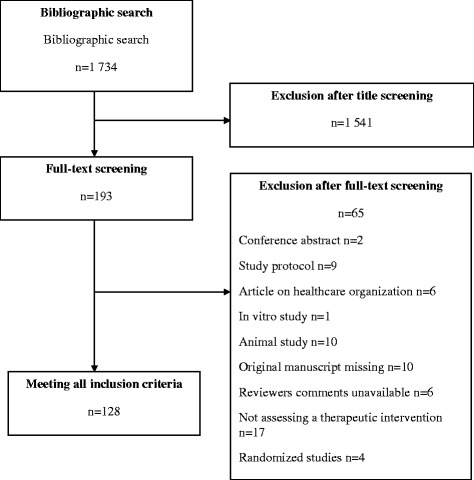
BACKGROUND: Spin represents specific reporting strategies, either intentional or unintentional, to convince the reader that the beneficial effect of the experimental intervention in terms of efficacy and safety is greater than that shown by the results. The objectives of this study were to 1) develop a classification of spin specific to non-randomized studies assessing an intervention and 2) estimate the prevalence of spin in abstracts of reports of such studies. METHODS: In a first step, we developed a specific classification of spin for non-randomized studies by a literature review and pilot study. In a second step, 2 researchers trained in the field of methodology evaluated the prevalence of spin in the abstract of all non-randomized studies assessing an intervention published in the BioMed Central Medical Series journals between January 1, 2011 and December 31, 2013. All disagreements were resolved by consensus. We also determined whether the level of spin in abstract conclusions was high (spin reported without uncertainty or recommendations for further trials), moderate (spin reported with some uncertainty or recommendations for further trials) or low (spin reported with uncertainty and recommendations for further trials). RESULTS: Among the 128 assessed articles assessed, 107 (84%) had at least one example of spin in their abstract. The most prevalent strategy of spin was the use of causal language, identified in 68 (53%) abstracts. Other frequent strategies were linguistic spin, inadequate implications for clinical practice, and lack of focus on harm, identified in 33 (26%), 25 (20%), and 34 (27%) abstracts respectively. Abstract conclusions of 61 (48%) articles featured a high level of spin. CONCLUSION: Abstract of reports of non-randomized studies assessing an intervention frequently includes spin. Efforts to reduce the prevalence of spin in abstract for such studies are needed.
Overview
The claims and statistics of this paper haven’t been checked yet.
Free: it reads the open-access text and checks the first 5 claims that cite a source we can check. Create a free account to check every claim.
Integrity signals
Registry
Cites
Statistics
Figures
Verification
Claims the paper makes
The claims and statistics of this paper haven’t been checked yet.
Free: it reads the open-access text and checks the first 5 claims that cite a source we can check. Create a free account to check every claim.
Claims other papers make about this one
Each is checked against this paper’s own text: does it say what the citing paper says it does?
The source backs part of the claim, not all of it — or backs it for a different population, condition or comparison.
In the citing paper
“Moreover, their capacity to detect errors [10, 11], identify deficiencies in reporting [12] and spin [13] has been found lacking.”
From Tools used to assess the quality of peer review reports: A methodological systematic review (2019) · cites this paper as [13]
Experimental — accuracy not yet measuredIn the citing paper
“There are several ways to spin a report (4, 6, 8–10).”
From Misrepresentation and distortion of research in biomedical literature (2018) · cites this paper as [10]
In the citing paper
“Specific classifications of spin have been developed for different study designs and contexts [randomized controlled trials with nonstatistically significant results (4), observational studies evaluating an intervention (10), diagnostic accuracy studies (8), systematic reviews (9)].”
From Misrepresentation and distortion of research in biomedical literature (2018) · cites this paper as [10]
Self-check
Percentages, sums and reported differences re-computed from the paper’s own numbers.
The self-check needs the paper’s full text.
Citations
Cites
Boutron, I. (2010) · JAMA · doi:10.1001/jama.2010.651 · Cited by 842 · cited 2×
“To develop the classification of spin, we performed a literature review of studies of spin for other study designs [3 – 5, 9, 11] as well as studies of distorted presentation and interpretation of findings from non-randomized studies [12 – 19].”
Self-citationComparison of Registered and Published Primary Outcomes in Randomized Controlled Trials
Mathieu, S. (2009) · JAMA · doi:10.1001/jama.2009.1242 · Cited by 730 · cited 1×
“To develop the classification of spin, we performed a literature review of studies of spin for other study designs [3 – 5, 9, 11] as well as studies of distorted presentation and interpretation of findings from non-randomized studies [12 – 19].”
Chan, A.-W., & Altman, D. G. (2005) · BMJ · doi:10.1136/bmj.38356.424606.8f · Cited by 613
When are observational studies as credible as randomised trials?
Vandenbroucke, J. P. (2004) · The Lancet · doi:10.1016/s0140-6736(04)16261-2 · Cited by 538 · cited 1×
“Particularly, contrary to randomized clinical trials, they may not allow for establishing causal inferences but rather, only an association [8 – 10].”
Boutron, I., Altman, D. G., Hopewell, S., Vera-Badillo, F., Tannock, I., & Ravaud, P. (2014) · Journal of Clinical Oncology · doi:10.1200/jco.2014.56.7503 · Cited by 368
Self-citationCausation in epidemiology: Table 1
Parascandola, M., & Weed, D. L. (2001) · Journal of Epidemiology and Community Health · doi:10.1136/jech.55.12.905 · Cited by 276 · cited 2×
“Particularly, contrary to randomized clinical trials, they may not allow for establishing causal inferences but rather, only an association [8 – 10].”
Comparisons against baseline within randomised groups are often used and can be highly misleading
Bland, J. M., & Altman, D. G. (2011) · Trials · doi:10.1186/1745-6215-12-264 · Cited by 241
Effect of interpretive bias on research evidence
Kaptchuk, T. J. (2003) · BMJ · doi:10.1136/bmj.326.7404.1453 · Cited by 222 · cited 1×
“This situation is problematic because it has been demonstrated [6] that spin in the abstract conclusions of randomized controlled trial reports could bias the interpretation of the results by clinicians [29].”
Overinterpretation and Misreporting of Diagnostic Accuracy Studies: Evidence of “Spin”
Ochodo, E. A., de Haan, M. C., Reitsma, J. B., Hooft, L., Bossuyt, P. M., & Leeflang, M. M. G. (2013) · Radiology · doi:10.1148/radiol.12120527 · Cited by 158 · cited 1×
“Spin was found in more than half of the abstract conclusions of randomized controlled trials with statistically non-significant results for the primary outcome [3]; moreover, one third of reports of diagnostic accuracy studies contained a form of over-interpretation [4].”
Brown, A. W., Bohan Brown, M. M., & Allison, D. B. (2013) · The American Journal of Clinical Nutrition · doi:10.3945/ajcn.113.064410 · Cited by 155 · cited 1×
“Brown et al. [32] evidenced a 26 % to 50 % rate of studies ascribing greater inferential strength than the study design warranted.”
Cited by
Items 101–149 of 149
Canto, G. D. L., Pauletto, P., Stefani, C. M., Gonçalves, T. M. S. V., Carvas, N., Flores‐Mir, C., Pinto, A. C. P. N., & Trevisani, V. F. M. (2025) · BMC Medical Research Methodology · doi:10.1186/s12874-025-02547-9 · Cited by 1
“Descriptive statistics were used to summarize the frequency and characteristics of the spin, and they were categorized into three types: (1) misleading reporting, (2) inadequate interpretation, and (3) inadequate extrapolation [30].”
Psychopathy Unmasked: The Rise and Fall of a Dangerous Diagnosis
Larsen, R. R. (2025) · The MIT Press eBooks · doi:10.7551/mitpress/15188.001.0001 · Cited by 5
van Hoesel, T. G. L., & Bakker, M. (2026) · Royal Society Open Science · doi:10.1098/rsos.251174 · Cited by 1
A probabilistic model of hype reveals a rhetorical shift in biomedicine
Mishra, A., Diesner, J., & Torvik, V. I. (2026) · Quantitative Science Studies · doi:10.1162/qss.a.482 · Cited by 1
Pires, A. L. C., dos Santos, L. G., Loomans, B. A. C., Pereira-Cenci, T., Chisini, L. A., & Pappen, F. G. (2026) · Australian Endodontic Journal · doi:10.1111/aej.70087 · Cited by 1
Annotating Spin in Biomedical Scientific Publications : the case of Random Controlled Trials (RCTs)
Koroleva, A., & Paroubek, P. (2018) · Language Resources and Evaluation Conference (LREC) · doi:10.63317/4ydwv7555nce · Cited by 1
“From previous research on spin classification (Boutron et al. 2010; Lazarus et al. 2015, Yavchitz et al. 2012], we can outline three main types and their subtypes of spin in RCT reports: 1. misleading reporting of study results: • selective reporting of outcomes (omission of the primary outcome;…”
MethodHayes, A. R., Chan, D. L. H., Chan, B. A., & Pavlakis, N. (2021) · Journal of Neuroendocrinology · doi:10.1111/jne.13015 · Cited by 1
Ottwell, R., Esmond, L., Rea, W., Hartwell, M. L., Som, M., Harris, R., Miao, Z., Zhu, L., Arthur, W., Brachtenbach, T., et al. (2021) · Diabetic Medicine · doi:10.1111/dme.14653 · Cited by 1
Faggion, C. M. (2023) · Postgraduate Medical Journal · doi:10.1093/postmj/qgad130 · Cited by 1
Dal‐Ré, R. (2018) · Medicina Clínica · doi:10.1016/j.medcli.2018.03.026
Hanna, M. (2019) · Springer eBooks · doi:10.1007/978-3-030-02955-5_27
Hanna, M. (2019) · Springer eBooks · doi:10.1007/978-3-030-02955-5_11
Dissemination and communication of clinical research in mass media
Haneef, R. (2017) · theses.fr (ABES) · doi:10.70675/e393710az53caz46d2zb1e9z1a5142868196
Self-citationEducators' inaccurate use of causal language to describe non-causal data
Gunseor, M. M. (2020) · Minds at UW (University of Wisconsin)
Peer review reduces spin in PCORI research reportsPreprint
Mayo‐Wilson, E., Phillips, M. L., Connor, A. E., Ley, K. V., Naaman, K., & Helfand, M. (2021) · MetArXiv (OSF Preprints) · doi:10.31222/osf.io/xknhp · Cited by 1
Boutron, I., Haneef, R., Yavchitz, A., Baron, G., Novack, J., Oransky, I., Schwitzer, G., & Ravaud, P. (2019) · BMC Medicine · doi:10.1186/s12916-019-1388-4
Self-citationAlves, C. P. D. L., da Costa, G. G., Segundo, J. D. D. B., & Helal, L. C. A. S. (2020) · OSF Preprints (OSF Preprints) · doi:10.31219/osf.io/7hdur
Misleading information generated in medical journals that reaches the citizen electronically
Dal‐Ré, R. (2018) · Medicina Clínica (English Edition) · doi:10.1016/j.medcle.2018.03.029
Hanna, M. (2019) · Springer eBooks · doi:10.1007/978-3-030-02955-5_1
Grant, S., Gardner, F. E. M., & Bradshaw, C. P. (2022) · Prevention Science · doi:10.1007/s11121-022-01393-1
“(2022) examine the important issue of publication bias in prevention, focusing on the harm and waste that results from the misrepresentation of study results, or “spin” (Lazarus et al., 2015), and from non-reporting of null and negative trial results (Li et al.”
BackgroundBangpan, M., Draper, A., Minchenko, D., Stansfield, C., Dickson, K., Tripney, J., & Oliver, S. R. (2023) · doi:10.51744/cswp10
Ferreira, L. S., Prado, L. C. U., Nakamoto, F. C., dos Santos, A. C. D. J., Gomes, C. A. F. D. P., Politti, F., & Biasotto‐Gonzalez, D. A. (2024) · Journal of Advances in Medicine and Medical Research · doi:10.9734/jammr/2024/v36i55423
Editorial. Spinning all around
Kestle, J. R. W. (2024) · Journal of neurosurgery · doi:10.3171/2024.2.jns232694
Suboptimal reporting practices in biomedical research
Ghannad, M. (2021) · theses.fr (ABES) · doi:10.70675/a6b7cb44z6076z445fz80f4z8d9c1b47b38a
van Hoesel, T. G. L., & Bakker, M. (2024) · PsyArXiv (OSF Preprints) · doi:10.31234/osf.io/rh9vg
Nunes, K. L., Hatton, C. E., & Pham, A. T. (2024) · Journal of Experimental Criminology · doi:10.1007/s11292-024-09649-2
To: Science over language: a plea to consider language bias in scientific publishing
Magoon, R. (2025) · Critical Care Science · doi:10.62675/2965-2774.20250027
Zhao, R. (2025) · Philology Theory & Practice · doi:10.30853/phil20250410
The Dark Sides of Modern Science: Publishing and Dissemination (Part II)Preprint
Sochi, T. (2025) · SSRN Electronic Journal · doi:10.2139/ssrn.5507278
Guo, F., Ye, W., Qin, D., Fang, X., Hua, F., & He, H. (2023) · Figshare · doi:10.6084/m9.figshare.24546947
Steegmans, P. A. J., Di Girolamo, N., & Reynders, R. M. (2024) · Figshare · doi:10.6084/m9.figshare.26598293
Steegmans, P. A. J., Di Girolamo, N., & Reynders, R. M. (2024) · Figshare · doi:10.6084/m9.figshare.26598299
Steegmans, P. A. J., Di Girolamo, N., & Reynders, R. M. (2024) · Figshare · doi:10.6084/m9.figshare.26598296
Misleading readers without lies: understanding spin and its relevance to acupuncture research
Bae, I., Ji, Y.-J., & Lee, H. (2025) · Integrative Medicine Research · doi:10.1016/j.imr.2025.101288
“23 Case example: In a meta-analysis published in 2023 on pregnancy outcome in patients with polycystic ovary syndrome, 24 no statistically significant differences were observed between the intervention and control groups.”
Seeking and reporting of adverse effects in orthodontic research
Steegmans, P. A. J. (2024) · UvA-DARE (University of Amsterdam)
Guidance on navigating the research gap in medical literature and points of caution
EL-Sobky, T. A., & Mahmoud, S. (2026) · Journal of Musculoskeletal Surgery and Research · doi:10.25259/jmsr_586_2025
Su, N., van der Linden, M. W., van der Heijden, G. J. M. G., Listl, S., & Faggion, C. M. (2026) · Journal of Clinical Epidemiology · doi:10.1016/j.jclinepi.2026.112264
Assisted authoring for avoiding inadequate claims in scientific reporting
Koroleva, A. (2020) · theses.fr (ABES) · doi:10.70675/f035bb8azddf1z4a7dzbf39zdf86c6947bb9 · Cited by 2
“From previous research on spin classification (Boutron et al., 2010; Lazarus et al., 2015; Yavchitz et al., 2016), we can outline three main types and their subtypes of spin in RCT reports:”
BackgroundMethodResultInfluentialMartikainen, H. (2019) · theses.fr (ABES) · doi:10.70675/ab2ef8b1z6a83z4ca5za10czbd25a32a8fca · Cited by 3
Shortcomings in and preferred strategies for evaluating biomarkers as medical tests
Olsen, M. (2021) · theses.fr (ABES) · doi:10.70675/535e1627z1a35z437cz8c94z8701a5d0d2b7
La santé publique comme nouvelle approche clinique de dépistage et de diagnostic du cancer oral
Lan, R. (2021) · theses.fr (ABES) · doi:10.70675/4ddb3800z1c27z48dbza352zadb4fd1346fa
Ein Abstract sagt mehr als 1.000 Worte? – Leider nicht so ganz …
Friederichs, H. (2026) · doi:10.59350/9fyra-sz611
Ein Abstract sagt mehr als 1.000 Worte? – Leider nicht so ganz …
Friederichs, H. (2026) · doi:10.59350/w9dqx-nse76
Fournier, J., Khouri, C., Bellier, A., Seigneurin, A., Laporte, S., & Roustit, M. (2026) · Journal of Clinical Epidemiology · doi:10.1016/j.jclinepi.2026.112536
Chung, Z., Grant, L.-A., Chen, J., Mbuagbaw, L., Mokete, L., & Thabane, L. (2026) · Pilot and Feasibility Studies · doi:10.1186/s40814-026-01846-2
“This rate is consistent with prior findings in oncology (75%, 39/52), pharma-covigilance (63%, 63/100), and non-randomized abstracts (84%, 107/128) [7, 13, 16].”
Akrivos, V. S., Claizergues, B., Collin, P., Levy, G., Valencia, G. V., van Rooij, F., & Lädermann, A. (2026) · Knee Surgery Sports Traumatology Arthroscopy · doi:10.1002/ksa.70476
“In addition to the type of spin, the two researchers evaluated the level of spin from the conclusions of the studies, according to the method developed by Lazarus et al. [25].”
InfluentialSugarmann, L. R., Sternberg-Sher, J., Feler, J. R., Schroeder, C. B., Michles, M. J., Gokaslan, Z. L., & Sullivan, P. L. Z. (2026) · Journal of neurosurgery · doi:10.3171/2026.1.jns251863
Polašek, O. (2026) · Research Square · doi:10.21203/rs.3.rs-10305898/v1
Metadata
- Authors
- Lazarus, C., Haneef, R., Ravaud, P., & Boutron, I.
- Affiliations
- Inserm (FR)
- Corresponding author
- Boutron, Isabelle
- Venue
- BMC Medical Research Methodology
- Published
- 2015-10-13
- Volume
- 15
- Issue
- 1
- Pages
- 85-85
- ISSN
- 1471-2288 (ISSN-L)
- PMC
- PMC4604617
- OpenAlex
- W1953064436
- Cited by
- 137
- References
- 38
- Citations by year
- 2026: 11 · 2025: 11 · 2024: 15 · 2023: 10 · 2022: 13 · 2021: 20 · 2020: 13 · 2019: 15 · 2018: 10 · 2017: 11 · 2016: 7 · 2015: 1
- FWCI
- 8.82
- Type
- journal article
- Language
- en
- Open access
- gold
- doi.org
- Licence
- Locations
- BMC Medical Research Methodology (publishedVersion, cc-by)
- Europe PMC (PubMed Central) (publishedVersion, cc-by)
- PubMed Central (publishedVersion, cc-by)
- PubMed (publishedVersion)
- Funders
- Assistance Publique - Hôpitaux de Paris
- Topics
- Social Sciences › Decision Sciences › Statistics, Probability and Uncertainty › Meta-analysis and systematic reviews
- Health Sciences › Nursing › Issues, ethics and legal aspects › Pharmaceutical industry and healthcare
- Social Sciences › Library and Information Sciences › Academic Publishing and Open Access
- Keywords
- spin, non-randomized studies, abstracts, reporting bias, causal language, harms reporting, clinical implications, intervention research, research integrity
- MeSH terms
- Abstracting and Indexing, Humans, Research Design, Bias
About these checks
Registry, retraction, Cites and statistics results are computed, not judged, with one exception: a printed reference that no index lists is read once by a model before it counts as a citation error. Claims are extracted by a model and kept only when their quote appears verbatim in the text; each cited source is then checked, with a model’s help, for whether it says what the claim relies on. Those verdicts can be wrong — read the claim’s quote and the cited source before relying on one.
Statistics and arithmetic are recomputed, not judged.
Confidence bands are shown only for fields calibrated on our annotated test set. None is calibrated yet, so no band is shown.
What counts as a claim ›How we measure confidence ›How we check this ›
Are you an author, or do you see a problem with this page? Request a review
Data sources
Bibliographic data: Semantic Scholar, OpenAlex, Crossref.
Contains information from the Semantic Scholar Academic Graph Datasets, made available under the ODC Attribution License (ODC-BY 1.0).
Semantic Scholar’s data is described in: Kinney, R., et al. (2023). The Semantic Scholar Open Data Platform. arXiv:2301.10140.
