

Guidance for using artificial intelligence for title and abstract screening while conducting knowledge syntheses
Open accessThe DOI matches its Crossref record; 41 of the 41 references it cites were found in a registry or an index.
Abstract
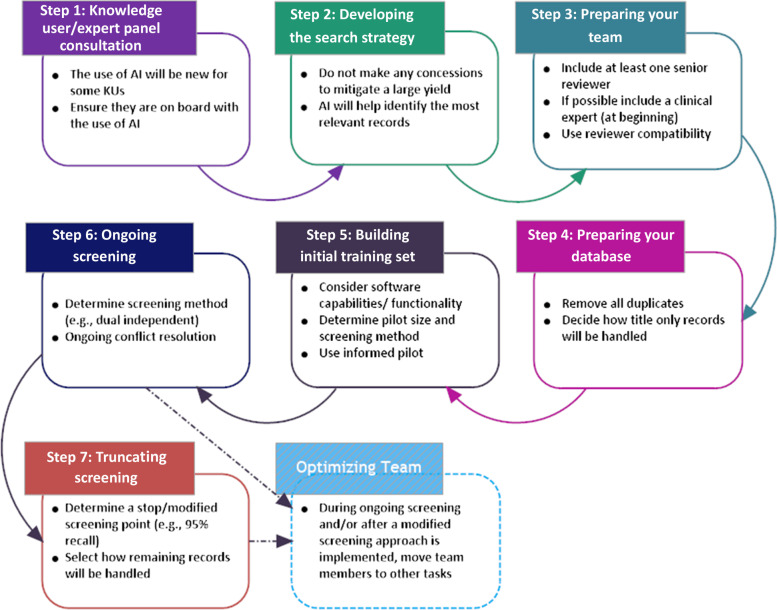
Background: Systematic reviews are the cornerstone of evidence-based medicine. However, systematic reviews are time consuming and there is growing demand to produce evidence more quickly, while maintaining robust methods. In recent years, artificial intelligence and active-machine learning (AML) have been implemented into several SR software applications. As some of the barriers to adoption of new technologies are the challenges in set-up and how best to use these technologies, we have provided different situations and considerations for knowledge synthesis teams to consider when using artificial intelligence and AML for title and abstract screening. Methods: We retrospectively evaluated the implementation and performance of AML across a set of ten historically completed systematic reviews. Based upon the findings from this work and in consideration of the barriers we have encountered and navigated during the past 24 months in using these tools prospectively in our research, we discussed and developed a series of practical recommendations for research teams to consider in seeking to implement AML tools for citation screening into their workflow. Results: We developed a seven-step framework and provide guidance for when and how to integrate artificial intelligence and AML into the title and abstract screening process. Steps include: (1) Consulting with Knowledge user/Expert Panel; (2) Developing the search strategy; (3) Preparing your review team; (4) Preparing your database; (5) Building the initial training set; (6) Ongoing screening; and (7) Truncating screening. During Step 6 and/or 7, you may also choose to optimize your team, by shifting some members to other review stages (e.g., full-text screening, data extraction). Conclusion: Artificial intelligence and, more specifically, AML are well-developed tools for title and abstract screening and can be integrated into the screening process in several ways. Regardless of the method chosen, transparent reporting of these methods is critical for future studies evaluating artificial intelligence and AML.
Overview
The claims and statistics of this paper haven’t been checked yet.
Free: it reads the open-access text and checks the first 5 claims that cite a source we can check. Create a free account to check every claim.
Integrity signals
Registry
Cites
Statistics
Figures
Verification
Claims the paper makes
The claims and statistics of this paper haven’t been checked yet.
Free: it reads the open-access text and checks the first 5 claims that cite a source we can check. Create a free account to check every claim.
Claims other papers make about this one
Each is checked against this paper’s own text: does it say what the citing paper says it does?
The cited source doesn’t support the claim as written.
In the citing paper
“as their development depends on knowledge of the true relevant records (Callaghan & Müller-Hansen, 2020; Hamel et al., 2021).”
From Screening Smarter, Not Harder: A Comparative Analysis of Machine Learning Screening Algorithms and Heuristic Stopping Criteria for Systematic Reviews in Educational Research (2024) · cites this paper as Hamel et al., 2021
Checked by a reasoning model — may be wrong.
Experimental — accuracy not yet measuredThe source backs part of the claim, not all of it — or backs it for a different population, condition or comparison.
In the citing paper
“Overall, the performance of heuristic stopping rules should not be generalized to databases where the number of relevant records is unknown, as their development depends on knowledge of the true relevant records (Callaghan & Müller-Hansen, 2020; Hamel et al., 2021).”
From Screening Smarter, Not Harder: A Comparative Analysis of Machine Learning Screening Algorithms and Heuristic Stopping Criteria for Systematic Reviews in Educational Research (2024) · cites this paper as Hamel et al., 2021
Experimental — accuracy not yet measuredThe cited source says what the claim attributes to it.
In the citing paper
“Nonetheless, forthcoming advances in automation (eg, active machine learning) 49 50 and crowdsourcing 8 51 have the potential to reduce screening time when conducting rapid reviews.”
From Updated recommendations for the Cochrane rapid review methods guidance for rapid reviews of effectiveness (2024) · cites this paper as [49]
Self-check
Percentages, sums and reported differences re-computed from the paper’s own numbers.
The self-check needs the paper’s full text.
Citations
Cites
The PRISMA 2020 statement: An updated guideline for reporting systematic reviews
Page, M. J., McKenzie, J. E., Bossuyt, P. M., Boutron, I., Hoffmann, T. C., Mulrow, C. D., Shamseer, L., Tetzlaff, J. M., Akl, E. A., Brennan, S. E., et al. (2021) · BMJ · doi:10.1136/bmj.n71 · Cited by 108,283
Self-citationRayyan-a web and mobile app for systematic reviews.
Ouzzani, M., Hammady, H., Fedorowicz, Z., & Elmagarmid, A. (2016) · Systematic Reviews · doi:10.1186/s13643-016-0384-4 · Cited by 26,092 · cited 1×
“…been introduced in several SR software applications, such as Abstrackr [18], DistillerSR ® [19], EPPI-Reviewer [20], Pico Portal [21], Rayyan [22], RobotAnalyst [23], and SWIFTActive-Screener [24], with a comprehensive list available at SR Toolbox (http:// syste matic revie wtools. com/…”
MethodThe PRISMA 2020 statement: an updated guideline for reporting systematic reviews
Page, M. J., McKenzie, J. E., Bossuyt, P. M., Boutron, I., Hoffmann, T. C., Mulrow, C. D., Shamseer, L., Tetzlaff, J. M., Akl, E. A., Brennan, S. E., et al. (2021) · Systematic Reviews · doi:10.1186/s13643-021-01626-4 · Cited by 13,874 · cited 1×
“…around the use of automation tools with a list of ‘essential elements for systematic reviews using automation tools in the selection process’ [46]; we feel this to be a sign of growing acceptance of the use of AI in the field of knowledge synthesis that should encourage those interested to…”
MethodSelf-citationA typology of reviews: an analysis of 14 review types and associated methodologies
Grant, M. J., & Booth, A. (2009) · Health Information & Libraries Journal · doi:10.1111/j.1471-1842.2009.00848.x · Cited by 10,817 · cited 1×
“Other examples include overview of reviews, rapid reviews, and scoping reviews [5].”
BackgroundThe PRISMA 2020 statement: an updated guideline for reporting systematic reviews
Page, M. J., McKenzie, J., Bossuyt, P., Boutron, I., Hoffmann, T., mulrow, C., Shamseer, L., Tetzlaff, J., Akl, E., Brennan, S. E., et al. (2020) · doi:10.31222/osf.io/v7gm2 · Cited by 5,177
Self-citationEvidence summaries: the evolution of a rapid review approach
Khangura, S., Konnyu, K., Cushman, R., Grimshaw, J., & Moher, D. (2012) · Systematic Reviews · doi:10.1186/2046-4053-1-10 · Cited by 1,232 · cited 2×
“This requires one reviewer to include a record and two reviewers to exclude a record [9].”
BackgroundMethodO’Mara-Eves, A., Thomas, J., McNaught, J., Miwa, M., & Ananiadou, S. (2015) · Systematic Reviews · doi:10.1186/2046-4053-4-5 · Cited by 681 · cited 1×
“Active machine-learning: An iterative process whereby the accuracy of the predictions made by the algorithm is improved through interaction with reviewers as they screen additional records [1].”
BackgroundMarshall, I. J., & Wallace, B. C. (2019) · Systematic Reviews · doi:10.1186/s13643-019-1074-9 · Cited by 638 · cited 1×
“Artificial intelligence (AI) and more specifically, active machine-learning (AML) have emerged during the past decade as an area of focus to expedite the performance of knowledge syntheses, and may offer potential value both in terms of time saved and costs averted [17].”
BackgroundLiving systematic reviews: 2. Combining human and machine effort
Thomas, J., Noel-Storr, A., Marshall, I., Wallace, B., McDonald, S., Mavergames, C., Glasziou, P., Shemilt, I., Synnot, A., Turner, T., et al. (2017) · Journal of Clinical Epidemiology · doi:10.1016/j.jclinepi.2017.08.011 · Cited by 355 · cited 1×
“…users for shorter timelines and lower cost reviews; (3) increased demand for updating reviews and producing living reviews, which require efficiencies in the review process [38]; and (4) the push for evidence-informed decision-making, especially during emergencies (e.g., COVID-19 COVID-19 ).”
BackgroundSelf-citationO’Mara-Eves, A., Thomas, J., McNaught, J., Miwa, M., & Ananiadou, S. (2015) · Systematic Reviews · doi:10.1186/s13643-015-0031-5 · Cited by 353
Research works printed but not linked: 3
- Cottrell E Whitlock E Kato E Uhl S Belinson S Chang C Defining the Benefits of Stakeholders Engagement in Systematic Reviews 2014 Rockville Agency for Healthcare Research and Quality (US) 24783309
- Thomas J Graziosi S Brunton J Ghouze Z O’Driscoll P Bond M EPPI-Reviewer: advanced software for systematic reviews, maps and evidence synthesis 2020 London UCL Social Research Institute: EPPI-Centre Software
- Rice D Wolfe D Garritty C Hersi M Esmaeilisaraji L Butler C Best Practice in Pain Management: Rapid Reviews of Guidelines and Knowledge Syntheses 2020 Ottawa Ottawa Hospital Research Insitute
Cited by
Items 101–120 of 120
Costa, I. C. P., Treviso, P., Chini, L. T., do Nascimento, M. C., Costa, A. C. B., Freitas, P. S., & Mendes, K. D. S. (2026) · Revista Latino-Americana de Enfermagem · doi:10.1590/1518-8345.7832.4786
Costa, I. C. P., Treviso, P., Chini, L. T., do Nascimento, M. C., Costa, A. C. B., Freitas, P. S., & Mendes, K. D. S. (2026) · Revista Latino-Americana de Enfermagem · doi:10.1590/1518-8345.7832.4787
Costa, I. C. P., Treviso, P., Chini, L. T., do Nascimento, M. C., Costa, A. C. B., Freitas, P. S., & Mendes, K. D. S. (2026) · Revista Latino-Americana de Enfermagem · doi:10.1590/1518-8345.7832.4785
Screening for prostate cancer using PSA with and without MRI: systematic reviews with meta-analysisPreprint
Pillay, J., Gaudet, L., Rahman, S., Grad, R. M., Thériault, G., Dahm, P., Todd, K. J., Macartney, G. M., Thombs, B. D., Saba, S., et al. (2026) · medRxiv · doi:10.64898/2026.03.30.26349764
Balcazar, J., Albanese, B. J., Rymer, T., Davis, M., Campos, S., Polimerou, M., Abel, E., Shapley, J., Algranatti, I., Wood, H., et al. (2026) · medRxiv · doi:10.64898/2026.05.14.26353209
Jung, S.-H. (2026) · Journal of Korean Institute of Industrial Engineers · doi:10.7232/jkiie.2026.52.3.231
Transdisciplinary Pedagogical Strategies for Complex Problems: A Scoping Review
Gandhi, R. K., Clow, K. M., Parmley, E. J., Reniers, J., & Olea‐Popelka, F. J. (2026) · The Canadian Journal for the Scholarship of Teaching and Learning · doi:10.5206/cjsotlrcacea.2026.1.19609
Masspersonal communication and mental health on social media in digital urban contexts
Schindler, M. (2026) · Common Library Network (Der Gemeinsame Bibliotheksverbund) · doi:10.22032/dbt.70560
Birth Weight in Infants with a Cleft Lip and/or Palate: A Systematic Review and Meta-Analysis
Ormanidou, I., Kinter, S. L., Denno, D. M., Meehan, A., Masterson, S., Nylander, E. M., Heike, C. L., & McKinney, C. M. (2026) · The Journal of Pediatrics · doi:10.1016/j.jpeds.2026.115244 · Cited by 2
Prowse, S. R., Ghouze, Z., & Treweek, S. P. (2026) · Cochrane Evidence Synthesis and Methods · doi:10.1002/cesm.70101
“Current research has shown the use of classifiers results in very high recall (i.e., most eligible records are retrieved) with few citations incorrectly assigned (i.e., high precision) [12, 13].”
Psychotherapy Treatment Manuals for Youth (1950–2025): A Scoping Review
Wislocki, K. E., Hernandez-Ramos, R., Tran, M.-L. M., Petti, E., Cenkner, D. P., Bridgwater, M. A., Naderi, G., Murphy, H., Walker, L., & Zalta, A. K. (2026) · Journal of Clinical Child & Adolescent Psychology · doi:10.1080/15374416.2026.2694087
Jay, M., Abi‐Jaoude, J., Straus, S. E., Eskander, A., Lipscombe, L. L., Dharma, C., & Yu, C. (2026) · Global Epidemiology · doi:10.1016/j.gloepi.2026.100282
“Tools such as Rayyan [21], Abstrackr [22], EPPI Reviewer classifiers [22], and DistillerSR machine-learning modules [23] can rank citations, predict relevance, or support semi-automated inclusion decisions.”
Self-citationExercise and pathologic complete response to cancer treatment: a systematic review and meta-analysis
Rato, N. D., Garcia, C., Pinto, D., Guedes, H., Joaquim, A. V., Viamonte, S., Helguero, L. A., Viana, J. L., & Alves, A. J. (2026) · Supportive Care in Cancer · doi:10.1007/s00520-026-11156-1
Gandhi, R. K. (2023) · The Atrium (University of Guelph)
Palarimath, S. (2025) · FishTaxa - Journal of Fish Taxonomy
Philosophical foundations of AI-mediated inquiry: filling the gap in automated knowledge production
Pirzada, Z. A., Shah, S. M. A., & Mahar, S. A. (2026) · Journal of Information Communication and Ethics in Society · doi:10.1108/jices-07-2025-0166
Pieterman, R. M., van der Poort, E. K. J., Baas-Thijssen, M. C. M., Hertler, C., Leeper, H. E., Sharma, A., Sudore, R. L., Walbert, T., van der Linden, Y. M., & Koekkoek, J. A. F. (2026) · Neuro-Oncology Practice · doi:10.1093/nop/npag100
Carvalho, S. A., & Rubio, N. (2026) · Issues in Mental Health Nursing · doi:10.1080/01612840.2026.2739251
Jay, M., ESTTAIFO, M., Samani, A., Wilson, E., Esttaifo, S., Morgan, M., Abi‐Jaoude, J., Reszetnik, G., Chopra, M., Alrashidi, A., et al. (2026) · medRxiv · doi:10.64898/2026.11.06.26367388
Self-citation
Metadata
- Authors
- Hamel, C., Hersi, M., Kelly, S. E., Tricco, A. C., Straus, S., Wells, G., Pham, B., & Hutton, B.
- Affiliations
- Ottawa Hospital Research Institute (CA)
- University of Ottawa (CA)
- St. Michael's Hospital (CA)
- Corresponding author
- Hamel, Candyce
- ORCID
- Venue
- BMC Medical Research Methodology
- Published
- 2021-12
- Volume
- 21
- Issue
- 1
- Pages
- 285-285
- ISSN
- 1471-2288 (ISSN-L)
- PMC
- PMC8686081
- OpenAlex
- W4200362342
- Semantic Scholar
- 23a6f783190957fee7ec26f72a84738f64bac71a
- Cited by
- 104
- References
- 40
- Citations by year
- 2026: 21 · 2025: 24 · 2024: 29 · 2023: 20 · 2022: 10
- FWCI
- 8.55
- Type
- journal article
- Language
- en
- Open access
- gold
- doi.org
- Licence
- cc-by
- creativecommons.org/licenses/by/4.0 (tdm)
- creativecommons.org/licenses/by/4.0 (vor, 19 d)
- Locations
- BMC Medical Research Methodology (publishedVersion, cc-by)
- PubMed Central (publishedVersion, cc-by)
- PubMed (publishedVersion)
- uO Research (University of Ottawa) (submittedVersion, public-domain)
- TSpace (University of Toronto) (submittedVersion, other-oa)
- DOAJ (DOAJ: Directory of Open Access Journals) (submittedVersion, cc-by-sa)
- Funders
- Canadian Institutes of Health Research (Tier 2)
- Topics
- Social Sciences › Decision Sciences › Statistics, Probability and Uncertainty › Meta-analysis and systematic reviews
- Physical Sciences › Computer Science › Information Systems › Information Retrieval and Search Behavior
- Health Sciences › Medicine › Health Informatics › Artificial Intelligence in Healthcare and Education
- Keywords
- artificial intelligence, active learning (machine learning), title and abstract screening, systematic reviews, knowledge synthesis, citation screening, screening workflow, search strategies, reporting transparency
- MeSH terms
- Artificial Intelligence, Humans, Mass Screening, Research Design, Retrospective Studies, Evidence-Based Medicine
About these checks
Registry, retraction, Cites and statistics results are computed, not judged, with one exception: a printed reference that no index lists is read once by a model before it counts as a citation error. Claims are extracted by a model and kept only when their quote appears verbatim in the text; each cited source is then checked, with a model’s help, for whether it says what the claim relies on. Those verdicts can be wrong — read the claim’s quote and the cited source before relying on one.
Statistics and arithmetic are recomputed, not judged.
Confidence bands are shown only for fields calibrated on our annotated test set. None is calibrated yet, so no band is shown.
What counts as a claim ›How we measure confidence ›How we check this ›
Are you an author, or do you see a problem with this page? Request a review
Data sources
Bibliographic data: Semantic Scholar, OpenAlex, Crossref.
Contains information from the Semantic Scholar Academic Graph Datasets, made available under the ODC Attribution License (ODC-BY 1.0).
Semantic Scholar’s data is described in: Kinney, R., et al. (2023). The Semantic Scholar Open Data Platform. arXiv:2301.10140.
