

Guidance for using artificial intelligence for title and abstract screening while conducting knowledge syntheses
Open accessThe DOI matches its Crossref record; 41 of the 41 references it cites were found in a registry or an index.
Abstract
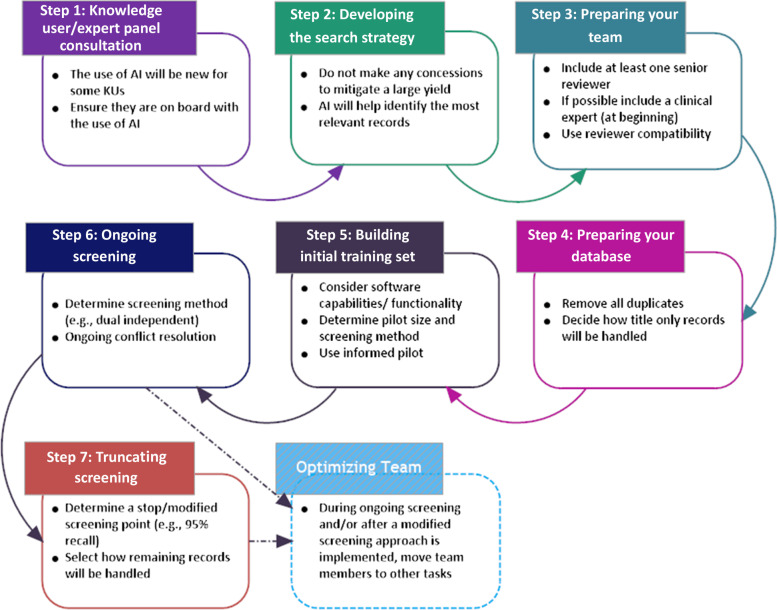
Background: Systematic reviews are the cornerstone of evidence-based medicine. However, systematic reviews are time consuming and there is growing demand to produce evidence more quickly, while maintaining robust methods. In recent years, artificial intelligence and active-machine learning (AML) have been implemented into several SR software applications. As some of the barriers to adoption of new technologies are the challenges in set-up and how best to use these technologies, we have provided different situations and considerations for knowledge synthesis teams to consider when using artificial intelligence and AML for title and abstract screening. Methods: We retrospectively evaluated the implementation and performance of AML across a set of ten historically completed systematic reviews. Based upon the findings from this work and in consideration of the barriers we have encountered and navigated during the past 24 months in using these tools prospectively in our research, we discussed and developed a series of practical recommendations for research teams to consider in seeking to implement AML tools for citation screening into their workflow. Results: We developed a seven-step framework and provide guidance for when and how to integrate artificial intelligence and AML into the title and abstract screening process. Steps include: (1) Consulting with Knowledge user/Expert Panel; (2) Developing the search strategy; (3) Preparing your review team; (4) Preparing your database; (5) Building the initial training set; (6) Ongoing screening; and (7) Truncating screening. During Step 6 and/or 7, you may also choose to optimize your team, by shifting some members to other review stages (e.g., full-text screening, data extraction). Conclusion: Artificial intelligence and, more specifically, AML are well-developed tools for title and abstract screening and can be integrated into the screening process in several ways. Regardless of the method chosen, transparent reporting of these methods is critical for future studies evaluating artificial intelligence and AML.
Overview
The claims and statistics of this paper haven’t been checked yet.
Free: it reads the open-access text and checks the first 5 claims that cite a source we can check. Create a free account to check every claim.
Integrity signals
Registry
Cites
Statistics
Figures
Verification
Claims the paper makes
The claims and statistics of this paper haven’t been checked yet.
Free: it reads the open-access text and checks the first 5 claims that cite a source we can check. Create a free account to check every claim.
Claims other papers make about this one
Each is checked against this paper’s own text: does it say what the citing paper says it does?
The cited source doesn’t support the claim as written.
In the citing paper
“as their development depends on knowledge of the true relevant records (Callaghan & Müller-Hansen, 2020; Hamel et al., 2021).”
From Screening Smarter, Not Harder: A Comparative Analysis of Machine Learning Screening Algorithms and Heuristic Stopping Criteria for Systematic Reviews in Educational Research (2024) · cites this paper as Hamel et al., 2021
Checked by a reasoning model — may be wrong.
Experimental — accuracy not yet measuredThe source backs part of the claim, not all of it — or backs it for a different population, condition or comparison.
In the citing paper
“Overall, the performance of heuristic stopping rules should not be generalized to databases where the number of relevant records is unknown, as their development depends on knowledge of the true relevant records (Callaghan & Müller-Hansen, 2020; Hamel et al., 2021).”
From Screening Smarter, Not Harder: A Comparative Analysis of Machine Learning Screening Algorithms and Heuristic Stopping Criteria for Systematic Reviews in Educational Research (2024) · cites this paper as Hamel et al., 2021
Experimental — accuracy not yet measuredThe cited source says what the claim attributes to it.
In the citing paper
“Nonetheless, forthcoming advances in automation (eg, active machine learning) 49 50 and crowdsourcing 8 51 have the potential to reduce screening time when conducting rapid reviews.”
From Updated recommendations for the Cochrane rapid review methods guidance for rapid reviews of effectiveness (2024) · cites this paper as [49]
Self-check
Percentages, sums and reported differences re-computed from the paper’s own numbers.
The self-check needs the paper’s full text.
Citations
Cites
The PRISMA 2020 statement: An updated guideline for reporting systematic reviews
Page, M. J., McKenzie, J. E., Bossuyt, P. M., Boutron, I., Hoffmann, T. C., Mulrow, C. D., Shamseer, L., Tetzlaff, J. M., Akl, E. A., Brennan, S. E., et al. (2021) · BMJ · doi:10.1136/bmj.n71 · Cited by 108,283
Self-citationRayyan-a web and mobile app for systematic reviews.
Ouzzani, M., Hammady, H., Fedorowicz, Z., & Elmagarmid, A. (2016) · Systematic Reviews · doi:10.1186/s13643-016-0384-4 · Cited by 26,092 · cited 1×
“…been introduced in several SR software applications, such as Abstrackr [18], DistillerSR ® [19], EPPI-Reviewer [20], Pico Portal [21], Rayyan [22], RobotAnalyst [23], and SWIFTActive-Screener [24], with a comprehensive list available at SR Toolbox (http:// syste matic revie wtools. com/…”
MethodThe PRISMA 2020 statement: an updated guideline for reporting systematic reviews
Page, M. J., McKenzie, J. E., Bossuyt, P. M., Boutron, I., Hoffmann, T. C., Mulrow, C. D., Shamseer, L., Tetzlaff, J. M., Akl, E. A., Brennan, S. E., et al. (2021) · Systematic Reviews · doi:10.1186/s13643-021-01626-4 · Cited by 13,874 · cited 1×
“…around the use of automation tools with a list of ‘essential elements for systematic reviews using automation tools in the selection process’ [46]; we feel this to be a sign of growing acceptance of the use of AI in the field of knowledge synthesis that should encourage those interested to…”
MethodSelf-citationA typology of reviews: an analysis of 14 review types and associated methodologies
Grant, M. J., & Booth, A. (2009) · Health Information & Libraries Journal · doi:10.1111/j.1471-1842.2009.00848.x · Cited by 10,817 · cited 1×
“Other examples include overview of reviews, rapid reviews, and scoping reviews [5].”
BackgroundThe PRISMA 2020 statement: an updated guideline for reporting systematic reviews
Page, M. J., McKenzie, J., Bossuyt, P., Boutron, I., Hoffmann, T., mulrow, C., Shamseer, L., Tetzlaff, J., Akl, E., Brennan, S. E., et al. (2020) · doi:10.31222/osf.io/v7gm2 · Cited by 5,177
Self-citationEvidence summaries: the evolution of a rapid review approach
Khangura, S., Konnyu, K., Cushman, R., Grimshaw, J., & Moher, D. (2012) · Systematic Reviews · doi:10.1186/2046-4053-1-10 · Cited by 1,232 · cited 2×
“This requires one reviewer to include a record and two reviewers to exclude a record [9].”
BackgroundMethodO’Mara-Eves, A., Thomas, J., McNaught, J., Miwa, M., & Ananiadou, S. (2015) · Systematic Reviews · doi:10.1186/2046-4053-4-5 · Cited by 681 · cited 1×
“Active machine-learning: An iterative process whereby the accuracy of the predictions made by the algorithm is improved through interaction with reviewers as they screen additional records [1].”
BackgroundMarshall, I. J., & Wallace, B. C. (2019) · Systematic Reviews · doi:10.1186/s13643-019-1074-9 · Cited by 638 · cited 1×
“Artificial intelligence (AI) and more specifically, active machine-learning (AML) have emerged during the past decade as an area of focus to expedite the performance of knowledge syntheses, and may offer potential value both in terms of time saved and costs averted [17].”
BackgroundLiving systematic reviews: 2. Combining human and machine effort
Thomas, J., Noel-Storr, A., Marshall, I., Wallace, B., McDonald, S., Mavergames, C., Glasziou, P., Shemilt, I., Synnot, A., Turner, T., et al. (2017) · Journal of Clinical Epidemiology · doi:10.1016/j.jclinepi.2017.08.011 · Cited by 355 · cited 1×
“…users for shorter timelines and lower cost reviews; (3) increased demand for updating reviews and producing living reviews, which require efficiencies in the review process [38]; and (4) the push for evidence-informed decision-making, especially during emergencies (e.g., COVID-19 COVID-19 ).”
BackgroundSelf-citationO’Mara-Eves, A., Thomas, J., McNaught, J., Miwa, M., & Ananiadou, S. (2015) · Systematic Reviews · doi:10.1186/s13643-015-0031-5 · Cited by 353
Research works printed but not linked: 3
- Cottrell E Whitlock E Kato E Uhl S Belinson S Chang C Defining the Benefits of Stakeholders Engagement in Systematic Reviews 2014 Rockville Agency for Healthcare Research and Quality (US) 24783309
- Thomas J Graziosi S Brunton J Ghouze Z O’Driscoll P Bond M EPPI-Reviewer: advanced software for systematic reviews, maps and evidence synthesis 2020 London UCL Social Research Institute: EPPI-Centre Software
- Rice D Wolfe D Garritty C Hersi M Esmaeilisaraji L Butler C Best Practice in Pain Management: Rapid Reviews of Guidelines and Knowledge Syntheses 2020 Ottawa Ottawa Hospital Research Insitute
Cited by
Garritty, C., Hamel, C., Trivella, M., Gartlehner, G., Nussbaumer-Streit, B., Devane, D., Kamel, C., Griebler, U., & King, V. J. (2024) · BMJ · doi:10.1136/bmj-2023-076335 · Cited by 260
Self-citationDennstädt, F., Zink, J., Putora, P. M., Hastings, J., & Cihoric, N. (2024) · Systematic Reviews · doi:10.1186/s13643-024-02575-4 · Cited by 145
“Several approaches have been developed that use machine learning (ML) to automate or semi-automate screening [1, 6].”
MethodGalli, C., Donos, N., & Calciolari, E. (2024) · Information · doi:10.3390/info15020068 · Cited by 100
Hasan, B., Saadi, S., Rajjoub, N. S., Hegazi, M., Al-Kordi, M., Fleti, F., Farah, M., Riaz, I. B., Banerjee, I., Wang, Z., et al. (2024) · BMJ Evidence-Based Medicine · doi:10.1136/bmjebm-2023-112597 · Cited by 67
Campos, D. G., Fütterer, T., Gfrörer, T., Lavelle-Hill, R., Murayama, K., König, L., Hecht, M., Zitzmann, S., & Scherer, R. (2024) · Educational Psychology Review · doi:10.1007/s10648-024-09862-5 · Cited by 75
“In a mixed-based strategy, researchers decide to stop reviewing after a certain number of abstracts have been reviewed and a certain threshold of consecutive irrelevant records have been found (Hamel et al., 2021; Yu & Menzies, 2019).”
Large scoping reviews: managing volume and potential chaos in a pool of evidence sources
Alexander, L., Cooper, K., Peters, M. D. J., Tricco, A. C., Khalil, H., Evans, C., Munn, Z., Pieper, D., Godfrey, C. M., McInerney, P. A., et al. (2024) · Journal of Clinical Epidemiology · doi:10.1016/j.jclinepi.2024.111343 · Cited by 73
Self-citationSantos, Á. O. D., da Silva, E. S., Couto, L. M., Reis, G. V. L., & Belo, V. S. (2023) · Journal of Biomedical Informatics · doi:10.1016/j.jbi.2023.104389 · Cited by 64
Human-AI collaboration to identify literature for evidence synthesis
Spillias, S., Tuohy, P., Andreotta, M., Annand-Jones, R., Boschetti, F., Cvitanovic, C., Duggan, J., Fulton, E. A., Karcher, D. B., Paris, C., et al. (2024) · Cell Reports Sustainability · doi:10.1016/j.crsus.2024.100132 · Cited by 52
Haby, M. M., Barreto, J. O. M., Kim, J. Y. H., Peiris, S., Mansilla, C., Torres, M., Guerrero‐Magaña, D. E., & Revéiz, L. (2023) · Research Synthesis Methods · doi:10.1002/jrsm.1664 · Cited by 53
“116 Given the rapid developments in machine learning, it may not be too long before it can be used with greater confidence to accelerate the review process.”
BackgroundEngel, J. S., Tran, J., Khalil, N., Hladkowicz, E., Lalu, M. M., Huang, A. R., Wong, C. L., Hutton, B., Dhesi, J. K., & McIsaac, D. I. (2023) · British Journal of Anaesthesia · doi:10.1016/j.bja.2022.12.010 · Cited by 46
Self-citationWolfe, D. M., Hutton, B., Corace, K., Chaiyakunapruk, N., Ngorsuraches, S., Nochaiwong, S., Presseau, J., Grant, A., Dowson, M., Palumbo, A., et al. (2023) · Frontiers in Public Health · doi:10.3389/fpubh.2023.1296239 · Cited by 37
“This approach aligns with recent guidance for the use of artificial intelligence in title/abstract screening (42).”
MethodSelf-citationScotti, K. L., Young, S. M. N., Gainey, M. A., & Lan, H. (2025) · Cochrane Evidence Synthesis and Methods · doi:10.1002/cesm.70046 · Cited by 37
Callaghan, M., Müller-Hansen, F., Bond, M., Hamel, C., Devane, D., Kusa, W., O’Mara-Eves, A., Spijker, R., Stevenson, M., Stansfield, C., et al. (2024) · Systematic Reviews · doi:10.1186/s13643-024-02699-7 · Cited by 27
Self-citationHow to update a living systematic review and keep it alive during a pandemic: a practical guide
Heron, L., Buitrago-Garcia, D., Ipekci, A. M., Baumann, R., Imeri, H., Salanti, G., Counotte, M. J., & Low, N. (2023) · Systematic Reviews · doi:10.1186/s13643-023-02325-y · Cited by 26
Harder, R. (2024) · MethodsX · doi:10.1016/j.mex.2024.102601 · Cited by 24
“Evidence synthesis can be supported by machine learning algorithms, such as topic modelling, to provide substantial enhancement to the productivity of evidence synthesis [ 4 , 5 , 10 , 14 ].”
Kang, R., Xuan, Z., Tong, L., Wang, Y., Jin, S., & Xiao, Q. (2025) · Journal of Medical Internet Research · doi:10.2196/65523 · Cited by 22
“For instance, AI tools have emerged in evidence-based research for semiautomated literature screening and data extraction [3].”
Gans, E. A., van Mun, L., de Groot, J. F., Munster, B. C. V., Rake, E. A., van Weert, J. C. M., Festen, S., & van den Bos, F. (2023) · Patient Education and Counseling · doi:10.1016/j.pec.2023.107981 · Cited by 20
Using machine learning for continuous updating of meta-analysis in educational context
Chernikova, O., Stadler, M. J., Melev, I., & Fischer, F. (2024) · Computers in Human Behavior · doi:10.1016/j.chb.2024.108215 · Cited by 22
Torres, J. P. F., Mulligan, C. E. A., Jorge, J. A., & Moreira, C. (2025) · Information · doi:10.3390/info16050420 · Cited by 22
“To enhance AI’s role in systematic reviews, Hamel et al. [26] developed a framework for integrating AI into the title and abstract screening phases of SLRs, stressing the importance of robust training sets and transparent reporting.”
Sherifali, D., Racey, M., Greenway, M., Alliston, P., Ali, M. U., Gerstein, H. C., Integrated Knowledge Translation (iKT) Type 2 Diabetes Remission Advisory Team*, Sherifali, D., Kastner, M., Ali, M. U., et al. (2025) · Diabetes Care · doi:10.2337/dc25-0562 · Cited by 21
Affengruber, L., Dobrescu, A. I., Persad, E., Klerings, I., Wagner, G., Sommer, I., & Gartlehner, G. (2022) · Systematic Reviews · doi:10.1186/s13643-022-02109-w · Cited by 20
“Generally, the growing use of automation software may prevent the false exclusion of studies [19].”
BackgroundOami, T., Okada, Y., Sakuraya, M., Fukuda, T., Shime, N., & Nakada, T. (2023) · Journal of Epidemiology · doi:10.2188/jea.je20230227 · Cited by 19
Rapid review methods series: Guidance on the use of supportive software
Affengruber, L., Nußbaumer-Streit, B., Hamel, C., van der Maten, M. M., Thomas, J., Mavergames, C., Spijker, R., & Gartlehner, G. (2024) · BMJ Evidence-Based Medicine · doi:10.1136/bmjebm-2023-112530 · Cited by 17
Self-citationMachine learning for accelerating screening in evidence reviews
Chappell, M., Edwards, M., Watkins, D., Marshall, C., & Graziadio, S. (2023) · Cochrane Evidence Synthesis and Methods · doi:10.1002/cesm.12021 · Cited by 20
“A more common approach, used for evaluations in the literature [13, 18, 20, 23, 25 – 27], and recommended in recent guidance and reviews [30, 31], is to use continued reviewer screening, tool training and reranking until all, or the majority, of included studies are likely to have been found (the “…”
Tanner, V., Millet, G. P., & Bourdillon, N. (2024) · Sports Medicine - Open · doi:10.1186/s40798-024-00768-8 · Cited by 19
“This tool’s false exclusion rate [62, 63] is comparable with human performance [64–66] and has thus been suggested as a second screener alternative [67–71].”
ResultHamel, C., Margau, R., Pageau, P., Venturi, M., Esmaeilisaraji, L., Avard, B., Campbell, S. G., Corser, N., Dea, N., Kwok, E. S. H., et al. (2023) · CMAJ Open · doi:10.9778/cmajo.20220098 · Cited by 16
Self-citationMachine Learning Methods for Systematic Reviews:: A Rapid Scoping Review.
Roth, S. C., & Wermer‐Colan, A. (2023) · PubMed Central · doi:10.32481/djph.2023.11.008 · Cited by 41
van Mossel, S., Wolcherink, M. J. O., Cardet, R. E. D. F., de Geus‐Oei, L., Vriens, D., Koffijberg, H., & Saing, S. (2025) · PharmacoEconomics · doi:10.1007/s40273-025-01481-4 · Cited by 15
“Practical guidance details how to prepare for AI-assisted screening including search strategy, database selection and retrieval of records [13], how to build an initial training set and to proceed screening [13], and how to select stopping rules [14, 15].”
Missing the Target: A Scoping Review of the Use of Percent Weight Loss for Obesity Management
Sherifali, D., Racey, M., Fitzpatrick‐Lewis, D., Greenway, M., Sockalingam, S., Wada, J., Teoh, S. H., Patton, I. T., Macklin, D., van Rossum, E. F. C., et al. (2025) · Obesity Reviews · doi:10.1111/obr.13960 · Cited by 13
Verret, M., Lam, N. H., Fergusson, D. A., Nicholls, S. G., Turgeon, A. F., McIsaac, D. I., Gilron, I., Hamtiaux, M., Srichandramohan, S., Al-Mazidi, A., et al. (2023) · BMJ Open · doi:10.1136/bmjopen-2022-070748 · Cited by 12
Self-citationThe Past, Present, and Future of Psychotherapy Manuals: Protocol for a Scoping Review
Wislocki, K. E., Tran, M.-L. M., Petti, E., Hernandez-Ramos, R., Cenkner, D. P., Bridgwater, M. A., Naderi, G., Walker, L., & Zalta, A. K. (2023) · JMIR Research Protocols · doi:10.2196/47708 · Cited by 10
“While rapidly expanding, current machine learning techniques are only recommended for certain phases of the process, including, particularly, the screening phase [19,20].”
InfluentialMethods to assess dermal exposures in occupational settings: a scoping review
Therkorn, J., Mathewson, B. A., Laursen, C. J., Maberti, S., Aizenberg, V., Dinkelacker, B. T., & Rege, S. V. (2024) · Annals of Work Exposures and Health · doi:10.1093/annweh/wxae015 · Cited by 10
Barman, B., Singh, R., PADARIA, R. N., Nain, M. S., Quader, S. W., & Praveen, K. V. (2026) · Discover Agriculture · doi:10.1007/s44279-026-00505-7 · Cited by 9
“A full-text review and an initial screening based on titles and abstracts were the two stages of screening that were carried out in compliance with PRISMA guidelines [23, 24].”
Verret, M., Lam, N. H., Lalu, M. M., Nicholls, S. G., Turgeon, A. F., McIsaac, D. I., Hamtiaux, M., Le, J. B. P., Gilron, I., Yang, L., et al. (2024) · British Journal of Anaesthesia · doi:10.1016/j.bja.2024.01.006 · Cited by 10
Self-citationAguirre, A. M. G., & Figueroa-Vallejo, C. J. (2022) · Revista de Investigación Desarrollo e Innovación · doi:10.19053/20278306.v12.n2.2022.15271 · Cited by 9
Ramchandani, R., Guo, E., Rakab, E., Rathod, J., Strain, J., Klement, W., Shorr, R., Williams, E., Jones, D., & Gilbert, S. (2025) · PeerJ Computer Science · doi:10.7717/peerj-cs.2822 · Cited by 8
Hillis, C., Bhattacharjee, M., AlMousawi, B., Eltanahy, T., Ono, S., Hui, M., Pham, B., Swab, M., Cormack, G. V., Grossman, M. R., et al. (2025) · PLoS ONE · doi:10.1371/journal.pone.0329020 · Cited by 9
“Database search strategies emphasize sensitivity rather than precision [38], given that a supervised machine learning tool [39] will be used to assist in the identification of relevant abstracts.”
Self-citationWolfe, D. M., Hamel, C., Berard, J. A., Veroniki, A. A., Skidmore, B., Kanji, S., Rabheru, K., McGee, S. F., Forbes, L. M., Machado, I., et al. (2025) · Cancers · doi:10.3390/cancers17213430 · Cited by 7
Self-citationMarketing strategies to improve service quality at sports and fitness venues: a systematic review
Sadewa, Y. R., Sumaryanto, S., & Sumarjo, S. (2024) · Retos · doi:10.47197/retos.v62.109886 · Cited by 8
“The screening process is carried out in several stages, identifying all articles that are relevant to the topic and then collecting them from a pre-determined database (Hamel et al., 2021; Hiebl, 2023; van Dinter et al., 2021).”
A scoping review identifies comments suggesting modifications to PRISMA-P 2015
Nejstgaard, C. H., Sondrup, N., Chan, A., Dwan, K. M., Moher, D., Page, M. J., Shamseer, L., Stewart, L. A., & Hróbjartsson, A. (2025) · Journal of Clinical Epidemiology · doi:10.1016/j.jclinepi.2025.111760 · Cited by 11
Lim, S. H., Hersi, M., Krishnan, R., Montroy, J. R., Rook, B., Farrah, K., Chung, Y.-E., Stevens, A., Zafack, J. G., Wong, E., et al. (2024) · Vaccine X · doi:10.1016/j.jvacx.2024.100575 · Cited by 6
Self-citationSpiero, I., Leeuwenberg, A., Moons, K. G. M., Hooft, L., & Damen, J. A. (2025) · Research Synthesis Methods · doi:10.1017/rsm.2025.10025 · Cited by 6
Kinter, S. L., Meehan, A., Ormanidou, I., Heike, C. L., Nylander, E. M., Rahman, M., Sadakkadulla, S., Madhoun, L. L., Crerand, C. E., & McKinney, C. M. (2025) · The Cleft Palate-Craniofacial Journal · doi:10.1177/10556656251365012 · Cited by 7
Hu, B., Tomini, E., Corrin, T., Pussegoda, K., Sandner, E., Henriques, A., Simniceanu, A., Fontana, L., Wagner, A., Brazeau, S., et al. (2025) · Cochrane Evidence Synthesis and Methods · doi:10.1002/cesm.70042 · Cited by 8
Using artificial intelligence to enhance evidence informed-decision-making
Munatsi, R. (2025) · South African journal of information management · doi:10.4102/sajim.v27i1.2004 · Cited by 6
Large language model enhanced framework for systematic reviews and meta-analyses
Shen, J., Luo, Z., Jia, D., Wang, S., Sun, F., & Wu, J. (2025) · BMJ Digital Health & AI · doi:10.1136/bmjdhai-2025-000017 · Cited by 8
Integration of Artificial Intelligence (AI) Into Academic Literature Reviews: An overview
Arhin, E. O., Ainoo, F. C., & Amponsah, B. K. (2025) · World Journal of Advanced Science and Technology · doi:10.53346/wjast.2025.7.1.0010 · Cited by 7
Nordmann, K., Schaller, M., Sauter, S., & Fischer, F. (2026) · JAMIA Open · doi:10.1093/jamiaopen/ooaf098 · Cited by 4
Wolfe, D. M., Hutton, B., Corace, K. M., Chaiyakunapruk, N., Ngorsuraches, S., Nochaiwong, S., Presseau, J., Grant, A., Suschinsky, K. D., Skidmore, B., et al. (2022) · BMJ Open · doi:10.1136/bmjopen-2022-064578 · Cited by 4
Self-citationMethods for conducting a living evidence profile on mpox: An evidence map of the literature
Pussegoda, K., Corrin, T., Baumeister, A., Ayache, D., & Waddell, L. A. (2024) · Cochrane Evidence Synthesis and Methods · doi:10.1002/cesm.12044 · Cited by 5
Spiero, I., Leeuwenberg, A. M., Moons, K. G. M., Hooft, L., & Damen, J. A. A. (2025) · Journal of Clinical Epidemiology · doi:10.1016/j.jclinepi.2025.111987 · Cited by 3
Holt, J., Bhar, S. S., Schofield, P. E., Koder, D., Owen, P. J., Seitz, D. P., & Bhowmik, J. (2024) · Systematic Reviews · doi:10.1186/s13643-024-02516-1 · Cited by 3
Analisis Keberhasilan Startup Pendidikan: Faktor-faktor yang Mempengaruhi Kesuksesan
Dhea, D. D. F., Humairah, I., Suhaila, S., Reihannah, R., & Revi, R. S. (2025) · Jurnal Riset Ekonomi dan Bisnis · doi:10.26623/jreb.v8i2.12370 · Cited by 3
Psychotherapy treatment manuals for adult populations (1950–2025): A scoping review
Wislocki, K. E., Bridgwater, M. A., Petti, E., Cenkner, D. P., Hernandez-Ramos, R., Tran, M.-L. M., Naderi, G., Murphy, H., Walker, L., & Zalta, A. K. (2026) · Clinical Psychology Review · doi:10.1016/j.cpr.2026.102721 · Cited by 3
Liu, Y., Yang, R., Liew, J. C. K., Yin, Z., Foote, H. P., Lindsell, C. J., & Hong, C. (2026) · Journal of Healthcare Informatics Research · doi:10.1007/s41666-026-00246-8 · Cited by 5
“Among these, the title and abstract screening stage alone can demand substantial resources to review thousands of publications [6].”
Shah, H., Wolfe, D. M., Clemons, M. J., Liu, M., Thavorn, K., Veroniki, A. A., Lunny, C., Pond, G. R., McGee, S. F., Skidmore, B., et al. (2023) · Systematic Reviews · doi:10.1186/s13643-023-02283-5 · Cited by 3
Self-citationDeveloping a CHECK approach to artificial intelligence usage in nurse education
Bosun-Arije, F. S., Mullaney, W., & Ekpenyong, M. S. (2024) · Nurse Education in Practice · doi:10.1016/j.nepr.2024.104055 · Cited by 3
Connecting patients with clinical trials using patient navigation: a scoping review protocol
Hilal, O., Gupta, P., Luginaah, A., Moshref, L. H., Askin, N., Epp, C., Nassar, R., Hirmiz, R., Paunic, M., Hossami, M., et al. (2025) · BMJ Open · doi:10.1136/bmjopen-2024-088828 · Cited by 2
“27”
InfluentialJay, M., Morgan, M., Straus, S. E., Wilson, E., Sutradhar, R., Yu, C., Conn, L. G., Dharma, C., Lipscombe, L. L., & Eskander, A. (2026) · JMIR Research Protocols · doi:10.2196/90588 · Cited by 3
“Others caution that errors, inconsistent outputs, and poor disclosure may compromise trust and reproducibility [5,10].”
Self-citationWolfe, D. M., Hamel, C., Rice, D. B., Veroniki, A. A., Skidmore, B., Kanji, S., Rabheru, K., McGee, S. F., Forbes, L., Liu, X., et al. (2024) · Systematic Reviews · doi:10.1186/s13643-024-02602-4 · Cited by 2
“In the context of high citation search yields, Level 1 screening will be aided by the artificial intelligence/ machine learning (AI/ML) tool in DistillerSR ® [48].”
MethodSelf-citationSwab, M. (2026) · Journal of the Medical Library Association JMLA · doi:10.5195/jmla.2026.2286 · Cited by 2
“One guidance article recommends performing the highest quality search strategy, “regardless of yield” [19].”
Neset, M., Scott, R. T., Narayanan, S. A., & Komarova, S. V. (2024) · Citizen Science Theory and Practice · doi:10.5334/cstp.687 · Cited by 2
Doolan, M., Cox, K. M., & Sarma, K. M. (2025) · Campbell Systematic Reviews · doi:10.1002/cl2.70076 · Cited by 1
Gaudet, L., Pillay, J., Zakaria, D., Saba, S., Vandermeer, B., Tan, M. C., & Hartling, L. (2025) · Epidemiologic Reviews · doi:10.1093/epirev/mxaf018 · Cited by 1
“19,20 Thus, 2 human reviewers independently screened the first 50% of records, after which DistillerAI acted as the second reviewer for the remaining records, using a likelihood threshold of 0.7 (the lowest score assigned to a study included by a human reviewer).”
InfluentialNordmann, K., & Fischer, F. (2025) · BMC Health Services Research · doi:10.1186/s12913-025-13901-4 · Cited by 3
Casu, M., Marletta, L., Ragaglia, C. V., Caponnetto, P., & Battiato, S. (2026) · Computers in Human Behavior Reports · doi:10.1016/j.chbr.2026.100963 · Cited by 1
Screenathon 2.0: human–AI collaborative screening applied to patient-generated health data
Bergmann, J. G., Azzi, T. D. S., Neeleman, R. C., Monschau, K., Yazan, B., Jalsovec, E., Westerbeek, E., Weijdema, F., Bruin, J. D., Fang, Q., et al. (2026) · Scientific Reports · doi:10.1038/s41598-026-45385-5 · Cited by 1
Reprioritising consultation in scoping reviews: Clarifying purposes and practices
Zaccagnini, M., Maggio, L. A., St‐Onge, C., & Dubé, T. V. (2026) · Medical Education · doi:10.1111/medu.70211 · Cited by 1
Mongeon, J. G., Ouadfel, S., Thullier, F., Gaboury, S., & Arsenault‐Lapierre, G. (2026) · International Journal of Social Research Methodology · doi:10.1080/13645579.2026.2668099 · Cited by 1
de Oliveira, J. M. D., Mello, A. T., Scandolara, D. H., Celuppi, I. C., Rampinelli, V. P. C., Wazlawick, R. S., & Dalmarco, E. M. (2026) · International Journal of Medical Informatics · doi:10.1016/j.ijmedinf.2026.106516 · Cited by 1
Lee, K. H., Kim, H., Yang, D. S., Yoon, W. S., & Rim, C. H. (2026) · Journal of Epidemiology · doi:10.2188/jea.je20260233 · Cited by 1
Life project: a scoping review of assessment tools for persons with autism spectrum disorder.
Ferrazzi, G., Marchi, M., Giuberti, V., Politi, V., Pingani, L., Ferrari, S., & Galeazzi, G. M. (2025) · Annali dell Istituto Superiore di Sanità · doi:10.4415/ann_25_01_05 · Cited by 3
Greenway, M., Domjancic, M., Liu, Y., Benzaquen, A., Racey, M., Jack, S. M., Sherifali, D., & Whitmore, C. (2025) · Obesity Reviews · doi:10.1111/obr.13980 · Cited by 1
Parlak, L., Levendoğlu, F., Batur, E. B., Tezcan, E. A., & Gezer, İ. A. (2025) · Genel Tıp Dergisi · doi:10.54005/geneltip.1725576 · Cited by 1
Siemens, W., Breuer, C., & Meerpohl, J. J. (2022) · Zeitschrift für Evidenz Fortbildung und Qualität im Gesundheitswesen · doi:10.1016/j.zefq.2022.11.008 · Cited by 1
The potential roles and risks of Artificial Intelligence in public health: A scoping reviewPreprint
Harrison, S., Meléndez‐Torres, G. J., Tatton, C., Kirby, J., Robinson, S., Mutanda, D., Davies, A., Armitage, J. M., Aslam, R. W., Arthur, T., et al. (2026) · Research Square · doi:10.21203/rs.3.rs-10117781/v1 · Cited by 1
Muller, A. E., Ames, H. M. R., Borge, T. C., Hestevik, C. H., Meneses-Echavez, J. F., & Rose, C. J. (2022) · Research Square · doi:10.21203/rs.3.rs-1644531/v1
Gao, Q., & Bai, J. (2023) · Lecture notes on data engineering and communications technologies · doi:10.1007/978-981-19-9373-2_60
How to update a living systematic review and keep it alive during a pandemic: a practical guide
(2023) · doi:10.21203/rs.3.rs-2364994/v1
Holt, J., Bhar, S. S., Schofield, P. E., Koder, D., Owen, P. J., Seitz, D. P., & Bhowmik, J. (2023) · Research Square · doi:10.21203/rs.3.rs-3325634/v1
Preventive interventions for post Covid-19 condition: systematic review updatePreprint
Pillay, J., Rahman, S., Gehring, N., Guitard, S., Ashiq, A. R., & Hartling, L. (2024) · medRxiv · doi:10.1101/2024.09.18.24313918
AI-Assisted 3D reconstruction of Organs from MRI and CT Data
Dalsaniya, A., Godhaniya, M., & Kothari, D. R. (2025) · Global Journal of Engineering and Technology Advances · doi:10.30574/gjeta.2025.22.3.0039
“First, there was an interaction with the image where the clinicians outlined all the structures of interest slice by slice, which was very tiresome and prone to inaccuracies [9].”
Dennstädt, F., Zink, J., Putora, P. M., Hastings, J., & Cihoric, N. (2024) · Figshare · doi:10.6084/m9.figshare.26045554
Heron, L., Buitrago-Garcia, D., Ipekci, A. M., Baumann, R., Imeri, H., Salanti, G., Counotte, M. J., & Low, N. (2023) · Figshare · doi:10.6084/m9.figshare.24078363
Affengruber, L., Dobrescu, A., Persad, E., Klerings, I., Wagner, G., Sommer, I., & Gartlehner, G. (2022) · Figshare · doi:10.6084/m9.figshare.21532782
Affengruber, L., Dobrescu, A., Persad, E., Klerings, I., Wagner, G., Sommer, I., & Gartlehner, G. (2022) · Figshare · doi:10.6084/m9.figshare.21532770
Affengruber, L., Dobrescu, A., Persad, E., Klerings, I., Wagner, G., Sommer, I., & Gartlehner, G. (2022) · Figshare · doi:10.6084/m9.figshare.21532773
Affengruber, L., Dobrescu, A., Persad, E., Klerings, I., Wagner, G., Sommer, I., & Gartlehner, G. (2022) · Figshare · doi:10.6084/m9.figshare.21532779
Holt, J., Bhar, S. S., Schofield, P. E., Koder, D., Owen, P. J., Seitz, D. P., & Bhowmik, J. (2024) · Figshare · doi:10.6084/m9.figshare.26707697
Heron, L., Buitrago-Garcia, D., Ipekci, A. M., Baumann, R., Imeri, H., Salanti, G., Counotte, M. J., & Low, N. (2023) · Figshare · doi:10.6084/m9.figshare.24078366
Affengruber, L., Dobrescu, A., Persad, E., Klerings, I., Wagner, G., Sommer, I., & Gartlehner, G. (2022) · Figshare · doi:10.6084/m9.figshare.21532776
Dennstädt, F., Zink, J., Putora, P. M., Hastings, J., & Cihoric, N. (2024) · Figshare · doi:10.6084/m9.figshare.26734479
Dennstädt, F., Zink, J., Putora, P. M., Hastings, J., & Cihoric, N. (2024) · Figshare · doi:10.6084/m9.figshare.26045481
Holt, J., Bhar, S. S., Schofield, P. E., Koder, D., Owen, P. J., Seitz, D. P., & Bhowmik, J. (2024) · Figshare · doi:10.6084/m9.figshare.26707691
Heron, L., Buitrago-Garcia, D., Ipekci, A. M., Baumann, R., Imeri, H., Salanti, G., Counotte, M. J., & Low, N. (2023) · Figshare · doi:10.6084/m9.figshare.24078360
Dennstädt, F., Zink, J., Putora, P. M., Hastings, J., & Cihoric, N. (2024) · Figshare · doi:10.6084/m9.figshare.26734476
Holt, J., Bhar, S. S., Schofield, P. E., Koder, D., Owen, P. J., Seitz, D. P., & Bhowmik, J. (2024) · Figshare · doi:10.6084/m9.figshare.26707694
Ancarani, E. (2023) · AMS Laurea Institutional Research Repository (University of Bologna)
Inclusive Digital Learning: Standards, Strategies, and Trends in Accessibility
Mancilla, R., & Frey, B. A. (2026) · IGI Global eBooks · doi:10.4018/979-8-3373-8795-6.ch001
Metadata
- Authors
- Hamel, C., Hersi, M., Kelly, S. E., Tricco, A. C., Straus, S., Wells, G., Pham, B., & Hutton, B.
- Affiliations
- Ottawa Hospital Research Institute (CA)
- University of Ottawa (CA)
- St. Michael's Hospital (CA)
- Corresponding author
- Hamel, Candyce
- ORCID
- Venue
- BMC Medical Research Methodology
- Published
- 2021-12
- Volume
- 21
- Issue
- 1
- Pages
- 285-285
- ISSN
- 1471-2288 (ISSN-L)
- PMC
- PMC8686081
- OpenAlex
- W4200362342
- Semantic Scholar
- 23a6f783190957fee7ec26f72a84738f64bac71a
- Cited by
- 104
- References
- 40
- Citations by year
- 2026: 21 · 2025: 24 · 2024: 29 · 2023: 20 · 2022: 10
- FWCI
- 8.55
- Type
- journal article
- Language
- en
- Open access
- gold
- doi.org
- Licence
- cc-by
- creativecommons.org/licenses/by/4.0 (tdm)
- creativecommons.org/licenses/by/4.0 (vor, 19 d)
- Locations
- BMC Medical Research Methodology (publishedVersion, cc-by)
- PubMed Central (publishedVersion, cc-by)
- PubMed (publishedVersion)
- uO Research (University of Ottawa) (submittedVersion, public-domain)
- TSpace (University of Toronto) (submittedVersion, other-oa)
- DOAJ (DOAJ: Directory of Open Access Journals) (submittedVersion, cc-by-sa)
- Funders
- Canadian Institutes of Health Research (Tier 2)
- Topics
- Social Sciences › Decision Sciences › Statistics, Probability and Uncertainty › Meta-analysis and systematic reviews
- Physical Sciences › Computer Science › Information Systems › Information Retrieval and Search Behavior
- Health Sciences › Medicine › Health Informatics › Artificial Intelligence in Healthcare and Education
- Keywords
- artificial intelligence, active learning (machine learning), title and abstract screening, systematic reviews, knowledge synthesis, citation screening, screening workflow, search strategies, reporting transparency
- MeSH terms
- Artificial Intelligence, Humans, Mass Screening, Research Design, Retrospective Studies, Evidence-Based Medicine
About these checks
Registry, retraction, Cites and statistics results are computed, not judged, with one exception: a printed reference that no index lists is read once by a model before it counts as a citation error. Claims are extracted by a model and kept only when their quote appears verbatim in the text; each cited source is then checked, with a model’s help, for whether it says what the claim relies on. Those verdicts can be wrong — read the claim’s quote and the cited source before relying on one.
Statistics and arithmetic are recomputed, not judged.
Confidence bands are shown only for fields calibrated on our annotated test set. None is calibrated yet, so no band is shown.
What counts as a claim ›How we measure confidence ›How we check this ›
Are you an author, or do you see a problem with this page? Request a review
Data sources
Bibliographic data: Semantic Scholar, OpenAlex, Crossref.
Contains information from the Semantic Scholar Academic Graph Datasets, made available under the ODC Attribution License (ODC-BY 1.0).
Semantic Scholar’s data is described in: Kinney, R., et al. (2023). The Semantic Scholar Open Data Platform. arXiv:2301.10140.
