

Effects of the tailored activity program (TAP) on dementia-related symptoms, health events and caregiver wellbeing: a randomized controlled trial
Open accessThe DOI matches its Crossref record; 45 of the 45 references it cites were found in a registry or an index.
Abstract
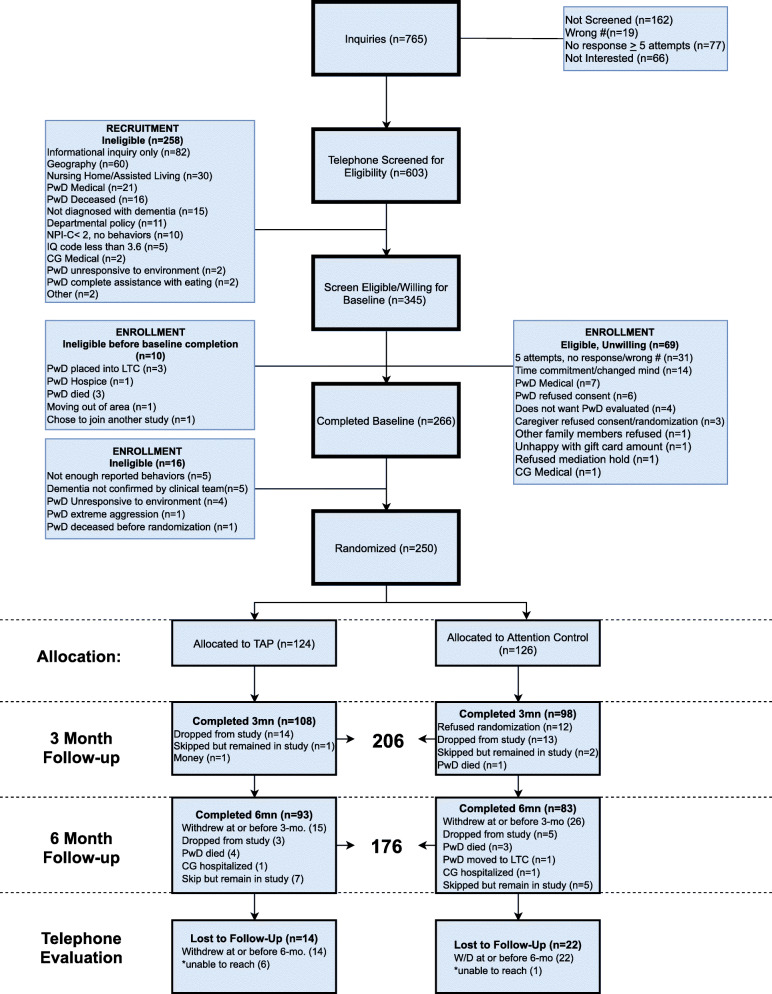
Background: People living with dementia (PLWD) and caregivers are adversely impacted by lack of meaningful activity leading to worse symptoms and impaired quality-of-life. There is a critical need to develop effective and well-tolerated treatments that mitigate clinical symptoms, engage PLWD and support caregiver wellbeing. We tested whether, compared to attention control, the Tailored Activity Program (TAP) reduced clinical symptoms and health-related events, and improved caregiver wellbeing, and if TAP activities were well-tolerated. Methods: We conducted a single-blind randomized controlled trial among 250 dyads recruited from Baltimore-Washington DC (2012–2016) with a dementia diagnosis and clinically significant agitation/aggression. Dyads were randomized to TAP ( n = 124) or attention control ( n = 126), and interviewed at baseline, 3 (endpoint) and 6-months (follow-up) by interviewers masked to group allocation. TAP assessed PLWD abilities/interests, instructed caregivers in using prescribed activities, and provided dementia education and stress reduction techniques. Attention controls received disease education and home safety tips. Both groups had up to 8 home visits over 3-months. The primary outcome was frequency by severity scores for agitation/aggression subscales of Neuropsychiatric Inventory-Clinician using caregiver ratings. Secondary outcomes included number of instrumental (IADL) and activities of daily living (ADL) needing assistance, caregiver wellbeing, and confidence using activities. Health-related events (PLWD death, hospitalizations, caregiver hospitalization, depression) and perceived study benefits were captured over 6 months. PLWD tolerability of prescribed activities was examined. Results: Of 250 dyads, most caregivers were female (81.2 %, n = 203), non-spouses (54.4 %, n = 136), white (59.2 %, n = 145) or African American (36.7 %, n = 90) with mean age = 65.4 (SD = 12.6). PLWD were mostly female (63.2 %, n = 158) with mean age = 81.4 (SD = 7.9), and mean MMSE = 14.3 (SD = 7.8). At 3-months, compared to controls, TAP conferred no benefit to agitation/aggression ( p = 0.43, d = 0.11), but resulted in less IADL ( p = 0.02, d =-0.33), and ADL ( p = 0.04, d =-0.30) assistance, improved caregiver wellbeing ( p = 0.01, d = 0.39), and confidence using activities ( p = 0.02, d = 0.32). By 6-months, 15 PLWD in TAP had ≥ 1 health-related event versus 28 PLWD in control, demonstrating 48.8 % improvement in TAP ( p = 0.03). TAP caregivers were more likely to perceive study benefits. Prescribed activities were well-tolerated. Conclusions: Although TAP did not benefit agitation/aggression, it impacted important outcomes that matter to families warranting its use in dementia care. Clinical trial registration: Clinicaltrials.gov # NCT01892579 at https://clinicaltrials.gov/ ; Date of clinical trial registration: 04/07/2013; Date first dyad enrolled: 15/11/2013.
Overview
The claims and statistics of this paper haven’t been checked yet.
Free: it reads the open-access text and checks the first 5 claims that cite a source we can check. Create a free account to check every claim.
Integrity signals
Registry
Cites
Statistics
Figures
Verification
Claims the paper makes
The claims and statistics of this paper haven’t been checked yet.
Free: it reads the open-access text and checks the first 5 claims that cite a source we can check. Create a free account to check every claim.
Self-check
Percentages, sums and reported differences re-computed from the paper’s own numbers.
The self-check needs the paper’s full text.
Citations
Cites
Statistical Power Analysis for the Behavioral Sciences
Muller, K. (1989) · Technometrics · doi:10.1080/00401706.1989.10488618 · Cited by 99,167
Statistical power analysis for the behavioral sciences
(1990) · Computers, Environment and Urban Systems · doi:10.1016/0198-9715(90)90050-4 · Cited by 65,269
The PHQ-9: Validity of a brief depression severity measure
Kroenke, K., Spitzer, R. L., & Williams, J. B. W. (2001) · Journal of General Internal Medicine · doi:10.1046/j.1525-1497.2001.016009606.x · Cited by 44,910
Dementia prevention, intervention, and care
Livingston, G., Sommerlad, A., Orgeta, V., Costafreda, S. G., Huntley, J., Ames, D., Ballard, C., Banerjee, S., Burns, A., Cohen-Mansfield, J., et al. (2017) · The Lancet · doi:10.1016/s0140-6736(17)31363-6 · Cited by 6,072 · cited 2×
“Caregivers experience daily care challenges resulting in increased risk for depression, and poor quality of life [4].”
BackgroundSelf-citationThe PHQ-9: A New Depression Diagnostic and Severity Measure
Kroenke, K., & Spitzer, R. L. (2002) · Psychiatric Annals · doi:10.3928/0048-5713-20020901-06 · Cited by 5,898 · cited 1×
“We did not find however, statistically significant differences in the number of caregivers with major or severe depression [45].”
BackgroundMaust, D. T., Kim, H. M., Seyfried, L. S., Chiang, C., Kavanagh, J., Schneider, L. S., & Kales, H. C. (2015) · JAMA Psychiatry · doi:10.1001/jamapsychiatry.2014.3018 · Cited by 617 · cited 1×
“Pharmacological options for NPS have modest benefits, while some are associated with significant risks including mortality, and do not typically address the many care challenges families identify as most problematic to them [6, 7].”
BackgroundLivingston, G., Johnston, K., Katona, C., Paton, J., Lyketsos, C. G., & Old Age Task Force of the World Federation of Biological Psychiatry (2005) · American Journal of Psychiatry · doi:10.1176/appi.ajp.162.11.1996 · Cited by 591 · cited 1×
“An emerging evidence base suggests that activity engagement can help PLWD by reducing one of the most serious forms of NPS, agitation/aggression [11, 12, 14, 15].”
BackgroundSelf-citationNonpharmacologic Management of Behavioral Symptoms in Dementia
Gitlin, L. N., Kales, H. C., & Lyketsos, C. G. (2012) · JAMA · doi:10.1001/jama.2012.36918 · Cited by 495 · cited 1×
“The objective of this phase III randomized clinical trial was to test the effectiveness of TAP to reduce agitated and aggressive behaviors, two of the most prevalent and upsetting behavioral symptoms of dementia [23] for caregivers and PLWD.”
MethodSelf-citationGitlin, L. N., Winter, L., Dennis, M. P., Hodgson, N., & Hauck, W. W. (2010) · JAMA · doi:10.1001/jama.2010.1253 · Cited by 367 · cited 1×
“The survey consisted of 9 questions adapted from prior trials [32]: Was study clearly explained? Were you and your relative treated with respect? How much did you benefit from participation? How much did participation help you better understand dementia? How much did participation help you feel more confident dealing…”
MethodSelf-citationGitlin, L. N., Winter, L., Burke, J., Chernett, N., Dennis, M. P., & Hauck, W. W. (2008) · The American Journal of Geriatric Psychiatry · doi:10.1097/01.jgp.0000300629.35408.94 · Cited by 362
Self-citation
Research works printed but not linked: 3
- Risk reduction of cognitive decline and dementia: WHO guidelines Geneva, Switzerland: World Health Organization; 2019. https://apps.who.int/iris/bitstream/handle/10665/312180/9789241550543-eng.pdf?ua=1. Accessed 11 June 2020. 31219687
- Parker LJ, Marx K, Gitlin LN. Factors associated with informed consent among people living with dementia: The dementia behavior study. J Am Geriatr Soc. under review.
- Gitlin LN, Hodgson N, Choi S. et al. Interventions to address functional decline in persons with dementia: Closing the gap between what a person “does do” and what they “can do:” In: Park R, ed. Neuropsychology of Alzheimer’s Disease and Other Dementias. 2nd Editio. Oxford University Press.
Cited by
Dementia prevention, intervention, and care: 2024 report of the Lancet standing Commission
Livingston, G., Huntley, J., Liu, K. Y., Costafreda, S. G., Selbæk, G., Alladi, S., Ames, D., Banerjee, S., Burns, A., Brayne, C., et al. (2024) · The Lancet · doi:10.1016/s0140-6736(24)01296-0 · Cited by 3,860
Self-citationCognitive rehabilitation for people with mild to moderate dementia
Kudlicka, A., Martyr, A., Bahar‐Fuchs, A., Sabatés, J., Woods, B. T., & Clare, L. (2023) · Cochrane Database of Systematic Reviews · doi:10.1002/14651858.cd013388.pub2 · Cited by 111
Balvert, S. C. E., Sordo, G. C. D., & Milders, M. V. (2024) · Ageing Research Reviews · doi:10.1016/j.arr.2024.102258 · Cited by 45
Kennedy, M. A., Stevens, C. J., Pepin, R. L., & Lyons, K. D. (2023) · The Gerontologist · doi:10.1093/geront/gnad046 · Cited by 26
Neuropsychiatric Symptom Burden across Neurodegenerative Disorders and its Association with Function
Kapustin, D., Zarei, S., Wang, W., Binns, M. A., McLaughlin, P. M., Abrahão, A., Black, S. E., BORRIE, M. J., Breen, D. P., Casaubon, L., et al. (2023) · The Canadian Journal of Psychiatry · doi:10.1177/07067437221147443 · Cited by 24
Functional Cognition: Moving the Field Forward
Giles, G. M., Goverover, Y., Foster, E. R., Connor, L. T., Edwards, D. F., Baum, C. M., & Toglia, J. P. (2024) · OTJR Occupational Therapy Journal of Research · doi:10.1177/15394492241296811 · Cited by 22
“The examples provided above emphasize the importance of considering individual abilities, goals, and engagement in various activities when assessing and addressing FC (Gitlin et al., 2021).”
Digital Intervention for the Management of Alzheimer’s Disease
Manchanda, N., Aggarwal, A., Setya, S., & Talegaonkar, S. (2022) · Current Alzheimer Research · doi:10.2174/1567205020666230206124155 · Cited by 21
Manges, K. A., Ashcraft, L. E., Rose, L., Hall, D. E., Brown, R. T., Bowen, M. E., Mavandadi, S., Brecher, A. C., Keddem, S., Kiosian, B., et al. (2023) · Implementation Science Communications · doi:10.1186/s43058-023-00431-5 · Cited by 17
Yous, M., Ploeg, J., Kaasalainen, S., McAiney, C. A., & Fisher, K. (2022) · BMC Geriatrics · doi:10.1186/s12877-022-03483-9 · Cited by 15
“Results from randomized controlled trials have shown that tailored activities for persons with dementia led to greater engagement, less agitation, and improved mood for persons with dementia as well as enhanced caregiver wellbeing and confidence in using activities [94, 95].”
BackgroundJutkowitz, E., Pizzi, L. T., Popp, J. H., Prioli, K. M., Scerpella, D. L., Marx, K., Samus, Q. M., Piersol, C. V., & Gitlin, L. N. (2021) · International Psychogeriatrics · doi:10.1017/s1041610221000089 · Cited by 14
Self-citationEikelboom, W. S., van den Berg, E., Coesmans, M., Goudzwaard, J. A., Koopmanschap, M. A., Lazaar, N., van Bruchem-Visser, R. L., Driesen, J. J. M., den Heijer, T., Hoogers, S. E., et al. (2023) · Journal of Alzheimer s Disease · doi:10.3233/jad-230116 · Cited by 14
“…individuals with early-stage AD, most promising approaches include the Tailored Activity Program to increase tailored meaningful activities [24, 25] and psychoe-ducation programs that enhance knowledge about AD and underlying causes of NPS in AD and provide caregivers with new skills to manage…”
Gitlin, L. N., Marx, K., Piersol, C. V., Hodgson, N. A., Parker, L. J., Cidav, T., & Roth, D. L. (2022) · Journal of the American Geriatrics Society · doi:10.1111/jgs.17981 · Cited by 13
“Treatment arms were described previously.(25,26) TAP dyads received up to 8, 11⁄2 h home visits over 3 months by occupational therapists who assessed abilities (mobility, fall risk, executive and cognitive functioning) and past/current interests (previous roles, occupations, hobbies) of PLWD, caregiver availability to…”
BackgroundMethodSelf-citationPetrovsky, D., Yıldız, M., Yefimova, M., Sefcik, J. S., Baker, Z. G., Ma, K. P. K., Rahemi, Z., Bacsu, J.-D., Smith, M. L., & Pickering, C. E. Z. (2024) · Innovation in Aging · doi:10.1093/geroni/igae034 · Cited by 8
“As a result of TAP, caregivers experienced improved well-being and reported enhanced skills and less upset with BPSD (Gitlin et al., 2009, 2018, 2021).”
BackgroundBannon, S. M., McCage, S., Walker, K., Brewer, J. R., Ahmad, N., Cornelius, T. M., Parker, R. A., Dams-O’Connor, K., Dickerson, B. C., Ritchie, C. S., et al. (2025) · Journal of Alzheimer s Disease · doi:10.1177/13872877251332658 · Cited by 8
“51,52 These interventions have been successfully implemented in close collaboration with healthcare and community organizations, and focus on fl ex-ible delivery of intervention content and skills.”
Dementia care partners’ reported outcomes after adaptive riding: a theoretical thematic analysis
Lassell, R., Fields, B., Cross, J. E., & Wood, W. H. (2022) · Quality in Ageing and Older Adults · doi:10.1108/qaoa-01-2022-0007 · Cited by 8
Bennett, S. H., Travers, C., Liddle, J., O’Connor, C. M. C., Low, L., Laver, K., Clemson, L. M., OʼReilly, M., Beattie, E., Smith, S. J., et al. (2022) · Australian Occupational Therapy Journal · doi:10.1111/1440-1630.12850 · Cited by 8
“Fewer hospitalisations and improvements in quality of life for both the person with dementia and their carer have also been reported (Gitlin et al., 2008, 2018, 2021; Novelli et al., 2016; O ’ Connor et al., 2019) and, importantly, TAP has been shown to be cost-BENNETT effective (Gitlin et al.,…”
BackgroundSelf-citationKales, H. C., Maust, D. T., & Gitlin, L. N. (2023) · JAMA Psychiatry · doi:10.1001/jamapsychiatry.2022.4435 · Cited by 8
Self-citationLassell, R., Tamayo, V., Pena, T., Kishi, M., Zwerling, J. L., Gitlin, L. N., & Brody, A. A. (2024) · Frontiers in Aging Neuroscience · doi:10.3389/fnagi.2024.1401255 · Cited by 6
Self-citationRochon, E. A., Thacker, A., Phillips, M., Ritchie, C. S., Vranceanu, A., & Plys, E. (2025) · JMIR Aging · doi:10.2196/66212 · Cited by 6
“For example, the tailored activity program intervention helps dyads identify and engage in personalized shared activities to reduce agitation among persons living with dementia and improve well-being among caregivers [18,19].”
Nonpharmacological interventions in dementia and diversity of samples: A scoping review
Roche, L., & Longacre, M. L. (2023) · Geriatric Nursing · doi:10.1016/j.gerinurse.2023.12.001 · Cited by 6
Hagen, C. M., Archbold, P. G., Miller, L. L., VALANIS, B. G., Hornbrook, M. C., O'Keeffe-Rosetti, M. C., Hiatt, S. O., & Stewart, B. J. (2023) · Research in Gerontological Nursing · doi:10.3928/19404921-20230220-02 · Cited by 5
Tan, J. R. O., Ettema, T. P., Hoogendoorn, A. W., Boersma, P., Sikkes, S. A. M., Gobbens, R. J. J., & Dröes, R. (2025) · Behavioral Sciences · doi:10.3390/bs15081008 · Cited by 4
“Adapting activities to the current skills and cognitive functioning of the residents makes it less likely that they lose interest in the activity (Buettner, 1999; Tak et al., 2013; Gitlin et al., 2021).”
Speckemeier, C., Abels, C., Höfer, K., Walendzik, A., Wasem, J., & Neusser, S. (2023) · Patient · doi:10.1007/s40271-023-00661-8 · Cited by 4
“…has been shown that involvement in activities such as walking, sports, playing cards, gardening, or singing has beneficial effects on persons with dementia, including decreased neuropsychiatric symptoms and functional dependence, less depression, and reduced use of psychotropic drugs [19, 21, 22].”
BackgroundWarren, C. M., Ashcraft, L. E., Peeples, A., Manges, K. A., Goodman, O., Gitlin, L. N., Long, J. A., Burke, R. E., Werner, R. M., & Brown, R. T. (2025) · INQUIRY The Journal of Health Care Organization Provision and Financing · doi:10.1177/00469580251322364 · Cited by 4
Self-citationBalvert, S. C. E., Butterbrod, E., Sikkes, S. A. M., Scherder, E., Dröes, R., & Milders, M. V. (2025) · Alzheimer s & Dementia Behavior & Socioeconomics of Aging · doi:10.1002/bsa3.70017 · Cited by 3
Lv, J., Xu, W., Mao, H., Zhao, F., Zhang, W., & Huang, J. (2025) · BMC Nursing · doi:10.1186/s12912-025-03060-6 · Cited by 2
“Studies confirm that fulfilling AD patients’ needs for meaningful activities significantly improves their quality of life, reduces behavioral and psychological symptoms, and fosters harmonious patient-caregiver relationships [12, 13].”
Self-citationAlmeida, I. G. S., Nascimento, J. S., da Conceição, J. C. M., & Rebellato, C. (2025) · Cadernos Brasileiros de Terapia Ocupacional · doi:10.1590/2526-8910.cto413140571 · Cited by 2
Gerritsen, D. L., Bossche, M. J. A. V. D., Atri, A., Chumki, S. R., Cummings, J. L., Declercq, I., Forester, B. P., Gastiazoro, M. P., Khoury, R., Michael, M. C., et al. (2026) · International Psychogeriatrics · doi:10.1016/j.inpsyc.2026.100241 · Cited by 2
Lenzen, S., Gannon, B., Norman, R., Bennett, S. H., Clemson, L. M., & Gitlin, L. N. (2024) · The European Journal of Health Economics · doi:10.1007/s10198-024-01738-3 · Cited by 2
“Second, the TAP program is an evidence-based program that has been shown to improve quality of life of people with dementia [15, 16].”
InfluentialSelf-citationGitlin, L. N., Roth, D. L., & Marx, K. (2025) · Journal of the American Geriatrics Society · doi:10.1111/jgs.70020 · Cited by 1
“Both TAP and attention control groups were described previously [16, 18, 24].”
Self-citationOn the same (evaluation) page: a novel approach to enhance mixed-methods implementation evaluation
Ashcraft, L. E., Peeples, A., Hall, D. E., Bowen, M. E., Brown, R. T., Long, J. A., Manges, K. A., Goodman, O., Warren, C. M., Pelcher, L. R., et al. (2025) · BMJ Open Quality · doi:10.1136/bmjoq-2023-002620 · Cited by 1
The cost of non-drug interventions that improve function and reduce dementia-related behaviors
Jutkowitz, E., Pizzi, L. T., Shewmaker, P., Alarid‐Escudero, F., Epstein-Lubow, G. P., Gaugler, J. E., & Gitlin, L. N. (2025) · BMC Geriatrics · doi:10.1186/s12877-025-06532-1 · Cited by 1
Self-citationAlmeida, I. G. S., Nascimento, J. S., da Conceição, J. C. M., & Rebellato, C. (2025) · Cadernos Brasileiros de Terapia Ocupacional · doi:10.1590/2526-8910.cto413140572 · Cited by 1
Song, J.-A., Yang, Y., Kim, I., Kim, J.-H., Hong, S., & Cheon, H. (2026) · International Journal of Nursing Studies · doi:10.1016/j.ijnurstu.2026.105337 · Cited by 1
Pozzi, C., Ferrara, M. C., Staglianò, A., Ballabio, C., Ponti, C. D., Antolini, L., Cavalli, S., Gitlin, L. N., & Bellelli, G. (2026) · BMC Geriatrics · doi:10.1186/s12877-026-07237-9 · Cited by 1
“TAP has demonstrated efficacy in community settings [21], and feasibility in hospital environments [22], yielding improved care-giver skills, reduced caregiver burden, and potentially decreased healthcare use.”
InfluentialSelf-citationNascimento, V., Lopes, M., Leitão, M. M., Fonseca, C. V., Alves, E., Bico, I. M. T., & de Pinho, L. G. (2026) · Healthcare · doi:10.3390/healthcare14060815 · Cited by 1
Chen, H., Wang, Y., Zhang, M., Wang, N., Hao, X., Xue, Z., Fang, K., & Liu, Y. (2023) · Frontiers in Psychiatry · doi:10.3389/fpsyt.2023.1148838
Meaningful Activity Approach for Persons with Dementia in Assisted Living
Holmes, S., Resnick, B. M., Galik, E. M., Scherr, S., O’Brien, E. M., Levy, S., Gurlu, M., & Zhu, S. (2025) · Activities Adaptation & Aging · doi:10.1080/01924788.2025.2496576
“These programs, such as the tailored activity program (TAP), emphasize a person-directed approach that is focused on the individual’s preserved abilities to foster engagement in activities that are tailored to individual preferences and interests (Gitlin et al., 2018, 2021).”
O impacto da atividade física na prevenção da demência em idosos
Costa, H., Cardozo, R. L. S. C., Barbosa, M. J. G., Ferreira, N. G. C., & Resende, I. S. O. (2025) · Revista Eletrônica Acervo Saúde · doi:10.25248/reas.e19527.2025
Lassell, R., Metaxas, A., Wang, K. W., Hantgan, S. L., Gottipati, P., Zwerling, S., Pena, T., Pollak, C., Gitlin, L. N., & Jariwala, S. P. (2025) · JMIR Formative Research · doi:10.2196/64930
“The co-design process incorporated options for session duration and frequencies based on previously successful programs such as the Tailored Activity Program for people living with dementia [60-62] and 2 green prescribing models [15,63].”
Self-citationLi, X., Kikuchi, A., Ohata, H., Nakata, Y. I., & Niikawa, T. (2026) · BMC Palliative Care · doi:10.1186/s12904-026-02085-1
“For example, programs such as the Tailored Activity Program (TAP) [37, 38], which guide carers in matching activities to cognitive ability, could be extended through an explicit relational lens: rather than focusing solely on individual task completion, clinicians might support carers in…”
Pickering, C. E. Z., Winstead, V., & Yıldız, M. (2025) · Alzheimer s & Dementia Behavior & Socioeconomics of Aging · doi:10.1002/bsa3.70056
Yous, M.-L., Ploeg, J., Kaasalainen, S., McAiney, C. A., & Fisher, K. (2022) · Figshare · doi:10.6084/m9.figshare.21332725
Innovative living and care arrangements for persons with dementia
Speckemeier, C. (2024) · DuEPublico (University of Duisburg-Essen) · doi:10.17185/duepublico/82564
Piazza, K. M., Ashcraft, L. E., Rose, L., Hall, D. E., Brown, R. T., Bowen, M. E., Mavandadi, S., Brecher, A. C., Keddem, S., Kiosian, B., et al. (2023) · Figshare · doi:10.6084/m9.figshare.23207926
Yous, M.-L., Ploeg, J., Kaasalainen, S., McAiney, C. A., & Fisher, K. (2022) · Figshare · doi:10.6084/m9.figshare.21332722
Case example for Chapter 12: Adapting interventions for different contexts and populations
Jean Gajardo, J. (2025) · Elsevier eBooks · doi:10.1016/b978-0-443-21664-0.09979-7
Study designs for intervention research
Gitlin, L. N., & Czaja, S. J. (2025) · Elsevier eBooks · doi:10.1016/b978-0-443-21664-0.00025-8
Self-citationThe science of intervention research
Gitlin, L. N., & Czaja, S. J. (2025) · Elsevier eBooks · doi:10.1016/b978-0-443-21664-0.00030-1
Self-citationApproaches for developing and advancing effective interventions
Gitlin, L. N., & Czaja, S. J. (2025) · Elsevier eBooks · doi:10.1016/b978-0-443-21664-0.00048-9
Self-citationAdapting interventions for different contexts and populations
Gitlin, L. N., & Czaja, S. J. (2025) · Elsevier eBooks · doi:10.1016/b978-0-443-21664-0.00033-7
Self-citationLanzoni, A., Sangiorgi, A., & Fabbo, A. (2025) · doi:10.3390/msf2025038003
“The Tailored Activity Program (TAP), designed by Laura Gitlin, is a structured home-based intervention that uses individualized activities to reduce behavioral symptoms and train CGs through an educational, problem-solving approach [6].”
Park, J. M., Kim, S. M., Seo, H.-J., Kim, S. R., Choo, I. H., Lee, S. J., Choi, Y., & Yang, H. (2025) · Journal of Korean Public Health Nursing · doi:10.5932/jkphn.2025.39.3.395
Staglianò, A., Visconti, S., Lucifora, R., Rizzo, M. A., Page, E. H., Ferrara, M. C., Pinardi, E., Tonus, B., Sironi, A., Sandi, F., et al. (2026) · Frontiers in Dementia · doi:10.3389/frdem.2026.1740269
“Intervention programmes such as the Tailored Activity Programme in OT (Gitlin et al., 2021; Pozzi et al., 2024) exemplify the principles of this model, by training caregivers to engage patients in meaningful activities while providing stress management and health education on BPSD.”
The We‐Relationship as a Key to Addressing Dementia‐Related Ambiguous Loss
Niikawa, T., & Li, X. (2026) · Journal of Applied Philosophy · doi:10.1002/japp.70090
Pimouguet, C., Krêt, M., Francis-Oliviero, F., Goff, M. L., Wittwer, J., Dartigues, J., & Helmer, C. (2026) · Journal of Alzheimer s Disease · doi:10.1177/13872877261442233
“10 Further analysis of this latter study, however, found that the bene fi cial effect on agitation/aggression was observed only among Black patients.”
Fu, X., Huang, C., Gao, Z., Yan, Y., Lin, R., Wei, B., & Li, H. (2026) · The Gerontologist · doi:10.1093/geront/gnag064
Birkeland, R. W., Ingvalson, S. N., Savard, G. M., Hobday, A., Urbanski, D. P., Pepin, R. L., Gitlin, L. N., Cigliana, J., & Gaugler, J. E. (2026) · Journal of Aging Research · doi:10.1155/jare/4036735
Self-citationBalvert, S. C. E., Butterbrod, E., Dröes, R. M., Heymans, M. W., Scherder, E., & Milders, M. V. (2026) · BMC Geriatrics · doi:10.1186/s12877-026-07634-0
“These findings are in line with previous studies on activity-based interventions that aimed to promote engagement and meaningful interaction in the home setting [9, 24], as well as other studies that found that a caregiver-led approach was feasible [21, 44].”
Park, C. S., & Han, J. W. (2026) · Journal of Cognitive Intervention and Digital Health · doi:10.58558/jcd.2026.5.1.1
dos Santos, J. M., Martins, M. R., Rebellato, C., & Nascimento, J. S. (2026) · Cadernos Brasileiros de Terapia Ocupacional · doi:10.1590/2526-8910.cto431942881
dos Santos, J. M., Martins, M. R., Rebellato, C., & Nascimento, J. S. (2026) · Cadernos Brasileiros de Terapia Ocupacional · doi:10.1590/2526-8910.cto431942882
Lindauer, A., Cloyes, K. G., Dieckmann, N. F., Zonker, C. S., Franklin, H., Rosenkranz, S. E., Speers, A. B., Kinsella, M., McClure, C., Young, K., et al. (2026) · medRxiv · doi:10.64898/2026.07.22.26357171
Meera, B., Hiatt, M., Hays, A., Punshon, S., Christensen, J. R., & Fields, B. (2026) · Frontiers in Health Services · doi:10.3389/frhs.2026.1799552
“These observations align with prior research supporting the therapeutic potential of EAS for individuals with ADRD (14, 32, 37) as well as the program’s indirect benefits for caregivers, who were frequently mentioned as visibly impacted by their loved ones’ participation (13, 38).”
Popali, M., & Daftary, R. (2026) · International Journal of Science and Healthcare Research · doi:10.52403/ijshr.20260319
Liu, Z., Xu, G., Ding, R., Ma, C., Huang, Y., Li, L., Zhang, T., Yan, J., Yu, Y., Xu, X., et al. (2026) · The Journal of Prevention of Alzheimer s Disease · doi:10.1016/j.tjpad.2026.100659
“…healthcare paradigms toward integrated functional support models, particularly through community-based services that address daily living challenges while mitigating safety risks — an approach proven to reduce caregiver burden and preventable hospitalizations in populations with dementia [41].”
Elliott, L., Post, E., McClendon, A., & Singer, J. (2026) · Journal of Alzheimer s Disease · doi:10.1177/13872877261476965
“Dyadic interventions have shown promising results in improving quality of life for the caregiver and decreasing behavioral and psychiatric symptoms of the person with AD/ADRD, 94 such as the Tailored Activity Program 95 or music therapy.”
Delgado, A. P., Rodríguez-Novo, Y. M., Martínez, M. L., & Muñoz, M. M. N. (2026) · European Journal of Investigation in Health Psychology and Education · doi:10.3390/ejihpe16090129
“…programs evaluated in the literature, such as the TAP, RTBPPT, online mindfulness training, and home-based disease management education, should be conceptualized as external systemic activators of resilience (Tkatch et al., 2017; J. Chen et al., 2020; Gitlin et al., 2021; Grosbois et al., 2022).”
InfluentialDeveloping an at‐home dementia rehabilitation intervention: An iterative qualitative codesign study
Stephenson, C., Hadjimichael, S., Bail, K. S., Gibson, D. M., Isbel, S. T., Bennett, M., & D'Cunha, N. M. (2026) · Australian Occupational Therapy Journal · doi:10.1111/1440-1630.70125
“Although TAP focused on education for care partners to deliver tailored activities within the home environment, it also emphasised the importance of a person-centred, tailored approach to intervention delivery, based on the person ’ s strengths, and highlighted the need for flexible approaches.”
Reyes-Consuelo, M. A., Kiss, J., & Voisin, J. I. A. (2026) · JMIR XR and spatial computing. · doi:10.2196/101192
Wu, M. (2026) · SSRN Electronic Journal · doi:10.2139/ssrn.7610360
Abdalnabi, N., Addepalli, V. R., Roessler, A., Kiselica, A., Kummerfeld, E., Sarker, S., Rao, P. R., & Lee, K. (2026) · doi:10.2196/preprints.114926
dos Santos, W. J. F., da Silva, É. R., & dos Santos, N. (2026) · Research Society and Development · doi:10.33448/rsd-v15i11.51904
Metadata
- Authors
- Gitlin, L. N., Marx, K., Piersol, C. V., Hodgson, N. A., Huang, J., Roth, D. L., & Lyketsos, C.
- Affiliations
- Johns Hopkins University (US)
- Thomas Jefferson University (US)
- University of Pennsylvania (US)
- Corresponding author
- Gitlin, Laura N.
- ORCID
- Venue
- BMC Geriatrics
- Published
- 2021-10-20
- Volume
- 21
- Issue
- 1
- Pages
- 581-581
- ISSN
- 1471-2318 (ISSN-L)
- PMC
- PMC8527762
- OpenAlex
- W3206060926
- Cited by
- 65
- References
- 45
- Citations by year
- 2026: 21 · 2025: 20 · 2024: 6 · 2023: 10 · 2022: 7 · 2021: 1
- FWCI
- 4.30
- Type
- journal article
- Language
- en
- Open access
- gold
- doi.org
- Licence
- cc-by
- creativecommons.org/licenses/by/4.0 (tdm)
- creativecommons.org/licenses/by/4.0 (vor)
- Locations
- BMC Geriatrics (publishedVersion, cc-by)
- Europe PMC (PubMed Central) (publishedVersion, other-oa)
- PubMed Central (publishedVersion, cc-by)
- PubMed (publishedVersion)
- The Medicine Forum (submittedVersion, cc-by)
- DOAJ (DOAJ: Directory of Open Access Journals) (submittedVersion, cc-by-sa)
- Funders
- National Institute on Aging (R01AG041781)
- Topics
- Health Sciences › Medicine › Psychiatry and Mental health › Dementia and Cognitive Impairment Research
- Health Sciences › Nursing › Research and Theory › Nursing care and research
- Health Sciences › Medicine › Geriatrics and Gerontology › Geriatric Care and Nursing Homes
- Keywords
- dementia, dementia care, caregiver well-being, agitation and aggression, caregiver education, stress reduction, instrumental activities of daily living, activities of daily living, caregiver depression, home visits, quality of life, caregiver dyads, dementia education, stress reduction techniques
- MeSH terms
- Activities of Daily Living, Aged, Aged, 80 and over, Dementia, Female, Humans, Male, Quality of Life, Single-Blind Method, Caregivers
About these checks
Registry, retraction, Cites and statistics results are computed, not judged, with one exception: a printed reference that no index lists is read once by a model before it counts as a citation error. Claims are extracted by a model and kept only when their quote appears verbatim in the text; each cited source is then checked, with a model’s help, for whether it says what the claim relies on. Those verdicts can be wrong — read the claim’s quote and the cited source before relying on one.
Statistics and arithmetic are recomputed, not judged.
Confidence bands are shown only for fields calibrated on our annotated test set. None is calibrated yet, so no band is shown.
What counts as a claim ›How we measure confidence ›How we check this ›
Are you an author, or do you see a problem with this page? Request a review
Data sources
Bibliographic data: Semantic Scholar, OpenAlex, Crossref.
Contains information from the Semantic Scholar Academic Graph Datasets, made available under the ODC Attribution License (ODC-BY 1.0).
Semantic Scholar’s data is described in: Kinney, R., et al. (2023). The Semantic Scholar Open Data Platform. arXiv:2301.10140.
