

Effects of the tailored activity program (TAP) on dementia-related symptoms, health events and caregiver wellbeing: a randomized controlled trial
Open accessThe DOI matches its Crossref record; 45 of the 45 references it cites were found in a registry or an index.
Abstract
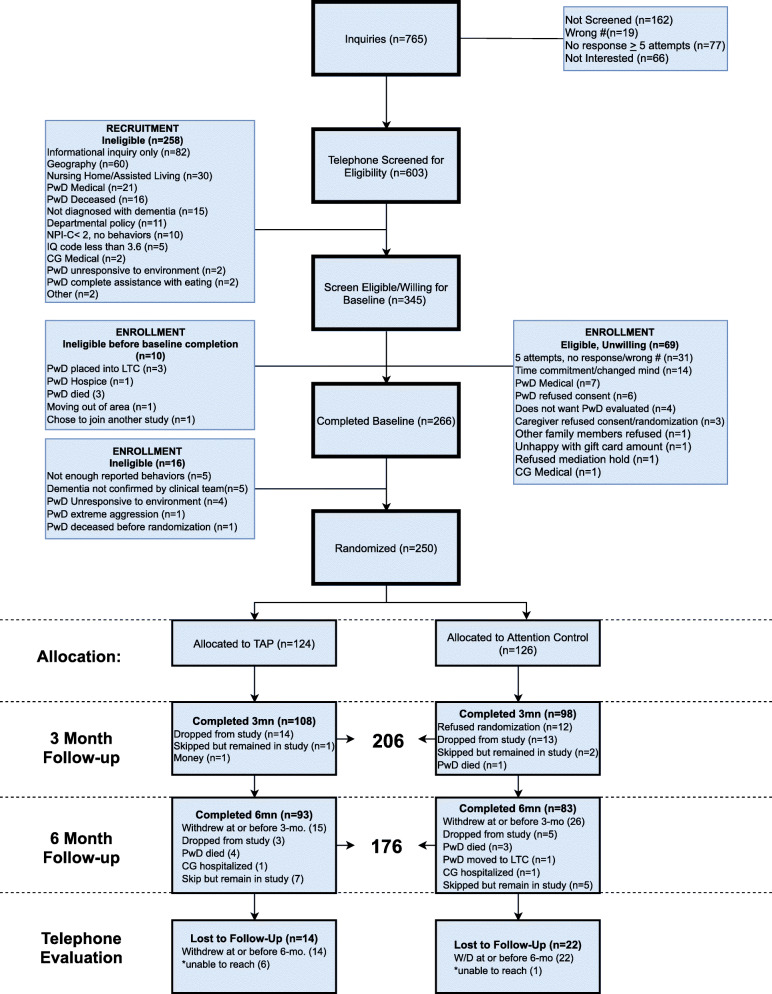
Background: People living with dementia (PLWD) and caregivers are adversely impacted by lack of meaningful activity leading to worse symptoms and impaired quality-of-life. There is a critical need to develop effective and well-tolerated treatments that mitigate clinical symptoms, engage PLWD and support caregiver wellbeing. We tested whether, compared to attention control, the Tailored Activity Program (TAP) reduced clinical symptoms and health-related events, and improved caregiver wellbeing, and if TAP activities were well-tolerated. Methods: We conducted a single-blind randomized controlled trial among 250 dyads recruited from Baltimore-Washington DC (2012–2016) with a dementia diagnosis and clinically significant agitation/aggression. Dyads were randomized to TAP ( n = 124) or attention control ( n = 126), and interviewed at baseline, 3 (endpoint) and 6-months (follow-up) by interviewers masked to group allocation. TAP assessed PLWD abilities/interests, instructed caregivers in using prescribed activities, and provided dementia education and stress reduction techniques. Attention controls received disease education and home safety tips. Both groups had up to 8 home visits over 3-months. The primary outcome was frequency by severity scores for agitation/aggression subscales of Neuropsychiatric Inventory-Clinician using caregiver ratings. Secondary outcomes included number of instrumental (IADL) and activities of daily living (ADL) needing assistance, caregiver wellbeing, and confidence using activities. Health-related events (PLWD death, hospitalizations, caregiver hospitalization, depression) and perceived study benefits were captured over 6 months. PLWD tolerability of prescribed activities was examined. Results: Of 250 dyads, most caregivers were female (81.2 %, n = 203), non-spouses (54.4 %, n = 136), white (59.2 %, n = 145) or African American (36.7 %, n = 90) with mean age = 65.4 (SD = 12.6). PLWD were mostly female (63.2 %, n = 158) with mean age = 81.4 (SD = 7.9), and mean MMSE = 14.3 (SD = 7.8). At 3-months, compared to controls, TAP conferred no benefit to agitation/aggression ( p = 0.43, d = 0.11), but resulted in less IADL ( p = 0.02, d =-0.33), and ADL ( p = 0.04, d =-0.30) assistance, improved caregiver wellbeing ( p = 0.01, d = 0.39), and confidence using activities ( p = 0.02, d = 0.32). By 6-months, 15 PLWD in TAP had ≥ 1 health-related event versus 28 PLWD in control, demonstrating 48.8 % improvement in TAP ( p = 0.03). TAP caregivers were more likely to perceive study benefits. Prescribed activities were well-tolerated. Conclusions: Although TAP did not benefit agitation/aggression, it impacted important outcomes that matter to families warranting its use in dementia care. Clinical trial registration: Clinicaltrials.gov # NCT01892579 at https://clinicaltrials.gov/ ; Date of clinical trial registration: 04/07/2013; Date first dyad enrolled: 15/11/2013.
Overview
The claims and statistics of this paper haven’t been checked yet.
Free: it reads the open-access text and checks the first 5 claims that cite a source we can check. Create a free account to check every claim.
Integrity signals
Registry
Cites
Statistics
Figures
Verification
Claims the paper makes
The claims and statistics of this paper haven’t been checked yet.
Free: it reads the open-access text and checks the first 5 claims that cite a source we can check. Create a free account to check every claim.
Self-check
Percentages, sums and reported differences re-computed from the paper’s own numbers.
The self-check needs the paper’s full text.
Citations
Cites
Statistical Power Analysis for the Behavioral Sciences
Muller, K. (1989) · Technometrics · doi:10.1080/00401706.1989.10488618 · Cited by 99,167
Statistical power analysis for the behavioral sciences
(1990) · Computers, Environment and Urban Systems · doi:10.1016/0198-9715(90)90050-4 · Cited by 65,269
The PHQ-9: Validity of a brief depression severity measure
Kroenke, K., Spitzer, R. L., & Williams, J. B. W. (2001) · Journal of General Internal Medicine · doi:10.1046/j.1525-1497.2001.016009606.x · Cited by 44,910
Dementia prevention, intervention, and care
Livingston, G., Sommerlad, A., Orgeta, V., Costafreda, S. G., Huntley, J., Ames, D., Ballard, C., Banerjee, S., Burns, A., Cohen-Mansfield, J., et al. (2017) · The Lancet · doi:10.1016/s0140-6736(17)31363-6 · Cited by 6,072 · cited 2×
“Caregivers experience daily care challenges resulting in increased risk for depression, and poor quality of life [4].”
BackgroundSelf-citationThe PHQ-9: A New Depression Diagnostic and Severity Measure
Kroenke, K., & Spitzer, R. L. (2002) · Psychiatric Annals · doi:10.3928/0048-5713-20020901-06 · Cited by 5,898 · cited 1×
“We did not find however, statistically significant differences in the number of caregivers with major or severe depression [45].”
BackgroundMaust, D. T., Kim, H. M., Seyfried, L. S., Chiang, C., Kavanagh, J., Schneider, L. S., & Kales, H. C. (2015) · JAMA Psychiatry · doi:10.1001/jamapsychiatry.2014.3018 · Cited by 617 · cited 1×
“Pharmacological options for NPS have modest benefits, while some are associated with significant risks including mortality, and do not typically address the many care challenges families identify as most problematic to them [6, 7].”
BackgroundLivingston, G., Johnston, K., Katona, C., Paton, J., Lyketsos, C. G., & Old Age Task Force of the World Federation of Biological Psychiatry (2005) · American Journal of Psychiatry · doi:10.1176/appi.ajp.162.11.1996 · Cited by 591 · cited 1×
“An emerging evidence base suggests that activity engagement can help PLWD by reducing one of the most serious forms of NPS, agitation/aggression [11, 12, 14, 15].”
BackgroundSelf-citationNonpharmacologic Management of Behavioral Symptoms in Dementia
Gitlin, L. N., Kales, H. C., & Lyketsos, C. G. (2012) · JAMA · doi:10.1001/jama.2012.36918 · Cited by 495 · cited 1×
“The objective of this phase III randomized clinical trial was to test the effectiveness of TAP to reduce agitated and aggressive behaviors, two of the most prevalent and upsetting behavioral symptoms of dementia [23] for caregivers and PLWD.”
MethodSelf-citationGitlin, L. N., Winter, L., Dennis, M. P., Hodgson, N., & Hauck, W. W. (2010) · JAMA · doi:10.1001/jama.2010.1253 · Cited by 367 · cited 1×
“The survey consisted of 9 questions adapted from prior trials [32]: Was study clearly explained? Were you and your relative treated with respect? How much did you benefit from participation? How much did participation help you better understand dementia? How much did participation help you feel more confident dealing…”
MethodSelf-citationGitlin, L. N., Winter, L., Burke, J., Chernett, N., Dennis, M. P., & Hauck, W. W. (2008) · The American Journal of Geriatric Psychiatry · doi:10.1097/01.jgp.0000300629.35408.94 · Cited by 362
Self-citationBlack, B. S., Johnston, D., Rabins, P. V., Morrison, A., Lyketsos, C., & Samus, Q. M. (2013) · Journal of the American Geriatrics Society · doi:10.1111/jgs.12549 · Cited by 335
Self-citationOrnstein, K., & Gaugler, J. E. (2012) · International Psychogeriatrics · doi:10.1017/s1041610212000737 · Cited by 294
de Medeiros, K., Robert, P., Gauthier, S., Stella, F., Politis, A., Leoutsakos, J., Taragano, F., Kremer, J., Brugnolo, A., Porsteinsson, A. P., et al. (2010) · International Psychogeriatrics · doi:10.1017/s1041610210000876 · Cited by 266 · cited 8×
“While caregivers reported behavioral symptoms (versus clinicians), interviewers were trained to explain each behavior using the administration guidelines for the NPI-C.”
BackgroundMethodInfluentialSelf-citationBallard, C., Corbett, A., Orrell, M., Williams, G., Moniz-Cook, E., Romeo, R., Woods, B., Garrod, L., Testad, I., Woodward-Carlton, B., et al. (2018) · PLOS Medicine · doi:10.1371/journal.pmed.1002500 · Cited by 263 · cited 1×
“An emerging evidence base suggests that activity engagement can help PLWD by reducing one of the most serious forms of NPS, agitation/aggression [11, 12, 14, 15].”
BackgroundKales, H. C., Lyketsos, C. G., Miller, E. M., & Ballard, C. (2019) · International Psychogeriatrics · doi:10.1017/s1041610218000534 · Cited by 220 · cited 1×
“Nonpharmacological approaches have been identified as first line treatments and have potential to address NPS as well as associated functional dependence, and caregiver distress [8, 9].”
BackgroundSelf-citationDo caregiver management strategies influence patient behaviour in dementia?
de Vugt, M. E., Stevens, F., Aalten, P., Lousberg, R., Jaspers, N., Winkens, I., Jolles, J., & Verhey, F. R. J. (2004) · International Journal of Geriatric Psychiatry · doi:10.1002/gps.1044 · Cited by 215
Gitlin, L. N., Winter, L., Vause Earland, T., Adel Herge, E., Chernett, N. L., Piersol, C. V., & Burke, J. P. (2009) · The Gerontologist · doi:10.1093/geront/gnp087 · Cited by 188 · cited 5×
“Caregiver confidence using activities was measured with five items [14], from not at all confident (0) to very confident (10).”
BackgroundMethodResultSelf-citationWatt, J. A., Goodarzi, Z., Veroniki, A. A., Nincic, V., Khan, P. A., Ghassemi, M., Thompson, Y., Tricco, A. C., & Straus, S. E. (2019) · Annals of Internal Medicine · doi:10.7326/m19-0993 · Cited by 159 · cited 1×
“Pharmacological options for NPS have modest benefits, while some are associated with significant risks including mortality, and do not typically address the many care challenges families identify as most problematic to them [6, 7].”
BackgroundIrving, J., Davis, S., & Collier, A. (2017) · The International Journal of Aging and Human Development · doi:10.1177/0091415017702908 · Cited by 150
The Impact of Behavioral Symptoms on Activities of Daily Living in Patients With Dementia
Norton, L., Malloy, P. F., & Salloway, S. (2001) · American Journal of Geriatric Psychiatry · doi:10.1097/00019442-200102000-00007 · Cited by 140 · cited 1×
“The effect of dementia is profound impacting behavioral patterns, daily functioning, quality of life, activity engagement and health care utilization [2, 3].”
BackgroundGiebel, C. M., Sutcliffe, C., Stolt, M., Karlsson, S., Renom-Guiteras, A., Soto, M., Verbeek, H., Zabalegui, A., & Challis, D. (2014) · International Psychogeriatrics · doi:10.1017/s1041610214000775 · Cited by 134 · cited 1×
“The effect of dementia is profound impacting behavioral patterns, daily functioning, quality of life, activity engagement and health care utilization [2, 3].”
BackgroundTargeting Behavioral Symptoms and Functional Decline in Dementia: A Randomized Clinical Trial
Gitlin, L. N., Arthur, P., Piersol, C., Hessels, V., Wu, S. S., Dai, Y., & Mann, W. C. (2018) · Journal of the American Geriatrics Society · doi:10.1111/jgs.15194 · Cited by 119 · cited 7×
“A trial of 160 Veterans found that TAP caregivers compared to those in usual care, reported significantly less pain in PLWD following intervention [15].”
BackgroundResultSelf-citationThomas, K. S., Baier, R. R., Kosar, C. M., Ogarek, J. A., Trepman, A. Z., & Mor, V. (2017) · American Journal of Geriatric Psychiatry · doi:10.1016/j.jagp.2017.04.008 · Cited by 117 · cited 1×
“Moreover, most nonpharmacological approaches involve rapport building and individualized attention, yet few studies control for potential effects of attention on outcomes [13] .”
BackgroundConvenience Samples and Caregiving Research: How Generalizable Are the Findings?
Pruchno, R. A., Brill, J. E., Shands, Y., Gordon, J. R., Genderson, M. W., Rose, M., & Cartwright, F. (2008) · The Gerontologist · doi:10.1093/geront/48.6.820 · Cited by 87
Gitlin, L. N., Roth, D. L., Burgio, L. D., Loewenstein, D. A., Winter, L., Nichols, L., Argüelles, S., Corcoran, M., Burns, R., & Martindale, J. (2005) · Journal of Aging and Health · doi:10.1177/0898264304274184 · Cited by 80 · cited 1×
“The PLWD functional dependence in instrumental (IADL) and activities of daily living (ADL) was measured using the Caregiver Assessment of Function and Upset (CAFU) [29].”
MethodSelf-citationKales, H. C., Gitlin, L. N., & Lyketsos, C. G. (2019) · Journal of the American Medical Directors Association · doi:10.1016/j.jamda.2019.05.022 · Cited by 76 · cited 1×
“Nonpharmacological approaches have been identified as first line treatments and have potential to address NPS as well as associated functional dependence, and caregiver distress [8, 9].”
BackgroundSelf-citationArthur, P. B., Gitlin, L. N., Kairalla, J. A., & Mann, W. C. (2018) · International Psychogeriatrics · doi:10.1017/s104161021700237x · Cited by 71
Self-citationGao, J., Armstrong, N. M., Deal, J. A., Lin, F. R., & He, P. (2020) · BMC Geriatrics · doi:10.1186/s12877-020-01615-7 · Cited by 71
Gitlin, L. N., Piersol, C. V., Hodgson, N., Marx, K., Roth, D. L., Johnston, D., Samus, Q., Pizzi, L., Jutkowitz, E., & Lyketsos, C. G. (2016) · Contemporary Clinical Trials · doi:10.1016/j.cct.2016.06.006 · Cited by 69 · cited 4×
“The Tailored Activity Program (TAP) has been described in detail elsewhere [25, 27, 28] Briefly, the program is delivered by occupational therapists (OT) and unfolds in three phases involving up to 8, 1 to 11⁄2 hour sessions over three months.”
BackgroundMethodSelf-citationde Oliveira, A. M., Radanovic, M., Homem de Mello, P. C., Buchain, P. C., Dias Vizzotto, A., Harder, J., Stella, F., Piersol, C. V., Gitlin, L. N., & Forlenza, O. V. (2019) · International Journal of Geriatric Psychiatry · doi:10.1002/gps.4958 · Cited by 67 · cited 5×
“This is in contrast to a Brazilian trial which found significant differences such that caregivers in TAP compared to those in usual care had improved quality of life, and decreased depression and burden scores [19].”
BackgroundResultSelf-citationO’Connor, C. M., Clemson, L., Brodaty, H., Low, L.-F., Jeon, Y.-H., Gitlin, L. N., Piguet, O., & Mioshi, E. (2019) · Disability and Rehabilitation · doi:10.1080/09638288.2017.1387614 · Cited by 57
Self-citationGitlin, L. N., Winter, L., Dennis, M. P., & Hauck, W. W. (2006) · American Journal of Alzheimer s Disease & Other Dementias® · doi:10.1177/1533317506292283 · Cited by 55 · cited 1×
“A total score was calculated by summing all 13 items, with higher scores indicating positive change [30].”
MethodSelf-citationFamily caregiving in the community up to 8-years after onset of dementia
Jutkowitz, E., Gaugler, J. E., Trivedi, A. N., Mitchell, L. L., & Gozalo, P. (2020) · BMC Geriatrics · doi:10.1186/s12877-020-01613-9 · Cited by 50 · cited 1×
“As other studies have shown that increased functional dependence is a predictor of more hours caregiving, hospitalizations and nursing home placements [35], even a small decline in the rate of dependence over time may lessen caregiver burden and improve PLWD quality of life.”
BackgroundNovelli, M. M. P. C., Machado, S. C. B., Lima, G. B., Cantatore, L., Sena, B. P., Rodrigues, R. S., Rodrigues, C. I. B., Canon, M. B. F., Piersol, C. V., Nitrini, R., et al. (2018) · Alzheimer Disease & Associated Disorders · doi:10.1097/wad.0000000000000256 · Cited by 46 · cited 5×
“This is in contrast to a Brazilian trial which found significant differences such that caregivers in TAP compared to those in usual care had improved quality of life, and decreased depression and burden scores [19].”
BackgroundResultSelf-citationPinyopornpanish, M., Pinyopornpanish, K., Soontornpun, A., Tanprawate, S., Nadsasarn, A., Wongpakaran, N., & Wongpakaran, T. (2021) · BMC Geriatrics · doi:10.1186/s12877-021-02136-7 · Cited by 46
Prescribing Activities that Engage Passive Residents: An Innovative Method
Kolanowski, A., & Buettner, L. (2008) · Journal of Gerontological Nursing · doi:10.3928/00989134-20080101-08 · Cited by 45
Gitlin, L. N., Marx, K. A., Alonzi, D., Kvedar, T., Moody, J., Trahan, M., & Van Haitsma, K. (2017) · The Gerontologist · doi:10.1093/geront/gnw052 · Cited by 32
Self-citationRecent advances in the management of neuropsychiatric symptoms in dementia
Forlenza, O. V., Loureiro, J. C., Pais, M. V., & Stella, F. (2017) · Current Opinion in Psychiatry · doi:10.1097/yco.0000000000000309 · Cited by 30
Lyketsos, C. G., & Miller, D. S. (2012) · Alzheimer s & Dementia · doi:10.1016/j.jalz.2011.11.001 · Cited by 26 · cited 1×
“A major cause of adverse outcomes for people living with dementia (PLWD) and caregivers are neuropsychiatric symptoms (NPS) which are almost universal and occur across all disease stages and etiologies [5].”
BackgroundSelf-citationTailored Activities to Reduce Neuropsychiatric Behaviors in Persons With Dementia: Case Report
Marx, K., Scott, J. B., Piersol, C. V., & Gitlin, L. N. (2019) · American Journal of Occupational Therapy · doi:10.5014/ajot.2019.029546 · Cited by 25
Self-citationBetter living with dementia implications for individuals, families, communities, and societies
Gitlin, L. N., & Hodgson, N. A. (2018) · Cited by 23
Self-citationMeaning and purpose in Huntington’s disease: a longitudinal study of its impact on quality of life
Sokol, L. L., Troost, J. P., Kluger, B. M., Applebaum, A. J., Paulsen, J. S., Bega, D., Frank, S., Hauser, J. M., Boileau, N. R., Depp, C. A., et al. (2021) · Annals of Clinical and Translational Neurology · doi:10.1002/acn3.51424 · Cited by 18 · cited 1×
“Purpose is an enduring need regardless of disease stage and etiology [36].”
BackgroundPsychometric Properties of the Functional Capacity Card Sort for Caregivers of People With Dementia
Piersol, C. V., Herge, E. A., Copolillo, A. E., Leiby, B. E., & Gitlin, L. N. (2016) · OTJR Occupational Therapy Journal of Research · doi:10.1177/1539449216666063 · Cited by 11 · cited 1×
“Most caregivers overestimate abilities of the person for whom they care [44].”
BackgroundSelf-citationLeven, N. V., de Lange, J., Groenewoud, J. G., van der Ploeg, E., & Pot, A. M. (2019) · BMC Geriatrics · doi:10.1186/s12877-019-1221-0 · Cited by 9 · cited 1×
“The Tailored Activity Program (TAP) has been described in detail elsewhere [25, 27, 28] Briefly, the program is delivered by occupational therapists (OT) and unfolds in three phases involving up to 8, 1 to 11⁄2 hour sessions over three months.”
MethodKolanowski, A. M., & Gunter, L. M. (1983) · Journal of Gerontological Nursing · doi:10.3928/0098-9134-19830101-03 · Cited by 8
Research works printed but not linked: 3
- Risk reduction of cognitive decline and dementia: WHO guidelines Geneva, Switzerland: World Health Organization; 2019. https://apps.who.int/iris/bitstream/handle/10665/312180/9789241550543-eng.pdf?ua=1. Accessed 11 June 2020. 31219687
- Parker LJ, Marx K, Gitlin LN. Factors associated with informed consent among people living with dementia: The dementia behavior study. J Am Geriatr Soc. under review.
- Gitlin LN, Hodgson N, Choi S. et al. Interventions to address functional decline in persons with dementia: Closing the gap between what a person “does do” and what they “can do:” In: Park R, ed. Neuropsychology of Alzheimer’s Disease and Other Dementias. 2nd Editio. Oxford University Press.
Cited by
Dementia prevention, intervention, and care: 2024 report of the Lancet standing Commission
Livingston, G., Huntley, J., Liu, K. Y., Costafreda, S. G., Selbæk, G., Alladi, S., Ames, D., Banerjee, S., Burns, A., Brayne, C., et al. (2024) · The Lancet · doi:10.1016/s0140-6736(24)01296-0 · Cited by 3,860
Self-citationCognitive rehabilitation for people with mild to moderate dementia
Kudlicka, A., Martyr, A., Bahar‐Fuchs, A., Sabatés, J., Woods, B. T., & Clare, L. (2023) · Cochrane Database of Systematic Reviews · doi:10.1002/14651858.cd013388.pub2 · Cited by 111
Balvert, S. C. E., Sordo, G. C. D., & Milders, M. V. (2024) · Ageing Research Reviews · doi:10.1016/j.arr.2024.102258 · Cited by 45
Kennedy, M. A., Stevens, C. J., Pepin, R. L., & Lyons, K. D. (2023) · The Gerontologist · doi:10.1093/geront/gnad046 · Cited by 26
Neuropsychiatric Symptom Burden across Neurodegenerative Disorders and its Association with Function
Kapustin, D., Zarei, S., Wang, W., Binns, M. A., McLaughlin, P. M., Abrahão, A., Black, S. E., BORRIE, M. J., Breen, D. P., Casaubon, L., et al. (2023) · The Canadian Journal of Psychiatry · doi:10.1177/07067437221147443 · Cited by 24
Metadata
- Authors
- Gitlin, L. N., Marx, K., Piersol, C. V., Hodgson, N. A., Huang, J., Roth, D. L., & Lyketsos, C.
- Affiliations
- Johns Hopkins University (US)
- Thomas Jefferson University (US)
- University of Pennsylvania (US)
- Corresponding author
- Gitlin, Laura N.
- ORCID
- Venue
- BMC Geriatrics
- Published
- 2021-10-20
- Volume
- 21
- Issue
- 1
- Pages
- 581-581
- ISSN
- 1471-2318 (ISSN-L)
- PMC
- PMC8527762
- OpenAlex
- W3206060926
- Cited by
- 65
- References
- 45
- Citations by year
- 2026: 21 · 2025: 20 · 2024: 6 · 2023: 10 · 2022: 7 · 2021: 1
- FWCI
- 4.30
- Type
- journal article
- Language
- en
- Open access
- gold
- doi.org
- Licence
- cc-by
- creativecommons.org/licenses/by/4.0 (tdm)
- creativecommons.org/licenses/by/4.0 (vor)
- Locations
- BMC Geriatrics (publishedVersion, cc-by)
- Europe PMC (PubMed Central) (publishedVersion, other-oa)
- PubMed Central (publishedVersion, cc-by)
- PubMed (publishedVersion)
- The Medicine Forum (submittedVersion, cc-by)
- DOAJ (DOAJ: Directory of Open Access Journals) (submittedVersion, cc-by-sa)
- Funders
- National Institute on Aging (R01AG041781)
- Topics
- Health Sciences › Medicine › Psychiatry and Mental health › Dementia and Cognitive Impairment Research
- Health Sciences › Nursing › Research and Theory › Nursing care and research
- Health Sciences › Medicine › Geriatrics and Gerontology › Geriatric Care and Nursing Homes
- Keywords
- dementia, dementia care, caregiver well-being, agitation and aggression, caregiver education, stress reduction, instrumental activities of daily living, activities of daily living, caregiver depression, home visits, quality of life, caregiver dyads, dementia education, stress reduction techniques
- MeSH terms
- Activities of Daily Living, Aged, Aged, 80 and over, Dementia, Female, Humans, Male, Quality of Life, Single-Blind Method, Caregivers
About these checks
Registry, retraction, Cites and statistics results are computed, not judged, with one exception: a printed reference that no index lists is read once by a model before it counts as a citation error. Claims are extracted by a model and kept only when their quote appears verbatim in the text; each cited source is then checked, with a model’s help, for whether it says what the claim relies on. Those verdicts can be wrong — read the claim’s quote and the cited source before relying on one.
Statistics and arithmetic are recomputed, not judged.
Confidence bands are shown only for fields calibrated on our annotated test set. None is calibrated yet, so no band is shown.
What counts as a claim ›How we measure confidence ›How we check this ›
Are you an author, or do you see a problem with this page? Request a review
Data sources
Bibliographic data: Semantic Scholar, OpenAlex, Crossref.
Contains information from the Semantic Scholar Academic Graph Datasets, made available under the ODC Attribution License (ODC-BY 1.0).
Semantic Scholar’s data is described in: Kinney, R., et al. (2023). The Semantic Scholar Open Data Platform. arXiv:2301.10140.
