

The DOI matches its Crossref record; 79 of the 79 references it cites were found in a registry or an index.
Is the superbug fungus really so scary? A systematic review and meta-analysis of global epidemiology and mortality of Candida auris
Open accessAbstract
Background: Candida auris is a new pathogen called “superbug fungus” which caused panic worldwide. There are no large-scale epidemiology studies by now, therefore a systematic review and meta-analysis was undertaken to determine the epidemic situation, drug resistance patterns and mortality of C. auris . Methods: We systematically searched studies on the clinical report of Candida auris in Pubmed, Embase and Cochrane databases until October 6, 2019. A standardized form was used for data collection, and then statics was performed with STATA11.0. Results: It showed that more than 4733 cases of C. auris were reported in over 33 countries, with more cases in South Africa, United States of America, India, Spain, United Kingdom, South Korea, Colombia and Pakistan. C. auirs exhibited a decrease in case count after 2016. Clade I and III were the most prevalent clades with more cases reported and wider geographical distribution. Blood stream infection was observed in 32% of the cases, which varied depending on the clades. Resistance to fluconazole, amphotericin B, caspofungin, micafungin and anidulafungin in C. auris were 91, 12, 12.1, 0.8 and 1.1%. The overall mortality of C. auris infection was 39%. Furthermore, subgroup analyses showed that mortality was higher in bloodstream infections (45%), and lower in Europe (20%). Conclusions: Over 4000 cases of C. auris were reported in at least 33 countries, which showed high resistance to fluconazole, moderate resistance to amphotericin B and caspofungin, high sensitivity to micafungin and anidulafungin. The crude mortality for BSI of C. auris was 45% which was similar to some drug-resistant bacteria previously reported. In conclusion, C. auris displayed similar characteristics to some drug resistance organisms. This study depicts several issues of C. auris that are most concerned, and is of great significance for the clinical management.
Overview
The claims and statistics of this paper haven’t been checked yet.
Run the check — free, no account needed. It reads the open-access text and checks the sources it cites.
Integrity signals
Registry
Cites
Statistics
Figures
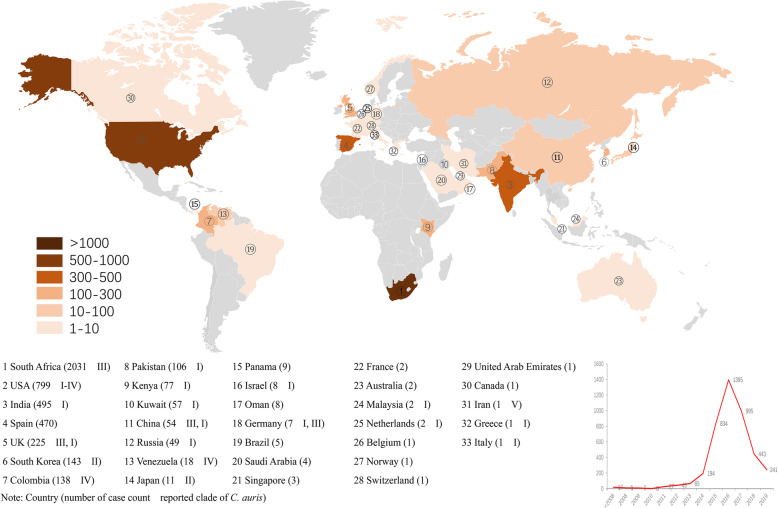
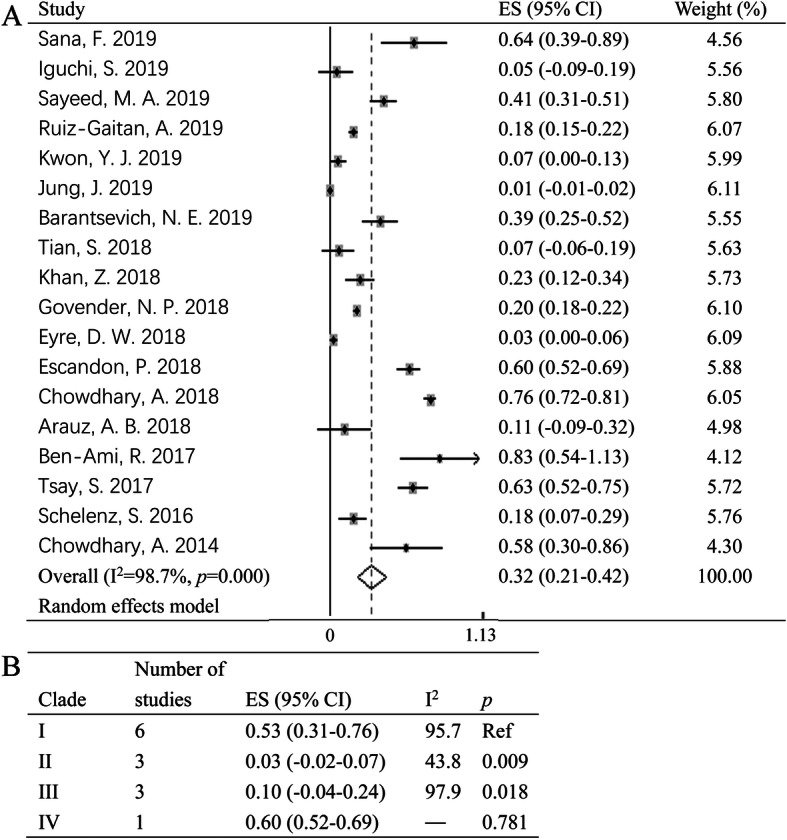
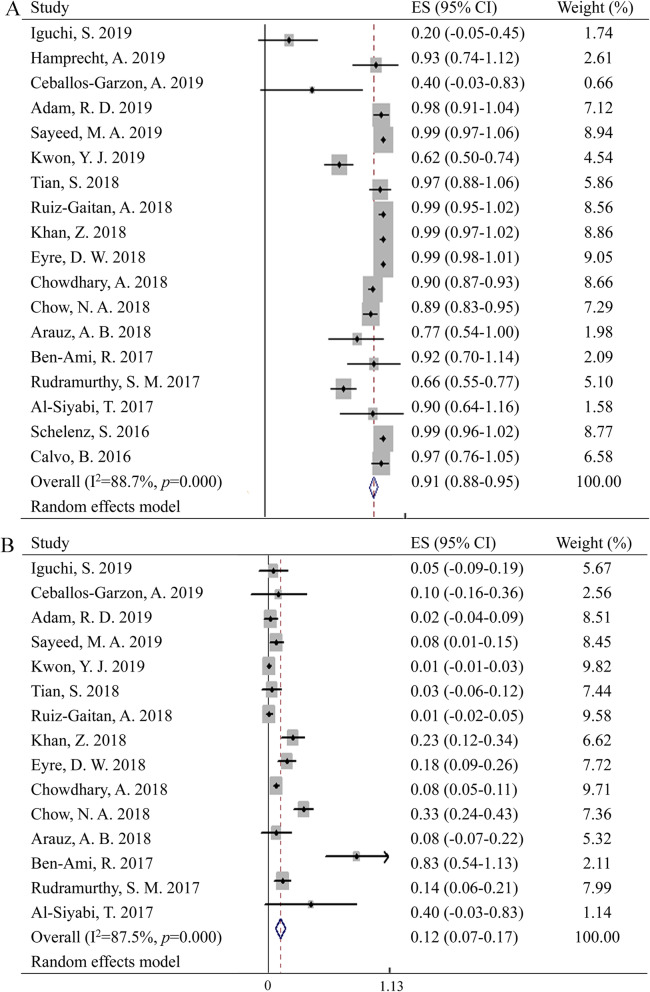
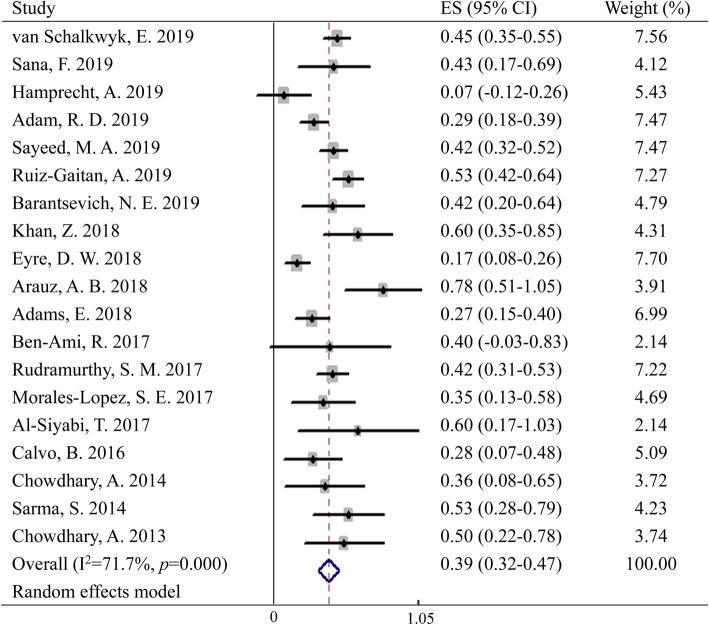
Verification
Claims the paper makes
The claims and statistics of this paper haven’t been checked yet.
Run the check — free, no account needed. It reads the open-access text and checks the sources it cites.
Claims other papers make about this one
Each is checked against this paper’s own text: does it say what the citing paper says it does?
The cited source says what the claim attributes to it.
In the citing paper
“C. auris can show clinical resistance to all classes of antifungal drugs, including echinocandins that are usually recommended as first-line therapies for invasive candidiasis.”
From Transcriptomics and Phenotyping Define Genetic Signatures Associated with Echinocandin Resistance in Candida auris (2022) · cites this paper as [15]
Self-check
Percentages, sums and reported differences re-computed from the paper’s own numbers.
The self-check needs the paper’s full text.
Citations
Cites
Lockhart, S. R., Etienne, K. A., Vallabhaneni, S., Farooqi, J., Chowdhary, A., Govender, N. P., Colombo, A. L., Calvo, B., Cuomo, C. A., Desjardins, C. A., et al. (2017) · Clinical Infectious Diseases · doi:10.1093/cid/ciw691 · Cited by 1,662
Satoh, K., Makimura, K., Hasumi, Y., Nishiyama, Y., Uchida, K., & Yamaguchi, H. (2009) · Microbiology and Immunology · doi:10.1111/j.1348-0421.2008.00083.x · Cited by 1,381
Pfaller, M. A., Diekema, D. J., Turnidge, J. D., Castanheira, M., & Jones, R. N. (2019) · Open Forum Infectious Diseases · doi:10.1093/ofid/ofy358 · Cited by 825
First hospital outbreak of the globally emerging Candida auris in a European hospital
Schelenz, S., Hagen, F., Rhodes, J. L., Abdolrasouli, A., Chowdhary, A., Hall, A., Ryan, L., Shackleton, J., Trimlett, R., Meis, J. F., et al. (2016) · Antimicrobial Resistance & Infection Control · doi:10.1186/s13756-016-0132-5 · Cited by 768
Xu, L., Sun, X., & Ma, X. (2017) · Annals of Clinical Microbiology and Antimicrobials · doi:10.1186/s12941-017-0191-3 · Cited by 673
Chowdhary, A., Prakash, A., Sharma, C., Kordalewska, M., Kumar, A., Sarma, S., Tarai, B., Singh, A., Upadhyaya, G., Upadhyay, S., et al. (2018) · Journal of Antimicrobial Chemotherapy · doi:10.1093/jac/dkx480 · Cited by 577
A Candida auris Outbreak and Its Control in an Intensive Care Setting
Eyre, D. W., Sheppard, A. E., Madder, H., Moir, I., Moroney, R., Quan, T. P., Griffiths, D., George, S., Butcher, L., Morgan, M., et al. (2018) · New England Journal of Medicine · doi:10.1056/nejmoa1714373 · Cited by 517
Muñoz, J. F., Gade, L., Chow, N. A., Loparev, V. N., Juieng, P., Berkow, E. L., Farrer, R. A., Litvintseva, A. P., & Cuomo, C. A. (2018) · Nature Communications · doi:10.1038/s41467-018-07779-6 · Cited by 458
Calvo, B., Melo, A. S. D. A., Mena, A. J. P., Hernandez, M., Francisco, E. C., Hagen, F., Meis, J. F. G. M., & Colombo, A. L. (2016) · Journal of Infection · doi:10.1016/j.jinf.2016.07.008 · Cited by 448
New Clonal Strain ofCandida auris, Delhi, India
Chowdhary, A., Sharma, C., Duggal, S., Agarwal, K., Prakash, A., Singh, P. K., Jain, S., Kathuria, S., Randhawa, H. S., Hagen, F., et al. (2013) · Emerging infectious diseases · doi:10.3201/eid1910.130393 · Cited by 418
Cited by
Sorted by citations
Ahmad, S., & Alfouzan, W. (2021) · Microorganisms · doi:10.3390/microorganisms9040807 · Cited by 269
The WHO fungal priority pathogens list: a crucial reappraisal to review the prioritisation
Casalini, G., Giacomelli, A., & Antinori, S. (2024) · The Lancet Microbe · doi:10.1016/s2666-5247(24)00042-9 · Cited by 217
Proctor, D. M., Dangana, T., Sexton, D. J., Fukuda, C., Yelin, R. D., Stanley, M., Bell, P. B., Baskaran, S., Deming, C., Chen, Q., et al. (2021) · Nature Medicine · doi:10.1038/s41591-021-01383-w · Cited by 198
Briano, F., Magnasco, L., Sepulcri, C., Dettori, S., Dentone, C., Mikulska, M., Ball, L., Vena, A., Robba, C., Patroniti, N. A., et al. (2022) · Infectious Diseases and Therapy · doi:10.1007/s40121-022-00625-9 · Cited by 145
Antimicrobial Peptides: Challenging Journey to the Pharmaceutical, Biomedical, and Cosmeceutical Use
Mazurkiewicz-Pisarek, A., Baran, J., & Ciach, T. (2023) · International Journal of Molecular Sciences · doi:10.3390/ijms24109031 · Cited by 112
Metadata
- Authors
- Chen, J., Tian, S., Han, X., Chu, Y., Wang, Q., Zhou, B., & Shang, H.
- Affiliations
- First Hospital of China Medical University (CN)
- Corresponding author
- Shang, Hong
- Venue
- BMC Infectious Diseases
- Published
- 2020-11-11
- Volume
- 20
- Issue
- 1
- Pages
- 827-827
- ISSN
- 1471-2334 (ISSN-L)
- PMC
- PMC7656719
- OpenAlex
- W3102866798
- Cited by
- 159
- References
- 79
- Citations by year
- 2026: 36 · 2025: 26 · 2024: 30 · 2023: 38 · 2022: 20 · 2021: 9
- FWCI
- 0.79
- Type
- journal article
- Language
- en
- Open access
- gold
- doi.org
- Locations
- BMC Infectious Diseases (publishedVersion, cc-by)
- PubMed Central (publishedVersion, cc-by)
- PubMed (publishedVersion)
- DOAJ (DOAJ: Directory of Open Access Journals) (submittedVersion, cc-by-sa)
- Funders
- Laboratory medicine innovation unit, Chinese Academy of Medical Sciences (2019RU017)
- Topics
- Health Sciences › Medicine › Infectious Diseases › Antifungal resistance and susceptibility
- Life Sciences › Immunology and Microbiology › Microbiology › Yeasts and Rust Fungi Studies
- Health Sciences › Medicine › Infectious Diseases › Fungal Infections and Studies
- Keywords
- Candida auris, fungemia, antifungal resistance, fluconazole resistance, amphotericin B resistance, caspofungin resistance, micafungin, anidulafungin, global epidemiology, mortality, emerging fungal pathogens
- MeSH terms
- Caspofungin, Micafungin, Anidulafungin, Amphotericin B, Antifungal Agents, Candida, Candidiasis, Humans, Fluconazole, Prevalence, Drug Resistance, Multiple, Fungal
About these checks
Registry, retraction, Cites and statistics results are computed, not judged, with one exception: a printed reference that no index lists is read once by a model before it counts as a citation error. Claims are extracted by a model and kept only when their quote appears verbatim in the text; each cited source is then checked, with a model’s help, for whether it says what the claim relies on. Those verdicts can be wrong — read the claim’s quote and the cited source before relying on one.
Statistics and arithmetic are recomputed, not judged.
Confidence bands are shown only for fields calibrated on our annotated test set. None is calibrated yet, so no band is shown.
What counts as a claim ›How we measure confidence ›How we check this ›
Are you an author, or do you see a problem with this page? Request a review
