

Highly selective SGLT2 inhibitor dapagliflozin reduces seizure activity in pentylenetetrazol-induced murine model of epilepsy
Open accessThe DOI matches its Crossref record; 31 of the 31 references it cites were found in a registry or an index.
Abstract
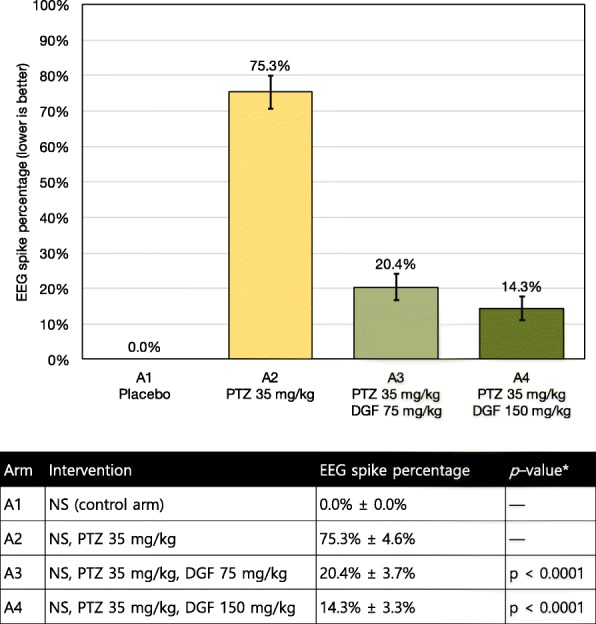
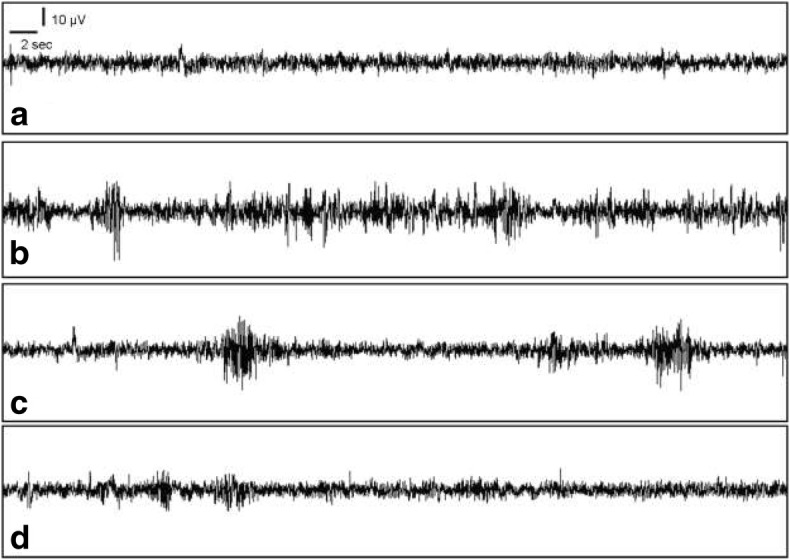
BACKGROUND: Worldwide, over 10 million individuals suffer from drug-resistant epilepsy. New therapeutic strategies are needed to address this debilitating disease. Inhibition of sodium-glucose linked transporters (SGLTs), which are variably expressed in the brain, has been demonstrated to reduce seizure activity in murine models of epilepsy. Here we investigated the effects of dapagliflozin, a highly competitive SGLT2 inhibitor currently used as a drug for diabetes mellitus, on seizure activity in rats with pentylenetetrazol (PTZ) induced seizures. METHODS: Laboratory rats (n = 48) were evenly randomized into two experiments, each with four study arms: (1) a vehicle-treated (placebo) arm infused with saline; (2) a control arm infused with PTZ; (3) a treatment arm with PTZ and dapagliflozin at 75 mg/kg, and (4) another treatment arm with PTZ and dapagliflozin at 150 mg/kg. Study subjects were assessed for seizures either via EEG as measured by spike wave percentage (SWP), or clinically via Racine's scales scores (RSS) and time to first myoclonic jerk (TFMJ). RESULTS: Rats treated with dapagliflozin had lower mean SWP on EEG (20.4% versus 75.3% for untreated rats). Behaviorally, treatment with dapagliflozin improved means RSS (2.33 versus 5.5) and mean TFMJ (68.3 versus 196.7 s). All of these findings were statistically significant with p-values of < 0.0001. There was a trend towards even better seizure control with the higher dose of dapagliflozin at 150 mg/kg, however this was not consistently statistically significant. CONCLUSIONS: Dapagliflozin decreased seizure activity in rats with PTZ-induced seizures. This may be explained by the anti-seizure effects of decreased glucose availability and a reduction in sodium transport across neuronal membranes which can confer a stabilizing effect against excitability and unwanted depolarization. The potential clinical role of dapagliflozin and other SGLT2 inhibitors as anti-seizure medications should be further explored.
Overview
The claims and statistics of this paper haven’t been checked yet.
Free: it reads the open-access text and checks the first 5 claims that cite a source we can check. Create a free account to check every claim.
Integrity signals
Registry
Cites
Statistics
Figures
Verification
Claims the paper makes
The claims and statistics of this paper haven’t been checked yet.
Free: it reads the open-access text and checks the first 5 claims that cite a source we can check. Create a free account to check every claim.
Claims other papers make about this one
Each is checked against this paper’s own text: does it say what the citing paper says it does?
In the citing paper
“based on the results obtained by Erdogan MA. et al., Dapagliflozin significantly reduces seizure activity, both at the electrophysiological and clinical level, in a rat model of epilepsy [32].”
From Neuroprotective effect of SGLT2 inhibitors. (2021) · cites this paper as [32]
In the citing paper
“However, SGLT-2 plays a role in other functions in CNS besides glucose transport.”
From Dapagliflozin Activates Neurons in the Central Nervous System and Regulates Cardiovascular Activity by Inhibiting SGLT-2 in Mice (2020) · cites this paper as [28]
Self-check
Percentages, sums and reported differences re-computed from the paper’s own numbers.
The self-check needs the paper’s full text.
Citations
Cites
AChE-stained horizontal sections of the rat brain in stereotaxic coordinates
Paxinos, G., Watson, C. R. R., & Emson, P. C. (1980) · Journal of Neuroscience Methods · doi:10.1016/0165-0270(80)90021-7 · Cited by 4,497 · cited 1×
“5 mm posterior to the lambda, along the midline [13, 14].”
BackgroundThe ketogenic diet for the treatment of childhood epilepsy: a randomised controlled trial
Neal, E. G., Chaffe, H., Schwartz, R. H., Lawson, M. S., Edwards, N., Fitzsimmons, G., Whitney, A., & Cross, J. H. (2008) · The Lancet Neurology · doi:10.1016/s1474-4422(08)70092-9 · Cited by 1,224 · cited 3×
“The augmentation of glucose transport and metabolism, typically by limiting its availability and encouraging the brain to rely on other substrates for energy such as ketones, is a strategy that has been proven to control certain seizure disorders, including treatment-intractable epilepsy in children [24].”
BackgroundMethodInfluentialMoshé, S. L., Perucca, E., Ryvlin, P., & Tomson, T. (2015) · The Lancet · doi:10.1016/s0140-6736(14)60456-6 · Cited by 905 · cited 2×
“It is estimated that approximately 2 million people in the United States have epilepsy [1].”
BackgroundRenal Na+-glucose cotransporters
Wright, E. M. (2001) · American Journal of Physiology-Renal Physiology · doi:10.1152/ajprenal.2001.280.1.f10 · Cited by 583 · cited 3×
“Sodium–glucose linked transporters (SGLTs) are transcribed from genes that belong to the solute carrier 5A (SLC5A) family of genes, which harness the gradient of sodium ions across the plasma membrane to drive glucose and galactose into cells [6, 20, 21].”
BackgroundThe sodium/glucose cotransport family SLC5
Wright, E. M., & Turk, E. (2004) · Pfl�gers Archiv European Journal of Physiology · doi:10.1007/s00424-003-1202-0 · Cited by 537 · cited 2×
“With regards to the SGLTs, these transporters were first identified in the intestine and kidney [6, 7].”
BackgroundFunctional expression of sodium-glucose transporters in cancer
Scafoglio, C., Hirayama, B. A., Kepe, V., Liu, J., Ghezzi, C., Satyamurthy, N., Moatamed, N. A., Huang, J., Koepsell, H., Barrio, J. R., et al. (2015) · Proceedings of the National Academy of Sciences · doi:10.1073/pnas.1511698112 · Cited by 329 · cited 1×
“Sodium–glucose linked transporters (SGLTs) are transcribed from genes that belong to the solute carrier 5A (SLC5A) family of genes, which harness the gradient of sodium ions across the plasma membrane to drive glucose and galactose into cells [6, 20, 21].”
BackgroundFacilitated Hexose Transporters: New Perspectives on Form and Function
Manolescu, A. R., Witkowska, K., Kinnaird, A., Cessford, T., & Cheeseman, C. (2007) · Physiology · doi:10.1152/physiol.00011.2007 · Cited by 235 · cited 1×
“Glucose transporters (GLUTs) exist in two major groups: [1] the GLUT energy-independent facilitated transporters [4]; and [2] the SGLT sodium-glucose linked transporters.”
BackgroundRovet, J. F., & Ehrlich, R. M. (1999) · The Journal of Pediatrics · doi:10.1016/s0022-3476(99)70211-8 · Cited by 220 · cited 1×
“This is an often-feared adverse effect of antidiabetic drugs such as insulin and sulfonylureas [27].”
BackgroundAeby, A., Poznanski, N., Verheulpen, D., Wetzburger, C., & Van Bogaert, P. (2005) · Epilepsia · doi:10.1111/j.1528-1167.2005.00337.x · Cited by 158
Cellular localization and characterization of Glut 3 glucose transporter isoform in human brain
Mantych, G. J. (1992) · Endocrinology · doi:10.1210/en.131.3.1270 · Cited by 146 · cited 1×
“While glucose transporter 1 (GLUT1) is the predominant isoform expressed in the BBB and glial cells [18], glucose transporter 3 (GLUT3) is the dominant isoform expressed in neurons [19].”
BackgroundSeizure Characterization and Electroencephalographic Features in Glut‐1 Deficiency Syndrome
Leary, L. D., Wang, D., Nordli, D. R., Engelstad, K., & De Vivo, D. C. (2003) · Epilepsia · doi:10.1046/j.1528-1157.2003.05302.x · Cited by 139 · cited 1×
“The transport of systemic glucose through the BBB and into neuronal as well as glial tissues is a fundamentally essential process, and abnormalities in these pathways are known to cause serious disorders, including several epilepsy syndromes such as GLUT1 deficiency [17], that oftentimes manifests in children.”
BackgroundExpression of the Na+‐d‐Glucose Cotransporter SGLT1 in Neurons
Poppe, R., Karbach, U., Gambaryan, S., Wiesinger, H., Lutzenburg, M., Kraemer, M., Witte, O. W., & Koepsell, H. (1997) · Journal of Neurochemistry · doi:10.1046/j.1471-4159.1997.69010084.x · Cited by 134
Regional distribution of SGLT activity in rat brain in vivo
Yu, A. S., Hirayama, B. A., Timbol, G., Liu, J., Diez-Sampedro, A., Kepe, V., Satyamurthy, N., Huang, S.-C., Wright, E. M., & Barrio, J. R. (2013) · American Journal of Physiology-Cell Physiology · doi:10.1152/ajpcell.00317.2012 · Cited by 126 · cited 3×
“The concomitant movement of this charged ion can result in increased excitability across the cellular membrane, alongside potential depolarization [8].”
BackgroundFunctional expression of SGLTs in rat brain
Yu, A. S., Hirayama, B. A., Timbol, G., Liu, J., Basarah, E., Kepe, V., Satyamurthy, N., Huang, S.-C., Wright, E. M., & Barrio, J. R. (2010) · American Journal of Physiology-Cell Physiology · doi:10.1152/ajpcell.00296.2010 · Cited by 123 · cited 1×
“The most studied members of this family are SGLT1 and SGLT2, whose products are involved in glucose transport in specialized regions of the mammalian brain [8, 22].”
BackgroundProlonged seizure activity impairs mitochondrial bioenergetics and induces cell death
Kovac, S., Domijan, A., Walker, M. C., & Abramov, A. Y. (2012) · Journal of Cell Science · doi:10.1242/jcs.099176 · Cited by 121 · cited 1×
“The mechanisms that result in a failure of neurons to compensate during this period of high energy demand remains unclear [31].”
BackgroundDEVASKAR, S., ZAHM, D. S., HOLTZCLAW, L., CHUNDU, K., & WADZINSKI, B. E. (1991) · Endocrinology · doi:10.1210/endo-129-3-1530 · Cited by 114 · cited 1×
“While glucose transporter 1 (GLUT1) is the predominant isoform expressed in the BBB and glial cells [18], glucose transporter 3 (GLUT3) is the dominant isoform expressed in neurons [19].”
BackgroundBrain energy metabolism and catecholaminergic activity in hypoxia, hypercapnia and ischemia.
Siesjö, B. K. (1978) · PubMed · Cited by 89
Brain Glucose Transporters: Relationship to Local Energy Demand
Duelli, R., & Kuschinsky, W. (2001) · Physiology · doi:10.1152/physiologyonline.2001.16.2.71 · Cited by 85 · cited 1×
“With regards to the first group, GLUT1 is expressed in the BBB and glial cells, while GLUT3 is expressed in neurons [5].”
BackgroundRegional differences in the dynamics of the cortical EEG in the rat after sleep deprivation
Schwierin, B., Achermann, P., Deboer, T., Oleksenko, A. I., Borbély, A. A., & Tobler, I. (1999) · Clinical Neurophysiology · doi:10.1016/s1388-2457(99)00020-6 · Cited by 78 · cited 1×
“5 mm posterior to the lambda, along the midline [13, 14].”
BackgroundDapagliflozin efficacy and safety: a perspective review
Anderson, S. L. (2014) · Therapeutic Advances in Drug Safety · doi:10.1177/2042098614551938 · Cited by 76 · cited 1×
“As per above, dapagliflozin prevents reabsorption of glucose in the proximal convoluted tubules of the kidneys and therefore induces loss of glucose from the body and into the urine [10].”
BackgroundChiba, Y., Yamada, T., Tsukita, S., Takahashi, K., Munakata, Y., Shirai, Y., Kodama, S., Asai, Y., Sugisawa, T., Uno, K., et al. (2016) · PLOS ONE · doi:10.1371/journal.pone.0150756 · Cited by 71 · cited 3×
“Attenuating seizure activity via inhibition of SGLTs Once existing in obscurity, SGLTs are now a focus of interest in the medical community, after it was discovered that inhibition of SGLT2 can result in improved plasma glucose control for patients living with diabetes mellitus type 2 (DMT2).”
BackgroundInfluentialAssociation Between Seizures and Diabetes Mellitus: A Comprehensive Review of Literature
Yun, C., & Xuefeng, W. (2013) · Current Diabetes Reviews · doi:10.2174/15733998113099990060 · Cited by 56 · cited 2×
“In individuals suffering from both diabetes mellitus and a seizure disorder, improved glycemic control have been associated with a reduction in seizure activity even when antiepileptic drugs were discontinued [25].”
BackgroundYamazaki, Y., Harada, S., & Tokuyama, S. (2012) · Brain Research · doi:10.1016/j.brainres.2012.10.020 · Cited by 50
de Oliveira, T. L., de Medeiros, N. C., Cavalcante-Araújo, P. M., de Melo, I. S., Sabino, E. F. P., de Fátima, L. A., Rocha, A. A., Goulart, L. R., Machado, U. F., Campos, R. R., et al. (2016) · Scientific Reports · doi:10.1038/srep21752 · Cited by 49 · cited 1×
“Sodium–glucose linked transporters (SGLTs) are transcribed from genes that belong to the solute carrier 5A (SLC5A) family of genes, which harness the gradient of sodium ions across the plasma membrane to drive glucose and galactose into cells [6, 20, 21].”
BackgroundYamazaki, Y., Ogihara, S., Harada, S., & Tokuyama, S. (2015) · Neuroscience · doi:10.1016/j.neuroscience.2015.10.005 · Cited by 36
Harada, S., Yamazaki, Y., Nishioka, H., & Tokuyama, S. (2013) · Brain Research · doi:10.1016/j.brainres.2013.09.041 · Cited by 31
Inhibitor effect of dexketoprofen in rat model of pentylenetetrazol-induced seizures
Erbaş, O., Solmaz, V., & Aksoy, D. (2014) · Neurological Research · doi:10.1179/1743132814y.0000000391 · Cited by 29 · cited 4×
“The rats were individually observed for seizure activity with Racine’s scale for PTZ-induced seizures in rats and also time to first myoclonic jerk (TFMJ) as previously described [15].”
BackgroundMethodInfluentialSelf-citationde Melo, I. S., dos Santos, Y. M. O., Costa, M. A., Pacheco, A. L. D., Silva, N. K. D. G. T., Cardoso-Sousa, L., Pereira, U. P., Goulart, L. R., Garcia‐Cairasco, N., Duzzioni, M., et al. (2016) · Epilepsy & Behavior · doi:10.1016/j.yebeh.2016.05.026 · Cited by 29 · cited 2×
“[12] that phlorizin, a specific SGLT inhibitor, increased the severity of limbic seizures induced by pilocarpine during status epilepticus and also worsened the severity of neurodegeneration in the hippocampus at 24 h after status epilepticus in mice.”
BackgroundSchachter, S. C. (2001) · Neurologic Clinics · doi:10.1016/s0733-8619(05)70005-0 · Cited by 21
Reduced glucose utilization underlies seizure protection with dietary therapy in epileptic EL mice
Meidenbauer, J. J., & Roberts, M. F. (2014) · Epilepsy & Behavior · doi:10.1016/j.yebeh.2014.08.007 · Cited by 15 · cited 1×
“In murine research, reduced glucose utilization in the form of long-term calorie restriction has been shown to confer seizure protection in epileptic mice [25, 26].”
BackgroundNorhammar, A., Eriksson, J. W., Bodegård, J., Thuresson, M., Fenici, P., Nathanson, D., Kosiborod, M., Gulseth, H. L., Nyström, T., & Birkeland, K. I. (2017) · Canadian Journal of Diabetes · doi:10.1016/j.jcjd.2017.08.133 · Cited by 2 · cited 1×
“Subsequent analysis from the CVD-REAL Nordic trial revealed that dapagliflozin may also reduce the risk of hospitalization due to kidney disease, heart failure, and death from any cause in patients with diabetes [11].”
Method
Cited by
Neuroprotective effect of SGLT2 inhibitors.
Pawlos, A., Broncel, M., Woźniak, E., & Gorzelak-Pabiś, P. (2021) · Molecules · doi:10.3390/molecules26237213 · Cited by 304
“Anti-epileptic Potential n/a n/a Yes [32] n/a /”
BackgroundInfluentialCognitive impairment and type 2 diabetes mellitus: Focus of SGLT2 inhibitors treatment
Rizzo, M. R., Di Meo, I., Polito, R., Auriemma, M. C., Gambardella, A., di Mauro, G., Capuano, A., & Paolisso, G. (2022) · Pharmacological Research · doi:10.1016/j.phrs.2022.106062 · Cited by 178
Arab, H. H., Safar, M. M., & Shahin, N. N. (2021) · ACS Chemical Neuroscience · doi:10.1021/acschemneuro.0c00722 · Cited by 178
Arab, H. H., Al‐Shorbagy, M. Y., & Saad, M. A. (2021) · Chemico-Biological Interactions · doi:10.1016/j.cbi.2021.109368 · Cited by 152
Emergence of SGLT2 Inhibitors as Powerful Antioxidants in Human Diseases
Tsai, K., Chen, Y., Chiou, T. T., Chu, T., Li, L., Ng, H., Lee, W., & Lee, C. (2021) · Antioxidants · doi:10.3390/antiox10081166 · Cited by 149
Metadata
- Authors
- Erdogan, M. A., Yusuf, D., Christy, J., Solmaz, V., Erdogan, A., Taskiran, E., & Erbas, O.
- Affiliations
- University of Alberta (CA)
- Simon Fraser University (CA)
- Trakya University (TR)
- Corresponding author
- Christy, Joanna
- Venue
- BMC Neurology
- Published
- 2018-06-07
- Volume
- 18
- Issue
- 1
- Pages
- 81-81
- ISSN
- 1471-2377 (ISSN-L)
- PMC
- PMC5991447
- OpenAlex
- W2805363895
- Cited by
- 87
- References
- 31
- Citations by year
- 2026: 12 · 2025: 23 · 2024: 9 · 2023: 16 · 2022: 11 · 2021: 8 · 2020: 7 · 2019: 1
- FWCI
- 3.15
- Type
- journal article
- Language
- en
- Open access
- gold
- doi.org
- Licence
- cc-by
- creativecommons.org/licenses/by/4.0/ (tdm)
- Locations
- BMC Neurology (publishedVersion, cc-by)
- Europe PMC (PubMed Central) (publishedVersion, cc-by)
- PubMed Central (publishedVersion, cc-by)
- PubMed (publishedVersion)
- Istanbul Science University (Istanbul Bilim University) (submittedVersion, other-oa)
- Trakya University's Institutional Open Access System (Trakya University) (submittedVersion, cc-by-nc-nd)
- DOAJ (DOAJ: Directory of Open Access Journals) (submittedVersion, cc-by-sa)
- Summit (Simon Fraser University) (submittedVersion, cc-by)
- Topics
- Health Sciences › Medicine › Clinical Neurology › Epilepsy research and treatment
- Health Sciences › Medicine › Pediatrics, Perinatology and Child Health › Pharmacological Effects and Toxicity Studies
- Health Sciences › Medicine › Physiology (medical) › Diet and metabolism studies
- Keywords
- dapagliflozin, SGLT2 inhibitors, drug-resistant epilepsy, pentylenetetrazole-induced seizures, antiseizure effects, glucose availability, sodium transport, myoclonic jerks
- MeSH terms
- Sodium-Glucose Transporter 2 Inhibitors, Animals, Benzhydryl Compounds, Disease Models, Animal, Epilepsy, Glucosides, Random Allocation, Rats
About these checks
Registry, retraction, Cites and statistics results are computed, not judged, with one exception: a printed reference that no index lists is read once by a model before it counts as a citation error. Claims are extracted by a model and kept only when their quote appears verbatim in the text; each cited source is then checked, with a model’s help, for whether it says what the claim relies on. Those verdicts can be wrong — read the claim’s quote and the cited source before relying on one.
Statistics and arithmetic are recomputed, not judged.
Confidence bands are shown only for fields calibrated on our annotated test set. None is calibrated yet, so no band is shown.
What counts as a claim ›How we measure confidence ›How we check this ›
Are you an author, or do you see a problem with this page? Request a review
Data sources
Bibliographic data: Semantic Scholar, OpenAlex, Crossref.
Contains information from the Semantic Scholar Academic Graph Datasets, made available under the ODC Attribution License (ODC-BY 1.0).
Semantic Scholar’s data is described in: Kinney, R., et al. (2023). The Semantic Scholar Open Data Platform. arXiv:2301.10140.
