

Mindfulness for pain, depression, anxiety, and quality of life in people with spinal cord injury: a systematic review
Open accessThe DOI matches its Crossref record; 33 of the 33 references it cites were found in a registry or an index; 22 of the 43 sources its claims cite were checked for support.
Abstract
Background: Populations with reduced sensory and motor function, such as spinal cord injury (SCI) are at increased risk of depression, anxiety, pain, and poorer quality of life (QoL). Mindfulness-Based Interventions (MBIs) have been developed with the aim of improving outcomes for people with SCI. To understand the value of MBIs, a systematic review was conducted pertaining to the use of MBIs, and interventions including elements of mindfulness, with people with SCI. Methods: Databases were reviewed from 1996 to October 2018 (updated January 2020). Eligibility criteria included the assessment of at least one of the common secondary consequences of SCI (i.e. risk of depression, anxiety, pain, and QoL), describe the use of mindfulness training as a component part of an intervention, or as the whole intervention. The Cochrane Collaboration Risk of Bias and The Effective Public Health Practice Project Quality Assessment Tools were utilised for quality appraisals. Two assessors appraised the studies and demonstrated good agreement (Cohen's k =.848, p <.001). Results: Five papers met the inclusion criteria, and demonstrated a range of results of interventions delivered individually, in a group format, in person, and online. Only one study reported significant reductions in pain-related outcomes (with moderate effect sizes), with the remaining studies (n = 4) demonstrating no change. Four studies described reductions in depressive symptoms and three reported reductions in anxiety. Despite the importance of good QoL as a goal for people with SCI, few studies (n = 2) assessed this as an outcome with no improvements reported. Study quality ranged from high to low/weak. Conclusions: The findings in this review provide mixed support for the use of mindfulness to improve outcomes after SCI. In particular, findings indicate that mindfulness may be particularly effective for improving symptoms of depression and anxiety. This review highlights the requirement for more rigorous, high-quality research, particularly larger randomised-controlled trials with long-term follow-up, in this area. The small number of studies included in the present review mean that conclusions drawn are preliminary and thus reflects the paucity of the research in the area to date. © 2020 The Author(s).
Overview
CoChat Summary
TL;DR
This systematic review found only five eligible studies on mindfulness-based interventions for people with spinal cord injury (SCI), with mixed evidence overall. The clearest signals were for reductions in depression and anxiety, while pain and quality-of-life findings were mostly null or inconsistent.
Key findings
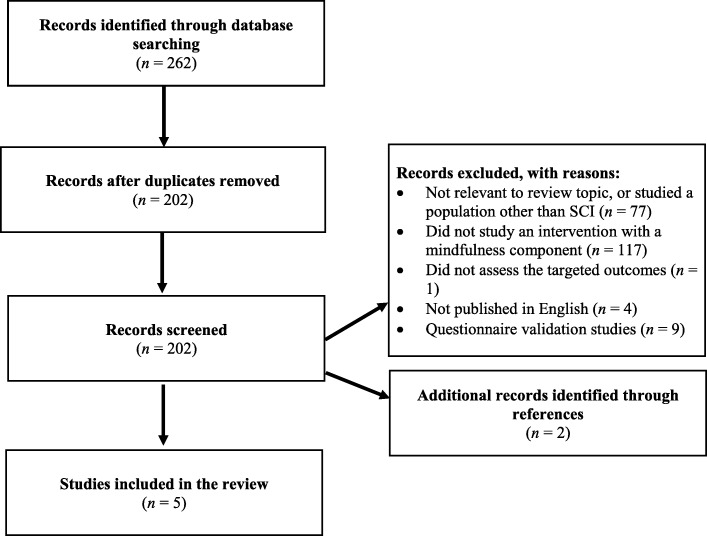
- The search (1996 to October 2018, updated January 2020) identified 262 articles, but only 5 papers met inclusion criteria; sample sizes in the included studies ranged from 2 to 67.
- For pain, only 1 of 4 studies reporting pain outcomes found significant improvements, specifically in pain unpleasantness and pain catastrophising immediately post-intervention, with follow-up improvement in catastrophising; the other 3 studies reported no change, and pain intensity did not improve in any study.
- For depression, all studies measured it; 4 studies reported reductions and 2 studies reported significant reductions with medium-to-large effects (e.g. η2p = .184 immediately post-intervention and η2p = .223 at three-month follow-up in one study).
- For anxiety, 3 of 4 studies showed reductions, but only 1 study reported statistical support with medium-to-large effects (η2p = .137 immediately post-intervention and η2p = .112 at three-month follow-up).
- Quality of life was assessed in only 2 studies, and neither reported improvement; no included study reported adverse events.
Methods
- Systematic review of all study designs (randomized and non-randomized) in adults with SCI, including interventions where mindfulness was the whole intervention or a component, and outcomes of pain, depression, anxiety, or QoL.
- Searched PsycINFO, PsycARTICLES, and MEDLINE from 1996 to October 2018 with an update in January 2020; reference lists were also screened.
- Quantitative and qualitative evidence were extracted; study quality was appraised using the Cochrane Risk of Bias Tool for randomized studies and the EPHPP Quality Assessment Tool for non-randomized studies, with two assessors showing good agreement (Cohen’s k = .848, p < .001).
Limitations
- The paper states that the included studies had major methodological differences, small sample sizes, and inconsistent outcome measures, which limits generalisability.
- The paper states that two studies failed to provide statistical results supporting their findings, and only one study reported comprehensive statistics; this weakens confidence in the results.
- Evident from the text: the review is based on only 5 studies, and only 1 randomized controlled trial used an intervention solely dedicated to mindfulness, so the evidence base is very small and preliminary.
Model-written summary. Check it against the paper before relying on it.
Integrity signals
Registry
Cites
Statistics
Figures
Verification
Claims the paper makes
17 Valid · 2 Not valid · 11 Not checked · 23 Own results and interpretations
The cited sources support only part of this claim — read each source’s verdict below.
In the paper
“Indeed, qualitative evidence suggests that people with SCI want better access to psychological interventions [5]”
§ Mindfulness for pain, depression, anxiety, and quality of life in people with spinal cord injury: a systematic review > Background
What the sources say
- Partly supportedcites [5] Hearn JH Cotter I Fine P Finlay KA Living with chronic neuropathic pain after spinal cord injury: an interpretative phenomenological analysis of community experience Disabil Rehabil 2015 37 23 2203 2211 10.3109/09638288.2014.1002579 25601144 sourceExperimental — accuracy not yet measured
The discussion (p. 21) says participants wanted treatment that acknowledged their distress and life restrictions, and suggests acceptance-based therapies as a possible intervention. It does not establish that participants specifically wanted better access to psychological interventions; that is the authors’ proposed response, not a reported request. (LLM, conf=0.84)
hedged- Asserted: passes — The authors put it forward as true.
- Checkable: passes — It can be checked against evidence.
- Load-bearing: passes — The paper’s conclusions depend on it.
- Based: passes — The paper gives a reason why it holds.
- Partly supported
The cited sources support only part of this claim — read each source’s verdict below.
In the paper
“Such non-adherence may arise from the requirement of active, self-motivated participation, which may act as a barrier to engagement [29].”
§ Mindfulness for pain, depression, anxiety, and quality of life in people with spinal cord injury: a systematic review > Discussion
What the sources say
- Partly supportedcites [29] Melville KM Casey LM Kavanagh DJ Dropout from internet-based treatment for psychological disorders Br J Clin Psychol 2010 49 455 471 10.1348/014466509X472138 19799804 sourceExperimental — accuracy not yet measured
The Conclusions section says insufficient motivation may reduce compliance with treatment tasks and increase the risk of dropping out. That supports the proposed barrier, but the paper discusses internet-based psychological treatment specifically, while the claim extends it to psychological interventions generally. (LLM, conf=0.82)
hedgedstates a possible cause- Asserted: passes — The authors put it forward as true.
- Checkable: passes — It can be checked against evidence.
- Load-bearing: unclear — It is unclear whether the paper’s conclusions depend on it.
- Based: passes — The paper gives a reason why it holds.
- Partly supported
Every source the paper cites for this claim was checked and supports it.
In the paper
“Of the four studies reporting on pain and pain-related outcomes, only one reported significant improvement in pain unpleasantness and pain catastrophising as a result of intensive mindfulness training immediately post-intervention [20]”
§ Mindfulness for pain, depression, anxiety, and quality of life in people with spinal cord injury: a systematic review > Results > Intervention effects
What the sources say
- Supportedcites [20] Hearn JH Finlay KA Internet-delivered mindfulness for people with depression and chronic pain following spinal cord injury: a randomized, controlled feasibility trial Spinal Cord 2018 56 750 761 10.1038/s41393-018-0090-2 29581519 source
The Effect of the intervention section reports significant improvements in both pain unpleasantness and pain catastrophizing in the mindfulness group at T2, the post-intervention assessment. The four-study comparison is the citing authors’ framing; this paper supports the finding attributed to the cited trial. (LLM, conf=0.91)
plain- Asserted: passes — The authors put it forward as true.
- Checkable: passes — It can be checked against evidence.
- Load-bearing: passes — The paper’s conclusions depend on it.
- Based: passes — The paper gives a reason why it holds.
- Supported
Every source the paper cites for this claim was checked and supports it.
In the paper
“One study demonstrated no change [23].”
§ Mindfulness for pain, depression, anxiety, and quality of life in people with spinal cord injury: a systematic review > Results > Intervention effects
What the sources say
- Supportedcites [23] Curtis KJB Hitzig SL Bechsgaard G Stoliker C Alton C Saunders N Leong N Katz J Evaluation of a specialized yoga program for persons with a spinal cord injury: a pilot randomized controlled trial J Pain Res 2017 10 999 1017 10.2147/JPR.S130530 28496356 PMC5422575 source
The Discussion reports no improvement in anxiety and describes a lack of significant reduction after the yoga intervention. This supports the citing sentence’s characterization of the study as showing no change in anxiety. (LLM, conf=0.92)
boosted- Asserted: passes — The authors put it forward as true.
- Checkable: passes — It can be checked against evidence.
- Load-bearing: unclear — It is unclear whether the paper’s conclusions depend on it.
- Based: passes — The paper gives a reason why it holds.
- Supported
The sources with a verdict support this claim; the rest weren’t checked yet, have no full text we could read, or their verdicts aren’t rated yet.
In the paper
“Weak quality assessments were drawn for the non-randomised studies [6, 21, 22].”
§ Mindfulness for pain, depression, anxiety, and quality of life in people with spinal cord injury: a systematic review > Results > Study quality
What the sources say
- Not checked — no full text of the sourcecites [6] Norrbrink Budh C Kowalski J Lundeberg T A comprehensive pain management programme comprising educational, cognitive and behavioural interventions for neuropathic pain following spinal cord injury J Rehabil Med 2006 38 172 180 10.1080/16501970500476258 16702084 source
- Supportedcites [21] Flores A Linehan MM Todd SR Hoffman HG The use of virtual reality to facilitate mindfulness skills training in dialectical behavioral therapy for spinal cord injury: a case study Front Psychol 2018 9 531 10.3389/fpsyg.2018.00531 29740365 PMC5924802 source
The Discussion (page unavailable) identifies this as two case studies and says case studies are inherently inconclusive and require larger, controlled follow-up studies. That supports citing it as an example of a non-randomised study with methodological limitations; the weak-quality rating is the citing authors’ assessment, not a rating reported by this paper. (LLM, conf=0.86)
- Not matchedcites [22] Curtis KJB Hitzig SL Leong N Wicks CE Ditor DS Katz J Evaluation of a modified yoga program for persons with spinal cord injury Therepeutic Recreation Journal 2015 XLIX 2 97 117
Its entry has no title and year that we can search by.
plain- Asserted: passes — The authors put it forward as true.
- Checkable: passes — It can be checked against evidence.
- Load-bearing: unclear — It is unclear whether the paper’s conclusions depend on it.
- Based: passes — The paper gives a reason why it holds.
22 more claims · 3 with their cited sources checked
Create a free account to see all 53 claims and to verify the 2 references still open.
- It may state two separate claims as one. 23
- Probably not a substantial claim. 7
Claims other papers make about this one
Each is checked against this paper’s own text: does it say what the citing paper says it does?
The source backs part of the claim, not all of it — or backs it for a different population, condition or comparison.
In the citing paper
“Additionally, a 2020 systematic review of 5 interventions involving mindfulness components delivered to individuals with SCI reported some support for reduced pain, depression, and anxiety.”
From Feasibility, Acceptability, and Efficacy of Mindfulness Training in People With Upper Motor Neuron Disorders: A Systematic Review (2022) · cites this paper as [62]
Experimental — accuracy not yet measuredThe source backs part of the claim, not all of it — or backs it for a different population, condition or comparison.
In the citing paper
“additional review of the feasibility and acceptability of MBIs and participant adherence with MBIs in these populations would add to the existing literature and serve to inform the development and implementation of future MBIs.”
From Feasibility, Acceptability, and Efficacy of Mindfulness Training in People With Upper Motor Neuron Disorders: A Systematic Review (2022) · cites this paper as [62]
Experimental — accuracy not yet measuredThe source backs part of the claim, not all of it — or backs it for a different population, condition or comparison.
In the citing paper
“This is similar to the effects of MBIs on depression, anxiety, and fatigue seen in a meta-analysis of patients with MS, BI, and SCI.60,62,117,119”
From Feasibility, Acceptability, and Efficacy of Mindfulness Training in People With Upper Motor Neuron Disorders: A Systematic Review (2022) · cites this paper as [62]
Experimental — accuracy not yet measuredThe source backs part of the claim, not all of it — or backs it for a different population, condition or comparison.
In the citing paper
“mindfulness has been shown to have positive psychological and physical health benefits for a significant number of chronic health conditions, including Spinal Cord Injury (SCI) [8], Multiple Sclerosis (MS) [9], Chronic Obstructive Pulmonary Disease [10], Parkinson’s Disease [11], stroke and traumatic brain injury [12].”
From Grieving a disrupted biography: an interpretative phenomenological analysis exploring barriers to the use of mindfulness after neurological injury or impairment (2021) · cites this paper as [8]
Experimental — accuracy not yet measuredThe source backs part of the claim, not all of it — or backs it for a different population, condition or comparison.
In the citing paper
“the sensation-focused language used in Mindfulness-based Stress Reduction (MBSR) and Mindfulness-based Cognitive Therapy (MBCT) [16] and lack of condition-specific health self-management in manualised MBSR meant that participants felt that MBSR was not adequately adapted to MS or SCI [8, 14].”
From Grieving a disrupted biography: an interpretative phenomenological analysis exploring barriers to the use of mindfulness after neurological injury or impairment (2021) · cites this paper as [8]
Experimental — accuracy not yet measured
8 more claims about this paper
Create a free account to see every claim other papers make about this one.
Citations
Cites
(2008) · Medical Entomology and Zoology · Cited by 7,477
Mindfulness training as a clinical intervention: a conceptual and empirical review
Baer, R. A. (2003) · Clinical Psychology: Science and Practice · doi:10.1093/clipsy.bpg015 · Cited by 4,577
Mindfulness training as a clinical intervention: A conceptual and empirical review.
Baer, R. A. (2003) · Clinical Psychology: Science and Practice · doi:10.1093/clipsy/bpg015 · Cited by 4,576
Shapiro, S. L., Carlson, L. E., Astin, J. A., & Freedman, B. (2006) · Journal of Clinical Psychology · doi:10.1002/jclp.20237 · Cited by 4,002
Ecological Momentary Assessment (Ema) in Behavioral Medicine
Stone, A. A., & Shiffman, S. (1994) · Annals of Behavioral Medicine · doi:10.1093/abm/16.3.199 · Cited by 1,931
Ma, S. H., & Teasdale, J. D. (2004) · Journal of Consulting and Clinical Psychology · doi:10.1037/0022-006x.72.1.31 · Cited by 1,390
Dropout from Internet‐based treatment for psychological disorders
Melville, K. M., Casey, L. M., & Kavanagh, D. J. (2010) · British Journal of Clinical Psychology · doi:10.1348/014466509x472138 · Cited by 597
American Spinal Injury Association 1989
(1990) · The Journal of The American Paraplegia Society · doi:10.1080/01952307.1990.11735804 · Cited by 419
Prevalence of Depression After Spinal Cord Injury: A Meta-Analysis
Williams, R., & Murray, A. (2015) · Archives of Physical Medicine and Rehabilitation · doi:10.1016/j.apmr.2014.08.016 · Cited by 320
Kingston, J., Chadwick, P., Meron, D., & Skinner, T. C. (2007) · Journal of Psychosomatic Research · doi:10.1016/j.jpsychores.2006.10.007 · Cited by 218
Cited by
Gkintoni, E., Vassilopoulos, S. P., & Νικολάου, Γ. (2025) · Journal of Clinical Medicine · doi:10.3390/jcm14051703 · Cited by 140
Ortega, M. A., Fraile‐Μartinez, O., Montero, C. G., Haro, S., Álvarez-Mon, M. Á., León-Oliva, D. D., Gomez-Lahoz, A. M., Monserrat, J., Atienza-Pérez, M., Díaz, D., et al. (2023) · Military Medical Research · doi:10.1186/s40779-023-00461-z · Cited by 77
Ferroptosis is a new therapeutic target for spinal cord injury
Bai, X., Liu, X., Deng, Z.-Z., Wei, D.-M., Zhang, D., Xi, H.-L., Wang, Q.-Y., He, M.-Z., & Yang, Y.-L. (2023) · Frontiers in Neuroscience · doi:10.3389/fnins.2023.1136143 · Cited by 39
“In addition, SCI is associated with a higher incidence of psychological disorders such as depression and anxiety than the general population (Hearn and Cross, 2020).”
BackgroundEller, O. C., Willits, A., Young, E. E., & Baumbauer, K. M. (2022) · Frontiers in Pain Research · doi:10.3389/fpain.2022.991736 · Cited by 35
“, on the use of mindfulness-based interventions in individuals with SCI pain found a variation in results on this therapy’s efficacy in the 5 studies reviewed (190).”
BackgroundDavid, S., Aroke, A., Roy, N., Solomon, H. S., Lundborg, C. S., & Wärnberg, M. G. (2021) · Injury · doi:10.1016/j.injury.2021.10.012 · Cited by 29
The role of the insula in chronic pain following spinal cord injury: A resting‐state fMRI study
Mandloi, S., Syed, M., Shoraka, O., Ailes, I., Kang, K. C., Sathe, A., Heller, J. E., Thalheimer, S., Mohamed, F. B., Sharan, A. D., et al. (2023) · Journal of Neuroimaging · doi:10.1111/jon.13117 · Cited by 23
Bhattarai, M., Smedema, S. M., Hoyt, W. T., & Bishop, M. L. (2022) · Health and Quality of Life Outcomes · doi:10.1186/s12955-022-02059-w · Cited by 22
Mohammadi, F., Oshvandi, K., Bijani, M., Borzou, S. R., Khodaveisi, M., & Masoumi, S. Z. (2022) · BMC Psychology · doi:10.1186/s40359-022-00909-2 · Cited by 26
“Studies of patients with hard-to-treat diseases show that to preserve the health and psychological security of these patients and their families, caregivers and the whole of society should treat them with respect and avoid stigmatizing them or pitying them [25, 27].”
BackgroundOnline Mindfulness Experience for Emotional Support to Healthcare staff in times of Covid-19
Castillo-Sánchez, G., Sacristán-Martín, O., Hernández, M. A., Muñoz, I., Díez, I. D. L. T., & Franco, M. (2022) · Journal of Medical Systems · doi:10.1007/s10916-022-01799-y · Cited by 15
Shahsavari Googhari, Z., Hafezi, F., Asgari, P., & Heidari, A. (2022) · Journal of Shahrekord University of Medical Sciences · doi:10.34172/jsums.2022.07 · Cited by 15
“The results revealed the significant effects of MBCT on subjective well-being, psychological distress, and emotion regulation, which is consistent with the research results of Cotton et al (33), and Hearn and Cross (34).”
ResultHuang, Y., Li, S., Chen, H., Feng, L., Yuan, W., & Han, T. (2022) · Experimental and Therapeutic Medicine · doi:10.3892/etm.2022.11151 · Cited by 16
“SCI is a destructive neurological and pathological state that can severely affect the quality of life of patients (25).”
BackgroundHearn, J. H., Finlay, K. A., & Sheffield, D. (2021) · British Journal of Health Psychology · doi:10.1111/bjhp.12462 · Cited by 15
“A recent review of mindfulness-based interventions for people with SCI, however, concluded that further evidence is required to demonstrate efficacy of such interventions and explore their suitability for people with neurological conditions (Hearn & Cross, 2020).”
BackgroundSelf-citationSzeliga, E., Borys, R., Brzozowska-Magoń, A., Wolan-Nieroda, A., Magoń, G., & Walicka-Cupryś, K. (2022) · International Journal of Environmental Research and Public Health · doi:10.3390/ijerph19031787 · Cited by 17
“Regular exercise and participation in sports activities contribute to better mental functioning [12,13] as well as to higher levels of life satisfaction and improvement in the quality of life [13–15].”
BackgroundLi, Y., Li, M., Bressington, D., Li, K., Wong, A. Y., Chung, W. M., Molassiotis, A., Ma, C. Z.-H., Kor, P. P. K., & Yeung, W. F. (2024) · Archives of Physical Medicine and Rehabilitation · doi:10.1016/j.apmr.2024.05.017 · Cited by 13
Integrated Neuroregenerative Techniques for Plasticity of the Injured Spinal Cord
Leemhuis, E., Favieri, F., Forte, G., & Pazzaglia, M. (2022) · Biomedicines · doi:10.3390/biomedicines10102563 · Cited by 14
“In SCI patients, the presence of clinically relevant depressive conditions is high; additionally, anxiety-related disorders also benefited from mindfulness techniques [101].”
BackgroundLi, Y., Wong, A., Chung, W. M., Li, M., Molasiotis, A., Bressington, D., Ma, C. Z.-H., Kor, P. P. K., & Yeung, W. F. (2023) · PLOS ONE · doi:10.1371/journal.pone.0282846 · Cited by 12
Wiles, M. D., Benson, I., Edwards, L. J., Miller, R., Tait, F., & Wynn-Hebden, A. (2023) · Anaesthesia · doi:10.1111/anae.16198 · Cited by 12
“Psychological support and a holistic and individualised approach to treatment are important, although this is a fi eld in need of more research [61, 62].”
BackgroundHuang, X.-L., Chen, Y.-C., Kuo, C.-C., & Tsai, S. (2022) · Tzu Chi Medical Journal · doi:10.4103/tcmj.tcmj_102_22 · Cited by 13
“SCI is a devastating condition that commonly causes incomplete or complete loss of motor or sensory function below the level of the injury [13].”
Backgroundde Winckel, A. V., Carpentier, S. T., Deng, W., Zhang, L., Philippus, A. H., Battaglino, R. A., & Morse, L. R. (2023) · Frontiers in Physiology · doi:10.3389/fphys.2023.1222616 · Cited by 12
“, 2021) reported pain reduction but without mentioning the type of pain (Tsang et al., 2015; Shem et al., 2016; Curtis et al., 2017; Qi et al., 2018; Madhusmita and Ebnezar, 2019; Hearn and Cross, 2020; Chalageri et al., 2021).”
BackgroundSharma, A., Feng, L., Muresanu, D. F., Huang, H., Menon, P. K., Sahib, S., Tian, Z. R., Lafuente, J. V., Buzoianu, A. D., Nozari, A., et al. (2021) · Progress in brain research · doi:10.1016/bs.pbr.2021.06.013 · Cited by 13
Depression Prevention by Mutual Empathy Training: Using Virtual Reality as a Tool
Li, Y. J., & Luo, H. (2021) · IEEE Conference on Virtual Reality and 3D User Interfaces Abstracts and Workshops (VRW) · doi:10.1109/vrw52623.2021.00017 · Cited by 14
“Inspired by the concept used in cognitive behavioral therapy (CBT) [15,16,27] and mindfulness-based intervention [10,13,22], and also under the advice of counselors, a game flow is designed for training cognitive behavior with an upward spiral process, which is depicted by Fig.”
MethodParker, M. A., Ichikawa, J. K., Bombardier, C. H., & Hammond, F. M. (2022) · Archives of Rehabilitation Research and Clinical Translation · doi:10.1016/j.arrct.2022.100211 · Cited by 16
“While life satisfaction has been associated with mental health concerns,(20) prior research on depression and/or anxiety generally has not considered life satisfaction.(13,21,22) However, 1 study in Sweden found higher levels of anxiety and depression associated with decreased life satisfaction in a mailed survey of t…”
BackgroundAcute Management of Cervical Spinal Cord Injuries
Hunt, A., & McQuillan, K. A. (2023) · Critical Care Nursing Clinics of North America · doi:10.1016/j.cnc.2023.02.004 · Cited by 9
Post-traumatic stress disorder symptoms and pain intensity in persons with spinal cord injury
Kuiper, H., van Leeuwen, C. M. C., Kopsky, D. J., Stolwijk-Swüste, J. M., & Post, M. W. M. (2021) · Spinal Cord · doi:10.1038/s41393-020-00599-w · Cited by 12
Korupolu, R., Malik, A., Ratcliff, C., Robinson-Whelen, S., & Taylor, H. B. (2022) · Archives of Physical Medicine and Rehabilitation · doi:10.1016/j.apmr.2022.05.020 · Cited by 8
Meshkini, A., Ohadi, M. A. D., Mirghaderi, P., Mirzaei, F., Rafiei, E., Allahyari, N., Namvar, M., & Iranmehr, A. (2023) · Interdisciplinary Neurosurgery · doi:10.1016/j.inat.2023.101883 · Cited by 8
Fiani, B., Runnels, J., Taylor, A., et al. (2020) · Reviews in the Neurosciences · doi:10.1515/revneuro-2020-0080 · Cited by 8
The impact of neurological disability and sensory loss on mindfulness practice
Finlay, K. A., Hearn, J. H., & Chater, A. (2022) · Disability and Rehabilitation · doi:10.1080/09638288.2021.1887946 · Cited by 8
“multidisciplinary interventions for patients with changed neurological functioning [9].”
BackgroundSelf-citationReilly, A., Sharif, A., Bhagra, O., Dominari, A., Katsos, K., Nathani, K. R., Johnson, S. E., & Bydon, M. (2025) · Clinical Neurology and Neurosurgery · doi:10.1016/j.clineuro.2025.108839 · Cited by 8
A Systematic Review of Yoga Interventions on the Mental Health of Nursing Professionals and Students
Arya, R. G., Srivastava, D., Divya, B. R., Madhu, M., & Bhargav, H. (2025) · International Journal of Yoga · doi:10.4103/ijoy.ijoy_195_24 · Cited by 23
Finlay, K. A., Hearn, J. H., & Chater, A. (2021) · BMC Psychology · doi:10.1186/s40359-021-00628-0 · Cited by 6
“These psychological barriers are held in tension with the clear research base suggesting that mindfulness may enhance variables associated with quality of life, from reduced stress [9], fatigue [3], depression and anxiety [8], to enhanced resilience [23] and self-compassion [24].”
BackgroundMethodInfluentialSelf-citationHan, A., Wilroy, J. D., Jenkins, J., & Yuen, H. K. (2023) · Disability and Rehabilitation · doi:10.1080/09638288.2022.2038283 · Cited by 10
Xi, B., Fu, J., Wan, D., & Xie, Z. (2023) · Neuroreport · doi:10.1097/wnr.0000000000001891 · Cited by 6
Perret, C., Käch, M., Hertig-Godeschalk, A., & Ammann, F. (2024) · European Journal of Applied Physiology · doi:10.1007/s00421-024-05486-3 · Cited by 6
“…training to enhance exercise performance based on specific strength and power improvements (Beattie et al. 2014; Cormie et al. 2011; McGuigan et al. 2012), patients mainly aim to gain or regain function and mobility leading to a higher quality of life (Hearn and Cross 2020; Perret et al. 2022).”
Mindfulness for health and wellbeing in adults with spinal cord injury: A scoping review
Bhattarai, M., Shigemoto, Y., Huang, Y.-C., Islam, M. T., & Sorenson, M. (2025) · The Journal of Spinal Cord Medicine · doi:10.1080/10790268.2024.2374130 · Cited by 6
“Some existing research supports the positive effects of mindfulness or mindfulness-based intervention as a self-care tool in managing secondary complications (e.g. chronic pain, anxiety, depression) and improving well-being outcomes in persons with SCI (19–22).”
Empathy Games for Depression Using Virtual Reality: A Literature Review and A Study Design
Li, Y., Luo, H., & Zhang, C. (2021) · Hawaii International Conference on System Sciences (HICSS) · doi:10.24251/hicss.2021.488 · Cited by 6
Sari, D. K., Nababan, R. H., & Daulay, W. (2023) · Jurnal Kesehatan · doi:10.46815/jk.v12i1.118 · Cited by 32
Exosome-based therapeutic approach for spinal cord injury: A review
Bai, S., Qiang, R. R., Liu, R. Y., Kang, D. J., & Yang, Y. L. (2025) · Molecular and Cellular Neuroscience · doi:10.1016/j.mcn.2025.104048 · Cited by 6
Bhattarai, M., McDaniels, B. W., Jin, Y., & Smedema, S. M. (2023) · Journal of Clinical Psychology · doi:10.1002/jclp.23616 · Cited by 9
Abrams, S. K., Rabinovitch, B. S., Zafar, R. R., Aziz, A. S., Cherup, N. P., McMillan, D. W., Nielson, J. L., & Lewis, E. C. (2023) · Neurotrauma Reports · doi:10.1089/neur.2023.0022 · Cited by 7
Li, M., Lo, W. Y., Hu, Y., Wang, S., Sun, T.-C., Temesgen, W. A., He, M., & Li, Y. (2025) · Spinal Cord · doi:10.1038/s41393-025-01068-y · Cited by 5
“A recent narrative systematic review focused on the effects of mindfulness-based interventions on anxiety, depression, pain, and quality of life among people with SCI [6].”
InfluentialMindfulness Based Sufism Intervention: Systematic Literature Review
Rejeki, S., Haryono, H., Sunawan, S., Mulawarman, M., & Hakim, A. R. (2025) · Ethics Medicine and Public Health · doi:10.1016/j.jemep.2025.101180 · Cited by 4
Choukas, N. R., Mace, R. A., Rochon, E. A., Brewer, J. R., & Vranceanu, A. (2023) · Archives of Gerontology and Geriatrics · doi:10.1016/j.archger.2023.105290 · Cited by 5
Xie, Z., Xu, T., Chen, J., Gui, Y., Wan, D., & Li, M. (2025) · ACS Chemical Neuroscience · doi:10.1021/acschemneuro.4c00413 · Cited by 4
Damico, V., Milani, M., & Murano, L. (2025) · Pain Management Nursing · doi:10.1016/j.pmn.2025.02.010 · Cited by 7
Liang, L.-Y., & Shek, D. T. L. (2024) · Applied Research in Quality of Life · doi:10.1007/s11482-024-10305-0 · Cited by 6
“With reference to the literature (Beauchamp et al., 2023; Cui, 2016; Hearn & Cross, 2020; Huang et al., 2017; Liu, 2017; Niu et al., 2022; Mir et al., 2023; Pradhan et al., 2007; Zhao, 2018), we expected that there would be reduction in depression and anxiety in people with PD after they join MBI…”
Daoud, A. K., Nasser, Z., Elias, C., et al. (2024) · Quality of Life Research · doi:10.1007/s11136-024-03650-y · Cited by 4
“This leads to a reduction in chronic pain, functional limitations, anxiety, and depression while also improving mental health, QoL, and various positive rehabilitation outcomes [52, 53].”
Are we doing enough? Lifestyle interventions for enhancing spine health
Choueiri, J. E., Pellicanò, F., Laurelli, F., et al. (2024) · Journal of Clinical Neuroscience · doi:10.1016/j.jocn.2024.111023 · Cited by 4
Espindula, P. A. V., Bastone, A. D. C., & Santos, A. P. (2023) · Journal of Spinal Cord Medicine · doi:10.1080/10790268.2023.2183327 · Cited by 3
“36 One in five individuals with SCI have depression, and this condition interferes with daily activities.”
Ricciardi, L., Lofrese, G., Perna, A., & Trungu, S. (2022) · IntechOpen eBooks · doi:10.5772/intechopen.98082 · Cited by 3
CE: Pain and Mental Health Symptoms After Traumatic Orthopedic Injury
Breazeale, S., Barrett, S., Holland, W., & Webb, M. (2022) · AJN American Journal of Nursing · doi:10.1097/01.naj.0000873444.48723.48 · Cited by 2
de Groot, S., Ettema, F. W. L., van Leeuwen, C. M. C., Achterberg, W. P., Janssen, T. W. J., & Hoekstra, S. P. (2023) · International Journal of Environmental Research and Public Health · doi:10.3390/ijerph20186784 · Cited by 2
“Stress reduction, following breathing and mindset exercises could also have an effect on spasticity and pain in people with SCI [16].”
BackgroundInfluentialGérard, M., Charvier, K. F., Leduc, H., & Courtois, F. J. (2023) · The Journal of Sex Research · doi:10.1080/00224499.2023.2260816 · Cited by 6
“In fact, the generic wording of mindfulness instruments has been identified as a barrier to the use of mindfulness with SCI individuals (Finlay et al., 2022; Hearn & Cross, 2020; Hearn et al., 2021).”
Tănase, I., Stoica, S. I., & Prada, G. I. (2024) · Balneo and PRM Research Journal · doi:10.12680/balneo.2024.735 · Cited by 2
Halalmeh, D. R., Salama, H. Z., Alnajjar, Y. A., Salama, A. Z., Waack, A. L., Ansari, Y.-Z., & Moisi, M. D. (2025) · World Neurosurgery · doi:10.1016/j.wneu.2025.123679 · Cited by 3
de Winckel, A. V., Zhang, L., Lim, K. O., Morse, L. R., Woodliff, B., Maestre, G. E., & Baker, K. (2025) · JMIR Research Protocols · doi:10.2196/82431 · Cited by 2
Pain medication misuse in the South African spinal cord injury context
Mashola, M. K., Korkie, E., & Mothabeng, J. (2024) · Health SA Gesondheid · doi:10.4102/hsag.v29i0.2377 · Cited by 2
“…but also appropriate techniques accommodated by the biopsychosocial model, such as pain neuroscience education (Wijma et al. 2016), therapeutic and psychological interventions such as physiotherapy, and cognitive behavioural therapy respectively (Van Straaten et al. 2017; Hearn & Cross 2020).”
MethodBhattarai, M., Smedema, S. M., Hoyt, W. T., et al. (2022) · Research Square · doi:10.21203/rs.3.rs-1396696/v1 · Cited by 2
Hoekstra, S. P., Ettema, F. W. L., van der Bijll, M., van der Sterren, V., van Binsbergen, E., van Orsouw, L., Achterberg, W. P., Daanen, H. A. M., Janssen, T. W. J., & de Groot, S. (2024) · Spinal Cord · doi:10.1038/s41393-024-00976-9 · Cited by 1
“In addition, the breathing exercises and cold exposure require focus and attention (i.e., the mindset component of WHM); a type of mindfulness that when practiced repeatedly may help manage some of the complications commonly associated with SCI (e.g. chronic pain and perceived stress) [2, 7].”
Factors Predicting the Quality of Life of Persons with Spinal Cord Injuries
Kim, T., Cho, K. H., Kim, B., & Park, S. (2024) · Journal of Korean Academy of Fundamentals of Nursing · doi:10.7739/jkafn.2024.31.3.286 · Cited by 2
Zhang, J., Qi, L., Sun, Y., Chen, S., Liu, J., Chen, J., Yan, F., Wang, W., Wang, Q., & Chen, L. (2025) · Frontiers in Cellular Neuroscience · doi:10.3389/fncel.2025.1457740 · Cited by 3
Sarabandi, R., Rashtabadi, O. R., Mehdipour‐Rabori, R., & Ahmadi, A. (2025) · Journal of Spinal Cord Medicine · doi:10.1080/10790268.2025.2555661 · Cited by 1
“Spinal cord injury (SCI) occurs when the spinal cord is damaged due to disease or trauma, often leading to the complete or partial loss of sensory and motor function below the lesion (1).”
InfluentialATF3 enhancement of CHAC1 expression: A pathway to neuronal ferroptosis in spinal cord injury
Wang, C., Liu, C., Wang, J., Ye, Y., & Zhang, Z. (2025) · Brain Research Bulletin · doi:10.1016/j.brainresbull.2025.111568 · Cited by 1
Akar, Z. A., Karakoç, M., Sarıyıldız, M. A., Batmaz, Ö. U., & Çevik, R. (2025) · Medicina · doi:10.3390/medicina61112047 · Cited by 2
“This observation is consistent with previous research highlighting the interplay between pain and anxiety in individuals with SCI [27].”
Sexual status of female systemic lupus erythematosus patients: A qualitative study
Xia, X.-Y., Liu, S.-T., Song, Z.-C., Chen, P.-L., Hao, M., Hu, J., Yang, F., & Zhao, W. (2026) · Lupus · doi:10.1177/09612033261429133 · Cited by 1
“…should strengthen the psychological assessment of patients, identify their negative emotions promptly, and provide practical psychological guidance and interventions, such as short-course power orientation psycho-therapy, 35 mindfulness-based interventions, 36 and emotional release therapy.”
Telerehabilitation for Integrative Health
Ratcliff, C. G., Bonthala, S., Torres, D., & Korupolu, R. (2022) · Elsevier eBooks · doi:10.1016/b978-0-323-82486-6.00015-0 · Cited by 3
de Winckel, A. V., Carpentier, S. T., Deng, W., Zhang, L., Philippus, A., Monden, K. R., Battaglino, R. A., & Morse, L. R. (2024) · Archives of Physical Medicine and Rehabilitation · doi:10.1016/j.apmr.2024.02.254 · Cited by 1
Prevalence and Interventions for Behavioral Pathology in Spinal Cord Injury
Rai, B., Singh, V., Sutar, R. F., & Agrawal, A. (2024) · Indian Journal of Neurotrauma · doi:10.1055/s-0044-1779429 · Cited by 1
“58 Another study by Bhattarai et al showed that mindfulness uniquely contributed to the higher quality of life above and beyond sociodemo-graphic and injury-related variables.”
BackgroundPostoperative anticipatory anxiety between women and men in patients with spinal cord injury
Tănase, I., Stoica, S. I., & Prada, G. I. (2024) · Balneo and PRM Research Journal · doi:10.12680/balneo.2024.734 · Cited by 1
“With the consent of the Ethics Commission of the "Bagdasar Arseni" Hospital, we studied 264 patients hospitalized in the Neurosurgery Clinic 2 of the "Bagdar Arseni" Hospital for acute spinal cord injuries in 2 groups of patients with and without CBT psychotherapy.”
InfluentialSharma, A., Muresanu, D. F., Tian, Z. R., Nozari, A., Lafuente, J. V., Buzoianu, A. D., Sjöquist, P.-O. B., Feng, L., Wiklund, L., & Sharma, H. S. (2023) · Advances in neurobiology · doi:10.1007/978-3-031-32997-5_5 · Cited by 1
Psychological Tools to Assist Your Practice
Brownstone, N. D., Myers, B. A., & Howard, J. (2021) · Wiley eBooks · doi:10.1002/9781119680116.ch18 · Cited by 1
Szeliga, E., Borys, R., Brzozowska-Magoń, A., Wolan-Nieroda, A., Magoń, G., & Walicka-Cupryś, K. (2021) · Research Square · doi:10.21203/rs.3.rs-848379/v1
Tanajura, N. P. M., Santana, E. G. D., Flôres, G. L. F., Silva, D. L., Pereira, W. S., Ferreira, Y. L. M., Reis, B. D. S., Batista, L. B., Gomes, M. C. A., & Soares, I. A. (2022) · Revista Eletrônica Acervo Saúde · doi:10.25248/reas.e9699.2022
Impulsivity and reduced quality of life in persons with paraplegia
Bjork, J. M., Perrin, P. B., Plonski, P. E., Vassileva, J., & Goetz, L. L. (2022) · Neurorehabilitation · doi:10.3233/nre-220115
“Finally, mindfulness interventions in SCI have shown greater efficacy for reducing depression than reducing pain (Hearn & Cross, 2020), suggesting the utility of this intervention in SCI populations defined more by negative affect.”
Xie, Z., Xi, B., Fu, J., & Wan, D. (2022) · Research Square · doi:10.21203/rs.3.rs-1713893/v2
Spinal Cord Stimulation for Spinal Cord Injury
Isagulyan, E. D., Mikhailova, V., & Ilyinskiy, N. О. (2022) · IntechOpen eBooks · doi:10.5772/intechopen.105005
Ong, W., Wen, L. H., Azizan, A., et al. (2023) · doi:10.2196/preprints.55656
Ping, Y., Zhu, S., Koval, O., Zhao, Y., & Yu, J. (2024) · IEEE International Conference on Software Quality, Reliability and Security Companion (QRS-C) · doi:10.1109/qrs-c63300.2024.00103 · Cited by 1
“Diseases such as stroke, spinal cord injury, and others can result in disabilities[3], hemiplegia[4], motor impairments[5], postoperative functional deficits, and other issues, necessitating appropriate intervention measures or medical rehabilitation methods.”
BackgroundLiao, J., Yang, Z., Wu, B., et al. (2024) · Neurorehabilitation · doi:10.1177/10538135241296385
“( viii)Psychological factors: SCI patients may experience psychological and emotional distress, including anxiety and depression (Hearn & Cross, 2020).”
Study on neural stem cells and spinal cord injury: Based on bibliometric analysis
Wang, B. (2025) · New cell · doi:10.61958/ncjh8635
Mindfulness Meditation: A Hellenic Perspective Through Quantitative and Qualitative Study
Callifronas, M. D., & Kaltsouni, A. (2025) · Journal of Advances in Medicine and Medical Research · doi:10.9734/jammr/2025/v37i15706
Li, M., Mei, X., Li, Y., Yorke, J., Sun, T.-C., Wang, Y., Tran, Y., & Craig, A. R. (2025) · Disability and Rehabilitation · doi:10.1080/09638288.2025.2491120
“In terms of physiological or environmental aspects, mindfulness may show no significant buffering effects on physical and social well-being [27].”
InfluentialKolaç, N., Taylan, S., & Özkan, İ. (2025) · Scandinavian Journal of Caring Sciences · doi:10.1111/scs.70100
Luong, D., Lee, T. J., Simpson, R., Fetterly, M.-J., Jaglal, S. B., Allin, S. J., Craven, C., Hearn, J. H., Webster, F., & Munce, S. (2025) · Disability and Rehabilitation · doi:10.1080/09638288.2025.2580297
“Online formats of MBIs in particular, may be especially impactful, as they increase the accessibility of the intervention, reducing transportation/travel burden and allowing individuals to practice in the comfort of their home [12,13,22,23].”
InfluentialSelf-citationUsing MMG to Assist Functional Classification in Wheelchair Rugby Athletes *
Santos, K. M. M., Vara, M. F. F., Santos, E. L. D., et al. (2025) · doi:10.1109/embc58623.2025.11252915
“SCI causes paralysis, limits physical activity, and accelerates morbidity and mortality rates [6].”
Ericson, E., Kulawy, R., Phalen, J., Winberg, A., & Moriello, G. (2025) · Journal of aquatic physical therapy /The journal of aquatic physical therapy · doi:10.1097/pxt.0000000000000051 · Cited by 1
Mindfulness Based Cognitive Therapy for Children And Adolescent: A Systematic Review
Karataş, H., & Tok, E. S. S. (2026) · Psikiyatride Guncel Yaklasimlar - Current Approaches in Psychiatry · doi:10.18863/pgy.1742265
Senthilnathan, V., Simpson, R., Jaglal, S. B., Craven, B. C., Fetterly, M.-J., Allin, S. J., Webster, F., Hearn, J. H., Luong, D., & Munce, S. E. (2026) · Disability and Rehabilitation · doi:10.1080/09638288.2025.2612456
“However, given the limited number of studies that assessed MBIs for SCI (five studies), Hearn and Cross emphasized the preliminary nature of their conclusions [22].”
InfluentialSelf-citationde Groot, S., Ettema, F. W. L., van der Bijll, M., Janssen, T. W. J., Achterberg-Warmer, W. J., WHM study group, & Hoekstra, S. P. (2026) · Clinical Rehabilitation · doi:10.1177/02692155261428705
ÖZTÜRK, S., AKYOL, D., & Beyaz, B. (2026) · European Journal of Integrative Medicine · doi:10.1016/j.eujim.2026.102658
Luo, Q., Hong, C., Duan, C., et al. (2026) · Frontiers in Neurology · doi:10.3389/fneur.2026.1725648
“Chronic pain, impaired or lost motor function, social isolation from family and society, and loss of confidence in the future can all lead to emotional disorders in SCI patients (45).”
Quality of life after spinal cord injury: a qualitative interview-based study
Stenimahitis, V., Holmgren, A. G., Gharios, M., et al. (2026) · Spinal Cord Series and Cases · doi:10.1038/s41394-026-00735-3
Occupational health challenges in mining: a study on spinal cord injuries and their impact on miners
Nezhadshahmohammad, F., Akbari‐Gharalari, N., Gilani, S.-O., & Hajihassani, M. (2026) · International Journal of Occupational Safety and Ergonomics · doi:10.1080/10803548.2026.2655554
Li, C., Lai, S., Wang, Y., Zhu, X., Song, S., Lu, D.-Z., Yang, Y., Xu, L., Cai, B., Wang, J., et al. (2026) · Journal of Translational Medicine · doi:10.1186/s12967-026-08340-6
“SCI often leads to the occurrence of pain‒depression comorbidity (PDC) [6, 7].”
Pour, S. S., Mosallanezhad, Z., Azadi, F., Norouzi, M., & Khashaman, F. (2026) · Applied Psychophysiology and Biofeedback · doi:10.1007/s10484-026-09792-8
Wang, S. Y., Luo, N., Jiang, J., Zhu, C., Xiao, Z., Fan, W., Chen, Y., Zhu, X., Hu, X., Xu, W., et al. (2026) · BMC Psychiatry · doi:10.1186/s12888-026-08245-0
“A previous review indicated the efficacy of mindfulness-based interventions in decreasing anxiety/depression and improving the life quality of patients with SCI [199].”
Bhattarai, M., Yuki, S., & Bajracharya, S. (2026) · Archives of Physical Medicine and Rehabilitation · doi:10.1016/j.apmr.2026.07.018
A Chinese Guideline for the Diagnosis and Management of Chronic Post-Traumatic Pain (2023 Edition)
Lü, Y., Cheng, Z., Liu, X., Liu, Q., Liu, J., Yang, X., Suoliang, W., Zeng, G., Zhuang, Z., Shi, C., et al. (2026) · International Journal of Pain Research · doi:10.11648/j.ijpr.20260203.17
Shahaned-Hellaba, T., Khodabakhshi‐Koolaee, A., & Falsafinejad, M. R. (2026) · Preventive Care In Nursing and Midwifery Journal · doi:10.66224/pcnm.16.2.14
Touchett, H. N., Kanzler, K. E., Trost, Z., Lindsay, J., & Skelton, F. (2026) · Frontiers in Digital Health · doi:10.3389/fdgth.2026.1923501
Metadata
- Authors
- Hearn, J. H., & Cross, A.
- Affiliations
- Manchester Metropolitan University (GB)
- University of Derby (GB)
- Corresponding author
- Hearn, Jasmine Heath
- Venue
- BMC Neurology
- Published
- 2020-01-21
- Volume
- 20
- Issue
- 1
- Pages
- 32-32
- ISSN
- 1471-2377 (ISSN-L)
- PMC
- PMC6971852
- OpenAlex
- W3010305229
- Semantic Scholar
- 4c6ffc9d7ef600021e8dc0d46203333194d0c01a
- Cited by
- 99
- References
- 33
- Citations by year
- 2026: 14 · 2025: 22 · 2024: 15 · 2023: 18 · 2022: 19 · 2021: 9 · 2020: 2
- FWCI
- 0.95
- Type
- journal article
- Language
- en
- Open access
- gold
- doi.org
- Licence
- cc-by
- creativecommons.org/licenses/by/4.0/ (tdm)
- creativecommons.org/licenses/by/4.0/ (vor)
- Locations
- BMC Neurology (publishedVersion, cc-by)
- PubMed Central (publishedVersion, cc-by)
- PubMed (publishedVersion)
- e-space (Manchester Metropolitan University) (acceptedVersion)
- University of Derby Online Research Archive. (University of Derby) (submittedVersion, public-domain)
- DOAJ (DOAJ: Directory of Open Access Journals) (submittedVersion)
- Figshare (submittedVersion, cc-by)
- Topics
- Social Sciences › Psychology › Clinical Psychology › Mindfulness and Compassion Interventions
- Health Sciences › Medicine › Clinical Neurology › Spinal Cord Injury Research
- Health Sciences › Medicine › Oncology › Cancer survivorship and care
- Keywords
- mindfulness-based interventions, spinal cord injury, chronic pain, depression, anxiety, quality of life, online mindfulness intervention
- MeSH terms
- Anxiety, Depression, Female, Humans, Male, Quality of Life, Spinal Cord Injuries, Chronic Pain, Mindfulness
About these checks
Registry, retraction, Cites and statistics results are computed, not judged, with one exception: a printed reference that no index lists is read once by a model before it counts as a citation error. Claims are extracted by a model and kept only when their quote appears verbatim in the text; each cited source is then checked, with a model’s help, for whether it says what the claim relies on. Those verdicts can be wrong — read the claim’s quote and the cited source before relying on one.
The claim verdicts this report counts are experimental: their accuracy is not yet measured.
A language model drew the claims from the paper on 2026-10-11, under version 3 of the claim definition (model deepseek-v4.1-flash, prompt extract-v3).
A second model labelled each claim on 2026-10-11 (model jev-1.13-20260917, definition revision gold-guideline-v0.2).
Cited sources are checked with a language model’s help (gpt-6-sol).
Statistics and arithmetic are recomputed, not judged.
Confidence bands are shown only for fields calibrated on our annotated test set. None is calibrated yet, so no band is shown.
What counts as a claim ›How we measure confidence ›How we check this ›
Are you an author, or do you see a problem with this page? Request a review
Data sources
Bibliographic data: Semantic Scholar, OpenAlex, Crossref.
Contains information from the Semantic Scholar Academic Graph Datasets, made available under the ODC Attribution License (ODC-BY 1.0).
Semantic Scholar’s data is described in: Kinney, R., et al. (2023). The Semantic Scholar Open Data Platform. arXiv:2301.10140.
