

Elevated SIRT2 of serum exosomes is positively correlated with diagnosis of acute ischemic stroke patients
Open accessThe DOI matches its Crossref record; 35 of the 39 references it cites were found in a registry or an index.
Abstract
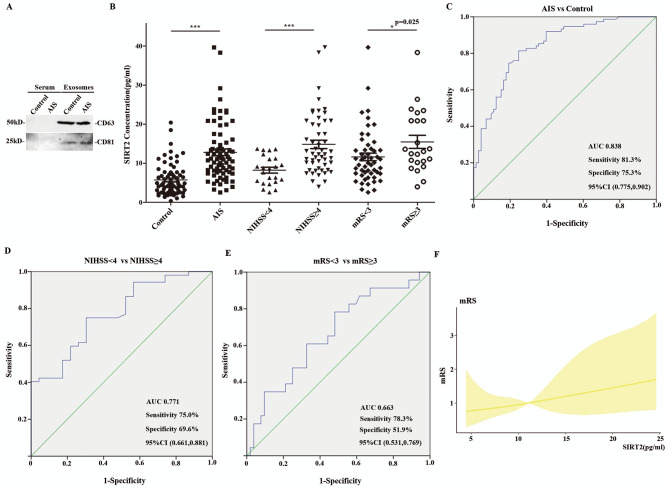
Background: Silent Information Regulator 2 (SIRT2) protein inhibition has been shown to play a neuroprotective role in acute ischemic stroke (AIS) in mice. However, its role in AIS patients has not been fully understood. In this study, we aimed to analyze SIRT2 protein expression in serum exosomes of AIS and non-AIS patients, and evaluate its potential role in diagnosis and prognosis of AIS. Methods: Serum exosomes from 75 non-AIS subjects and 75 AIS patients were isolated. The SIRT2 protein levels in exosomes were analyzed using enzyme linked immunosorbent assay (ELISA). The National Institutes of Health Stroke Scale (NIHSS) was used to evaluate the severity of the disease. The modified Rankin Scale (mRS) was employed to assess the functional outcomes of the patients at 3-months following stroke onset. Results: The SIRT2 protein concentration of serum exosomes were higher in AIS patients than non-AIS patients (p < 0.001). Furthermore, the receiver operative characteristic curve (ROC) demonstrated that higher serum exosome SIRT2 could differentiate AIS patients from non-AIS patients with a sensitivity of 81.3% and a specificity of 75.3%. The area under the curve was 0.838 (95% CI: 0.775, 0.902). Additionally, higher SIRT2 concentration of serum exosomes were associated with NIHSS ≥ 4 (p < 0.001) and mRS ≥ 3 (p = 0.025) in AIS patients. The ROC analysis showed SIRT2 could discriminate stroke with NIHSS ≥ 4 from mild stroke (NIHSS < 4) with a sensitivity of 75.0% and a specificity of 69.6%. The area under the curve was 0.771 (95% CI: 0.661,0.881). Similarly, the test showed SIRT2 could differentiate between AIS patients with mRS ≥ 3 from those with mRS < 3 with a sensitivity of 78.3% and a specificity of 51.9%. The area under the curve was 0.663 (95% CI: 0.531,0.796). The logistic regression analysis revealed that SIRT2 concentration in serum exosomes can independently predict the diagnosis of AIS (odd ratio = 1.394, 95%CI 1.231–1.577, p < 0.001) and higher NIHSS scores (≥ 4) (odd ratio = 1.258, 95%CI 1.084–1.460, p = 0.002). However, it could not independently predict the prognosis of AIS (odd ratio = 1.065, 95%CI 0.983–1.154, p = 0.125). Conclusion: The elevation of SIRT2 in serum exosomes may be a valuable biomarker of AIS, which may be a potential diagnostic tool to facilitate decision making for AIS patients.
Overview
The claims and statistics of this paper haven’t been checked yet.
Free: it reads the open-access text and checks the first 5 claims that cite a source we can check. Create a free account to check every claim.
Integrity signals
Registry
Cites
Statistics
Figures
Verification
Claims the paper makes
The claims and statistics of this paper haven’t been checked yet.
Free: it reads the open-access text and checks the first 5 claims that cite a source we can check. Create a free account to check every claim.
Claims other papers make about this one
Each is checked against this paper’s own text: does it say what the citing paper says it does?
The source backs part of the claim, not all of it — or backs it for a different population, condition or comparison.
In the citing paper
“More recently, Lu and colleagues found that the Silent Information Regulator 2 (SIRT2) protein is higher in the serum EVs of ischemic stroke patients compared to non-ischemic stroke patients [302].”
From Extracellular vesicles as nanotheranostic platforms for targeted neurological disorder interventions (2024) · cites this paper as [302]
Experimental — accuracy not yet measuredThe source backs part of the claim, not all of it — or backs it for a different population, condition or comparison.
In the citing paper
“Circulating EVs have proven to be valuable biomarkers for the early, noninvasive diagnosis of ischemic stroke [301–304].”
From Extracellular vesicles as nanotheranostic platforms for targeted neurological disorder interventions (2024) · cites this paper as [302]
Experimental — accuracy not yet measured
Self-check
Percentages, sums and reported differences re-computed from the paper’s own numbers.
The self-check needs the paper’s full text.
Citations
Cites
Current knowledge on exosome biogenesis and release
Hessvik, N. P., & Llorente, A. (2018) · Cellular and Molecular Life Sciences · doi:10.1007/s00018-017-2595-9 · Cited by 2,362 · cited 1×
“Neural cells derived exosomes could be detected in the cerebrospinal fluid and plasma, making them a more accurate representation of brain activity [18–20].”
BackgroundStroke in China: advances and challenges in epidemiology, prevention, and management
Wu, S., Wu, B., Liu, M., Chen, Z., Wang, W., Anderson, C. S., Sandercock, P., Wang, Y., Huang, Y., Cui, L., et al. (2019) · The Lancet Neurology · doi:10.1016/s1474-4422(18)30500-3 · Cited by 1,589 · cited 1×
“As a result of the occlusion of cerebral blood vessels, patients may suffer from hemiplegia paralysis, aphasia, coma, and even death [1].”
BackgroundSelf-citationThe Human Sir2 Ortholog, SIRT2, Is an NAD+-Dependent Tubulin Deacetylase
North, B. J., Marshall, B. L., Borra, M. T., Denu, J. M., & Verdin, E. (2003) · Molecular Cell · doi:10.1016/s1097-2765(03)00038-8 · Cited by 1,536 · cited 1×
“Silent Information Regulator 2 (SIRT2), a member of the Sirtuins family, is an NAD+-dependent lysine deacetylase [8, 9], which plays a vital role in physical and pathological processes, such as the induction of telomeric silencing, cell mobility, suppression of tumorigenesis, and regulation of longevity [10, 11].”
BackgroundExosomes: composition, biogenesis, and mechanisms in cancer metastasis and drug resistance
Mashouri, L., Yousefi, H., Aref, A. R., Ahadi, A. M., Molaei, F., & Alahari, S. K. (2019) · Molecular Cancer · doi:10.1186/s12943-019-0991-5 · Cited by 1,363 · cited 1×
“These signaling molecules are known to play important roles in mediating communications between cells [21, 31].”
BackgroundPathophysiology and treatment of stroke: present status and future perspectives
Kuriakose, D., & Xiao, Z. (2020) · International Journal of Molecular Sciences · doi:10.3390/ijms21207609 · Cited by 1,350 · cited 1×
“Ischemia and reperfusion (IR), which occur in acute ischemic stroke (AIS), can result in various detrimental effects such as neuroinflammation, peroxidation, and increased permeability of the vessels, apoptosis, necrosis, and blood-brain barrier (BBB) injury [22–24].”
BackgroundSurface functionalized exosomes as targeted drug delivery vehicles for cerebral ischemia therapy
Tian, T., Zhang, H.-X., He, C.-P., Fan, S., Zhu, Y.-L., Qi, C., Huang, N.-P., Xiao, Z.-D., Lu, Z.-H., Tannous, B. A., et al. (2018) · Biomaterials · doi:10.1016/j.biomaterials.2017.10.012 · Cited by 1,154 · cited 1×
“They may be a useful tool for diagnosing and predicting the course of central nervous system conditions [30].”
MethodManagement of Acute Ischemic Stroke
Herpich, F., & Rincon, F. (2020) · Critical Care Medicine · doi:10.1097/ccm.0000000000004597 · Cited by 933
Neurotransmitter-Triggered Transfer of Exosomes Mediates Oligodendrocyte–Neuron Communication
Frühbeis, C., Fröhlich, D., Kuo, W. P., Amphornrat, J., Thilemann, S., Saab, A. S., Kirchhoff, F., Möbius, W., Goebbels, S., Nave, K.-A., et al. (2013) · PLoS Biology · doi:10.1371/journal.pbio.1001604 · Cited by 902 · cited 1×
“This communication between neurons and glial cells via exosomes is critical for maintaining the integrity of the nervous system [33].”
BackgroundTicagrelor and Aspirin or Aspirin Alone in Acute Ischemic Stroke or TIA
Johnston, S. C., Amarenco, P., Denison, H., Evans, S. R., Himmelmann, A., James, S., Knutsson, M., Ladenvall, P., Molina, C. A., & Wang, Y. (2020) · New England Journal of Medicine · doi:10.1056/nejmoa1916870 · Cited by 608
Cell Death Pathways in Ischemic Stroke and Targeted Pharmacotherapy
Datta, A., Sarmah, D., Mounica, L., Kaur, H., Kesharwani, R., Verma, G., Veeresh, P., Kotian, V., Kalia, K., Borah, A., et al. (2020) · Translational Stroke Research · doi:10.1007/s12975-020-00806-z · Cited by 323
SIRT2: Controversy and multiple roles in disease and physiology
Wang, Y., Yang, J., Hong, T., Chen, X., & Cui, L. (2019) · Ageing Research Reviews · doi:10.1016/j.arr.2019.100961 · Cited by 282 · cited 1×
“…Regulator 2 (SIRT2), a member of the Sirtuins family, is an NAD + -dependent lysine deacetylase [8, 9], which plays a vital role in physical and pathological processes, such as the induction of telomeric silencing, cell mobility, suppression of tumorigenesis, and regulation of longevity [10, 11].”
BackgroundSelf-citationEmerging Role of Neuronal Exosomes in the Central Nervous System
Chivet, M., Hemming, F., Pernet-Gallay, K., Fraboulet, S., & Sadoul, R. (2012) · Frontiers in Physiology · doi:10.3389/fphys.2012.00145 · Cited by 223
Role of Exosomes in Central Nervous System Diseases
Liu, W., Bai, X., Zhang, A., Huang, J., Xu, S., & Zhang, J. (2019) · Frontiers in Molecular Neuroscience · doi:10.3389/fnmol.2019.00240 · Cited by 221 · cited 1×
“Central nervous system derived exosomes were detected in the cerebrospinal fluid and peripheral body fluids because exosomes can penetrate the blood-brain barrier (BBB) and are highly stable in circulating blood [36].”
BackgroundInside(sight) of tiny communicator: exosome biogenesis, secretion, and uptake
Jadli, A. S., Ballasy, N., Edalat, P., & Patel, V. B. (2020) · Molecular and Cellular Biochemistry · doi:10.1007/s11010-020-03703-z · Cited by 214 · cited 2×
“Exosomes contain a variety of contents including proteins, lipids, nucleic acids, organelle fragments, and metabolites, which can be used as potential diagnostic tools [21].”
BackgroundThe Sirtuin 2 Inhibitor AK-7 Is Neuroprotective in Huntington’s Disease Mouse Models
Chopra, V., Quinti, L., Kim, J., Vollor, L., Narayanan, K. L., Edgerly, C., Cipicchio, P. M., Lauver, M. A., Choi, S. H., Silverman, R. B., et al. (2012) · Cell Reports · doi:10.1016/j.celrep.2012.11.001 · Cited by 212 · cited 1×
“The SIRT2 inhibitor AK-7 has been shown to ameliorate the deterioration of Parkinson’s disease and Huntington’s disease, but not amyotrophic lateral sclerosis [13, 14].”
Backgroundde Oliveira, R. M., Vicente Miranda, H., Francelle, L., Pinho, R., Szegö, É. M., Martinho, R., Munari, F., Lázaro, D. F., Moniot, S., Guerreiro, P., et al. (2017) · PLOS Biology · doi:10.1371/journal.pbio.2000374 · Cited by 209 · cited 1×
“Fortunately, SIRT2 could deacetylate α-synuclein, it can have a neuroprotective effect [14, 28].”
BackgroundAstrocyte and Oligodendrocyte Cross-Talk in the Central Nervous System
Nutma, E., van Gent, D., Amor, S., & Peferoen, L. A. N. (2020) · Cells · doi:10.3390/cells9030600 · Cited by 183 · cited 1×
“What’s more, exosomes mediate interactions between astrocytes and other brain cells [20, 34].”
BackgroundMechanisms of Acupuncture in the Regulation of Oxidative Stress in Treating Ischemic Stroke
Su, X.-T., Wang, L., Ma, S.-M., Cao, Y., Yang, N.-N., Lin, L.-L., Fisher, M., Yang, J.-W., & Liu, C.-Z. (2020) · Oxidative Medicine and Cellular Longevity · doi:10.1155/2020/7875396 · Cited by 172 · cited 1×
“Ischemia and reperfusion (IR), which occur in acute ischemic stroke (AIS), can result in various detrimental effects such as neuroinflammation, peroxidation, and increased permeability of the vessels, apoptosis, necrosis, and blood-brain barrier (BBB) injury [22–24].”
BackgroundPei, X., Li, Y., Zhu, L., & Zhou, Z. (2019) · Experimental Cell Research · doi:10.1016/j.yexcr.2019.06.019 · Cited by 146 · cited 1×
“Astrocyte-derived exosomes have been proved to ameliorate neuronal damage in ischemic stroke by suppressing apoptosis and inflammation [35].”
BackgroundMicrotubule Deacetylases, SirT2 and HDAC6, in the Nervous System
Southwood, C. M., Peppi, M., Dryden, S. C., Tainsky, M. A., & Gow, A. (2006) · Neurochemical Research · doi:10.1007/s11064-006-9127-6 · Cited by 144 · cited 2×
“Silent Information Regulator 2 (SIRT2), a member of the Sirtuins family, is an NAD + -dependent lysine deacetylase [8, 9], which plays a vital role in physical and pathological processes, such as the induction of telomeric silencing, cell mobility, suppression of tumorigenesis, and regulation of…”
BackgroundChen, X., Wales, P., Quinti, L., Zuo, F., Moniot, S., Herisson, F., Rauf, N. A., Wang, H., Silverman, R. B., Ayata, C., et al. (2015) · PLOS ONE · doi:10.1371/journal.pone.0116919 · Cited by 138 · cited 2×
“Fortu-nately, SIRT2 could deacetylate α-synuclein, it can have a neuroprotective effect [14, 28].”
BackgroundSelf-citationThe role of SIRT2 in cancer: A novel therapeutic target
Chen, G., Huang, P., & Hu, C. (2020) · International Journal of Cancer · doi:10.1002/ijc.33118 · Cited by 134 · cited 1×
“Silent Information Regulator 2 (SIRT2), a member of the Sirtuins family, is an NAD+-dependent lysine deacetylase [8, 9], which plays a vital role in physical and pathological processes, such as the induction of telomeric silencing, cell mobility, suppression of tumorigenesis, and regulation of longevity [10, 11].”
BackgroundPuig, J., Shankar, J., Liebeskind, D. S., Terceño, M., Nael, K., Demchuk, A. M., Menon, B. K., Dowlatshahi, D. D., Leiva‐Salinas, C., Wintermark, M., et al. (2020) · Journal of Neuroimaging · doi:10.1111/jon.12693 · Cited by 110
She, D. T., Wong, L. J., Baik, S., & Arumugam, T. V. (2018) · Molecular Neurobiology · doi:10.1007/s12035-018-1058-0 · Cited by 87 · cited 1×
“Furthermore, SIRT2 inhibitors, such as AK1 or AGK2, have been reported to reduce cell apoptosis by downregulating the AKT/ FOXO3a and MAPK pathways, resulting in a reduction in the ipsilateral infarct area after ischemic stroke [26].”
BackgroundThe Function of Astrocyte Mediated Extracellular Vesicles in Central Nervous System Diseases
Gharbi, T., Zhang, Z., & Yang, G.-Y. (2020) · Frontiers in Cell and Developmental Biology · doi:10.3389/fcell.2020.568889 · Cited by 85 · cited 1×
“What’s more, exosomes mediate interactions between astrocytes and other brain cells [20, 34].”
BackgroundPhysiological and pathological roles of exosomes in the nervous system
Yuyama, K., & Igarashi, Y. (2016) · Biomolecular Concepts · doi:10.1515/bmc-2015-0033 · Cited by 66 · cited 1×
“In the central nervous system, cells like oligodendrocytes and neurons also secrete exosomes which carry specific proteins and RNA cargos [32].”
BackgroundKrey, L., Lühder, F., Kusch, K., Czech-Zechmeister, B., Könnecke, B., Outeiro, T. F., & Trendelenburg, G. (2015) · Journal of Cerebral Blood Flow & Metabolism · doi:10.1038/jcbfm.2015.178 · Cited by 55 · cited 1×
“In animal models, it was observed that SIRT2 mRNA was upregulated after cerebral ischemia, and by knocking out SIRT2, neurological functions were preserved [25].”
BackgroundSIRT2, tubulin deacetylation, and oligodendroglia differentiation
Tang, B. L., & Chua, C. E. L. (2007) · Cell Motility and the Cytoskeleton · doi:10.1002/cm.20253 · Cited by 54 · cited 1×
“For example, SIRT2 deacetylates tubulin to regulate myelinogenesis and oligodendroglia differentiation [9, 12].”
BackgroundZhong, P., Wu, D., Ye, X., Wang, X., Zhou, Y., Zhu, X., & Liu, X. (2019) · Annals of Translational Medicine · doi:10.21037/atm.2019.06.71 · Cited by 35
Self-citationWu, D., Lu, W., Wei, Z., Xu, M., & Liu, X. (2018) · Neuroscience · doi:10.1016/j.neuroscience.2018.01.040 · Cited by 28 · cited 2×
“In addition, in a study conducted on mice, a SIRT2 inhibitor called AK7 was found to decrease the infarct size and attenuate neurological deficits by activating the P38 MAPK pathway [16].”
BackgroundSelf-citationSUMOylation is essential for Sirt2 tumor-suppressor function in neuroblastoma
Lu, W., Wang, Q., Xu, C., Yuan, H., Fan, Q., Chen, B., Cai, R., Wu, D., & Xu, M. (2020) · Neoplasia · doi:10.1016/j.neo.2020.11.013 · Cited by 25 · cited 1×
“In neuroblastoma, SIRT2 has been reported to suppress tumor growth by sumoylation modification [15].”
BackgroundSelf-citationElevated Serum SIRT 2 May Differentiate Parkinson’s Disease From Atypical Parkinsonian Syndromes
Singh, A. P., Ramana, G., Bajaj, T., Singh, V., Dwivedi, S. N., Behari, M., Dey, A. B., & Dey, S. (2019) · Frontiers in Molecular Neuroscience · doi:10.3389/fnmol.2019.00129 · Cited by 24 · cited 2×
“Researchers discovered that elevated serum SIRT2 protein was correlated with higher α-Syn Parkinson’s disease patients [17].”
BackgroundEfficacy and Safety of PCSK9 Inhibitors in Stroke Prevention
Moustafa, B., & Testai, F. D. (2021) · Journal of Stroke and Cerebrovascular Diseases · doi:10.1016/j.jstrokecerebrovasdis.2021.106057 · Cited by 19 · cited 1×
“Furthermore, the use of proprotein convertase subtilisin/kexin type 9 (PCSK9) inhibitors could prevent stroke by reducing LDL-C [7].”
Overexpression of sirtuin 2 and its association with prognosis in acute ischemic stroke patients
Zhang, Y., Yan, Q., & Zhang, Y. (2021) · Journal of Clinical Laboratory Analysis · doi:10.1002/jcla.23707 · Cited by 13 · cited 1×
“Higher levels of serum SIRT2 are associated with overexpression of inflammatory factors in AIS patients with severe neurological deficits [29].”
BackgroundSelf-assembly of 4-sided fractals in the Two-Handed Tile Assembly Model
Hendricks, J., & Opseth, J. (2018) · Natural Computing · doi:10.1007/s11047-018-9718-6 · Cited by 2
Research works printed but not linked: 2
- Yuan S Tang B Zheng J Larsson SC Circulating lipoprotein lipids Apolipoproteins and Ischemic Stroke 2020 88 6 1229 36 PMC7756401 32981134
- Xie XQ Zhang P Tian B Chen XQ Downregulation of NAD-Dependent deacetylase SIRT2 protects mouse Brain Against Ischemic Stroke 2017 54 9 7251 61 27796760
Cited by
Angerfors, A., Brännmark, C., Lagging, C., Tai, K., Svedberg, R. M., Andersson, B., Jern, C., & Stanne, T. M. (2023) · Journal of Neuroinflammation · doi:10.1186/s12974-023-02912-9 · Cited by 52
“Our results are concordant with a recent small study of 75 ischemic stroke patients in whom higher SIRT2 in serum exosomes was associated with unfavorable 3-month functional outcome [23].”
ResultRima, M., Dakramanji, M., Hayek, E. E., Khoury, T. E., Fajloun, Z., & Rima, M. (2025) · Heliyon · doi:10.1016/j.heliyon.2025.e42509 · Cited by 41
“Therefore, SIRT2 concentration in serum exosomes can be used to predict the diagnosis of AIS [123].”
Extracellular vesicles as nanotheranostic platforms for targeted neurological disorder interventions
Choi, H. K., Chen, M., Goldston, L. L., & Lee, K.-B. (2024) · Nano Convergence · doi:10.1186/s40580-024-00426-5 · Cited by 26
Sartor, F., Ferrero‐Bordera, B., Haspel, J. A., Sperandio, M., Holloway, P. M., & Merrow, M. W. (2024) · Circulation Research · doi:10.1161/circresaha.124.323518 · Cited by 27
Yao, L., Peng, P., Ding, T., Yi, J., & Liang, J. (2024) · Molecular Neurobiology · doi:10.1007/s12035-024-04005-x · Cited by 24
Metadata
- Authors
- Lu, W., Hou, D., Chen, X., Zhong, P., Liu, X., & Wu, D.
- Affiliations
- Shanghai Medical College of Fudan University (CN)
- Tongji University (CN)
- Corresponding author
- Liu, Xueyuan
- Wu, Danhong
- Venue
- BMC Neurology
- Published
- 2023-09-08
- Volume
- 23
- Issue
- 1
- Pages
- 321-321
- ISSN
- 1471-2377 (ISSN-L)
- PMC
- PMC10485972
- OpenAlex
- W4386544772
- Cited by
- 17
- References
- 39
- Citations by year
- 2026: 6 · 2025: 3 · 2024: 6 · 2023: 2
- FWCI
- 1.51
- Type
- journal article
- Language
- en
- Open access
- gold
- doi.org
- Licence
- cc-by
- creativecommons.org/licenses/by/4.0 (tdm)
- creativecommons.org/licenses/by/4.0 (vor)
- Locations
- BMC Neurology (publishedVersion, cc-by)
- PubMed Central (publishedVersion, cc-by)
- PubMed (publishedVersion)
- DOAJ (DOAJ: Directory of Open Access Journals) (submittedVersion, cc-by-sa)
- Funders
- the Talent Development Plan funded by Shanghai Fifth People’s Hospital, Fudan University (2020WYRCSG04)
- Shanghai Committee of Science and Technology (201409004900 and 20S31904400)
- Shanghai Minhang District Health and Family Planning Commission (2020MWDXK01)
- Shanghai Fifth People’s Hospital Construction Project for Key Specialty (2020WYZDZK04)
- Topics
- Life Sciences › Biochemistry, Genetics and Molecular Biology › Molecular Biology › Extracellular vesicles in disease
- Health Sciences › Medicine › Clinical Neurology › Acute Ischemic Stroke Management
- Health Sciences › Medicine › Geriatrics and Gerontology › Sirtuins and Resveratrol in Medicine
- Keywords
- SIRT2, serum exosomes, acute ischemic stroke, stroke diagnosis, biomarkers, stroke severity, functional outcome, NIHSS, modified Rankin Scale, exosome isolation, SIRT2 inhibition, neuroprotection, stroke prognosis, blood-based biomarkers, ischemic penumbra, cerebral edema, cerebral infarction
- MeSH terms
- Cefdinir, Ischemic Stroke, Animals, United States, Stroke, Mice, Exosomes, Sirtuin 2
About these checks
Registry, retraction, Cites and statistics results are computed, not judged, with one exception: a printed reference that no index lists is read once by a model before it counts as a citation error. Claims are extracted by a model and kept only when their quote appears verbatim in the text; each cited source is then checked, with a model’s help, for whether it says what the claim relies on. Those verdicts can be wrong — read the claim’s quote and the cited source before relying on one.
Statistics and arithmetic are recomputed, not judged.
Confidence bands are shown only for fields calibrated on our annotated test set. None is calibrated yet, so no band is shown.
What counts as a claim ›How we measure confidence ›How we check this ›
Are you an author, or do you see a problem with this page? Request a review
Data sources
Bibliographic data: Semantic Scholar, OpenAlex, Crossref.
Contains information from the Semantic Scholar Academic Graph Datasets, made available under the ODC Attribution License (ODC-BY 1.0).
Semantic Scholar’s data is described in: Kinney, R., et al. (2023). The Semantic Scholar Open Data Platform. arXiv:2301.10140.
