

A study to prolong breastfeeding duration: design and rationale of the Parent Infant Feeding Initiative (PIFI) randomised controlled trial
Open accessThe DOI matches its Crossref record; 70 of the 74 references it cites were found in a registry or an index.
Abstract
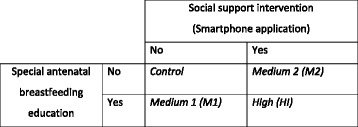
BACKGROUND: Very few Australian infants are exclusively breastfed to 6 months as recommended by the World Health Organization. There is strong empirical evidence that fathers have a major impact on their partner's decision to breastfeed and continuation of breastfeeding. Fathers want to participate in the breastfeeding decision making process and to know how they can support their partner to achieve their breastfeeding goals. The aim of the Parent Infant Feeding Initiative (PIFI) is to evaluate the effect on duration of any and exclusive breastfeeding of three breastfeeding promotion interventions of differing intensity and duration, targeted at couples but channelled through the male partner. The study will also undertake a cost-effectiveness evaluation of the interventions. METHODS/DESIGN: The PIFI study is a factorial randomised controlled trial. Participants will be mothers and their male partners attending antenatal classes at selected public and private hospitals with maternity departments in Perth, Western Australia. Fathers will be randomly allocated to either the usual care control group (CG), one of two medium intensity (MI1 and MI2) interventions, or a high intensity (HI) intervention. MI1 will include a specialised antenatal breastfeeding education session for fathers with supporting print materials. MI2 will involve the delivery of an antenatal and postnatal social support intervention delivered via a smartphone application and HI will include both the specialised antenatal class and the social support intervention. Outcome data will be collected from couples at baseline and at six and 26 weeks postnatally. A total of 1600 couples will be recruited. This takes into account a 25% attrition rate, and will detect at least a 10% difference in the proportion of mothers breastfeeding between any two of the groups at 26 weeks at 80% power and 5% level of significance, using a Log-rank survival test. Multivariable survival and logistic regression analyses will be used to assess the effect of the treatment groups on the outcomes after adjusting for covariates. DISCUSSION: The PIFI study will be the first Australian study to provide Level II evidence of the impact on breastfeeding duration of a comprehensive, multi-level, male-partner-focused breastfeeding intervention. Unique features of the intervention include its large sample size, delivery of two of the interventions by mobile device technology, a rigorous assessment of intervention fidelity and a cost-effectiveness evaluation. TRIAL REGISTRATION: Australian New Zealand Clinical Trials Registry ACTRN12614000605695. Registered 6 June 2014.
Overview
The claims and statistics of this paper haven’t been checked yet.
Free: it reads the open-access text and checks the first 5 claims that cite a source we can check. Create a free account to check every claim.
Integrity signals
Registry
Cites
Statistics
Figures
Verification
Claims the paper makes
The claims and statistics of this paper haven’t been checked yet.
Free: it reads the open-access text and checks the first 5 claims that cite a source we can check. Create a free account to check every claim.
Claims other papers make about this one
Each is checked against this paper’s own text: does it say what the citing paper says it does?
The cited source says what the claim attributes to it.
In the citing paper
“Finally, the PIFI study includes an economic analysis of the cost effectiveness of the two different interventions being trialled.25”
From Designing evaluation plans for health promotion mHealth interventions: a case study of the Milk Man mobile app (2016) · cites this paper as [25]
In the citing paper
“The PIFI study is a four-armed RCT that aims to increase the duration and/or exclusivity of breastfeeding.25”
From Designing evaluation plans for health promotion mHealth interventions: a case study of the Milk Man mobile app (2016) · cites this paper as [25]
Self-check
Percentages, sums and reported differences re-computed from the paper’s own numbers.
The self-check needs the paper’s full text.
Citations
Cites
CONSORT 2010 Statement: updated guidelines for reporting parallel group randomised trials
the CONSORT Group, Schulz, K. F., Altman, D. G., & Moher, D. (2010) · BMC Medicine · doi:10.1186/1741-7015-8-18 · Cited by 13,371
CONSORT 2010 statement: updated guidelines for reporting parallel group randomised trials
Schulz, K. F., Altman, D. G., Moher, D., & for the CONSORT Group (2010) · PLoS Medicine · doi:10.1371/journal.pmed.1000251 · Cited by 2,296
Boutron, I., Moher, D., Altman, D. G., Schulz, K. F., Ravaud, P., & for the CONSORT Group* (2008) · Annals of Internal Medicine · doi:10.7326/0003-4819-148-4-200802190-00008 · Cited by 2,292
Heron, K. E., & Smyth, J. M. (2010) · British Journal of Health Psychology · doi:10.1348/135910709x466063 · Cited by 1,438
Standards of Evidence: Criteria for Efficacy, Effectiveness and Dissemination
Flay, B. R., Biglan, A., Boruch, R. F., Castro, F. G., Gottfredson, D., Kellam, S., Mościcki, E. K., Schinke, S., Valentine, J. C., & Ji, P. (2005) · Prevention Science · doi:10.1007/s11121-005-5553-y · Cited by 1,338 · cited 1×
“Prevention Research [52].”
Healthcare in the pocket: Mapping the space of mobile-phone health interventions
Klasnja, P., & Pratt, W. (2012) · Journal of Biomedical Informatics · doi:10.1016/j.jbi.2011.08.017 · Cited by 970
Development and psychometric testing of the Breastfeeding Self-Efficacy Scale
Dennis, C.-L., & Faux, S. (1999) · Research in Nursing & Health · doi:10.1002/(sici)1098-240x(199910)22:5<399::aid-nur6>3.0.co;2-4 · Cited by 629
Gearing, R. E., El-Bassel, N., Ghesquiere, A., Baldwin, S., Gillies, J., & Ngeow, E. (2011) · Clinical Psychology Review · doi:10.1016/j.cpr.2010.09.007 · Cited by 610
Early‐life determinants of overweight and obesity: a review of systematic reviews
Monasta, L., Batty, G. D., Cattaneo, A., Lutje, V., Ronfani, L., Van Lenthe, F. J., & Brug, J. (2010) · Obesity Reviews · doi:10.1111/j.1467-789x.2010.00735.x · Cited by 607
Predictors of Breastfeeding Duration: Evidence From a Cohort Study
Scott, J. A., Binns, C. W., Oddy, W. H., & Graham, K. I. (2006) · Pediatrics · doi:10.1542/peds.2005-1991 · Cited by 526
Self-citationThe Iowa Infant Feeding Attitude Scale: Analysis of Reliability and Validity1
Mora, A. D. L., Russell, D. W., Dungy, C. I., Losch, M., & Dusdieker, L. (1999) · Journal of Applied Social Psychology · doi:10.1111/j.1559-1816.1999.tb00115.x · Cited by 424
Effects of breastfeeding on the mother
Labbok, M. H. (2001) · Pediatric Clinics of North America · doi:10.1016/s0031-3955(05)70290-x · Cited by 321 · cited 1×
“breast cancers, bone remineralisation to levels exceeding those present before lactation and improved blood glucose profiles in women with gestational diabetes [5].”
BackgroundFactors associated with breastfeeding at discharge and duration of breastfeeding
Scott, J., Landers, M., Hughes, R., & Binns, C. (2001) · Journal of Paediatrics and Child Health · doi:10.1046/j.1440-1754.2001.00646.x · Cited by 309
Self-citationHealth Care Costs of Formula-feeding in the First Year of Life
Ball, T. M., & Wright, A. L. (1999) · Pediatrics · doi:10.1542/peds.103.s1.870 · Cited by 299
Society for Prevention Research Type 2 Translational Task Force Members and Contributing Authors, Spoth, R., Rohrbach, L. A., Greenberg, M., Leaf, P., Brown, C. H., Fagan, A., Catalano, R. F., Pentz, M. A., Sloboda, Z., et al. (2013) · Prevention Science · doi:10.1007/s11121-012-0362-6 · Cited by 283 · cited 1×
“Discussion This proposal follows a Type 2 Translational Research approach [51] being the culmination of over 20 years of high quality observational, developmental and intervention research on breastfeeding in Australia by the research group.”
MethodFairbank, O'Meara, Renfrew, Woolridge, Sowden, & Lister-Sharp (2000) · Health Technology Assessment · doi:10.3310/hta4250 · Cited by 273
A Controlled Trial of the Father's Role in Breastfeeding Promotion
Pisacane, A., Continisio, G. I., Aldinucci, M., D'Amora, S., & Continisio, P. (2005) · Pediatrics · doi:10.1542/peds.2005-0479 · Cited by 269
Initiation and continuation of breastfeeding: theory of planned behaviour
Swanson, V., & Power, K. G. (2005) · Journal of Advanced Nursing · doi:10.1111/j.1365-2648.2005.03390.x · Cited by 257
Wolfberg, A. J., Michels, K. B., Shields, W., O'Campo, P., Bronner, Y., & Bienstock, J. (2004) · American Journal of Obstetrics and Gynecology · doi:10.1016/j.ajog.2004.05.019 · Cited by 254
The Effect of Peer Support on Postpartum Depression: A Pilot Randomized Controlled Trial
Dennis, C.-L. (2003) · The Canadian Journal of Psychiatry · doi:10.1177/070674370304800209 · Cited by 249 · cited 1×
“These will include, but are not limited to, the Iowa Infant Feeding Attitude Scale [44], the Breastfeeding Self-Efficacy Scale [45], the Postpartum Partner Support Scale [46], the Child Care Stress Checklist [47] and the Depression Anxiety Scale (DASS-21) [48].”
MethodA review of the use of mobile phone text messaging in clinical and healthy behaviour interventions
Wei, J., Hollin, I., & Kachnowski, S. (2011) · Journal of Telemedicine and Telecare · doi:10.1258/jtt.2010.100322 · Cited by 245
Breastfeeding promotion for infants in neonatal units: a systematic review and economic analysis
Renfrew, M., Craig, D., Dyson, L., McCormick, F., Rice, S., King, S., Misso, K., Stenhouse, E., & Williams, A. (2009) · Health Technology Assessment · doi:10.3310/hta13400 · Cited by 244
Dennis, C., & Ross, L. (2006) · Journal of Advanced Nursing · doi:10.1111/j.1365-2648.2006.04059.x · Cited by 235
An Evaluation of Mobile Health Application Tools
Sama, P. R., Eapen, Z. J., Weinfurt, K. P., Shah, B. R., & Schulman, K. A. (2014) · JMIR mHealth and uHealth · doi:10.2196/mhealth.3088 · Cited by 230
Breastfeeding: maintaining an irreplaceable immunological resource
Labbok, M. H., Clark, D., & Goldman, A. S. (2004) · Nature Reviews Immunology · doi:10.1038/nri1393 · Cited by 227
Brown, A., & Davies, R. (2014) · Maternal & Child Nutrition · doi:10.1111/mcn.12129 · Cited by 216 · cited 2×
“Furthermore, fathers want to be involved in the breastfeeding decision making process [26] and new fathers want practical advice on how they can support their partner as well as strategies for troubleshooting/problem solving common breastfeeding difficulties that their partner may encounter [30].”
BackgroundThe Breastfeeding Team: The Role of Involved Fathers in the Breastfeeding Family
Rempel, L. A., & Rempel, J. K. (2011) · Journal of Human Lactation · doi:10.1177/0890334410390045 · Cited by 214 · cited 1×
“This highlights the need for fathers to be included in the antenatal preparation for breastfeeding [28] as well as in the postnatal period, so as to deflect negative attitudes associated with breastfeeding and increase support for the mother [29].”
BackgroundA Western Australian Survey of Breastfeeding Initiation, Prevalence and Early Cessation Patterns
Hauck, Y. L., Fenwick, J., Dhaliwal, S. S., & Butt, J. (2011) · Maternal and Child Health Journal · doi:10.1007/s10995-009-0554-2 · Cited by 192
Self-citationTohotoa, J., Maycock, B., Hauck, Y. L., Howat, P., Burns, S., & Binns, C. W. (2009) · International Breastfeeding Journal · doi:10.1186/1746-4358-4-15 · Cited by 183
Self-citationCoparenting Breastfeeding Support and Exclusive Breastfeeding: A Randomized Controlled Trial
Abbass-Dick, J., Stern, S. B., Nelson, L. E., Watson, W., & Dennis, C.-L. (2015) · Pediatrics · doi:10.1542/peds.2014-1416 · Cited by 171
Infant feeding attitudes of expectant parents: breastfeeding and formula feeding
Shaker, I., Scott, J. A., & Reid, M. (2004) · Journal of Advanced Nursing · doi:10.1046/j.1365-2648.2003.02887.x · Cited by 158
Self-citationBreastfeeding Support from Partners and Grandmothers: Perceptions of Swedish Women
Ekström, A., Widström, A., & Nissen, E. (2003) · Birth · doi:10.1046/j.1523-536x.2003.00256.x · Cited by 156
Inclusion of Fathers in an Intervention to Promote Breastfeeding: Impact on Breastfeeding Rates
Rosane Odeh Susin, L., & Regina Justo Giugliani, E. (2008) · Journal of Human Lactation · doi:10.1177/0890334408323545 · Cited by 155
Education and Support for Fathers Improves Breastfeeding Rates: A Randomized Controlled Trial
Maycock, B., Binns, C. W., Dhaliwal, S., Tohotoa, J., Hauck, Y., Burns, S., & Howat, P. (2013) · Journal of Human Lactation · doi:10.1177/0890334413484387 · Cited by 153 · cited 6×
“Our earlier intervention, the FIFI study, resulted in increased rates of any breastfeeding at six weeks but failed to result in an increase in the proportion of couples fully or exclusively breastfeeding at this time and there was no difference between intervention and control couples in the proportion still breastfee…”
BackgroundMethodResultInfluentialSelf-citationSystematic review of respite care in the frail elderly
Shaw, C., McNamara, R., Abrams, K., Cannings-John, R., Hood, K., Longo, M., Myles, S., O'Mahony, S., Roe, B., & Williams, K. (2009) · Health Technology Assessment · doi:10.3310/hta13200 · Cited by 142
Factors associated with the duration of breastfeeding amongst women in Perth, Australia
Scott, J., Aitkin, I., Binns, C., & Aroni, R. (1999) · Acta Paediatrica · doi:10.1111/j.1651-2227.1999.tb01133.x · Cited by 142
Self-citationEarly-life determinants of overweight and obesity: a review of systematic reviews
Monasta, L., Batty, G. D., Cattaneo, A., Lutje, V, Ronfani, L., Van Lenthe, F. J., & - (2011) · Obesity and metabolism · doi:10.14341/2071-8713-4961 · Cited by 141
Temporal Changes in the Determinants of Breastfeeding Initiation
Scott, J. A., Binns, C. W., Graham, K. I., & Oddy, W. H. (2006) · Birth · doi:10.1111/j.0730-7659.2006.00072.x · Cited by 137
Self-citationJiang, H., Li, M., Wen, L. M., Hu, Q., Yang, D., He, G., Baur, L. A., Dibley, M. J., & Qian, X. (2014) · JAMA Pediatrics · doi:10.1001/jamapediatrics.2014.58 · Cited by 133
Breastfeeding determinants and a suggested framework for action in Europe
Yngve, A., & Sjöström, M. (2001) · Public Health Nutrition · doi:10.1079/phn2001164 · Cited by 133
Mars, T., Ellard, D., Carnes, D., Homer, K., Underwood, M., & Taylor, S. J. C. (2013) · BMJ Open · doi:10.1136/bmjopen-2013-003555 · Cited by 132
INCOMPATIBLE EXPECTATIONS: THE DILEMMA OF BREASTFEEDING MOTHERS
Hauck, Y. L., & Irurita, V. F. (2003) · Health Care For Women International · doi:10.1080/07399330390170024 · Cited by 116
Self-citationThe influence of reported paternal attitudes on the decision to breast‐feed
SCOTT, J., BINNS, C., & ARONI, R. (1997) · Journal of Paediatrics and Child Health · doi:10.1111/j.1440-1754.1997.tb01605.x · Cited by 114
Self-citationThe impact of knowledge and social influences on adolescents' breast-feeding beliefs and intentions
Swanson, V., Power, K., Kaur, B., Carter, H., & Shepherd, K. (2006) · Public Health Nutrition · doi:10.1079/phn2006845 · Cited by 99
Fathers as Supporters for Improved Exclusive Breastfeeding in Viet Nam
Bich, T. H., Hoa, D. T. P., & Målqvist, M. (2013) · Maternal and Child Health Journal · doi:10.1007/s10995-013-1384-9 · Cited by 98
Influences on Breast-Feeding by Lower-Income Women
Sciacca, J. P., Phipps, B. L., Dube, D. A., & Ratliff, M. I. (1995) · Journal of the American Dietetic Association · doi:10.1016/s0002-8223(95)00083-6 · Cited by 90
Breastfeeding attitudes of Finnish parents during pregnancy
Laanterä, S., Pölkki, T., Ekström, A., & Pietilä, A. (2010) · BMC Pregnancy and Childbirth · doi:10.1186/1471-2393-10-79 · Cited by 89
Mitchell-Box, K. M., & Braun, K. L. (2013) · Journal of Human Lactation · doi:10.1177/0890334413491833 · Cited by 85
Intervention fidelity: A necessary aspect of intervention effectiveness studies
Murphy, S. L., & Gutman, S. A. (2012) · American Journal of Occupational Therapy · doi:10.5014/ajot.2010.005405 · Cited by 77 · cited 1×
“Many studies reporting intervention effectiveness fail to consider or discuss intervention fidelity [62], which is the extent to which the intervention was delivered in the manner it was intended [63].”
BackgroundA Description of a Male-Focused Breastfeeding Promotion Corporate Lactation Program
Cohen, R., Lange, L., & Slusser, W. (2002) · Journal of Human Lactation · doi:10.1177/089033440201800111 · Cited by 69
Mothers’ experience of fathers’ support for breast-feeding
Nickerson, L. E., Sykes, A. C., & Fung, T. T. (2012) · Public Health Nutrition · doi:10.1017/s1368980011003636 · Cited by 66
Liamputtong, P. (2010) · Springer eBooks · doi:10.1007/978-1-4419-6873-9 · Cited by 61
Fathers' perspectives on breastfeeding: ideas for intervention
Sherriff, N., Hall, V., & Pickin, M. (2009) · British Journal of Midwifery · doi:10.12968/bjom.2009.17.4.41670 · Cited by 61 · cited 3×
“The PIFI study will employ mobile technology to deliver the intervention to participants as they go about their daily business, thus addressing an accessibility and flexibility barrier identified in the FIFI [41, 42] and other studies [25].”
BackgroundMethodTohotoa, J., Maycock, B., Hauck, Y., Howat, P., Burns, S., & Binns, C. (2011) · Health Promotion International · doi:10.1093/heapro/daq077 · Cited by 56
Self-citationBreastfeeding and Fathers: Illuminating the Darker Side
Jordan, P. L., & Wall, V. R. (1990) · Birth · doi:10.1111/j.1523-536x.1990.tb00024.x · Cited by 55
Hauck, Y., Hall, W. A., & Jones, C. (2007) · Journal of Advanced Nursing · doi:10.1111/j.1365-2648.2006.04136.x · Cited by 52
Self-citationBreast‐feeding in Perth: recent trends
Scott, J. A., Binns, C. W., & Aroni, R. (1996) · Australian and New Zealand Journal of Public Health · doi:10.1111/j.1753-6405.1996.tb01820.x · Cited by 52
Self-citationBrown, A., & Lee, M. (2011) · Breastfeeding Medicine · doi:10.1089/bfm.2010.0097 · Cited by 49
The structure of emotional symptoms in the postpartum period: Is it unique?
Cunningham, N. K., Brown, P. M., Brooks, J., & Page, A. C. (2013) · Journal of Affective Disorders · doi:10.1016/j.jad.2013.08.002 · Cited by 47
The Effectiveness of the Internet in Improving Breastfeeding Outcomes: A Systematic Review
Giglia, R., & Binns, C. (2014) · Journal of Human Lactation · doi:10.1177/0890334414527165 · Cited by 47
Self-citationImpact of Expectant Fathers in Breast-Feeding Decisions
SHARMA, M., & PETOSA, R. (1997) · Journal of the American Dietetic Association · doi:10.1016/s0002-8223(97)00312-x · Cited by 46 · cited 1×
“Research indicates that the support of fathers is critical to breastfeeding success and is identified as one of the strongest and most consistent factors associated with women’s willingness to breastfeed [24].”
BackgroundNational targets for breastfeeding at hospital discharge have been achieved in Perth
Graham, K. I., Scott, J. A., Binns, C. W., & Oddy, W. H. (2005) · Acta Paediatrica · doi:10.1111/j.1651-2227.2005.tb03079.x · Cited by 41
Self-citationAttitudes toward Breastfeeding in Perth, Australia: Qualitative Analysis
Scott, J. A., Binns, C. W., & Arnold, R. V. (1997) · Journal of Nutrition Education · doi:10.1016/s0022-3182(97)70213-9 · Cited by 40
Self-citationEconomic advantages of breast-feeding in an HMO: setting a pilot study.
Hoey, C., & Jl, W. (1997) · PubMed · Cited by 34
Rice, S. J. C., Craig, D., McCormick, F. M., Renfrew, M. J., & Williams, A. F. (2010) · International Journal of Technology Assessment in Health Care · doi:10.1017/s0266462310000115 · Cited by 33
Knowledge of Breastfeeding Among Pregnant Mothers and Fathers
Laanterä, S., Pietilä, A., & Pölkki, T. (2010) · The Journal of Perinatal & Neonatal Nursing · doi:10.1097/jpn.0b013e3181ec0c60 · Cited by 33
Factors influencing mothers' decision to breastfeed in public.
Hauck, Y. L. (2004) · UWA Profiles and Research Repository (UWA) · Cited by 25
Self-citationScott, J. A. (2010) · Springer eBooks · doi:10.1007/978-1-4419-6873-9_3 · Cited by 11
Self-citation(2007) · PubMed Central
Research works printed but not linked: 3
- Horta B Victora C Long-term effects of breastfeeding: a systematic review 2013 Geneva World Health Organization
- WHO/UNICEF Global strategy for infant and young child feeding 2003 Geneva World Health Organization
- Australian Institute of Health and Welfare 2010 Australian National Infant Feeding Survey: Indicator results 2011 Canberra AIHW
Cited by
Support for healthy breastfeeding mothers with healthy term babies
Renfrew, M. J., McCormick, F. M., Wade, A., Quinn, B., & Dowswell, T. (2012) · Cochrane Database of Systematic Reviews · doi:10.1002/14651858.cd001141.pub4 · Cited by 665
Support for healthy breastfeeding mothers with healthy term babies
McFadden, A., Gavine, A., Renfrew, M. J., Wade, A., Buchanan, P., Taylor, J. L., Veitch, E., Rennie, A. M., Crowther, S. A., Neiman, S., et al. (2017) · Cochrane Database of Systematic Reviews · doi:10.1002/14651858.cd001141.pub5 · Cited by 581
Antenatal breastfeeding education for increasing breastfeeding duration
Lumbiganon, P., Martis, R., Laopaiboon, M., Festin, M. R., Ho, J. J., & Hakimi, M. (2016) · Cochrane Database of Systematic Reviews · doi:10.1002/14651858.cd006425.pub4 · Cited by 263
Support for healthy breastfeeding mothers with healthy term babies
Gavine, A., Shinwell, S. C., Buchanan, P., Farre, A., Wade, A., Lynn, F., Marshall, J., Cumming, S. E., Dare, S., & McFadden, A. (2022) · Cochrane Database of Systematic Reviews · doi:10.1002/14651858.cd001141.pub6 · Cited by 164
Effectiveness of targeting fathers for breastfeeding promotion: systematic review and meta-analysis
Mahesh, P. K. B., Gunathunga, M. W., Arnold, S. M., Jayasinghe, C., Pathirana, S., Makarim, M. F., Manawadu, P. M., & Senanayake, S. J. (2018) · BMC Public Health · doi:10.1186/s12889-018-6037-x · Cited by 149
Metadata
- Authors
- Maycock, B. R., Scott, J. A., Hauck, Y. L., Burns, S. K., Robinson, S., Giglia, R., Jorgensen, A., White, B., Harries, A., Dhaliwal, S., Howat, P. A., & Binns, C. W.
- Affiliations
- Curtin University (AU)
- The Kids Research Institute Australia (AU)
- Corresponding author
- Scott, Jane A.
- ORCID
- Venue
- BMC Pregnancy and Childbirth
- Published
- 2015-08-01
- Volume
- 15
- Issue
- 1
- Pages
- 159-159
- ISSN
- 1471-2393 (ISSN-L)
- PMC
- PMC4522088
- OpenAlex
- W1912831371
- Cited by
- 35
- References
- 74
- Citations by year
- 2024: 1 · 2023: 1 · 2022: 4 · 2021: 3 · 2020: 3 · 2019: 4 · 2018: 5 · 2017: 8 · 2016: 5
- FWCI
- 4.70
- Type
- journal article
- Language
- en
- Open access
- gold
- doi.org
- Locations
- BMC Pregnancy and Childbirth (publishedVersion, cc-by)
- Europe PMC (PubMed Central) (publishedVersion, other-oa)
- PubMed Central (publishedVersion, cc-by)
- UWA Profiles and Research Repository (UWA) (publishedVersion, other-oa)
- PubMed (publishedVersion)
- eSpace (Curtin University) (submittedVersion, cc-by)
- Figshare (submittedVersion, cc-by)
- Funders
- Healthway (24006, 24023)
- Topics
- Health Sciences › Medicine › Epidemiology › Breastfeeding Practices and Influences
- Health Sciences › Nursing › Nutrition and Dietetics › Infant Nutrition and Health
- Health Sciences › Medicine › Pediatrics, Perinatology and Child Health › Infant Development and Preterm Care
- Keywords
- breastfeeding duration, exclusive breastfeeding, breastfeeding promotion, prenatal education, social support interventions, mobile application, cost-effectiveness, couples, antenatal classes
- MeSH terms
- Attitude to Health, Australia, Breast Feeding, Fathers, Female, Health Promotion, Humans, Infant, Infant, Newborn, Male, Mothers, Pregnancy, Time Factors, Multivariate Analysis, Logistic Models, Survival Analysis, Self Efficacy, Prenatal Education
About these checks
Registry, retraction, Cites and statistics results are computed, not judged, with one exception: a printed reference that no index lists is read once by a model before it counts as a citation error. Claims are extracted by a model and kept only when their quote appears verbatim in the text; each cited source is then checked, with a model’s help, for whether it says what the claim relies on. Those verdicts can be wrong — read the claim’s quote and the cited source before relying on one.
Statistics and arithmetic are recomputed, not judged.
Confidence bands are shown only for fields calibrated on our annotated test set. None is calibrated yet, so no band is shown.
What counts as a claim ›How we measure confidence ›How we check this ›
Are you an author, or do you see a problem with this page? Request a review
Data sources
Bibliographic data: Semantic Scholar, OpenAlex, Crossref.
Contains information from the Semantic Scholar Academic Graph Datasets, made available under the ODC Attribution License (ODC-BY 1.0).
Semantic Scholar’s data is described in: Kinney, R., et al. (2023). The Semantic Scholar Open Data Platform. arXiv:2301.10140.
