

Maternal age and the risk of adverse pregnancy outcomes: a retrospective cohort study
Open accessThe DOI matches its Crossref record; 62 of the 64 references it cites were found in a registry or an index.
Abstract
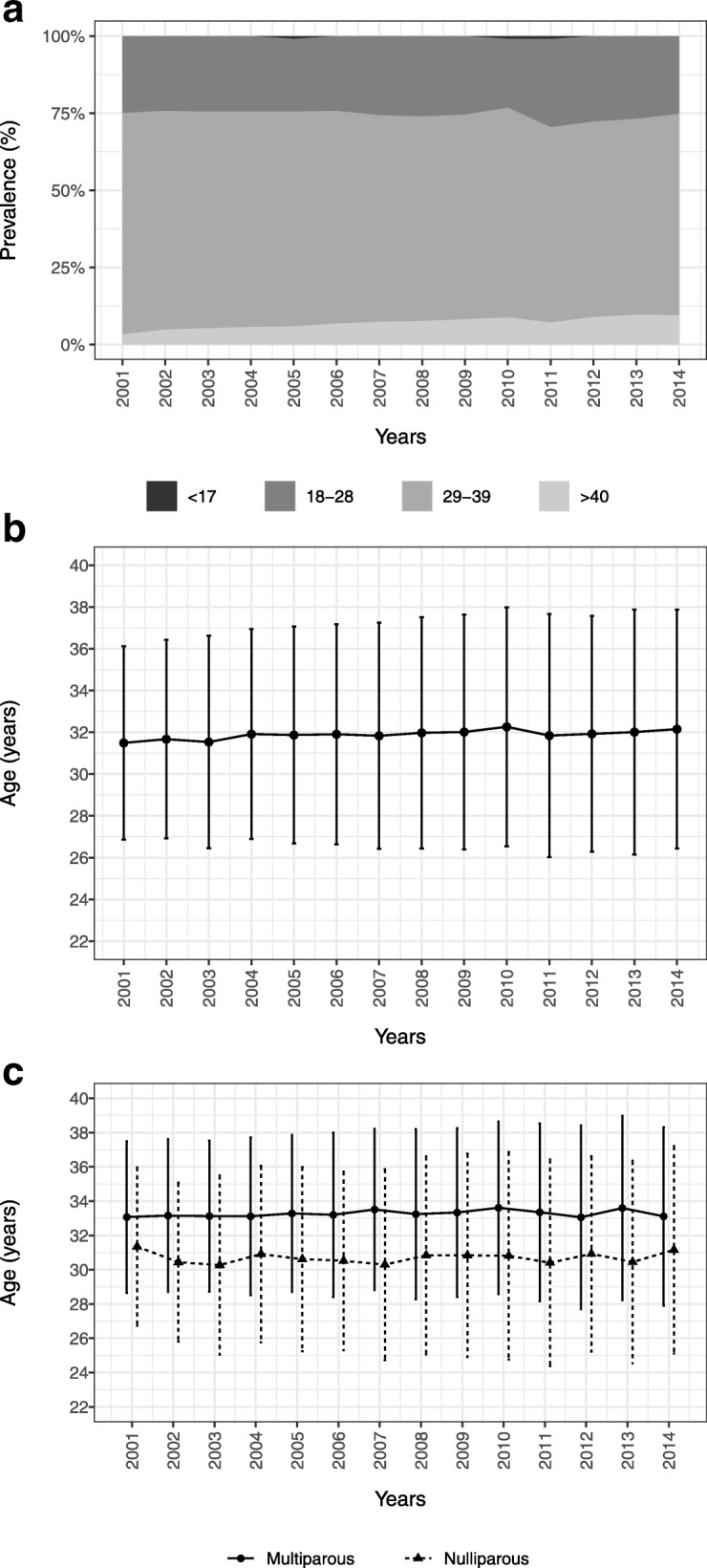
BACKGROUND: The increased potential for negative pregnancy outcomes in both extremes of reproductive age is a well-debated argument. The aim of this study was to analyze the prevalence and the outcome of pregnancies conceived at extreme maternal ages. METHODS: This retrospective study considered all single consecutive pregnancies delivered in a tertiary referral center between 2001 and 2014. Patients were categorized into 4 groups according to maternal age at delivery (< 17 years; 18-28 years; 29-39 years; > 40 years). The following outcomes were considered (amongst others): pregnancy-related hypertensive disorders (PRHDs), neonatal resuscitation (NR), neonatal intensive care unit (NICU) admission, periventricular leucomalacia (PVL), and grade 3 and 4 intraventicular hemorrhage (IVH). RESULTS: During the considered period 22,933 single pregnancies gave birth in our unit. We observed 71 women aged < 17 years, and 1552 aged > 40 years. In each year throughout the study period, there was a significant increment in maternal age of 0.041 years (95% CI 0.024-0.058) every new year. Multivariate analysis concluded out that maternal age over 40 years was an independent risk factor for preterm delivery (OR 1.36 95% CI 1.16-1.61, p < 0.05, PRHDs (OR 2.36 95% CI 1.86-3.00, p < 0.05), GDM (OR 1.71 95% CI 1.37-2.12, p < 0.05) cesarean section (OR 1.99 95% CI 1.78-2.23, p < 0.05), abnormal fetal presentation (OR 1.29 95% CI 1.03-1.61, p < 0.05), and fetal PVL (OR 3.32 95% CI 1.17-9.44, p < 0.05). We also observed that maternal age under 17 years or over 40 years was an independent risk factor for grade 3 or 4 neonatal IVH (OR 2.97 95% CI 1.24-7.14, p < 0.05). CONCLUSIONS: These findings confirm a negative impact of extreme maternal ages on pregnancy. These results should be carefully taken into account by maternal care providers in order to inform women adequately, supporting them in understanding potential risks associated with their procreation choices, and to improve clinical surveillance.
Overview
The claims and statistics of this paper haven’t been checked yet.
Free: it reads the open-access text and checks the first 5 claims that cite a source we can check. Create a free account to check every claim.
Integrity signals
Registry
Cites
Statistics
Figures
Verification
Claims the paper makes
The claims and statistics of this paper haven’t been checked yet.
Free: it reads the open-access text and checks the first 5 claims that cite a source we can check. Create a free account to check every claim.
Claims other papers make about this one
Each is checked against this paper’s own text: does it say what the citing paper says it does?
The source backs part of the claim, not all of it — or backs it for a different population, condition or comparison.
In the citing paper
“Studies have shown older women are more likely to have chronic morbidities prior to conception, such as hypertension, diabetes, and various autoimmune diseases.”
From Age-related disparities in national maternal mortality trends: A population-based study (2025) · cites this paper as [34]
Experimental — accuracy not yet measuredThe source backs part of the claim, not all of it — or backs it for a different population, condition or comparison.
In the citing paper
“These pre-existing conditions also render them at greater likelihood of developing peripartum adverse conditions [34, 35].”
From Age-related disparities in national maternal mortality trends: A population-based study (2025) · cites this paper as [34]
Experimental — accuracy not yet measured
Self-check
Percentages, sums and reported differences re-computed from the paper’s own numbers.
The self-check needs the paper’s full text.
Citations
Cites
Papile, L.-A., Burstein, J., Burstein, R., & Koffler, H. (1978) · The Journal of Pediatrics · doi:10.1016/s0022-3476(78)80282-0 · Cited by 6,430
An international classification of retinopathy of prematurity
(1985) · International Ophthalmology · doi:10.1007/bf00136454 · Cited by 1,005
Teenage pregnancy and adverse birth outcomes: a large population based retrospective cohort study.
Chen, X.-K., Wen, S. W., Fleming, N., Demissie, K., Rhoads, G. G., & Walker, M. (2007) · International Journal of Epidemiology · doi:10.1093/ije/dyl284 · Cited by 971
Intraventricular Hemorrhage in Premature Infants: Mechanism of Disease
Ballabh, P. (2010) · Pediatric Research · doi:10.1203/pdr.0b013e3181c1b176 · Cited by 782
Advanced Maternal Age and Adverse Perinatal Outcome
Jacobsson, B., Ladfors, L., & Milsom, I. (2004) · Obstetrics & Gynecology · doi:10.1097/01.aog.0000140682.63746.be · Cited by 704
(2015) · PubMed · Cited by 615
Advanced Maternal Age and Adverse Pregnancy Outcome: Evidence from a Large Contemporary Cohort
Kenny, L. C., Lavender, T., McNamee, R., O’Neill, S. M., Mills, T., & Khashan, A. S. (2013) · PLoS ONE · doi:10.1371/journal.pone.0056583 · Cited by 605
Cerebral White Matter Injury of the Premature Infant—More Common Than You Think
Volpe, J. J. (2003) · Pediatrics · doi:10.1542/peds.112.1.176 · Cited by 538
Advanced maternal age and pregnancy outcomes: a multicountry assessment
Laopaiboon, M., Lumbiganon, P., Intarut, N., Mori, R., Ganchimeg, T., Vogel, J., Souza, J., Gülmezoglu, A., & on behalf of the WHO Multicountry Survey on Maternal Newborn Health Research Network (2014) · BJOG: An International Journal of Obstetrics & Gynaecology · doi:10.1111/1471-0528.12659 · Cited by 492
The risks associated with pregnancy in women aged 35 years or older
Jolly, M. (2000) · Human Reproduction · doi:10.1093/humrep/15.11.2433 · Cited by 490
Cited by
Madar, J., Roehr, C. C., Ainsworth, S., Ersdal, H., Morley, C., Rüdiger, M., Skåre, C., Szczapa, T., te Pas, A., Trevisanuto, D., et al. (2021) · Resuscitation · doi:10.1016/j.resuscitation.2021.02.014 · Cited by 524
Hall, M. B., Willis, D. E., Rodriguez, E. L., & Schwarz, J. M. (2023) · Frontiers in Neuroscience · doi:10.3389/fnins.2023.1135559 · Cited by 134
“Increased maternal age is also associated with an increased risk of pregnancy and obstetric or birth complications that are often associated with inflammation, such as preeclampsia, gestational diabetes, or general hypertension (Londero et al., 2019).”
BackgroundUnraveling female reproductive senescence to enhance healthy longevity
Dong, L., Teh, D. B. L., Kennedy, B. K., & Huang, Z. (2023) · Cell Research · doi:10.1038/s41422-022-00718-7 · Cited by 101
Wang, S., Egan, M., Ryan, C. A., Boyaval, P., Dempsey, E. M., Ross, R. P., & Stanton, C. (2020) · FEMS Microbiology Reviews · doi:10.1093/femsre/fuaa030 · Cited by 99
Togunwa, T. O., Babatunde, A. O., & Abdullah, K.-U.-R. (2023) · Frontiers in Artificial Intelligence · doi:10.3389/frai.2023.1213436 · Cited by 109
“Risk factors for adverse maternal health outcomes during pregnancy can include a variety of factors such as age, pre-existing medical conditions, lifestyle factors, and socioeconomic status (Londero et al., 2019; Crear-Perry et al., 2021).”
BackgroundLi, H., Nawsherwan, N., Fan, C., Mubarik, S., Nabi, G., & Ping, Y. X. (2022) · BMC Pregnancy and Childbirth · doi:10.1186/s12884-022-04807-8 · Cited by 88
“The association between AMA and increased risk of HDP is not enough clear.”
BackgroundInfluentialWang, S., Yang, L., Shang, L., Yang, W., Qi, C., Huang, L., Xie, G., Wang, R., & Chung, M. (2020) · BMC Pregnancy and Childbirth · doi:10.1186/s12884-020-03445-2 · Cited by 96
Parity and the risks of adverse birth outcomes: a retrospective study among Chinese
Lin, L., Lu, C., Chen, W., Li, C., & Guo, V. Y. (2021) · BMC Pregnancy and Childbirth · doi:10.1186/s12884-021-03718-4 · Cited by 106
Lewandowska, M. (2021) · International Journal of Environmental Research and Public Health · doi:10.3390/ijerph18136936 · Cited by 92
The Main Changes in Pregnancy—Therapeutic Approach to Musculoskeletal Pain
Fiat, F., Merghes, P. E., Semenescu, A.-D., Guta, B. A., Dehelean, C. A., Varan, N., & Bernad, E. S. (2022) · Medicina · doi:10.3390/medicina58081115 · Cited by 115
“However, the mother’s advanced age is more strongly associated with complications at birth [8].”
BackgroundAitken, R. J. (2024) · Frontiers in Reproductive Health · doi:10.3389/frph.2024.1364352 · Cited by 84
“A major consequence of this trend is that women are now leaving it until their early 30s to initiate a family in most modern post-transition societies (49).”
BackgroundOuédraogo, L., Habonimana, D., Nkurunziza, T., Asmani, C., Elamin, H., Tall, F., Kidula, N., Conombo, G., Muriithi, A., & Onyiah, P. (2021) · Reproductive Health · doi:10.1186/s12978-020-01038-y · Cited by 70
Frederiksen, L. E., Ølgaard, S. M., Roos, L., Petersen, O. B., Rode, L., Hartwig, T. S., Ekelund, C. K., the Danish Central Cytogenetics Registry Study Group, & Vogel, I. (2023) · Acta Obstetricia Et Gynecologica Scandinavica · doi:10.1111/aogs.14713 · Cited by 70
Effect of advanced parental age on pregnancy outcome and offspring health
Zhang, C., Yan, L., & Qiao, J. (2022) · Journal of Assisted Reproduction and Genetics · doi:10.1007/s10815-022-02533-w · Cited by 64
Liu, C., Luo, D., Wang, Q., Ma, Y., Ping, L., Wu, T., Tang, J. J., Peng, D., & PingZhao (2020) · BMC Pregnancy and Childbirth · doi:10.1186/s12884-020-02860-9 · Cited by 49
Assessing the association between periodontitis and premature birth: a case-control study
Uwambaye, P., Munyanshongore, C., Rulisa, S., Shiau, H. J., Nuhu, A., & Kerr, M. (2021) · BMC Pregnancy and Childbirth · doi:10.1186/s12884-021-03700-0 · Cited by 62
Zhao, Y. M., Zhao, Y., Fan, K., & Jin, L. (2021) · Diabetes & Metabolism · doi:10.1016/j.diabet.2021.101293 · Cited by 50
Stjernholm, Y. V., Charvalho, P. D. S., Bergdahl, O., Vladić, T., & Petersson, M. (2021) · Frontiers in Psychology · doi:10.3389/fpsyg.2021.582823 · Cited by 58
“Maternal age and BMI might have been confounders regarding labor outcome since high maternal age and high BMI increase the risk of CS (Weiss et al., 2004; Londero et al., 2019).”
BackgroundReproductive value and the evolution of altruism
Rodrigues, A. M. M., & Gardner, A. (2021) · Trends in Ecology & Evolution · doi:10.1016/j.tree.2021.11.007 · Cited by 43
Dysglycemia in Pregnancy and Maternal/Fetal Outcomes
Silva, C. M., Arnegard, M. E., & Maric‐Bilkan, C. (2021) · Journal of Women s Health · doi:10.1089/jwh.2020.8853 · Cited by 50
Parental Age and the Risk of ADHD in Offspring: A Systematic Review and Meta-Analysis
Min, X., Li, C., & Yan, Y. (2021) · International Journal of Environmental Research and Public Health · doi:10.3390/ijerph18094939 · Cited by 45
“Secondly, young mothers are more likely to have inadequate prenatal care and adverse birth outcomes such as low birth weight and prematurity [56,57].”
BackgroundAmbient temperature during pregnancy and fetal growth in Eastern Massachusetts, USA
Leung, M., Laden, F., Coull, B. A., Modest, A. M., Hacker, M. R., Wylie, B. J., Iyer, H. S., Hart, J. E., Wei, Y., Schwartz, J. D., et al. (2022) · International Journal of Epidemiology · doi:10.1093/ije/dyac228 · Cited by 38
Li, J., Yan, J., & Jiang, W. (2023) · The Journal of Maternal-Fetal & Neonatal Medicine · doi:10.1080/14767058.2023.2250894 · Cited by 43
“In the United States and Italy, the mean age at childbearing was constantly rising, the proportion of pregnant individuals with AMA was consistently increasing from 2007 to 2013, and the percentage of pregnancies in patients younger than 17 years of age decreased over the same period [8,9].”
Backgroundde Morais, N. S., Saraiva, D. A., Corcino, C. M., Berbara, T. M. B. L., Schtscherbyna, A., Moreira, K. L., Vaisman, M., Alexander, E. K., & Teixeira, P. D. F. D. S. (2020) · Thyroid · doi:10.1089/thy.2019.0462 · Cited by 36
“We decided to exclude patients with extreme maternal ages due to potential increase in negative pregnancy outcomes in this scenario (11,12).”
Abdullah, R. K., Liu, N., Zhao, Y., Yang, S. C., Shen, Z., Zeng, H. M., & Wu, J. (2020) · Scientific Reports · doi:10.1038/s41598-020-68896-1 · Cited by 34
The Influence of Maternal BMI on Adverse Pregnancy Outcomes in Older Women
Lewandowska, M., Sajdak, S., Więckowska, B., Manevska, N., & Lubiński, J. (2020) · Nutrients · doi:10.3390/nu12092838 · Cited by 38
Economic Crisis Impact and Social Determinants of Perinatal Outcomes and Infant Mortality in Greece
Zilidis, C., & Hadjichristodoulou, C. S. (2020) · International Journal of Environmental Research and Public Health · doi:10.3390/ijerph17186606 · Cited by 42
“Most studies, though not all, found an association between advanced maternal age and low birth weight and the risk of perinatal death [19,49,50].”
BackgroundMadar, J., Roehr, C. C., Ainsworth, S. B., Ersda, H., Morley, C. J., Rüdiger, M., Skåre, C., Szczapa, T., Pas, A. B. T., Trevisanuto, D., et al. (2021) · Notfall + Rettungsmedizin · doi:10.1007/s10049-021-00894-w · Cited by 41
Periodontal disease and preterm delivery: a nationwide population-based cohort study of Taiwan
Lee, Y., Hu, H., Chou, S., Lin, C.-L., Cheng, F.-S., Yu, C.-Y., & Chu, D. (2022) · Scientific Reports · doi:10.1038/s41598-022-07425-8 · Cited by 43
Getaneh, T., Nigussie, A. A., Hiyaru, T., & Fenta, S. L. (2021) · Scientific Reports · doi:10.1038/s41598-021-93613-x · Cited by 36
Advanced Maternal Age Among Nulliparous at Term and Risk of Unscheduled Cesarean Delivery
Braggion, A., Favre, G., Lepigeon, K., Sichitiu, J., Baud, D., & Desseauve, D. (2023) · American Journal of Obstetrics & Gynecology MFM · doi:10.1016/j.ajogmf.2023.100972 · Cited by 29
Noaimi, G. A., Yunis, K. A., Asmar, K. E., Salem, F. K. A., Afif, C., Ghandour, L. A., Hamandi, A., & Dhaini, H. R. (2021) · Environmental Pollution · doi:10.1016/j.envpol.2021.117022 · Cited by 31
Gebreegziabher, E., Bountogo, M., Sié, A., Zakané, A., Compaoré, G., Ouédraogo, T., Lebas, E., Nyatigo, F., Glymour, M. M., Arnold, B. F., et al. (2023) · International Journal of Epidemiology · doi:10.1093/ije/dyac236 · Cited by 37
Placental acute inflammation infiltrates and pregnancy outcomes: a retrospective cohort study
Orsaria, M., Liviero, S., Rossetti, E., Pittini, C., Driul, L., Londero, A. P., & Mariuzzi, L. (2021) · Scientific Reports · doi:10.1038/s41598-021-03655-4 · Cited by 26
Self-citationBreast cancer and the steadily increasing maternal age: are they colliding?
Londero, A. P., Bertozzi, S., Xholli, A., Cedolini, C., & Cagnacci, A. (2024) · BMC Women s Health · doi:10.1186/s12905-024-03138-4 · Cited by 30
“Although the causes of delayed childbearing are multi-factorial, it is essential to consider the long-term effects of this trend [19].”
BackgroundInfluentialSelf-citationKleine, I., Vamvakas, G., Lautarescu, A., Falconer, S., Chew, A. T. M., Counsell, S. J., Pickles, A. R., Edwards, A. D., & Nosarti, C. (2022) · BMJ Open · doi:10.1136/bmjopen-2021-058540 · Cited by 25
Lu, H.-Y., Chiu, C.-W., Kao, P.-H., Tsai, Z., Gau, C., Lee, W.-F., Wu, C., Lan, Y.-T., Hung, C.-C., Chang, F., et al. (2020) · World Allergy Organization Journal · doi:10.1016/j.waojou.2020.100127 · Cited by 23
Rocha, T. A. H., Thomaz, É. B. A. F., de Almeida, D. G., da Silva, N. C., Queiroz, R. C. D. S., de Andrade, L., Facchini, L. A., Sartori, M. L. L., Costa, D. B., Campos, M. A. G., et al. (2021) · The Lancet Regional Health - Americas · doi:10.1016/j.lana.2021.100053 · Cited by 26
“Advanced maternal age is independently associated with spon-taneous prematurity and mainly spontaneous rather than PTB iatrogenic [61,62] .”
BackgroundPregnancy outcomes at advanced maternal age in a tertiary Hospital, Jeddah, Saudi Arabia
Aljahdali, E. A., & Alsinani, N. (2022) · Saudi Medical Journal · doi:10.15537/smj.2022.43.5.20220023 · Cited by 27
Rama, N., Lescay, H., & Raheem, O. A. (2023) · Obstetrics and Gynecology Clinics of North America · doi:10.1016/j.ogc.2023.08.001 · Cited by 24
Havrljenko, J., Kopitović, V., Trninić-Pjević, A., Milatović, S., Pavlica, T., Andric, N. L., & Pogrmic‐Majkic, K. (2023) · Medicina · doi:10.3390/medicina59101799 · Cited by 29
“%) was found among women over 40 years of age [41].”
BackgroundIslam, B., Ibrahim, T. I., Wang, T., Wu, M., & Qin, J. (2025) · Journal of Global Health · doi:10.7189/jogh.15.04049 · Cited by 46
“Studies from Italy have shown that maternal age is a key determinant of stunting, with younger maternal age (below 18 years) linked to an increased risk of child mal-nutrition and negative pregnancy outcomes [ 113 ].”
Čvorović, J. (2022) · Public Health Nutrition · doi:10.1017/s1368980022000544 · Cited by 26
Chen, A., Väyrynen, K., Leskelä, R., Torkki, P. M., Heinonen, S. T., Tekay, A., & Acharya, G. (2023) · Acta Obstetricia Et Gynecologica Scandinavica · doi:10.1111/aogs.14506 · Cited by 21
Brenes-Monge, A., Álvarez, I. Y., Meneses‐León, J., Poblano-Verástegui, O., Vértiz-Ramírez, J. D. J., & Saturno-Hernández, P. J. (2020) · Salud Pública de México · doi:10.21149/11974 · Cited by 47
Wang, N., Guo, H., Jing, Y., Song, L., Chen, H., Wang, M., Gao, L., Huang, L., Song, Y., Sun, B., et al. (2022) · Metabolites · doi:10.3390/metabo12111040 · Cited by 22
Kim, H. W., & Kim, S. Y. (2023) · Archives of Public Health · doi:10.1186/s13690-023-01127-x · Cited by 24
Tembo, T., Koyuncu, A., Zhuo, H., Mwendafilumba, M., & Manasyan, A. (2020) · BMC Pregnancy and Childbirth · doi:10.1186/s12884-020-03361-5 · Cited by 24
Laudanno, O. M. O., Garrido, J., Ahumarán, G., Gollo, P., & Khoury, M. C. (2020) · Endoscopy International Open · doi:10.1055/a-1293-7783 · Cited by 17
Neighborhood Incarceration Rates and Adverse Birth Outcomes in New York City, 2010-2014
Holaday, L. W., Tolliver, D. G., Moore, T., Thompson, K., & Wang, E. A. (2023) · JAMA Network Open · doi:10.1001/jamanetworkopen.2023.6173 · Cited by 17
AdvFPCG-Delineator: Advanced delineator for fetal phonocardiography
Tomassini, S., Sbrollini, A., Strazza, A., Sameni, R., Marcantoni, I., Morettini, M., & Burattini, L. (2020) · Biomedical Signal Processing and Control · doi:10.1016/j.bspc.2020.102021 · Cited by 16
Nanotechnologies in Obstetrics and Cancer during Pregnancy: A Narrative Review
Bertozzi, S., Corradetti, B., Seriau, L., Nanez, J. A. D., Cedolini, C., Fruscalzo, A., Cesselli, D., Cagnacci, A., & Londero, A. P. (2022) · Journal of Personalized Medicine · doi:10.3390/jpm12081324 · Cited by 18
“With the progressive delay of first pregnancies due to contemporary social and working habits, modern society is now experiencing its highest infertility rate [15,122].”
BackgroundSelf-citationHan, Z., Zhang, Y., Li, X., Chiu, W., Yin, Y., & Hou, H. (2021) · Frontiers in Endocrinology · doi:10.3389/fendo.2021.689888 · Cited by 18
The effect of advanced maternal age on perinatal outcomes in nulliparous pregnancies
Elçi, G. G., Çakmak, A., Elçi, E., & Sayan, S. (2022) · Journal of Perinatal Medicine · doi:10.1515/jpm-2021-0298 · Cited by 23
Okine, R., Hughes, L. M., Smith, G. L., Bonus, M. L., Feinberg, E. C., & Bernardi, L. A. (2023) · Heliyon · doi:10.1016/j.heliyon.2023.e14623 · Cited by 24
“Despite evidence that knowledge of the age-related fertility decline is generally insufficient [1,2], the mean maternal age at first birth in the United States has increased steadily over time [3,4,5].”
BackgroundAbdelaziz, E. M., Alshammari, A. M., Elsharkawy, N. B., Oraby, F. A., & Ramadan, O. M. E. (2025) · BMC Pregnancy and Childbirth · doi:10.1186/s12884-025-07341-5 · Cited by 26
“Moreover, pregnant who are experiencing childbirth for the first time frequently report greater fear and uncertainty, as they lack prior experience to draw upon [82, 83].”
Rutayisire, E., Mochama, M., Ntihabose, C. K., Utumatwishima, J. N., & Habtu, M. (2023) · BMC Pregnancy and Childbirth · doi:10.1186/s12884-023-05653-y · Cited by 23
An IVF survivor unravels ‘fertility’ industry narratives
Tsigdinos, P. M. (2021) · Journal of Marketing Management · doi:10.1080/0267257x.2021.2003847 · Cited by 17
“Could I live with myself if I created lifelong pain for another human being? What if a premature birth, a high probability for IVF babies (Londero, 2019) led to health complications and other”
BackgroundSocioeconomic inequality in congenital heart diseases in Iran
Rarani, M. A., Vahedi, S., Borjali, M., & Nosratabadi, M. (2021) · International Journal for Equity in Health · doi:10.1186/s12939-021-01591-3 · Cited by 20
“Mother’s age at delivery was also classified into four age categories [37] (≤17, 18–28, 29–39, and ≥ 40 years old).”
BackgroundKokorudz, C., Radford, B. N., Dean, W., & Hemberger, M. (2022) · Cells · doi:10.3390/cells12010076 · Cited by 16
Unplanned cesarean sections in advanced maternal age: A predictive model
Veenstra, J., Cohen, Z., Korteweg, F. J., van der Ham, D. P., Kuppens, S. M., Kroese, J. A., Hermsen, B. B. J., Kamphuis, M. M., Vanhommerig, J. W., & van Pampus, M. G. (2024) · Acta Obstetricia Et Gynecologica Scandinavica · doi:10.1111/aogs.14765 · Cited by 13
“27 Preterm delivery did not significantly increase with age as earlier research indicated, 26 TABLE 3 Risk factors for unplanned cesarean sections in women who attempted vaginal delivery. for gestational age was found to be two to three times higher than in the average population, in accordance…”
ResultPredictive analysis on the factors associated with birth Outcomes: A machine learning perspective
Adebanji, A., Asare, C., & Gyamerah, S. A. (2024) · International Journal of Medical Informatics · doi:10.1016/j.ijmedinf.2024.105529 · Cited by 12
Murugesu, S., Charalambides, M. M., Jones, B. P., Saso, S., Faris, R., Parikh, J., Nicopoullos, J. D. M., Thum, M., & Bracewell‐Milnes, T. (2023) · Acta Obstetricia Et Gynecologica Scandinavica · doi:10.1111/aogs.14565 · Cited by 12
Risk factors associated with 31-day unplanned hospital readmission in newborns: a systematic review
Della, P. R., Huang, H., Roberts, P. A., Porter, P., Adams, E., & Zhou, H. (2023) · European Journal of Pediatrics · doi:10.1007/s00431-023-04819-2 · Cited by 13
Pacyga, D. C., Papandonatos, G. D., Rosas, L., Whalen, J., Smith, S. C., Park, J.-S., Gardiner, J. C., Braun, J. M., Schantz, S. L., & Strakovsky, R. S. (2024) · International Journal of Hygiene and Environmental Health · doi:10.1016/j.ijheh.2024.114380 · Cited by 12
Ritu, G., Veerasigamani, G., Ashraf, M. C., Singh, S., Laheri, S., Colaco, S., & Modi, D. N. (2022) · Journal of Human Reproductive Sciences · doi:10.4103/jhrs.jhrs_103_21 · Cited by 11
“It is well established that advanced maternal age has a detrimental effect on pregnancy outcomes due to compromised oocyte quality.[3,47] Studies have reported low mtDNA levels in cumulus cells or oocytes of women with advanced age.”
BackgroundCaesarean section delivery and its associated factors in Ghana: A multilevel analysis
Tilahun, W. M., Simegn, M. B., Abate, A., Golla, E. B., Ali, M. A., Kumbi, H., Wondie, S. G., & Geremew, H. (2025) · PLoS ONE · doi:10.1371/journal.pone.0318223 · Cited by 13
“…was associated with higher risks of comorbidities like gestational diabetes mellitus, CS, hypertension, low birth weight, hypertensive disorders of pregnancy, preeclampsia, placenta accreta, placenta previa, preterm birth, large for gestational age, macrosomia, and fetal congenital anomaly [35–37].”
Effect of maternal age on cardiac adaptation in pregnancy
Ling, H. Z., Jara, P. G., Nicolaides, K. H., & Kametas, N. A. (2021) · Ultrasound in Obstetrics and Gynecology · doi:10.1002/uog.23614 · Cited by 10
Johnson, D., Madsen, C., Banaag, A. L., Krantz, D. S., & Koehlmoos, T. P. (2021) · Military Medicine · doi:10.1093/milmed/usab429 · Cited by 13
How do women prepare for pregnancy in a low-income setting? Prevalence and associated factors
Mwase-Musicha, L., Chipeta, M. G., Stephenson, J., & Hall, J. (2022) · PLoS ONE · doi:10.1371/journal.pone.0263877 · Cited by 13
Xodo, S., Londero, A. P., D’Agostin, M., Novak, A., Galasso, S., Pittini, C., Baccarini, G., Grimaldi, F., & Driul, L. (2021) · Medicina · doi:10.3390/medicina57050461 · Cited by 12
“This composite outcome included at least one of the following items: (1) preterm delivery (defined as delivery before 37 weeks of gestation) [9]; (2) SGA or LGA (as previously defined) [10]; (3) intrauterine fetal demise or perinatal death (as previously defined) [11,12]; (4) neonatal symptomatic hypoglycemia (as prev…”
BackgroundSelf-citationAge-related disparities in national maternal mortality trends: A population-based study
Huang, R. S., Spence, A. R., & Abenhaim, H. A. (2025) · PLoS ONE · doi:10.1371/journal.pone.0316578 · Cited by 9
Misser, V. H. S., Hindori‐Mohangoo, A. D., Shankar, A., Wickliffe, J. K., Lichtveld, M. Y., & Mans, D. R. A. (2022) · Toxics · doi:10.3390/toxics10080464 · Cited by 12
“These covariates included medical conditions, such as diabetes mellitus [46,47], hypertension [48], and anemia [44,49,50], as well as maternal age older than 35 years [51,52], multiparity [53,54], alcohol use until at least 3 months before pregnancy [55,56], smoking until at least 3 months before pregnancy [57,58], an…”
BackgroundXodo, S., Trombetta, G., Celante, L., Pittini, C., Driul, L., Cagnacci, A., & Londero, A. P. (2022) · Frontiers in Pediatrics · doi:10.3389/fped.2022.894526 · Cited by 11
Self-citationBarassi, F., & Grealish, A. (2022) · Australian journal of advanced nursing · doi:10.37464/2020.392.446 · Cited by 9
Fang, T., Ji, X., Su, Z. Z., Zhang, A., Zhu, L., Tang, J., Mai, Z., Lin, H., Ouyang, N., & Chen, H. (2024) · BMC Pregnancy and Childbirth · doi:10.1186/s12884-024-07048-z · Cited by 10
Li, H., Nawsherwan, N., Khan, A., Haq, I. U., & Mei, S. Y. (2022) · Iranian Journal of Public Health · doi:10.18502/ijph.v51i5.9421 · Cited by 9
“Women with AMA are significantly associated with hypertensive disorders of pregnancy (HDP), abnormal placenta placentation, and adverse perinatal outcomes (3, 5-7).”
BackgroundLi, H., Shi, Y., Ahmed, Z., Khan, A., Xu, K., Yin, X., Nawsherwan, N., & Zhang, H. (2022) · Scientific Reports · doi:10.1038/s41598-022-27194-8 · Cited by 10
Handing, G. E., Straneo, M., Agossou, C., Wanduru, P., Kandeya, B., Abeid, M. S., Annerstedt, K. S., & Hanson, C. (2024) · Acta Obstetricia Et Gynecologica Scandinavica · doi:10.1111/aogs.14754 · Cited by 11
Kabahenda, M. K., & Stoecker, B. J. (2024) · BMC Nutrition · doi:10.1186/s40795-024-00885-3 · Cited by 8
“1) was guided by findings from other research that showed associations between maternal age and child birthweight [22–24].”
MethodIn vitro fertilization is associated with placental accelerated villous maturation.
Londero, A. P., Orsaria, M., Parisi, N., Tassi, A., Pittini, C., Driul, L., & Mariuzzi, L. (2021) · International Journal of Clinical and Experimental Pathology · Cited by 15
Self-citationSonaglioni, A., Nicolosi, G. L., Migliori, C., Bianchi, S., & Lombardo, M. (2021) · The International Journal of Cardiovascular Imaging · doi:10.1007/s10554-021-02485-9 · Cited by 10
Um, S., Sopheab, H., An, Y., & Muir, J. A. (2023) · PLoS ONE · doi:10.1371/journal.pone.0274925 · Cited by 18
Ortiz, S. S., Huerta, C., Llorente‐García, A., Ortega, P., Astasio, P., & Soriano, L. C. (2021) · Healthcare · doi:10.3390/healthcare9050596 · Cited by 9
Wang, R., Liang, X., & Su, X. (2024) · World Journal of Psychiatry · doi:10.5498/wjp.v14.i10.1448 · Cited by 14
Maeda, N., Koyama, M., Takatsuka, S., Oyatani, K., Himuro, N., Mariya, T., Kuno, Y., Hinotsu, S., Saito, T., & Ohnishi, H. (2025) · PLoS ONE · doi:10.1371/journal.pone.0319177 · Cited by 10
“It has already been reported that maternal advanced age is a risk factor for hypertension during pregnancy [15,17–19, 37 ], and study reports on teenage morbidity morbidity, According to the current analysis of NDB data for the 9 years before the COVID-19 epidemic, the incidence of HDP increased…”
Ismaili, A.-K. A., Al-Duqhaishi, T., Rajaibi, H. A., Waili, K. A., Al‐Rasadi, K., Nadar, S. K., & Al-Hashmi, K. (2021) · Oman Medical Journal · doi:10.5001/omj.2022.43 · Cited by 7
Liu, C., Pace, S. C., Bromley, R., & Dobson, R. (2023) · EClinicalMedicine · doi:10.1016/j.eclinm.2023.102157 · Cited by 9
Beyene, G. A., Yunus, M. A., Derribow, A. B., & Kasahun, A. W. (2024) · BMC Women s Health · doi:10.1186/s12905-024-03223-8 · Cited by 8
“This hypothesis is supported by previous studies that have shown that maternal age is inversely related to basal metabolic rate and energy expenditure [33, 34].”
ResultImplications of maternal-fetal health on perinatal stem cell banking
Zhu, D., Barabadi, M., McDonald, C. A., Kusuma, G. D., Inocencio, I. M., & Lim, R. (2023) · Gene Therapy · doi:10.1038/s41434-023-00426-w · Cited by 7
“It is noteworthy, however, that advanced maternal age over 40 years, is an independent risk factor for preterm delivery, pregnancy-related hypertension disorders, gestational diabetes and abnormal fetal presentation [55, 56].”
BackgroundHuang, Z. G., Zhang, Y., Wang, J., Tan, X., & Zhang, A. (2025) · BMC Pregnancy and Childbirth · doi:10.1186/s12884-025-07199-7 · Cited by 9
“While many studies support the association between maternal age and birth weight, most have focused on the effects of extreme maternal ages on adverse outcomes [14, 15].”
Ma, W., Zhou, X., Xiao, R., Tang, X., Fu, L., Xiang, Y.-X., Yu, S.-M., Ding, Y., & Zhong, Z. (2025) · PLoS ONE · doi:10.1371/journal.pone.0322581 · Cited by 7
“Maternal age [16,17], pre-pregnancy BMI [18,19], weight gain during pregnancy [20], whether it is the first pregnancy [21], whether to use assisted reproductive technology [22], delivery gestational week, presence or absence of thyroid diseases [23] (including hyperthyroidism, hypothyroidism, and…”
Household Wealth, Decision-Making, and High-Parity Pregnancies in Nigeria
Solanke, B. L. (2020) · Women s Reproductive Health · doi:10.1080/23293691.2020.1861411 · Cited by 6
Taylor, C. L., Brown, H. K., Saunders, N. R., Barker, L. C., Chen, S., Cohen, E., Dennis, C., Ray, J. G., & Vigod, S. N. (2021) · Acta Psychiatrica Scandinavica · doi:10.1111/acps.13281 · Cited by 6
Wang, Y., Gong, Y., Xu, Y., Wang, X., Shan, S., Cheng, G., & Zhang, B. (2024) · BMC Pregnancy and Childbirth · doi:10.1186/s12884-023-06231-y · Cited by 5
“Many factors may affect GWG, among which maternal age receives much attention as a trend in delayed childbearing has been observed in many countries [7, 8].”
BackgroundThe association of apparent temperature with fetal growth: A birth cohort study in Beijing, China
Yuan, X., Zhou, S., Li, X., Lyu, J., Lin, L., Ji, Y., Wang, H., Li, Q., Li, Q., & Wang, H. (2025) · Sustainable Cities and Society · doi:10.1016/j.scs.2025.106266 · Cited by 5
STRA6 and Placental Retinoid Metabolism in Gestational Diabetes Mellitus
Fruscalzo, A., Viola, L., Orsaria, M., Marzinotto, S., Bulfoni, M., Driul, L., Londero, A. P., & Mariuzzi, L. (2021) · Journal of Personalized Medicine · doi:10.3390/jpm11121301 · Cited by 5
“Furthermore, gestational diabetes was diagnosed through the 75 g two-hour oral glucose tolerance test according to the presence of risk factors at 16–18 or 24–28 weeks gestation [18].”
MethodSelf-citationCongenital heart disease in a patient with COVID-19 infection during early pregnancy: a case report
Abdelkader, M. A., Abbas, H. M., Aboelkhair, I. M., Alafify, A. S. A., Elgazzar, B. A., & Koura, M. S. E.-D. (2022) · The Egyptian Heart Journal · doi:10.1186/s43044-022-00295-5 · Cited by 5
Cendana, P., & Kim, S.-Y. (2025) · Asia Pacific Journal of Public Health · doi:10.1177/10105395251337970 · Cited by 10
Nawsherwan, N., Mubarik, S., Nabi, G., Wang, S., & Fan, C. (2020) · Iranian Journal of Public Health · doi:10.18502/ijph.v49i9.4092 · Cited by 11
“ir 1732 uteroplacental blood flow should induce decreased fetal growth, with an increased risk of PTD and LBW (10, 23).”
BackgroundInfluential
Metadata
- Authors
- Londero, A. P., Rossetti, E., Pittini, C., Cagnacci, A., & Driul, L.
- Affiliations
- University of Udine (IT)
- Corresponding author
- Londero, Ambrogio P.
- Venue
- BMC Pregnancy and Childbirth
- Published
- 2019-07-23
- Volume
- 19
- Issue
- 1
- Pages
- 261-261
- ISSN
- 1471-2393 (ISSN-L)
- PMC
- PMC6651936
- OpenAlex
- W2964184732
- Cited by
- 285
- References
- 64
- Citations by year
- 2026: 30 · 2025: 45 · 2024: 32 · 2023: 47 · 2022: 49 · 2021: 47 · 2020: 35
- FWCI
- 35.63
- Type
- journal article
- Language
- en
- Open access
- gold
- doi.org
- Licence
- cc-by
- creativecommons.org/licenses/by/4.0/ (tdm)
- creativecommons.org/licenses/by/4.0/ (vor)
- Locations
- BMC Pregnancy and Childbirth (publishedVersion, cc-by)
- PubMed Central (publishedVersion, cc-by)
- PubMed (publishedVersion)
- Institutional Research Information System (University of Udine) (submittedVersion, cc-by-nc-nd)
- DOAJ (DOAJ: Directory of Open Access Journals) (submittedVersion, cc-by-sa)
- CINECA IRIS Institutial Research Information System (University of Genoa) (submittedVersion, other-oa)
- Topics
- Health Sciences › Medicine › Obstetrics and Gynecology › Maternal and Perinatal Health Interventions
- Health Sciences › Medicine › Obstetrics and Gynecology › Pregnancy and preeclampsia studies
- Health Sciences › Medicine › Pediatrics, Perinatology and Child Health › Assisted Reproductive Technology and Twin Pregnancy
- Keywords
- maternal age, advanced maternal age, adolescent pregnancy, preterm birth, gestational diabetes mellitus, cesarean section, fetal presentation, periventricular leukomalacia, intraventricular hemorrhage, neonatal intensive care admission, neonatal resuscitation, adverse pregnancy outcomes, risk factors, singleton pregnancy
- MeSH terms
- Adolescent, Adult, Cesarean Section, Female, Gestational Age, Humans, Maternal Age, Maternal Welfare, Pre-Eclampsia, Pregnancy, Pregnancy Complications, Pregnancy Outcome, Retrospective Studies, Risk Factors, Premature Birth, Stillbirth, Young Adult
About these checks
Registry, retraction, Cites and statistics results are computed, not judged, with one exception: a printed reference that no index lists is read once by a model before it counts as a citation error. Claims are extracted by a model and kept only when their quote appears verbatim in the text; each cited source is then checked, with a model’s help, for whether it says what the claim relies on. Those verdicts can be wrong — read the claim’s quote and the cited source before relying on one.
Statistics and arithmetic are recomputed, not judged.
Confidence bands are shown only for fields calibrated on our annotated test set. None is calibrated yet, so no band is shown.
What counts as a claim ›How we measure confidence ›How we check this ›
Are you an author, or do you see a problem with this page? Request a review
Data sources
Bibliographic data: Semantic Scholar, OpenAlex, Crossref.
Contains information from the Semantic Scholar Academic Graph Datasets, made available under the ODC Attribution License (ODC-BY 1.0).
Semantic Scholar’s data is described in: Kinney, R., et al. (2023). The Semantic Scholar Open Data Platform. arXiv:2301.10140.
