

The DOI matches its Crossref record; 70 of the 71 references it cites were found in a registry or an index.
Burden, risk factors and maternal and offspring outcomes of gestational diabetes mellitus (GDM) in sub-Saharan Africa (SSA): a systematic review and meta-analysis
Open accessAbstract
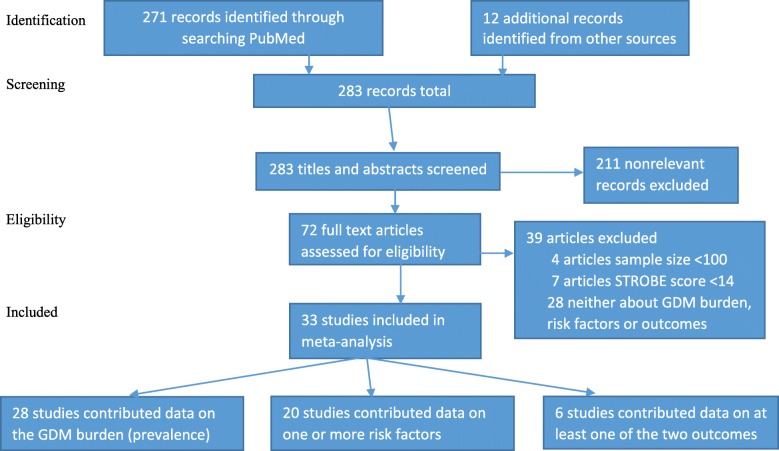
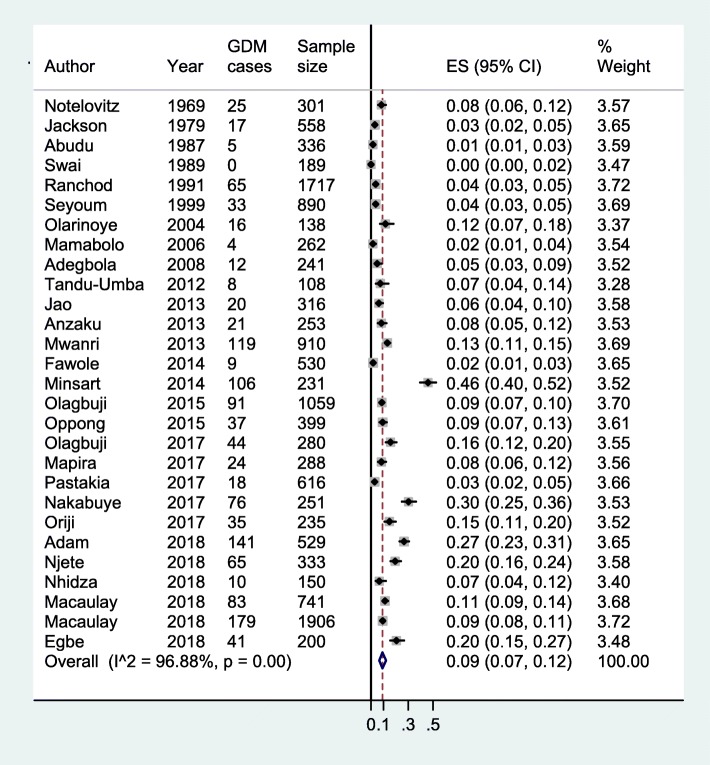
Background: The burden, determinants and outcomes of gestational diabetes mellitus (GDM) in sub-Saharan Africa are not known. We summarized existing evidence on the prevalence, risk factors and complications of GDM in the region. Methods: PubMed was searched from inception to January 31st 2019. Studies were included if carried out in any of the sub-Saharan Africa countries and were available as abstracts or full texts. Interventional studies and those only including qualitative data were excluded. We employed random effects modelling to estimate the pooled GDM prevalence and risk ratios (RRs) for risk factors and outcomes of GDM and their 95%CI. Results: 283 papers were identified in the initial search, 33 of which met the inclusion criteria. Data on GDM burden suggest a pooled prevalence of 9% (95%CI, 7–12%). Family history of type 2 diabetes and previous history of GDM, macrosomia, stillbirth and abortion were important risk factors of GDM. In addition, being overweight or obese, over 25 years of age or hypertensive increased the risk of GDM. In terms of complications, GDM more than doubles the risk macrosomia (RR; 95%CI: 2.2; 1.1–4.4). Conclusions: There is a high burden of gestational diabetes mellitus in sub-Saharan Africa, but more studies are needed to document locally important risk factors as well as maternal and offspring outcomes. Interventions to reduce obesity among older African women might lead to reduced risk of GDM in sub-Saharan Africa.
Overview
The claims and statistics of this paper haven’t been checked yet.
Run the check — free, no account needed. It reads the open-access text and checks the sources it cites.
Integrity signals
Registry
Cites
Statistics
Figures
Verification
Claims the paper makes
The claims and statistics of this paper haven’t been checked yet.
Run the check — free, no account needed. It reads the open-access text and checks the sources it cites.
Claims other papers make about this one
Each is checked against this paper’s own text: does it say what the citing paper says it does?
The cited source doesn’t support the claim as written.
In the citing paper
“Even after changing the criteria for a GDM diagnosis in the WHO/IADPSG 2013, the overall prevalence of GDM is still unknown.”
From Evolution of Gestational Diabetes Mellitus across Continents in 21st Century (2022) · cites this paper as [30]
Checked by a reasoning model — may be wrong.
Experimental — accuracy not yet measuredThe source backs part of the claim, not all of it — or backs it for a different population, condition or comparison.
In the citing paper
“Several studies concerning GDM in Africa were performed to try to fill in the gap regarding GDM prevalence, risk factors, outcomes and management, but the majority of them focused on specific populations [30,31,32].”
From Evolution of Gestational Diabetes Mellitus across Continents in 21st Century (2022) · cites this paper as [30]
Experimental — accuracy not yet measuredThe source backs part of the claim, not all of it — or backs it for a different population, condition or comparison.
In the citing paper
“According to Natamba et al.’s systematic review, the incidence of GDM was assessed at 3% before 2010 and approximately 13% between 2010 and 2018”
From Evolution of Gestational Diabetes Mellitus across Continents in 21st Century (2022) · cites this paper as [30]
Experimental — accuracy not yet measuredThe source backs part of the claim, not all of it — or backs it for a different population, condition or comparison.
In the citing paper
“This is connected with urbanization, changing lifestyles, and newer and more common GDM screening methods [30,31].”
From Evolution of Gestational Diabetes Mellitus across Continents in 21st Century (2022) · cites this paper as [30]
Experimental — accuracy not yet measuredThe source backs part of the claim, not all of it — or backs it for a different population, condition or comparison.
In the citing paper
“Additionally, an age greater than 25 years, overweight, or obesity, and mutliparity also increased the risk of GDM, but primiparity decreased this risk.”
From Evolution of Gestational Diabetes Mellitus across Continents in 21st Century (2022) · cites this paper as [30]
Experimental — accuracy not yet measured
The cited source says what the claim attributes to it.
In the citing paper
“According to Natamba et al. the most important risk factors for GDM in subSaharan Africa were: GDM, stillbirth, abortion, macrosomia in previous pregnancies, family history of T2DM and hypertension.”
From Evolution of Gestational Diabetes Mellitus across Continents in 21st Century (2022) · cites this paper as [30]
The cited source says what the claim attributes to it.
In the citing paper
“On the African continent, a few ways diagnosing GDM diagnosis have still exist. The WHO 1985, WHO 1999, WHO 2006, CC criteria, ADA 2003/2004, WHO/IADPSG 2013 or individual protocols are taken into account [30,31].”
From Evolution of Gestational Diabetes Mellitus across Continents in 21st Century (2022) · cites this paper as [30]
The cited source says what the claim attributes to it.
In the citing paper
“Other parameters (e.g., HIV infection) were not statistically significant [30].”
From Evolution of Gestational Diabetes Mellitus across Continents in 21st Century (2022) · cites this paper as [30]
The cited source says what the claim attributes to it.
In the citing paper
“but if the IADPSG criteria were used the prevalence was approximately 16% in sub-Saharan Africa [30].”
From Evolution of Gestational Diabetes Mellitus across Continents in 21st Century (2022) · cites this paper as [30]
Self-check
Percentages, sums and reported differences re-computed from the paper’s own numbers.
The self-check needs the paper’s full text.
Citations
Cites
Preferred Reporting Items for Systematic Reviews and Meta-Analyses: the PRISMA statement
Moher, D., Liberati, A., Tetzlaff, J., Altman, D. G., & for the PRISMA Group (2009) · BMJ · doi:10.1136/bmj.b2535 · Cited by 83,823
Preferred reporting items for systematic reviews and meta-analyses: the PRISMA Statement.
(2009) · PubMed Central · Cited by 44,859
Meta-analysis in clinical trials
DerSimonian, R., & Laird, N. (1986) · Controlled Clinical Trials · doi:10.1016/0197-2456(86)90046-2 · Cited by 39,552
Preferred reporting items for systematic reviews and meta-analyses: The PRISMA statement
Moher, D., Liberati, A., Tetzlaff, J., Altman, D. G., & the PRISMA Group* (2009) · Annals of Internal Medicine · doi:10.7326/0003-4819-151-4-200908180-00135 · Cited by 37,554
Quantifying heterogeneity in a meta‐analysis
Higgins, J. P. T., & Thompson, S. G. (2002) · Statistics in Medicine · doi:10.1002/sim.1186 · Cited by 36,763
von Elm, E., Altman, D. G., Egger, M., Pocock, S. J., Gøtzsche, P. C., Vandenbroucke, J. P., & Initiative, F. T. S. (2007) · PLoS Medicine · doi:10.1371/journal.pmed.0040296 · Cited by 23,020
Vandenbroucke, J. P., von Elm, E., Altman, D. G., Gøtzsche, P. C., Mulrow, C. D., Pocock, S. J., Poole, C., Schlesselman, J. J., Egger, M., & Initiative, F. T. S. (2007) · PLoS Medicine · doi:10.1371/journal.pmed.0040297 · Cited by 8,613
International Association of Diabetes and Pregnancy Study Groups Consensus Panel (2010) · Diabetes Care · doi:10.2337/dc09-1848 · Cited by 5,390
Classification and diagnosis of diabetes mellitus and other categories of glucose intolerance.
National Diabetes Data Group (1979) · Diabetes · doi:10.2337/diab.28.12.1039 · Cited by 4,909
Vandenbroucke, J. P., Elm, E. V., Altman, D. G., Gøtzsche, P. C., Mulrow, C. D., Pocock, S. J., Poole, C., Schlesselman, J. J., Egger, M., & initiative, F. T. S. (2007) · Annals of Internal Medicine · doi:10.7326/0003-4819-147-8-200710160-00010-w1 · Cited by 3,543
Cited by
Sorted by citations
Epidemiology and management of gestational diabetes
Sweeting, A., Hannah, W., Backman, H., Catalano, P., Feghali, M., Herman, W. H., Hivert, M.-F., Immanuel, J., Meek, C., Oppermann, M. L., et al. (2024) · The Lancet · doi:10.1016/s0140-6736(24)00825-0 · Cited by 431
Factors Associated with Gestational Diabetes Mellitus: A Meta-Analysis
Zhang, Y., Xiao, C.-M., Zhang, Y., Chen, Q., Zhang, X., Li, X., Shao, R.-Y., & Gao, Y. (2021) · Journal of Diabetes Research · doi:10.1155/2021/6692695 · Cited by 112
Li, H., Nawsherwan, N., Fan, C., Mubarik, S., Nabi, G., & Ping, Y. X. (2022) · BMC Pregnancy and Childbirth · doi:10.1186/s12884-022-04807-8 · Cited by 76
Lewandowska, M. (2021) · International Journal of Environmental Research and Public Health · doi:10.3390/ijerph18136936 · Cited by 74
Egbe, T. O., Tsaku, E. S., Tchounzou, R., & Ngowe, M. N. (2018) · Pan African Medical Journal · doi:10.11604/pamj.2018.31.195.17177 · Cited by 51
Metadata
- Authors
- Natamba, B. K., Namara, A. A., & Nyirenda, M. J.
- Affiliations
- MRC/UVRI & LSHTM Uganda Research Unit (UG)
- London School of Hygiene & Tropical Medicine (GB)
- Corresponding author
- Natamba, Barnabas Kahiira
- Venue
- BMC Pregnancy and Childbirth
- Published
- 2019-11-28
- Volume
- 19
- Issue
- 1
- Pages
- 450-450
- ISSN
- 1471-2393 (ISSN-L)
- PMC
- PMC6883645
- OpenAlex
- W2990004610
- Cited by
- 100
- References
- 71
- Citations by year
- 2026: 17 · 2025: 11 · 2024: 16 · 2023: 12 · 2022: 13 · 2021: 23 · 2020: 6
- FWCI
- 1.66
- Type
- journal article
- Language
- en
- Open access
- gold
- doi.org
- Locations
- BMC Pregnancy and Childbirth (publishedVersion, cc-by)
- PubMed Central (publishedVersion, cc-by)
- PubMed (publishedVersion)
- DOAJ (DOAJ: Directory of Open Access Journals) (submittedVersion)
- Topics
- Health Sciences › Medicine › Obstetrics and Gynecology › Gestational Diabetes Research and Management
- Health Sciences › Medicine › Endocrinology, Diabetes and Metabolism › Diabetes, Cardiovascular Risks, and Lipoproteins
- Health Sciences › Medicine › Pediatrics, Perinatology and Child Health › Maternal and Neonatal Healthcare
- Keywords
- gestational diabetes mellitus, sub-Saharan Africa, prevalence, risk factors, macrosomia, stillbirth, abortion, maternal outcomes, offspring outcomes, family history of type 2 diabetes, maternal obesity, maternal age, hypertension in pregnancy, maternal overweight
- MeSH terms
- Abortion, Spontaneous, Diabetes Mellitus, Type 2, Family Health, Female, Fetal Macrosomia, Humans, Hypertension, Obesity, Pregnancy, Pregnancy Outcome, Risk Factors, Prevalence, Diabetes, Gestational, Africa South of the Sahara, Stillbirth
About these checks
Registry, retraction, Cites and statistics results are computed, not judged, with one exception: a printed reference that no index lists is read once by a model before it counts as a citation error. Claims are extracted by a model and kept only when their quote appears verbatim in the text; each cited source is then checked, with a model’s help, for whether it says what the claim relies on. Those verdicts can be wrong — read the claim’s quote and the cited source before relying on one.
Statistics and arithmetic are recomputed, not judged.
Confidence bands are shown only for fields calibrated on our annotated test set. None is calibrated yet, so no band is shown.
What counts as a claim ›How we measure confidence ›How we check this ›
Are you an author, or do you see a problem with this page? Request a review
