

Effects of pre-pregnancy body mass index and gestational weight gain on maternal and infant complications
Open accessThe DOI matches its Crossref record; 45 of the 45 references it cites were found in a registry or an index.
Abstract
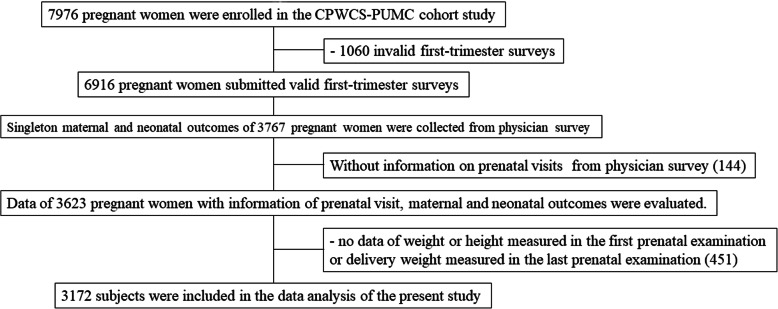
Background: The potential effects of pre-pregnancy body mass (BMI) and gestational weight gain (GWG) on pregnancy outcomes remain unclear. Thus, we investigated socio-demographic characteristics that affect pre-pregnancy BMIs and GWG and the effects of pre-pregnancy BMI and GWG on Chinese maternal and infant complications. Methods: 3172 women were enrolled in the Chinese Pregnant Women Cohort Study-Peking Union Medical College from July 25, 2017 to July 24, 2018, whose babies were delivered before December 31, 2018. Regression analysis was employed to evaluate the socio-demographic characteristics affecting pre-pregnancy BMI and GWG values and their effects on adverse maternal and infant complications. Results: Multivariate logistic regression analysis revealed that age groups < 20 years (OR: 1.97), 25–30 years (OR: 1.66), 30–35 years (OR: 2.24), 35–40 years (OR: 3.90) and ≥ 40 years (OR: 3.33) as well as elementary school or education below (OR: 3.53), middle school (OR: 1.53), high school (OR: 1.40), and living in the north (OR: 1.37) were risk factors in maintaining a normal pre-pregnancy BMI. An age range of 30–35 years (OR: 0.76), living in the north (OR: 1.32) and race of ethnic minorities (OR: 1.51) were factors affecting GWG. Overweight (OR: 2.01) and inadequate GWG (OR: 1.60) were risk factors for gestational diabetes mellitus (GDM). Overweight (OR: 2.80) and obesity (OR: 5.42) were risk factors for gestational hypertension (GHp). Overweight (OR: 1.92), obesity (OR: 2.48) and excessive GWG (OR: 1.95) were risk factors for macrosomia. Overweight and excessive GWG were risk factors for a large gestational age (LGA) and inadequate GWG was a risk factor for low birth weights. Conclusions: Overweight and obesity before pregnancy and an excessive GWG are associated with a greater risk of developing GDM, GHp, macrosomia and LGA. The control of body weight before and during the course of pregnancy is recommended to decrease adverse pregnancy outcomes, especially in pregnant women aged < 20 or > 25 years old educated below university and college levels, for ethnic minorities and those women who live in the north of China. Trial registration: Registered at Clinical Trials ( NCT03403543 ), September 29, 2017.
Overview
The claims and statistics of this paper haven’t been checked yet.
Free: it reads the open-access text and checks the first 5 claims that cite a source we can check. Create a free account to check every claim.
Integrity signals
Registry
Cites
Statistics
Figures
Verification
Claims the paper makes
The claims and statistics of this paper haven’t been checked yet.
Free: it reads the open-access text and checks the first 5 claims that cite a source we can check. Create a free account to check every claim.
Claims other papers make about this one
Each is checked against this paper’s own text: does it say what the citing paper says it does?
The source backs part of the claim, not all of it — or backs it for a different population, condition or comparison.
In the citing paper
“A weight gain of over 18 kg is associated with a twice higher risk of macrosomia [84,85].”
From Gestational Diabetes Mellitus—Recent Literature Review (2022) · cites this paper as [85]
Experimental — accuracy not yet measuredThe source backs part of the claim, not all of it — or backs it for a different population, condition or comparison.
In the citing paper
“most of the current evidences displayed that inadequate and excessive GWG were related to poor pregnancy outcomes for non-diabetic women in Western or high-income countries [9, 19, 20]”
From Associations of maternal pre-pregnancy BMI and gestational weight gain with the risks of adverse pregnancy outcomes in Chinese women with gestational diabetes mellitus (2023) · cites this paper as [9]
Experimental — accuracy not yet measured
Self-check
Percentages, sums and reported differences re-computed from the paper’s own numbers.
The self-check needs the paper’s full text.
Citations
Cites
(2004) · The Lancet · doi:10.1016/s0140-6736(03)15268-3 · Cited by 12,717
Weight Gain During Pregnancy: Reexamining the Guidelines
Rasmussen, K. M., & Yaktine, A. L. (2009) · Cited by 4,493
Brown, M. A., Lindheimer, M. D., Swiet, M. D., Assche, A. V., & Moutquin, J.-M. (2001) · Hypertension in Pregnancy · doi:10.1081/prg-100104165 · Cited by 1,894 · cited 1×
“GHp was defined as systolic blood pressure being ≥140 mmHg or diastolic pressure being ≥90 mmHg during the 3rd trimester, or if the mother-to-be had been prescribed medication to control hypertension [20].”
BackgroundGoldstein, R. F., Abell, S. K., Ranasinha, S., Misso, M., Boyle, J. A., Black, M. H., Li, N., Hu, G., Corrado, F., Rode, L., et al. (2017) · JAMA · doi:10.1001/jama.2017.3635 · Cited by 1,636
Anatomie aspects of vaginal eversion after hysterectomy
DeLancey, J. O. L. (1992) · American Journal of Obstetrics and Gynecology · doi:10.1016/0002-9378(92)91562-o · Cited by 993
Diagnostic Criteria and Classification of Hyperglycaemia First Detected in Pregnancy
Agarwal, M., Boulvain, M., Coetzee, E. J., Colagiuri, S., Falavigna, M., Hod, M., Meltzer, S. J., Metzger, B. E., Omori, Y., Rasa, I., et al. (2013) · Cited by 769
Swift, S., Woodman, P., O'Boyle, A., Kahn, M., Valley, M., Bland, D., Wang, W., & Schaffer, J. (2005) · American Journal of Obstetrics and Gynecology · doi:10.1016/j.ajog.2004.10.602 · Cited by 752
Outcomes of maternal weight gain.
Viswanathan, M., Siega‐Riz, A. M., Moos, M. K., Deierlein, A. L., Mumford, S. L., Knaack, J., Thieda, P., Lux, L. J., & Lohr, K. N. (2008) · PubMed · Cited by 500
Trends in Pre‐pregnancy Obesity in Nine States, 1993–2003
Kim, S. Y., Dietz, P. M., England, L., Morrow, B., & Callaghan, W. M. (2007) · Obesity · doi:10.1038/oby.2007.621 · Cited by 402
Maternal Prepregnancy Body Mass Index and Gestational Weight Gain on Pregnancy Outcomes
Li, N., Liu, E., Guo, J., Pan, L., Li, B., Wang, P., Liu, J., Wang, Y., Liu, G., Baccarelli, A. A., et al. (2013) · PLoS ONE · doi:10.1371/journal.pone.0082310 · Cited by 356
Self-citation
Research works printed but not linked: 5
- Organization WH A Guide for Progamme Managers 2001 Geneva World Health Organization; Iron Deficiency Anemia. Assessment, Prevention and Control
- Jin Z Ma S Dong L Li X Zhu J Zhang H Chin J Public Health 2009 25 4 415 416
- Li B Kong Y Research progress on the relationship between BMI and pregnancy outcome in pregnant women Chin J Family Plann 2017 25 10 715 717
- ZHAO J, HUANG W, QIN B, Ruiqing Z. Associations of pre-pregnancy BMI, pregnancy weight gain and newborn weight. China Med Her. 2018;15(30):84–6.
- Zhao R, Xu L, Wu M, Li R, Zhang Z, Cao X. Relationship between pre-pregnancy bodymass index,gestational weight gain and birth weight. Acta Univ Med Anhui. 2017;52(05):709–14.
Cited by
Items 301–358 of 358
Talebi, S., Mehrabani, S., Ghoreishy, S. M., Wong, A., Moghaddam, A., Rahimi-Feyli, P., Amirian, P., Zarpoosh, M., Kermani, M. A. H., & Moradi, S. (2024) · Figshare · doi:10.6084/m9.figshare.26721162
Talebi, S., Mehrabani, S., Ghoreishy, S. M., Wong, A., Moghaddam, A., Rahimi-Feyli, P., Amirian, P., Zarpoosh, M., Kermani, M. A. H., & Moradi, S. (2024) · Figshare · doi:10.6084/m9.figshare.26721168
Wu, H., Zhang, S., Lin, X., He, J., Wang, S., & Zhou, P. (2021) · Figshare · doi:10.6084/m9.figshare.16928195
Self-citationGu, C., Wu, W., Lai, K., Li, H., Wu, L., Lu, W., Ruan, X., & Luo, M. (2023) · Figshare · doi:10.6084/m9.figshare.22715314
Aji, A. S., Lipoeto, N. I., Yusrawati, Y., Malik, S. G., Kusmayanti, N. A., Susanto, I., Majidah, N. M., Nurunniyah, S., Alfiana, R. D., Wahyuningsih, W., et al. (2022) · Figshare · doi:10.6084/m9.figshare.20080446
Talebi, S., Mehrabani, S., Ghoreishy, S. M., Wong, A., Moghaddam, A., Rahimi-Feyli, P., Amirian, P., Zarpoosh, M., Kermani, M. A. H., & Moradi, S. (2024) · Figshare · doi:10.6084/m9.figshare.26721174
Talebi, S., Mehrabani, S., Ghoreishy, S. M., Wong, A., Moghaddam, A., Rahimi-Feyli, P., Amirian, P., Zarpoosh, M., Kermani, M. A. H., & Moradi, S. (2024) · Figshare · doi:10.6084/m9.figshare.26721171
Talebi, S., Mehrabani, S., Ghoreishy, S. M., Wong, A., Moghaddam, A., Rahimi-Feyli, P., Amirian, P., Zarpoosh, M., Kermani, M. A. H., & Moradi, S. (2024) · Figshare · doi:10.6084/m9.figshare.26721177
Boutros, P. H. (2024) · eScholarship@McGill (McGill) · doi:10.82308/24447
The experience of pregnant women withgestational diabetes mellitus : A Descriptive Literature review
Yang, H., & Yang, Y. (2025) · DiVA (University of Gävle)
Paula, W. O. (2023) · LA Referencia (Red Federada de Repositorios Institucionales de Publicaciones Científicas)
Ganancia de peso relacionada con la práctica alimentaria en gestantes de un centro materno infantil
Chavesta, J. J. C., Leon-Pastuso, P., Liñán-Bermúdez, A., & Barja–Ore, J. (2023) · Revista cubana de medicina militar
Alimentation et variation pondérale en contexte de maternité
Lebrun, A. (2020) · Corpus Université Laval (Université Laval)
PERINATAL DETERMINANTS OF OFFSPRING NEURODEVELOPMENT
Mortaji, N. (2023) · MacSphere (McMaster University) · doi:10.71548/24016
Tohara, A., Hikita, N., Khadbaatar, M., Oidovsuren, O., Matsufuji, H., Sato, Y., Suetsugu, Y., Morokuma, S., & Baatar, B. (2025) · Journal of Nursing Education and Practice · doi:10.63564/jnep.v16n1p1
Mendes, R. C. M. G. (2023) · LA Referencia (Red Federada de Repositorios Institucionales de Publicaciones Científicas)
Recent Advances in Gestational Diabetes: Diagnosis, Treatment and Prevention
(2026) · Frontiers research topics · doi:10.3389/978-2-8325-7437-9
Wickramasinghe, P., Liyanage, G., de Silva, H., Weliange, S. D. S., Walpita, Y. N., Jayaweera, H., Siriwardena, I., Rowel, D. S., Daniel, A. E., & Senarath, U. (2026) · BMJ Public Health · doi:10.1136/bmjph-2024-002409
de Almeida, L. G., Silva, L. G. R., de Sousa, R. M. L., da Silva, A. M., Barros, R. A. D. J. P. A., Barroso, F. A., de Almeida-Pititto, B., ARAUJO, E., & Mattar, R. (2026) · Revista Brasileira Ginecologia e Obstetrícia · doi:10.61622/rbgo/2026rbgo102
“(10,11) On the other hand, underweight during pregnancy raises concerns about fetal development and the risk of prematurity and mortality.”
Diagnosis of Fetal Macrosomia and Perinatal Outcomes in Patients with Gestational Diabetes
Sabaliauskaitė, E. (2024) · Lithuanian University of Health Sciences
Deshpande, S. S. (2025) · Tampere University Institutional Repository (Tampere University)
Wu, Y., Zhang, J., Wang, X., Chen, L., Qin, J., & Wang, T. (2026) · International Journal of Gynecology & Obstetrics · doi:10.1002/ijgo.70981
“7 A recent small-scale retrospective cohort study suggested that among women with GDM, those with pre-pregnancy overweight or obesity exhibited a markedly higher LGA risk compared to their normal-weight counterparts.”
The impact of obesity on maternal and fetal outcome
Tuteja, M., & Patil, C. S. (2026) · International Journal of Reproduction Contraception Obstetrics and Gynecology · doi:10.18203/2320-1770.ijrcog20260881
[Impact of pre-pregnancy body mass index on maternal and infant outcomes in twin pregnancies].
Wang, H.-Y., Shi, B., Lu, D., Ren, S.-H., Huang, K., Shen, W., Chen, Z.-F., Liu, J., You, C., Li, G.-F., et al. (2026) · PubMed Central · doi:10.7499/j.issn.1008-8830.2507140
Self-citationGoff, S. L. (2021) · theses.fr (ABES) · doi:10.70675/9dc17421ze12cz448fzb5eczba114d656ef9 · Cited by 1
Lifestyle of Women Ill with Gestational Diabetes and the Course of Pregnancy and Its Complications
Koženevskienė, L. (2023) · Lithuanian University of Health Sciences
Ye, X., Li, P., & Shi, C. (2026) · Frontiers in Global Women s Health · doi:10.3389/fgwh.2026.1777069
Huo, Y., Li, Y., Jin, X., Kuang, X., Fang, L., Sun, F., Zhou, P., & Wang, R. (2026) · Clinical and Experimental Obstetrics & Gynecology · doi:10.31083/ceog48617
Efecto de la obesidad en el embarazo y el desarrollo fetal. Una revisión sistemática
Miguel, G. A. L. S., León, M. F. C., Moyano, D. M. C., Jaramillo, P. A. V., Sánchez, M. G., & Ordoñez, P. E. R. (2026) · Mediciencias UTA (Impresa)/Mediciencias UTA (En línea) · doi:10.31243/mdc.uta.v10i2.3223.2026
Xu, Q., Zhang, H., Chen, B., Xie, Z., Lin, Q., Zhao, Y., She, G., Zhong, F., & Li, J. (2026) · International Journal of Women s Health · doi:10.2147/ijwh.s599831
Ma, X., Liu, Y., Xu, X., Wang, H., & Zhao, X. (2026) · Molecular Genetics and Genomics · doi:10.1007/s00438-026-02430-2
“Being overweight before pregnancy is considered a risk factor for GDM(Sun et al. 2020).”
Yu, T., Lyu, K., Wang, Y., Yang, Y., Gou, L., & He, J. (2026) · BMC Pregnancy and Childbirth · doi:10.1186/s12884-026-09338-0
“The combined effects of fetal hyperinsulinemia and hyperglycemia further promote fat and protein accumulation, ultimately contributing to excessive fetal growth and the development of LGA [29, 30].”
Self-citationInfluence of Body Mass Index (BMI) on Mother’s Health during Pregnancy and Fetal Outcomes
Abid, M., Yazdani, T., Sheikh, N., Chaudhry, H., Mehmood, I., & Tahir, Z. (2026) · Pakistan Armed Forces Medical Journal · doi:10.51253/pafmj.v76isuppl-5.12374
Yang, R., Wang, Y., Fu, Q., Zhang, Y., Qiu, L., & Peng, Y. (2026) · BMJ Open · doi:10.1136/bmjopen-2025-112189 · Cited by 1
“21 22–24 Therefore, developing gestational management standards that simultaneously address the dual outcomes of preventing maternal pregnancy complications and ensuring appropriate neonatal weight has become imperative.”
Self-citationPerspektif Sosial dan Budaya dalam Perawatan Kesehatan Reproduksi
Darti, N. A. (., Nasution, D. L. (., & Karo, E. I. B. (2026) · Neliti
Gestational Weight Gain and Perinatal Outcomes in Pregnancies with Prepregnancy BMI = 50 kg/m²
Aderibigbe, O. A., & Gibson, K. S. (2026) · American Journal of Perinatology · doi:10.1055/a-2890-2010
Liu, L., Wang, C., Chen, X., Zhu, Y., Jiao, J., Li, L., & Huang, C. (2026) · International Journal of Women s Health · doi:10.2147/ijwh.s619071
“24,25 The association between anemia and SCH may also be biologically plausible.”
Stogianni, A., Penna, M., Jönsson, A., Wanby, A.-S., Alvarsson, M., Landin‐Olsson, M., Wanby, P., & Thunander, M. (2026) · Research Square · doi:10.21203/rs.3.rs-9671498/v1
Effect of Body Mass Index on the Active Stage of Labour
Akram, S., Chohan, S., Ashraf, V., Siraj, A., Toheed, M., & Anwar, R. (2026) · Pakistan Armed Forces Medical Journal · doi:10.51253/pafmj.v76i3.12542
Ren, Z., Zhang, A., Zhang, J., Fan, X., & Tang, H. (2026) · Maternal and Child Nutrition · doi:10.1111/mcn.70225 · Cited by 1
“Consequently, while the BMI distribution in our sample is not representative of the general population, key demographic and clinical associations (e.g., age, Cesarean section rates by BMI) are broadly consistent with larger Chinese cohorts (Sun et al. 2020).”
InfluentialXu, X.-P., Ding, S., Che, Y.-M., Li, J., Zhang, Z., & Qian, C. (2026) · World Journal of Diabetes · doi:10.4239/wjd.123635
Gómez-Gutiérrez, A. M., Velásquez-Penagos, J. A., Higuita-Gutiérrez, L. F., Galeano, E., Restrepo-Espinosa, D. C., Osorio, E., Quintana-Castillo, J. C., & Bueno-Sánchez, J. C. (2026) · Frontiers in Physiology · doi:10.3389/fphys.2026.1856926
“These alterations have been associated with insulin resistance, predisposing mothers to metabolic disturbances during pregnancy (as observed in the cohort) or to an increased risk of such complications later in life (Parrettini et al., 2020; Sun et al., 2020).”
Current Therapeutic Strategies for Obesity in the Pediatric Population: A Literature Review
Rokosz, J., Mazur, K., Michałek, S., Koczuk, J., Sładek, K., Trzepizur, A., & Spaczyńska-Kwiatkowska, M. (2026) · Quality in Sport · doi:10.12775/qs.2026.63.73245
Hung, T., Hsu, T., Ou, C., Lo, L., Shaw, S. W., & Wan, G. (2026) · iScience · doi:10.1016/j.isci.2026.117029
“25,26 A higher proportion of women in the GH group were primiparous and delivered by cesarean section, patterns that have also been reported in previous studies of GH. 27–29 The etiology of GH remains incompletely understood, but it likely involves multiple mechanisms, including maternal…”
Abudureyimu, M., Shen, C., Sun, R., Sun, J., Wan, L., Wang, Q., & Chen, Y. (2026) · Scientific Reports · doi:10.1038/s41598-026-64760-w
Self-citationJi, Q., Fu, B., Gao, L., Liu, H., Liu, Y., Quan, H., & Wang, F. (2026) · Frontiers in Endocrinology · doi:10.3389/fendo.2026.1870018
“Most existing anthropometric studies have focused on traditional indicators, including body mass index (BMI), waist-to-hip ratio, body fat percentage (9, 10), and GWG (11).”
Isohata, H., Miura, S., Yamazaki, Y., Goto, D., Goto, H., Yoshimura, Y., Hattori, K., Shimaoka, T., Inada, K., & Ochiai, D. (2026) · Journal of obstetrics and gynaecology research · doi:10.1111/jog.70470
Wu, Y., Shen, K., Guo, H., & Wang, H. (2026) · Frontiers in Endocrinology · doi:10.3389/fendo.2026.1904624
Double Burden of Malnutrition Prevalence in Pregnant Women: Systematic Review and Meta‐Analysis
Biete, A., Biete, C., Gonçalves, V. S. S., Patriota, É. S. O., & Pizato, N. (2026) · Journal of Human Nutrition and Dietetics · doi:10.1111/jhn.70347
Xu, L., Sun, P., Li, J., Wan, Y., Kang, S., Wang, Z., Wu, M., & Song, J. (2026) · BMC Pregnancy and Childbirth · doi:10.1186/s12884-026-09974-6
Global Research Trends on Low Birth Weight in Midwifery: A Bibliometric Analysis from 2000-2025
Kastinani, K., Hakimi, M., & Rokhananwati, D. (2026) · Jurnal Manajemen Informasi Kesehatan (Health Information Management) · doi:10.51851/jmik.v11i1.1099
“These factors continue to be the main way that scientists look at and understand low birth weight (Mohamed et al., 2022; Bartsch et al., 2016; Arabzadeh et al., 2024; Sun et al., 2020).”
Lappermsub, M., Singtan, J., Tachasuksri, T., Kaewpoung, S., & Aontawon, T. (2026) · Nursing Science Journal of Thailand
García, A. F. (2023) · Repositorio de la Universidad de Oviedo (RUO)
Derdaki, M., Bakkali, M. E., Zghaïd, M., Arfaoui, A., Quyou, A., & Ouahidi, M. L. (2026) · doi:10.5005/aijms-11038-0031
Li, J., Yang, M., Chen, Y., Qi, X., Wu, L., Wang, M., & Wang, Y. (2026) · Frontiers in Public Health · doi:10.3389/fpubh.2026.1933184
Self-citationYaşam Boyu Sağlığın Geliştirilmesi: Halk Sağlığı ve Güncel Yaklaşımlar
ÜÇLER, E. Ç., GENÇOĞLU, F., Demiryürek, S. Ç., TİMUR, A., YILDIRIM, Ö., SEVİNÇ, N., SEVİNÇ, N., Bayrakçeken, E., SERDAROĞLU, G. K., Bilgili, N., et al. (2026) · Bidge Yayınları eBooks · doi:10.70269/vw61px42aeh7
The Role of Fatty Acid-Binding Protein 4 in Pregnancy Complications and Fetal Health
Mierzyński, R., Poniedziałek‐Czajkowska, E., Świda, K., & Mierzyńska, K. (2026) · International Journal of Molecular Sciences · doi:10.3390/ijms27219860
Sari, N. M. (2026) · Blossom Journal of Midwifery · doi:10.35730/vyrbzw54
Metadata
- Authors
- Sun, Y., Shen, Z., Zhan, Y., Wang, Y., Ma, S., Zhang, S., Liu, J., Wu, S., Feng, Y., Chen, Y., Cai, S., Shi, Y., Ma, L., & Jiang, Y.
- Affiliations
- Peking Union Medical College Hospital (CN)
- Chinese Academy of Medical Sciences & Peking Union Medical College (CN)
- Corresponding author
- Ma, Liangkun
- Jiang, Yu
- ORCID
- Venue
- BMC Pregnancy and Childbirth
- Published
- 2020-07-06
- Volume
- 20
- Issue
- 1
- Pages
- 390-390
- ISSN
- 1471-2393 (ISSN-L)
- PMC
- PMC7336408
- OpenAlex
- W3039753871
- Semantic Scholar
- 781167c9d6f8ccb3cbdf8aaa1520e673d070d7c2
- Cited by
- 319
- References
- 44
- Citations by year
- 2026: 27 · 2025: 52 · 2024: 77 · 2023: 77 · 2022: 55 · 2021: 24 · 2020: 5
- FWCI
- 24.49
- Type
- journal article
- Language
- en
- Open access
- gold
- doi.org
- Licence
- cc-by
- creativecommons.org/licenses/by/4.0 (tdm)
- creativecommons.org/licenses/by/4.0 (vor)
- Locations
- BMC Pregnancy and Childbirth (publishedVersion, cc-by)
- PubMed Central (publishedVersion, cc-by)
- PubMed (publishedVersion)
- DOAJ (DOAJ: Directory of Open Access Journals) (submittedVersion, cc-by-sa)
- Funders
- Chinese Academy of Medical Sciences Innovation Fund for Medical Sciences (2016-I2, M-1-008)
- Topics
- Health Sciences › Medicine › Obstetrics and Gynecology › Gestational Diabetes Research and Management
- Health Sciences › Medicine › Pediatrics, Perinatology and Child Health › Maternal and Neonatal Healthcare
- Health Sciences › Medicine › Public Health, Environmental and Occupational Health › Obesity, Physical Activity, Diet
- Keywords
- pre-pregnancy body mass index, gestational weight gain, maternal complications, neonatal complications, gestational diabetes mellitus, gestational hypertension, macrosomia, low birth weight, maternal obesity, maternal overweight, excessive weight gain, risk factors, sociodemographic factors, Chinese pregnant women, pregnancy outcomes, maternal age, maternal education, ethnic minorities, regional variation
- MeSH terms
- Gestational Weight Gain, Adult, Birth Weight, China, Female, Fetal Macrosomia, Gestational Age, Humans, Infant, Newborn, Obesity, Pregnancy, Pregnancy Complications, Pregnancy Outcome, Risk Factors, Socioeconomic Factors, Cohort Studies, Body Mass Index, Diabetes, Gestational, Hypertension, Pregnancy-Induced, Overweight, Young Adult
About these checks
Registry, retraction, Cites and statistics results are computed, not judged, with one exception: a printed reference that no index lists is read once by a model before it counts as a citation error. Claims are extracted by a model and kept only when their quote appears verbatim in the text; each cited source is then checked, with a model’s help, for whether it says what the claim relies on. Those verdicts can be wrong — read the claim’s quote and the cited source before relying on one.
Statistics and arithmetic are recomputed, not judged.
Confidence bands are shown only for fields calibrated on our annotated test set. None is calibrated yet, so no band is shown.
What counts as a claim ›How we measure confidence ›How we check this ›
Are you an author, or do you see a problem with this page? Request a review
Data sources
Bibliographic data: Semantic Scholar, OpenAlex, Crossref.
Contains information from the Semantic Scholar Academic Graph Datasets, made available under the ODC Attribution License (ODC-BY 1.0).
Semantic Scholar’s data is described in: Kinney, R., et al. (2023). The Semantic Scholar Open Data Platform. arXiv:2301.10140.
