

Adherence to iron-folic acid supplementation among pregnant women in Ethiopia: a systematic review and meta-analysis
Open accessThe DOI matches its Crossref record; 36 of the 36 references it cites were found in a registry or an index.
Abstract
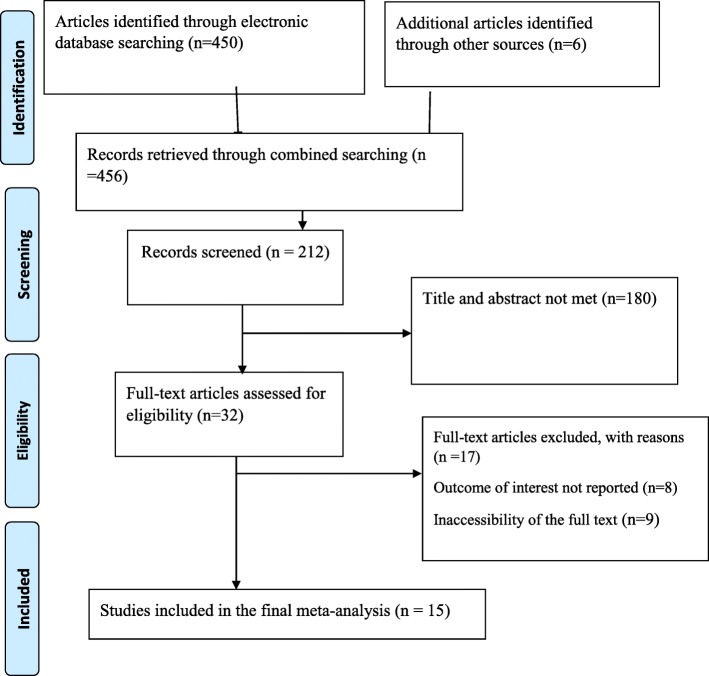
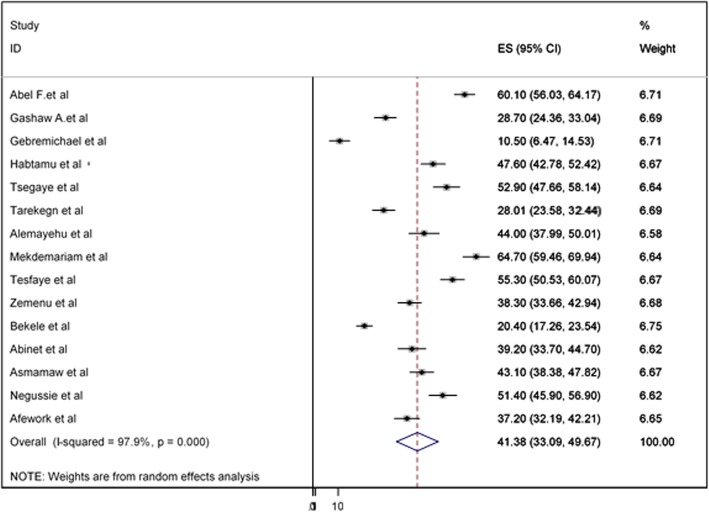
Background: Despite the supplementation of iron-folic acid is the recommended strategy during the antenatal period; iron deficiency anemia is the commonest hematologic complication during pregnancy. Therefore, this systematic review and meta-analysis aimed to assess the level of adherence to iron-folic acid supplementation and its associated factors among pregnant women in Ethiopia. Methods: Systematic review and meta-analysis guideline was followed for this study. Different online databases were used for the review: PubMed, HINARI, EMBASE, Google Scholar and African Journals Online. Different searching terms were applied based on the adapted PICO principles to achieve and access all the essential articles. The data were entered and analyzed using Microsoft Excel and Stata 11 software respectively. Results: Fifteen studies were included in this systematic review and meta-analysis with a total of 5808 pregnant women. The overall pooled prevalence of adherence to iron-folic acid supplementation among pregnant women in Ethiopia was 41.38% (95% CI: 33.09, 49.67). Having secondary and above educational status of the women (AOR:2.68,95%CI:1.25, 5.74), having an early registration of antenatal care follow-up (≤16 weeks) (AOR:2.54,95%CI:1.99, 3.24), having anemia complication during current pregnancy (AOR:3.01,95%CI:1.88, 4.81), having good knowledge of iron-folic acid supplementation (AOR: 2.96, 95%CI:1.76, 4.99), having four times or more antenatal care follow up (AOR:3.66, 95%CI:2.81, 4.77), getting health education about benefit of iron and folic acid (AOR:2.62,95%CI:1.46,4.72), and having good knowledge about anemia (AOR:2.99,95%CI:2.32, 3.85) were associated risk factors for adherence to iron-folic acid supplementation. Conclusion: The overall pooled prevalence adherence of IFAS among pregnant women was lower than the WHO recommendations. Educational status, early registration of ANC, anemia in the current pregnancy, good knowledge of IFAS, number of ANC visits, good knowledge of anemia and receiving health education about the benefit of IFAS were factors associated with the adherence of IFAS among pregnant women in Ethiopia. This finding is important to design strategic policies and to prevent anemia and congenital anomaly resulted from inadequate intake of iron and folic acid.
Overview
The claims and statistics of this paper haven’t been checked yet.
Free: it reads the open-access text and checks the first 5 claims that cite a source we can check. Create a free account to check every claim.
Integrity signals
Registry
Cites
Statistics
Figures
Verification
Claims the paper makes
The claims and statistics of this paper haven’t been checked yet.
Free: it reads the open-access text and checks the first 5 claims that cite a source we can check. Create a free account to check every claim.
Self-check
Percentages, sums and reported differences re-computed from the paper’s own numbers.
The self-check needs the paper’s full text.
Citations
Cites
1 retracted
Periconceptional supplementation with folate and/or multivitamins for preventing neural tube defects
Lumley, J., Watson, L., Watson, M., & Bower, C. (2001) · Cochrane Database of Systematic Reviews · doi:10.1002/14651858.cd001056 · Cited by 388
RetractedKirk, J., MacDonald, A., Lavender, P., Dean, J., & Rubin, G. (2017) · Biomedicine Hub · doi:10.1159/000480347 · Cited by 3,887
Adherence and health care costs
McGuire, M., & Iuga (2014) · Risk Management and Healthcare Policy · doi:10.2147/rmhp.s19801 · Cited by 708
Guideline: Daily iron and folic acid supplementation in pregnant women
Who, W. (2012) · Cited by 381
Peña-Rosas, J. P., & Viteri, F. E. (2009) · Cochrane Database of Systematic Reviews · doi:10.1002/14651858.cd004736.pub3 · Cited by 279
Kawaguchi, A., Nita, M., Ishii, T., Watanabe, M., & Noutoshi, Y. (2019) · BMC Research Notes · doi:10.1186/s13104-018-4038-6 · Cited by 204
Compliance with iron-folic acid (IFA) therapy among pregnant women in an urban area of south India
Mithra, P., Unnikrishnan, B., Rekha, T., Nithin, K., Mohan, K., Kulkarni, V, Kulkarni, V, & Agarwal, D. (2014) · African Health Sciences · doi:10.4314/ahs.v13i4.3 · Cited by 181
Taye, B., Abeje, G., & Mekonen, A. (2015) · Pan African Medical Journal · doi:10.11604/pamj.2015.20.43.4894 · Cited by 155 · cited 1×
“[23] 2013 Amhara Community-based 634 20.”
Kamau, M. W., Mirie, W., & Kimani, S. (2018) · BMC Public Health · doi:10.1186/s12889-018-5437-2 · Cited by 125
Ugwu, E., Olibe, A., Obi, S., & Ugwu, A. (2014) · Nigerian Journal of Clinical Practice · doi:10.4103/1119-3077.141427 · Cited by 114
Research works printed but not linked: 10
- World Health Organization. Recommendation on antenatal care for positive pregnancy. 2016.
- World Health Organization. The global prevalence of anaemia in 2011. Geneva: world health organization; 2011.
- FMOH. National guideline for control and prevention of micronutrient deficiencies. Family Health Department, Federal Ministry of Health, Government of Ethiopia: Addis Ababa; 2009.
- WHO, Guideline: Daily iron and folic acid supplementation in pregnant women: 2006.
- FMOH: A Rapid, Initial Assessment of the Distribution and Consumption of Iron-Folic Acid Tab-lets through Antenatal Care in Ethiopia in selected four regions: 2013.
- FMOH A. Rapid, initial assessment of the distribution and consumption of Iron-folic acid tab-lets through antenatal Care in Ethiopia in selected four regions. SPRING. SPRING; 2013.
- Abdul-Rahman AM. Adherence to folic acid supplements during Peri- Conceptional period. Int J Curr Microbiol App Sci. 2015;4(7):215-23.
- Ibrahim ZM, et al. Assessment of adherence to iron and folic acid supplementation and prevalence of anemia in pregnant women. Med J Cairo Univ. 2011;79(2):2422-4.
- Ugwu EO, Olibe AO, et al. Determinants of compliance to iron supplementation among pregnant women in Enugu, Southeastern Nigeria. Nigerian J Clin Pract. 2014;17(5):608-12. · DOI · Paper page
- Vongvichit P, Isaranurug S, et al. Compliance of pregnant women regarding iron supplementation in Vientiane municipality. J Public Health Dev. 2003; 2(1):41-2.
Cited by
Perinatal asphyxia and its associated factors in Ethiopia: a systematic review and meta-analysis
Waltengus, F., Gedefaw, G. A., & Fenta, S. L. (2020) · BMC Pediatrics · doi:10.1186/s12887-020-02039-3 · Cited by 94
“than seven and above of the NOS criteria [11].”
BackgroundMethodSelf-citationElsharkawy, N. B., Abdelaziz, E. M., Ouda, M. M. A., & Oraby, F. A. (2022) · International Journal of Environmental Research and Public Health · doi:10.3390/ijerph19052724 · Cited by 92
“Non-compliance with iron supplements could have negative consequences on pregnant women and their fetal health, and increased compliance to iron supplementation has been linked with a lower risk of anemia during pregnancy and hemorrhagic disease in the newborn [20].”
BackgroundSaragih, I. D., Felipe‐Dimog, E. B., Saragih, I. S., & Lin, C. (2021) · Midwifery · doi:10.1016/j.midw.2021.103185 · Cited by 91
Gebremariam, A. D., Tiruneh, S. A., Abate, B. A., Engidaw, M. T., & Asnakew, D. T. (2019) · PLOS ONE · doi:10.1371/journal.pone.0210086 · Cited by 79
Hidayanty, H., Nurzakiah, N., Irmayanti, I., Yuliana, Y., Helmizar, H., & Yahya, Y. (2025) · International Journal of Environmental Research and Public Health · doi:10.3390/ijerph22020209 · Cited by 50
Micronutrients Deficiency and Their Associations with Pregnancy Outcomes: A Review
Walle, B. M., Adekunle, A. O., Arowojolu, A. O., Tolessa, T., & Mebiratie, A. L. (2020) · Nutrition and Dietary Supplements · doi:10.2147/nds.s274646 · Cited by 50
Billah, S. M., Raynes‐Greenow, C. H., Ali, N. B., Karim, F., Lotus, S. U., Azad, R., Sari, M., Mustaphi, P., Maniruzzaman, M., Rahman, S. M. M., et al. (2022) · Nutrients · doi:10.3390/nu14153114 · Cited by 45
“The large within-country geographic variations in IFA coverage and the population covered in the previous studies explains this difference [25,47].”
BackgroundAnato, A., & Reshid, M. (2025) · Scientific Reports · doi:10.1038/s41598-025-87957-x · Cited by 44
Lavanya, P., Jayalakshmy, R., Rajaa, S., & Thulasingam, M. (2020) · Journal of Family Medicine and Primary Care · doi:10.4103/jfmpc.jfmpc_721_20 · Cited by 43
“Similar findings were observed from other studies done in India[2,14,19] and Ethiopia.[4,21] The observed higher adherence among primigravida mothers than multigravida mothers might be due to perceived risks by the new mothers compared to multigravida.”
BackgroundResultInfluentialDebi, S., Basu, G., Mondal, R., Chakrabarti, S., Roy, S., & Ghosh, S. (2020) · Journal of Family Medicine and Primary Care · doi:10.4103/jfmpc.jfmpc_392_20 · Cited by 42
Handiso, Y. H., Belachew, T., Abuye, C., Workicho, A., & Baye, K. (2021) · Scientific Reports · doi:10.1038/s41598-021-89115-5 · Cited by 42
Directrices de la OMS sobre intervenciones de autocuidado para la salud y el bienestar
de la Salud, O. P. (2022) · Pan American Health Organization eBooks · doi:10.37774/9789275326275 · Cited by 43
Berhane, A., & Belachew, T. (2022) · Journal of Nutritional Science · doi:10.1017/jns.2022.51 · Cited by 37
Tesema, G. A., Tessema, Z. T., Angaw, D. A., Tamirat, K. S., & Teshale, A. B. (2021) · PLoS ONE · doi:10.1371/journal.pone.0259147 · Cited by 34
Bahati, F., Kairu-Wanyoike, S., & Nzioki, J. M. (2021) · Wellcome Open Research · doi:10.12688/wellcomeopenres.16699.2 · Cited by 30
Sanghvi, T. G., Nguyen, P. H., Forissier, T., Ghosh, S., Zafimanjaka, M., Walissa, T., Mahmud, Z., & Kim, S. S. (2023) · Food and Nutrition Bulletin · doi:10.1177/03795721231179570 · Cited by 29
Shao, Y., Meng, C., & Liang, Y. (2024) · Frontiers in Medicine · doi:10.3389/fmed.2024.1375622 · Cited by 23
“Nevertheless, the sustained impact of these intervention strategies is limited, with only a modest effect (11, 17–19).”
BackgroundBeressa, G., Lencha, B., Bosha, T., & Egata, G. (2022) · Scientific Reports · doi:10.1038/s41598-022-20614-9 · Cited by 22
John, S. E., Azizi, K. A., Hancy, A., Twinomujuni, A., Katana, D., Shine, J., Lyatuu, V., Sanga, A., Mwiru, R. S., Abdallah, F., et al. (2023) · PLOS Global Public Health · doi:10.1371/journal.pgph.0001828 · Cited by 22
Tadesse, A. W., Aychiluhm, S. B., & Mare, K. U. (2021) · Heliyon · doi:10.1016/j.heliyon.2021.e07521 · Cited by 22
“This finding is similar to studies conducted in 22 Sub-Saharan African countries [17], Ethiopia [31], evidence from the 2011 EDHS [44], Pakistan [47], a systematic review of 15 studies [51].”
ResultShlobin, N. A., Roach, J. T., Kancherla, V., Cáceres, A., Öcal, E., Ghotme, K. A., Lam, S. K., Park, K. B., Rosseau, G. L., Blount, J. P., et al. (2022) · Journal of Neurosurgery Pediatrics · doi:10.3171/2022.9.peds22188 · Cited by 21
Battung, S. M., Groen, H., & van der Beek, E. M. (2025) · BMC Public Health · doi:10.1186/s12889-025-22129-0 · Cited by 20
“Indeed, several IFA studies showed high adherence when mothers were equipped with sufficient information on the benefits of supplementation [19–21].”
Demisse, B., Temesgen, H., Dessie, B., & Kassa, G. M. (2021) · SAGE Open Medicine · doi:10.1177/20503121211049934 · Cited by 20
Tamirat, K. S., Kebede, F. B., Zayede, T., Tessema, G. A., & Tessema, Z. T. (2022) · BMC Pregnancy and Childbirth · doi:10.1186/s12884-022-04461-0 · Cited by 19
“found a direct link between anemia and maternal deaths, with each 10 g/L rise in hemoglobin associated with a 29% reduction in maternal mortality [5, 6].”
BackgroundResultInfluentialTemesgen, H., Woyraw, W., Feleke, F. W., Mezgebu, G. S., Taye, K., & Awoke, T. (2024) · Frontiers in Nutrition · doi:10.3389/fnut.2024.1348275 · Cited by 19
“A meta-analysis studies done in 2019 and 2020 show that the pooled estimated prevalence of adherence to iron-folic acid supplementation among pregnant women in Ethiopia was 41.38 and 46.15% ranging from the lowest 17.1% to the highest 74.5%, respectively, (13, 14).”
BackgroundInfluentialKurzawa, Z., Cotton, C. S., Mazurkewich, N., Verney, A., Busch‐Hallen, J., & Kashi, B. (2020) · Maternal and Child Nutrition · doi:10.1111/mcn.13124 · Cited by 19
Ali, S. A., Ali, S. A., Razzaq, S., Khowaja, N., Gutkind, S., Raheman, F. U., & Suhail, N. (2021) · BMC Pregnancy and Childbirth · doi:10.1186/s12884-021-03825-2 · Cited by 20
Byamugisha, J. K., Adero, N., Kiwanuka, T. S., Nalwadda, C. K., Ntuyo, P., Namagembe, I., Nabunya, E., Nakirijja, E., Mwadime-Ngolo, R., Mukasa, D. C., et al. (2022) · BMC Pregnancy and Childbirth · doi:10.1186/s12884-022-04507-3 · Cited by 16
“A systematic review and meta-analysis mentioned educational status of the mothers as one of the key determinants of adherence to IFA supplementation [14].”
BackgroundGaranet, F., Sampabré, G., & Tinta, A. A. (2023) · Journal of Public Health in Africa · doi:10.4081/jphia.2023.2734 · Cited by 15
Yassin, M. A., Kumma, W. P., Haile, D. T., & Elilo, L. T. (2024) · Scientific Reports · doi:10.1038/s41598-024-79066-y · Cited by 15
Mare, K. U., Aychiluhm, S. B., Mulaw, G. F., Sabo, K. G., Ebrahim, O. A., Tebeje, T. M., & Seifu, B. L. (2024) · BMC Pregnancy and Childbirth · doi:10.1186/s12884-024-07105-7 · Cited by 15
King, S. E., Yeh, P. T., Rhee, D. K., Tunçalp, Ö., Rogers, L. M., & Narasimhan, M. (2021) · BMJ Global Health · doi:10.1136/bmjgh-2021-005531 · Cited by 15
Sanin, K. I., Shaun, M. M. A., Rita, R. S., Hasan, M. K., Khanam, M., & Haque, M. A. (2023) · Nutrients · doi:10.3390/nu15061512 · Cited by 14
“Other studies support our findings with similar results [42,43,49,50].”
ResultPei, M., Liu, H., Yu, Y., Wei, T., & Guo, D. (2022) · Postharvest Biology and Technology · doi:10.1016/j.postharvbio.2022.112207 · Cited by 14
Demie, T. G., Gessese, G. T., Woldeamanuel, B. T., Biratu, T. D., & Handebo, S. (2023) · Food Science & Nutrition · doi:10.1002/fsn3.3503 · Cited by 13
Yalew, M., Adane, B., Damtie, Y., Kefale, B., Arefaynie, M., & Yasin, T. (2020) · PLoS ONE · doi:10.1371/journal.pone.0241975 · Cited by 13
“Even the prevalence of good adherence to iron/folic acid supplementation during pregnancy and immediate postpartum was low which may contributed to increase anemia among pregnant and/or lactating women [57, 58].”
BackgroundWorku, D. T., Yimer, M. A., & Geletaw, T. (2022) · Journal of Blood Medicine · doi:10.2147/jbm.s361675 · Cited by 12
Rockenbach, M. K., Rohweder, R., Schüler‐Faccini, L., Sanseverino, M. T. V., & Kowalski, T. W. (2025) · Nutrients · doi:10.3390/nu17172752 · Cited by 12
“Many of the challenges faced by Brazil are similar in other low-and middle-income countries, where socioeconomic vulnerabilities, limited access to healthcare, and lower education levels can impair adherence to folic acid supplementation [77,98].”
Shehnaz, S. I., Palivela, D., & Chaturvedula, L. (2021) · Journal of Family and Community Medicine · doi:10.4103/jfcm.jfcm_445_20 · Cited by 12
Asmamaw, D. B., Debebe Negash, W., Bitew, D. A., & Belachew, T. B. (2022) · Frontiers in Nutrition · doi:10.3389/fnut.2022.1023046 · Cited by 11
Mohamed, A. I., Mohamed, J., Abdillahi, M. M., Abdeeq, B. A., & Lema, T. B. (2024) · Clinical Epidemiology and Global Health · doi:10.1016/j.cegh.2024.101565 · Cited by 11
Bekele, Y. A., Gallagher, C., Batra, M., Vicendese, D., Buultjens, M., & Erbas, B. (2024) · Nutrients · doi:10.3390/nu16162801 · Cited by 11
“…including ongoing professional development to frontline health workers in ANC services who can facilitate behaviour change to improve women’s knowledge of and access to supplementation, which evidence shows can protect women and their babies from the preventable, adverse birth outcomes.”
BackgroundTsegai, M. B., Berhe, A., Tesfaezgi, S. B., Weldemariam, D. G., Petros, K. T., Weldetinsae, H. B., & Tesfamariam, E. H. (2023) · International Journal of Women s Health · doi:10.2147/ijwh.s419813 · Cited by 11
Saeed, M., Adam, G. K., Hussein, S., AlHabardi, N., & Adam, I. (2024) · Patient Preference and Adherence · doi:10.2147/ppa.s476738 · Cited by 10
Alemu, G. G., Adugna, D. G., Workie, A. M., Agimas, M. C., Baffa, L. D., Abuhay, H. W., Aweke, M. N., Alemu, T. G., & Baykemagn, N. D. (2025) · PLoS ONE · doi:10.1371/journal.pone.0329458 · Cited by 10
Delie, A. M., Gezie, L. D., Gebeyehu, A. A., Tarekegn, G. E., & Muche, A. A. (2022) · Frontiers in Nutrition · doi:10.3389/fnut.2022.955819 · Cited by 10
Berarti, A. E., Bore, M. G., & Beyene, B. (2023) · International Journal of Africa Nursing Sciences · doi:10.1016/j.ijans.2023.100526 · Cited by 9
Asres, A. W., Samuel, S., Daga, W. B., Tena, A., Alemu, A., Workie, S. B., Alemayehu, M. A., & Messel, H. (2023) · BMC Public Health · doi:10.1186/s12889-023-15794-6 · Cited by 9
“The serum iron level has a direct correlation with the level of blood pressure, concentration of total hemoglobin, and serum iron [34, 35].”
BackgroundResultGeta, T., Ashiko, A., & Tilahun, C. (2023) · Women s Health Reports · doi:10.1089/whr.2023.0020 · Cited by 8
Gebremariam, B. M., Hailu, D., Stoecker, B. J., & Mulugeta, A. (2025) · PLoS ONE · doi:10.1371/journal.pone.0315122 · Cited by 8
Ummair, M., Durrani, A., Jamshaid, M., Amjad, M., Gul, M., Khan, J., & Khan, A. Q. (2025) · Cureus · doi:10.7759/cureus.79495 · Cited by 8
“Additionally, lack of awareness about the benefits of IFAS, along with cultural beliefs, attitudes, and perceptions, further contributes to poor adherence [7,8].”
Yalew, M., Getachew, S., Mohammed, K., Hankarso, H., Bayile, A., Asmamaw, S. D., Assefa, M. G., Bazie, G. W., Mebratu, W., Kefale, B., et al. (2023) · BMC Pregnancy and Childbirth · doi:10.1186/s12884-023-05593-7 · Cited by 7
Legese, N., Roba, K. T., Demeke, H., Raru, T. B., Daba, A. K., Worku, N., & Abebe, Z. (2025) · PLoS ONE · doi:10.1371/journal.pone.0327410 · Cited by 7
“These findings are consistent with previous systematic reviews and meta-analyses [39], a study in Bangladesh [29], a study in low-middle-income countries of Asian, African, Latin American, and Caribbean nations [30], and studies in Ethiopia [36,37,40].”
Erowati, D., Yolahumaroh, Y., & Marlina, Y. (2023) · Jurnal kesehatan komunitas (Journal of community health) · doi:10.25311/keskom.vol9.iss3.1514 · Cited by 7
Urgessa, B., & Abdo, Z. A. (2020) · BLDE University Journal of Health Sciences · doi:10.4103/bjhs.bjhs_48_20 · Cited by 7
Hailu, B. A., Laillou, A., Chitekwe, S., Beyene, J., & Baye, K. (2021) · Maternal and Child Nutrition · doi:10.1111/mcn.13277 · Cited by 8
Bantie, B., Yirga, G. K., Eshetie, Y., Muhamed, A. N., Tassew, S. F., Kassie, Y. T., Tiruneh, C. M., Moges, N., Birhane, B. M., Anley, D. T., et al. (2023) · PLoS ONE · doi:10.1371/journal.pone.0279967 · Cited by 7
“intensive counseling and had optimal ANC visits which all affects the utilization of deworming medication [30, 47].”
BackgroundSeid, M. A., Gebru, A. S., Yimer, A., Ali, K., Yesuf, A., Sirage, N., Seid, A., Tesfa, N. A., & Yesuf, H. A. (2025) · BMC Pregnancy and Childbirth · doi:10.1186/s12884-025-08119-5 · Cited by 6
“Sample size was determined using a single population proportion formula with assumptions; p = 41.4% [43], 95% CI, and 5% margin of error (d = 0.05).”
InfluentialBancha, B., Lajore, B. A., Petros, L., Hassen, H., & Jemal, A. (2022) · PLoS ONE · doi:10.1371/journal.pone.0275086 · Cited by 6
“The aim of this study was to determine time- to- non-adherence to IFAS and associ- ated factors among pregnant women in Hosanna Town, South Ethiopia.”
BackgroundResultInfluentialAnalisis Pengetahuan dengan Kejadian Anemia pada Ibu Hamil di Puskesmas X
Aldania, F., & Masruroh, M. (2024) · Indonesian Journal of Midwifery (IJM) · doi:10.35473/ijm.v7i1.2565 · Cited by 6
Belay, S. A., Mulugeta, A., Petegem, W. V., & Matthys, C. (2026) · JMIR mhealth and uhealth · doi:10.2196/81001 · Cited by 5
“Adherence to iron and folic acid supplementation was defined as the consumption of at least 4 iron-folic acid tablets per week for the recommended period [33].”
Atmadani, R. N., Irham, L. M., Perwitasari, D. A., Akrom, A., & Urbayatun, S. (2023) · Public Health of Indonesia · doi:10.36685/phi.v9i1.647 · Cited by 5
Saje, S. M., Gashu, D., Joy, E. J. M., Adams, K. P., Moges, T., Tessema, M., & Ander, E. L. (2024) · Current Developments in Nutrition · doi:10.1016/j.cdnut.2024.103794 · Cited by 5
“%) of young children receive high dose vitamin A and only 41.4% of pregnant women are taking iron – folic acid supplementation [28,29].”
BackgroundInfluentialBonilla, C., & Cardenas, B. R. (2022) · Revista de Investigación de la Universidad Norbert Wiener · doi:10.37768/unw.rinv.11.01.r0001 · Cited by 5
Ssewankambo, U., & Nakaziba, R. (2023) · Nursing Communications · doi:10.53388/in2023021 · Cited by 5
“Previous studies have consistently highlighted the importance of providing information to mothers in enhancing the effectiveness of IFAS programs [31].”
Yanti, L. M., Mahardita, M. U., Hidayati, L., Firmansyah, F., Warajati, S., & Isnaeni, I. (2023) · Prosiding University Research Colloquium · Cited by 5
Perfil epidemiológico da mortalidade materna em Ouro Preto - MG, de 2010 a 2020
Teixeira, A. M. M., Sírio, M. A. D. O., Mendonça, R. D. D., & Pinto, V. D. (2023) · Revista Eletrônica Acervo Saúde · doi:10.25248/reas.e12268.2023 · Cited by 4
Shumi, L., Geda, A., & Bidira, K. (2024) · Health Science Reports · doi:10.1002/hsr2.1998 · Cited by 4
Irmawati, I., Usman, A. N., Ahmad, M., & Arsyad, N. A. (2022) · Nurse and Health Jurnal Keperawatan · doi:10.36720/nhjk.v11i1.315 · Cited by 4
“With increased adherence to folic acid consumption, the risk of anemia in the mother and newborn hemorrhagic disease and congenital anomalies in the fetus may decrease (Sendeku et al., 2020).”
BackgroundKnowledge and attitudes of pregnant women regarding folic acid supplementation
Mahmoud, N. F., Moneim, E. F. A.-E., Elsayed, H. F., & Farag, D. S. S. (2022) · International Journal of Health Sciences · doi:10.53730/ijhs.v6ns8.13472 · Cited by 4
Hubungan Pengetahuan dan Sikap Ibu Hamil dengan Kepatuhan Mengkonsumsi Tablet Fe
Arlym, L. T., Nurzannah, E. M., & Husna, H. M. (2024) · Jurnal Ilmu Kesehatan Bhakti Husada Health Sciences Journal · doi:10.34305/jikbh.v15i01.950 · Cited by 3
“Kunjungan ANC lebih awal dan rutin, dapat memberikan informasi berulang-ulang tentang manfaat tablet besi (Sendeku et al., 2020).”
BackgroundKarki, R., Khanal, S. P., Joshi, D. R., & Kaphle, M. (2025) · Advances in Public Health · doi:10.1155/adph/9964809 · Cited by 3
“Good knowledge was associated with a 2.4 times higher likelihood of compliance, consistent with previous research [3, 7, 20, 30, 33].”
InfluentialDennis, K., Marera, D., & Were, T. (2022) · The Egyptian Journal of Haematology · doi:10.4103/ejh.ejh_10_22 · Cited by 3
Tolera, C., Tafesse, T., Dessalegn, R., & Amenu, D. (2024) · Health Science Reports · doi:10.1002/hsr2.1952 · Cited by 3
Bulcha, F., Bikila, H., Debelo, S., Tolera, C., Tafesse, T., Dessalegn, R., & Amenu, D. (2024) · Health Science Reports · doi:10.1002/hsr2.2119 · Cited by 3
Ali, S. H., & Abdo, Z. A. (2022) · American Journal of Health Research · doi:10.11648/j.ajhr.20221002.11 · Cited by 3
Ferrero, E. M., Partap, U., & Fawzi, W. W. (2026) · British Journal Of Nutrition · doi:10.1017/s000711452610720x · Cited by 2
“…and associated barriers and facilitators, including secondary analyses of Demographic and Health Surveys (DHS) (5,12,14,15) , literature reviews (16,17) and cross-sectional studies (18 – 25) , data tend to be fragmented, with studies mostly reporting data for a limited number of countries and not…”
Atmadani, R. N., Arum, D. F., Akrom, A., & Urbayatun, S. (2025) · Jurnal Kebidanan Midwiferia · doi:10.21070/midwiferia.v11i2.1720 · Cited by 2
“The initial stage of the research was carried out by preparing a list of questionnaire questions that would be used based on some previous literature (Fuady & Bangun, 2013; Kusumawardani et al., 2019; Sendeku et al., 2020; Tegodan et al., 2021).”
Edukasi Gizi dalam Kehamilan sebagai Upaya Pencegahan Anemia
Masruroh, Cahyaningrum, & Pranoto, H. H. (2025) · Indonesian Journal of Community Empowerment (IJCE) · doi:10.35473/ijce.v7i1.3898 · Cited by 2
Turanzomwe, S., Amanyire, J., & Tumwebaze, M. (2022) · American Journal of Health Medicine and Nursing Practice · doi:10.47672/ajhmn.1302 · Cited by 2
Ampratwum, K. A., Nyanor, I., & Alem, J. N. (2023) · International Journal of Nutrition and Food Sciences · doi:10.11648/j.ijnfs.20231203.11 · Cited by 2
“Sendeku et al also found knowledge to be significant in determining compliance [45].”
BackgroundWakhungu, H. K., Abong, G. O., Muthike, C., Mutono, N., Muema, J., Omondi, G., Thumbi, S. M., & Bukania, Z. (2025) · Food Science & Nutrition · doi:10.1002/fsn3.4625 · Cited by 2
“…in developing countries especially due to the high poverty rates, high food insecurity status and poor adherence to iron and folic acid supplementation among these women (Gebremariam et al. 2019; Kamau, Mirie, and Kimani 2018; Lyoba et al. 2020; Saragih et al. 2022; Sendeku, Azeze, and Fenta 2020).”
Sengupta, A., Prakash, M., & Dutta, T. (2026) · BMC Pregnancy and Childbirth · doi:10.1186/s12884-026-09639-4 · Cited by 2
“However, a survey conducted in Ethiopia found that women in the higher age group (more than 35 years) showed less adherence when compared to women in the age group between 25 and 29 years [19].”
Romthira, S., Thinkhamrop, J., Chaiyarach, S., & Kreetiyutanont, S. (2020) · doi:10.21203/rs.3.rs-103713/v1 · Cited by 2
“9% from a previous study (15), with 95% con dence level and an error margin of 5%, the estimated sample size was at least 349.”
BackgroundNutrition and sustainable development goal 12: Responsible consumption
(2024) · Frontiers research topics · doi:10.3389/978-2-8325-4706-9 · Cited by 1
Hanson, L., Albert, K., Malloy, E., Singh, M., Kallay, M., Brandt, A., Morris, C., Kleber, D., & Forgie, M. M. (2024) · Journal of Midwifery & Women s Health · doi:10.1111/jmwh.13686 · Cited by 1
Acharya, K. P., Aryal, A., Paudel, R., Poudyal, A. K., & Shrestha, A. (2023) · A Bi-annual south Asian journal of research and innovation. · doi:10.3126/jori.v10i2.71841 · Cited by 1
“The results also indicate a possible link between Iron and Folic Acid (IFA) supplementation and reduced anemia prevalence among pregnant women (Siekmans et al., 2018; Sendeku et al., 2020; Fite et al., 2021).”
Saimaa, P., Mathiyalagen, P., Pandiamunian, J., Sabita, P., Sivagami, K., & Basu, M. (2024) · Healthline · doi:10.51957/healthline6462024 · Cited by 1
Hubungan Pengetahuan dalam Keteraturan Ibu Hamil Mengkonsumsi Tablet Fe di PMB Winanti, S. TR. KEB
Friskila, F., Meldawati, M., Darsono, P. V., & Suhartati, S. (2025) · Jurnal Ilmu Kedokteran dan Kesehatan Indonesia · doi:10.55606/jikki.v5i2.6585 · Cited by 1
The Cost of Expanding Ethiopia’s Salt Iodization Program to Include Multiple Micronutrients
Adams, K. P., Gashu, D., Zegeye, E. A., Mannar, M. G. V., Diosady, L. L., Ananth, N., & Ander, E. L. (2025) · Current Developments in Nutrition · doi:10.1016/j.cdnut.2025.107508 · Cited by 1
“[24], and contrary to the WHO recommendation to avert NTDs [25], a majority of women (71.5”
InfluentialCan Weekly Home Visits by The Community Improve Iron Supplementation Intake among Pregnant Women?
Ramadhani, K. (2025) · Jurnal PROMKES · doi:10.20473/jpk.v13.i2.2025.214-223 · Cited by 1
Santos-Antonio, G., Gonzales-Achuy, E., Solis, G., Hinojosa-Mamani, P., & Aparco, J. P. (2025) · Anales de la Facultad de Medicina · doi:10.15381/anales.v86i2.30986 · Cited by 1
Melsany, E. P., & Astuti, D. A. (2025) · Borneo Nursing Journal (BNJ) · doi:10.61878/bnj.v8i1.149 · Cited by 1
Tassew, W. C., Zeleke, A. M., Ferede, Y. A., Weldeab, A. N., & Ayenew, G. M. (2026) · Journal of the International Association of Providers of AIDS Care (JIAPAC) · doi:10.1177/23259582261432458 · Cited by 1
Borges, L. M. V., de Sousa, M. N. A., Nogueira, R. B. D. S. D. S., & Nogueira, T. B. D. S. D. S. (2022) · Temas em Saúde · doi:10.29327/213319.22.1-5 · Cited by 1
Machini, M. B., Oyore, J. P., & Wanyoro, A. K. (2023) · International Journal of TROPICAL DISEASE & Health · doi:10.9734/ijtdh/2023/v44i221496 · Cited by 1
Bustamante, D., & Vega, D. S. R. (2023) · Universidad Peruana de Ciencias Aplicadas (UPC) · doi:10.19083/tesis/668424 · Cited by 1
Vásquez, F. D. (2023) · LA Referencia (Red Federada de Repositorios Institucionales de Publicaciones Científicas) · Cited by 1
Koning, M., Koning, J., & O’Neill, P. (2023) · Springer eBooks · doi:10.1007/978-3-031-28127-3_7
Metadata
- Authors
- Sendeku, F. W., Azeze, G. G., & Fenta, S. L.
- Affiliations
- Bahir Dar University (ET)
- Venue
- BMC Pregnancy and Childbirth
- Published
- 2020-03-04
- Volume
- 20
- Issue
- 1
- Pages
- 138-138
- ISSN
- 1471-2393 (ISSN-L)
- PMC
- PMC7057669
- OpenAlex
- W3011309994
- Semantic Scholar
- 9ddcc21bced037904ff15f54cbc99353b9c2ca28
- Cited by
- 108
- References
- 36
- Citations by year
- 2026: 19 · 2025: 13 · 2024: 16 · 2023: 18 · 2022: 23 · 2021: 10 · 2020: 8
- FWCI
- 3.26
- Type
- journal article
- Language
- en
- Open access
- gold
- doi.org
- Licence
- cc-by
- creativecommons.org/licenses/by/4.0/ (tdm)
- creativecommons.org/licenses/by/4.0/ (vor)
- Locations
- BMC Pregnancy and Childbirth (publishedVersion, cc-by)
- PubMed Central (publishedVersion, cc-by)
- PubMed (publishedVersion)
- DOAJ (DOAJ: Directory of Open Access Journals) (submittedVersion)
- Topics
- Health Sciences › Medicine › Pediatrics, Perinatology and Child Health › Global Maternal and Child Health
- Health Sciences › Medicine › Pediatrics, Perinatology and Child Health › Public Health and Nutrition
- Health Sciences › Medicine › Pediatrics, Perinatology and Child Health › Maternal and Neonatal Healthcare
- Keywords
- iron and folic acid supplementation, adherence, pregnant women, prenatal care, iron deficiency anemia, risk factors, maternal education, health education, Ethiopia, anemia knowledge, antenatal care follow-up
- MeSH terms
- Anemia, Ethiopia, Female, Folic Acid, Humans, Iron, Health Knowledge, Attitudes, Practice, Pregnancy, Pregnancy Complications, Hematologic, Prenatal Care, Prevalence, Drug Monitoring, Anemia, Iron-Deficiency, Dietary Supplements, Pregnant People
About these checks
Registry, retraction, Cites and statistics results are computed, not judged, with one exception: a printed reference that no index lists is read once by a model before it counts as a citation error. Claims are extracted by a model and kept only when their quote appears verbatim in the text; each cited source is then checked, with a model’s help, for whether it says what the claim relies on. Those verdicts can be wrong — read the claim’s quote and the cited source before relying on one.
Statistics and arithmetic are recomputed, not judged.
Confidence bands are shown only for fields calibrated on our annotated test set. None is calibrated yet, so no band is shown.
What counts as a claim ›How we measure confidence ›How we check this ›
Are you an author, or do you see a problem with this page? Request a review
Data sources
Bibliographic data: Semantic Scholar, OpenAlex, Crossref.
Contains information from the Semantic Scholar Academic Graph Datasets, made available under the ODC Attribution License (ODC-BY 1.0).
Semantic Scholar’s data is described in: Kinney, R., et al. (2023). The Semantic Scholar Open Data Platform. arXiv:2301.10140.
