

Adherence to iron-folic acid supplementation among pregnant women in Ethiopia: a systematic review and meta-analysis
Open accessThe DOI matches its Crossref record; 36 of the 36 references it cites were found in a registry or an index.
Abstract
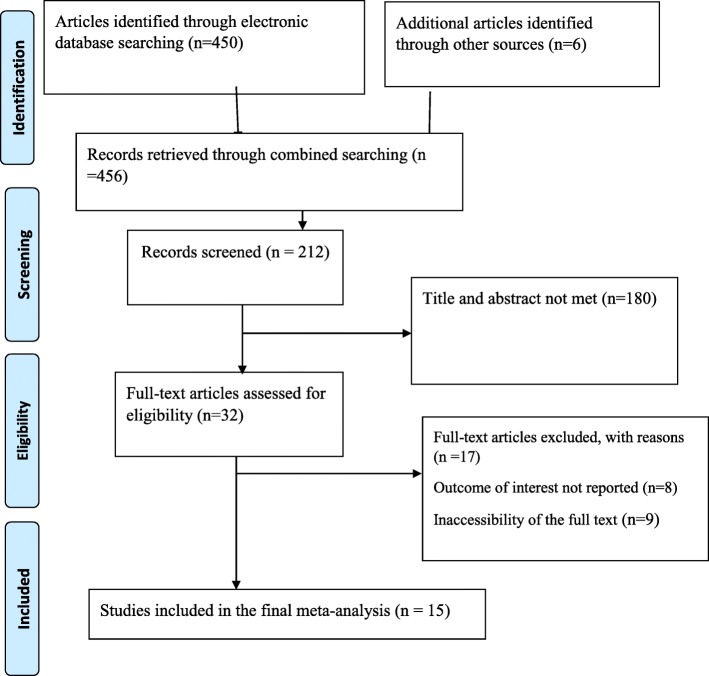
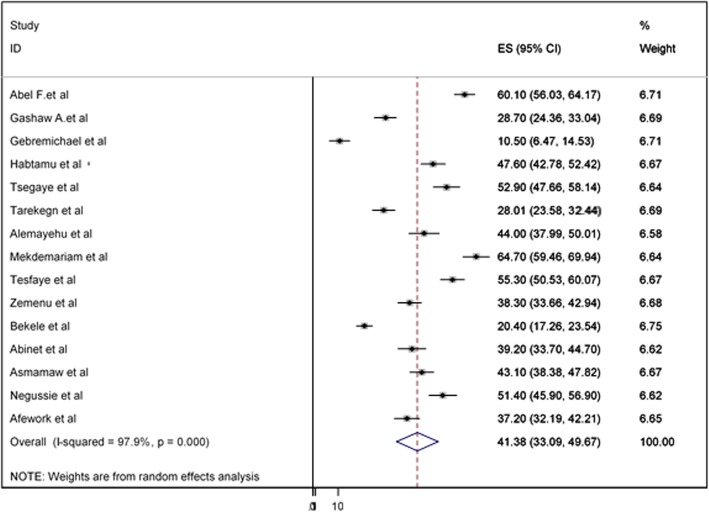
Background: Despite the supplementation of iron-folic acid is the recommended strategy during the antenatal period; iron deficiency anemia is the commonest hematologic complication during pregnancy. Therefore, this systematic review and meta-analysis aimed to assess the level of adherence to iron-folic acid supplementation and its associated factors among pregnant women in Ethiopia. Methods: Systematic review and meta-analysis guideline was followed for this study. Different online databases were used for the review: PubMed, HINARI, EMBASE, Google Scholar and African Journals Online. Different searching terms were applied based on the adapted PICO principles to achieve and access all the essential articles. The data were entered and analyzed using Microsoft Excel and Stata 11 software respectively. Results: Fifteen studies were included in this systematic review and meta-analysis with a total of 5808 pregnant women. The overall pooled prevalence of adherence to iron-folic acid supplementation among pregnant women in Ethiopia was 41.38% (95% CI: 33.09, 49.67). Having secondary and above educational status of the women (AOR:2.68,95%CI:1.25, 5.74), having an early registration of antenatal care follow-up (≤16 weeks) (AOR:2.54,95%CI:1.99, 3.24), having anemia complication during current pregnancy (AOR:3.01,95%CI:1.88, 4.81), having good knowledge of iron-folic acid supplementation (AOR: 2.96, 95%CI:1.76, 4.99), having four times or more antenatal care follow up (AOR:3.66, 95%CI:2.81, 4.77), getting health education about benefit of iron and folic acid (AOR:2.62,95%CI:1.46,4.72), and having good knowledge about anemia (AOR:2.99,95%CI:2.32, 3.85) were associated risk factors for adherence to iron-folic acid supplementation. Conclusion: The overall pooled prevalence adherence of IFAS among pregnant women was lower than the WHO recommendations. Educational status, early registration of ANC, anemia in the current pregnancy, good knowledge of IFAS, number of ANC visits, good knowledge of anemia and receiving health education about the benefit of IFAS were factors associated with the adherence of IFAS among pregnant women in Ethiopia. This finding is important to design strategic policies and to prevent anemia and congenital anomaly resulted from inadequate intake of iron and folic acid.
Overview
The claims and statistics of this paper haven’t been checked yet.
Free: it reads the open-access text and checks the first 5 claims that cite a source we can check. Create a free account to check every claim.
Integrity signals
Registry
Cites
Statistics
Figures
Verification
Claims the paper makes
The claims and statistics of this paper haven’t been checked yet.
Free: it reads the open-access text and checks the first 5 claims that cite a source we can check. Create a free account to check every claim.
Self-check
Percentages, sums and reported differences re-computed from the paper’s own numbers.
The self-check needs the paper’s full text.
Citations
Cites
1 retracted
Periconceptional supplementation with folate and/or multivitamins for preventing neural tube defects
Lumley, J., Watson, L., Watson, M., & Bower, C. (2001) · Cochrane Database of Systematic Reviews · doi:10.1002/14651858.cd001056 · Cited by 388
RetractedKirk, J., MacDonald, A., Lavender, P., Dean, J., & Rubin, G. (2017) · Biomedicine Hub · doi:10.1159/000480347 · Cited by 3,887
Adherence and health care costs
McGuire, M., & Iuga (2014) · Risk Management and Healthcare Policy · doi:10.2147/rmhp.s19801 · Cited by 708
Guideline: Daily iron and folic acid supplementation in pregnant women
Who, W. (2012) · Cited by 381
Peña-Rosas, J. P., & Viteri, F. E. (2009) · Cochrane Database of Systematic Reviews · doi:10.1002/14651858.cd004736.pub3 · Cited by 279
Kawaguchi, A., Nita, M., Ishii, T., Watanabe, M., & Noutoshi, Y. (2019) · BMC Research Notes · doi:10.1186/s13104-018-4038-6 · Cited by 204
Compliance with iron-folic acid (IFA) therapy among pregnant women in an urban area of south India
Mithra, P., Unnikrishnan, B., Rekha, T., Nithin, K., Mohan, K., Kulkarni, V, Kulkarni, V, & Agarwal, D. (2014) · African Health Sciences · doi:10.4314/ahs.v13i4.3 · Cited by 181
Taye, B., Abeje, G., & Mekonen, A. (2015) · Pan African Medical Journal · doi:10.11604/pamj.2015.20.43.4894 · Cited by 155 · cited 1×
“[23] 2013 Amhara Community-based 634 20.”
Kamau, M. W., Mirie, W., & Kimani, S. (2018) · BMC Public Health · doi:10.1186/s12889-018-5437-2 · Cited by 125
Ugwu, E., Olibe, A., Obi, S., & Ugwu, A. (2014) · Nigerian Journal of Clinical Practice · doi:10.4103/1119-3077.141427 · Cited by 114
Ogundipe, O., Hoyo, C., Østbye, T., Oneko, O., Manongi, R., Lie, R. T., & Daltveit, A. K. (2012) · BMC Public Health · doi:10.1186/1471-2458-12-481 · Cited by 114
Arega Sadore, A., Abebe Gebretsadik, L., & Aman Hussen, M. (2015) · Journal of Environmental and Public Health · doi:10.1155/2015/781973 · Cited by 114
Nisar, Y. B., Dibley, M. J., & Mir, A. M. (2014) · BMC Pregnancy and Childbirth · doi:10.1186/1471-2393-14-305 · Cited by 97
Antenatal iron and folic acid supplementation use by pregnant women in Khartoum, Sudan
Abdullahi, H., Gasim, G. I., Saeed, A., Imam, A. M., & Adam, I. (2014) · BMC Research Notes · doi:10.1186/1756-0500-7-498 · Cited by 88
Getachew, M., Abay, M., Zelalem, H., Gebremedhin, T., Grum, T., & Bayray, A. (2018) · BMC Pregnancy and Childbirth · doi:10.1186/s12884-018-1716-2 · Cited by 84
Reducing pill burden and helping with medication awareness to improve adherence
Farrell, B. J., French-Merkley, V., & Ingar, N. (2013) · Canadian Pharmacists Journal / Revue des Pharmaciens du Canada · doi:10.1177/1715163513500208 · Cited by 83
Gebreamlak, B., Dadi, A. F., & Atnafu, A. (2017) · PLOS ONE · doi:10.1371/journal.pone.0169415 · Cited by 80
Gebremariam, A. D., Tiruneh, S. A., Abate, B. A., Engidaw, M. T., & Asnakew, D. T. (2019) · PLOS ONE · doi:10.1371/journal.pone.0210086 · Cited by 79
Kassa, Z. Y., Awraris, T., Daba, A. K., & Tenaw, Z. (2019) · Reproductive Health · doi:10.1186/s12978-019-0679-8 · Cited by 79
Assefa, H., Abebe, S. M., & Sisay, M. (2019) · BMC Pregnancy and Childbirth · doi:10.1186/s12884-019-2422-4 · Cited by 77
Kiwanuka, T. S., Ononge, S., Kiondo, P., & Namusoke, F. (2017) · BMC Research Notes · doi:10.1186/s13104-017-2834-z · Cited by 73
Compliance to iron and folic acid supplementation in pregnancy, Northwest Ethiopia
Birhanu, T. M., Birarra, M. K., & Mekonnen, F. A. (2018) · BMC Research Notes · doi:10.1186/s13104-018-3433-3 · Cited by 70
Gebre, A. (2015) · International Journal of Nutrition and Food Sciences · doi:10.11648/j.ijnfs.20150402.16 · Cited by 64
(2018) · PubMed Central · Cited by 62
Molla, T., Guadu, T., Muhammad, E. A., & Hunegnaw, M. T. (2019) · BMC Research Notes · doi:10.1186/s13104-019-4045-2 · Cited by 61 · cited 1×
“[17] 2018 Amhara Facility-based 348 52.”
Boti, N., Bekele, T., Godana, W., Getahun, E., Gebremeskel, F., Tsegaye, B., & Oumer, B. (2018) · International Journal of Reproductive Medicine · doi:10.1155/2018/2365362 · Cited by 60
Agegnehu, G., Atenafu, A., Dagne, H., & Dagnew, B. (2019) · International Journal of Reproductive Medicine · doi:10.1155/2019/5863737 · Cited by 54
Demis, A., Geda, B., Alemayehu, T., & Abebe, H. (2019) · BMC Research Notes · doi:10.1186/s13104-019-4142-2 · Cited by 53
Ejidokun, O. O. (2000) · Midwifery · doi:10.1054/midw.1999.0196 · Cited by 44 · cited 1×
“Literature finding in South-East Asia, Latin America, and a few African countries showed that factors which lead to poor adherence to IFAS among pregnant women were; intolerance of gastrointestinal side effects that can occur with taking iron, inadequate supply of tablets, poor counseling of healthcare providers regar…”
BackgroundThe genome of the Black Bengal goat (Capra hircus)
Siddiki, A. Z., Baten, A., Billah, M., Alam, M. A. U., Shawrob, K. S. M., Saha, S. T., Chowdhury, M., Rahman, A. H., Stear, M. J., Miah, G., et al. (2019) · BMC Research Notes · doi:10.1186/s13104-019-4400-3 · Cited by 35
Maternal Anemia and Pregnancy outcomes: a Systematic Review and Meta-Analysis
Rahmati, S., Delpisheh, A., Parizad, N., & Sayehmiri, K. (2016) · Research Repository Portal (Ilam University of Medical Sciences) · doi:10.22038/ijp.2016.7221 · Cited by 32 · cited 1×
“Low adherence hurts levels of energy, productivity, cognitive and physical development, and immune function [10].”
BackgroundDeterminants of Iron Consumption among Pregnant Women in Southern Senegal
Niang, K., Faye, A., Diégane Tine, J. A., Diongue, F. B., Ndiaye, B., Ndiaye, M. B., Ndiaye, P., & Tal-Dia, A. (2017) · Open Journal of Obstetrics and Gynecology · doi:10.4236/ojog.2017.71005 · Cited by 32
Gebremichael, T. G., Haftu, H., & Gereziher, T. A. (2019) · Patient Preference and Adherence · doi:10.2147/ppa.s184168 · Cited by 30
Tarekegn, M., Wubshet, M., Atenafu, A., Derso, T., & Woretaw, A. (2019) · Archives of Public Health · doi:10.1186/s13690-019-0356-y · Cited by 24
(2013) · Cited by 18
Nwaru, B. I., Salomé, G., Abacassamo, F., Augusto, O., Cliff, J., Sousa, C., Regushevskaya, E., Parkkali, S., & Hemminki, E. (2015) · Public Health Nutrition · doi:10.1017/s1368980014001359 · Cited by 17
Research works printed but not linked: 10
- World Health Organization. Recommendation on antenatal care for positive pregnancy. 2016.
- World Health Organization. The global prevalence of anaemia in 2011. Geneva: world health organization; 2011.
- FMOH. National guideline for control and prevention of micronutrient deficiencies. Family Health Department, Federal Ministry of Health, Government of Ethiopia: Addis Ababa; 2009.
- WHO, Guideline: Daily iron and folic acid supplementation in pregnant women: 2006.
- FMOH: A Rapid, Initial Assessment of the Distribution and Consumption of Iron-Folic Acid Tab-lets through Antenatal Care in Ethiopia in selected four regions: 2013.
- FMOH A. Rapid, initial assessment of the distribution and consumption of Iron-folic acid tab-lets through antenatal Care in Ethiopia in selected four regions. SPRING. SPRING; 2013.
- Abdul-Rahman AM. Adherence to folic acid supplements during Peri- Conceptional period. Int J Curr Microbiol App Sci. 2015;4(7):215-23.
- Ibrahim ZM, et al. Assessment of adherence to iron and folic acid supplementation and prevalence of anemia in pregnant women. Med J Cairo Univ. 2011;79(2):2422-4.
- Ugwu EO, Olibe AO, et al. Determinants of compliance to iron supplementation among pregnant women in Enugu, Southeastern Nigeria. Nigerian J Clin Pract. 2014;17(5):608-12. · DOI · Paper page
- Vongvichit P, Isaranurug S, et al. Compliance of pregnant women regarding iron supplementation in Vientiane municipality. J Public Health Dev. 2003; 2(1):41-2.
Cited by
Perinatal asphyxia and its associated factors in Ethiopia: a systematic review and meta-analysis
Waltengus, F., Gedefaw, G. A., & Fenta, S. L. (2020) · BMC Pediatrics · doi:10.1186/s12887-020-02039-3 · Cited by 94
“than seven and above of the NOS criteria [11].”
BackgroundMethodSelf-citationElsharkawy, N. B., Abdelaziz, E. M., Ouda, M. M. A., & Oraby, F. A. (2022) · International Journal of Environmental Research and Public Health · doi:10.3390/ijerph19052724 · Cited by 92
“Non-compliance with iron supplements could have negative consequences on pregnant women and their fetal health, and increased compliance to iron supplementation has been linked with a lower risk of anemia during pregnancy and hemorrhagic disease in the newborn [20].”
BackgroundSaragih, I. D., Felipe‐Dimog, E. B., Saragih, I. S., & Lin, C. (2021) · Midwifery · doi:10.1016/j.midw.2021.103185 · Cited by 91
Gebremariam, A. D., Tiruneh, S. A., Abate, B. A., Engidaw, M. T., & Asnakew, D. T. (2019) · PLOS ONE · doi:10.1371/journal.pone.0210086 · Cited by 79
Hidayanty, H., Nurzakiah, N., Irmayanti, I., Yuliana, Y., Helmizar, H., & Yahya, Y. (2025) · International Journal of Environmental Research and Public Health · doi:10.3390/ijerph22020209 · Cited by 50
Metadata
- Authors
- Sendeku, F. W., Azeze, G. G., & Fenta, S. L.
- Affiliations
- Bahir Dar University (ET)
- Venue
- BMC Pregnancy and Childbirth
- Published
- 2020-03-04
- Volume
- 20
- Issue
- 1
- Pages
- 138-138
- ISSN
- 1471-2393 (ISSN-L)
- PMC
- PMC7057669
- OpenAlex
- W3011309994
- Cited by
- 108
- References
- 36
- Citations by year
- 2026: 19 · 2025: 13 · 2024: 16 · 2023: 18 · 2022: 23 · 2021: 10 · 2020: 8
- FWCI
- 3.26
- Type
- journal article
- Language
- en
- Open access
- gold
- doi.org
- Licence
- cc-by
- creativecommons.org/licenses/by/4.0/ (tdm)
- creativecommons.org/licenses/by/4.0/ (vor)
- Locations
- BMC Pregnancy and Childbirth (publishedVersion, cc-by)
- PubMed Central (publishedVersion, cc-by)
- PubMed (publishedVersion)
- DOAJ (DOAJ: Directory of Open Access Journals) (submittedVersion)
- Topics
- Health Sciences › Medicine › Pediatrics, Perinatology and Child Health › Global Maternal and Child Health
- Health Sciences › Medicine › Pediatrics, Perinatology and Child Health › Public Health and Nutrition
- Health Sciences › Medicine › Pediatrics, Perinatology and Child Health › Maternal and Neonatal Healthcare
- Keywords
- iron and folic acid supplementation, adherence, pregnant women, prenatal care, iron deficiency anemia, risk factors, maternal education, health education, Ethiopia, anemia knowledge, antenatal care follow-up
- MeSH terms
- Anemia, Ethiopia, Female, Folic Acid, Humans, Iron, Health Knowledge, Attitudes, Practice, Pregnancy, Pregnancy Complications, Hematologic, Prenatal Care, Prevalence, Drug Monitoring, Anemia, Iron-Deficiency, Dietary Supplements, Pregnant People
About these checks
Registry, retraction, Cites and statistics results are computed, not judged, with one exception: a printed reference that no index lists is read once by a model before it counts as a citation error. Claims are extracted by a model and kept only when their quote appears verbatim in the text; each cited source is then checked, with a model’s help, for whether it says what the claim relies on. Those verdicts can be wrong — read the claim’s quote and the cited source before relying on one.
Statistics and arithmetic are recomputed, not judged.
Confidence bands are shown only for fields calibrated on our annotated test set. None is calibrated yet, so no band is shown.
What counts as a claim ›How we measure confidence ›How we check this ›
Are you an author, or do you see a problem with this page? Request a review
Data sources
Bibliographic data: Semantic Scholar, OpenAlex, Crossref.
Contains information from the Semantic Scholar Academic Graph Datasets, made available under the ODC Attribution License (ODC-BY 1.0).
Semantic Scholar’s data is described in: Kinney, R., et al. (2023). The Semantic Scholar Open Data Platform. arXiv:2301.10140.
