

Nurse-led group consultation intervention reduces depressive symptoms in men with localised prostate cancer: a cluster randomised controlled trial
Open accessThe DOI matches its Crossref record; 31 of the 32 references it cites were found in a registry or an index.
Abstract
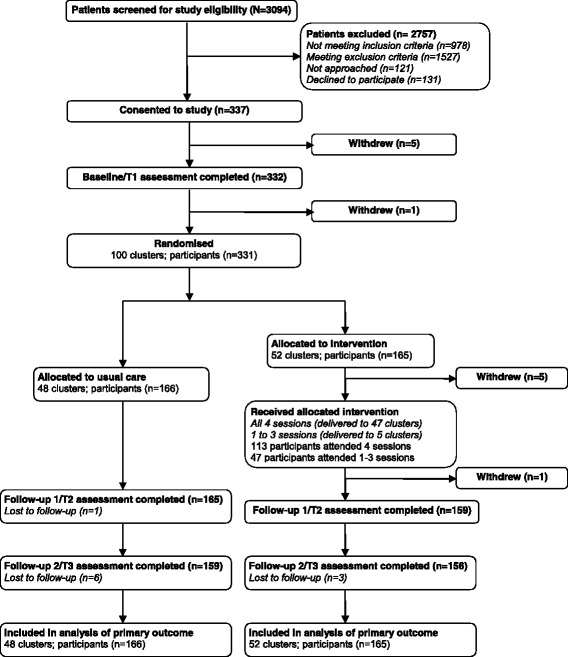
BACKGROUND: Radiotherapy for localised prostate cancer has many known and distressing side effects. The efficacy of group interventions for reducing psychological morbidity is lacking. This study investigated the relative benefits of a group nurse-led intervention on psychological morbidity, unmet needs, treatment-related concerns and prostate cancer-specific quality of life in men receiving curative intent radiotherapy for prostate cancer. METHODS: This phase III, two-arm cluster randomised controlled trial included 331 men (consent rate: 72 %; attrition: 5 %) randomised to the intervention (n = 166) or usual care (n = 165). The intervention comprised four group and one individual consultation all delivered by specialist uro-oncology nurses. Primary outcomes were anxious and depressive symptoms as assessed by the Hospital Anxiety and Depression Scale. Unmet needs were assessed with the Supportive Care Needs Survey-SF34 Revised, treatment-related concerns with the Cancer Treatment Scale and quality of life with the Expanded Prostate Cancer Index -26. Assessments occurred before, at the end of and 6 months post-radiotherapy. Primary outcome analysis was by intention-to-treat and performed by fitting a linear mixed model to each outcome separately using all observed data. RESULTS: Mixed models analysis indicated that group consultations had a significant beneficial effect on one of two primary endpoints, depressive symptoms (p = 0.009), and one of twelve secondary endpoints, procedural concerns related to cancer treatment (p = 0.049). Group consultations did not have a significant beneficial effect on generalised anxiety, unmet needs and prostate cancer-specific quality of life. CONCLUSIONS: Compared with individual consultations offered as part of usual care, the intervention provides a means of delivering patient education and is associated with modest reductions in depressive symptoms and procedural concerns. Future work should seek to confirm the clinical feasibility and cost-effectiveness of group interventions. TRIAL REGISTRATION: Australian and New Zealand Clinical Trials Registry ANZCTRN012606000184572 . 1 March 2006.
Overview
The claims and statistics of this paper haven’t been checked yet.
Free: it reads the open-access text and checks the first 5 claims that cite a source we can check. Create a free account to check every claim.
Integrity signals
Registry
Cites
Statistics
Figures
Verification
Claims the paper makes
The claims and statistics of this paper haven’t been checked yet.
Free: it reads the open-access text and checks the first 5 claims that cite a source we can check. Create a free account to check every claim.
Self-check
Percentages, sums and reported differences re-computed from the paper’s own numbers.
The self-check needs the paper’s full text.
Citations
Cites
The Hospital Anxiety and Depression Scale
Zigmond, A. S., & Snaith, R. P. (1983) · Acta Psychiatrica Scandinavica · doi:10.1111/j.1600-0447.1983.tb09716.x · Cited by 47,139
Depression and quality of life in older persons: A review
Sivertsen, H., Bjørkløf, G. H., Engedal, K., Selbæk, G., & Helvik, A.-S. (2015) · Dementia and Geriatric Cognitive Disorders · doi:10.1159/000437299 · Cited by 14,152
Multilevel analysis techniques and applications
Hox, J. J., Moerbeek, M., & van de Schoot, R. (2002) · Cited by 6,845
Hox, J., Moerbeek, M., & van de Schoot, R. (2002) · doi:10.4324/9781410604118 · Cited by 2,419
The Hospital Anxiety And Depression Scale.
(2003) · Health and Quality of Life Outcomes · doi:10.1186/1477-7525-1-29 · Cited by 2,391
Wei, J. T., Dunn, R. L., Litwin, M. S., Sandler, H. M., & Sanda, M. G. (2000) · Urology · doi:10.1016/s0090-4295(00)00858-x · Cited by 1,520 · cited 3×
“For EPIC-26 domains, none of the differences in rate of change for the intervention group relative to the usual care group were significant (all p > 0.05, Table 3).”
MethodInfluentialAndrogen Deprivation Therapy for Prostate Cancer
Sharifi, N. (2005) · JAMA · doi:10.1001/jama.294.2.238 · Cited by 1,083
High levels of untreated distress and fatigue in cancer patients
Carlson, L. E., Angen, M., Cullum, J., Goodey, E., Koopmans, J., Lamont, L., MacRae, J. H., Martin, M., Pelletier, G., Robinson, J., et al. (2004) · British Journal of Cancer · doi:10.1038/sj.bjc.6601887 · Cited by 939 · cited 1×
“Enduring side effects can result in unmet needs [2], poorer health-related quality of life (HRQOL) [3] and ongoing psychological maladjustment [4–6].”
BackgroundEldridge, S. M., Ashby, D., & Kerry, S. (2006) · International Journal of Epidemiology · doi:10.1093/ije/dyl129 · Cited by 529 · cited 1×
“[19], the estimated design effect for the study was 1.”
BackgroundInternational epidemiology of prostate cancer: Geographical distribution and secular trends
Baade, P. D., Youlden, D. R., & Krnjacki, L. J. (2009) · Molecular Nutrition & Food Research · doi:10.1002/mnfr.200700511 · Cited by 444 · cited 1×
“The need for evidence-based interventions is clear, especially given the prevalence of prostate cancer and the often favourable long-term prognosis associated with localised disease [8].”
BackgroundSmith, D. P., King, M. T., Egger, S., Berry, M. P., Stricker, P. D., Cozzi, P., Ward, J., O'Connell, D. L., & Armstrong, B. K. (2009) · BMJ · doi:10.1136/bmj.b4817 · Cited by 286
Lepore, S. J., Helgeson, V. S., Eton, D. T., & Schulz, R. (2003) · Health Psychology · doi:10.1037/0278-6133.22.5.443 · Cited by 274 · cited 2×
“Previous trials using depression as an outcome have shown little, if any, impact on depressive symptoms in the short- or long-term [24, 25].”
BackgroundResultDevelopments in cluster randomized trials and Statistics in Medicine
Campbell, M. J., Donner, A., & Klar, N. (2007) · Statistics in Medicine · doi:10.1002/sim.2731 · Cited by 246 · cited 1×
“05) [20].”
Penedo, F. J., Molton, I., Dahn, J. R., Shen, B.-J., Kinsinger, D., Traeger, L., Siegel, S., Schneiderman, N., & Antoni, M. (2006) · Annals of Behavioral Medicine · doi:10.1207/s15324796abm3103_8 · Cited by 223 · cited 1×
“Previously tested interventions either provided no or substantially fewer opportunities for peer support, which has been emphasised as a possible mechanism of effect in group-based interventions [9, 11, 25].”
BackgroundAnxiety and depression after prostate cancer diagnosis and treatment: 5-year follow-up
Korfage, I. J., Essink-Bot, M.-L., Janssens, A. C. J. W., Schröder, F. H., & de Koning, H. J. (2006) · British Journal of Cancer · doi:10.1038/sj.bjc.6603057 · Cited by 176 · cited 1×
“Enduring side effects can result in unmet needs [2], poorer health-related quality of life (HRQOL) [3] and ongoing psychological maladjustment [4–6].”
BackgroundPenedo, F. J., Dahn, J. R., Molton, I., Gonzalez, J. S., Kinsinger, D., Roos, B. A., Carver, C. S., Schneiderman, N., & Antoni, M. H. (2004) · Cancer · doi:10.1002/cncr.11894 · Cited by 169 · cited 2×
“Previous trials have used general HRQOL as an outcome [10–12], rather than prostate cancer-specific HRQOL, making it impossible to compare the results.”
BackgroundResultA systematic review of psychosocial interventions for men with prostate cancer and their partners
Chambers, S. K., Pinnock, C., Lepore, S. J., Hughes, S., & O’Connell, D. L. (2011) · Patient Education and Counseling · doi:10.1016/j.pec.2011.01.027 · Cited by 142 · cited 2×
“Extant supportive care trials suggest that group-based interventions, involving one health professional and a group of patients, may provide an efficient and effective mode of delivering disease, treatment and self-management information [9].”
BackgroundTaylor, C. L. C., deMoor, C., Smith, M. A., Dunn, A. L., Basen-Engquist, K., Nielsen, I., Pettaway, C., Sellin, R., Massey, P., & Gritz, E. R. (2006) · Psycho-Oncology · doi:10.1002/pon.1023 · Cited by 140 · cited 1×
“Previous trials using depression as an outcome have shown little, if any, impact on depressive symptoms in the short- or long-term [24, 25].”
ResultAranda, S. K., Jefford, M., Yates, P. M., Gough, K., Seymour, J. F., Francis, P. A., Baravelli, C. M., Breen, S. J., & Schofield, P. (2011) · Annals of Oncology · doi:10.1093/annonc/mdr042 · Cited by 138 · cited 1×
“Together with the results from our recent trial of a nurse-led pre-chemotherapy education intervention [28], the current findings suggest that well-structured and appropriately timed nurse-led consultations can be effective in reducing cancer treatment-related concerns, especially those related to the procedural aspec…”
ResultSelf-citationPenedo, F. J., Traeger, L., Dahn, J., Molton, I., Gonzalez, J. S., Schneiderman, N., & Antoni, M. H. (2007) · International Journal of Behavioral Medicine · doi:10.1007/bf03000188 · Cited by 115 · cited 2×
“Previous trials have used general HRQOL as an outcome [10–12], rather than prostate cancer-specific HRQOL, making it impossible to compare the results.”
BackgroundResultLinden, W., & Girgis, A. (2012) · Psycho-Oncology · doi:10.1002/pon.2035 · Cited by 96
Effects of two weight-loss diets on health-related quality of life
Yancy, W. S., Almirall, D., Maciejewski, M. L., Kolotkin, R. L., McDuffie, J. R., & Westman, E. C. (2009) · Quality of Life Research · doi:10.1007/s11136-009-9444-8 · Cited by 74 · cited 1×
“The between-group effect size was calculated as the difference between study arms in mean change from baseline divided by the pooled standard deviation of change [22].”
MethodSchofield, P., Gough, K., Lotfi‐Jam, K., & Aranda, S. (2012) · Psycho-Oncology · doi:10.1002/pon.2016 · Cited by 64 · cited 1×
“The 34-item SCNS-SF34-R comprises five subscales measuring levels of unmet psychological, health system and information, physical and daily living, patient care and support and sexuality needs in the last month [17].”
MethodSelf-citationLittle, D. J., Kuban, D. A., Levy, L. B., Zagars, G. K., & Pollack, A. S. (2003) · Urology · doi:10.1016/s0090-4295(03)00504-1 · Cited by 50
Zhang, A. Y., Strauss, G. J., & Siminoff, L. A. (2007) · Oncology Nursing Forum · doi:10.1188/07.onf.47-53 · Cited by 45 · cited 1×
“Nevertheless, recent evidence suggests that functioning and symptom bother related to prostate cancer and its treatment may require much more targeted and intensive intervention than that offered to either study arm in this trial [29].”
BackgroundSchofield, P., Gough, K., Ugalde, A., Carey, M., Aranda, S., & Sanson‐Fisher, R. (2012) · Psycho-Oncology · doi:10.1002/pon.1896 · Cited by 24 · cited 1×
“Cancer treatmentrelated concerns were measured with the Cancer Treatment Scale (CaTS) [16].”
MethodSelf-citationDo prostate cancer patients suffer more from depressed mood or anhedonia?
Sharpley, C. F., Bitsika, V., & Christie, D. (2012) · Psycho-Oncology · doi:10.1002/pon.3203 · Cited by 20
Development of a Psychoeducational Intervention for Men with Prostate Cancer
Boonzaier, A., Schubach, K., Troup, K., Pollard, A. C., Aranda, S. K., & Schofield, P. E. (2009) · Journal of Psychosocial Oncology · doi:10.1080/07347330802616100 · Cited by 17 · cited 1×
“Intervention: group consultations Development and content of the group consultation intervention has been described in detail previously [13], so only a brief description follows.”
BackgroundSelf-citationSupportive Care Needs Survey—Short Form—Revised
Schoefield, P., Gough, K., Lotfi‐Jam, K., & Aranda, S. K. (2012) · PsycTESTS Dataset · doi:10.1037/t29357-000 · Cited by 1
Self-citationRapid screening for psychologic distress in men with prostate carcinoma
Roth, A. J., Kornblith, A. B., Batel-Copel, L., Peabody, E., Scher, H. I., & Holland, J. C. (1998) · Cancer · doi:10.1002/(sici)1097-0142(19980515)82:10<1904::aid-cncr13>3.0.co;2-x · cited 1×
“The single-item DT provides a measure of global distress experienced in the past 7 days [15].”
BackgroundThe prevalence of psychological distress by cancer site
Zabora, J., BrintzenhofeSzoc, K., Curbow, B., Hooker, C., & Piantadosi, S. (2001) · Psycho-Oncology · doi:10.1002/1099-1611(200101/02)10:1<19::aid-pon501>3.0.co;2-6
Research works printed but not linked: 2
- 5. Zabora J, BrintzenhofeSzoc K, Curbow B, Hooker C, Piantadosi S. The prevalence of psychological distress by cancer site. Psychooncology. 2001;10(1):19–28. doi: 10.1002/1099-1611(200101/02)10:1<19::AID-PON501>3.0.CO;2-6. · DOI · Paper page
- 23. Rasbash J, Charlton C, Browne WJ, Healy M, Cameron B. MLwiN Version 2.1. Bristol, UK: Centre for Multilevel Modelling, University of Bristol; 2009.
Cited by
Management of Anxiety and Depression in Adult Survivors of Cancer: ASCO Guideline Update
Andersen, B. L., Lacchetti, C., Ashing, K., Berek, J. S., Berman, B. S., Bolte, S., Dizon, D. S., Given, B., Nekhlyudov, L., Pirl, W., et al. (2023) · Journal of Clinical Oncology · doi:10.1200/jco.23.00293 · Cited by 318
Chambers, S. K., Hyde, M. K., Smith, D. P., Hughes, S., Yuill, S., Egger, S., O'Connell, D. L., Stein, K., Frydenberg, M., Wittert, G., et al. (2017) · Psycho-Oncology · doi:10.1002/pon.4431 · Cited by 72
Sanjida, S., McPhail, S. M., Shaw, J., Couper, J., Kissane, D., Price, M. A., & Janda, M. (2018) · Psycho-Oncology · doi:10.1002/pon.4794 · Cited by 74
“Characteristics of each study are presented in Supplementary Table 1.(5,14-20,40-102) More than half of the included studies (n = 38/71) were published after 2010.”
BackgroundNursing interventions to promote patient engagement in cancer care: A systematic review
Bonetti, L., Tolotti, A., Anderson, G., Nania, T., Vignaduzzo, C., Sari, D., & Barello, S. (2022) · International Journal of Nursing Studies · doi:10.1016/j.ijnurstu.2022.104289 · Cited by 78
Palese, A., Rossettini, G., Colloca, L., & Testa, M. (2019) · PAIN Reports · doi:10.1097/pr9.0000000000000716 · Cited by 56
Metadata
- Authors
- Schofield, P., Gough, K., Lotfi-Jam, K., Bergin, R., Ugalde, A., Dudgeon, P., Crellin, W., Schubach, K., Foroudi, F., Tai, K. H., Duchesne, G., Sanson-Fisher, R., & Aranda, S.
- Affiliations
- The University of Melbourne (AU)
- Peter MacCallum Cancer Centre (AU)
- Deakin University (AU)
- Corresponding author
- Schofield, Penelope
- ORCID
- Venue
- BMC Cancer
- Published
- 2016-08-16
- Volume
- 16
- Issue
- 1
- Pages
- 637-637
- ISSN
- 1471-2407 (ISSN-L)
- PMC
- PMC4986252
- OpenAlex
- W2516821748
- Cited by
- 30
- References
- 32
- Citations by year
- 2026: 1 · 2025: 1 · 2024: 2 · 2023: 3 · 2022: 4 · 2021: 8 · 2020: 6 · 2019: 3 · 2018: 1 · 2017: 1
- FWCI
- 0.90
- Type
- journal article
- Language
- en
- Open access
- gold
- doi.org
- Licence
- Locations
- BMC Cancer (publishedVersion, cc-by)
- Europe PMC (PubMed Central) (publishedVersion, cc-by)
- PubMed Central (publishedVersion, cc-by)
- PubMed (publishedVersion)
- Minerva Access (University of Melbourne) (submittedVersion, cc-by)
- Figshare (submittedVersion, cc-by)
- Swinburne figshare (Swinburne University of Technology) (submittedVersion, cc-by)
- NOVA (University of Newcastle Australia) (submittedVersion, cc-by)
- Swinburne figshare (Swinburne University of Technology) (cc-by)
- Funders
- Medical Research Council
- National Health and Medical Research Council (509143)
- Topics
- Health Sciences › Medicine › Oncology › Cancer survivorship and care
- Health Sciences › Medicine › Urology › Prostate Cancer Diagnosis and Treatment
- Health Sciences › Medicine › Public Health, Environmental and Occupational Health › Palliative and Oncologic Care
- Keywords
- localized prostate cancer, radiotherapy, depressive symptoms, anxiety, unmet supportive care needs, psychological morbidity, patient education
- MeSH terms
- Adaptation, Psychological, Aged, Aged, 80 and over, Anxiety, Australia, Counseling, Depression, Humans, Male, Middle Aged, New Zealand, Prostatic Neoplasms, Quality of Life, Surveys and Questionnaires, Treatment Outcome, Focus Groups, Nurse's Role
About these checks
Registry, retraction, Cites and statistics results are computed, not judged, with one exception: a printed reference that no index lists is read once by a model before it counts as a citation error. Claims are extracted by a model and kept only when their quote appears verbatim in the text; each cited source is then checked, with a model’s help, for whether it says what the claim relies on. Those verdicts can be wrong — read the claim’s quote and the cited source before relying on one.
Statistics and arithmetic are recomputed, not judged.
Confidence bands are shown only for fields calibrated on our annotated test set. None is calibrated yet, so no band is shown.
What counts as a claim ›How we measure confidence ›How we check this ›
Are you an author, or do you see a problem with this page? Request a review
Data sources
Bibliographic data: Semantic Scholar, OpenAlex, Crossref.
Contains information from the Semantic Scholar Academic Graph Datasets, made available under the ODC Attribution License (ODC-BY 1.0).
Semantic Scholar’s data is described in: Kinney, R., et al. (2023). The Semantic Scholar Open Data Platform. arXiv:2301.10140.
