

Combined application of anti-VEGF and anti-EGFR attenuates the growth and angiogenesis of colorectal cancer mainly through suppressing AKT and ERK signaling in mice model
Open accessThe DOI matches its Crossref record; 59 of the 59 references it cites were found in a registry or an index.
Abstract
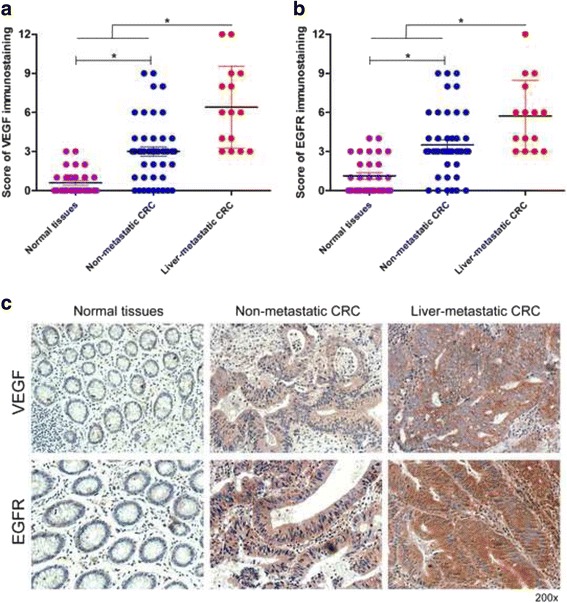
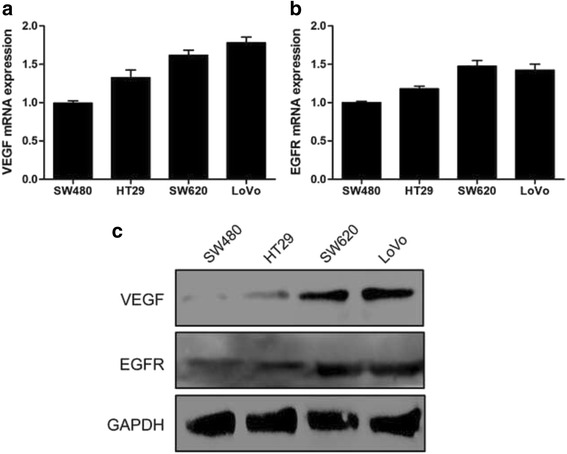
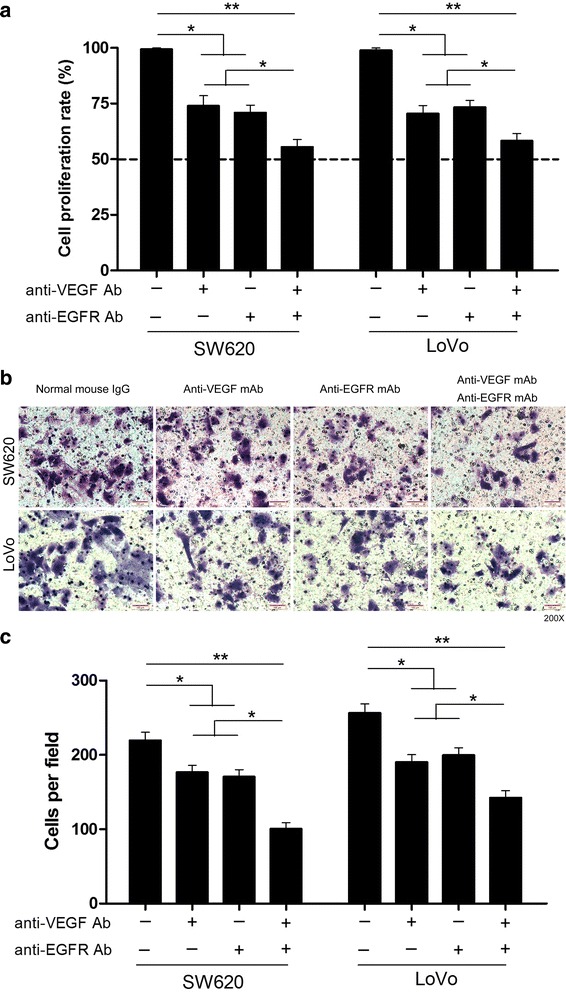
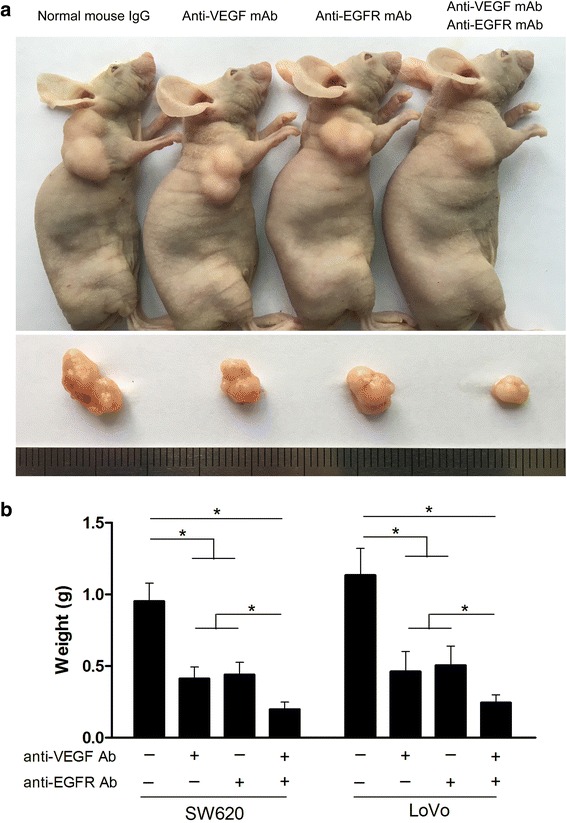
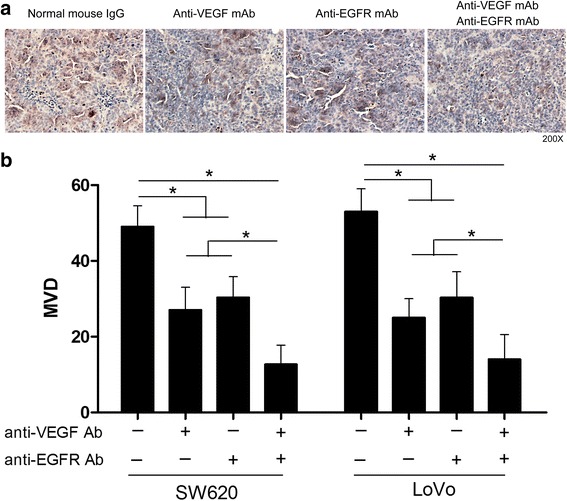
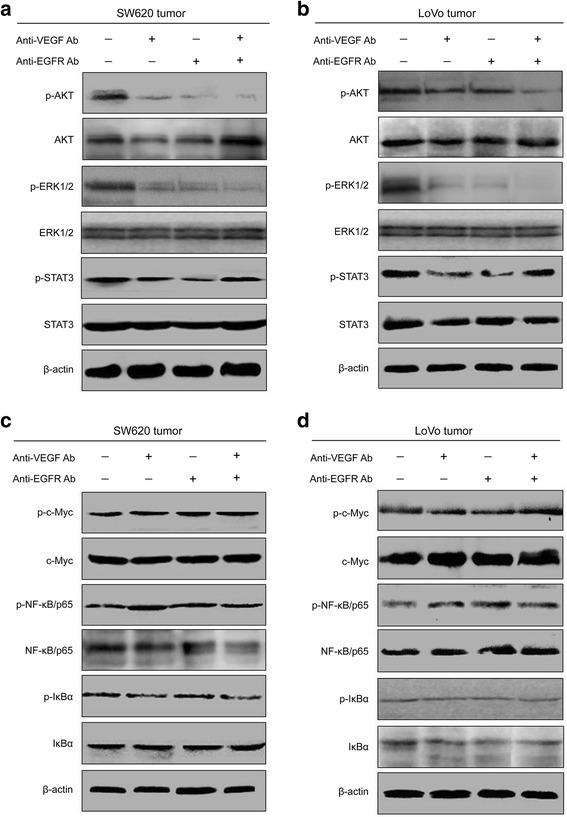
BACKGROUND: Angiogenesis is generally involved during the cancer development and hematogenous metastasis. Vascular endothelial growth factor (VEGF) and epidermal growth factor receptor (EGFR) are considered to have an important role in tumor-associated angiogenesis. However, the effects of simultaneously targeting on VEGF and EGFR on the growth and angiogenesis of colorectal cancer (CRC), and its underlying mechanisms remain unknown. METHODS: Immunohistochemical staining was used to detect the VEGF and EGFR expression in different CRC tissue specimens, and the correlation between VEGF/EGFR expression with the clinicopathologic features was analyzed. Cell counting kit‑8 (CCK-8) and transwell assays were used to assess the cellular proliferation and invasion of CRC cells after treated with anti-VEGF antibody and/or anti-EGFR antibody in vitro, respectively. Moreover, in vivo tumor formation was performed on nude mice model, and the tumor microvessel density (MVD) was determined by anti-CD34 staining in different groups. Finally, we evaluated the impact of anti-VEGF antibody and/or anti-EGFR antibody on the activation of downstream signaling effectors using western blot. RESULTS: VEGF and EGFR were upregulated in CRC tissues, and their expression levels were correlated with hepatic metastasis. Blockage on VEGF or EGFR alone could inhibit the cellular proliferation and metastasis while their combination could reach a good synergism in vitro. In addition, in vivo xenograft mice model demonstrated that the tumor formation and angiogenesis were strongly suppressed by combination treatment of anti-VEGF and anti-EGFR antibodies. Besides, the combination treatment significantly reduced the activation of AKT and ERK1/2, but barely affected the activation of c-Myc, NF-κB/p65 and IκBα in CRC cells tumors. Interestingly, anti-VEGF antibody or anti-EGFR antibody alone could attenuate the phosphorylation of STAT3 as compared with negative control group, whereas the combined application not further suppressed but at least partially restored the activation of STAT3 in vivo. CONCLUSIONS: Simultaneous targeting on VEGF and EGFR does show significant inhibition on CRC tumor growth and angiogenesis in mice model, and these effects are mainly attributed to suppression of the AKT and ERK signaling pathways.
Overview
The claims and statistics of this paper haven’t been checked yet.
Free: it reads the open-access text and checks the first 5 claims that cite a source we can check. Create a free account to check every claim.
Integrity signals
Registry
Cites
Statistics
Figures
Verification
Claims the paper makes
The claims and statistics of this paper haven’t been checked yet.
Free: it reads the open-access text and checks the first 5 claims that cite a source we can check. Create a free account to check every claim.
Claims other papers make about this one
Each is checked against this paper’s own text: does it say what the citing paper says it does?
In the citing paper
“In a mouse CRC xenograft model, combined blocking of VEGF and EGFR significantly inhibited tumor growth and angiogenesis [61].”
From Drug Resistance in Colorectal Cancer: From Mechanism to Clinic (2022) · cites this paper as [61]
In the citing paper
“Combination treatment with anti-VEGF and anti-EGFR antibodies demonstrated synergistic activity in vitro, and tumour growth and angiogenesis were strongly suppressed in an in vivo xenograft mouse model [151].”
From Resistance to anti-EGFR therapies in metastatic colorectal cancer: underlying mechanisms and reversal strategies (2021) · cites this paper as [151]
Self-check
Percentages, sums and reported differences re-computed from the paper’s own numbers.
The self-check needs the paper’s full text.
Citations
Cites
1 retracted
Wu, J., Zhang, J., Shen, B., Yin, K., Xu, J., Gao, W., & Zhang, L. (2015) · Journal of Experimental & Clinical Cancer Research · doi:10.1186/s13046-015-0229-3 · Cited by 117 · cited 1×
“In addition, STAT3 is persistently activated in many human cancers during cancer development and progression [48].”
RetractedJemal, A., Bray, F., Center, M. M., Ferlay, J., Ward, E., & Forman, D. (2011) · CA: A Cancer Journal for Clinicians · doi:10.3322/caac.20107 · Cited by 54,679
Global cancer statistics, 2012
Torre, L. A., Bray, F., Siegel, R. L., Ferlay, J., Lortet‐Tieulent, J., & Jemal, A. (2015) · CA: A Cancer Journal for Clinicians · doi:10.3322/caac.21262 · Cited by 26,850
Cancer statistics in China, 2015
Chen, W., Zheng, R., Baade, P. D., Zhang, S., Zeng, H., Bray, F., Jemal, A., Yu, X. Q., & He, J. (2016) · CA: A Cancer Journal for Clinicians · doi:10.3322/caac.21338 · Cited by 17,038
Bevacizumab plus Irinotecan, Fluorouracil, and Leucovorin for Metastatic Colorectal Cancer
Hurwitz, H., Fehrenbacher, L., Novotny, W., Cartwright, T., Hainsworth, J., Heim, W., Berlin, J., Baron, A., Griffing, S., Holmgren, E., et al. (2004) · New England Journal of Medicine · doi:10.1056/nejmoa032691 · Cited by 10,968 · cited 1×
“Inhibition of VEGF activity has been reported to suppress the proliferation of cancer cells and improve the prognosis for unresectable CRC patients [13].”
The biology of VEGF and its receptors
Ferrara, N., Gerber, H.-P., & LeCouter, J. (2003) · Nature Medicine · doi:10.1038/nm0603-669 · Cited by 9,591
Angiogenesis in cancer, vascular, rheumatoid and other disease
Folkman, J. (1995) · Nature Medicine · doi:10.1038/nm0195-27 · Cited by 7,627 · cited 1×
“Angiogenesis, the process leading to the formation of new blood vessels, plays an important role in tumor development and distant metastasis [8], and its induction is mediated by numerous angiogenic factors [9].”
Tumor Angiogenesis and Metastasis — Correlation in Invasive Breast Carcinoma
Weidner, N., Semple, J. P., Welch, W. R., & Folkman, J. (1991) · New England Journal of Medicine · doi:10.1056/nejm199101033240101 · Cited by 5,627 · cited 1×
“Tumor MVD was determined as described [22].”
Missing Pieces in the NF-κB Puzzle
Ghosh, S., & Karin, M. (2002) · Cell · doi:10.1016/s0092-8674(02)00703-1 · Cited by 3,638
Kim, K. J., Li, B., Winer, J., Armanini, M., Gillett, N., Phillips, H. S., & Ferrara, N. (1993) · Nature · doi:10.1038/362841a0 · Cited by 3,605 · cited 1×
“Animal studies have manifested that inhibition of VEGF suppresses both tumor angiogenesis and tumor growth in vivo [37, 38].”
Cited by
Zhou, J., Ji, Q., & Li, Q. (2021) · Journal of Experimental & Clinical Cancer Research · doi:10.1186/s13046-021-02130-2 · Cited by 246
Drug Resistance in Colorectal Cancer: From Mechanism to Clinic
Wang, Q., Shen, X., Chen, G., & Du, J. (2022) · Cancers · doi:10.3390/cancers14122928 · Cited by 160
Mazewski, C., Liang, K., & de Mejía, E. G. (2017) · Food Chemistry · doi:10.1016/j.foodchem.2017.09.086 · Cited by 128
Kim, H., Shim, B. Y., Lee, S., Lee, J. Y., Lee, H. J., & Kim, I.-H. (2021) · International Journal of Molecular Sciences · doi:10.3390/ijms22189795 · Cited by 117
“The combination of anti-EGFR and anti-VEGF was found to have antitumor activity through the regulation of the ARK and ERK signaling pathways [49].”
BackgroundTherapeutic Targeting of the Colorectal Tumor Stroma
Fridman, W. H., Miller, I. S., Sautès‐Fridman, C., & Byrne, A. T. (2019) · Gastroenterology · doi:10.1053/j.gastro.2019.09.045 · Cited by 79
Ding, C., Tang, W., Wu, H., Fan, X., Luo, J., Feng, J., Wen, K., & Wu, G. (2018) · Cancer Letters · doi:10.1016/j.canlet.2018.11.014 · Cited by 57
Self-citationDing, C., Tang, W., Fan, X., Wang, X., Wu, H., Xu, H., Xu, W., Gao, W., & Wu, G. (2018) · Cell Death and Disease · doi:10.1038/s41419-018-0817-1 · Cited by 53
Self-citationZhong, X., Liu, D., Jiang, Z., Li, C., Chen, L., Xia, Y., Liu, D., Yao, Q., & Wang, D. (2020) · OncoTargets and Therapy · doi:10.2147/ott.s246031 · Cited by 51
“(CCK-8) assay kit (Dojindo, Kumamoto, Japan) was described previously.(11) Briefly, cells at a density of 4 × 10(3) cells/well were seeded in 96-well plates and incubated for 48 h (37°C, 5% CO2).”
MethodDing, C., Luo, J., Fan, X., Li, L., Li, S., Wen, K., Feng, J., & Wu, G. (2017) · Journal of Experimental & Clinical Cancer Research · doi:10.1186/s13046-017-0524-2 · Cited by 46
“Tumor vascular density was determined as previously described [28, 29].”
MethodSelf-citationZhong, X., Huang, S., Liu, D., Jiang, Z., Jin, Q., Li, C., Liu, D., Yao, Q., & Wang, D. (2020) · Cancer Medicine · doi:10.1002/cam4.3195 · Cited by 44
Long non-coding RNAs: Key regulators in oxaliplatin resistance of colorectal cancer
Qi, F.-F., Yang, Y., Zhang, H., & Chen, H. (2020) · Biomedicine & Pharmacotherapy · doi:10.1016/j.biopha.2020.110329 · Cited by 37
Liu, Y., Tsai, J., Weng, Y., & Hsu, F. (2020) · Biomedicine & Pharmacotherapy · doi:10.1016/j.biopha.2020.110319 · Cited by 36
Xu, X., Yu, Y., Liu, M., Liang, L., & Liu, T. (2022) · Translational Cancer Research · doi:10.21037/tcr-20-3539 · Cited by 35
Liang, X., Li, Z., Zhang, L., Wang, D., & Tian, J. (2020) · Ultrasonic Imaging · doi:10.1177/0161734620959780 · Cited by 30
Chen, L., Li, Q., Jiang, Z., Li, C., Hu, H., Wang, T., Gao, Y., & Wang, D. (2021) · Frontiers in Oncology · doi:10.3389/fonc.2021.651644 · Cited by 29
“Cell Counting Kit-8 Assay The GC cells (4 × 10(3)) were cultured and seeded prior treatment with chrysin, siRNAs, overexpression vectors, let-7a-3p mimics and let-7a-3p inhibitors in order to conduct cell viability assay, as previously described (24).”
MethodDong, W., Liu, L., Dou, Y., Xu, M., Liu, T., Wang, S., Zhang, Y., Deng, B., Wang, B., & Cao, H. (2018) · Journal of Cellular and Molecular Medicine · doi:10.1111/jcmm.13709 · Cited by 28
“Epidermal growth factor receptor (EGFR), which plays an important role in tumorigenesis, is overexpressed in many types of can- cers, especially in CRC.9,10 EGFR tyrosine kinase activation leads to Dong, Liu and Dou equally contributed to this study.”
BackgroundLi, C., Sun, X., Niu, S., Yang, C., Hao, Y., Kou, J., Li, X., & Wang, X. (2018) · Oncology Reports · doi:10.3892/or.2018.6558 · Cited by 27
“AKT and ERK are serine/threonine kinases that are critical for many diverse processes, including cell proliferation, apoptosis, migration, angiogenesis and metastasis (28-31).”
Taha, A. M., Aboulwafa, M., Hafez-Zedan, H., & Helmy, O. M. (2022) · Scientific Reports · doi:10.1038/s41598-022-21582-w · Cited by 26
Orally delivered targeted nanotherapeutics for the treatment of colorectal cancer
Zhang, X., Song, H., Canup, B. S. B., & Xiao, B. (2020) · Expert Opinion on Drug Delivery · doi:10.1080/17425247.2020.1748005 · Cited by 25
“It is found that vascular endothelial growth factor (VEGF) is highly overexpressed in CRC [18].”
BackgroundLi, Y., Chen, X., Li, W., Ye, Y., Du, X., Sun, S., Liu, L., & Zhang, H. (2021) · Frontiers in Oncology · doi:10.3389/fonc.2021.684309 · Cited by 24
Li, J., Yan, Y., Ang, L., Li, X., Liu, C., Sun, B., Lin, X., Peng, Z., Zhang, X., Zhang, Q., et al. (2019) · Carcinogenesis · doi:10.1093/carcin/bgz096 · Cited by 23
Hydroxyurea promotes TET1 expression and induces apoptosis in osteosarcoma cells
Teng, S., Ma, C., Yu, Y., & Yi, C. (2019) · Bioscience Reports · doi:10.1042/bsr20190456 · Cited by 22
Lin, J.-C., Lee, Y.-C., Liang, Y., Fann, Y. C., Johnson, K. R., & Lin, Y. (2017) · Scientific Reports · doi:10.1038/srep44204 · Cited by 21
“In addition to progressive signatures, active angiogenesis is another hallmark of various cancers, including CRC cells 26 .”
Liu, X., Huang, Y., Jin, C., Zhou, Y., Chen, X., Li, J., Chen, Y., Li, M., Yao, Q., Li, K., et al. (2017) · Oncotarget · doi:10.18632/oncotarget.21537 · Cited by 20
“Engagement of the EGFR by its ligand can activate the downstream MAPK and AKT signaling to promote the proliferation, angiogenesis and metastasis of lung cancers [39, 40].”
BackgroundSubbiah, V., Dumbrava, E. I., Jiang, Y., Thein, K. Z., Naing, A., Hong, D. S., Fu, S., Piha-Paul, S. A., Tsimberidou, A. M., Jankú, F., et al. (2020) · Experimental Hematology and Oncology · doi:10.1186/s40164-020-00159-1 · Cited by 20
Zaki, R. M., Wani, M. Y., Mohammed, A., & El-Said, W. A. (2022) · Journal of Molecular Structure · doi:10.1016/j.molstruc.2022.134670 · Cited by 19
INPP4B inhibits cell proliferation, invasion and chemoresistance in human hepatocellular carcinoma
Tang, W., Yang, L., Yang, T., Liu, M., Zhou, Y., Lin, J., Wang, K., & Ding, C. (2019) · OncoTargets and Therapy · doi:10.2147/ott.s196832 · Cited by 19
“Cell proliferation and clonogenic assays Huh7 and SK-HEP1 transfected cells were plated in 96well plates at a density of 1×10(4)/well with triplicate, and the cell proliferation was measured with a Cell Counting Kit-8 (CCK-8) assay kit (Dojindo, Kumamoto, Japan) for 4 days as previously described.(29) About Lapatinib-…”
MethodSelf-citationQuercetin Mediated TET1 Expression Through MicroRNA-17 Induced Cell Apoptosis in Melanoma Cells
Gao, Y., Li, C., Xue, T., Lin, C., Hou, R., Xia, Q., Ding, D., Li, J., Wang, D., & Ye, F. (2022) · Biochemical Genetics · doi:10.1007/s10528-022-10286-5 · Cited by 15
Overview of research progress and application of experimental models of colorectal cancer
Liu, L., Yan, Q., Chen, Z., Wei, X., Li, L., Tang, D., Tan, J., Xu, C., Yu, C., Lai, Y., et al. (2023) · Frontiers in Pharmacology · doi:10.3389/fphar.2023.1193213 · Cited by 14
Self-citationP2 purinergic receptors regulate the progression of colorectal cancer
Zhang, W., Zhang, L., Lin, S., Wang, C., & Le, Y. (2023) · Purinergic Signalling · doi:10.1007/s11302-023-09983-6 · Cited by 12
“The expression of VEGF and EGFR is up-regulated in colorectal cancer, and their expression level is related to liver metastasis of colorectal cancer [66], while blocking VEGF or EGFR can inhibit proliferation and metastasis of colorectal cancer [66].”
TET1 overexpression affects cell proliferation and apoptosis in aging ovaries
Feng, Q., Li, Q., Hu, Y., Wang, Z., Zhou, H., Lin, C., & Wang, D. (2024) · Journal of Assisted Reproduction and Genetics · doi:10.1007/s10815-024-03271-x · Cited by 12
Chen, J., Liu, J., Xu, B., Cao, Y., Liang, X., Wu, F., Shen, X., Ma, X., & Liu, J. (2022) · Toxicology and Applied Pharmacology · doi:10.1016/j.taap.2022.115911 · Cited by 12
Zhang, Y., Yuan, Z., Jin, Y., Zhang, W., & Yuan, W. (2021) · Pharmaceutics · doi:10.3390/pharmaceutics13122058 · Cited by 10
Li, J., Qiu, M., Chen, L., Liu, L., Tan, G., & Liu, J. (2016) · Oncology Letters · doi:10.3892/ol.2016.5519 · Cited by 10
“Inhibition of VEGF suppresses tumor angiogenesis and tumor growth in vivo (20).”
Kaveh, S., Ebrahimi, P., Rezapour, A., Mozafari, M., & Sayehmiri, K. (2019) · International Journal of Clinical Pharmacy · doi:10.1007/s11096-018-0754-1 · Cited by 11
Li, C., Peng, C., Jiang, Z., Hu, H., Lin, C., Gao, Y., Liu, D., Sun, B., & Wang, D. (2021) · DNA and Cell Biology · doi:10.1089/dna.2021.0418 · Cited by 10
“The cells were counted using a Cell Counting Kit-8 (CCK-8; Dojindo Molecular Technologies, Inc., Kumamoto, Japan) as previously described (Ding et al. , 2016).”
Molecular mechanism of angiogenesis in colorectal cancer
Raphela-Choma, P. P., Choene, M. S., & Motadi, L. R. (2025) · Gene Reports · doi:10.1016/j.genrep.2025.102163 · Cited by 9
The expression of TET3 regulated cell proliferation in HepG2 cells
Zhong, X., Liu, D., Hao, Y., Li, C., Hao, J., Lin, C., Shi, S., & Wang, D. (2019) · Gene · doi:10.1016/j.gene.2019.02.040 · Cited by 9
Fei, H., Li, Z., YingZhang, Yue-Liu, & Wang, F.-Z. (2018) · Gene · doi:10.1016/j.gene.2018.01.019 · Cited by 7
Mansour, M. A., Abbas, S. H., AboulMagd, A. M., Abdel-Rahman, H. M., & Osman, M. S. A. (2023) · Journal of advanced Biomedical and Pharmaceutical Sciences · doi:10.21608/jabps.2023.234736.1203 · Cited by 5
“Additionally, Gefitinib (4) analogs were synthesized as inhibitors of the mutant EGFR[85].”
BackgroundInfluentialDeng, L., Wang, L., Zhang, J., Zhao, L., Meng, Y. F., Zheng, J., Xu, W., Zhu, Z., & Huang, H. (2023) · Heliyon · doi:10.1016/j.heliyon.2023.e16922 · Cited by 5
Barczyk, A., Six, P., Rivoal, M., Devos, C., Dezitter, X., Cornu-Choi, M.-J., Huard, K., Pellegrini, E., Cusack, S., Dubuquoy, L., et al. (2024) · Journal of Medicinal Chemistry · doi:10.1021/acs.jmedchem.4c01713 · Cited by 4
Meloti-Fiorio, L., Alves, I. S. S., Rohor-de-Souza, F., Bautz, W. G., Silva-Souza-Ribeiro, F., Pinto-Nogueira-da-Gama, L., & da Gama-de-Souza, L. N. (2022) · Revista de Gastroenterología de México · doi:10.1016/j.rgmx.2022.03.011 · Cited by 2
Significance of CD70, VEGF, and CD90 Immunohistochemically Expression in Colorectal Cancer
Aboushousha, T., Osama, M. S., Mohamed, M., Khaled, Y., ElmelIgy, H. A., & Ossama, Y. (2024) · Asian Pacific Journal of Cancer Prevention · doi:10.31557/apjcp.2024.25.10.3691 · Cited by 2
“This result was supported by a previous study done by Ding et al. [29] which showed that VEGF score could be exemplified in CRC.”
Li, J., Yan, Y., Ang, L., Li, X., Liu, C., Sun, B., Lin, X., Peng, Z., Zhang, X., Zhang, Q., et al. (2020) · Carcinogenesis · doi:10.1093/carcin/bgz145 · Cited by 2
Shyshkin, M. A. (2019) · Pathologia · doi:10.14739/2310-1237.2019.2.177075 · Cited by 1
“(2016) показано, что метастатическая КРА характеризуется достоверно большей экспрессией VEGF-A в сравнении с неметастатической карциномой [12].”
Mazewski, C. (2019) · Illinois Digital Environment for Access to Learning and Scholarship (University of Illinois at Urbana-Champaign) · Cited by 1
Targeting Angiogenesis for Colorectal Cancer Therapy
Gupta, V., Bharmal, T., Dixit, V., Vishvakarma, N. K., Tiwari, A. K., Shukla, D., & Shukla, S. (2021) · Springer eBooks · doi:10.1007/978-3-030-63369-1_11 · Cited by 1
Meloti-Fiorio, L., Alves, I. S. S., Rohor-de-Souza, F., Bautz, W. G., Silva-Souza-Ribeiro, F., Pinto-Nogueira-da-Gama, L., & da Gama-de-Souza, L. N. (2022) · Revista de Gastroenterología de México (English Edition) · doi:10.1016/j.rgmxen.2022.06.004 · Cited by 1
Prado, M. B. (2023) · Digital Library of Theses and Dissertations (Universidade de São Paulo) · doi:10.11606/t.42.2023.tde-24082023-144800
Cheng, Z., Peng, X., Wu, S., Li, W., Liu, X., & Zhang, G. (2025) · Anti-Cancer Drugs · doi:10.1097/cad.0000000000001766
Subbiah, V., Dumbrava, E. I., Jiang, Y., Thein, K. Z., Naing, A., Hong, D. S., Fu, S., Piha-Paul, S. A., Tsimberidou, A. M., Janku, F., et al. (2020) · Figshare · doi:10.6084/m9.figshare.12160338
Kuang, Y., Zheng, Y., Li, G., Du, Y., Jia, C., Wu, T., Diao, X., & Wu, R. (2026) · Clinical Radiology · doi:10.1016/j.crad.2026.107256
Suenaga, M., Mashima, T., Kawata, N., Dan, S., Seimiya, H., & Yamaguchi, K. (2026) · ESMO Gastrointestinal Oncology · doi:10.1016/j.esmogo.2026.100323
“29-32 These findings support a mechanistic link between FTD-induced DNA damage and EGFR signaling via AREG/EREG modulation (Figure 4).”
Lee, J., Sim, J., Lee, Y., Lee, G.-W., Jung, H. S., Kim, K.-P., Kim, T.-Y., Ryu, H., Ryu, M., Ahn, M. S., et al. (2026) · International Journal of Clinical Oncology · doi:10.1007/s10147-026-03080-5
da Costa, M. H. D. A., Filgueiras, L. A., & Mendes, A. N. (2026) · Drugs and Drug Candidates · doi:10.3390/ddc5030041
Abuhassan, Q., Sayed, U., Patel, P. N., Jyothi, S. R., Singh, G., Nayak, P. P., Arora, V., & Shakhmurova, G. (2026) · Advanced Pharmaceutical Bulletin · doi:10.34172/apb.47456
Metadata
- Authors
- Ding, C., Li, L., Yang, T., Fan, X., & Wu, G.
- Affiliations
- Southeast University (CN)
- Zunyi Medical University (CN)
- Zhongda Hospital Southeast University (CN)
- Corresponding author
- Wu, Guoqiu
- Venue
- BMC Cancer
- Published
- 2016-10-12
- Volume
- 16
- Issue
- 1
- Pages
- 791-791
- ISSN
- 1471-2407 (ISSN-L)
- PMC
- PMC5059930
- OpenAlex
- W2530365028
- Cited by
- 56
- References
- 59
- Citations by year
- 2026: 5 · 2025: 2 · 2024: 3 · 2023: 5 · 2022: 9 · 2021: 7 · 2020: 8 · 2019: 7 · 2018: 5 · 2017: 4 · 2016: 1
- FWCI
- 2.94
- Type
- journal article
- Language
- en
- Open access
- gold
- doi.org
- Licence
- Locations
- BMC Cancer (publishedVersion, cc-by)
- Europe PMC (PubMed Central) (publishedVersion, cc-by)
- PubMed Central (publishedVersion, cc-by)
- PubMed (publishedVersion)
- Funders
- National Natural Science Foundation of China (CN) (No. 30970809)
- National Natural Science Foundation of China (NO. 81271636)
- Natural Science Foundation of Jiangsu Province (No. BK2009274)
- Special Fund of Clinical Medicine, Jiangsu Province, China (No. BL2012063)
- Topics
- Life Sciences › Biochemistry, Genetics and Molecular Biology › Molecular Biology › Angiogenesis and VEGF in Cancer
- Health Sciences › Medicine › Oncology › Colorectal Cancer Treatments and Studies
- Health Sciences › Medicine › Oncology › Cancer Cells and Metastasis
- Keywords
- colorectal cancer, anti-VEGF antibody, anti-EGFR monoclonal antibody, combination therapy, tumor angiogenesis, Akt signaling, ERK signaling, STAT3, liver metastasis, tumor cell proliferation, tumor invasion, tumor microvessel density, c-Myc, NF-κB
- MeSH terms
- Adult, Aged, Animals, Antibodies, Monoclonal, Antineoplastic Agents, Disease Models, Animal, Female, Humans, Immunohistochemistry, Male, Middle Aged, Neoplasm Metastasis, Neovascularization, Pathologic, Colorectal Neoplasms, Signal Transduction, Apoptosis, Angiogenesis Inhibitors, Xenograft Model Antitumor Assays, Vascular Endothelial Growth Factor A, Cell Line, Tumor, Tumor Burden, Extracellular Signal-Regulated MAP Kinases, Cell Proliferation, Proto-Oncogene Proteins c-akt, Mice, Neoplasm Grading, ErbB Receptors
About these checks
Registry, retraction, Cites and statistics results are computed, not judged, with one exception: a printed reference that no index lists is read once by a model before it counts as a citation error. Claims are extracted by a model and kept only when their quote appears verbatim in the text; each cited source is then checked, with a model’s help, for whether it says what the claim relies on. Those verdicts can be wrong — read the claim’s quote and the cited source before relying on one.
Statistics and arithmetic are recomputed, not judged.
Confidence bands are shown only for fields calibrated on our annotated test set. None is calibrated yet, so no band is shown.
What counts as a claim ›How we measure confidence ›How we check this ›
Are you an author, or do you see a problem with this page? Request a review
Data sources
Bibliographic data: Semantic Scholar, OpenAlex, Crossref.
Contains information from the Semantic Scholar Academic Graph Datasets, made available under the ODC Attribution License (ODC-BY 1.0).
Semantic Scholar’s data is described in: Kinney, R., et al. (2023). The Semantic Scholar Open Data Platform. arXiv:2301.10140.
