

Impact of resistance training on body composition and metabolic syndrome variables during androgen deprivation therapy for prostate cancer: a pilot randomized controlled trial
Open accessThe DOI matches its Crossref record; 58 of the 59 references it cites were found in a registry or an index, and 1 are not checked yet.
Abstract
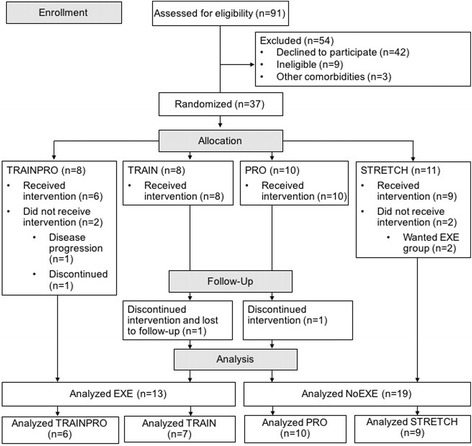
Prostate cancer patients on androgen deprivation therapy (ADT) experience adverse effects such as lean mass loss, known as sarcopenia, fat gain, and changes in cardiometabolic factors that increase risk of metabolic syndrome (MetS). Resistance training can increase lean mass, reduce body fat, and improve physical function and quality of life, but no exercise interventions in prostate cancer patients on ADT have concomitantly improved body composition and MetS. This pilot trial investigated 12 weeks of resistance training on body composition and MetS changes in prostate cancer patients on ADT. An exploratory aim examined if a combined approach of training and protein supplementation would elicit greater changes in body composition. Prostate cancer patients on ADT were randomized to resistance training and protein supplementation (TRAINPRO), resistance training (TRAIN), protein supplementation (PRO), or control stretching (STRETCH). Exercise groups (EXE = TRAINPRO, TRAIN) performed supervised exercise 3 days per week for 12 weeks, while non-exercise groups (NoEXE = PRO, STRETCH) performed a home-based stretching program. TRAINPRO and PRO received 50 g⋅day− 1 of whey protein. The primary outcome was change in lean mass assessed through dual energy x-ray absorptiometry. Secondary outcomes examined changes in sarcopenia, assessed through appendicular skeletal mass (ASM) index (kg/m2), body fat %, strength, physical function, quality of life, MetS score and the MetS components of waist circumference, blood pressure, glucose, high-density lipoprotein-cholesterol, and triglyceride levels. A total of 37 participants were randomized; 32 participated in the intervention (EXE n = 13; NoEXE n = 19). At baseline, 43.8% of participants were sarcopenic and 40.6% met the criteria for MetS. Post-intervention, EXE significantly improved lean mass (d = 0.9), sarcopenia prevalence (d = 0.8), body fat % (d = 1.1), strength (d = 0.8–3.0), and prostate cancer-specific quality of life (d = 0.9) compared to NoEXE (p < 0.05). No significant differences were observed between groups for physical function or MetS-related variables except waist circumference (d = 0.8). A 12-week resistance training intervention effectively improved sarcopenia, body fat %, strength and quality of life in hypogonadal prostate cancer patients, but did not change MetS or physical function. PRO did not offer additional benefit in improving body composition. ClinicalTrials.gov: NCT01909440 . Registered 24 July 2013.
Overview
The claims and statistics of this paper haven’t been checked yet.
Free: it reads the open-access text and checks the first 5 claims that cite a source we can check. Create a free account to check every claim.
Integrity signals
Registry
Cites
Statistics
Figures
Verification
Claims the paper makes
The claims and statistics of this paper haven’t been checked yet.
Free: it reads the open-access text and checks the first 5 claims that cite a source we can check. Create a free account to check every claim.
Claims other papers make about this one
Each is checked against this paper’s own text: does it say what the citing paper says it does?
The cited source says what the claim attributes to it.
In the citing paper
“Evidence also indicates that RT can effectively mitigate LM or skeletal muscle mass loss associated with dietary interventions (75) and in response to disease states (76).This occurs independently of reductions in body weight and fat mass.”
From Incretin-Based Weight Loss Pharmacotherapy: Can Resistance Exercise Optimize Changes in Body Composition? (2024) · cites this paper as [76]
Self-check
Percentages, sums and reported differences re-computed from the paper’s own numbers.
The self-check needs the paper’s full text.
Citations
Cites
The CES-D Scale: A Self-Report Depression Scale for Research in the General Population
Radloff, L. S. (1977) · Applied Psychological Measurement · doi:10.1177/014662167700100306 · Cited by 53,267 · cited 1×
“Emotional distress was measured using the Center for Epidemiologic Studies – Depression Scale (CES-D), where a lower score indicates the presence of less symptomatology [46].”
MethodSarcopenia: European consensus on definition and diagnosis
Cruz-Jentoft, A. J., Baeyens, J. P., Bauer, J. M., Boirie, Y., Cederholm, T., Landi, F., Martin, F. C., Michel, J.-P., Rolland, Y., Schneider, S. M., et al. (2010) · Age and Ageing · doi:10.1093/ageing/afq034 · Cited by 11,601 · cited 1×
“In addition, our approach to classifying sarcopenia was based solely on muscle mass, rather than the three-outcome criteria of muscle mass, handgrip strength and gait speed developed by the European Working Group on Sarcopenia in Older People (EWGSOP) [55].”
MethodCohen, J. (1992) · Psychological Bulletin · doi:10.1037//0033-2909.112.1.155 · Cited by 8,771
Compendium of physical activities: an update of activity codes and MET intensities
AINSWORTH, B. E., HASKELL, W. L., WHITT, M. C., IRWIN, M. L., SWARTZ, A. M., STRATH, S. J., O???BRIEN, W. L., BASSETT, D. R., SCHMITZ, K. H., EMPLAINCOURT, P. O., et al. (2000) · Medicine & Science in Sports & Exercise · doi:10.1097/00005768-200009001-00009 · Cited by 8,497 · cited 1×
“The resistance training program met the American Cancer Society’s (ACS) guidelines for strength training [29] and the Compendium of Physical Activity’s classification for vigorous intensity [30].”
BackgroundAlberti, K. G. M. M., Zimmet, P., & Shaw, J. (2006) · Diabetic Medicine · doi:10.1111/j.1464-5491.2006.01858.x · Cited by 6,597 · cited 2×
“Together, the cardiometabolic risk factors that comprise MetS have been associated with insulin resistance [6], and, collectively, these ADT-related changes have been implicated in an increased risk of cardiovascular disease [7].”
BackgroundMethod(2007) · Circulation · doi:10.1161/circulationaha.107.185649 · Cited by 6,545 · cited 1×
“In healthy adults, exercise has been proposed as a lifestyle modification to enhance body composition, improve MetS components and reduce the risk of cardiovascular disease [8], with results from older adults and insulin resistant patient populations [9] also supporting these recommendations.”
BackgroundEpidemiology of Sarcopenia among the Elderly in New Mexico
Baumgartner, R. N., Koehler, K. M., Gallagher, D., Romero, L., Heymsfield, S. B., Ross, R. R., Garry, P. J., & Lindeman, R. D. (1998) · American Journal of Epidemiology · doi:10.1093/oxfordjournals.aje.a009520 · Cited by 4,004 · cited 1×
“[36], which was chosen due to the use of similar equipment (Lunar GE iDXA) in collecting reference data [37, 38].”
MethodBonora, E., Targher, G., Alberiche, M., Bonadonna, R. C., Saggiani, F., Zenere, M. B., Monauni, T., & Muggeo, M. (2000) · Diabetes Care · doi:10.2337/diacare.23.1.57 · Cited by 2,456
Nutrition and physical activity guidelines for cancer survivors
Rock, C. L., Doyle, C., Demark‐Wahnefried, W., Meyerhardt, J., Courneya, K. S., Schwartz, A. L., Bandera, E. V., Hamilton, K. K., Grant, B., McCullough, M., et al. (2012) · CA: A Cancer Journal for Clinicians · doi:10.3322/caac.21142 · Cited by 1,995
Strength testing—predicting a one-rep max from reps-to-fatigue
Brzycki, M. (1993) · Journal of Physical Education, Recreation & Dance · doi:10.1080/07303084.1993.10606684 · Cited by 1,236
Cited by
Sarcopenia in the Older Adult With Cancer
Williams, G. R., Dunne, R. F., Giri, S., Shachar, S. S., & Caan, B. J. (2021) · Journal of Clinical Oncology · doi:10.1200/jco.21.00102 · Cited by 248
Locatelli, J. C., Costa, J. G., Haynes, A., Naylor, L. H., Fegan, P. G., Yeap, B. B., & Green, D. J. (2024) · Diabetes Care · doi:10.2337/dci23-0100 · Cited by 152
Management of Sarcopenia: A Network Meta-Analysis of Randomized Controlled Trials
Negm, A. M., Lee, J., Hamidian, R., Jones, C. A., & Khadaroo, R. G. (2022) · Journal of the American Medical Directors Association · doi:10.1016/j.jamda.2022.01.057 · Cited by 137
Exercise for individuals with bone metastases: A systematic review
Weller, S., Hart, N. H., Bolam, K. A., Mansfield, S., Santa Mina, D., Winters-Stone, K. M., Campbell, A., Rosenberger, F., Wiskemann, J., Quist, M., et al. (2021) · Critical Reviews in Oncology/Hematology · doi:10.1016/j.critrevonc.2021.103433 · Cited by 84
LOPEZ, P., TAAFFE, D. R., NEWTON, R. U., & GALVÃO, D. A. (2021) · Medicine & Science in Sports & Exercise · doi:10.1249/mss.0000000000002503 · Cited by 74
Diet and lifestyle considerations for patients with prostate cancer
Zuniga, K. B., Chan, J. M., Ryan, C. J., & Kenfield, S. A. (2019) · Urologic Oncology Seminars and Original Investigations · doi:10.1016/j.urolonc.2019.06.018 · Cited by 78
Houben, L. H. P., Overkamp, M., KRAAIJ, P. V., Trommelen, J., van Roermund, J. G. H., de Vries, P. W., de Laet, K., van der Meer, S., Mikkelsen, U. R., Verdijk, L. B., et al. (2022) · Medicine & Science in Sports & Exercise · doi:10.1249/mss.0000000000003095 · Cited by 79
“Furthermore, based on Dawson et al. (17), it could be speculated that the provided protein dose was insufficient to compensate for the anabolic resistance likely caused by inactivity and testosterone deprivation in this PCa patient population (21,36).”
BackgroundMethodResultInfluentialNdjavera, W., Orange, S. T., O’Doherty, A. F., Leicht, A. S., Rochester, M. A., Mills, R., & Saxton, J. (2019) · British Journal of Urology · doi:10.1111/bju.14922 · Cited by 69
Effect of Exercise on Sarcopenia among Cancer Survivors: A Systematic Review
Cao, A., Ferrucci, L. M., Caan, B. J., & Irwin, M. L. (2022) · Cancers · doi:10.3390/cancers14030786 · Cited by 68
“[25] also observed a significant increase in ASMI in the exercise groups compared to the non-exercise groups (3.”
BackgroundResultInfluentialKoeppel, M., Mathis, K. M., Schmitz, K. H., & Wiskemann, J. (2021) · Critical Reviews in Oncology/Hematology · doi:10.1016/j.critrevonc.2021.103371 · Cited by 69
Andersen, M. F., Midtgaard, J., & Bjerre, E. D. (2022) · International Journal of Environmental Research and Public Health · doi:10.3390/ijerph19020972 · Cited by 55
Impact of cancer rehabilitation on the prognosis of patients with hepatocellular carcinoma
Hashida, R., Kawaguchi, T., Koya, S., Hirota, K., Goshima, N., Yoshiyama, T., Otsuka, T., Bekki, M., Iwanaga, S., Nakano, D., et al. (2020) · Oncology Letters · doi:10.3892/ol.2020.11345 · Cited by 49
“Dawson et al (34) showed that CR improves muscle mass in patients with prostate cancer during androgen treatment.”
Chen, Z., Zhang, Y., Lu, C., Zeng, H., Schumann, M., & Cheng, S. (2019) · Frontiers in Physiology · doi:10.3389/fphys.2019.00843 · Cited by 42
Weight Loss for Obese Prostate Cancer Patients on Androgen Deprivation Therapy
Wilson, R. L., Newton, R. U., Taaffe, D. R., Hart, N. H., Lyons‐Wall, P., & Galvao, D. A. (2020) · Medicine & Science in Sports & Exercise · doi:10.1249/mss.0000000000002509 · Cited by 35
“(40) conducted a resistance training intervention in prostate cancer patients on ADT using four groups, exercise, exercise and protein supplement, protein supplement, and control, providing a daily protein supplement of 50 g, which is higher than the protein supplement of 40 g provided 3 d·wk−1 in the current study.”
BackgroundThe Role of Exercise in Cancer-Related Sarcopenia and Sarcopenic Obesity
Papadopetraki, A., Giannopoulos, A., Maridaki, M., Zagouri, F., Droufakou, S., Koutsilieris, M., & Philippou, A. (2023) · Cancers · doi:10.3390/cancers15245856 · Cited by 34
“However, “delayed” exercise interventions in patients who have already developed sarcopenia appears to be able to provide health benefits and improve their clinical appearance [46,143–145] (Table 5).”
BackgroundInfluentialUssing, A., Mikkelsen, M.-L. K., Villumsen, B. R., Wejlgaard, J., Bidstrup, P. E., Birkefoss, K., & Bandholm, T. (2021) · Prostate Cancer and Prostatic Diseases · doi:10.1038/s41391-021-00450-0 · Cited by 35
“Nine trials included patients with stage T1T4 cancer [17, 21, 22, 27, 31, 47, 50–54, 56], five trials included stage T3-T4 [18, 19, 29, 30, 45], and in four trials cancer stages were unclear [20, 28, 46, 48].”
BackgroundEffect of Exercise on Secondary Sarcopenia: A Comprehensive Literature Review
Supriya, R., Singh, K. P., Gao, Y., Gu, Y., & Baker, J. S. (2021) · Biology · doi:10.3390/biology11010051 · Cited by 42
“…Year Place, N Subjects with (Baseline Sarcope ia) Mean Age ± SD (Years), Sex Exercise Interve tion and Number of Groups Measured Outcomes Results 1 Dawson et al., 2018 Los angeles, 37 Prostate cancer pati nts on ADT (43.8% of participants were sarcopenic) 67.4 ± 8.8, M Resistance training for…”
BackgroundMethodInfluentialGeng, Q., Zhai, H., Wang, L., Wei, H., & Hou, S. (2023) · Medicine · doi:10.1097/md.0000000000034254 · Cited by 33
“Among the resistance exercise intervention programs included in this study, 4 studies had exercise intervention twice a week,[30,32,41,43] and 6 studies had exercise intervention 3 times a week,[29,31,35,38,42,53] all of which lasted >8 weeks.”
BackgroundLópez, P., Taaffe, D. R., Newton, R. U., Buffart, L. M., & Galvao, D. A. (2020) · Prostate Cancer and Prostatic Diseases · doi:10.1038/s41391-020-00301-4 · Cited by 36
Functional hypogonadism among patients with obesity, diabetes, and metabolic syndrome
Louters, M., Pearlman, M., Solsrud, E., & Pearlman, A. (2022) · International Journal of Impotence Research · doi:10.1038/s41443-021-00496-7 · Cited by 32
“6% meeting criteria for MetS), a 12-week resistance training intervention improved sarcopenia, body fat percentage, and quality of life, though did not affect MetS or physical function [49].”
BackgroundBarnes, O., Wilson, R. L., Encabo, P. G., Kang, D., Christopher, C. N., Bentley, T., & Dieli-Conwright, C. M. (2022) · Nutrients · doi:10.3390/nu14102110 · Cited by 29
Self-citationWilson, R. L., Taaffe, D. R., Newton, R. U., Hart, N. H., Lyons‐Wall, P., & Galvao, D. A. (2021) · Nutrients · doi:10.3390/nu13051664 · Cited by 28
Zanetti, M., Cappellari, G. G., Barazzoni, R., & Sanson, G. (2020) · Nutrients · doi:10.3390/nu12072099 · Cited by 30
“US Dawson, 2018 [37] Randomized controlled trial Follow up: 12 w N = 37 M/F: 37/0 Age: 66.”
BackgroundResultInfluentialAndrogen deprivation in prostate cancer: benefits of home-based resistance training
Lam, T., Cheema, B. S., Hayden, A. J., Lord, S. R., Gurney, H., Gounden, S., Reddy, N., Shahidipour, H., Read, S. A., Stone, G., et al. (2020) · Sports Medicine - Open · doi:10.1186/s40798-020-00288-1 · Cited by 29
Ni, H.-J., Hsu, T., Chen, L., Chou, H., Tung, H., Chow, L., & Chen, Y. (2021) · Archives of Gerontology and Geriatrics · doi:10.1016/j.archger.2021.104605 · Cited by 26
Nabi, J., Cone, E. B., Vasavada, A., Sun, M., Kilbridge, K. L., Kibel, A. S., Berry, D. L., & Trinh, Q. (2020) · JMIR mhealth and uhealth · doi:10.2196/20224 · Cited by 24
“Previous studies have documented that men exposed to gonadotropin-releasing hormone agonists—a common form of ADT—manifested a weight gain of 2.4%, an increase in body fat percentage of 9.4%, and a loss in lean body mass of 2%-4% (also known as sarcopenia) by the end of the first year [7,8].”
InfluentialIkeda, T., Noma, K., Maeda, N., Tanabe, S., Sakamoto, Y., Katayama, Y., Shirakawa, Y., Fujiwara, T., & Senda, M. (2022) · Surgery Today · doi:10.1007/s00595-021-02449-5 · Cited by 24
“Our study supported these studies [24, 25].”
BackgroundKovač, M. B., Pavlin, T., Čavka, L., Ribnikar, D., Spazzapan, S., Templeton, A. J., & Šeruga, B. (2023) · Journal of Geriatric Oncology · doi:10.1016/j.jgo.2023.101594 · Cited by 27
Zhang, Q., Gao, Y., Wang, W., Zhao, X., Yu, J., & Huang, H. (2024) · Frontiers in Oncology · doi:10.3389/fonc.2024.1393902 · Cited by 29
López, P., Newton, R. U., Taaffe, D. R., Singh, F., Lyons‐Wall, P., Buffart, L. M., Tang, C., Hayne, D., & Galvao, D. A. (2021) · Medicine & Science in Sports & Exercise · doi:10.1249/mss.0000000000002843 · Cited by 23
“999) after removing interventionmodalities with insufficient number of studies (50,52,56,57,61,65,68,76) or the study of Cormie et al.”
BackgroundInfluentialExercise and Bone Health in Cancer: Enemy or Ally?
Avancini, A., Benato, G., Borsati, A., Oliviero, L., Belluomini, L., Sposito, M., Tregnago, D., Trestini, I., Insolda, J., Zacchi, F., et al. (2022) · Cancers · doi:10.3390/cancers14246078 · Cited by 24
“Additionally, inclusion criteria for selecting patients with bone metastases rarely report detailed information and often exclude the frailest patients, such as those with bone pain or unstable metastases [26,27,33,39,44,45].”
BackgroundWochner, R., Clauss, D., Nattenmüller, J., Tjaden, C., Bruckner, T. M., Kauczor, H., Hackert, T., Wiskemann, J., & Steindorf, K. (2020) · PLoS ONE · doi:10.1371/journal.pone.0242785 · Cited by 24
Couderc, A., Muracciole, X., Nouguerède, E., Rey, D., Schneider, S., Champsaur, P., Lechevallier, É., Lalys, L., & Villani, P. (2019) · The journal of nutrition health & aging · doi:10.1007/s12603-019-1294-7 · Cited by 21
“This result stresses the importance of systematically screening for sarcopenia before initiating ADT, to reduce ADT adverse effects with adapted nutritional and exercise interventions (4, 29).”
Bland, K. A., Kouw, I. W. K., van Loon, L. J. C., Zopf, E. M., & Fairman, C. M. (2022) · Sports Medicine · doi:10.1007/s40279-021-01638-z · Cited by 22
“However, there was no significant independent effect of protein on body composition outcomes, and this may be for several reasons, including a small sample size (n = 34) or the dose of protein prescribed (50 g daily supplement divided into two 25 g doses) [192].”
BackgroundResultLee, K., Park, J., Oh, E. G., Lee, J., Park, C. G., & Choi, Y. D. (2024) · JMIR mhealth and uhealth · doi:10.2196/47102 · Cited by 19
“Furthermore, Dawson et al [55] conducted a program that emphasized exercise and protein supplementation for 3 months in patients with PC receiving ADT.”
BackgroundResultInfluentialPapadopoulos, E., Mina, D. S., Culos-Reed, N. S., Durbano, S., Ritvo, P., Sabiston, C. M., Krahn, M. D., TOMLINSON, G. A., O’Neill, M., Iqbal, A., et al. (2020) · Journal of Geriatric Oncology · doi:10.1016/j.jgo.2020.02.013 · Cited by 20
Geerkens, M., Pouwels, N. S. A., & Beerlage, H. P. (2019) · Quality of Life Research · doi:10.1007/s11136-019-02361-z · Cited by 19
Sánchez, A., Kissel, S., Coletta, A. M., Scott, J. M., & Furberg, H. F. (2020) · Urologic Oncology Seminars and Original Investigations · doi:10.1016/j.urolonc.2020.03.017 · Cited by 18
Prognostic Impact of Sarcopenia in Patients with Advanced Prostate Carcinoma: A Systematic Review
de Pablos‐Rodríguez, P., del Pino‐Sedeño, T., Infante‐Ventura, D., de Armas‐Castellano, A., Backhaus, M., Loro-Ferrer, J. F., de Pablos-Velasco, P. L., Rueda‐Domínguez, A., & Trujillo‐Martín, M. M. (2022) · Journal of Clinical Medicine · doi:10.3390/jcm12010057 · Cited by 18
“Thus, preliminary studies have shown that physical exercise programs can improve sarcopenia in patients with PCa [39], even in the absence of testosterone [40].”
Fairman, C. M., Kendall, K. L., Newton, R. U., Hart, N. H., Taaffe, D. R., Chee, R., Tang, C., & Galvao, D. A. (2019) · BMJ Open · doi:10.1136/bmjopen-2019-030080 · Cited by 21
Hu, J., Wang, Z., Lei, B., Li, J., & Wang, R. (2021) · International Journal of Environmental Research and Public Health · doi:10.3390/ijerph182010740 · Cited by 19
Filamin A cooperates with the androgen receptor in preventing skeletal muscle senescence
Donato, M. D., Moretti, A., Sorrentino, C., Toro, G., Gentile, G., Iolascon, G., Castoria, G., & Migliaccio, A. (2023) · Cell Death Discovery · doi:10.1038/s41420-023-01737-y · Cited by 16
“Cells were routinely monitored for Mycoplasma contamination.”
Inglis, J. E., Fernandez, I. D., van Wijngaarden, E., Culakova, E., Reschke, J. E., Kleckner, A. S., Lin, P., Mustian, K. M., & Peppone, L. J. (2020) · Nutrition and Cancer · doi:10.1080/01635581.2020.1819348 · Cited by 18
Yang, U. S., Harikrishna, A., Preda, V. A., & Chen, J. (2023) · Clinical Nutrition ESPEN · doi:10.1016/j.clnesp.2023.09.001 · Cited by 18
Umlauff, L., Weber, M., Freitag, N., Fairman, C. M., Heidenreich, A., Bloch, W., & Schumann, M. (2021) · Prostate Cancer and Prostatic Diseases · doi:10.1038/s41391-021-00411-7 · Cited by 15
“We examined the changes in dietary intake in all six studies that reported diet assessment outcomes (see Table 2) and found that only two interventions, a low-carbohydrate diet [30] and protein supplementation [44], Fig.”
BackgroundMethodResultInfluentialRosenberger, F., Sprave, T., Clauss, D., Hoffmann, P., Welzel, T., Debus, J., Rief, H., & Wiskemann, J. (2021) · Cancers · doi:10.3390/cancers13020201 · Cited by 19
Dawson, J., Dorff, T. B., Tuzon, C. T., Rice, J. C., Schroeder, E. T., Lane, C. J., Gross, M. E., & Dieli-Conwright, C. M. (2021) · Integrative Cancer Therapies · doi:10.1177/15347354211035442 · Cited by 17
Self-citationKeats, M. R., Grandy, S. A., Blanchard, C., Fowles, J. R., Neyedli, H. F., Weeks, A., & MacNeil, M. V. (2022) · JMIR Research Protocols · doi:10.2196/37709 · Cited by 14
“For example, resistance training has been shown to reduce body fat and improve muscle mass, strength, functional ability, and QOL in prostate cancer survivors [35-37].”
Hanson, E. D., Betik, A. C., Timpani, C. A., Tarle, J., Zhang, X., & Hayes, A. (2020) · Journal of Applied Physiology · doi:10.1152/japplphysiol.00752.2019 · Cited by 14
Horii, N., Kosaka, T., Fujiwara, R., Sato, S., Akiyama, H., Kunisaki, C., & Endo, I. (2021) · Asia-Pacific Journal of Clinical Oncology · doi:10.1111/ajco.13514 · Cited by 13
“Median (IQR) 12(1-55) 11 (1-118) Effects of POC”
Effect of exercise on body composition among women with ovarian cancer
Cao, A., Cartmel, B., Li, F., Gottlieb, L. T., Harrigan, M., Ligibel, J. A., Gogoi, R. P., Schwartz, P. E., Irwin, M. L., & Ferrucci, L. M. (2022) · Journal of Cancer Survivorship · doi:10.1007/s11764-022-01207-x · Cited by 13
“Women with DEXA (N = 103) included in this analysis were similar to women without DEXA (N = 41), except those without baseline DEXA were more likely to have an advanced degree and to have been self-referred (only 7 women were not self-referred), and further from date of diagnosis (data not shown).”
BackgroundInfluentialExercise Intervention for Bone Metastasis: Safety, Efficacy and Method of Delivery
Duong, H., Walker, M. A., & Maugham, M. (2023) · Cancers · doi:10.3390/cancers15061786 · Cited by 12
“Muscle strength and lean mass were reported in eleven trials with eight trials reporting positive outcomes [8,11,13,16,17,26,30,34] (six using in-person training, one which used remot training and one which used mixed method training).”
BackgroundMethodInfluentialA mini-review-cancer energy reprogramming on drug resistance and immune response
Liu, C., Yang, L., Gao, T., Yuan, X., Bajinka, O., & Wang, K. (2024) · Translational Oncology · doi:10.1016/j.tranon.2024.102099 · Cited by 12
Does Androgen Deprivation for Prostate Cancer Affect Normal Adaptation to Resistance Exercise?
Nilsen, T. S., Johansen, S. H., Thorsen, L., Fairman, C. M., Wisløff, T. F., & Raastad, T. (2022) · International Journal of Environmental Research and Public Health · doi:10.3390/ijerph19073820 · Cited by 11
Body composition and metastatic prostate cancer survivorship
Coletta, A. M., Sayegh, N., & Agarwal, N. (2021) · Cancer Treatment and Research Communications · doi:10.1016/j.ctarc.2021.100322 · Cited by 11
Wang, Y., Wang, Y., Cui, Y. J., Su, W., & Xue, Y. (2025) · European Journal of Oncology Nursing · doi:10.1016/j.ejon.2025.103022 · Cited by 10
Hasenoehrl, T., Palma, S., Huber, D., Zdravkovic, A., & Crevenna, R. (2020) · Wiener klinische Wochenschrift · doi:10.1007/s00508-020-01739-1 · Cited by 9
Aja, P. M., Agu, P. C., Musyoka, A. M., Ngwueche, W., Odo, J. U., Alum, E. U., Fasogbon, I. V., Herbert, M., & Eze, E. D. (2025) · American Journal of Men s Health · doi:10.1177/15579883251344571 · Cited by 9
Bae, C. R., Gelvosa, M. N., & Jeon, J. Y. (2022) · Current Oncology Reports · doi:10.1007/s11912-022-01229-9 · Cited by 8
Newton, R. U., Mavropalias, G., Fragala, M. S., Kraemer, W. J., Häkkinen, K., Taaffe, D. R., Spry, N. A., Joseph, D. J., & Galvao, D. A. (2021) · Experimental Gerontology · doi:10.1016/j.exger.2021.111427 · Cited by 7
Lin, Y., Shao, I., Juan, Y., Yeh, K., Hou, C., Chen, C., Yu, K., Chen, L.-S., Lin, C.-L., & Chuang, H. (2022) · Nutrients · doi:10.3390/nu14235088 · Cited by 7
Modifying dietary amino acids in cancer patients
Connolly-Schoonen, J., Biamonte, S. F., Danowski, L., & Montrose, D. C. (2022) · International review of cytology · doi:10.1016/bs.ircmb.2022.02.004 · Cited by 9
Tian, S. I. P., Ding, M., & Sun, H. (2022) · The Aging Male · doi:10.1080/13685538.2022.2146670 · Cited by 7
Kim, J., Taaffe, D. R., Galvao, D. A., Saad, F., & Newton, R. U. (2023) · Exercise and Sport Sciences Reviews · doi:10.1249/jes.0000000000000323 · Cited by 6
Encabo, P. G., Gardiner, J. R., Norris, M. K., Wilson, R. L., Normann, A. J., Nguyen, D., Parker, N. H., Tjogas, D., Brais, L. K., Meyerhardt, J. A., et al. (2025) · PLoS ONE · doi:10.1371/journal.pone.0322192 · Cited by 7
Self-citationTsou, P.-H., Lan, T.-C., Tam, K., & Huang, T. (2022) · Seminars in Oncology Nursing · doi:10.1016/j.soncn.2022.151368 · Cited by 6
Wright, H. H., Walker, M. A., Broadbent, S., Linton, C., Keech, J. J., Rune, K. T., Davis, C., Morris, M. F., Zhang, A., Newton, R. U., et al. (2024) · Maturitas · doi:10.1016/j.maturitas.2024.107940 · Cited by 7
Coletta, A. M., Simon, L. H., Maslana, K. E., Taylor, S., Larson, K., Hansen, P. A., Thomas, V. M., Ulrich, C. M., Kohli, M., Chipman, J., et al. (2024) · BMC Cancer · doi:10.1186/s12885-024-12260-3 · Cited by 8
“…CSPC survivors receiving ADT that suggests that 12-weeks of in-person, supervised RT, twice weekly, utilizing free weights or resistance machines is safe and feasible to preserve muscle mass, improve fatigue, physical function, strength, and insulin sensitivity, and reduce fat mass [15–21].”
BackgroundThe 28th Annual Prostate Cancer Foundation Scientific Retreat report
Miyahira, A. K., & Soule, H. R. (2022) · The Prostate · doi:10.1002/pros.24409 · Cited by 6
“ACTIVATE is a recently completed follow‐up pilot trial that tested circuit‐based intervals of aerobic and resistance exercise in sedentary overweight/obese patients with prostate cancer undergoing ADT.”
BackgroundInfluentialAbbasi, F., Khademi, Z., Eslami, R., & Milajerdi, A. (2021) · Journal of Physical Activity and Health · doi:10.1123/jpah.2020-0637 · Cited by 6
Cai, L., Xie, H., Li, W., Chen, C., Li, T., Xu, L., Mao, Y., Liang, J., Wen, J., & Chen, G. (2025) · Endocrine · doi:10.1007/s12020-025-04199-7 · Cited by 5
“Additionally, sedentary behavior may disrupt circadian rhythms, further impairing the pulsatile release of GnRH and luteinizing hormone [47].”
Intervention strategies for cancer-related sarcopenia: a scoping review
Li, L., Zhu, H., Chen, J.-S., Shan, L., & Xu, J. (2025) · Frontiers in Nutrition · doi:10.3389/fnut.2025.1666547 · Cited by 4
Pérez, S. L., Macia, J.-C., Lillo-García, C., Caravaca, I., Lopez-Rodriguez, F., Calero, A., Tomás-Rodríguez, M. I., Moya-Martínez, A., Arroyo, A., & Lacueva, F. J. (2024) · Annals of Surgical Oncology · doi:10.1245/s10434-024-15756-1 · Cited by 5
“Thus, one study carried out with patients with prostate cancer detected an improvement in the ASM after performing 12 weeks of resistance training, 15 but no benefit was observed for the interaction between exercise and protein supplements.”
Inclusivity in prostate cancer and exercise research: a systematic review
Ashton, R. E. M., Faghy, M. A., Roscoe, C. M. P., & Aning, J. J. (2024) · Supportive Care in Cancer · doi:10.1007/s00520-024-08793-9 · Cited by 4
“Fifteen studies 15/28 (53.6%; [11, 25, 26, 29–31, 33, 38–40, 42, 43, 45, 47, 50]) adopted a randomised control trial design, four 4/28 (14.3%; [36, 41, 46, 51]) cross-sectional, two 2/28 (7.1%; [31, 49]) cohort, two prospective 2/28 (7.1%; [44, 48]), two feasibility 2/28 (7.1%; [27, 28]),…”
BackgroundInfluentialHouben, L. H. P., Overkamp, M., Senden, J. M., van Roermund, J. G. H., de Vries, P. W., de Laet, K., van der Meer, S., van Loon, L. J. C., Beelen, M., & Beijer, S. (2024) · European Journal of Sport Science · doi:10.1002/ejsc.12050 · Cited by 6
“We and others have shown that resistance exercise training increases muscle mass and strength (Dawson et al., 2018; Houben et al., 2023; Newton et al., 2019; Nilsen et al., 2015; Segal et al., 2003; Winters ‐ Stone et al., 2015a, 2015b), Winters ‐ Stone, Dieckmann, et al., 2015 and can even reduce…”
BackgroundChang, W., Hong, J.-H., Chen, D., Huang, C., Chen, Y., Cha, T., Wu, Y., Lin, T., Cheng, K., Chiang, P.-J., et al. (2025) · PubMed Central · doi:10.6515/acs.202505_41(3).20250224a · Cited by 4
Yang, P.-J., Lin, C., Lee, C., Huang, J., Hsieh, M., & Yang, S. (2023) · Cancers · doi:10.3390/cancers15112915 · Cited by 4
Efeito do Oncofitness na amplitude articular de pacientes com câncer de próstata
Bezerra, J. C. P., de Jesus, E. V., Moreira, G. D. S., Neto, P. A. D. F., Oliveira, S. D. R. C., dos Santos, D. T., & Dantas, E. H. M. (2022) · Ciencias de la actividad física · doi:10.29035/rcaf.23.especial_ihmn.8 · Cited by 3
“Foram encontrados dados semelhantes em estudos realizados com pacientes com câncer realizando atividade física (Bultijnck et al., 2018; Dawson et al., 2018) Os dados revelaram que apenas na flexão de joelho e na abdução de quadril do GE obteve-se diferença estatística no pré e pós-intervenção; na…”
BackgroundCecchi, M., Ninot, G., Rébillard, X., Thuret, R., Droupy, S., Ayuso, D., & Poinas, G. (2023) · The French Journal of Urology · doi:10.1016/j.purol.2023.03.005 · Cited by 3
Fatigue and depression improvements on breast cancer survivors practitioners of strength training
Chaves, S. N., de Lima, F. D., Perondi, B. L. B., Vieira, J., Elias, J. D. M., Ribeiro, L. A., Silva, A. K. S., Clael, S., & de Oliveira, R. J. (2021) · Brazilian Journal of Kinanthropometry and Human Performance · doi:10.1590/1980-0037.2021v23e73039 · Cited by 3
Flôr, E. C. C., Noce, B. P., Alves, T. A., & Fernandes, W. V. (2021) · Brazilian Journal of Health Review · doi:10.34119/bjhrv4n3-358 · Cited by 2
Lee, H., & Kim, J.-S. (2022) · Cancer Nursing · doi:10.1097/ncc.0000000000001098 · Cited by 3
Parraça, J. A., Salas-Gómez, D., Dinis, R., Denche-Zamorano, Á. M., Vega-Muñoz, A., Tomás-Carús, P., Centro de Investigación en Educación de Calidad para la Equidad, U. C. D. C., & Facultad de Ciencias Empresariales, U. A. P. (2025) · AIMS Public Health · doi:10.3934/publichealth.2025033 · Cited by 2
Edwards, S., Lulic-Kuryllo, T., & Batra, A. (2025) · Frontiers in Rehabilitation Sciences · doi:10.3389/fresc.2025.1655422 · Cited by 1
Whole-Body Vibration Exercise in Cancer
Lopes-Souza, P., de Sá-Caputo, D. D. C., Taïar, R., & Bernardo-Filho, M. (2020) · Springer eBooks · doi:10.1007/978-3-030-43985-9_28 · Cited by 1
Prostatakarzinom beim geriatrischen Patienten
Wiedemann, A. (2020) · Springer eBooks · doi:10.1007/978-3-662-61494-5_11 · Cited by 1
Fox, I. N., & Wassersug, R. J. (2022) · BMJ Supportive & Palliative Care · doi:10.1136/bmjspcare-2021-003370 · Cited by 1
Shimabukuro, T., Ohmi, C., Nagamitsu, R., Shiraishi, K., & Matsuyama, H. (2021) · The Japanese Journal of Urology · doi:10.5980/jpnjurol.112.81 · Cited by 2
Hu, S., Xiong, X., Qiu, S., Li, J., Xu, H., Zhou, X., Wang, S., Wei, Q., & Yang, L. (2024) · Urologia Internationalis · doi:10.1159/000538114 · Cited by 1
“Most participants received ADT, except for a small number of patients who only accepted antiandrogen therapy [24] and patients with testosterone 50 ng · dL − 1 [32].”
Urogeriatrisches Denken am Beispiel der antiandrogenen Therapie des Prostatakarzinoms
Wiedemann, A., Manseck, A., Stein, J. R., Fröhner, M., Fiebig, C., Piotrowski, A., & Kirschner-Hermanns, R. K. M. (2024) · Die Urologie · doi:10.1007/s00120-024-02397-1 · Cited by 1
A lifestyle intervention to improve outcomes in men with castrate-resistant prostate cancer
Greasley, R. (2018) · Sheffield Hallam University · doi:10.7190/shu-thesis-00165
de Ávila, S. C. A., Dias, M. G., Pereira, F. G., Coppola, O. J. V., & Reis, A. D. (2021) · International Journal of Sports and Exercise Medicine · doi:10.23937/2469-5718/1510192
言語使用とトランスナショナルな生活への適応パターン : 在米日本人駐在家庭に育つ子どもたちの事例(II-5部会 異文化接触,研究発表II,一般研究報告)
額賀, 美. (2009) · 日本教育社会学会大会発表要旨集録
Prostate Cancer Survivorship and Physical Health
Goonewardene, S. S., Young, A., Cahill, D. J., & Persad, R. A. (2022) · Springer eBooks · doi:10.1007/978-3-030-84752-4_20
Chen, Z., Zhang, Y., Lu, C., Zeng, H., Schumann, M., & Cheng, S. (2019) · Frontiers in Physiology · doi:10.3389/fphys.2019.01126
Carvalho, H. D. S., Machado, J. M., Schütz, E. D. S. F., & Ouriques, E. P. M. (2021) · Revista Brasileira de Ciência e Movimento · doi:10.31501/rbcm.v29i1.12860 · Cited by 3
“GC: 57,74 (2,83) GE: 60,44 (5,34) GC: 0/18 GE: 0/19 GC: 18 GE: 19 GC: 124,63(5,34) GE: 125,85(4,86) GC: 80,42(6,13) GE: 81,20(7,50)”
InfluentialSilva, C. A. D. Á., Monteiro, G. D., Freitas, G. P., Oliveira, J. V. C., & Abdalla, D. R. (2023) · Seven International Congress of Health · doi:10.56238/homeiisevenhealth-002
BÖLÜKBAŞ, M. G., & Vatansever, Ş. (2023) · Ankara Üniversitesi Beden Eğitimi ve Spor Yüksekokulu SPORMETRE Beden Eğitimi ve Spor Bilimleri Dergisi · doi:10.33689/spormetre.1224290
Ganzkörpervibrationstraining bei Krebs
Lopes-Souza, P., de Sá-Caputo, D. D. C., Taïar, R., & Bernardo-Filho, M. (2023) · Springer eBooks · doi:10.1007/978-3-031-13621-4_28
Exercise training in prostate cancer patients on androgen deprivation therapy
Houben, L. H. P. (2024) · Research Publications (Maastricht University) · doi:10.26481/dis.20240111lh
Metadata
- Authors
- Dawson, J. K., Dorff, T. B., Todd Schroeder, E., Lane, C. J., Gross, M. E., & Dieli-Conwright, C. M.
- Affiliations
- University of Southern California (US)
- USC Norris Comprehensive Cancer Center (US)
- Ellison Medical Institute (US)
- Corresponding author
- Dawson, Jacqueline K.
- ORCID
- Venue
- BMC Cancer
- Published
- 2018-04-03
- Volume
- 18
- Issue
- 1
- Pages
- 368-368
- ISSN
- 1471-2407 (ISSN-L)
- PMC
- PMC5883585
- OpenAlex
- W2807622313
- Cited by
- 112
- References
- 58
- Citations by year
- 2026: 9 · 2025: 12 · 2024: 12 · 2023: 12 · 2022: 22 · 2021: 21 · 2020: 16 · 2019: 6 · 2018: 1
- FWCI
- 7.56
- Type
- journal article
- Language
- en
- Open access
- gold
- doi.org
- Licence
- cc-by
- creativecommons.org/licenses/by/4.0/ (tdm)
- creativecommons.org/licenses/by/4.0/ (vor)
- Locations
- BMC Cancer (publishedVersion, cc-by)
- Europe PMC (PubMed Central) (publishedVersion, cc-by)
- PubMed Central (publishedVersion, cc-by)
- PubMed (publishedVersion)
- DOAJ (DOAJ: Directory of Open Access Journals) (submittedVersion, cc-by-sa)
- Funders
- National Strength and Conditioning Association
- California State University
- Southern California Clinical and Translational Science Institute (UL1TR001855)
- National Cancer Institute (K07CA160718)
- Topics
- Health Sciences › Medicine › Physiology (medical) › Nutrition and Health in Aging
- Health Sciences › Medicine › Oncology › Cancer survivorship and care
- Health Sciences › Nursing › Nutrition and Dietetics › Muscle metabolism and nutrition
- Keywords
- resistance training, prostate cancer, androgen deprivation therapy, sarcopenia, body composition, lean body mass, fat mass, whey protein supplementation, metabolic syndrome, quality of life, physical function, strength, stretching, cardiometabolic risk, fat gain, waist circumference, HDL cholesterol, triglycerides, blood pressure, glucose, home-based exercise intervention
- MeSH terms
- Physical Functional Performance, Androgen Antagonists, Body Composition, Diet, Home Care Services, Humans, Male, Physical Fitness, Pilot Projects, Prostatic Neoplasms, Quality of Life, Biomarkers, Treatment Outcome, Antineoplastic Agents, Hormonal, Metabolic Syndrome, Muscle Strength, Resistance Training, Medication Adherence
About these checks
Registry, retraction, Cites and statistics results are computed, not judged, with one exception: a printed reference that no index lists is read once by a model before it counts as a citation error. Claims are extracted by a model and kept only when their quote appears verbatim in the text; each cited source is then checked, with a model’s help, for whether it says what the claim relies on. Those verdicts can be wrong — read the claim’s quote and the cited source before relying on one.
Statistics and arithmetic are recomputed, not judged.
Confidence bands are shown only for fields calibrated on our annotated test set. None is calibrated yet, so no band is shown.
What counts as a claim ›How we measure confidence ›How we check this ›
Are you an author, or do you see a problem with this page? Request a review
Data sources
Bibliographic data: Semantic Scholar, OpenAlex, Crossref.
Contains information from the Semantic Scholar Academic Graph Datasets, made available under the ODC Attribution License (ODC-BY 1.0).
Semantic Scholar’s data is described in: Kinney, R., et al. (2023). The Semantic Scholar Open Data Platform. arXiv:2301.10140.
