

Impact of resistance training on body composition and metabolic syndrome variables during androgen deprivation therapy for prostate cancer: a pilot randomized controlled trial
Open accessThe DOI matches its Crossref record; 58 of the 59 references it cites were found in a registry or an index, and 1 are not checked yet.
Abstract
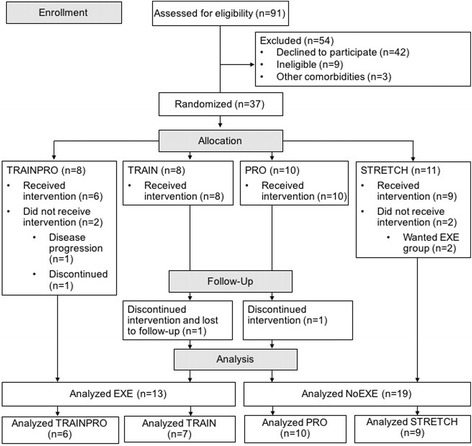
Prostate cancer patients on androgen deprivation therapy (ADT) experience adverse effects such as lean mass loss, known as sarcopenia, fat gain, and changes in cardiometabolic factors that increase risk of metabolic syndrome (MetS). Resistance training can increase lean mass, reduce body fat, and improve physical function and quality of life, but no exercise interventions in prostate cancer patients on ADT have concomitantly improved body composition and MetS. This pilot trial investigated 12 weeks of resistance training on body composition and MetS changes in prostate cancer patients on ADT. An exploratory aim examined if a combined approach of training and protein supplementation would elicit greater changes in body composition. Prostate cancer patients on ADT were randomized to resistance training and protein supplementation (TRAINPRO), resistance training (TRAIN), protein supplementation (PRO), or control stretching (STRETCH). Exercise groups (EXE = TRAINPRO, TRAIN) performed supervised exercise 3 days per week for 12 weeks, while non-exercise groups (NoEXE = PRO, STRETCH) performed a home-based stretching program. TRAINPRO and PRO received 50 g⋅day− 1 of whey protein. The primary outcome was change in lean mass assessed through dual energy x-ray absorptiometry. Secondary outcomes examined changes in sarcopenia, assessed through appendicular skeletal mass (ASM) index (kg/m2), body fat %, strength, physical function, quality of life, MetS score and the MetS components of waist circumference, blood pressure, glucose, high-density lipoprotein-cholesterol, and triglyceride levels. A total of 37 participants were randomized; 32 participated in the intervention (EXE n = 13; NoEXE n = 19). At baseline, 43.8% of participants were sarcopenic and 40.6% met the criteria for MetS. Post-intervention, EXE significantly improved lean mass (d = 0.9), sarcopenia prevalence (d = 0.8), body fat % (d = 1.1), strength (d = 0.8–3.0), and prostate cancer-specific quality of life (d = 0.9) compared to NoEXE (p < 0.05). No significant differences were observed between groups for physical function or MetS-related variables except waist circumference (d = 0.8). A 12-week resistance training intervention effectively improved sarcopenia, body fat %, strength and quality of life in hypogonadal prostate cancer patients, but did not change MetS or physical function. PRO did not offer additional benefit in improving body composition. ClinicalTrials.gov: NCT01909440 . Registered 24 July 2013.
Overview
The claims and statistics of this paper haven’t been checked yet.
Free: it reads the open-access text and checks the first 5 claims that cite a source we can check. Create a free account to check every claim.
Integrity signals
Registry
Cites
Statistics
Figures
Verification
Claims the paper makes
The claims and statistics of this paper haven’t been checked yet.
Free: it reads the open-access text and checks the first 5 claims that cite a source we can check. Create a free account to check every claim.
Claims other papers make about this one
Each is checked against this paper’s own text: does it say what the citing paper says it does?
The cited source says what the claim attributes to it.
In the citing paper
“Evidence also indicates that RT can effectively mitigate LM or skeletal muscle mass loss associated with dietary interventions (75) and in response to disease states (76).This occurs independently of reductions in body weight and fat mass.”
From Incretin-Based Weight Loss Pharmacotherapy: Can Resistance Exercise Optimize Changes in Body Composition? (2024) · cites this paper as [76]
Self-check
Percentages, sums and reported differences re-computed from the paper’s own numbers.
The self-check needs the paper’s full text.
Citations
Cites
The CES-D Scale: A Self-Report Depression Scale for Research in the General Population
Radloff, L. S. (1977) · Applied Psychological Measurement · doi:10.1177/014662167700100306 · Cited by 53,267 · cited 1×
“Emotional distress was measured using the Center for Epidemiologic Studies – Depression Scale (CES-D), where a lower score indicates the presence of less symptomatology [46].”
MethodSarcopenia: European consensus on definition and diagnosis
Cruz-Jentoft, A. J., Baeyens, J. P., Bauer, J. M., Boirie, Y., Cederholm, T., Landi, F., Martin, F. C., Michel, J.-P., Rolland, Y., Schneider, S. M., et al. (2010) · Age and Ageing · doi:10.1093/ageing/afq034 · Cited by 11,601 · cited 1×
“In addition, our approach to classifying sarcopenia was based solely on muscle mass, rather than the three-outcome criteria of muscle mass, handgrip strength and gait speed developed by the European Working Group on Sarcopenia in Older People (EWGSOP) [55].”
MethodCohen, J. (1992) · Psychological Bulletin · doi:10.1037//0033-2909.112.1.155 · Cited by 8,771
Compendium of physical activities: an update of activity codes and MET intensities
AINSWORTH, B. E., HASKELL, W. L., WHITT, M. C., IRWIN, M. L., SWARTZ, A. M., STRATH, S. J., O???BRIEN, W. L., BASSETT, D. R., SCHMITZ, K. H., EMPLAINCOURT, P. O., et al. (2000) · Medicine & Science in Sports & Exercise · doi:10.1097/00005768-200009001-00009 · Cited by 8,497 · cited 1×
“The resistance training program met the American Cancer Society’s (ACS) guidelines for strength training [29] and the Compendium of Physical Activity’s classification for vigorous intensity [30].”
BackgroundAlberti, K. G. M. M., Zimmet, P., & Shaw, J. (2006) · Diabetic Medicine · doi:10.1111/j.1464-5491.2006.01858.x · Cited by 6,597 · cited 2×
“Together, the cardiometabolic risk factors that comprise MetS have been associated with insulin resistance [6], and, collectively, these ADT-related changes have been implicated in an increased risk of cardiovascular disease [7].”
BackgroundMethod(2007) · Circulation · doi:10.1161/circulationaha.107.185649 · Cited by 6,545 · cited 1×
“In healthy adults, exercise has been proposed as a lifestyle modification to enhance body composition, improve MetS components and reduce the risk of cardiovascular disease [8], with results from older adults and insulin resistant patient populations [9] also supporting these recommendations.”
BackgroundEpidemiology of Sarcopenia among the Elderly in New Mexico
Baumgartner, R. N., Koehler, K. M., Gallagher, D., Romero, L., Heymsfield, S. B., Ross, R. R., Garry, P. J., & Lindeman, R. D. (1998) · American Journal of Epidemiology · doi:10.1093/oxfordjournals.aje.a009520 · Cited by 4,004 · cited 1×
“[36], which was chosen due to the use of similar equipment (Lunar GE iDXA) in collecting reference data [37, 38].”
MethodBonora, E., Targher, G., Alberiche, M., Bonadonna, R. C., Saggiani, F., Zenere, M. B., Monauni, T., & Muggeo, M. (2000) · Diabetes Care · doi:10.2337/diacare.23.1.57 · Cited by 2,456
Nutrition and physical activity guidelines for cancer survivors
Rock, C. L., Doyle, C., Demark‐Wahnefried, W., Meyerhardt, J., Courneya, K. S., Schwartz, A. L., Bandera, E. V., Hamilton, K. K., Grant, B., McCullough, M., et al. (2012) · CA: A Cancer Journal for Clinicians · doi:10.3322/caac.21142 · Cited by 1,995
Strength testing—predicting a one-rep max from reps-to-fatigue
Brzycki, M. (1993) · Journal of Physical Education, Recreation & Dance · doi:10.1080/07303084.1993.10606684 · Cited by 1,236
Body Composition in Healthy Aging
BAUMGARTNER, R. N. (2000) · Annals of the New York Academy of Sciences · doi:10.1111/j.1749-6632.2000.tb06498.x · Cited by 1,078 · cited 2×
“[36], which was chosen due to the use of similar equipment (Lunar GE iDXA) in collecting reference data [37, 38].”
BackgroundMethodMetabolic Syndrome and Insulin Resistance: Underlying Causes and Modification by Exercise Training
Roberts, C. K., Hevener, A. L., & Barnard, R. J. (2013) · Comprehensive Physiology · doi:10.1002/cphy.c110062 · Cited by 831 · cited 1×
“In healthy adults, exercise has been proposed as a lifestyle modification to enhance body composition, improve MetS components and reduce the risk of cardiovascular disease [8], with results from older adults and insulin resistant patient populations [9] also supporting these recommendations.”
BackgroundResistance Exercise in Men Receiving Androgen Deprivation Therapy for Prostate Cancer
Segal, R. J., Reid, R. D., Courneya, K. S., Malone, S. C., Parliament, M. B., Scott, C. G., Venner, P. M., Quinney, H. A., Jones, L. W., Slovinec D’Angelo, M. E., et al. (2003) · Journal of Clinical Oncology · doi:10.1200/jco.2003.09.534 · Cited by 786 · cited 2×
“Other resistance exercise trials have reported improvements in fatigue as measured by the Functional Assessment of Cancer Therapy – Fatigue (FACT-F) scale [14, 54].”
BackgroundMethodEsper, P., Mo, F., Chodak, G., Sinner, M., Cella, D., & Pienta, K. J. (1997) · Urology · doi:10.1016/s0090-4295(97)00459-7 · Cited by 696
Galvão, D. A., Taaffe, D. R., Spry, N., Joseph, D., & Newton, R. U. (2010) · Journal of Clinical Oncology · doi:10.1200/jco.2009.23.2488 · Cited by 657 · cited 3×
“Several RCTs have established resistance training as an effective form of exercise for increasing lean mass, strength, physical function and quality of life in men with prostate cancer on ADT [12, 19, 20].”
BackgroundResultHolten, M. K., Zacho, M., Gaster, M., Juel, C., Wojtaszewski, J. F. P., & Dela, F. (2004) · Diabetes · doi:10.2337/diabetes.53.2.294 · Cited by 615 · cited 1×
“Importantly, this study was not powered to detect changes in MetS, although the lack of improvement is surprising considering that resistance training has been shown to enhance insulin sensitivity in type II diabetics [50], while resistance plus aerobic training has been shown to reduce MetS criteria in dyslipidemic […”
BackgroundMetabolic Syndrome in Men With Prostate Cancer Undergoing Long-Term Androgen-Deprivation Therapy
Braga-Basaria, M., Dobs, A. S., Muller, D. C., Carducci, M. A., John, M., Egan, J., & Basaria, S. (2006) · Journal of Clinical Oncology · doi:10.1200/jco.2006.05.9741 · Cited by 585 · cited 1×
“Low testosterone levels in prostate cancer patients on ADT have also been associated with the development of the metabolic syndrome (MetS) [4].”
BackgroundBalducci, S., Zanuso, S., Nicolucci, A., Fernando, F., Cavallo, S., Cardelli, P., Fallucca, S., Alessi, E., Letizia, C., Jimenez, A., et al. (2010) · Nutrition, Metabolism and Cardiovascular Diseases · doi:10.1016/j.numecd.2009.04.015 · Cited by 566 · cited 2×
“One explanation for the discrepancy between the present study and non-cancer study findings may relate to the overall greater exercise intensity (vigorous-to-high) and volume (120–180 min/ week) performed in the non-cancer studies [51, 52].”
BackgroundResultAndrogen deprivation therapy increases cardiovascular morbidity in men with prostate cancer
Saigal, C. S., Gore, J. L., Krupski, T. L., Hanley, J., Schonlau, M., & Litwin, M. S. (2007) · Cancer · doi:10.1002/cncr.22933 · Cited by 542 · cited 1×
“Together, the cardiometabolic risk factors that comprise MetS have been associated with insulin resistance [6], and, collectively, these ADT-related changes have been implicated in an increased risk of cardiovascular disease [7].”
Background(2019) · Digital Access to Libraries (Université catholique de Louvain (UCL), l'Université de Namur (UNamur) and the Université Saint-Louis (USL-B)) · doi:10.1200/jco · Cited by 522
Schoenfeld, B. J. (2013) · Sports Medicine · doi:10.1007/s40279-013-0017-1 · Cited by 495 · cited 1×
“Resistance training may also be an advantageous form of exercise for contributing to fat loss, particularly if substantial metabolic stress is maintained throughout the exercise session through limited rest periods [21].”
BackgroundCross-sectional Age Differences in Body Composition in Persons 60 + Years of Age
Baumgartner, R. N., Stauber, P. M., McHugh, D., Koehler, K. M., & Garry, P. J. (1995) · The Journals of Gerontology Series A: Biological Sciences and Medical Sciences · doi:10.1093/gerona/50a.6.m307 · Cited by 378 · cited 1×
“[36], which was chosen due to the use of similar equipment (Lunar GE iDXA) in collecting reference data [37, 38].”
MethodREYNOLDS, J. M., GORDON, T. J., & ROBERGS, R. A. (2006) · Journal of Strength and Conditioning Research · doi:10.1519/00124278-200608000-00020 · Cited by 365 · cited 1×
“To determine the load assignments, 1RM values were calculated from the 10RM load using regression equations for the leg press [41] and chest press [42], while all other exercises used 1RM= 10RM / 0.”
MethodAging impairs contraction-induced human skeletal muscle mtorc1 signaling and protein synthesis
Fry, C. S., Drummond, M. J., Glynn, E. L., Dickinson, J. M., Gundermann, D. M., Timmerman, K. L., Walker, D. K., Dhanani, S., Volpi, E., & Rasmussen, B. B. (2011) · Skeletal Muscle · doi:10.1186/2044-5040-1-11 · Cited by 351 · cited 1×
“However, prostate cancer patients on ADT may exhibit a blunted response to the anabolic stimulus of exercise due to an older age at the time of diagnosis [25] and treatmentinduced testosterone deficiency [26].”
BackgroundResistance Exercise Overtraining and Overreaching: Neuroendocrine Responses
Fry, A. C., & Kraemer, W. J. (1997) · Sports Medicine · doi:10.2165/00007256-199723020-00004 · Cited by 286 · cited 1×
“Because brief periods of overreaching were expected due to each load increase, repetitions were tapered by 2 in the second week of each microcycle to maximize adaptations without overtraining [33].”
BackgroundCormie, P., Galvão, D. A., Spry, N., Joseph, D., Chee, R., Taaffe, D. R., Chambers, S. K., & Newton, R. U. (2015) · BJU International · doi:10.1111/bju.12646 · Cited by 277 · cited 1×
“Significant improvements have been reported in the stair climb following 16 weeks of seated machine-based resistance exercise [20] and in the 400 m walk following a combined program of 12 weeks of machine-based resistance and aerobic exercise [10].”
BackgroundHurtig-Wennlöf, A., Hagströmer, M., & Olsson, L. A. (2010) · Public Health Nutrition · doi:10.1017/s1368980010000157 · Cited by 249 · cited 1×
“Physical activity history was assessed at baseline using the International Physical Activity Questionnaire [47].”
MethodSafety and efficacy of resistance exercise in prostate cancer patients with bone metastases
Cormie, P., Newton, R. U., Spry, N., Joseph, D., Taaffe, D. R., & Galvão, D. A. (2013) · Prostate Cancer and Prostatic Diseases · doi:10.1038/pcan.2013.22 · Cited by 239
Bateman, L. A., Slentz, C. A., Willis, L. H., Shields, A. T., Piner, L. W., Bales, C. W., Houmard, J. A., & Kraus, W. E. (2011) · The American Journal of Cardiology · doi:10.1016/j.amjcard.2011.04.037 · Cited by 235
Cella, D., Nichol, M. B., Eton, D., Nelson, J. B., & Mulani, P. (2009) · Value in Health · doi:10.1111/j.1524-4733.2008.00409.x · Cited by 213 · cited 1×
“As a difference in total FACT-P score of 6–10 points is considered clinically meaningful [53], the 14-point difference and large effect size between EXE and NoEXE groups suggests that the exercise intervention was beneficial in improving patient well-being.”
BackgroundCulos-Reed, S. N., Robinson, J. W., Lau, H., Stephenson, L., Keats, M., Norris, S., Kline, G., & Faris, P. (2010) · Supportive Care in Cancer · doi:10.1007/s00520-009-0694-3 · Cited by 209
Chalé, A., Cloutier, G. J., Hau, C., Phillips, E. M., Dallal, G. E., & Fielding, R. A. (2013) · The Journals of Gerontology: Series A · doi:10.1093/gerona/gls221 · Cited by 208 · cited 1×
“For TRAINPRO participants, one dose was given immediately after the exercise session to optimize post-exercise anabolic stimuli [34].”
MethodBourke, L., Gilbert, S., Hooper, R., Steed, L. A., Joshi, M., Catto, J. W. F., Saxton, J. M., & Rosario, D. J. (2014) · European Urology · doi:10.1016/j.eururo.2013.09.040 · Cited by 205
Galvão, D. A., Spry, N., Denham, J., Taaffe, D. R., Cormie, P., Joseph, D., Lamb, D. S., Chambers, S. K., & Newton, R. U. (2014) · European Urology · doi:10.1016/j.eururo.2013.09.041 · Cited by 198
Hamilton, E. J., Gianatti, E., Strauss, B. J., Wentworth, J., Lim-Joon, D., Bolton, D., Zajac, J. D., & Grossmann, M. (2011) · Clinical Endocrinology · doi:10.1111/j.1365-2265.2010.03942.x · Cited by 196 · cited 1×
“This decrease in lean mass, known as sarcopenia, is often accompanied by increases in fat mass [2], decreases in strength [3], physical function [3] and quality of life [3].”
BackgroundSarcopenia During Androgen-Deprivation Therapy for Prostate Cancer
Smith, M. R., Saad, F., Egerdie, B., Sieber, P. R., Tammela, T. L. J., Ke, C., Leder, B. Z., & Goessl, C. (2012) · Journal of Clinical Oncology · doi:10.1200/jco.2011.38.8850 · Cited by 196 · cited 1×
“Background Due to marked reductions in testosterone levels, patients receiving androgen deprivation therapy (ADT) for prostate cancer lose approximately 2–4% lean mass in the first year of therapy [1].”
BackgroundMaximizing muscle protein anabolism: the role of protein quality
Tang, J. E., & Phillips, S. M. (2009) · Current Opinion in Clinical Nutrition & Metabolic Care · doi:10.1097/mco.0b013e32831cef75 · Cited by 178 · cited 1×
“The combined use of resistance exercise and protein supplementation (TRAINPRO) has been employed to counter both ageand androgen suppression-related impairments in acute muscle protein synthesis [26], as the synergistic effects of the combined approach are proposed to be greater than either stimulus alone [27].”
MethodBourke, L., Doll, H., Crank, H., Daley, A., Rosario, D., & Saxton, J. M. (2011) · Cancer Epidemiology, Biomarkers & Prevention · doi:10.1158/1055-9965.epi-10-1143 · Cited by 163
Familiarization and Reliability of One Repetition Maximum Strength Testing in Older Women
do Nascimento, M. A., Januário, R. S. B., Gerage, A. M., Mayhew, J. L., Pina, F. L. C., & Cyrino, E. S. (2012) · The Journal of Strength and Conditioning Research · doi:10.1519/jsc.0b013e3182717318 · Cited by 156 · cited 1×
“Prior to the baseline strength testing, two familiarization sessions were performed to acclimate participants to the exercise equipment and increase reliability of the strength measurements [40].”
MethodManipulating Resistance Training Program Variables to Optimize Maximum Strength in Men: A Review
TAN, B. (1999) · Journal of Strength and Conditioning Research · doi:10.1519/00124278-199908000-00019 · Cited by 154
Nilsen, T. S., Raastad, T., Skovlund, E., Courneya, K. S., Langberg, C. W., Lilleby, W., Fosså, S. D., & Thorsen, L. (2015) · Acta Oncologica · doi:10.3109/0284186x.2015.1037008 · Cited by 141 · cited 4×
“Several RCTs have established resistance training as an effective form of exercise for increasing lean mass, strength, physical function and quality of life in men with prostate cancer on ADT [12, 19, 20].”
BackgroundResultInfluentialWinters-Stone, K. M., Dobek, J. C., Bennett, J. A., Dieckmann, N. F., Maddalozzo, G. F., Ryan, C. W., & Beer, T. M. (2015) · Archives of Physical Medicine and Rehabilitation · doi:10.1016/j.apmr.2014.08.010 · Cited by 126 · cited 2×
“Several RCTs have established resistance training as an effective form of exercise for increasing lean mass, strength, physical function and quality of life in men with prostate cancer on ADT [12, 19, 20].”
BackgroundResultValidity of 1RM Prediction Equations for Older Adults
KNUTZEN, K. M., BRILLA, L. R., & CAINE, D. (1999) · Journal of Strength and Conditioning Research · doi:10.1519/00124278-199908000-00011 · Cited by 121
Ahmadizad, S., Ghorbani, S., Ghasemikaram, M., & Bahmanzadeh, M. (2014) · Clinical Biochemistry · doi:10.1016/j.clinbiochem.2013.12.019 · Cited by 87 · cited 1×
“Previous interventions utilizing resistance training with progressive loads and limited rest periods have demonstrated significant improvements in body composition and cardiometabolic variables in overweight young men [22], middle-aged men [23] and older women [24].”
BackgroundAge and androgen-deprivation therapy on exercise outcomes in men with prostate cancer
Alberga, A. S., SEGAL, R. J., Reid, R. D., Scott, C. G., Sigal, R. J., Khandwala, F., Jaffey, J., Wells, G. A., & Kenny, G. P. (2011) · Supportive Care in Cancer · doi:10.1007/s00520-011-1169-x · Cited by 84 · cited 1×
“These findings are consistent with previous RCTs utilizing progressive resistance training in men with prostate cancer on ADT that demonstrated increases in strength following 12 weeks – 1 year [12, 19, 20, 49].”
ResultA Randomized Trial of Aerobic versus Resistance Exercise in Prostate Cancer Survivors
Santa Mina, D., Alibhai, S. M. H., Matthew, A. G., Guglietti, C. L., Pirbaglou, M., Trachtenberg, J., & Ritvo, P. (2013) · Journal of Aging and Physical Activity · doi:10.1123/japa.21.4.455 · Cited by 75
Galvao, D. A., Taaffe, D. R., Cormie, P., Spry, N. A., Chambers, S. K., Peddle‐McIntyre, C. J., Baker, M. K., Denham, J. W., Joseph, D. J., Groom, G., et al. (2011) · BMC Cancer · doi:10.1186/1471-2407-11-517 · Cited by 69 · cited 2×
“This modular approach has been utilized in previous investigations conducted in patients with bone metastatic disease [31, 32].”
Gilbert, S. E., Tew, G. A., Fairhurst, C., Bourke, L., Saxton, J. M., Winter, E. M., & Rosario, D. J. (2016) · British Journal of Cancer · doi:10.1038/bjc.2015.479 · Cited by 68
(2013) · PubMed · Cited by 63
Hart, N. H., Nimphius, S., Spiteri, T., Wilkie, J. C., & Newton, R. U. (2015) · Europe PMC (PubMed Central) · Cited by 55
Hanson, E. D., Nelson, A. R., West, D. W. D., Violet, J. A., O’Keefe, L., Phillips, S. M., & Hayes, A. (2017) · The Journal of Clinical Endocrinology & Metabolism · doi:10.1210/jc.2016-3383 · Cited by 40 · cited 4×
“However, prostate cancer patients on ADT may exhibit a blunted response to the anabolic stimulus of exercise due to an older age at the time of diagnosis [25] and treatmentinduced testosterone deficiency [26].”
BackgroundMethodInfluentialNorris, M. K., Bell, G. J., North, S. A., & Courneya, K. S. (2015) · Prostate Cancer and Prostatic Diseases · doi:10.1038/pcan.2015.28 · Cited by 31 · cited 1×
“Other resistance exercise trials have reported improvements in fatigue as measured by the Functional Assessment of Cancer Therapy – Fatigue (FACT-F) scale [14, 54].”
MethodAndrogen-Deprivation Therapy in Prostate Cancer: A European Expert Panel Review
Schulman, C. C., Irani, J., Moróte, J., Schalken, J. A., Montorsi, F., Chłosta, P. L., & Heidenreich, A. (2010) · European Urology Supplements · doi:10.1016/j.eursup.2010.07.001 · Cited by 28 · cited 1×
“This decrease in lean mass, known as sarcopenia, is often accompanied by increases in fat mass [2], decreases in strength [3], physical function [3] and quality of life [3].”
BackgroundLibardi, C. A., Bonganha, V., Conceição, M. S., de Souza, G. V., Bernardes, C. F., Secolin, R., Madruga, V. A., & Chacon‐Mikahil, M. P. T. (2012) · PubMed · Cited by 24
Kiwata, J. L., Dorff, T. B., Schroeder, E. T., Salem, G. J., Lane, C. J., Rice, J. C., Gross, M. E., & Dieli-Conwright, C. M. (2017) · BMJ Open · doi:10.1136/bmjopen-2017-016910 · Cited by 23
Self-citationMetabolic Syndrome as a Peculiar Target for Management of Prostate Cancer Patients
Conteduca, V., Lorenzo, G. D., Bozza, G., Ardito, R., & Aieta, M. (2013) · Clinical Genitourinary Cancer · doi:10.1016/j.clgc.2013.04.009 · Cited by 22 · cited 1×
“While clinical features of ADT-derived MetS differ from the features of classically-defined MetS in type of fat accumulation and high-density lipoprotein-C (HDL-C) response, both are comprised of elevations in blood pressure, triglycerides and glucose levels [5].”
BackgroundSchulman, C. (2011) · European Urology · doi:10.1016/j.eururo.2011.03.032 · Cited by 5
Langley, R. E., Price, P., & Abel, P. D. (2011) · European Urology · doi:10.1016/j.eururo.2011.01.005 · Cited by 5
The rapid assessment of fatigue severity in cancer patients
Mendoza, T. R., Wang, X. S., Cleeland, C. S., Morrissey, M., Johnson, B. A., Wendt, J. K., & Huber, S. L. (1999) · Cancer · doi:10.1002/(sici)1097-0142(19990301)85:5 · Cited by 1
Cited by
Sarcopenia in the Older Adult With Cancer
Williams, G. R., Dunne, R. F., Giri, S., Shachar, S. S., & Caan, B. J. (2021) · Journal of Clinical Oncology · doi:10.1200/jco.21.00102 · Cited by 248
Locatelli, J. C., Costa, J. G., Haynes, A., Naylor, L. H., Fegan, P. G., Yeap, B. B., & Green, D. J. (2024) · Diabetes Care · doi:10.2337/dci23-0100 · Cited by 152
Management of Sarcopenia: A Network Meta-Analysis of Randomized Controlled Trials
Negm, A. M., Lee, J., Hamidian, R., Jones, C. A., & Khadaroo, R. G. (2022) · Journal of the American Medical Directors Association · doi:10.1016/j.jamda.2022.01.057 · Cited by 137
Exercise for individuals with bone metastases: A systematic review
Weller, S., Hart, N. H., Bolam, K. A., Mansfield, S., Santa Mina, D., Winters-Stone, K. M., Campbell, A., Rosenberger, F., Wiskemann, J., Quist, M., et al. (2021) · Critical Reviews in Oncology/Hematology · doi:10.1016/j.critrevonc.2021.103433 · Cited by 84
LOPEZ, P., TAAFFE, D. R., NEWTON, R. U., & GALVÃO, D. A. (2021) · Medicine & Science in Sports & Exercise · doi:10.1249/mss.0000000000002503 · Cited by 74
Metadata
- Authors
- Dawson, J. K., Dorff, T. B., Todd Schroeder, E., Lane, C. J., Gross, M. E., & Dieli-Conwright, C. M.
- Affiliations
- University of Southern California (US)
- USC Norris Comprehensive Cancer Center (US)
- Ellison Medical Institute (US)
- Corresponding author
- Dawson, Jacqueline K.
- ORCID
- Venue
- BMC Cancer
- Published
- 2018-04-03
- Volume
- 18
- Issue
- 1
- Pages
- 368-368
- ISSN
- 1471-2407 (ISSN-L)
- PMC
- PMC5883585
- OpenAlex
- W2807622313
- Cited by
- 112
- References
- 58
- Citations by year
- 2026: 9 · 2025: 12 · 2024: 12 · 2023: 12 · 2022: 22 · 2021: 21 · 2020: 16 · 2019: 6 · 2018: 1
- FWCI
- 7.56
- Type
- journal article
- Language
- en
- Open access
- gold
- doi.org
- Licence
- cc-by
- creativecommons.org/licenses/by/4.0/ (tdm)
- creativecommons.org/licenses/by/4.0/ (vor)
- Locations
- BMC Cancer (publishedVersion, cc-by)
- Europe PMC (PubMed Central) (publishedVersion, cc-by)
- PubMed Central (publishedVersion, cc-by)
- PubMed (publishedVersion)
- DOAJ (DOAJ: Directory of Open Access Journals) (submittedVersion, cc-by-sa)
- Funders
- National Strength and Conditioning Association
- California State University
- Southern California Clinical and Translational Science Institute (UL1TR001855)
- National Cancer Institute (K07CA160718)
- Topics
- Health Sciences › Medicine › Physiology (medical) › Nutrition and Health in Aging
- Health Sciences › Medicine › Oncology › Cancer survivorship and care
- Health Sciences › Nursing › Nutrition and Dietetics › Muscle metabolism and nutrition
- Keywords
- resistance training, prostate cancer, androgen deprivation therapy, sarcopenia, body composition, lean body mass, fat mass, whey protein supplementation, metabolic syndrome, quality of life, physical function, strength, stretching, cardiometabolic risk, fat gain, waist circumference, HDL cholesterol, triglycerides, blood pressure, glucose, home-based exercise intervention
- MeSH terms
- Physical Functional Performance, Androgen Antagonists, Body Composition, Diet, Home Care Services, Humans, Male, Physical Fitness, Pilot Projects, Prostatic Neoplasms, Quality of Life, Biomarkers, Treatment Outcome, Antineoplastic Agents, Hormonal, Metabolic Syndrome, Muscle Strength, Resistance Training, Medication Adherence
About these checks
Registry, retraction, Cites and statistics results are computed, not judged, with one exception: a printed reference that no index lists is read once by a model before it counts as a citation error. Claims are extracted by a model and kept only when their quote appears verbatim in the text; each cited source is then checked, with a model’s help, for whether it says what the claim relies on. Those verdicts can be wrong — read the claim’s quote and the cited source before relying on one.
Statistics and arithmetic are recomputed, not judged.
Confidence bands are shown only for fields calibrated on our annotated test set. None is calibrated yet, so no band is shown.
What counts as a claim ›How we measure confidence ›How we check this ›
Are you an author, or do you see a problem with this page? Request a review
Data sources
Bibliographic data: Semantic Scholar, OpenAlex, Crossref.
Contains information from the Semantic Scholar Academic Graph Datasets, made available under the ODC Attribution License (ODC-BY 1.0).
Semantic Scholar’s data is described in: Kinney, R., et al. (2023). The Semantic Scholar Open Data Platform. arXiv:2301.10140.
