

Body mass index and lung cancer risk in never smokers: a meta-analysis
Open accessThe DOI matches its Crossref record; 35 of the 35 references it cites were found in a registry or an index.
Abstract
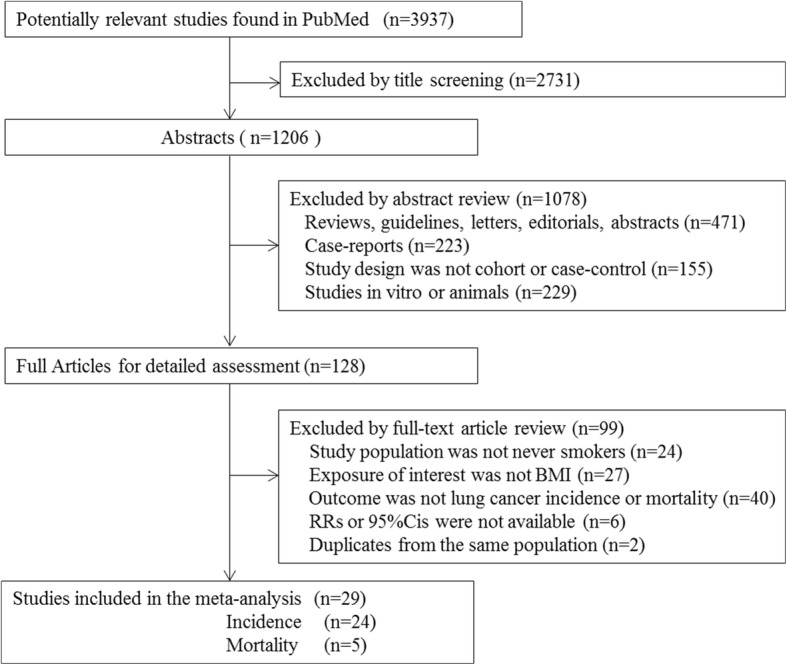
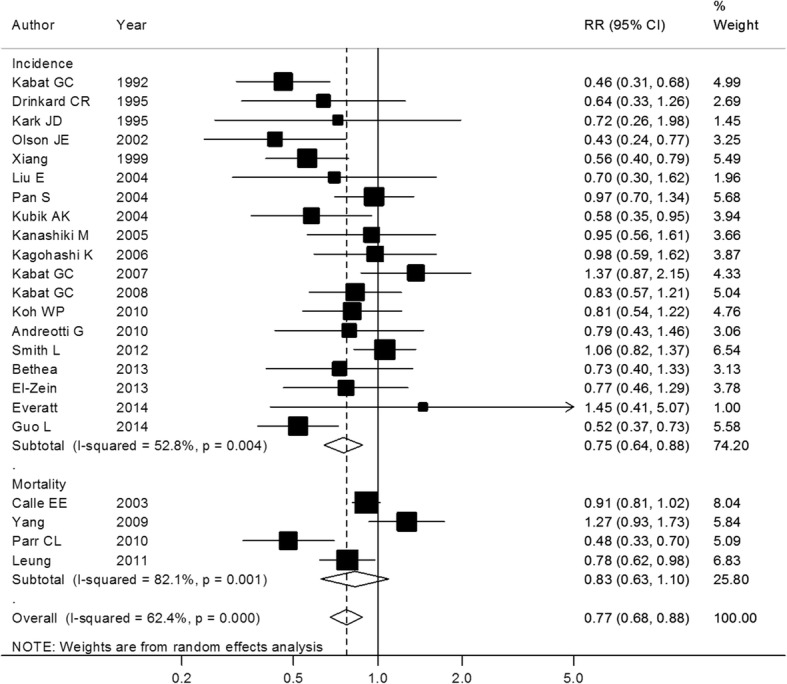
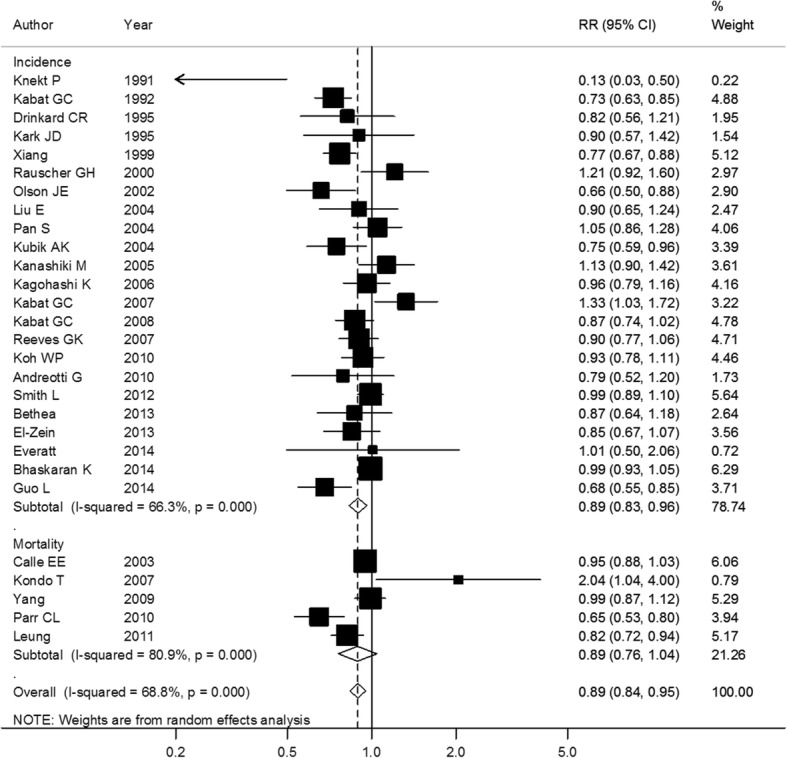
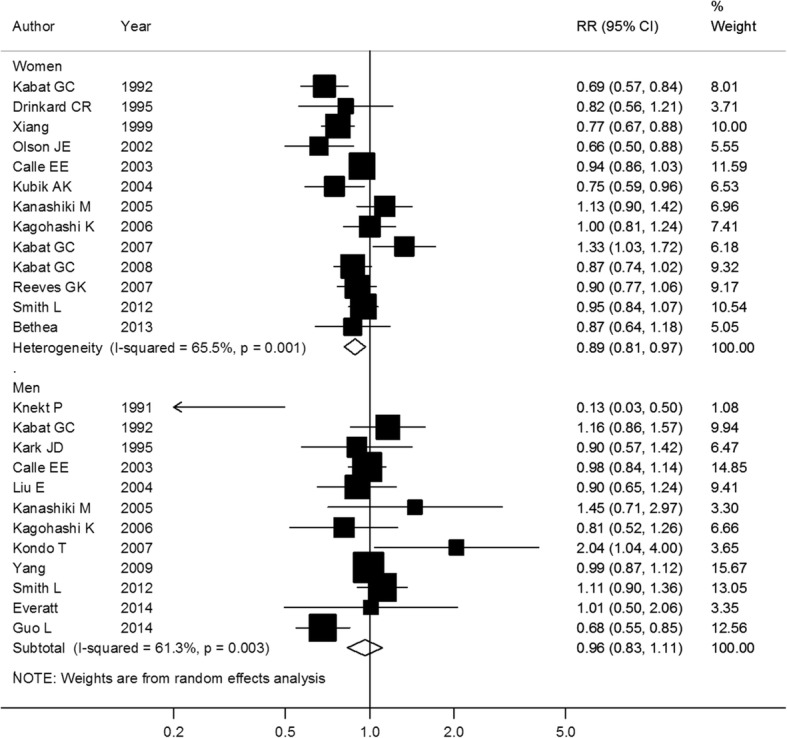
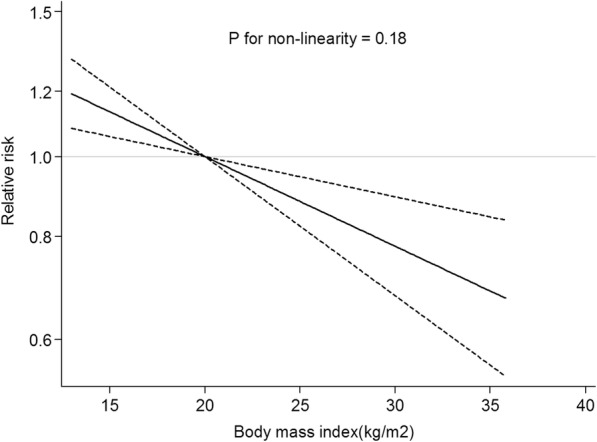
Obesity is found to increase the risk of most cancer types, but reduce lung cancer risk in many studies. However, the association between obesity and lung cancer is still controversial, mainly owing to the confounding effect of smoking. Eligible studies were identified from electric databases to July 1, 2017. Relevant data were extracted and pooled using random-effects models; dose-response and subgroup analyses were also performed. Twenty-nine studies with more than 10,000 lung cancer cases in15 million never smokers were included. Compared with normal weight, the summary relative risk (RR) was 0.77(95% confidence interval [CI]: 0.68–0.88, P < 0.01) for excess body weight (body mass index [BMI] ≥ 25 kg/m 2 ). An inverse linear dose-response relationship was observed between BMI and lung cancer risk in never smokers, with an RR of 0.89(95% CI: 0.84–0.95, P < 0.01) per 5 kg/m 2 increment in BMI. The results remained stable in most subgroup analyses. However, when stratified by sex, a significant inverse association existed in women but not in men. Similar results were found in analyses for other categories of BMI. Our results indicate that higher BMI is associated with lower lung cancer risk in never smokers.
Overview
The claims and statistics of this paper haven’t been checked yet.
Free: it reads the open-access text and checks the first 5 claims that cite a source we can check. Create a free account to check every claim.
Integrity signals
Registry
Cites
Statistics
Figures
Verification
Claims the paper makes
The claims and statistics of this paper haven’t been checked yet.
Free: it reads the open-access text and checks the first 5 claims that cite a source we can check. Create a free account to check every claim.
Claims other papers make about this one
Each is checked against this paper’s own text: does it say what the citing paper says it does?
The source backs part of the claim, not all of it — or backs it for a different population, condition or comparison.
In the citing paper
“Persons who are overweight (>25 kg/m2) or obese (>30 kg/m2) may have an increased risk of a variety of cancers, although risk may be modified by age, sex, race, menopausal status, duration of obesity, anthropomorphic distribution of adiposity, and the presence of additional metabolic syndrome components.1730,1732–1738”
From American Association of Clinical Endocrinology Clinical Practice Guideline: Developing a Diabetes Mellitus Comprehensive Care Plan-2022 Update. (2022) · cites this paper as [1738]
Experimental — accuracy not yet measured
Self-check
Percentages, sums and reported differences re-computed from the paper’s own numbers.
The self-check needs the paper’s full text.
Citations
Cites
Measuring inconsistency in meta-analyses
Higgins, J. P. T., Thompson, S. G., Deeks, J. J., & Altman, D. G. (2003) · BMJ · doi:10.1136/bmj.327.7414.557 · Cited by 63,139
Siegel, R. L., Miller, K. D., & Jemal, A. (2016) · CA: A Cancer Journal for Clinicians · doi:10.3322/caac.21332 · Cited by 16,003
Prospective Studies Collaboration (2009) · The Lancet · doi:10.1016/s0140-6736(09)60318-4 · Cited by 4,807
Methods for Trend Estimation from Summarized Dose-Response Data, with Applications to Meta-Analysis
Greenland, S., & Longnecker, M. P. (1992) · American Journal of Epidemiology · doi:10.1093/oxfordjournals.aje.a116237 · Cited by 2,353 · cited 4×
“Only studies that reported RRs with 95% CIs for at least 3categories were included into the dose-response analysis using the method proposed by Greenland [21] and Orsiniet al. [22].”
MethodInfluentialBhaskaran, K., Douglas, I., Forbes, H., dos-Santos-Silva, I., Leon, D. A., & Smeeth, L. (2014) · The Lancet · doi:10.1016/s0140-6736(14)60892-8 · Cited by 1,707 · cited 1×
“Previous studies reported that obesity was associated with a lower risk of certain cancer types, particularly smoking related-cancers [2, 11, 12, 31].”
BackgroundReeves, G. K., Pirie, K., Beral, V., Green, J., Spencer, E., & Bull, D. (2007) · BMJ · doi:10.1136/bmj.39367.495995.ae · Cited by 1,507
Generalized Least Squares for Trend Estimation of Summarized Dose–response Data
Orsini, N., Bellocco, R., & Greenland, S. (2006) · The Stata Journal: Promoting communications on statistics and Stata · doi:10.1177/1536867x0600600103 · Cited by 1,241 · cited 1×
“To compute the study-specific slope from the correlated log RR estimates across BMI levels, a two-stage generalized least-squares method with fractional-polynomial regression models was employed [22].”
MethodObesity and Cancer Mechanisms: Tumor Microenvironment and Inflammation
Iyengar, N. M., Gucalp, A., Dannenberg, A. J., & Hudis, C. A. (2016) · Journal of Clinical Oncology · doi:10.1200/jco.2016.67.4283 · Cited by 1,004 · cited 1×
“Paradoxically, systemic inflammation, which might increase lung cancer risk [33], is also closely associated with obesity [34].”
BackgroundHamling, J., Lee, P., Weitkunat, R., & Ambühl, M. (2008) · Statistics in Medicine · doi:10.1002/sim.3013 · Cited by 651
Loft, S., Vistisen, K., Ewertz, M., Tjønneland, A., Overvad, K., & Poulsen, H. E. (1992) · Carcinogenesis · doi:10.1093/carcin/13.12.2241 · Cited by 642
Cited by
Bade, B. C., & Dela Cruz, C. S. (2020) · Clinics in Chest Medicine · doi:10.1016/j.ccm.2019.10.001 · Cited by 1,911
Cancer Progress and Priorities: Lung Cancer
Schabath, M. B., & Cote, M. L. (2019) · Cancer Epidemiology, Biomarkers & Prevention · doi:10.1158/1055-9965.epi-19-0221 · Cited by 1,160
Blonde, L., Umpierrez, G. E., Reddy, S. S., McGill, J. B., Berga, S. L., Bush, M., Chandrasekaran, S., DeFronzo, R. A., Einhorn, D., Galindo, R. J., et al. (2022) · Endocrine Practice · doi:10.1016/j.eprac.2022.08.002 · Cited by 507
Li, M.-Y., Liu, L.-Z., & Dong, M. (2021) · Molecular Cancer · doi:10.1186/s12943-021-01312-y · Cited by 215
“77 for excess body weight with a BMI of 25 kg/m(2) or greater [32], while underweight is associated with lower lung cancer risk in a nonlinear, inverted U-shaped relationship [33].”
BackgroundShepshelovich, D., Xu, W., Lü, L., Fares, A. F., Yang, P., Christiani, D. C., Zhang, J., Shiraishi, K., Ryan, B. M., Chen, C., et al. (2019) · Journal of Thoracic Oncology · doi:10.1016/j.jtho.2019.05.031 · Cited by 140
Leptin: A Heavyweight Player in Obesity-Related Cancers
Caruso, A., Gelsomino, L., Panza, S., Accattatis, F. M., Naimo, G. D., Barone, I., Giordano, C., Catalano, S., & Andò, S. (2023) · Biomolecules · doi:10.3390/biom13071084 · Cited by 74
DeRouen, M. C., Canchola, A. J., Thompson, C. A., Jin, A., Nie, S., Wong, C., Lichtensztajn, D. Y., Allen, L., Patel, M. I., Daida, Y. G., et al. (2021) · JNCI Journal of the National Cancer Institute · doi:10.1093/jnci/djab143 · Cited by 57
Predicting Lung Cancer Occurrence in Never-Smoking Females in Asia: TNSF-SQ, a Prediction Model
Chien, L.-H., Chen, C.-H., Chen, T.-Y., Chang, G., Tsai, Y., Hsiao, C., Chen, K.-Y., Su, W., Wang, W., Huang, M., et al. (2019) · Cancer Epidemiology Biomarkers & Prevention · doi:10.1158/1055-9965.epi-19-1221 · Cited by 57
Parra-Soto, S. L., Cowley, E. S., Rezende, L. F. M., Ferreccio, C., Mathers, J. C., Pell, J. P., Ho, F. K. W., & Celis-Morales, C. A. (2021) · BMC Medicine · doi:10.1186/s12916-020-01848-8 · Cited by 64
“These disagree with a recent meta-analysis with considerable statistical power, which pooled data from 29 observational studies, including 15 million never smokers, where BMI was inversely associated with lung cancer [40].”
ResultPredicted lean body mass, fat mass and risk of lung cancer: prospective US cohort study
Jeong, S.-M., Lee, D. H., & Giovannucci, E. L. (2019) · European Journal of Epidemiology · doi:10.1007/s10654-019-00587-2 · Cited by 47
Obesity Paradox in Lung Diseases: What Explains It?
Yao, S., Zeng, L., Wang, F., & Chen, K. (2023) · Obesity Facts · doi:10.1159/000531792 · Cited by 49
“…showed that obesity protected both men and women from pneumonia and CAP [9, 12, 156, 157], whereas the studies conducted by Kornum et al. [155] and Phung et al. [158] showed the obesity-reduced risk of pneumonia among women, not men, which is also observed in the patients with lung cancer [159].”
BackgroundResultObesity and lung cancer—a narrative review
Vedire, Y., Kalvapudi, S., & Yendamuri, S. (2023) · Journal of Thoracic Disease · doi:10.21037/jtd-22-1835 · Cited by 45
“Confounding by smoking and reverse causation due to pretreatment weight change are frequently used explanations to explain the obesity paradox (8,26,28).”
InfluentialThe Obesity Paradox in Lung Cancer: Associations With Body Size Versus Body Shape
Ardesch, F. H., Ruiter, R., Mulder, M., Lahousse, L., Stricker, B. H. C., & Jong, J. C. K. (2020) · Frontiers in Oncology · doi:10.3389/fonc.2020.591110 · Cited by 41
“Previous studies showed that obesity is unbeneficial for developing lung cancer (20, 38), which could flattened the BMI-lung cancer curve for this group in our population.”
BackgroundResultLiu, J., Wang, R., Tan, S., Zhao, X., & Hou, A. (2024) · Diabetology & Metabolic Syndrome · doi:10.1186/s13098-024-01308-w · Cited by 35
Lung cancer and obesity: A contentious relationship (Review)
Georgakopoulou, V., Lempesis, I. G., Τράκας, Ν., Sklapani, P., He, Y., & Spandidos, D. A. (2024) · Oncology Reports · doi:10.3892/or.2024.8817 · Cited by 37
“By contrast, recent studies and meta‑analyses have shown that a high BMI is an independent predictor of lower lung cancer risk, improved treatment outcomes and longer overall survival (OS) (17,19,20).”
ResultGlobal burden of common cancers attributable to metabolic risks from 1990 to 2019
Xing, Q.-Q., Li, J.-M., Chen, Z., Lin, X.-Y., You, Y.-Y., Hong, M., Weng, S., & Pan, J. (2023) · Med · doi:10.1016/j.medj.2023.02.002 · Cited by 34
Parra-Soto, S. L., Petermann-Rocha, F. E., Boonpor, J., Gray, S. R., Pell, J. P., Celis-Morales, C. A., & Ho, F. K. W. (2020) · American Journal of Clinical Nutrition · doi:10.1093/ajcn/nqaa335 · Cited by 32
Nakharutai, N., Traisathit, P., Thongsak, N., Supasri, T., Srikummoon, P., Thumronglaohapun, S., Hemwan, P., & Chitapanarux, I. (2022) · International Journal of Environmental Research and Public Health · doi:10.3390/ijerph19084521 · Cited by 31
“Other characteristics related to the mortality of lung cancer are sex (men have a higher risk than women) [7,12], age (a higher risk with increasing age) [7,10,11], body mass index (being overweight is riskier) [13,14], family history [8,10], and cancer stage [7,15].”
BackgroundAdiposity and cancer: systematic review and meta-analysis
Watts, E. L., Gonzalez‐Feliciano, A. G., Gunter, M. J., Chatterjee, N., & Moore, S. C. (2026) · Nature Metabolism · doi:10.1038/s42255-026-01542-8 · Cited by 27
“Consequently, some studies suggest a protective effect of adiposity 42–45 , while others attribute these associations to incomplete adjustment for smoking 14,41,46–50 .”
Role of Omentin in Obesity Paradox in Lung Cancer
Parida, S., Siddharth, S., & Sharma, D. (2021) · Cancers · doi:10.3390/cancers13020275 · Cited by 28
Biegański, H. M., Dąbrowski, K. M., & Różańska-Walędziak, A. M. (2025) · Biomedicines · doi:10.3390/biomedicines13030632 · Cited by 22
“An interesting deviation from this rule is lung cancer, in which obesity reduces the risk of the disease and even improves prognosis among affected patients [75].”
Yeo, Y., Shin, D. W., Han, K., Park, S. H., Jeon, K. H., Lee, J., Kim, J., & Shin, A. (2021) · Cancers · doi:10.3390/cancers13143496 · Cited by 19
“reported that an inverse linear dose-response relationship was observed between BMI and lung cancer risk in never smokers [47].”
BackgroundSchussler, O., Bobbio, A., Dermine, H., Mansuet‐Lupo, A., Damotte, D., Lecarpentier, Y., & Alifano, M. (2022) · Cancers · doi:10.3390/cancers14040874 · Cited by 17
Gomez, S. L., DeRouen, M. C., Chen, M. S., Wakelee, H. A., Velotta, J. B., Sakoda, L. C., Shariff‐Marco, S., Reynolds, P., & Cheng, I. C. (2024) · JNCI Journal of the National Cancer Institute · doi:10.1093/jnci/djae299 · Cited by 18
Chei, C., Sawada, N., Khankari, N. K., Iwasaki, M., Yamaji, T., Cai, H., Shimazu, T., Inoue, M., Shu, X., Zheng, W., et al. (2022) · European Journal of Nutrition · doi:10.1007/s00394-022-02968-y · Cited by 16
Racial difference in BMI and lung cancer diagnosis: analysis of the National Lung Screening Trial
Zhao, J. L., Barta, J. A., McIntire, R. K., Shusted, C. S., Zeigler-Johnson, C. M., & Juon, H. (2022) · BMC Cancer · doi:10.1186/s12885-022-09888-4 · Cited by 15
“More specifically, among current or former smokers, overweight or obese patients may have decreased risk of lung cancer [9, 10, 13].”
BackgroundQayyum, M. A., Farooq, Z., Yaseen, M. W., Mahmood, M. H., Irfan, A., Zafar, M. N., MUDDASSIR, K. M., Naeem, K., & Kısa, D. (2019) · Biological Trace Element Research · doi:10.1007/s12011-019-01998-8 · Cited by 14
“Also, BMI has been found to be unrelated with the risk of LC, so, the true relationship between BMI and LC risk remains to be clarified [21].”
BackgroundInfluentialEvaluating risk factors for lung cancer among never-smoking individuals using two Australian studies
Cheng, E. S., Weber, M. F., Steinberg, J., Canfell, K., & Yu, X. Q. (2022) · Journal of Cancer Research and Clinical Oncology · doi:10.1007/s00432-022-04043-9 · Cited by 14
“The two groups had very similar distributions for the variables of Asian country of birth, family history of lung cancer, BMI, alcohol consumption, diabetes and parity, and were broadly comparable in SEIFA, highest educational level and use of MHT.”
BackgroundInfluentialCancer in Ecuadorian subjects with Laron syndrome (ELS)
Guevara‐Aguirre, J., Peña, G., Pazmiño, G., Acosta, W., Saavedra, J., Lescano, D., Guevara, A., & Gavilanes, A. W. D. (2023) · Endocrine Related Cancer · doi:10.1530/erc-22-0389 · Cited by 12
The Prognostic Impact of Pericardial Fat Volumes in Resected Non-small Cell Lung Cancer
Shinohara, S., Otsuki, R., KOBAYASHI, K. P., Matsuo, M., Harada, K., Sugaya, M., & Nakagawa, M. (2019) · Annals of Surgical Oncology · doi:10.1245/s10434-019-07703-2 · Cited by 12
Lee, J. S., Martin-Schwarze, A. M., Freiheit, E., Trzaskoma, B., & Burg, C. (2022) · Advances in Therapy · doi:10.1007/s12325-022-02382-0 · Cited by 10
Jiang, L., Sun, Y., Brumpton, B. M., Langhammer, A., Chen, Y., & Mai, X. (2022) · BMC Cancer · doi:10.1186/s12885-022-10215-0 · Cited by 12
“On the other hand, the measurements of BMI in most observational studies are attained at one time point [1, 2, 8, 9].”
BackgroundImani, P., Grigoryan, H., Dudoit, S., Shu, X., Wong, J. Y. Y., Zhang, L., Zhang, J. J., Hu, W., Cai, Q., Gao, Y., et al. (2025) · Antioxidants · doi:10.3390/antiox14030335 · Cited by 9
“This reflects the significantly lower values of BMI in cases here (Table 1) and in the literature [38].”
InfluentialTargeting the molecular crosstalk between diabetes and lung cancer for therapeutic intervention
Azani, A., Avval, N. A., Meigoli, M. S. S., Imankhan, M., Asgari, P., Ebrahimisaraj, G., Morovatshoar, R., Hosseini, A. M., Mirzohreh, S., Nouri, M., et al. (2025) · Discover Oncology · doi:10.1007/s12672-025-03264-x · Cited by 8
“In parallel, Zhu et al.‘s meta-analysis unveiled an inverse correlation between BMI and lung cancer risk within a cohort of 15,000,000 never smokers [42].”
Wu, H., Yang, J., Wang, H., & Li, L. (2023) · Frontiers in Oncology · doi:10.3389/fonc.2023.1143059 · Cited by 9
Lung cancer in non-smoking women (LCINSW): from risk factors to precision therapy
Zhao, J., Li, M., Niu, L., Zhao, Y., & Song, X. (2025) · Cancer and Metastasis Reviews · doi:10.1007/s10555-025-10289-9 · Cited by 7
“In never smokers, each 5 kg/ m 2 increase in BMI corresponds to an approximately 11% lower risk of lung cancer, with a greater protective effect in women than in men [23].”
Research on lung cancer and its funding, 2004–2018
Begum, M., Urquhart, I., Lewison, G., Fouad, F. M., & Sullivan, R. J. (2020) · ecancermedicalscience · doi:10.3332/ecancer.2020.1132 · Cited by 7
“Other factors are residential radon [5], chronic obstructive pulmonary disease [6] and being underweight [7].”
BackgroundLung cancer incidence differences in migrant men in Belgium, 2004–2013: histology-specific analyses
Vanthomme, K., Rosskamp, M., Schutter, H. D., & Vandenheede, H. (2021) · BMC Cancer · doi:10.1186/s12885-021-08038-6 · Cited by 8
Mariean, C. R., Tiucă, O. M., Mariean, A., Szekely, T.-B., Niculescu, R., Sabău, A.-H., Al-Akel, C. F., & Cotoi, O. S. (2025) · Journal of Clinical Medicine · doi:10.3390/jcm14093038 · Cited by 6
Hsu, R. C., Chen, D., Xia, B., Feldman, R. A., Cozen, W., Raez, L. E., Borghaei, H., Kim, C., Nagasaka, M., Mamdani, H. M., et al. (2023) · Frontiers in Oncology · doi:10.3389/fonc.2023.1215524 · Cited by 5
Thoracic CT imaging in obesity: Technical challenges, imaging findings and future outlook
Suwathep, P., Sheeka, A., & Copley, S. J. (2024) · Meta-Radiology · doi:10.1016/j.metrad.2024.100100 · Cited by 4
Hadaegh, F., Asgari, S., Hashemi, P., Baghbani‐Oskouei, A., Eskandari, F., Azizi, F., & Tohidi, M. (2020) · Public Health · doi:10.1016/j.puhe.2020.01.003 · Cited by 4
Obesity Promotes Lung Carcinogenesis Through Airway Immune Dysfunction
Barbi, J. J., Smith, R. J., Vedire, Y., Washington, D., Zollo, R. A., Kalvapudi, S., Pachimatla, A. G., Lee, M., Liu, G., Liu, H., et al. (2026) · Journal of Thoracic Oncology · doi:10.1016/j.jtho.2026.104066 · Cited by 3
External lung cancer risk factors in non-smokers
Venclíček, O. (2020) · Onkologie · doi:10.36290/xon.2020.005 · Cited by 2
Cancer: Epidemiology of lung cancer
Alberg, A. J., Gupta, R. D., & Akonde, M. (2022) · Elsevier eBooks · doi:10.1016/b978-0-12-821848-8.00187-6 · Cited by 2
Gupta, R., Merchant, A. T., McDonnell, K. K., Akonde, M., Zhao, L., Zhang, J., & Alberg, A. J. (2026) · Cancer Causes & Control · doi:10.1007/s10552-026-02143-2 · Cited by 1
Hawwash, N. K., Sperrin, M., Martin, G. P., Sinha, R., Matthews, C. E., Schulze, M. B., Hiensch, A. E., Amiano, P., Neuhouser, M., Joshu, C. E., et al. (2026) · International Journal of Cancer · doi:10.1002/ijc.70464 · Cited by 1
“A meta-analysis of 29 studies showed an inverse association between BMI and lung cancer risk in never smokers [31].”
Güzel, K., Ocak, Ö. K., Ergenç, H., Ergenç, Z., & Gökosmanoğlu, F. (2021) · Obesity Surgery · doi:10.1007/s11695-021-05747-6 · Cited by 1
Wu, T., Ma, X., Zuo, P., Chen, S., Tang, X., Zhang, X., & Hou, E. (2025) · Medicine · doi:10.1097/md.0000000000045357 · Cited by 1
“[31,32] Concerning lung cancer histology and obesity, studies have shown a decrease in the frequency of adenocarcinoma and squamous cell carcinoma with increasing BMI.”
Rusmaully, J. (2021) · theses.fr (ABES) · doi:10.70675/429390c2z2ebez44fczbd20ze3168ba221a8 · Cited by 1
Flegal, K. M. (2019) · Journal of Thoracic Disease · doi:10.21037/jtd.2019.03.85
Chiang, H., Chang, P., Chang, T., Chen, K.-H., Liu, Y., Li, H., Chou, S., & Chang, Y. (2023) · Journal of Personalized Medicine · doi:10.3390/jpm13030497
“Body mass index (BMI) is a common and useful parameter for population-based studies, including cardiovascular accidents, diabetes mellitus, and other metabolic related diseases [7].”
BackgroundNeutrophil–Lymphocyte and Platelet–Lymphocyte Ratios are Predictors of Lung Malignancy
Sutanto, Y. S., Rudianor, M., Aphridasari, J., & Kurniawan, H. (2024) · Journal of Biomedicine and Translational Research · doi:10.14710/jbtr.v10i2.20330
“In 2018, Zhu et al. 18 reported that high BMI was associated with a low risk of lung cancer.”
BackgroundHasan, A. A., Hussoon, S. M., AL.Qassab, T., & Mohammed, R. M. (2024) · South Eastern European Journal of Public Health · doi:10.70135/seejph.vi.1440
Li, K., Yang, Z., Li, H., & Yan, C. (2025) · Food Science & Nutrition · doi:10.1002/fsn3.70918
Jiang, L., Sun, Y.-Q., Brumpton, B. M., Langhammer, A., Chen, Y., & Mai, X.-M. (2022) · Figshare · doi:10.6084/m9.figshare.21522071
Liu, J., Wang, R., Tan, S., Zhao, X., & Hou, A. (2024) · Figshare · doi:10.6084/m9.figshare.26691607
Parra-Soto, S. L., Cowley, E. S., Rezende, L. F. M., Catterina Ferreccio, R., Mathers, J. C., Pell, J. P., Ho, F. K., & Celis-Morales, C. (2021) · Figshare · doi:10.6084/m9.figshare.13552017
Statistical Methods for Uncovering the Role of the Exposome in Complex Disease Risk
Imani, P. (2024) · eScholarship (California Digital Library)
Female-specific risk factors for lung cancer: insights from the All of Us Research Program
Islam, M., Siddiqua, S. M., Islam, H., Shahriar, H., Chowdhury, M. A. H., Tasmin, S., Konda, S., & Ahsan, H. (2026) · BMC Public Health · doi:10.1186/s12889-026-27269-5
“This observation aligns with previous studies describing the “obesity paradox” in lung cancer, where higher BMI may offer a survival advantage or lower risk, despite traditional assumptions about obesity and health risk [24–27].”
Development and Validation of Lung Cancer Risk Prediction Models in the Singapore Chinese Population
Juang, Y. R., Chen, W., Ng, A. J. H., Sim, X., Lim, D. W.-T., Yuan, J.-M., Seow, A., & Seow, W. J. (2026) · Clinical Lung Cancer · doi:10.1016/j.cllc.2026.04.014
Fractions and number of cancer cases attributable to excess body fat in South Korea
Lee, D., Kim, B., Jung, K., Nam, G. E., Rhee, S. Y., Kim, S. P., Cho, H., Cho, I. Y., Han, K., & Shin, D. W. (2026) · International Journal of Epidemiology · doi:10.1093/ije/dyag119
Healthy lifestyle and cancer risk: a pan-cancer analysis in the UK Biobank prospective cohort
Ding, J., Schöttker, B., Brenner, H., & Hoffmeister, M. (2026) · British Journal of Cancer · doi:10.1038/s41416-026-03613-9
Mok, T. S. K., Finley, C., Köksal, D., Li, M. S. C., Shum, E., Velotta, J. B., & Yang, P.-C. (2026) · Lung Cancer Management · doi:10.1080/17581966.2026.2743569
Obesity and Cancer Risk in Young Adults in Korea: A Nationwide Health Screening Cohort Study
Yun, J., Mun, H., Jung, J., Park, Y. B., Kim, S. Y., Kim, K., Ko, S., Ahn, Y., Kwon, H., Han, K., et al. (2026) · Annals of Internal Medicine · doi:10.7326/annals-25-02612
Metadata
- Authors
- Zhu, H., & Zhang, S.
- Affiliations
- Shangqiu First People's Hospital (CN)
- First Affiliated Hospital of Henan University (CN)
- Corresponding author
- Zhang, Shuanglin
- Venue
- BMC Cancer
- Published
- 2018-06-05
- Volume
- 18
- Issue
- 1
- Pages
- 635-635
- ISSN
- 1471-2407 (ISSN-L)
- PMC
- PMC5987408
- OpenAlex
- W2806726236
- Cited by
- 61
- References
- 35
- Citations by year
- 2026: 9 · 2025: 6 · 2024: 6 · 2023: 8 · 2022: 10 · 2021: 9 · 2020: 6 · 2019: 7
- FWCI
- 0.57
- Type
- journal article
- Language
- en
- Open access
- gold
- doi.org
- Licence
- cc-by
- creativecommons.org/licenses/by/4.0/ (tdm)
- Locations
- BMC Cancer (publishedVersion, cc-by)
- Europe PMC (PubMed Central) (publishedVersion, cc-by)
- PubMed Central (publishedVersion, cc-by)
- PubMed (publishedVersion)
- DOAJ (DOAJ: Directory of Open Access Journals) (submittedVersion, cc-by-sa)
- Topics
- Health Sciences › Medicine › Oncology › Cancer Risks and Factors
- Health Sciences › Medicine › Public Health, Environmental and Occupational Health › Obesity, Physical Activity, Diet
- Health Sciences › Medicine › Pulmonary and Respiratory Medicine › Lung Cancer Diagnosis and Treatment
- Keywords
- body mass index, lung cancer risk, never smokers, obesity, overweight, sex differences, dose-response relationship, smoking confounding
- MeSH terms
- Smokers, Humans, Lung Neoplasms, Obesity, Risk Factors, Body Mass Index
About these checks
Registry, retraction, Cites and statistics results are computed, not judged, with one exception: a printed reference that no index lists is read once by a model before it counts as a citation error. Claims are extracted by a model and kept only when their quote appears verbatim in the text; each cited source is then checked, with a model’s help, for whether it says what the claim relies on. Those verdicts can be wrong — read the claim’s quote and the cited source before relying on one.
Statistics and arithmetic are recomputed, not judged.
Confidence bands are shown only for fields calibrated on our annotated test set. None is calibrated yet, so no band is shown.
What counts as a claim ›How we measure confidence ›How we check this ›
Are you an author, or do you see a problem with this page? Request a review
Data sources
Bibliographic data: Semantic Scholar, OpenAlex, Crossref.
Contains information from the Semantic Scholar Academic Graph Datasets, made available under the ODC Attribution License (ODC-BY 1.0).
Semantic Scholar’s data is described in: Kinney, R., et al. (2023). The Semantic Scholar Open Data Platform. arXiv:2301.10140.
