

Body mass index and lung cancer risk in never smokers: a meta-analysis
Open accessThe DOI matches its Crossref record; 35 of the 35 references it cites were found in a registry or an index.
Abstract
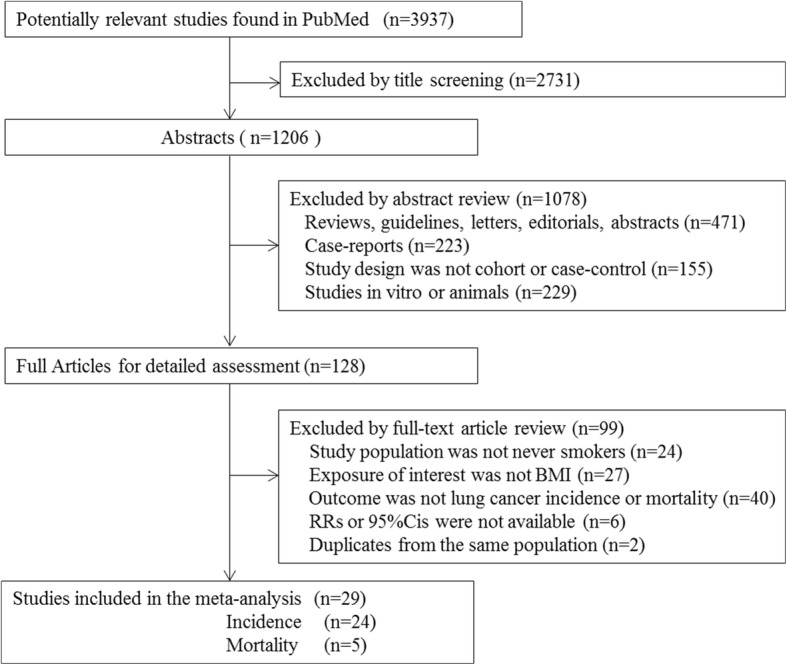
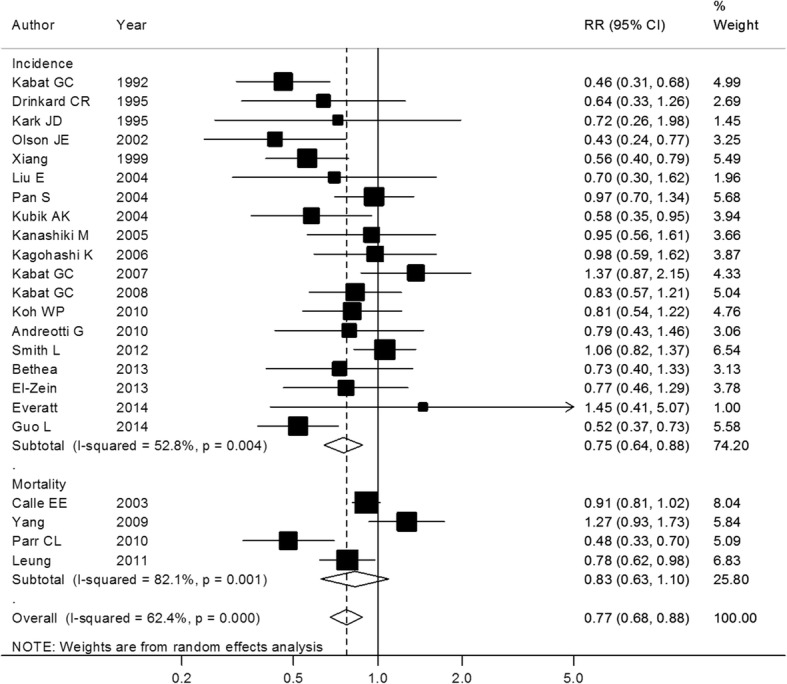
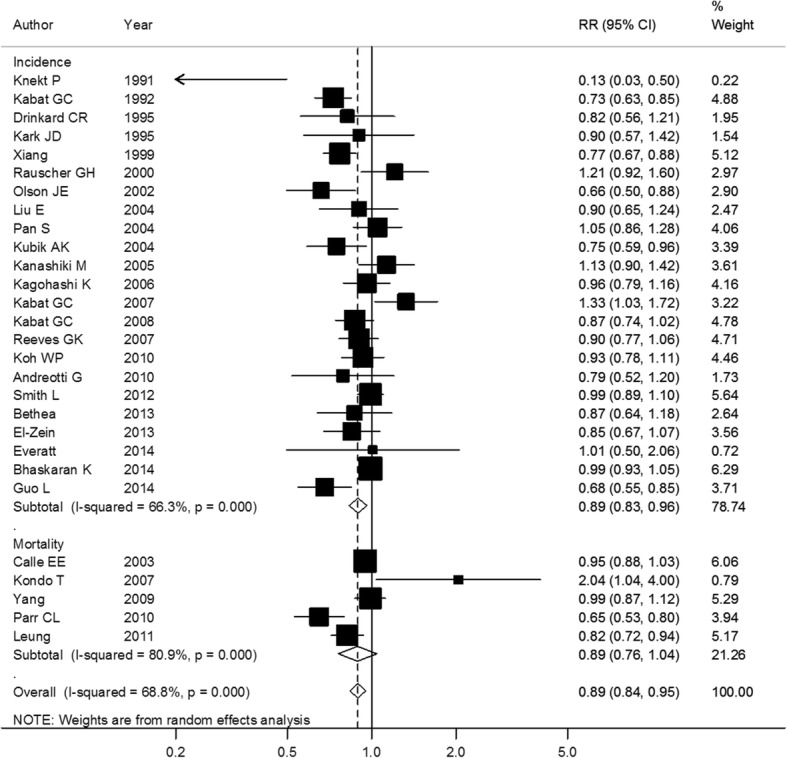
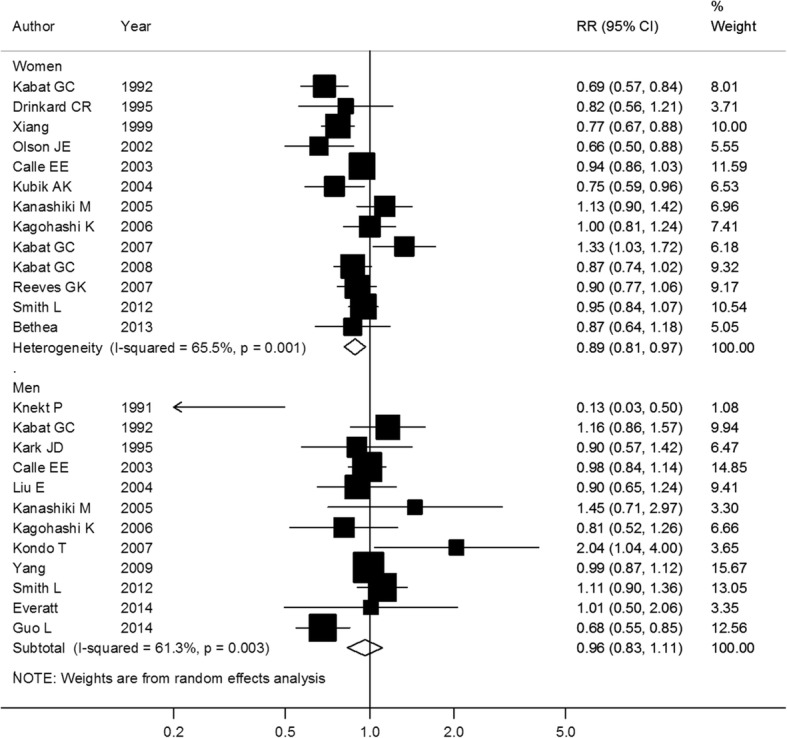
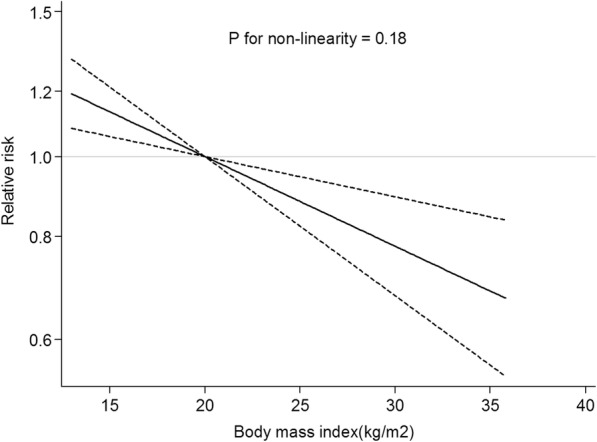
Obesity is found to increase the risk of most cancer types, but reduce lung cancer risk in many studies. However, the association between obesity and lung cancer is still controversial, mainly owing to the confounding effect of smoking. Eligible studies were identified from electric databases to July 1, 2017. Relevant data were extracted and pooled using random-effects models; dose-response and subgroup analyses were also performed. Twenty-nine studies with more than 10,000 lung cancer cases in15 million never smokers were included. Compared with normal weight, the summary relative risk (RR) was 0.77(95% confidence interval [CI]: 0.68–0.88, P < 0.01) for excess body weight (body mass index [BMI] ≥ 25 kg/m 2 ). An inverse linear dose-response relationship was observed between BMI and lung cancer risk in never smokers, with an RR of 0.89(95% CI: 0.84–0.95, P < 0.01) per 5 kg/m 2 increment in BMI. The results remained stable in most subgroup analyses. However, when stratified by sex, a significant inverse association existed in women but not in men. Similar results were found in analyses for other categories of BMI. Our results indicate that higher BMI is associated with lower lung cancer risk in never smokers.
Overview
The claims and statistics of this paper haven’t been checked yet.
Free: it reads the open-access text and checks the first 5 claims that cite a source we can check. Create a free account to check every claim.
Integrity signals
Registry
Cites
Statistics
Figures
Verification
Claims the paper makes
The claims and statistics of this paper haven’t been checked yet.
Free: it reads the open-access text and checks the first 5 claims that cite a source we can check. Create a free account to check every claim.
Claims other papers make about this one
Each is checked against this paper’s own text: does it say what the citing paper says it does?
The source backs part of the claim, not all of it — or backs it for a different population, condition or comparison.
In the citing paper
“Persons who are overweight (>25 kg/m2) or obese (>30 kg/m2) may have an increased risk of a variety of cancers, although risk may be modified by age, sex, race, menopausal status, duration of obesity, anthropomorphic distribution of adiposity, and the presence of additional metabolic syndrome components.1730,1732–1738”
From American Association of Clinical Endocrinology Clinical Practice Guideline: Developing a Diabetes Mellitus Comprehensive Care Plan-2022 Update. (2022) · cites this paper as [1738]
Experimental — accuracy not yet measured
Self-check
Percentages, sums and reported differences re-computed from the paper’s own numbers.
The self-check needs the paper’s full text.
Citations
Cites
Measuring inconsistency in meta-analyses
Higgins, J. P. T., Thompson, S. G., Deeks, J. J., & Altman, D. G. (2003) · BMJ · doi:10.1136/bmj.327.7414.557 · Cited by 63,139
Siegel, R. L., Miller, K. D., & Jemal, A. (2016) · CA: A Cancer Journal for Clinicians · doi:10.3322/caac.21332 · Cited by 16,003
Prospective Studies Collaboration (2009) · The Lancet · doi:10.1016/s0140-6736(09)60318-4 · Cited by 4,807
Methods for Trend Estimation from Summarized Dose-Response Data, with Applications to Meta-Analysis
Greenland, S., & Longnecker, M. P. (1992) · American Journal of Epidemiology · doi:10.1093/oxfordjournals.aje.a116237 · Cited by 2,353 · cited 4×
“Only studies that reported RRs with 95% CIs for at least 3categories were included into the dose-response analysis using the method proposed by Greenland [21] and Orsiniet al. [22].”
MethodInfluentialBhaskaran, K., Douglas, I., Forbes, H., dos-Santos-Silva, I., Leon, D. A., & Smeeth, L. (2014) · The Lancet · doi:10.1016/s0140-6736(14)60892-8 · Cited by 1,707 · cited 1×
“Previous studies reported that obesity was associated with a lower risk of certain cancer types, particularly smoking related-cancers [2, 11, 12, 31].”
BackgroundReeves, G. K., Pirie, K., Beral, V., Green, J., Spencer, E., & Bull, D. (2007) · BMJ · doi:10.1136/bmj.39367.495995.ae · Cited by 1,507
Generalized Least Squares for Trend Estimation of Summarized Dose–response Data
Orsini, N., Bellocco, R., & Greenland, S. (2006) · The Stata Journal: Promoting communications on statistics and Stata · doi:10.1177/1536867x0600600103 · Cited by 1,241 · cited 1×
“To compute the study-specific slope from the correlated log RR estimates across BMI levels, a two-stage generalized least-squares method with fractional-polynomial regression models was employed [22].”
MethodObesity and Cancer Mechanisms: Tumor Microenvironment and Inflammation
Iyengar, N. M., Gucalp, A., Dannenberg, A. J., & Hudis, C. A. (2016) · Journal of Clinical Oncology · doi:10.1200/jco.2016.67.4283 · Cited by 1,004 · cited 1×
“Paradoxically, systemic inflammation, which might increase lung cancer risk [33], is also closely associated with obesity [34].”
BackgroundHamling, J., Lee, P., Weitkunat, R., & Ambühl, M. (2008) · Statistics in Medicine · doi:10.1002/sim.3013 · Cited by 651
Loft, S., Vistisen, K., Ewertz, M., Tjønneland, A., Overvad, K., & Poulsen, H. E. (1992) · Carcinogenesis · doi:10.1093/carcin/13.12.2241 · Cited by 642
American Society of Clinical Oncology Position Statement on Obesity and Cancer
Ligibel, J. A., Alfano, C. M., Courneya, K. S., Demark-Wahnefried, W., Burger, R. A., Chlebowski, R. T., Fabian, C. J., Gucalp, A., Hershman, D. L., Hudson, M. M., et al. (2014) · Journal of Clinical Oncology · doi:10.1200/jco.2014.58.4680 · Cited by 526
IL-7-Induced Glycerol Transport and TAG Synthesis Promotes Memory CD8+ T Cell Longevity
Cui, G., Staron, M. M., Gray, S. M., Ho, P.-C., Amezquita, R. A., Wu, J., & Kaech, S. M. (2015) · Cell · doi:10.1016/j.cell.2015.03.021 · Cited by 324 · cited 1×
“Some studies also suggested that adipose tissue was helpful to keep the memory of CD8 T cells to maintain normal immune functions [32].”
BackgroundInflammation in the development of lung cancer: epidemiological evidence
Engels, E. A. (2008) · Expert Review of Anticancer Therapy · doi:10.1586/14737140.8.4.605 · Cited by 299 · cited 2×
“In addition, increased insulin-like growth factor-1 level which might explain the obesity-carcinogenesis connection was found not to be associated with lung cancer [33].”
BackgroundParr, C. L., Batty, G. D., Lam, T. H., Barzi, F., Fang, X., Ho, S. C., Jee, S. H., Ansary-Moghaddam, A., Jamrozik, K., Ueshima, H., et al. (2010) · The Lancet Oncology · doi:10.1016/s1470-2045(10)70141-8 · Cited by 243
Cota, G. F., de Sousa, M. R., Fereguetti, T. O., & Rabello, A. (2013) · PLoS Neglected Tropical Diseases · doi:10.1371/journal.pntd.0002195 · Cited by 189 · cited 1×
“Quality of original studies was assessed by the Newcastle-Ottawa scale [18], which was widely used in observational studies, with a final score ≥ 7 considered as high quality.”
MethodObesity and incidence of lung cancer: A meta‐analysis
Yang, Y., Dong, J., Sun, K., Zhao, L., Zhao, F., Wang, L., & Jiao, Y. (2013) · International Journal of Cancer · doi:10.1002/ijc.27719 · Cited by 174 · cited 3×
“Previous studies reported that obesity was associated with a lower risk of certain cancer types, particularly smoking related-cancers [2, 11, 12, 31].”
BackgroundObesity Paradox in Lung Cancer Prognosis: Evolving Biological Insights and Clinical Implications
Zhang, X., Liu, Y., Shao, H., & Zheng, X. (2017) · Journal of Thoracic Oncology · doi:10.1016/j.jtho.2017.07.022 · Cited by 129
Body Mass Index and Risk of Lung Cancer Among Never, Former, and Current Smokers
Smith, L., Brinton, L. A., Spitz, M. R., Lam, T. K., Park, Y., Hollenbeck, A. R., Freedman, N. D., & Gierach, G. L. (2012) · JNCI: Journal of the National Cancer Institute · doi:10.1093/jnci/djs179 · Cited by 127 · cited 2×
“The authors speculated that estrogens might play a protective role in lung cancer development [26], which was in accordance with our results.”
BackgroundResultObesity and Risk of Cancer in Postmenopausal Korean Women
Song, Y.-M., Sung, J., & Ha, M. (2008) · Journal of Clinical Oncology · doi:10.1200/jco.2007.15.7867 · Cited by 118 · cited 1×
“2studies were excluded because of multiple reports of the same population [7, 25].”
BackgroundBody Mass Index and Lung Cancer Risk
Kabat, G. C., & Wynder, E. L. (1992) · American Journal of Epidemiology · doi:10.1093/oxfordjournals.aje.a116363 · Cited by 105
Body mass index and risk of lung cancer: Systematic review and dose-response meta-analysis
Duan, P., Hu, C., Quan, C., Yi, X., Zhou, W., Yuan, M., Yu, T., Kourouma, A., & Yang, K. (2015) · Scientific Reports · doi:10.1038/srep16938 · Cited by 100
Lam, V. K. L., Bentzen, S. M., Mohindra, P., Nichols, E., Bhooshan, N., Vyfhuis, M. A. L., Scilla, K. A., Feigenberg, S. J., Edelman, M. J., & Feliciano, J. L. (2016) · Lung Cancer · doi:10.1016/j.lungcan.2016.11.017 · Cited by 100
Knekt, P., Heliövaara, M., Rissanen, A., Aromaa, A., Seppänen, R., Teppo, L., & Pukkala, E. (1991) · International Journal of Cancer · doi:10.1002/ijc.2910490211 · Cited by 99
Lung Cancer, Smoke Exposure, and Sex
Gazdar, A. F., & Thun, M. J. (2007) · Journal of Clinical Oncology · doi:10.1200/jco.2006.09.4623 · Cited by 74 · cited 1×
“Lung cancer in never-smokers accounts for approximately 10–15% of all lung cancer patients and causes more than 15,000 deaths annually [17].”
BackgroundLeanness and Lung Cancer Risk: Fact or Artifact?
Henley, S. J., Flanders, W. D., Manatunga, A., & Thun, M. J. (2002) · Epidemiology · doi:10.1097/00001648-200205000-00006 · Cited by 73 · cited 2×
“2studies were excluded because of multiple reports of the same population [7, 25].”
BackgroundResultGupta, A., Majumder, K., Arora, N., Mayo, H., Singh, P. P., Beg, M. S., Hughes, R. S., Singh, S., & Johnson, D. H. (2016) · Lung Cancer · doi:10.1016/j.lungcan.2016.10.017 · Cited by 68
Radoï, L., Paget‐Bailly, S., Cyr, D., Papadopoulos, A., Guida, F., Tarnaud, C., Menvielle, G., Schmaus, A., Cénée, S., Carton, M., et al. (2013) · Cancer Causes & Control · doi:10.1007/s10552-013-0223-z · Cited by 43 · cited 1×
“Previous studies reported that obesity was associated with a lower risk of certain cancer types, particularly smoking related-cancers [2, 11, 12, 31].”
BackgroundBody mass index, lifetime smoking intensity and lung cancer risk
El‐Zein, M., Parent, M., Nicolau, B., Koushik, A., Siemiatycki, J., & Rousseau, M. (2013) · International Journal of Cancer · doi:10.1002/ijc.28185 · Cited by 37 · cited 1×
“Preclinical weight loss and socioeconomic status were also considered to be involved in the association [3, 13].”
Background[Body mass index and cancer incidence:a prospective cohort study in northern China].
Guo, L., Li, N., Wang, G., Su, K., Li, F., Yang, L., Ren, J., Chang, S., Chen, S., Wu, S., et al. (2014) · PubMed · Cited by 31
Association of Body Mass Index with Chromosome Damage Levels and Lung Cancer Risk among Males
Li, X., Bai, Y., Wang, S., Nyamathira, S. M., Zhang, X., Zhang, W., Wang, T., Deng, Q., He, M., Zhang, X., et al. (2015) · Scientific Reports · doi:10.1038/srep09458 · Cited by 28 · cited 1×
“It has long been noted that lower BMI might increase the susceptibility of DNA to chemical carcinogens in cigarettes [27], and excess weight was associated with decreased chromosome damage [28].”
BackgroundShen, N., Fu, P., Cui, B., Bu, C.-Y., & Bi, J. (2017) · Medicine · doi:10.1097/md.0000000000007721 · Cited by 25
Kondo, T., Hori, Y., Yatsuya, H., Tamakoshi, K., Toyoshima, H., Nishino, Y., Seki, N., Ito, Y., Suzuki, K. A. O., Ozasa, K., et al. (2007) · Cancer Causes & Control · doi:10.1007/s10552-006-0069-8 · Cited by 17 · cited 1×
“[30], the heterogeneity was reduced to some extent, but the results were unchanged.”
ResultComments on a recent meta‐analysis: Obesity and lung cancer
El‐Zein, M., Parent, M., & Rousseau, M. (2012) · International Journal of Cancer · doi:10.1002/ijc.27854 · Cited by 8
[A case-control study on relationship between body mass index and lung cancer in non-smoking women].
Xiang, Y., Gao, Y., Zhong, L., Jin, F., Sun, L., Cheng, J., & Zhai, Y. (1999) · PubMed · Cited by 4
Authors' reply to comments on a recent meta‐analysis: Obesity and lung cancer
Yang, Y., & Jiao, Y. (2012) · International Journal of Cancer · doi:10.1002/ijc.27853 · Cited by 2
Cited by
Bade, B. C., & Dela Cruz, C. S. (2020) · Clinics in Chest Medicine · doi:10.1016/j.ccm.2019.10.001 · Cited by 1,911
Cancer Progress and Priorities: Lung Cancer
Schabath, M. B., & Cote, M. L. (2019) · Cancer Epidemiology, Biomarkers & Prevention · doi:10.1158/1055-9965.epi-19-0221 · Cited by 1,160
Blonde, L., Umpierrez, G. E., Reddy, S. S., McGill, J. B., Berga, S. L., Bush, M., Chandrasekaran, S., DeFronzo, R. A., Einhorn, D., Galindo, R. J., et al. (2022) · Endocrine Practice · doi:10.1016/j.eprac.2022.08.002 · Cited by 507
Li, M.-Y., Liu, L.-Z., & Dong, M. (2021) · Molecular Cancer · doi:10.1186/s12943-021-01312-y · Cited by 215
“77 for excess body weight with a BMI of 25 kg/m(2) or greater [32], while underweight is associated with lower lung cancer risk in a nonlinear, inverted U-shaped relationship [33].”
BackgroundShepshelovich, D., Xu, W., Lü, L., Fares, A. F., Yang, P., Christiani, D. C., Zhang, J., Shiraishi, K., Ryan, B. M., Chen, C., et al. (2019) · Journal of Thoracic Oncology · doi:10.1016/j.jtho.2019.05.031 · Cited by 140
Metadata
- Authors
- Zhu, H., & Zhang, S.
- Affiliations
- Shangqiu First People's Hospital (CN)
- First Affiliated Hospital of Henan University (CN)
- Corresponding author
- Zhang, Shuanglin
- Venue
- BMC Cancer
- Published
- 2018-06-05
- Volume
- 18
- Issue
- 1
- Pages
- 635-635
- ISSN
- 1471-2407 (ISSN-L)
- PMC
- PMC5987408
- OpenAlex
- W2806726236
- Cited by
- 61
- References
- 35
- Citations by year
- 2026: 9 · 2025: 6 · 2024: 6 · 2023: 8 · 2022: 10 · 2021: 9 · 2020: 6 · 2019: 7
- FWCI
- 0.57
- Type
- journal article
- Language
- en
- Open access
- gold
- doi.org
- Licence
- cc-by
- creativecommons.org/licenses/by/4.0/ (tdm)
- Locations
- BMC Cancer (publishedVersion, cc-by)
- Europe PMC (PubMed Central) (publishedVersion, cc-by)
- PubMed Central (publishedVersion, cc-by)
- PubMed (publishedVersion)
- DOAJ (DOAJ: Directory of Open Access Journals) (submittedVersion, cc-by-sa)
- Topics
- Health Sciences › Medicine › Oncology › Cancer Risks and Factors
- Health Sciences › Medicine › Public Health, Environmental and Occupational Health › Obesity, Physical Activity, Diet
- Health Sciences › Medicine › Pulmonary and Respiratory Medicine › Lung Cancer Diagnosis and Treatment
- Keywords
- body mass index, lung cancer risk, never smokers, obesity, overweight, sex differences, dose-response relationship, smoking confounding
- MeSH terms
- Smokers, Humans, Lung Neoplasms, Obesity, Risk Factors, Body Mass Index
About these checks
Registry, retraction, Cites and statistics results are computed, not judged, with one exception: a printed reference that no index lists is read once by a model before it counts as a citation error. Claims are extracted by a model and kept only when their quote appears verbatim in the text; each cited source is then checked, with a model’s help, for whether it says what the claim relies on. Those verdicts can be wrong — read the claim’s quote and the cited source before relying on one.
Statistics and arithmetic are recomputed, not judged.
Confidence bands are shown only for fields calibrated on our annotated test set. None is calibrated yet, so no band is shown.
What counts as a claim ›How we measure confidence ›How we check this ›
Are you an author, or do you see a problem with this page? Request a review
Data sources
Bibliographic data: Semantic Scholar, OpenAlex, Crossref.
Contains information from the Semantic Scholar Academic Graph Datasets, made available under the ODC Attribution License (ODC-BY 1.0).
Semantic Scholar’s data is described in: Kinney, R., et al. (2023). The Semantic Scholar Open Data Platform. arXiv:2301.10140.
