

Viewpoints from families for improving transition from NICU-to-home for infants with medical complexity at a safety net hospital: a qualitative study
Open accessThe DOI matches its Crossref record; 71 of the 71 references it cites were found in a registry or an index.
Abstract
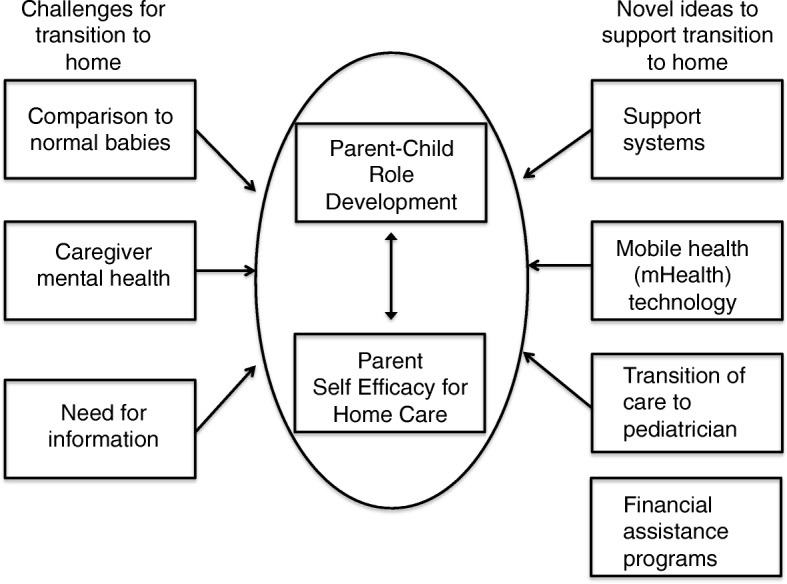
BACKGROUND: We have limited information on families' experiences during transition and after discharge from the neonatal intensive care unit. METHODS: Open-ended semi-structured interviews were conducted with English or Spanish- speaking families enrolled in Medicaid in an urban high-risk infant follow up clinic at a safety-net center, which serves preterm and high-risk term infants. We generated salient themes using inductive-deductive thematic analysis. RESULTS: Twenty-one participants completed the study. The infant's median (IQR) birth weight was 1750 (1305, 2641) grams; 71% were Hispanic and 10% were Black non-Hispanic; 62% reported living in a neighborhood with 3-4th quartile economic hardship. All were classified as having chronic disease per the Pediatric Medical Complexity Algorithm and 67% had medical complexity. A conceptual model was constructed and the analysis revealed major themes describing families' challenges and ideas to support transition centered on the parent-child role and parent self-efficacy. The challenges were: (1) comparison to normal babies, (2) caregiver mental health, (3) need for information. Ideas to support transition included, (1) support systems, (2) interventions using mobile health technology (3) improved communication to the primary care provider and (4) information regarding financial assistance programs. Specific subthemes differed in frequency counts between infants with and without medical complexity. CONCLUSIONS: Families often compare their preterm or high-risk infant to their peers and mothers feel great anxiety and stress. However, families often found hope and resilience in peer support and cited that in addition to information needs, interventions using mobile health technology and transition and financial systems could better support families after discharge.
Overview
The claims and statistics of this paper haven’t been checked yet.
Free: it reads the open-access text and checks the first 5 claims that cite a source we can check. Create a free account to check every claim.
Integrity signals
Registry
Cites
Statistics
Figures
Verification
Claims the paper makes
The claims and statistics of this paper haven’t been checked yet.
Free: it reads the open-access text and checks the first 5 claims that cite a source we can check. Create a free account to check every claim.
Claims other papers make about this one
Each is checked against this paper’s own text: does it say what the citing paper says it does?
The source backs part of the claim, not all of it — or backs it for a different population, condition or comparison.
In the citing paper
“Recently,Lakshmanan et al. 2019) highlighted the limited information on families' experiences during transition and after discharge from the neonatal unit.”
From The transition home of extremely premature babies: An integrative review (2021) · cites this paper as Lakshmanan et al. 2019
Experimental — accuracy not yet measuredThe cited source says what the claim attributes to it.
In the citing paper
“Their conceptual model described families' challenges and ideas to support transition; namely: comparison to normal babies, caregiver mental health and the need for information.”
From The transition home of extremely premature babies: An integrative review (2021) · cites this paper as Lakshmanan et al. 2019
In the citing paper
“Proposed ideas to support transition included provision of adequate support systems, interventions using mobile health technology, improved communication to the family and information regarding practical support at home.”
From The transition home of extremely premature babies: An integrative review (2021) · cites this paper as Lakshmanan et al. 2019
Self-check
Percentages, sums and reported differences re-computed from the paper’s own numbers.
The self-check needs the paper’s full text.
Citations
Cites
Screening for Depression in Adults: US Preventive Services Task Force Recommendation Statement
Siu, A. L., and the US Preventive Services Task Force (USPSTF), Bibbins-Domingo, K., Grossman, D. C., Baumann, L. C., Davidson, K. W., Ebell, M., García, F. A. R., Gillman, M., Herzstein, J., et al. (2016) · JAMA · doi:10.1001/jama.2015.18392 · Cited by 1,407
Qualitative research in healthcare: An introduction to grounded theory using thematic analysis
Chapman, A., Hadfield, M., & Chapman, C. (2015) · Journal of the Royal College of Physicians of Edinburgh · doi:10.4997/jrcpe.2015.305 · Cited by 654
Hospital Discharge of the High-Risk Neonate
Committee on Fetus and Newborn (2008) · Pediatrics · doi:10.1542/peds.2008-2174 · Cited by 537
Access Barriers to Health Care for Latino Children
Flores, G., Abreu, M., Olivar, M. A., & Kastner, B. (1998) · Archives of Pediatrics & Adolescent Medicine · doi:10.1001/archpedi.152.11.1119 · Cited by 459
Rosenberg, S. A., Zhang, D., & Robinson, C. C. (2008) · Pediatrics · doi:10.1542/peds.2007-1680 · Cited by 429
Annual Summary of Vital Statistics: 2010–2011
Hamilton, B. E., Hoyert, D. L., Martin, J. A., Strobino, D. M., & Guyer, B. (2013) · Pediatrics · doi:10.1542/peds.2012-3769 · Cited by 375
A systematic approach for using qualitative methods in primary prevention research
Willms, D. G., Best, J. A., Taylor, D. W., Gilbert, J. R., Wilson, D. M. C., Lindsay, E. A., & Singer, J. (1990) · Medical Anthropology Quarterly · doi:10.1525/maq.1990.4.4.02a00020 · Cited by 310
Hospital discharge of the high-risk neonate
Zarbock, S. F. (1998) · Home Care Provider · doi:10.1016/s1084-628x(98)90006-5 · Cited by 282
Neonatal Abstinence Syndrome and High School Performance
Oei, J. L., Melhuish, E., Uebel, H., Azzam, N., Breen, C., Burns, L., Hilder, L., Bajuk, B., Abdel-Latif, M. E., Ward, M., et al. (2017) · Pediatrics · doi:10.1542/peds.2016-2651 · Cited by 275
Development and Validation of the Pediatric Medical Complexity Algorithm (PMCA) Version 3.0
Simon, T. D., Haaland, W., Hawley, K., Lambka, K., & Mangione-Smith, R. (2018) · Academic Pediatrics · doi:10.1016/j.acap.2018.02.010 · Cited by 233
Barriers to health care access for Latino children: a review.
Flores, G., & Vega, L. R. (1998) · PubMed · Cited by 203
Families of Children With Medical Complexity: A View From the Front Lines
Allshouse, C., Comeau, M., Rodgers, R., & Wells, N. (2018) · Pediatrics · doi:10.1542/peds.2017-1284d · Cited by 173
Screening parents of high-risk infants for emotional distress: rationale and recommendations
Hynan, M. T., Mounts, K. O., & Vanderbilt, D. L. (2013) · Journal of Perinatology · doi:10.1038/jp.2013.72 · Cited by 168
Self-citationThe impact of race on participation in part C early intervention services
Feinberg, E., Silverstein, M., Donahue, S., & Bliss, R. (2011) · Journal of Developmental & Behavioral Pediatrics · doi:10.1097/dbp.0b013e3182142fbd · Cited by 159
Multiculturalism, Chronic Illness, and Disability
Groce, N. E., & Zola, I. K. (1993) · Pediatrics · doi:10.1542/peds.91.5.1048 · Cited by 155 · cited 1×
“A handful of studies have examined the role of social media websites and forums and their impact on parenting and help-seeking behaviors [49, 51].”
BackgroundDelineating Among Parenting Confidence, Parenting Self-Efficacy, and Competence
Vance, A. J., & Brandon, D. H. (2017) · Advances in Nursing Science · doi:10.1097/ans.0000000000000179 · Cited by 154
Models of Care Delivery for Children With Medical Complexity
Pordes, E., Gordon, J., Sanders, L. M., & Cohen, E. (2018) · Pediatrics · doi:10.1542/peds.2017-1284f · Cited by 154
Care Coordination for CSHCN: Associations With Family-Provider Relations and Family/Child Outcomes
Turchi, R. M., Berhane, Z., Bethell, C., Pomponio, A., Antonelli, R., & Minkovitz, C. S. (2009) · Pediatrics · doi:10.1542/peds.2009-1255o · Cited by 147
Hodek, J.-M., von der Schulenburg, J.-M., & Mittendorf, T. (2011) · Health Economics Review · doi:10.1186/2191-1991-1-6 · Cited by 145
Families' Health-Related Social Problems and Missed Referral Opportunities
Fleegler, E. W., Lieu, T. A., Wise, P. H., & Muret-Wagstaff, S. (2007) · Pediatrics · doi:10.1542/peds.2006-1505 · Cited by 143
Lakshmanan, A., Agni, M., Lieu, T., Fleegler, E., Kipke, M., Friedlich, P. S., McCormick, M. C., & Belfort, M. B. (2017) · Health and Quality of Life Outcomes · doi:10.1186/s12955-017-0602-3 · Cited by 132
Self-citationPart C early intervention for infants and toddlers: percentage eligible versus served
Rosenberg, S. A., Robinson, C. C., Shaw, E. F., & Ellison, M. C. (2013) · Pediatrics · doi:10.1542/peds.2012-1662 · Cited by 127
Depression screening and patient outcomes in pregnancy or postpartum: A systematic review
Thombs, B. D., Arthurs, E., Coronado-Montoya, S., Roseman, M., Delisle, V. C., Leavens, A., Levis, B., Azoulay, L., Smith, C., Ciofani, L., et al. (2014) · Journal of Psychosomatic Research · doi:10.1016/j.jpsychores.2014.01.006 · Cited by 123
Flores, M. E. S., Simonsen, S. E., Manuck, T. A., Dyer, J. M., & Turok, D. K. (2012) · Women s Health Issues · doi:10.1016/j.whi.2012.07.005 · Cited by 121
Wang, C. J., McGlynn, E. A., Brook, R. H., Leonard, C. H., Piecuch, R. E., Hsueh, S. I., & Schuster, M. A. (2006) · Pediatrics · doi:10.1542/peds.2005-1904 · Cited by 119
Desai, A. D., Durkin, L. K., Jacob‐Files, E., & Mangione-Smith, R. M. (2015) · Academic Pediatrics · doi:10.1016/j.acap.2015.08.003 · Cited by 117
Families’ Priorities Regarding Hospital-to-Home Transitions for Children With Medical Complexity
Leyenaar, J. K., O’Brien, E. R., Leslie, L. K., Lindenauer, P. K., & Mangione-Smith, R. M. (2017) · Pediatrics · doi:10.1542/peds.2016-1581 · Cited by 115
Transition From Hospital to Home for Parents of Preterm Infants
Boykova, M., & Kenner, C. (2012) · Journal of Perinatal & Neonatal Nursing · doi:10.1097/jpn.0b013e318243e948 · Cited by 112
Galbraith, A. A., Wong, S. T., Kim, S. E., & Newacheck, P. W. (2005) · Health Services Research · doi:10.1111/j.1475-6773.2005.00421.x · Cited by 102
Household Language Use and Health Care Access, Unmet Need, and Family Impact Among CSHCN
Yu, S. M., & Singh, G. K. (2009) · Pediatrics · doi:10.1542/peds.2009-1255m · Cited by 99
Racial and Ethnic Disparities in Indicators of a Primary Care Medical Home for Children
Raphael, J. L., Guadagnolo, B. A., Beal, A. C., & Giardino, A. P. (2009) · Academic Pediatrics · doi:10.1016/j.acap.2009.01.011 · Cited by 95
Parent perspectives on readiness for discharge home after neonatal intensive care unit admission
Berman, L., Raval, M. V., Ottosen, M., Mackow, A. K., Cho, M., & Goldin, A. B. (2019) · The Journal of Pediatrics · doi:10.1016/j.jpeds.2018.08.086 · Cited by 95
Garfield, L., Holditch-Davis, D., Carter, C. S., McFarlin, B. L., Schwertz, D., Seng, J. S., Giurgescu, C., & White-Traut, R. (2015) · Advances in Neonatal Care · doi:10.1097/anc.0000000000000131 · Cited by 89
Social emotional factors increase risk of postpartum depression in mothers of preterm infants
Hawes, K., McGowan, E., O'Donnell, M., Tucker, R., & Vohr, B. (2016) · The Journal of Pediatrics · doi:10.1016/j.jpeds.2016.07.008 · Cited by 83
Thoren, E. M., Metze, B., Bührer, C., & Garten, L. (2013) · Archives of Disease in Childhood - Fetal and Neonatal Edition · doi:10.1136/archdischild-2012-303572 · Cited by 81
Franck, L. S., McNulty, A., & Alderdice, F. (2017) · Journal of Perinatal & Neonatal Nursing · doi:10.1097/jpn.0000000000000273 · Cited by 76
Kerr, S., King, C., Hogg, R., McPherson, K. E., Hanley, J., Brierton, M., & Ainsworth, S. B. (2017) · BMC Pediatrics · doi:10.1186/s12887-017-0917-6 · Cited by 71
Transition From Hospital to Home for Parents of Preterm Infants
(2012) · Journal of Perinatal & Neonatal Nursing · doi:10.1097/jpn.0b013e318248b20c · Cited by 65
Hintz, S. R., Gould, J. B., Bennett, M. V., Gray, E. E., Kagawa, K. J., Schulman, J. D., Murphy, B., Dueñas, G., & Lee, H. C. (2014) · The Journal of Pediatrics · doi:10.1016/j.jpeds.2014.10.038 · Cited by 61
Liu, Y., McGowan, E., Tucker, R., Glasgow, L., Kluckman, M., & Vohr, B. (2018) · The Journal of Pediatrics · doi:10.1016/j.jpeds.2018.04.038 · Cited by 59
Discharge of Infants from NICU to Latino Families with Limited English Proficiency
Miquel‐Verges, F., Donohue, P., & Boss, R. D. (2010) · Journal of Immigrant and Minority Health · doi:10.1007/s10903-010-9355-3 · Cited by 58
eHealth interventions for parents in neonatal intensive care units: a systematic review
Dol, J., Delahunty-Pike, A., Anwar Siani, S., & Campbell-Yeo, M. (2017) · JBI Database of Systematic Reviews and Implementation Reports · doi:10.11124/jbisrir-2017-003439 · Cited by 57
Neonatal Intensive Care Unit Discharge Preparedness: Primary Care Implications
Smith, V. C., Dukhovny, D., Zupancic, J. A. F., Gates, H. B., & Pursley, D. M. (2012) · Clinical Pediatrics · doi:10.1177/0009922811433036 · Cited by 51
Perspectives of Low Socioeconomic Status Mothers of Premature Infants
Enlow, E., Faherty, L. J., Wallace-Keeshen, S., Martin, A. E., Shea, J. A., & Lorch, S. A. (2017) · Pediatrics · doi:10.1542/peds.2016-2310 · Cited by 45
Magnusson, D. M., Minkovitz, C. S., Kuhlthau, K. A., Caballero, T. M., & Mistry, K. B. (2017) · Pediatrics · doi:10.1542/peds.2017-2059 · Cited by 45
Howe, C. J., Cipher, D. J., LeFlore, J. L., & Lipman, T. H. (2015) · Journal of Health Communication · doi:10.1080/10810730.2015.1083636 · Cited by 44
Use of Social Media by Fathers of Premature Infants
Kim, H. N., Wyatt, T. H., Li, X., & Gaylord, M. (2016) · Journal of Perinatal & Neonatal Nursing · doi:10.1097/jpn.0000000000000214 · Cited by 41
Lindberg, B., Axelsson, K., & Öhrling, K. (2009) · Journal of Telemedicine and Telecare · doi:10.1258/jtt.2009.090112 · Cited by 38
Enlow, E., Herbert, S. L., Jovel, I. J., Lorch, S. A., Anderson, C., & Chamberlain, L. J. (2014) · Journal of Perinatology · doi:10.1038/jp.2014.75 · Cited by 38
Davis, D. W., Jones, V. F., Logsdon, M. C., Ryan, L., & Wilkerson-McMahon, M. (2013) · Clinical Pediatrics · doi:10.1177/0009922813506607 · Cited by 38
Children with Special Health Care Needs, Supplemental Security Income, and Food Insecurity
Rose-Jacobs, R., Goodhart Fiore, J., Ettinger de Cuba, S., Black, M., Cutts, D. B., Coleman, S. M., Heeren, T., Chilton, M., Casey, P., Cook, J., et al. (2016) · Journal of Developmental & Behavioral Pediatrics · doi:10.1097/dbp.0000000000000260 · Cited by 38
Gabbert, T. I., Metze, B., Bührer, C., & Garten, L. (2013) · European Journal of Pediatrics · doi:10.1007/s00431-013-2067-7 · Cited by 37
What Parents of Children With Complex Medical Conditions Want Their Child’s Physicians to Understand
Carosella, A., Snyder, A., & Ward, E. D. (2018) · Archives of Pediatrics and Adolescent Medicine · doi:10.1001/jamapediatrics.2017.3931 · Cited by 37
Incomplete Specialty Referral among Children in Community Health Centers
Zuckerman, K. E., Cai, X., Perrin, J. M., & Donelan, K. (2010) · The Journal of Pediatrics · doi:10.1016/j.jpeds.2010.07.012 · Cited by 36
Palinkas, L. A., Um, M. Y., Jeong, C. H., Chor, K. H. B., Olin, S., Horwitz, S. M., & Hoagwood, K. E. (2017) · Health Research Policy and Systems · doi:10.1186/s12961-017-0190-z · Cited by 36 · cited 1×
“We used an inductive-deductive thematic analysis approach; an iterative process of coding to identify the patterns between concepts [29, 30].”
MethodDiao, K., Tripodis, Y., Long, W. E., & Garg, A. (2016) · Academic Pediatrics · doi:10.1016/j.acap.2016.07.006 · Cited by 31
Alderdice, F., Gargan, P., McCall, E., & Franck, L. (2018) · Health Expectations · doi:10.1111/hex.12670 · Cited by 31
Desai, A. D., Jacob‐Files, E., Wignall, J., Wang, G., Pratt, W., Mangione-Smith, R. M., & Britto, M. T. (2018) · Hospital Pediatrics · doi:10.1542/hpeds.2017-0242 · Cited by 31
Specialty Referral Communication and Completion in the Community Health Center Setting
Zuckerman, K. E., Nelson, K. P., Bryant, T. K., Hobrecker, K., Perrin, J. M., & Donelan, K. (2011) · Academic Pediatrics · doi:10.1016/j.acap.2011.03.002 · Cited by 29
Supplemental Security Income (SSI) for Children and Youth With Disabilities
Council on Children With Disabilities (2009) · PEDIATRICS · doi:10.1542/peds.2009-2557 · Cited by 27
Kirchhoff, A. C., Parsons, H. M., Kuhlthau, K. A., Leisenring, W. M., Donelan, K., Warner, E. L., Armstrong, G. T., Robison, L. L., Oeffinger, K. C., & Park, E. R. (2015) · JNCI Journal of the National Cancer Institute · doi:10.1093/jnci/djv057 · Cited by 23
The Impact of Insurance on Satisfaction and Family-Centered Care for CSHCN
Thompson, L. A., Knapp, C. A., Saliba, H., Giunta, N., Shenkman, E. A., & Nackashi, J. A. (2009) · PEDIATRICS · doi:10.1542/peds.2009-1255n · Cited by 20
Examining Trends and Coexisting Conditions Among Children Qualifying for SSI Under ADHD, ASD, and ID
Pulcini, C. D., Perrin, J. M., Houtrow, A. J., SARGENT, J. A., Shui, A. M., & Kuhlthau, K. A. (2015) · Academic Pediatrics · doi:10.1016/j.acap.2015.05.002 · Cited by 17
Shields, W. C., McDonald, E. M., McKenzie, L. B., & GIELEN, A. C. (2015) · Clinical Pediatrics · doi:10.1177/0009922815602889 · Cited by 16
Zuckerman, K. E., Chavez, A. E., & Reeder, J. A. (2017) · Journal of Developmental & Behavioral Pediatrics · doi:10.1097/dbp.0000000000000446 · Cited by 14
Computing Theoretical Rates of Part C Eligibility Based on Developmental Delays
Rosenberg, S. A., Ellison, M. C., Fast, B., Robinson, C. C., & Lazar, R. (2012) · Maternal and Child Health Journal · doi:10.1007/s10995-012-0982-2 · Cited by 13
Identifying Depression in Neonatal Intensive Care Unit Parents: Then What?
Bogen, D. L., Fisher, S. D., & Wisner, K. L. (2016) · The Journal of Pediatrics · doi:10.1016/j.jpeds.2016.09.001 · Cited by 13
Building Systems That Work for Children With Complex Health Care Needs: Editor’s Note
Agrawal, R., & Stille, C. J. (2018) · PEDIATRICS · doi:10.1542/peds.2017-1284c · Cited by 7
Healthy Eating and Active Lifestyle in Adolescents: A Qualitative Study to Prevent/Treat Obesity
Cristiani, V., Kumbamu, A., Asiedu, G. B., O’Brien, J. R. G., & Kumar, S. (2017) · Innovations in Obesity Prevention, Assessment, and Treatment Forum · doi:10.1542/peds.140.1_meetingabstract.5 · Cited by 4
Poverty and Supplemental Security Income
Kelleher, K. J., Boat, T. F., Houtrow, A. J., & Hoagwood, K. (2016) · Journal of Developmental & Behavioral Pediatrics · doi:10.1097/dbp.0000000000000283 · Cited by 3
Supplemental Security Income for Children With Mental Disabilities
Kelleher, K. J., Stein, R. E. K., & Hoagwood, K. (2016) · PEDIATRICS · doi:10.1542/peds.2015-3342 · Cited by 2
Cited by
A brief history of telemedicine and the evolution of teleneonatology
Jagarapu, J., & Savani, R. C. (2021) · Seminars in Perinatology · doi:10.1016/j.semperi.2021.151416 · Cited by 115
Ronan, S., Brown, M., & Marsh, L. (2020) · Journal of Clinical Nursing · doi:10.1111/jocn.15396 · Cited by 58
Parent Experiences in the NICU and Transition to Home
Spence, C. M., Stuyvenberg, C. L., Kane, A. E., Burnsed, J., & Dusing, S. C. (2023) · International Journal of Environmental Research and Public Health · doi:10.3390/ijerph20116050 · Cited by 57
“Many families took a prolonged leave of absence from work, which was required to meet the intensity of their preterm infant’s needs [24,25].”
BackgroundThe transition home of extremely premature babies: An integrative review
Green, J., Fowler, C., Petty, J., & Whiting, L. (2021) · Journal of Neonatal Nursing · doi:10.1016/j.jnn.2020.09.011 · Cited by 47
Garfield, C. F., Kerrigan, E., Christie, R., Jackson, K., & Lee, Y. S. (2022) · The Journal of Pediatrics · doi:10.1016/j.jpeds.2022.01.004 · Cited by 49
Metadata
- Authors
- Lakshmanan, A., Kubicek, K., Williams, R., Robles, M., Vanderbilt, D. L., Mirzaian, C. B., Friedlich, P. S., & Kipke, M.
- Affiliations
- University of Southern California (US)
- Children's Hospital Los Angeles (US)
- Corresponding author
- Lakshmanan, Ashwini
- ORCID
- Venue
- BMC Pediatrics
- Published
- 2019-07-05
- Volume
- 19
- Issue
- 1
- Pages
- 223-223
- ISSN
- 1471-2431 (ISSN-L)
- PMC
- PMC6610911
- OpenAlex
- W2954106482
- Cited by
- 89
- References
- 71
- Citations by year
- 2026: 10 · 2025: 15 · 2024: 15 · 2023: 15 · 2022: 22 · 2021: 8 · 2020: 4
- FWCI
- 8.84
- Type
- journal article
- Language
- en
- Open access
- gold
- doi.org
- Licence
- cc-by
- creativecommons.org/licenses/by/4.0/ (tdm)
- creativecommons.org/licenses/by/4.0/ (vor)
- Locations
- BMC Pediatrics (publishedVersion, cc-by)
- PubMed Central (publishedVersion, cc-by)
- PubMed (publishedVersion)
- DOAJ (DOAJ: Directory of Open Access Journals) (submittedVersion, cc-by-sa)
- Funders
- National Center for Advancing Translational Sciences (KL2TR001854)
- Topics
- Health Sciences › Medicine › Pediatrics, Perinatology and Child Health › Infant Development and Preterm Care
- Health Sciences › Medicine › Pediatrics, Perinatology and Child Health › Adolescent and Pediatric Healthcare
- Social Sciences › Psychology › Clinical Psychology › Family and Disability Support Research
- Keywords
- neonatal intensive care unit discharge, transition to home, family experiences, parental self-efficacy, caregiver mental health, peer support, mobile health technology, primary care communication, financial assistance programs, preterm infants, high-risk infants, safety-net hospitals, Medicaid, Latino families
- MeSH terms
- Transitional Care, Psychosocial Support Systems, Black or African American, Child Development, Family, Financial Support, Gestational Age, Hispanic or Latino, Humans, Infant, Infant, Premature, Intensive Care Units, Neonatal, Health Knowledge, Attitudes, Practice, Mental Health, Parents, Patient Discharge, Prospective Studies, Referral and Consultation, Parenting, Telemedicine, Self Efficacy, Needs Assessment, Qualitative Research, White People, Asian People, Quality Improvement, Early Medical Intervention, Safety-net Providers
About these checks
Registry, retraction, Cites and statistics results are computed, not judged, with one exception: a printed reference that no index lists is read once by a model before it counts as a citation error. Claims are extracted by a model and kept only when their quote appears verbatim in the text; each cited source is then checked, with a model’s help, for whether it says what the claim relies on. Those verdicts can be wrong — read the claim’s quote and the cited source before relying on one.
Statistics and arithmetic are recomputed, not judged.
Confidence bands are shown only for fields calibrated on our annotated test set. None is calibrated yet, so no band is shown.
What counts as a claim ›How we measure confidence ›How we check this ›
Are you an author, or do you see a problem with this page? Request a review
Data sources
Bibliographic data: Semantic Scholar, OpenAlex, Crossref.
Contains information from the Semantic Scholar Academic Graph Datasets, made available under the ODC Attribution License (ODC-BY 1.0).
Semantic Scholar’s data is described in: Kinney, R., et al. (2023). The Semantic Scholar Open Data Platform. arXiv:2301.10140.
