

Atypical antipsychotic augmentation in SSRI treatment refractory obsessive-compulsive disorder: a systematic review and meta-analysis
Open accessThe DOI matches its Crossref record; 43 of the 44 references it cites were found in a registry or an index.
Abstract
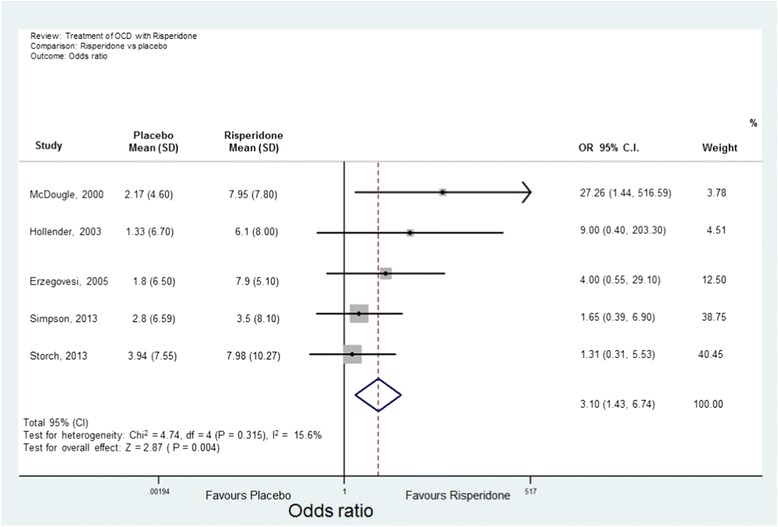
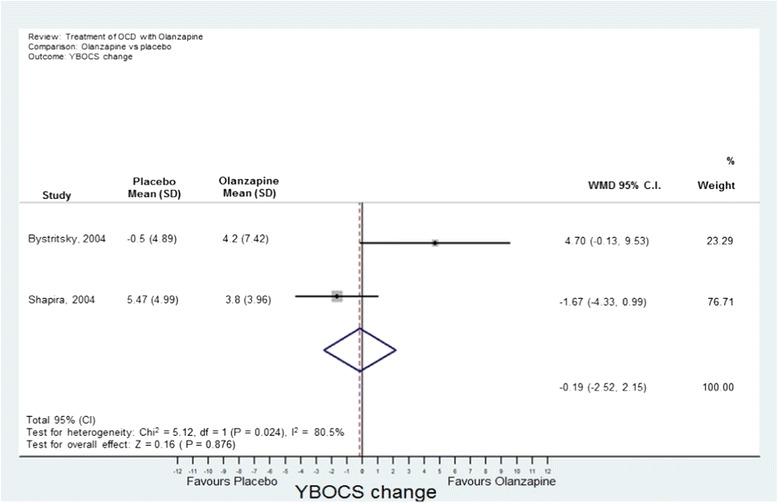
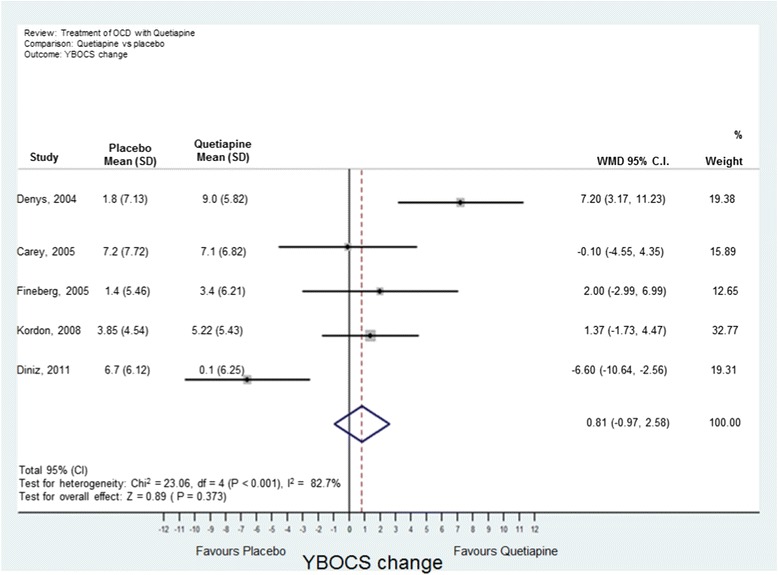
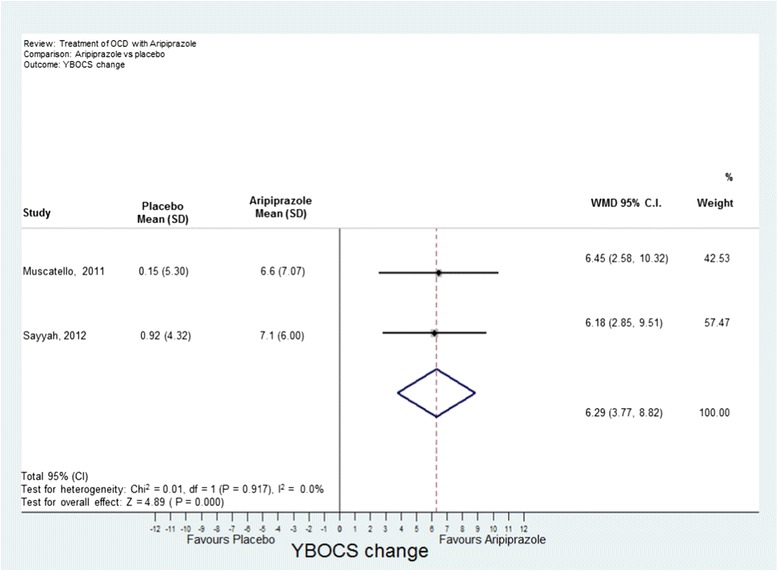
BACKGROUND: In 2006, the National Institute of Clinical and Health Excellence (NICE) guidelines for Obsessive Compulsive Disorder (OCD) recommended anti-psychotics as a class for SSRI treatment resistant OCD. The article aims to systematically review and conduct a meta-analysis on the clinical effectiveness of atypical anti-psychotics augmenting an SSRI. METHODS: Studies that were double-blind randomized controlled trials of an atypical antipsychotic against a placebo, for a minimum of 4 weeks, in adults with OCD, were included. Yale-Brown Obsessive Compulsive Scale (Y-BOCS) scores were the primary outcome measure. Inclusion criteria included Y-BOCS score of 16 or more and at least one adequate trial of a SSRI or clomipramine for at least 8 weeks prior to randomization. Data sources included Medline, Embase, PsycINFO, Cochrane Database of Systematic Reviews (CDSR), trial registries and pharmaceutical databases and manufacturers up to September 2013. Forest-plots were drawn to display differences between drug and placebo on the Y-BOCS. RESULTS: Two studies found aripiprazole to be effective in the short-term. There was a small effect-size for risperidone or anti-psychotics in general in the short-term. We found no evidence for the effectiveness of quetiapine or olanzapine in comparison to placebo. CONCLUSIONS: Risperidone and aripiprazole can be used cautiously at a low dose as an augmentation agent in non-responders to SSRIs and CBT but should be monitored at 4 weeks to determine efficacy.
Overview
The claims and statistics of this paper haven’t been checked yet.
Free: it reads the open-access text and checks the first 5 claims that cite a source we can check. Create a free account to check every claim.
Integrity signals
Registry
Cites
Statistics
Figures
Verification
Claims the paper makes
The claims and statistics of this paper haven’t been checked yet.
Free: it reads the open-access text and checks the first 5 claims that cite a source we can check. Create a free account to check every claim.
Claims other papers make about this one
Each is checked against this paper’s own text: does it say what the citing paper says it does?
The cited source says what the claim attributes to it.
In the citing paper
“According to a recent meta-analysis, low doses of add-on aripiprazole had an important overall effect size and was the most effective short-term option [28].”
From Clinical Advances in Treatment Strategies for Obsessive-compulsive Disorder in Adults (2023) · cites this paper as [28]
In the citing paper
“Whilst dopaminergic medications are not first-line treatments for OCD, dopamine receptor antagonists are often used to augment first-line treatment in refractory cases (Hirschtritt et al. 2017) and the efficacy of this strategy is confirmed by meta-analyses (Dold et al. 2015; Veale et al. 2014).”
From Dopaminergic drug treatment remediates exaggerated cingulate prediction error responses in obsessive-compulsive disorder (2019) · cites this paper as Veale et al. 2014
In the citing paper
“meta-analysis confirms that dopamine receptor antagonists reduce obsessive-compulsive symptoms in SSRI-refractory OCD (Dold et al. 2015; Veale et al. 2014).”
From Dopaminergic drug treatment remediates exaggerated cingulate prediction error responses in obsessive-compulsive disorder (2019) · cites this paper as Veale et al. 2014
Self-check
Percentages, sums and reported differences re-computed from the paper’s own numbers.
The self-check needs the paper’s full text.
Citations
Cites
Preferred Reporting Items for Systematic Reviews and Meta-Analyses: the PRISMA statement
Moher, D., Liberati, A., Tetzlaff, J., Altman, D. G., & for the PRISMA Group (2009) · BMJ · doi:10.1136/bmj.b2535 · Cited by 83,823
Preferred reporting items for systematic reviews and meta-analyses: the PRISMA Statement.
(2009) · PubMed Central · Cited by 44,859
Meta-analysis in clinical trials
DerSimonian, R., & Laird, N. (1986) · Controlled Clinical Trials · doi:10.1016/0197-2456(86)90046-2 · Cited by 39,552 · cited 1×
“), using a random effects meta-analysis model of continuous data, with each study change score weighted by the inverse of the variance [29].”
MethodPreferred reporting items for systematic reviews and meta-analyses: The PRISMA statement
Moher, D., Liberati, A., Tetzlaff, J., Altman, D. G., & the PRISMA Group* (2009) · Annals of Internal Medicine · doi:10.7326/0003-4819-151-4-200908180-00135 · Cited by 37,554
Preferred Reporting Items for Systematic Reviews and Meta-Analyses: The PRISMA Statement
Moher, D., Liberati, A., Tetzlaff, J., & Altman, D. G. (2009) · Journal of Clinical Epidemiology · doi:10.1016/j.jclinepi.2009.06.005 · Cited by 19,575
Grading quality of evidence and strength of recommendations
(2004) · BMJ · doi:10.1136/bmj.328.7454.1490 · Cited by 8,477
Jacobson, N. S., & Truax, P. (1991) · Journal of Consulting and Clinical Psychology · doi:10.1037/0022-006x.59.1.12 · Cited by 7,770 · cited 2×
“Jacobson NS, Truax P: Clinical significance: a statistical approach to defining meaningful change in psychotherapy research.”
MethodThe Yale-Brown Obsessive Compulsive Scale: I. Development, Use, and Reliability
Goodman, W. K. (1989) · Archives of General Psychiatry · doi:10.1001/archpsyc.1989.01810110048007 · Cited by 7,712 · cited 1×
“(2) They used the Yale-Brown Obsessive Compulsive Scale (Y-BOCS) [11] as a primary outcome measure.”
MethodMeta-Analytic Procedures for Social Research
Rosenthal, R. (1991) · doi:10.4135/9781412984997 · Cited by 4,635 · cited 1×
“However the small number of studies and participants for each individual drug made it difficult to interpret [30].”
BackgroundMeta-Analytic Procedures for Social Research.
Metcalfe, A., & Rosenthal, R. (1994) · The Statistician · doi:10.2307/2348600 · Cited by 4,249
Research works printed but not linked: 1
- Tatari F Khazaei H Jahandar F Rezaei M Effect of adding risperidone to fluoxetine in treatment of obsession compulsion disorder patients Life Sci J 2013 10 11s 153 157
Cited by
Items 101–174 of 174
Raphe nuclei echogenicity changes in obsessive-compulsive disorder
Mohammadzadea, N., Shalbafan, M., Shariat, V., Zamani, B., Shariati, B., Omrani, F., & Rohani, M. (2018) · Medical Journal of the Islamic Republic of Iran · doi:10.14196/mjiri.32.91 · Cited by 6
Marazziti, D., Mucci, F., Avella, M. T., Dell’Oste, V., Baroni, S., & Dell’Osso, L. (2019) · Expert Opinion on Drug Metabolism & Toxicology · doi:10.1080/17425255.2019.1640211 · Cited by 6
Poyurovsky, M., & Weizman, A. (2021) · Clinical Neuropharmacology · doi:10.1097/wnf.0000000000000456 · Cited by 4
“This is in contrast to the lack of quetiapine's efficacy in patients with “pure” OCD resistant to SSRIs, as revealed in recent meta-analyses.(13,14) It is plausible that quetiapine's therapeutic utility in patients with OCD is restricted to those with comorbid bipolar disorder, particularly BP-D episode.”
ResultObsessive‐compulsive disorder: current management options
Harris, P. G., Drummond, L. M., & Fineberg, N. A. (2019) · Prescriber · doi:10.1002/psb.1793 · Cited by 5
Pharmacotherapy of Obsessive-Compulsive Disorder During Breastfeeding
Uğuz, F. (2016) · American Journal of Therapeutics · doi:10.1097/mjt.0000000000000500 · Cited by 4
Baptista, T., Araujo, H., & de León, J. (2018) · Journal of Clinical Psychopharmacology · doi:10.1097/jcp.0000000000000982 · Cited by 4
“A systematic review suggests that risperidone and aripiprazole can be used cautiously in low doses as augmentation agents in OCD patients who are nonresponders to selective serotonin reuptake inhibitors and cognitive-behavioral therapy.(3) Unsurprisingly, this systematic review did not provide any data on CLO.”
BackgroundObsessive-Compulsive and Related Disorders
Dougherty, D. D., Wilhelm, S., & Jenike, M. A. (2019) · American Psychiatric Association Publishing eBooks · doi:10.1176/appi.books.9781615371501.lr14 · Cited by 4
Rosso, G., PERACCHIA, S., Pesci, N. R., Salvo, G. D., & Maina, G. (2026) · Biomedicines · doi:10.3390/biomedicines14010179 · Cited by 3
“Augmentation with antipsychotic medication has yielded a strong evidence, specifically related to the use of second-generation medications like risperidone [6,7].”
Zai, G. C., Zai, C. C. H., Burroughs, E., Arnold, P. D., Kennedy, J. L., & Richter, M. A. (2025) · Progress in Neuro-Psychopharmacology and Biological Psychiatry · doi:10.1016/j.pnpbp.2025.111428 · Cited by 3
Cavanna, A. E. (2020) · Elsevier eBooks · doi:10.1016/b978-0-12-816563-8.00003-6 · Cited by 4
Psychiatric Treatment and Management of Psychiatric Comorbidities of Movement Disorders
Walsh, K. H., Soe, K. C., & Sarawgi, S. (2017) · Seminars in Pediatric Neurology · doi:10.1016/j.spen.2017.12.002 · Cited by 3
Choi, E. (2026) · Journal of Oral Rehabilitation · doi:10.1111/joor.70260 · Cited by 2
Sayyah, M., & Rahim, F. (2016) · Asian Journal of Pharmaceutical and Clinical Research · doi:10.22159/ajpcr.2017.v10i1.14528 · Cited by 2
“including risperidone, quetiapine, olanzapine, and aripiprazole [134].”
Outpatient Treatment Patterns of Pediatric Obsessive-Compulsive Disorder
Smith, J. L., McBride, N. M., & Storch, E. A. (2017) · Journal of Child and Adolescent Psychopharmacology · doi:10.1089/cap.2017.0011 · Cited by 2
“…antipsychotics for obsessive-compulsive symptoms among children, there are preliminary data to suggest its benefit among youth with SRI-resistant OCD (Masi et al. 2009, 2010) although findings in adults are mixed (Simpson et al. 2013; Veale et al. 2014; Fineberg et al. 2015; Wheaton et al. 2015).”
Singer, P., & Yee, B. K. (2017) · Springer eBooks · doi:10.1007/978-3-319-53126-7_28 · Cited by 3
Sertdemir, M., & Akça, Ö. F. (2017) · Clinical Neuropharmacology · doi:10.1097/wnf.0000000000000234 · Cited by 2
“Aripiprazole has also been suggested for use as an augmentative agent for adolescent cases with treatment-refractory OCD.12 However, studies that report that it may have beneficial effects on childhood OCD when used as monotherapy are limited.5 Aripiprazole is a third-generation antipsychotic with a more specific mech…”
BackgroundSoleimani, R., Jalali, M. M., Keshtkar, A., & Jalali, S. M. (2017) · PubMed Central · Cited by 3
Psychopharmacotherapy of Obsessive-Compulsive and Related Disorders
Hoffman, J., & Stein, D. J. (2022) · Springer eBooks · doi:10.1007/978-3-030-62059-2_433 · Cited by 2
Shafti, S. S., & Kaviani, H. (2019) · Current Psychopharmacologye · doi:10.2174/2211556008666190314113446 · Cited by 3
Obsessieve-compulsieve stoornis: praktische handvatten voor de huisarts
Tandt, H. L. N., Audenaert, K., & Lemmens, G. M. D. (2021) · Tijdschrift voor Geneeskunde · doi:10.47671/tvg.77.20.118 · Cited by 1
Inagaki, T., Funada, D., Imamura, F., Mitamura, Y., Murata, Y., Yoshimura, N., & Kito, S. (2024) · BMC Psychiatry · doi:10.1186/s12888-024-05793-1 · Cited by 2
“On hospitalization day 52, brexpiprazole was replaced with aripip-razole because of recent findings showing the efficacy of augmentation therapy with aripiprazole [6], although with off-label use.”
Chapter 52. Treatment of Obsessive-Compulsive Disorder
Kayser, R. R., & Simpson, H. B. (2024) · American Psychiatric Association Publishing eBooks · doi:10.1176/appi.books.9781615375523.as52 · Cited by 1
Obsessive-compulsive disorder and temporal lobe porencephaly: a case report
Deng, G., Cao, Y., & Qiu, C. (2025) · BMC Psychiatry · doi:10.1186/s12888-025-06774-8 · Cited by 1
“A meta-analysis indicated that aripiprazole provides a moderate effect size benefit for OCD patients who exhibit partial resistance to one SSRI in the short term [49].”
Shahtou, A., Omara, H. R., Qari, S. A., Alqahtani, R. S., Alnasyan, Z. S., Alotaibi, A. E., Ali, A. A., Alabdulrahim, J. M., Naser, S. A., Asad, N., et al. (2026) · Cureus · doi:10.7759/cureus.108358 · Cited by 1
Sachdev, R. A., Ruparelia, R., Reid, J. E., Mpavenda, D., Cinosi, E., & Fineberg, N. A. (2018) · Cambridge University Press eBooks · doi:10.1017/9781108164313.016 · Cited by 2
Uğuz, F. (2019) · Springer eBooks · doi:10.1007/978-3-319-92919-4_16 · Cited by 1
de Miranda, A. S., Ferreira, R. N., Teixeira, A. L., & de Miranda, A. S. (2020) · Springer eBooks · doi:10.1007/978-3-319-56015-1_47-1 · Cited by 1
Weaver, L., & Timko, C. A. (2018) · Elsevier eBooks · doi:10.1016/b978-0-323-51147-6.00007-7 · Cited by 2
Chapter 14. Obsessive-Compulsive and Related Disorders
Dougherty, D. D., Wilhelm, S., & Jenike, M. A. (2019) · American Psychiatric Association Publishing eBooks · doi:10.1176/appi.books.9781615372980.lr14 · Cited by 1
Neuropsychopharmacotherapy in Children and Adolescents
Walitza, S., Berger, G. E., GELLER, D. A., & Smigielski, L. (2022) · Springer eBooks · doi:10.1007/978-3-030-62059-2_270 · Cited by 1
Chapter 29. Risperidone and Paliperidone
Lopez, L. V., Hill, M. B., & GOFF, D. C. (2024) · American Psychiatric Association Publishing eBooks · doi:10.1176/appi.books.9781615375523.as29 · Cited by 1
Depression and Anxiety Disorders
(2021) · Wiley eBooks · doi:10.1002/9781119870203.mpg003 · Cited by 1
Bation, R. (2018) · theses.fr (ABES) · doi:10.70675/3c89240bzc242z45f4z9247z73969c8af558 · Cited by 1
Neue Studien zur Behandlung der Zwangsstörung
Voderholzer, U., & Schennach, R. (2015) · DNP - Der Neurologe und Psychiater · doi:10.1007/s15202-015-0814-5 · Cited by 1
Integrative Therapie der Zwangsstörungen
Voderholzer, U. (2016) · Springer eBooks · doi:10.1007/978-3-642-45028-0_70-1
“Nach einer Metaanalyse von Veale et al. (2014), die im Gesamten ein uneinheitliches Bild ergab, wird folgendes Vorgehen empfohlen: Bei Therapieresistenz mit SSRI sollte ein Versuch entweder mit Aripiprazol (Kurzzeitwirksamkeit in 2 Studien bestätigt) oder mit Risperidon (geringe Effektstärke) über…”
BackgroundObsessive-Compulsive Disorder: Overview and Standard Treatment Strategies
Seibell, P. J., Hamblin, R. J., & Hollander, E. (2015) · Psychiatric Annals · doi:10.3928/00485713-20150602-04 · Cited by 1
Complexities and conundrums in mental health
Titmarsh, S. (2017) · Progress in Neurology and Psychiatry · doi:10.1002/pnp.468
The Use of Quetiapine for Comorbid Bipolar and Obsessive Compulsive Disorders
Yoldi‐Negrete, M., Flores‐Ramos, M., Rodríguez‐Ramírez, A. M., Carvajal-Lohr, A., Ávila-Solorio, J., Alejandra, M.-M. M., Alejandra, A., & González-Flores, L. (2015) · Current Psychopharmacologye · doi:10.2174/2211556005666151216224828
Rickelt, J., & Schruers, K. R. J. (2017) · Bohn Stafleu van Loghum eBooks · doi:10.1007/978-90-368-2052-3_34
Stovezky, Y. R., Gershkovich, M., Kayser, R. R., & Simpson, H. B. (2018) · Cambridge University Press eBooks · doi:10.1017/9781108164313.020
Psychopharmacotherapy of Obsessive-Compulsive and Related Disorders
Hoffman, J., & Stein, D. J. (2021) · Springer eBooks · doi:10.1007/978-3-319-56015-1_433-1 · Cited by 1
Leentjens, A. F. G., & Verhey, F. R. J. (2017) · Bohn Stafleu van Loghum eBooks · doi:10.1007/978-90-368-2052-3_30
Neuropsychopharmacotherapy in Children and Adolescents
Walitza, S., Berger, G. E., GELLER, D. A., & Smigielski, L. (2022) · Springer eBooks · doi:10.1007/978-3-319-56015-1_270-1
Kordon, A., Zurowski, B., Wahl, K., & Hohagen, F. (2019) · Elsevier eBooks · doi:10.1016/b978-3-437-22485-0.00013-0 · Cited by 1
Bibliography: Obsessive-Compulsive and Related Disorders
(2015) · FOCUS The Journal of Lifelong Learning in Psychiatry · doi:10.1176/appi.focus.130214
Hassle Faced with Induced Mania in Elderly Female While Treating for Obsessive-Compulsive Symptoms
Bharti, P., Singh, A. H., & Gupta, P. (2022) · Journal of Datta Meghe Institute of Medical Sciences University · doi:10.4103/jdmimsu.jdmimsu_288_20
de Miranda, A. S., Ferreira, R. N., Teixeira, A. L., & de Miranda, A. S. (2022) · Springer eBooks · doi:10.1007/978-3-030-62059-2_47
Combining Pharmacotherapy and Psychological Treatments for Obsessive-Compulsive Disorder
Tolin, D. F., & Sain, K. S. (2023) · Oxford University Press eBooks · doi:10.1093/oxfordhb/9780190068752.013.21
裴, 瑞. (2024) · Advances in Clinical Medicine · doi:10.12677/acm.2024.142476
Osman, H. I. (2024) · International Journal of Research Publications · doi:10.47119/ijrp1001501620246668
Buckley, P. F., & Foster, A. E. (2024) · American Psychiatric Association Publishing eBooks · doi:10.1176/appi.books.9781615375523.as28
Voderholzer, U., Rubart, A., Kathmann, N., Staniloiu, A., Kordon, A., & Zurowski, B. (2024) · Springer eBooks · doi:10.1007/978-3-662-67878-7_6
Pagliaccio, D. (2024) · Springer eBooks · doi:10.1007/978-3-031-32035-4_104-1
Sharma, A., Thakur, M. R., & Prasad, S. (2025) · Industrial Psychiatry Journal · doi:10.4103/ipj.ipj_185_24
“…to a history of TEAS, mECT was not considered as family members denied consenting for mECT despite multiple attempts to explain the need and safety of mECT in pregnancy, and quetiapine monotherapy was not considered as no report of quetiapine monotherapy in co-morbid OCD-BD [5,7] has been reported.”
Pagliaccio, D. (2025) · Springer eBooks · doi:10.1007/978-3-031-73368-0_104
Uğuz, F. (2025) · Springer eBooks · doi:10.1007/978-3-031-99720-4_18
Monteiro, M. B. A., Hühne, V., Fonseca, L. M., Salles-Fonseca, I. M., Moreira‐de‐Oliveira, M. E., de Menezes, G. B., & Fontenelle, L. F. (2025) · Neuropsychobiology · doi:10.1159/000548947
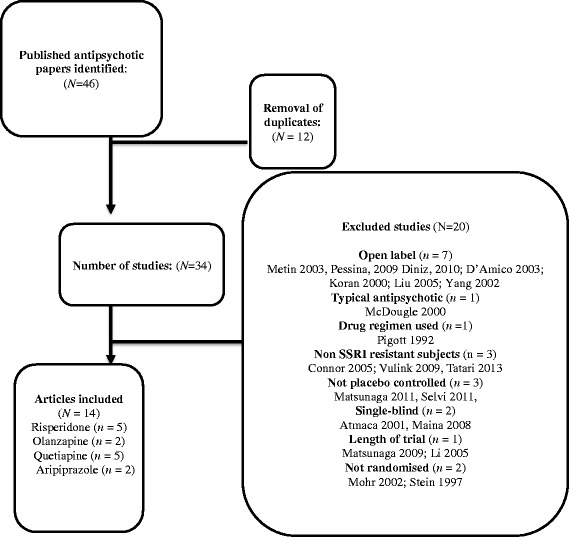
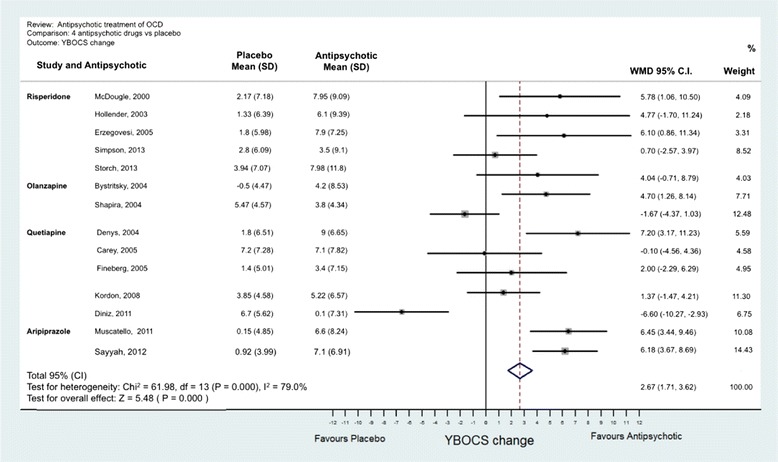
“In a review on the efficacy of atypical antipsychotics as an augmentation strategy for OCD, for example, among the 14 included studies, all had trials of at least 6 weeks, with an average of more than 9 weeks [44].”
Innovative treatment approaches for paediatric obsessive-compulsive disorder
Marazziti, D., Gurrieri, R., Gambini, M., Russomanno, G., Palagini, L., & Mucci, F. (2025) · Expert Opinion on Pharmacotherapy · doi:10.1080/14656566.2025.2591073
“The add-on with antipsychotics is generally recommended in subjects treated for at least 3 months with the maximum tolerated dose of SRIs [220].”
Homar-Ruano, P. (2020) · Dipòsit Digital de la Universitat de Barcelona (Universitat de Barcelona)
Understanding Perinatal Obsessive-Compulsive Disorder (OCD): From prevention to clinical practice
Mulcahy, M. (2021) · eSpace (Curtin University) · Cited by 2
Inoue, T., Okada, S., Yamana, H., Horai, T., Shirai, T., Otsuka, I., & Hishimoto, A. (2026) · Psychiatry Research Case Reports · doi:10.1016/j.psycr.2026.100314
Medicinal plants for obsessive-compulsive disorder: A review of phytotherapeutic approaches
Devaraja Dravida Pandiyan, S., Jeyabalan, S., Subramaniyan, V., Balu, A., Wong, L. S., Sekar, M., & Ashok, C. (2026) · Journal of Psychiatric Research · doi:10.1016/j.jpsychires.2026.05.011 · Cited by 1
Islam, S., Hossain, S., Torsa, N. T., & Islam, M. R. (2026) · Health Science Reports · doi:10.1002/hsr2.72441
Advancements in the Assessment and Treatment of Pediatric OCD
Kim, T. U., Miller, M., & Mcguire, J. F. (2026) · Current Psychiatry Reports · doi:10.1007/s11920-026-01698-w
“A meta-analysis completed by Veale and colleagues found that low doses of risperidone and aripiprazole can be used to augment SRIs and CBT in initial treatment non-responders [44].”
Cheung, H. K., & Cheung, N. (2026) · Cureus · doi:10.7759/cureus.112492
“…differentiation and reduction of overvalued ideas occurred after risperidone was increased from 0.25 mg to 1 mg. Risperidone has evidence as an augmentation strategy in treatment-resistant OCD and related presentations, especially when intrusive or overvalued content is prominent [21-23].”
InfluentialPostma, T. S., van der Werf, Y. D., Arns, M., Batelaan, N. M., van den Berg, M., Bosmans, J. E., Eikelenboom, M., Hendriks, G., Hoogendoorn, A. W., Kampman, M., et al. (2026) · JMIR Research Protocols · doi:10.2196/94288
“We use rTMS in addition to intensive 4-week daily ERP, and we therefore conservatively lowered the expected effect size to 0.4, in line with, for example, the augmentative effect of antipsychotics to either SSRI or cognitive behavioral therapy [59].”
InfluentialHudak, R., Eken, H. N., & Donahue, C. (2026) · Elsevier eBooks · doi:10.1016/b978-0-443-27446-6.00006-6
Neurochemistry and neurotransmitters involved in obsessive–compulsive disorder
Grant, J. E., & Sohl, E. (2026) · Elsevier eBooks · doi:10.1016/b978-0-443-27446-6.00004-2
Rostami, H., Pourshams, M., & abiri, R. (2026) · Jundishapur Journal of Chronic Disease Care · doi:10.5812/jjcdc-171658
Sayer, Ö. N., & Hocaoğlu, Ç. (2026) · Psychiatry and Behavioral Sciences · doi:10.5455/pbs.20260217104338
Obsessive-compulsive disorder in the context of schizotypal disorder among children and adolescents
Блинова, Т. Е., Chaika, Y. A., & Goryunov, А. V. (2026) · S S Korsakov Journal of Neurology and Psychiatry · doi:10.17116/jnevro202612609220
Casetta, C., Zahid, U., Mangiaterra, L., Bonora, S., Harris, E., & MacCabe, J. H. (2026) · Neuroscience & Biobehavioral Reviews · doi:10.1016/j.neubiorev.2026.107078
Metadata
- Authors
- Veale, D., Miles, S., Smallcombe, N., Ghezai, H., Goldacre, B., & Hodsoll, J.
- Affiliations
- King's College London (GB)
- London School of Hygiene & Tropical Medicine (GB)
- Corresponding author
- Veale, David
- Venue
- BMC Psychiatry
- Published
- 2014-11-29
- Volume
- 14
- Issue
- 1
- Pages
- 317-317
- ISSN
- 1471-244X (ISSN-L)
- PMC
- PMC4262998
- OpenAlex
- W2067425354
- Cited by
- 162
- References
- 44
- Citations by year
- 2026: 16 · 2025: 10 · 2024: 10 · 2023: 8 · 2022: 8 · 2021: 11 · 2020: 19 · 2019: 24 · 2018: 16 · 2017: 15 · 2016: 14 · 2015: 11
- FWCI
- 2.03
- Type
- journal article
- Language
- en
- Open access
- gold
- doi.org
- Locations
- BMC Psychiatry (publishedVersion, cc-by)
- PubMed Central (publishedVersion, cc-by)
- PubMed (publishedVersion)
- LSHTM Research Online (London School of Hygiene and Tropical Medicine) (acceptedVersion)
- Research Portal (King's College London) (submittedVersion)
- Funders
- South London and Maudsley NHS Foundation Trust
- National Institute for Health and Care Research
- King's College London
- Topics
- Social Sciences › Psychology › Clinical Psychology › Obsessive-Compulsive Spectrum Disorders
- Health Sciences › Medicine › Psychiatry and Mental health › Schizophrenia research and treatment
- Social Sciences › Psychology › Experimental and Cognitive Psychology › Anxiety, Depression, Psychometrics, Treatment, Cognitive Processes
- Keywords
- obsessive-compulsive disorder, atypical antipsychotics, SSRI augmentation, treatment-resistant OCD, aripiprazole, risperidone, quetiapine, olanzapine, Yale-Brown Obsessive Compulsive Scale, clomipramine, cognitive behavioral therapy
- MeSH terms
- Aripiprazole, Quetiapine Fumarate, Olanzapine, Adult, Benzodiazepines, Clomipramine, Dibenzothiazepines, Double-Blind Method, Drug Resistance, Drug Therapy, Combination, Humans, Obsessive-Compulsive Disorder, Piperazines, Antipsychotic Agents, Quinolones, Randomized Controlled Trials as Topic, Treatment Outcome, Selective Serotonin Reuptake Inhibitors, Risperidone
About these checks
Registry, retraction, Cites and statistics results are computed, not judged, with one exception: a printed reference that no index lists is read once by a model before it counts as a citation error. Claims are extracted by a model and kept only when their quote appears verbatim in the text; each cited source is then checked, with a model’s help, for whether it says what the claim relies on. Those verdicts can be wrong — read the claim’s quote and the cited source before relying on one.
Statistics and arithmetic are recomputed, not judged.
Confidence bands are shown only for fields calibrated on our annotated test set. None is calibrated yet, so no band is shown.
What counts as a claim ›How we measure confidence ›How we check this ›
Are you an author, or do you see a problem with this page? Request a review
Data sources
Bibliographic data: Semantic Scholar, OpenAlex, Crossref.
Contains information from the Semantic Scholar Academic Graph Datasets, made available under the ODC Attribution License (ODC-BY 1.0).
Semantic Scholar’s data is described in: Kinney, R., et al. (2023). The Semantic Scholar Open Data Platform. arXiv:2301.10140.
