

Depression and the risk of coronary heart disease: a meta-analysis of prospective cohort studies
Open accessThe DOI matches its Crossref record; 77 of the 77 references it cites were found in a registry or an index.
Abstract
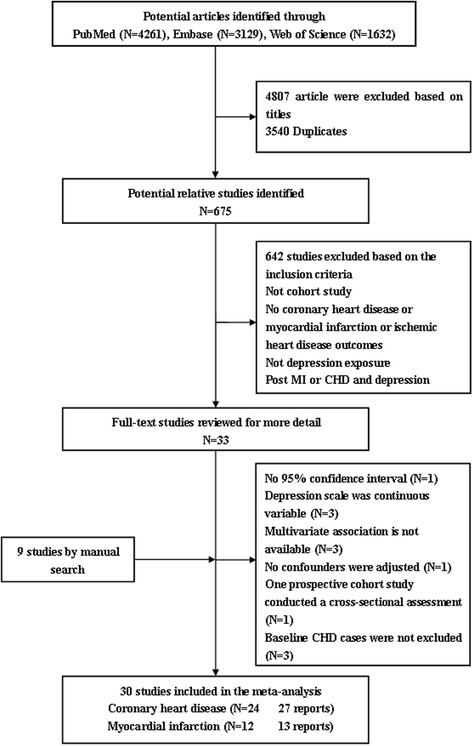
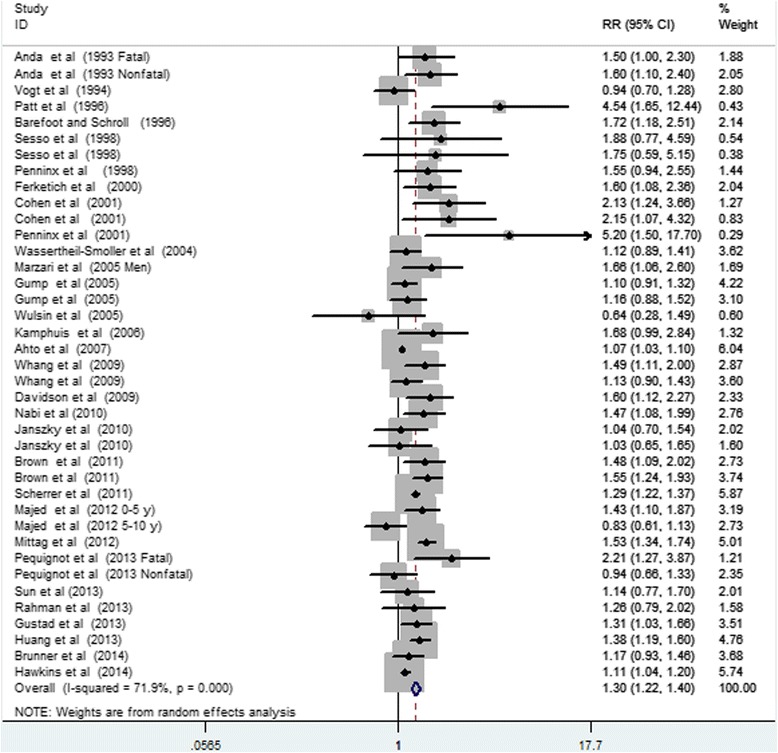
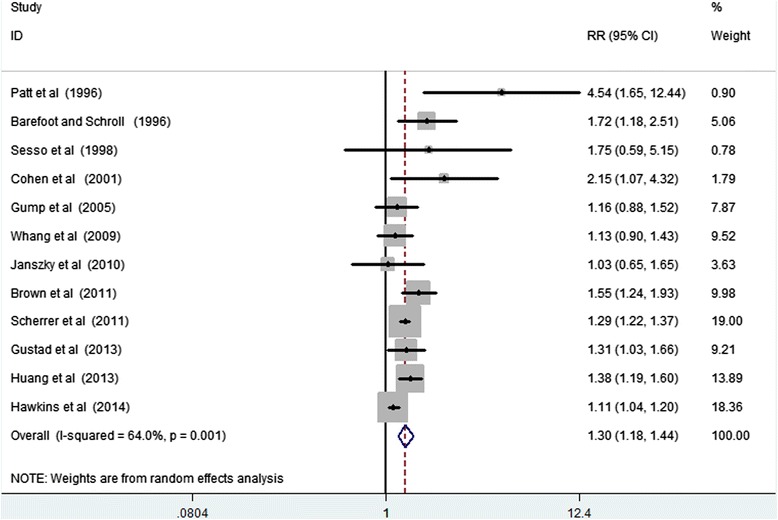
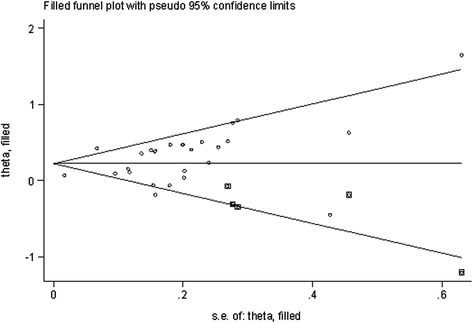
BACKGROUND: Several systematic reviews and meta-analyses demonstrated the association between depression and the risk of coronary heart disease (CHD), but the previous reviews had some limitations. Moreover, a number of additional studies have been published since the publication of these reviews. We conducted an updated meta-analysis of prospective studies to assess the association between depression and the risk of CHD. METHODS: Relevant prospective studies investigating the association between depression and CHD were retrieved from the PubMed, Embase, Web of Science search (up to April 2014) and from reviewing reference lists of obtained articles. Either a random-effects model or fixed-effects model was used to compute the pooled risk estimates when appropriate. RESULTS: Thirty prospective cohort studies with 40 independent reports met the inclusion criteria. These groups included 893,850 participants (59,062 CHD cases) during a follow-up duration ranging from 2 to 37 years. The pooled relative risks (RRs) were 1.30 (95% CI, 1.22-1.40) for CHD and 1.30 (95% CI, 1.18-1.44) for myocardial infarction (MI). In the subgroup analysis by follow-up duration, the RR of CHD was 1.36 (95% CI, 1.24-1.49) for less than 15 years follow-up, and 1.09 (95% CI, 0.96-1.23) for equal to or more than 15 years follow-up. Potential publication bias may exist, but correction for this bias using trim-and-fill method did not alter the combined risk estimate substantially. CONCLUSIONS: The results of our meta-analysis suggest that depression is independently associated with a significantly increased risk of CHD and MI, which may have implications for CHD etiological research and psychological medicine.
Overview
The claims and statistics of this paper haven’t been checked yet.
Free: it reads the open-access text and checks the first 5 claims that cite a source we can check. Create a free account to check every claim.
Integrity signals
Registry
Cites
Statistics
Figures
Verification
Claims the paper makes
The claims and statistics of this paper haven’t been checked yet.
Free: it reads the open-access text and checks the first 5 claims that cite a source we can check. Create a free account to check every claim.
Claims other papers make about this one
Each is checked against this paper’s own text: does it say what the citing paper says it does?
The source backs part of the claim, not all of it — or backs it for a different population, condition or comparison.
In the citing paper
“Indeed, several meta-analyses of prospective cohort studies have reported that baseline MDD increases the risk of future cardiovascular events38-41.”
From Comorbidity between major depressive disorder and physical diseases: a comprehensive review of epidemiology, mechanisms and management (2023) · cites this paper as [38]
Experimental — accuracy not yet measuredThe source backs part of the claim, not all of it — or backs it for a different population, condition or comparison.
In the citing paper
“In this 2014 meta-analysis, depression was associated with an increased risk of MI (RR, 1.30 [95% CI, 1.22-1.40])”
From Psychological Health, Well-Being, and the Mind-Heart-Body Connection: A Scientific Statement From the American Heart Association (2021) · cites this paper as [42]
Experimental — accuracy not yet measuredThe cited source says what the claim attributes to it.
In the citing paper
“Depression was found to be associated with an increased risk of AD, any dementia, DM and CHD by between 30% and 104%,11,77,80 but had no effect on VaD risk.11”
From Common risk factors for major noncommunicable disease, a systematic overview of reviews and commentary: the implied potential for targeted risk reduction (2019) · cites this paper as [80]
The cited source says what the claim attributes to it.
In the citing paper
“These associations remained significant after adjustment for potential confounders, including sociodemographic factors and health behaviors.”
From Psychological Health, Well-Being, and the Mind-Heart-Body Connection: A Scientific Statement From the American Heart Association (2021) · cites this paper as [42]
The check wasn’t confident either way, so it gives no verdict — never disputed.
In the citing paper
“HCV prevalence ranging from 2.1 to 51% and an average weighted prevalence of 16.32%.”
From The Lancet Psychiatry Commission: a blueprint for protecting physical health in people with mental illness (2019) · cites this paper as [33]
Experimental — accuracy not yet measured
3 more claims about this paper
Create a free account to see every claim other papers make about this one.
Self-check
Percentages, sums and reported differences re-computed from the paper’s own numbers.
The self-check needs the paper’s full text.
Citations
Cites
Bias in meta-analysis detected by a simple, graphical test
Egger, M., Smith, G. D., Schneider, M., & Minder, C. (1997) · BMJ · doi:10.1136/bmj.315.7109.629 · Cited by 56,722 · cited 1×
“We used the Begg test [20], the Egger test [21] and visual inspection of a funnel plot to assess the publication bias.”
MethodDermyshi, E., Wang, Y., Yan, C., Hong, W., Qiu, G., Gong, X., & Zhang, T. (2017) · Neonatology · doi:10.1159/000454668 · Cited by 24,451
Self-citationMeta-analysis of Observational Studies in Epidemiology<SUBTITLE>A Proposal for Reporting</SUBTITLE>
Stroup, D. F. (2000) · JAMA · doi:10.1001/jama.283.15.2008 · Cited by 20,623
Operating characteristics of a rank correlation test for publication bias
Begg, C. B., & Mazumdar, M. (1994) · Biometrics · doi:10.2307/2533446 · Cited by 16,955 · cited 1×
“We used the Begg test [20], the Egger test [21] and visual inspection of a funnel plot to assess the publication bias.”
MethodDuval, S., & Tweedie, R. (2000) · Biometrics · doi:10.1111/j.0006-341x.2000.00455.x · Cited by 14,099 · cited 1×
“The Duval and Tweedie nonparametric trim-and-fill method [22] was performed to further assess the potential publication bias.”
MethodPractical Statistics for Medical Research
Altman, D. G. (1990) · doi:10.1201/9780429258589 · Cited by 10,668
European Guidelines on cardiovascular disease prevention in clinical practice (version 2012)
Authors/Task Force Members:, Perk, J., De Backer, G., Gohlke, H., Graham, I., Reiner, Ž., Verschuren, M., Albus, C., Benlian, P., Boysen, G., et al. (2012) · European Heart Journal · doi:10.1093/eurheartj/ehs092 · Cited by 8,490
Molecular Mechanisms of Depression: Perspectives on New Treatment Strategies
Lang, U. E., & Borgwardt, S. (2013) · Cellular Physiology and Biochemistry · doi:10.1159/000350094 · Cited by 8,475
(1996) · Cited by 6,884
Heart Disease and Stroke Statistics—2011 Update: A Report From the American Heart Association
Roger, V. L., Go, A. S., Lloyd-Jones, D. M., Adams, R. J., Berry, J. D., Brown, T. M., Carnethon, M. R., Dai, S., de Simone, G., Ford, E. S., et al. (2011) · Circulation · doi:10.1161/cir.0b013e3182009701 · Cited by 6,149
Research works printed but not linked: 1
- 54. Sun WJ, Xu L, Chan WM, Lam TH, Schooling CM: Are Depressive Symptoms Associated With Cardiovascular Mortality Among Older Chinese: A Cohort Study of 64,000 People in Hong Kong? Am J Geriatr Psychiatry 2013. · DOI
Cited by
Items 201–300 of 500
Depression, neuroticism and 2D:4D ratio: evidence from a large, representative sample
Lautenbacher, L. M., & Neyse, L. (2020) · Scientific Reports · doi:10.1038/s41598-020-67882-x · Cited by 17
Lee, A. T. C., Cheng, G. W. H., Lin, C., Wong, B. H. C., & LAM, L. C. W. (2021) · BMJ Open · doi:10.1136/bmjopen-2020-046658 · Cited by 18
Depression and Cardiovascular Disease in Women
Rivera, M. A. M., Rivera, I. R., Ávila, W. S., Marques-Santos, C., Costa, F. A., Ferro, C. R. C., & Fernandes, J. M. G. (2022) · International Journal of Cardiovascular Sciences · doi:10.36660/ijcs.20200416 · Cited by 17
Вачиковна, П. Н., Оганов, Р. Г., Boytsov, S. A., Аушева, А. К., Sokolova, O. Y., Kursakov, A. A., Pozdnyakov, Y. M., Salbieva, A. O., Lelchuk, I. N., Gusarova, T. A., et al. (2017) · CARDIOVASCULAR THERAPY AND PREVENTION · doi:10.15829/1728-8800-2017-5-20-26 · Cited by 14
Iozzia, G., de Miranda Azevedo, R., van der Harst, P., Rosmalen, J. G. M., de Jonge, P., & Roest, A. M. (2020) · Psychosomatic Medicine · doi:10.1097/psy.0000000000000846 · Cited by 12
Cao, L., Sheng, C., Luo, G. Z., & Ou, J. (2020) · The Journal of Cardiovascular Nursing · doi:10.1097/jcn.0000000000000760 · Cited by 15
“Furthermore, there is a large body of evidence indicating an increased risk of developing coronary artery disease or myocardial infarction in depressed versus nondepressed populations initially without coronary artery disease.(12,13) Also, coronary artery disease or myocardial infarction has been established as the ma…”
BackgroundA sad heart: Depression and favorable cardiovascular health in Brazil
Bousquet‐Santos, K., Chen, R., & Kubzansky, L. D. (2020) · Preventive Medicine · doi:10.1016/j.ypmed.2020.106378 · Cited by 10
Management of Psychiatric Disorders in Patients with Cardiovascular Diseases
Gundugurti, P. R., Bhattacharyya, R., & Koneru, A. (2022) · Indian Journal of Psychiatry · doi:10.4103/indianjpsychiatry.indianjpsychiatry_42_22 · Cited by 18
Well‐Being and Cardiovascular Health: Insights From the UK Biobank Study
Zhong, J., Zhang, P., Dong, Y., Xu, Y., Huang, H., Ye, R., Liu, X., & Sun, W. (2024) · Journal of the American Heart Association · doi:10.1161/jaha.124.035225 · Cited by 15
Meshing Anxiety, Depression, Quality of Life, and Functionality in Chronic Disease
Costa, A. P., Brito, I. D. S., Mestre, T. D., Pires, A. M., & Lopes, M. J. (2025) · Healthcare · doi:10.3390/healthcare13050539 · Cited by 20
“Anxiety and depression have been associated with adverse social and individual effects, with higher health care costs [5,6] and an increased risk of comorbidities [7,8].”
Park, D. H., Cho, J. J., Yoon, J. L., Kim, M. Y., & Ju, Y. (2020) · Korean Journal of Family Medicine · doi:10.4082/kjfm.18.0134 · Cited by 12
Burden of Chronic Conditions Among Persons with HIV/AIDS and Psychiatric Comorbidity
Chhatre, S., WOODY, G. E., Metzger, D. S., & Jayadevappa, R. (2021) · Current HIV Research · doi:10.2174/1570162x19666210805092258 · Cited by 12
Sousa, N. F. D. S., Barros, M. B. D. A., Medina, L. D. P. B., Malta, D. C., & Szwarcwald, C. L. (2021) · Revista Brasileira de Epidemiologia · doi:10.1590/1980-549720210015.supl.2 · Cited by 15
Hu, T., Yang, F., He, K., Ying, J., & Cui, H. (2022) · Nutrition Metabolism and Cardiovascular Diseases · doi:10.1016/j.numecd.2022.01.004 · Cited by 11
Psychosocial risk factors in cardiac practice
Pushkarev, G. S., & Мацкеплишвили, С. Т. (2021) · Patologiya krovoobrashcheniya i kardiokhirurgiya · doi:10.21688/1681-3472-2021-4-30-40 · Cited by 15
Zarkasi, K. A., Abdullah, N., Murad, N. A. A., Ahmad, N., & Jamal, R. (2022) · Diagnostics · doi:10.3390/diagnostics12102561 · Cited by 16
“The papers’ overall quality was marked as low, moderate, or high if their final scores were between 0–3, 4–6, or 7–9, respectively [22].”
BackgroundEvidence for an enhanced procoagulant state in remitted major depression
von Känel, R., Merz, F., Pfister, H., Brückl, T. M., Zimmermann, P., Uhr, M., Holsboer, F., Höhne, N., & Ising, M. (2019) · The World Journal of Biological Psychiatry · doi:10.1080/15622975.2019.1696475 · Cited by 16
Kouvari, M., Panagiotakos, D. B., Chrysohoou, C. A., Notara, V., Georgousopoulou, E. N., Tousoulis, D. M., & Pitsavos, C. E. (2019) · Hellenic Journal of Cardiology · doi:10.1016/j.hjc.2019.10.017 · Cited by 13
Wimmelmann, C. L., Andersen, N. K., Grønkjær, M. S., Hegelund, E. R., & Flensborg‐Madsen, T. (2021) · Scandinavian Cardiovascular Journal · doi:10.1080/14017431.2021.1872796 · Cited by 15
Luque, B., Farhane‐Medina, N. Z., Villalba, M., Castillo‐Mayén, R., Cuadrado, E., & Tabernero, C. (2023) · Journal of Personalized Medicine · doi:10.3390/jpm13050873 · Cited by 14
Hühne, V., Chacur, C., de Oliveira, M. V. S., Fortes, P. P., de Menezes, G. M. B., & Fontenelle, L. F. (2023) · Expert Review of Neurotherapeutics · doi:10.1080/14737175.2023.2265066 · Cited by 11
Вачиковна, П. Н., Ausheva, A. K., Saner, H. E., & Boytsov, S. A. (2023) · Kardiologiia · doi:10.18087/cardio.2023.12.n2564 · Cited by 11
Tu, H., Hsieh, H., Liu, T., Jiang, H., Wang, P., & Huang, C. (2016) · Psychosomatics · doi:10.1016/j.psym.2016.11.007 · Cited by 12
Chair, S. Y., Cheng, H. Y., Chew, H. S. J., Zang, Y., Siow, E. K. C., & Cao, X. (2020) · Worldviews on Evidence-Based Nursing · doi:10.1111/wvn.12425 · Cited by 15
Assessing mood symptoms through heartbeat dynamics: An HRV study on cardiosurgical patients
Gentili, C., Benvenuti, S. M., Palomba, D., Greco, A., Scilingo, E. P., & Valenza, G. (2017) · Journal of Psychiatric Research · doi:10.1016/j.jpsychires.2017.08.018 · Cited by 15
Cundiff, J. M., Jennings, J. R., & Matthews, K. A. (2018) · Personality and Social Psychology Bulletin · doi:10.1177/0146167218808504 · Cited by 12
“Suppression may also directly influence psychophysiology during stress, which is implicated in the development and progression of CVD. Cardiovascular reactivity, and to a lesser extent, high-frequency heart rate variability (HF-HRV; an index of parasympathetic influence on the heart) have both been linked to risk for…”
BackgroundInfluentialSmith, T. W., Eagle, D. E., & Proeschold‐Bell, R. J. (2017) · Annals of Behavioral Medicine · doi:10.1007/s12160-017-9883-3 · Cited by 13
“could be a mechanism contributing to the association of depression with subsequent coronary heart disease [8], stroke [9], diabetes [10], and cancer [11].”
Uchino, B. N., & Eisenberger, N. I. (2019) · Psychosomatic Medicine · doi:10.1097/psy.0000000000000741 · Cited by 14
Depression, HIV, and COVID-19: A Deadly Trifecta
May, D., & Fullilove, R. E. (2022) · Public Health Reports · doi:10.1177/00333549221074389 · Cited by 12
Lu, Q., Wang, Y., Geng, T., Zhang, Y., Tu, Z., Pan, A., & Liu, G. (2023) · Journal of Affective Disorders · doi:10.1016/j.jad.2023.11.046 · Cited by 12
Self-citationKayumova, M. M., Игоревна, Б. М., Гафаров, В. В., Гакова, Е. И., Akimov, A. M., Викторович, Л. Е., Владиславович, Н. А., Petelina, T. I., & Викторовна, А. Е. (2023) · Vrach · doi:10.29296/25877305-2023-08-09 · Cited by 12
Clinical Assessment of People With Obesity: Focus on Adiposity-Related Multimorbidity
Bianchettin, R. G., Gawey, B. J., Acosta, A. J., Borlaug, B. A., Caples, S. M., Collazo–Clavell, M. L., Clark, M. M., Lara-Breitinger, K. M., Lerman, A., Lerman, L. O., et al. (2025) · Mayo Clinic Proceedings · doi:10.1016/j.mayocp.2025.02.021 · Cited by 16
Sex and gender differences in genetic and lifestyle risk and protective factors for dementia
Sindi, S., Toopchiani, S. T., Barbera, M., Håkansson, K., Lehtisalo, J., Rosenberg, A., Stephen, R., Udeh‐Momoh, C. T., & Kivipelto, M. (2021) · Elsevier eBooks · doi:10.1016/b978-0-12-819344-0.00013-2 · Cited by 15
Datta, B. K., Tiwari, A., Pollard, E. M., & Ravula, H. (2023) · Children · doi:10.3390/children10010138 · Cited by 10
Brupbacher, G., Straus, D., Porschke, H., Zander-Schellenberg, T., Gerber, M., von Känel, R., & Schmidt‐Trucksäss, A. (2019) · Trials · doi:10.1186/s13063-019-3415-3 · Cited by 13
“bidities [3] and cardiovascular mortality [4].”
Won, M. H. (2019) · Korean Journal of Adult Nursing · doi:10.7475/kjan.2019.31.6.691 · Cited by 10
Li, Y., Song, Y., Dang, W., Guo, L., & Xu, W. (2020) · Journal of Occupational Health · doi:10.1002/1348-9585.12113 · Cited by 11
Liu, Q., Wang, M., Wang, H., Xie, H., Han, J., Chen, J., Yu, P., Shen, L., Li, Y., Tian, R., et al. (2023) · Journal of Ethnopharmacology · doi:10.1016/j.jep.2023.116486 · Cited by 12
Gu, T., Hao, P., Chen, P., & Wu, Y. (2022) · Evidence-based Complementary and Alternative Medicine · doi:10.1155/2022/8322484 · Cited by 13
“To the best of the authors’ knowledge, this is the first systematic review and meta-analysis that has specifically focused on examining the efficiency of HIIT for improving depression and anxiety in people with CVDs, compared with conventional low- to moderate-intensity continuous training or usual care.”
BackgroundInfluentialPolygenic risk score of shorter telomere length and risk of depression and anxiety in women
Chang, S., Prescott, J., Vivo, I. D., Kraft, P. L., & Okereke, O. I. (2018) · Journal of Psychiatric Research · doi:10.1016/j.jpsychires.2018.05.021 · Cited by 11
Brupbacher, G., Gerger, H., Wechsler, M., Zander-Schellenberg, T., Straus, D., Porschke, H., Gerber, M., von Känel, R., & Schmidt‐Trucksäss, A. (2019) · Systematic Reviews · doi:10.1186/s13643-019-1018-4 · Cited by 11
“This is relevant because depression is known to increase the risk of cardiovascular mortality and morbidity [29, 30].”
BackgroundMultiscale Risk Factors of Cardiovascular Disease: CLSA Analysis of Genetic and Psychosocial Factors
Menniti, G., Paquet, C., Han, H. Y., Dubé, L., & Nielsen, D. E. (2021) · Frontiers in Cardiovascular Medicine · doi:10.3389/fcvm.2021.599671 · Cited by 12
Parkin, L., Balkwill, A., Green, J., REEVES, G. K., Beral, V., Floud, S., & Collaborators, F. T. M. W. S. (2021) · Psychological Medicine · doi:10.1017/s0033291721003159 · Cited by 9
“Several meta-analyses of prospective observational studies have reported significant associations between depression and acute myocardial infarction (Gan et al., 2014; Nicholson, Kuper, & Hemingway, 2006; Van der Kooy et al., 2007; Wu & Kling, 2016), although the authors noted there was…”
BackgroundResultInfluentialHeart Rate fractality disruption as a footprint of subthreshold depressive symptomsPreprint
Mandarano, P., Ossola, P., Marazzi, P., Carsillo, M., Marazzi, P., & Carsillo, M. (2021) · medRxiv · doi:10.36131/cnfioritieditore20220305 · Cited by 14
“Depression has been linked to an elevated risk of ischemic heart disease, myocardial infraction, and stroke in numerous meta-analyses (Gan et al., 2014; Van der Kooy et al., 2007; Woody & Gibb, 2015).”
BackgroundPsychosocial determinants of depression in the community of the elderly with cardiovascular disease
Xu, M., Chen, R., Bing, L., Chai, Y. K., Boer, D. D., Hu, P. F., & Hu, Z. (2018) · Psychiatry Research · doi:10.1016/j.psychres.2018.03.008 · Cited by 10
“Coronary heart disease is present in 30% of patients with mood disorders (Chauvet-Gelinier et al., 2013), while depression can increase 30% risk of both coronary heart disease and myocardial infarction (Gan et al., 2014).”
BackgroundCalling, S., Johansson, S.-E., Midlöv, P., Memon, A. A., Sundquist, J., & Sundquist, K. (2018) · Maturitas · doi:10.1016/j.maturitas.2018.06.003 · Cited by 10
Campion, J. (2018) · Springer eBooks · doi:10.1007/978-3-319-70554-5_31 · Cited by 10
Srinivas, S., Anand, K., & Chockalingam, A. (2020) · Benchmarking An International Journal · doi:10.1108/bij-01-2020-0028 · Cited by 10
Gupta, S. K., Slaven, J. E., Liu, Z., Polanka, B. M., Freiberg, M. S., & Stewart, J. C. (2020) · Open Forum Infectious Diseases · doi:10.1093/ofid/ofaa280 · Cited by 10
“Depression has been linked to a higher risk of cardiovascular disease (CVD) in the general population [1, 2], and preliminary evidence suggests that successful depression treatment may reduce the risk of first CVD events [3].”
BackgroundDas, D. R., Nayak, M. R., Mohapatra, D., & Mahanta, D. (2022) · Cureus · doi:10.7759/cureus.21630 · Cited by 12
“has established depression to be a risk factor for coronary heart disease and myocardial infarction [27].”
BackgroundSilventoinen, K., Korhonen, K., & Martikainen, P. (2022) · SSM - Population Health · doi:10.1016/j.ssmph.2022.101080 · Cited by 10
“It is well known that depression (Gan et al., 2014) and social isolation (Valtorta et al.”
BackgroundRancāns, E., Vrubļevska, J., Ķīvīte‐Urtāne, A., Ivanovs, R., & Ziedonis, D. M. (2019) · Nordic Journal of Psychiatry · doi:10.1080/08039488.2019.1668961 · Cited by 12
“The association between depression and cardiovascular disorders (CVDs) is well recognized and demonstrated by several systematic reviews and meta-analyses [43,45].”
BackgroundKim, H., Lee, Y., Lee, J., Kang, D., Kim, G., Jin, S., Kim, J. H., Hur, K. Y., & Jeon, H. J. (2024) · Journal of Affective Disorders · doi:10.1016/j.jad.2024.02.034 · Cited by 12
Li, X., Ma, G., Chen, H., Zhang, L., He, J., Liu, S., Wang, N., Wang, S. P., Wang, L., & Liu, G. (2025) · Heart and Mind · doi:10.4103/hm.hm-d-24-00068 · Cited by 12
Mack, C., Terhorst, Y., Stephan, M., Baumeister, H., Stach, M., Meßner, E.-M., Bengel, J., & Sander, L. (2021) · International Journal of Environmental Research and Public Health · doi:10.3390/ijerph181910323 · Cited by 9
Sex, Gender, and Women's Heart Health: How Women's Heart Programs Address the Knowledge Gap
Parvand, M., Ghadiri, S., Théberge, E. T., Comber, L., Mullen, K., Bhalla, N. P., Johnson, D., McKinley, G., & Sedlak, T. (2023) · CJC Open · doi:10.1016/j.cjco.2023.10.012 · Cited by 11
Heartache and Heartbreak: An Observational and Mendelian Randomization Study
Cai, D., Xia, M., Chen, X., Yagi, K., Xu, L., Wang, B., Wang, Y., Zhou, Y., & Liu, J. (2024) · Global Heart · doi:10.5334/gh.1302 · Cited by 10
“…is a frequent coexistence of CVD. Mounting observational studies have consistently demonstrated a correlation between depression and CVD, including coronary heart disease (CHD) [7, 8], myocardial infarction (MI) [8, 9], stroke [10, 11], heart failure (HF) [9, 12], and atrial fibrillation (AF) [13].”
BackgroundMethodSelf-citationTang, K., Wang, L., Ye, J., & Feng, Y. (2025) · Frontiers in Endocrinology · doi:10.3389/fendo.2025.1526114 · Cited by 9
Guan, S., Fang, X., Gu, X., Yang, H., Tang, Z., Liu, B., & Zhang, Z. (2019) · Archives of Gerontology and Geriatrics · doi:10.1016/j.archger.2019.02.013 · Cited by 8
Schneider, G., Köhnke, C., Teismann, H., & Berger, K. (2021) · Journal of Psychosomatic Research · doi:10.1016/j.jpsychores.2021.110513 · Cited by 12
van Zutphen, E. M., Kok, A. A. L., Rhebergen, D., Huisman, M. A., & Beekman, A. T. F. (2021) · Journal of Psychosomatic Research · doi:10.1016/j.jpsychores.2021.110572 · Cited by 9
Polanka, B. M., Gupta, S. K., So‐Armah, K., Freiberg, M. S., Zapolski, T. C. B., Hirsh, A. T., & Stewart, J. C. (2022) · Annals of Behavioral Medicine · doi:10.1093/abm/kaab119 · Cited by 11
Kappner, N., Lang, J., Berthold, A., & Gaum, P. M. (2022) · BMC Psychiatry · doi:10.1186/s12888-022-04170-0 · Cited by 12
Ischemic Heart Disease as an Important Risk Factor for Depression—A Case Report
Bondar, L. I., Osser, B., Osser, G., Mariș, M. A., Piroș, E. L., Almășan, R., & Popescu, M. I. (2024) · Applied Sciences · doi:10.3390/app14051969 · Cited by 8
Nedeljković, I. (2018) · European Journal of Preventive Cardiology · doi:10.1177/2047487318774094 · Cited by 8
Bertele, N., Wendling, C., Reinken, V., Gross, J. J., & Talmon, A. (2022) · Psychotherapy Research · doi:10.1080/10503307.2022.2090870 · Cited by 9
“To date, psychosomatic medicine research has focused predominantly on how particular somatic symptoms relate to psychiatric symptoms (Amiri et al., 2020; Gan et al., 2014; Smith et al., 2013), with comparatively little attention to somatic symptom patterns.”
BackgroundMethodInfluentialZhang, H., Xu, Y., & Xu, Y. (2024) · Frontiers in Psychiatry · doi:10.3389/fpsyt.2024.1433990 · Cited by 11
Welsh, J., Banks, E., Joshy, G., Butterworth, P., Strazdins, L. M., & Korda, R. (2021) · BMJ Open · doi:10.1136/bmjopen-2020-039628 · Cited by 11
Chen, X., Liu, Z., Yang, Y., Chen, G., Wan, Q., Qin, G., Yan, L., Wang, G., Qin, Y., Luo, Z., et al. (2022) · Frontiers in Cardiovascular Medicine · doi:10.3389/fcvm.2022.865063 · Cited by 9
Self-citationBordelois, P., Koenen, K. C., Elkind, M. S. V., Suglia, S. F., & Keyes, K. M. (2023) · Journal of Affective Disorders · doi:10.1016/j.jad.2023.04.084 · Cited by 10
Gonçalves, C., Bravo, J., Abreu, A., Pais, J., & Raimundo, A. M. D. M. (2024) · Journal of Public Health · doi:10.1007/s10389-024-02224-z · Cited by 9
Fi, B., Sumin, A. N., Garganeeva, N. P., Ларева, Н. В., Петрова, М. М., Петрунько, О. В., Попонина, Т. М., Repin, A. N., & Собенников, В. С. (2024) · Complex Issues of Cardiovascular Diseases · doi:10.17802/2306-1278-2024-13-3s-222-253 · Cited by 9
Piwoński, J., Piwońska, A., Zdrojewski, T. R., Cicha‐Mikołajczyk, A., Rutkowski, M., Bandosz, P., Stokwiszewski, J., Pająk, A., Tykarski, A., Kozakiewicz, K., et al. (2021) · Polskie Archiwum Medycyny Wewnętrznej · doi:10.20452/pamw.15945 · Cited by 13
Mirpuri, S., Traub, K., Romero, S. A., Hernandez, M., & Gany, F. M. (2021) · Work · doi:10.3233/wor-213525 · Cited by 12
“Mental health issues, including excessive stress [16] and depression [17, 18], have also been associated with CVD.”
Better together: Relationship quality and mental health among cardiac patients and spouses
Bouchard, K., Gareau, A., Sztajerowska, K., Greenman, P. S., Lalande, K. M., & Tulloch, H. E. (2022) · Family Process · doi:10.1111/famp.12836 · Cited by 7
Associations of baseline depressed mood and happiness with subsequent well-being in cardiac patients
Craner, J. R., Douglas, K. V., Dierkhising, R., Hathaway, J. C., Goel, K., & Thomas, R. J. (2016) · Social Science & Medicine · doi:10.1016/j.socscimed.2016.12.013 · Cited by 9
“A large body of research suggests that depression is a risk marker for morbidity and mortality (e.g., Gan et al., 2014).”
BackgroundResultArrebola‐Moreno, M., Petrova, D., Sánchez, M., Rivera-López, R. F., & Ramírez‐Hernández, J. A. (2020) · PLoS ONE · doi:10.1371/journal.pone.0228262 · Cited by 9
“Some of the psychosocial factors that have been related to increased cardiovascular risk are: lack of social support [12], low resilience [13], stress [10], depression [14], anxiety [15], and type-D personality [16].”
BackgroundZhou, W., Hopkins, A., Zaman, M., Tao, X. G., Rodney, A., Yao, Y., Cao, Z., Ma, Y., Hu, Z., Copeland, J. J., et al. (2020) · BMJ Open · doi:10.1136/bmjopen-2020-038341 · Cited by 7
Brupbacher, G., Zander-Schellenberg, T., Straus, D., Porschke, H., Infanger, D., Gerber, M., von Känel, R., & Schmidt‐Trucksäss, A. (2021) · Journal of Clinical Medicine · doi:10.3390/jcm10174028 · Cited by 8
Zhang, Z., Wang, C., Zhao, L. Y., Wang, Z., Zhou, X., Yang, W., & Meng, X. (2025) · Diabetes Obesity and Metabolism · doi:10.1111/dom.16293 · Cited by 8
“43 A cohort study from the China Kadoorie Biobank also reported that depression was associated with a 32% higher risk of CVD mortality among Chinese adults.”
Gut microbiota: A bridge between depression and cardiovascular disease-A narrative review
Mu, X., Feng, L., Li, H., & Sun, Y. (2025) · The Microbe · doi:10.1016/j.microb.2025.100292 · Cited by 8
You, S., He, W., Li, B., Cai, Y.-W., Huang, Z.-G., Zhang, H., Wu, Y., Wu, X., Liu, Z., Wang, J.-F., et al. (2025) · Journal of Affective Disorders · doi:10.1016/j.jad.2025.119508 · Cited by 7
Shell, A. L., Gonzenbach, V., Sawhney, M., Crawford, C. A., & Stewart, J. C. (2022) · Journal of Psychosomatic Research · doi:10.1016/j.jpsychores.2022.110992 · Cited by 7
Anxiety is associated with coronary microvascular dysfunction: Results from the CAMADA study
Li, Y., Xu, W., & Guo, L. (2023) · Microcirculation · doi:10.1111/micc.12798 · Cited by 6
AFFECTIVE DISORDERS IN WOMEN WITH ARTERIAL HYPERTENSION IN COMBINATION WITH METABOLIC SYNDROME
Yaskevich, R. A., & Moskalenko, O. L. (2022) · Siberian Journal of Life Sciences and Agriculture · doi:10.12731/2658-6649-2022-14-3-267-286 · Cited by 7
“А поскольку наряду с МС аффективные расстройства создают значительные проблемы для общественного здравоохранения, в настоящее время внимание большинства исследователей привлекает взаимосвязь между этими двумя состояниями [1, 4, 8, 9, 12, 18, 20, 23].”
Prevalence of anxiety and depression in adult patients with CHD
Keshavarzi, R., Divsalar, P., & Aliramezany, M. (2023) · Cardiology in the Young · doi:10.1017/s1047951123004079 · Cited by 6
Association of heart rate variability and C-reactive protein in patients with depression
Singh, S., Singh, S., Shukla, N., & Shukla, A. (2024) · Journal of Family Medicine and Primary Care · doi:10.4103/jfmpc.jfmpc_1020_23 · Cited by 8
von Känel, R., Merz, F., Pfister, H., Brückl, T. M., Zimmermann, P., Uhr, M., Holsboer, F., Höhne, N., & Ising, M. (2020) · Annals of Behavioral Medicine · doi:10.1093/abm/kaaa001 · Cited by 6
Duncan, F. H., McGrath, M., Baskin, C., Osborn, D., Dykxhoorn, J. L., Kaner, E., Gnani, S., Lafortune, L., Lee, C. Y., Walters, K. R., et al. (2020) · BMJ Open · doi:10.1136/bmjopen-2020-037631 · Cited by 7
von Känel, R., Pazhenkottil, A. P., Meister‐Langraf, R. E., Znoj, H., Schmid, J., Zuccarella‐Hackl, C., Barth, J., Schnyder, U., & Princip, M. (2021) · Clinical Cardiology · doi:10.1002/clc.23689 · Cited by 8
Du, M., Wang, B., & Hui, H. (2025) · Scientific Reports · doi:10.1038/s41598-025-17559-0 · Cited by 6
Nuyen, J., Bos, E. H., de Jonge, P., van Dorsselaer, S., Tuithof, M., Kleinjan, M., de Graaf, R., & ten Have, M. (2021) · Social Psychiatry and Psychiatric Epidemiology · doi:10.1007/s00127-020-02007-3 · Cited by 7
“Most meta-analyses found higher risk estimates in studies with shorter follow-up duration [15, 19, 20, 22], while other meta-analyses observed the reverse [17], or no influence of follow-up duration [9, 12, 14, 16].”
BackgroundKarlsen, H. R., Løchen, M., & Langvik, E. (2022) · Psychosomatic Medicine · doi:10.1097/psy.0000000000001144 · Cited by 7
“This was unexpected given prior findings in the same population (56,57) and in general on depression as a risk factor for CVD and MI (4,5,58).”
BackgroundResultThe Cost of Mental Health Comorbid Conditions in Burn Patients: A Single-site Experience
Nam, J. J., Sljivic, S., Matthews, R., Pak, J., Agala, C. B., Salamah, H., Hatch, E. S., Nizamani, R., King, B. T., Laughon, S. L., et al. (2022) · Journal of Burn Care & Research · doi:10.1093/jbcr/irac181 · Cited by 6
AFFECTIVE DISORDERS IN MEN WITH ARTERIAL HYPERTENSION IN COMBINATION WITH METABOLIC SYNDROME
Yaskevich, R. A., & Moskalenko, O. L. (2022) · Siberian Journal of Life Sciences and Agriculture · doi:10.12731/2658-6649-2022-14-4-126-145 · Cited by 6
Prospective association between depressive symptoms and blood-pressure related outcomes in Kosovo
Obas, K. A., Kwiatkowski, M., Bytyçi-Katanolli, A., Statovci, S., Jerliu, N., Ramadani, Q., Fota, N., Gerold, J., Zahorka, M., & Probst-Hensch, N. M. (2023) · PLOS Global Public Health · doi:10.1371/journal.pgph.0000851 · Cited by 10
Meta-analysis of Shugan Jieyu Capsule for depression in patients with coronary heart disease
Liu, Z., Gu, C., & Jian, L. (2023) · Medicine · doi:10.1097/md.0000000000034685 · Cited by 6
“[4] It is reported that several psychosocial factors were closely associated with high cardiovascular disease mortality,[5] and depression is regarded as one of the most significant factors relating to CHD events[6] and poor prognosis after acute myocardial infarction (AMI).”
BackgroundPrincip, M., von Känel, R., Sivakumar, S., Jellestad, L., Pazhenkottil, A. P., Langraf-Meister, R. E., Znoj, H., Schmid, J., Barth, J., Schnyder, U., et al. (2023) · PLoS ONE · doi:10.1371/journal.pone.0287166 · Cited by 6
Chen, Q., Zhao, W., Zhang, Q., Li, S., Zhao, J., Chen, W., Xia, M., & Liu, Y. (2024) · Canadian Journal of Cardiology · doi:10.1016/j.cjca.2024.08.280 · Cited by 7
Gender Differences in Brain-Heart Connection
Trevisan, C., Sergi, G., & Maggi, S. (2020) · Springer eBooks · doi:10.1007/978-3-319-90305-7_61-1 · Cited by 6
Metadata
- Authors
- Gan, Y., Gong, Y., Tong, X., Sun, H., Cong, Y., Dong, X., Wang, Y., Xu, X., Yin, X., Deng, J., Li, L., Cao, S., & Lu, Z.
- Affiliations
- Huazhong University of Science and Technology (CN)
- Nanfang Hospital (CN)
- Jiangxi Science and Technology Normal University (CN)
- Corresponding author
- Cao, Shiyi
- Lu, Zuxun
- ORCID
- Venue
- BMC Psychiatry
- Published
- 2014-12
- Volume
- 14
- Issue
- 1
- Pages
- 371-371
- ISSN
- 1471-244X (ISSN-L)
- PMC
- PMC4336481
- OpenAlex
- W2050428535
- Semantic Scholar
- aca069354d584e2aa1a2f966d259f0a6b06a2f47
- Cited by
- 502
- References
- 77
- Citations by year
- 2026: 37 · 2025: 41 · 2024: 45 · 2023: 54 · 2022: 64 · 2021: 64 · 2020: 59 · 2019: 52 · 2018: 40 · 2017: 21 · 2016: 20 · 2015: 5
- FWCI
- 2.47
- Type
- journal article
- Language
- en
- Open access
- gold
- doi.org
- Locations
- BMC Psychiatry (publishedVersion, cc-by)
- Europe PMC (PubMed Central) (publishedVersion, cc-by)
- PubMed Central (publishedVersion, cc-by)
- PubMed (publishedVersion)
- Topics
- Health Sciences › Medicine › Cardiology and Cardiovascular Medicine › Cardiac Health and Mental Health
- Health Sciences › Medicine › Cardiology and Cardiovascular Medicine › Cardiovascular Health and Risk Factors
- Health Sciences › Medicine › Psychiatry and Mental health › Mental Health Treatment and Access
- Keywords
- depression, coronary artery disease, myocardial infarction, cardiovascular risk, psychological factors in disease, follow-up duration, publication bias
- MeSH terms
- Adult, Aged, Cardiovascular Diseases, Coronary Disease, Depressive Disorder, Female, Humans, Male, Middle Aged, Myocardial Infarction, Prospective Studies, Risk Factors, Publication Bias
About these checks
Registry, retraction, Cites and statistics results are computed, not judged, with one exception: a printed reference that no index lists is read once by a model before it counts as a citation error. Claims are extracted by a model and kept only when their quote appears verbatim in the text; each cited source is then checked, with a model’s help, for whether it says what the claim relies on. Those verdicts can be wrong — read the claim’s quote and the cited source before relying on one.
Statistics and arithmetic are recomputed, not judged.
Confidence bands are shown only for fields calibrated on our annotated test set. None is calibrated yet, so no band is shown.
What counts as a claim ›How we measure confidence ›How we check this ›
Are you an author, or do you see a problem with this page? Request a review
Data sources
Bibliographic data: Semantic Scholar, OpenAlex, Crossref.
Contains information from the Semantic Scholar Academic Graph Datasets, made available under the ODC Attribution License (ODC-BY 1.0).
Semantic Scholar’s data is described in: Kinney, R., et al. (2023). The Semantic Scholar Open Data Platform. arXiv:2301.10140.
