

The DOI matches its Crossref record; 46 of the 47 references it cites were found in a registry or an index.
The two-year course of late-life depression; results from the Netherlands study of depression in older persons
Open accessAbstract
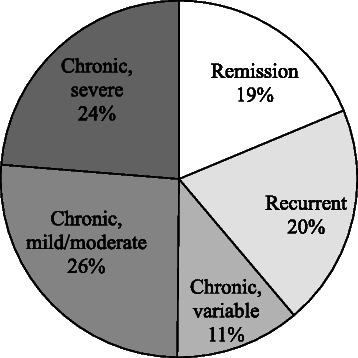
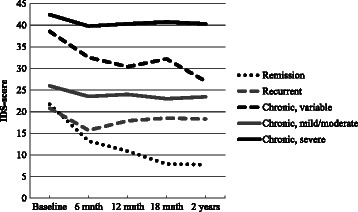
BACKGROUND: We aimed to examine the course of depression during 2-year follow-up in a group clinically depressed older persons. Subsequently, we studied which socio-demographic and clinical characteristics predict a depression diagnoses at 2-year follow-up. METHODS: Data were used from the Netherlands Study of Depression in Older persons (NESDO; N = 510). Diagnoses of depression DSM-IV-TR criteria were available from 285 patients at baseline and at 2-year follow-up. Severity of the depressive symptoms, as assessed with the Inventory of Depressive Symptoms (IDS), was obtained from 6-monthly postal questionnaires. Information about socio-demographic and clinical variables was obtained from the baseline measurement. RESULT: From the 285 older persons who were clinically depressed at baseline almost half (48.4%) also suffered from a depressive disorder two years later. Patients with more severe depressive symptoms, comorbid dysthymia, younger age of onset and more chronic diseases were more likely to be depressed at 2-year follow-up. 61% of the persons that were depressed at baseline had a chronic course of depressive symptoms during these two years. CONCLUSIONS: Late-life depression often has a chronic course, even when treated conform current guidelines for older persons. Our results suggest that physical comorbidity may be candidate for adjusted and intensified treatment strategies of older depressed patients with chronic and complex pathology.
Overview
The claims and statistics of this paper haven’t been checked yet.
Run the check — free, no account needed. It reads the open-access text and checks the sources it cites.
Integrity signals
Registry
Cites
Statistics
Figures
Verification
Claims the paper makes
The claims and statistics of this paper haven’t been checked yet.
Run the check — free, no account needed. It reads the open-access text and checks the sources it cites.
Claims other papers make about this one
Each is checked against this paper’s own text: does it say what the citing paper says it does?
In the citing paper
“The idiom 'thinking too much' denotes a broader mental health syndrome, with manifestations such as sadness, lack of motivation, poor concentration, sleep difficulties and irritability, perhaps similar to the construct of 'common mental disorders'. 112-117”
From Time for united action on depression: a Lancet–World Psychiatric Association Commission (2022) · cites this paper as [115]
Self-check
Percentages, sums and reported differences re-computed from the paper’s own numbers.
The self-check needs the paper’s full text.
Citations
Cites
Diagnostic and Statistical Manual of Mental Disorders
Williams, J. B. W., & First, M. B. (2013) · Oxford University Press eBooks · doi:10.1093/acrefore/9780199975839.013.104 · Cited by 109,845
Folstein, M. F., Folstein, S. E., & McHugh, P. R. (1975) · Journal of Psychiatric Research · doi:10.1016/0022-3956(75)90026-6 · Cited by 88,282
Hirono, N., Mori, E., Ikejiri, Y., Imamura, T., Shimomura, T., Hashimoto, M., Yamashita, H., & Ikeda, M. (1997) · PubMed · Cited by 21,012
Kok, J. S., Berg, I. J., & Scherder, E. J. A. (2013) · Dementia and Geriatric Cognitive Disorders Extra · doi:10.1159/000353441 · Cited by 20,589
Older Adults' Reasons for Using Technology while Aging in Place
Peek, S. T. M., Luijkx, K. G., Rijnaard, M. D., Nieboer, M. E., van der Voort, C. S., Aarts, S., van Hoof, J., Vrijhoef, H. J., & Wouters, E. (2015) · Gerontology · doi:10.1159/000430949 · Cited by 19,852
Diagnostic and Statistical Manual of Mental Disorders.
Widiger, T. A. (2000) · Oxford University Press eBooks · doi:10.1037/10518-009 · Cited by 19,766
Sensitivity and False Alarm Rate of a Fall Sensor in Long-Term Fall Detection in the Elderly
Kangas, M., Korpelainen, R., Vikman, I., Nyberg, L., & Jämsä, T. J. (2014) · Gerontology · doi:10.1159/000362720 · Cited by 19,007
The Epidemiology of Depression Across Cultures
Kessler, R. C., & Bromet, E. J. (2013) · Annual Review of Public Health · doi:10.1146/annurev-publhealth-031912-114409 · Cited by 2,657 · cited 1×
“Background Late-life depression is a complex mood disorder with various etiological pathways [1] and high comorbidity with psychiatric and physical diseases, and cognitive decline [2-5].”
BackgroundThe Inventory of Depressive Symptomatology (IDS): Psychometric properties
Rush, A. J., Gullion, C. M., Basco, M. R., Jarrett, R. B., & Trivedi, M. H. (1996) · Psychological Medicine · doi:10.1017/s0033291700035558 · Cited by 2,177 · cited 1×
“Severity of the depressive symptoms was assessed with the Inventory of Depressive Symptoms (IDS) [27].”
MethodTRIVEDI, M. H., RUSH, A. J., IBRAHIM, H. M., CARMODY, T. J., BIGGS, M. M., SUPPES, T., CRISMON, M. L., SHORES-WILSON, K., TOPRAC, M. G., DENNEHY, E. B., et al. (2004) · Psychological Medicine · doi:10.1017/s0033291703001107 · Cited by 968
Cited by
Sorted by citations
Time for united action on depression: a Lancet–World Psychiatric Association Commission
Herrman, H., Patel, V., Kieling, C., Berk, M., Buchweitz, C., Cuijpers, P., Furukawa, T. A., Kessler, R. C., Kohrt, B. A., Maj, M., et al. (2022) · The Lancet · doi:10.1016/s0140-6736(21)02141-3 · Cited by 1,104
Depression Among Older Adults: A 20-Year Update on Five Common Myths and Misconceptions
Haigh, E. A. P., Bogucki, O. E., Sigmon, S. T., & Blazer, D. G. (2017) · American Journal of Geriatric Psychiatry · doi:10.1016/j.jagp.2017.06.011 · Cited by 345
As, B. A. L. V., Imbimbo, E., Franceschi, A., Menesini, E., & Nocentini, A. (2021) · International Psychogeriatrics · doi:10.1017/s1041610221000399 · Cited by 203
Kaster, T. S., Daskalakis, Z. J., Noda, Y., Knyahnytska, Y., Downar, J., Rajji, T. K., Levkovitz, Y., Zangen, A., Butters, M. A., Mulsant, B. H., et al. (2018) · Neuropsychopharmacology · doi:10.1038/s41386-018-0121-x · Cited by 174
Holvast, F., Burger, H., de Waal, M. M. W., van Marwijk, H. W. J., Comijs, H. C., & Verhaak, P. F. M. (2015) · Journal of Affective Disorders · doi:10.1016/j.jad.2015.06.036 · Cited by 164
Self-citation
Metadata
- Authors
- Comijs, H. C., Nieuwesteeg, J., Kok, R., van Marwijk, H. W., van der Mast, R. C., Naarding, P., Voshaar, R. C. O., Verhaak, P., de Waal, M. W., & Stek, M. L.
- Affiliations
- Amsterdam Public Health (NL)
- GGZ inGeest (NL)
- Parnassia Groep (NL)
- GGNet (NL)
- University Medical Center Groningen (NL)
- Corresponding author
- Comijs, Hannie C
- Venue
- BMC Psychiatry
- Published
- 2015-02-12
- Volume
- 15
- Issue
- 1
- Pages
- 20-20
- ISSN
- 1471-244X (ISSN-L)
- PMC
- PMC4329675
- OpenAlex
- W2059949121
- Cited by
- 136
- References
- 47
- Citations by year
- 2026: 4 · 2025: 9 · 2024: 4 · 2023: 10 · 2022: 15 · 2021: 19 · 2020: 9 · 2019: 16 · 2018: 19 · 2017: 14 · 2016: 14 · 2015: 3
- FWCI
- 17.81
- Type
- journal article
- Language
- en
- Open access
- gold
- doi.org
- Locations
- BMC Psychiatry (publishedVersion, cc-by)
- Europe PMC (PubMed Central) (publishedVersion, cc-by)
- PubMed Central (publishedVersion, cc-by)
- PubMed (publishedVersion)
- Amsterdam UMC (VU Amsterdam) - Institutional Repository (publishedVersion)
- University of Groningen research database (University of Groningen / Centre for Information Technology) (publishedVersion, cc-by)
- Data Archiving and Networked Services (DANS) (submittedVersion)
- Data Archiving and Networked Services (DANS) (submittedVersion, other-oa)
- Leiden Repository (Leiden University) (submittedVersion)
- Pure Amsterdam UMC (submittedVersion, other-oa)
- Research Explorer (The University of Manchester) (submittedVersion)
- University of Groningen research database (University of Groningen / Centre for Information Technology) (submittedVersion, cc-by)
- Funders
- Vrije Universiteit Amsterdam
- Fonds NutsOhra (0701-065, project 0701‐065)
- Topics
- Health Sciences › Medicine › Public Health, Environmental and Occupational Health › Aging, Health, and Disability
- Health Sciences › Medicine › Psychiatry and Mental health › Mental Health Treatment and Access
- Social Sciences › Psychology › Experimental and Cognitive Psychology › Anxiety, Depression, Psychometrics, Treatment, Cognitive Processes
- Keywords
- geriatric depression, course of depression, older adults, chronic depression, depression severity, dysthymia, age of onset, comorbidities, chronic physical illness, predictors of recurrence
- MeSH terms
- Aged, Aged, 80 and over, Chronic Disease, Depression, Depressive Disorder, Female, Humans, Male, Middle Aged, Netherlands, Personality Inventory, Surveys and Questionnaires, Recurrence, Comorbidity, Treatment Outcome, Dysthymic Disorder
About these checks
Registry, retraction, Cites and statistics results are computed, not judged, with one exception: a printed reference that no index lists is read once by a model before it counts as a citation error. Claims are extracted by a model and kept only when their quote appears verbatim in the text; each cited source is then checked, with a model’s help, for whether it says what the claim relies on. Those verdicts can be wrong — read the claim’s quote and the cited source before relying on one.
Statistics and arithmetic are recomputed, not judged.
Confidence bands are shown only for fields calibrated on our annotated test set. None is calibrated yet, so no band is shown.
What counts as a claim ›How we measure confidence ›How we check this ›
Are you an author, or do you see a problem with this page? Request a review
