

Community-based mental health treatments for survivors of torture and militant attacks in Southern Iraq: a randomized control trial
Open accessThe DOI matches its Crossref record; 52 of the 54 references it cites were found in a registry or an index.
Abstract
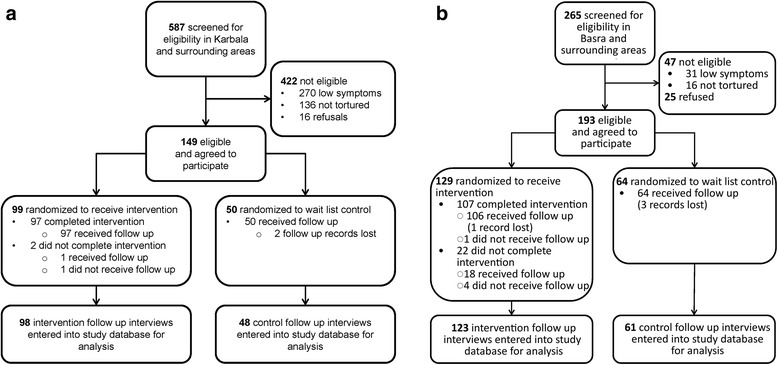
BACKGROUND: Systematic violence is a long-standing problem in Iraq. Research indicates that survivors often experience multiple mental health problems, and that there is a need for more rigorous research that targets symptoms beyond post-traumatic stress (PTS). Our objective was to test the effectiveness of two counseling therapies in Southern Iraq in addressing multiple mental health problems among survivors of systematic violence: (1) a transdiagnostic intervention (Common Elements Treatment Approach or CETA); and (2) cognitive processing therapy (CPT). The therapies were provided by non-specialized health workers since few MH professionals are available to provide therapy in Iraq. METHODS: This was a randomized, parallel, two site, two-arm (1:1 allocation), single-blinded, wait-list controlled (WLC) trial of CETA in one site (99 CETA, 50 WLC), and CPT in a second site (129 CPT, 64 WLC). Eligibility criteria were elevated trauma symptoms and experience of systematic violence. The primary and secondary outcomes were trauma symptoms and dysfunction, respectively, with additional assessment of depression and anxiety symptoms. Non-specialized health workers (community mental health worker, CMHW) provided the interventions in government-run primary health centers. Treatment effects were determined using longitudinal, multilevel models with CMHW and client as random effects, and a time by group interaction with robust variance estimation, to test for the net difference in mean score for each outcome between the baseline and follow up interview. Multiple imputation techniques were used to account for missingness at the item level and the participant level. All analyses were conducted using Stata 12. RESULTS: The CETA intervention showed large effect sizes for all outcomes. The CPT intervention showed moderate effects sizes for trauma and depression, with small to no effect for anxiety or dysfunction, respectively. CONCLUSIONS: Both CETA and CPT appear to benefit survivors of systematic violence in Southern Iraq by reducing multiple mental health symptoms, with CETA providing a very large benefit across a range of symptoms. Non-specialized health workers were able to treat comorbid symptoms of trauma, depression and anxiety, and dysfunction among survivors of systematic violence who have limited access to mental health professionals. The trial further supports the use of evidence-based therapies in lower-resource settings. TRIAL REGISTRATION AND PROTOCOL: This trial was registered at ClinicalTrials.gov on 16 July 2010 with an identifier of NCT01177072 as the Study of Effectiveness of Mental Health Interventions among Torture Survivors in Southern Iraq. The study protocol can be downloaded from the following website: http://tinyurl.com/CETA-Iraq-Protocol . In the protocol, the CETA intervention is given a different name: components-based intervention or CBI.
Overview
The claims and statistics of this paper haven’t been checked yet.
Free: it reads the open-access text and checks the first 5 claims that cite a source we can check. Create a free account to check every claim.
Integrity signals
Registry
Cites
Statistics
Figures
Verification
Claims the paper makes
The claims and statistics of this paper haven’t been checked yet.
Free: it reads the open-access text and checks the first 5 claims that cite a source we can check. Create a free account to check every claim.
Claims other papers make about this one
Each is checked against this paper’s own text: does it say what the citing paper says it does?
The source backs part of the claim, not all of it — or backs it for a different population, condition or comparison.
In the citing paper
“RCTs for the CETA conducted in Thailand [32], Zambia [33], Iraq [34], Iraqi Kurdistan [35], Colombia [36], and Somalia [37] have all indicated significant positive effects on mental health outcomes for men, women and children.”
From Psychological Interventions for Survivors of Intimate Partner Violence in Humanitarian Settings: An Overview of the Evidence and Implementation Considerations (2022) · cites this paper as [34]
Experimental — accuracy not yet measuredThe cited source says what the claim attributes to it.
In the citing paper
“Task sharing with non-specialists has been a key strategy 5 also in humanitarian settings. 5-7”
From Guided self-help to reduce psychological distress in South Sudanese female refugees in Uganda: A cluster randomised trial (2020) · cites this paper as [6]
The cited source says what the claim attributes to it.
In the citing paper
“others have used a modular approach that tailors key strategies to the primary problems that a person is experiencing 190,191 .”
From Post‐traumatic stress disorder: a state‐of‐the‐art review of evidence and challenges (2019) · cites this paper as [190]
Self-check
Percentages, sums and reported differences re-computed from the paper’s own numbers.
The self-check needs the paper’s full text.
Citations
Cites
Statistical Power Analysis for the Behavioral Sciences
Muller, K. (1989) · Technometrics · doi:10.1080/00401706.1989.10488618 · Cited by 99,167
Statistical power analysis for the behavioral sciences
(1990) · Computers, Environment and Urban Systems · doi:10.1016/0198-9715(90)90050-4 · Cited by 65,269
Multiple Imputation for Nonresponse in Surveys
Rubin, D. B. (1987) · Wiley Series in Probability and Statistics · doi:10.1002/9780470316696 · Cited by 20,701
Specification Tests in Econometrics
Hausman, J. A. (1978) · Econometrica · doi:10.2307/1913827 · Cited by 18,820 · cited 1×
“05 [52].”
Multiple imputation by chained equations: what is it and how does it work?
Azur, M. J., Stuart, E. A., Frangakis, C., & Leaf, P. J. (2011) · International Journal of Methods in Psychiatric Research · doi:10.1002/mpr.329 · Cited by 3,542 · cited 1×
“Missing data, including information about participants who were lost to follow-up, were imputed using STATA’s chained equations command for multiple imputation (MI) using Rubin’s rules for pooling data [50, 51].”
MethodSteel, Z., Chey, T., Silove, D., Marnane, C., Bryant, R. A., & van Ommeren, M. (2009) · JAMA · doi:10.1001/jama.2009.1132 · Cited by 2,246 · cited 1×
“[6] found that those who reported torture had twice the odds of posttraumatic stress disorder (PTSD) and one and half times the odds of depression.”
BackgroundMollica, R. F., Caspi-Yavin, Y., Bollini, P., Truong, T., Tor, S., & Lavelle, J. (1992) · PubMed · Cited by 1,551
Cognitive processing therapy for sexual assault victims.
Resick, P. A., & Schnicke, M. K. (1992) · Journal of Consulting and Clinical Psychology · doi:10.1037/0022-006x.60.5.748 · Cited by 1,490 · cited 1×
“Cognitive Processing Therapy (CPT) is an evidencedbased cognitive behavioral psychotherapy originally developed for treatment of PTS or PTS with comorbid depression [40, 41].”
BackgroundMOLLICA, R. F., CASPI-YAVIN, Y., BOLLINI, P., TRUONG, T., TOR, S., & LAVELLE, J. (1992) · The Journal of Nervous and Mental Disease · doi:10.1097/00005053-199202000-00008 · Cited by 1,489 · cited 1×
“The study instrument included the symptom section of the Harvard Trauma Questionnaire (HTQ) to assess trauma symptoms, the Hopkins Symptom Checklist for Depression and Anxiety (HSCL-25), and a separate section containing 20 frequently mentioned mental health symptoms from the qualitative study (described above) not al…”
MethodResick, P. A., Nishith, P., Weaver, T. L., Astin, M. C., & Feuer, C. A. (2002) · Journal of Consulting and Clinical Psychology · doi:10.1037/0022-006x.70.4.867 · Cited by 1,294 · cited 1×
“The therapy has been highly effective at reducing symptoms of PTS, depression, and anxiety across several RCTs and efficacy studies across a range of trauma exposed populations including sexual assault, child sexual abuse, domestic violence, and combat [25, 41–45].”
Background
Research works printed but not linked: 10
- 3. International A. Iraq: a decade of abuses. London: Amnesty International; 2013.
- 4. Human Rights Watch. The road to Abu Ghraib. New York City, United States: Human Rights Watch; 2004.
- 27. Applied Mental Health Research Group. Design, implementation monitoring, and evaluation of mental health and psychosocial assistance programs for trauma survivors in Low resource countries: a user's manual for researchers and program implementers (adult version), Module 1: qualitative assessment. United States: Johns Hopkins University Bloomberg School of Public Health; 2013.
- 29. Weiss W, Bolton P. Qualitative assessment of persons affected by torture and related violence in Southern Iraq: a research report of the Johns Hopkins University and Heartland Alliance International. 2010.
- 31. Hesbacher PT, Rickels K, Morris RJ, Newman H, Rosenfeld H. Psychiatric illness in family practice. J Clin Psychiatry. 1980;41:6-10.
- 33. Applied Mental Health Research Group. Design, implementation monitoring, and evaluation of mental health and psychosocial assistance programs for trauma survivors in Low resource countries: a user's manual for researchers and program implementers (adult version), Module 2: developing quantitative tools. United States: Johns Hopkins University Bloomberg School of Public Health; 2013.
- 34. Weiss W, Bolton P. Assessment of torture survivors in Southern Iraq - development and testing of a locally-adapted psychosocial assessment instrument. A research report of the Johns Hopkins University and Heartland Alliance international. 2010.
- 35. Nunnally JC. Psychometric theory. New York: McGraw-Hill; 1978.
- 39. Applied Mental Health Research Group. Design, implementation monitoring, and evaluation of mental health and psychosocial assistance programs for trauma survivors in low resource countries: a user's manual for researchers and program implementers (adult version), Module 5: intervention selection, adaptation, and implementation. United States: Johns Hopkins University Bloomberg School of Public Health; 2013.
- 49. StataCorp. Stata statistical software: release 12. College Station, TX: StataCorp LP; 2011.
Cited by
Items 101–200 of 211
From delivery science to discovery science: realising the full potential of global mental health
Patel, V. (2016) · Epidemiology and Psychiatric Sciences · doi:10.1017/s2045796016000263 · Cited by 13
“A recent series of trials of trans-diagnostic psychological treatments for people affected by conflict in Thailand and Iraq based on common elements of psychotherapy is an example of how innovations delivered in very resource-poor settings are helping us redesign psychological treatments for all (Bolton et al. 2014; W…”
Nguyen, A. J., Russell, T., Skavenski, S. V. W., Bogdanov, S., Lomakina, K., Іванюк, І. В., Aldridge, L. R., Bolton, P. A., Murray, L. K., & Bass, J. (2023) · Global Health Science and Practice · doi:10.9745/ghsp-d-22-00488 · Cited by 13
Self-citationMcEwen, F. S., Khatib, H. E., Hadfield, K., Pluess, K., Chehade, N., Bosqui, T. J., Skavenski, S. V. W., Murray, L. K., Weierstall‐Pust, R., Karam, E. G., et al. (2024) · Conflict and Health · doi:10.1186/s13031-023-00565-2 · Cited by 11
Self-citationDas, S., Grant, L., & Fearon, D. (2025) · Critical Public Health · doi:10.1080/09581596.2025.2501495 · Cited by 10
“From 2014 onwards, researchers published extensively on tS/S’s merits in MH management, showing how non-specialists effectively delivered care in low-resource settings (Atif et al., 2016; weiss et al., 2015).”
Mahmooth, Z., Weiss, W. M., Zangana, G. A. S., & Bolton, P. A. (2018) · Cambridge Prisms Global Mental Health · doi:10.1017/gmh.2018.11 · Cited by 10
Self-citationMeza, R. D., Kiche, S. W., Soi, C., Khairuzzaman, A. N., Nales, C. J. R., Whetten, K., Wasonga, A. I., Amanya, C., & Dorsey, S. (2020) · Cambridge Prisms Global Mental Health · doi:10.1017/gmh.2020.9 · Cited by 12
“For instance, funds have been provided for communication between counselors and their supervisors when clinical emergencies arose and to contact participants for follow-up (e.g. Murray et al., 2013b; Weiss et al., 2015).”
BackgroundSelf-citationFabian, K. E., Muanido, A., Cumbe, V., Mukunta, C., Manaca, N., Dorsey, S., Hammett, W. H., & Wagenaar, B. H. (2021) · JAIDS Journal of Acquired Immune Deficiency Syndromes · doi:10.1097/qai.0000000000002863 · Cited by 12
Self-citationIto, M., Horikoshi, M., Resick, P. A., Katayanagi, A., Miyamae, M., Takagishi, Y., Takebayashi, Y., Kanie, A., Hirabayashi, N., & Furukawa, T. A. (2017) · BMJ Open · doi:10.1136/bmjopen-2016-014292 · Cited by 10
“15 18 19 Because both patients and therapists are reluctant to directly remember or confront the details of a traumatic experience using techniques similar to imaginal exposure as PTSD treatments, determining the efficacy of cogni-tive-only CPT is crucial.”
BackgroundCognitive behavioral therapy around the globe
Kuo, C. (2019) · Elsevier eBooks · doi:10.1016/b978-0-12-814932-4.00005-7 · Cited by 11
Triplett, N. S., Mbwayo, A., Kiche, S. W., Liu, L., Silva, J., AlRasheed, R., Johnson, C. M., Amanya, C., Munson, S. A., Weiner, B. J., et al. (2023) · Cambridge Prisms Global Mental Health · doi:10.1017/gmh.2023.23 · Cited by 12
“Though less research has examined mobile phone and digital technology use in task-shifting, a large body of research has examined the challenges and opportunities of mobile phone use in LMIC (Kusimba et al., 2015; Murphy and Priebe, 2017; Wyche and Olson, 2018).”
BackgroundInfluentialSelf-citationNguyen, A. J., Rykiel, N. A., Murray, L. K., Amin, A., Haroz, E. E., Lee, C., & Bolton, P. A. (2019) · International Journal of Mental Health Systems · doi:10.1186/s13033-019-0330-7 · Cited by 10
Self-citationFigge, C. J., Kane, J. C., Skavenski, S. V. W., Haroz, E. E., Mwenge, M., Munthali, S., Aldridge, L. R., Vinikoor, M. J., Sharma, A., Inoue, S., et al. (2022) · Trials · doi:10.1186/s13063-022-06319-4 · Cited by 9
Self-citationTransdiagnostic therapeutic approaches: A global perspective
Murray, L. K., Metz, K. L., & Callaway, K. L. (2019) · Elsevier eBooks · doi:10.1016/b978-0-12-814932-4.00002-1 · Cited by 9
Self-citationTierney, D. W., Bolton, P. A., Matanu, B., Garasu, L., Barnabas, E., & Silove, D. M. (2016) · International Journal of Mental Health Systems · doi:10.1186/s13033-016-0054-x · Cited by 12
Self-citationHammett, W. H., Muanido, A., Cumbe, V., Mukunta, C., Manaca, N., Hicks, L., Dorsey, S., Fabian, K. E., & Wagenaar, B. H. (2022) · AIDS Care · doi:10.1080/09540121.2022.2039356 · Cited by 8
“CETA includes flexibility to address specific co-morbid CMDs and the intervention has been successful in reducing the symptoms and disability associated with CMDs in several LMICs, including Iraq (Weiss et al., 2015) and Thailand (Bolton et al., 2014).”
BackgroundSelf-citationGalovski, T. E., Wachen, J. S., Chard, K. M., & Monson, C. M. (2022) · Springer eBooks · doi:10.1007/978-3-030-97802-0_10 · Cited by 8
Pluess, M., McEwen, F. S., Biazoli, C. E., Chehade, N., Bosqui, T. J., Skavenski, S. V. W., Murray, L. K., Weierstall‐Pust, R., Bolton, P. A., & Karam, E. G. (2024) · Conflict and Health · doi:10.1186/s13031-024-00616-2 · Cited by 8
Self-citationBentley, J. A., & Dolezal, M. L. (2018) · Journal of Immigrant & Refugee Studies · doi:10.1080/15562948.2018.1480824 · Cited by 8
Cognitive Processing Therapy for Posttraumatic Stress Disorder in Japan: A Randomized Clinical Trial
Ito, M., Katayanagi, A., Miyamae, M., Inomata, T., Takagishi, Y., Kikuchi, A., Makino, M., Matsuda, Y., Yamaguchi, K., Nakayama, C., et al. (2025) · JAMA Network Open · doi:10.1001/jamanetworkopen.2024.58059 · Cited by 10
Hagerty, S. L., Wielgosz, J., Kraemer, J., Nguyen, H. V., Loew, D. E., & Kaysen, D. L. (2020) · Journal of Traumatic Stress · doi:10.1002/jts.22583 · Cited by 8
Self-citationReinhardt, I., Schmidt, L., Reske, D., Zielasek, J., Braun, G., Böttche, M., Boettcher, J., Burchert, S., Glaesmer, H., Knaevelsrud, C., et al. (2023) · BMC Health Services Research · doi:10.1186/s12913-023-10403-z · Cited by 6
Promotion of Mental Health: A Gender Perspective
Bolea-Alamanac, B. M. (2017) · Springer eBooks · doi:10.1007/978-3-319-59123-0_13 · Cited by 7
A qualitative study of mental health problems among children living in New Delhi slums
Martin, P., Haroz, E. E., Lee, C., Bolton, P. A., Martin, K., Meza, R. D., McCarthy, E., & Dorsey, S. (2024) · Transcultural Psychiatry · doi:10.1177/13634615231202098 · Cited by 6
“…interventions that have been adapted and successfully delivered in LMICs include the Common Elements Treatment Approach (CETA; Bolton et al., 2014; Murray et al., 2014, 2018; Weiss et al., 2015) and Problem Management Plus (PM + ; Dawson et al., 2015; Rahman et al., 2016; Sijbrandij et al., 2016).”
MethodSelf-citationPsychiatry in the 21st century: the glass is half full
Unützer, J. (2022) · World Psychiatry · doi:10.1002/wps.21005 · Cited by 6
Park, S., Cubillos, L., Martínez‐Camblor, P., Bartels, S. M., Torrey, W. C., John, D. T., Cepeda, M., Bell, K. R., Castro, S., Suárez‐Obando, F., et al. (2023) · Psychiatric Services · doi:10.1176/appi.ps.20220267 · Cited by 7
Castelfranc-Allen, J., & Hope, L. (2018) · Psychiatry Psychology and Law · doi:10.1080/13218719.2018.1474814 · Cited by 6
“Future work should comprise a larger field trial or, ideally, a randomized controlled trial with diverse traumatized populations in order to document the clinical performance of the narrative graph in combination with its therapeutic component (e.g. following Weiss et al., 2015).”
BackgroundLow Intensity Interventions for Psychological Symptoms Following Mass Trauma
Dawson, K. S., & Rahman, A. (2018) · Springer eBooks · doi:10.1007/978-3-319-97046-2_17 · Cited by 8
Bruno, W., Tringale, K. R., & Al‐Delaimy, W. K. (2020) · Journal of International Humanitarian Action · doi:10.1186/s41018-020-00081-5 · Cited by 6
“While the HSCL-25 has been shown to be useful in non-western refugee patients, prior investigations have varied in the robustness of using the standard cutoffs in Iraqi and Somali patients (Wind et al. 2017; Weiss 2015; Taylor et al 2014).”
ResultAn equivalence analysis of provider education in youth mental health care
McGuier, E. A., Rothenberger, S. D., Friedman, A. L., & Kolko, D. J. (2021) · Health Services Research · doi:10.1111/1475-6773.13659 · Cited by 6
Pascoe, S. J. S., Fox, M. P., Kane, J. C., Mngadi-Ncube, S., Manganye, P., Long, L. C., Metz, K. L., Allen, T., Sardana, S. M., Greener, R., et al. (2022) · BMJ Open · doi:10.1136/bmjopen-2022-065848 · Cited by 5
Self-citationvan Stolk‐Cooke, K., Price, M., Dyar, C., Zimmerman, L., & Kaysen, D. L. (2024) · European Journal of Psychotraumatology · doi:10.1080/20008066.2023.2287911 · Cited by 5
“In their examination of PTSD and trauma-related di ffi culties in SMW and heterosexual women, Weiss and colleagues (Weiss et al., 2015) found that high levels of social support were associated with reduced PTSD symptom severity in both SMW and heterosexual women, while low levels of support were…”
BackgroundSelf-citationScaling up and implementing psychotherapies in low-resource settings
Bass, J., & Hamdani, S. U. (2019) · Elsevier eBooks · doi:10.1016/b978-0-12-814932-4.00004-5 · Cited by 5
Self-citationLópez‐Castro, T., Sohler, N., Riback, L. R., Bravo, G., Ohlendorf, E., Ghiroli, M. M., & Fox, A. D. (2024) · Harm Reduction Journal · doi:10.1186/s12954-024-01019-5 · Cited by 6
“PTSD treatments have demonstrated efficacy when delivered in a variety of low-resource settings where exposure to adversity and violence may be chronic and ongoing [50–52].”
BackgroundKane, J. C., Kamanga, M., Skavenski, S. V. W., Murray, L. K., Shawa, M., Bwalya, B., Metz, K. L., Paul, R., Mushabati, N., Ventevogel, P., et al. (2023) · Intervention · doi:10.4103/intv.intv_21_22 · Cited by 5
“…anxiety, trauma symptoms, functional impairment and unhealthy alcohol use (Bogdanov et al., 2021; Bonilla-Escobar et al., 2018; Kane et al., 2022; Murray et al., 2014, 2020; Weiss et al., 2015) (www.cetaglobal.org), including with displaced populations (Bolton et al., 2014; Murray et al., 2018).”
BackgroundSelf-citationPsychotherapy for refugees and other populations exposed to conflict
Silove, D. M., Tay, A. K., & Rees, S. J. (2019) · Elsevier eBooks · doi:10.1016/b978-0-12-814932-4.00016-1 · Cited by 5
Gagnon, K. W., Levy, S. M., Figge, C. J., Wolford‐Clevenger, C., Murray, L. K., Kane, J. C., Bosomprah, S., Sharma, A., Nghiem, V. T. H., Chitambi, C., et al. (2023) · Contemporary Clinical Trials Communications · doi:10.1016/j.conctc.2023.101123 · Cited by 4
Self-citationDarnell, D. A., Ranna-Stewart, M., Psaros, C., Filipowicz, T., Grimes, L., Henderson, S., Parman, M. A., Gaddis, K., Gaynes, B. N., Mugavero, M. J., et al. (2023) · JMIR Formative Research · doi:10.2196/45106 · Cited by 3
“82) symptoms relative to a waitlist control (n=50) [11].”
Self-citationOutcomes of an individual counselling programme in Grozny, Chechnya: a randomised controlled study
Lenglet, A., Lopes-Cardozo, B., Shanks, L., Blanton, C., Feo, C., Tsatsaeva, Z., Idrisov, K. A., Bolton, P. A., & Pintaldi, G. (2018) · BMJ Open · doi:10.1136/bmjopen-2017-019794 · Cited by 3
“Moderate to high improvements in the intervention group compared with the waitlisted group on these outcomes were measured using CETA in Burmese refugees in Thailand and in Iraqi Kurdistan.12 14 In contrast, mixed results from group problem-solving counselling in terms of functioning were observed in war-affected adul…”
ResultSelf-citationPractice Responses to Climigration
Palinkas, L. A. (2020) · Springer eBooks · doi:10.1007/978-3-030-41890-8_9 · Cited by 3
Metz, K. L., Figge, C. J., Alto, M. E., Kane, J. C., & Murray, L. K. (2021) · Springer eBooks · doi:10.1007/978-3-030-57296-9_145 · Cited by 2
Self-citationRussette, H., Grubin, F., Ingalls, A., Martin, L., Leonard, A., Kushman, E., Cisler, A., Leffler, E., Herman, A., & Haroz, E. (2022) · Infant Mental Health Journal · doi:10.1002/imhj.22012 · Cited by 2
Lasater, M. E., Kanguya, T., Chipungu, J., Kane, J. C., Skavenski, S. V. W., Murray, L. K., Vinikoor, M. J., & Sharma, A. (2023) · SSM - Mental Health · doi:10.1016/j.ssmmh.2023.100195 · Cited by 2
Self-citationMassazza, A., Eaton, J., Elshazly, M., Charlson, F., & Augustinavicius, J. (2022) · Intervention · doi:10.4103/intv.intv_30_21 · Cited by 4
Röhr, A.-K., Kohn, N., Bergs, R., Clemens, B., Lampert, A., Spehr, M., Habel, U., & Wagels, L. (2024) · Scientific Reports · doi:10.1038/s41598-024-57585-y · Cited by 2
“Many survivors suffer from multiple mental health problems that benefit from a trans-diagnostic treatment approach 15–17 .”
Fine, S. L., Augustinavicius, J., Barnabas, E., Poli, M. K., Tierney, D. W., & Bolton, P. A. (2024) · Journal of Pacific Rim Psychology · doi:10.1177/18344909241249593 · Cited by 2
“Notably, similar CBT-based transdiagnostic interventions have been used in a number of post-con fl ict settings to effectively address a range of mental health issues, including anxiety, depression, and PTSD (Bolton et al., 2014; Weiss et al., 2015).”
Self-citationPsychotherapy adaptation for children and adolescents
Dorsey, S., Lucid, L., Leith, J., Eise, L. M., Amanya, C., & Dong, L. X. (2019) · Elsevier eBooks · doi:10.1016/b978-0-12-814932-4.00013-6 · Cited by 1
Self-citationBoettcher, J., Heinrich, M., Boettche, M., Burchert, S., Glaesmer, H., Gouzoulis‐Mayfrank, E., Heeke, C., Hernek, M., Knaevelsrud, C., Konnopka, A., et al. (2024) · Trials · doi:10.1186/s13063-023-07845-5 · Cited by 1
“We assumed that the difference between active treatment and waitlist conditions is between d = 0.6–0.8 [30].”
BackgroundMethodInfluentialKaysen, D. L., & Vega, L. (2025) · CBT: science into practice · doi:10.1007/978-3-031-87356-0_12 · Cited by 1
Self-citationRangel, R., Brown, A. D., Galea, J. T., Rai, S., Ross, N., Raji, M., Shrestha, P., Cheng, B., Akellot, J., & Kohrt, B. A. (2025) · PLOS Global Public Health · doi:10.1371/journal.pgph.0005123 · Cited by 1
“Standard CETA consists of 8–12 sessions (each 50–60 minutes long), and a five-session brief version has been trialed in Ukraine; however, the results are pending [81,84].”
InfluentialMiller, A. P., Nakigozi, G. F., Menya, E., Figge, C. J., Lukwata, H., Byansi, W., Mugamba, S., Tuhebwe, D., Murray, L. K., Nalugoda, F. K., et al. (2025) · SSM - Mental Health · doi:10.1016/j.ssmmh.2025.100569 · Cited by 1
“…anxiety, trauma, violence, functional impairment, unhealthy alcohol use, and risky behaviors has been established in over 6 randomized trials (Bogdanov et al., 2021; Bolton et al., 2014; Murray et al., 2018; Murray et al., 2020; Weiss et al., 2015), in addition to multiple other implementations.”
Self-citationChadha, A. (2025) · Journal of Underrepresented & Minority Progress · doi:10.32674/07c02q68 · Cited by 1
Zheng, A., Kane, J. C., Mngadi-Ncube, S., Fox, M. P., Manganye, P., Long, L. C., Metz, K. L., Sardana, S. M., Alto, M. E., Greener, R., et al. (2026) · BMJ Mental Health · doi:10.1136/bmjment-2025-302246 · Cited by 1
Self-citationPatel, A., Ramirez, G., Fernandes, L., Bariya-Sousa, A., McGuinness, E., Taha, S., Biswal, B., Awasthi, A., Wilson, D., Dixon, K. E., et al. (2026) · The Lancet Psychiatry · doi:10.1016/s2215-0366(26)00123-9 · Cited by 2
Bolton, P. A. (2018) · Springer eBooks · doi:10.1007/978-3-319-97046-2_18 · Cited by 1
Self-citationTreatment development: The early years
Galovski, T. E., Nixon, R. D. V., & Kaysen, D. L. (2020) · Elsevier eBooks · doi:10.1016/b978-0-12-816715-1.00003-0 · Cited by 1
Self-citationIncorporating Case Formulation into the Delivery of Cognitive Processing Therapy
Galovski, T. E., McSweeney, L. B., & Galovski, S. E. (2025) · CBT: science into practice · doi:10.1007/978-3-031-87356-0_15 · Cited by 1
Aladro, C. P. (2020) · Arrow@dit (Dublin Institute of Technology) · Cited by 1
Review: Scalable interventions for refugees — R1/PR10
Bryant, R. A. (2022) · Cambridge Prisms Global Mental Health · doi:10.1017/gmh.2022.59.pr10 · Cited by 1
Author comment: Scalable interventions for refugees — R1/PR8
Bryant, R. A. (2022) · Cambridge Prisms Global Mental Health · doi:10.1017/gmh.2022.59.pr8 · Cited by 1
Transdiagnostic Approaches With Children
Temkin, A. B., Yadegar, M., Cho, C., & Chu, B. C. (2018) · Oxford University Press eBooks · doi:10.1093/oxfordhb/9780190634841.013.48
Lund, C., Bemme, D., & Bass, J. (2020) · doi:10.1093/med/9780198713005.003.0003 · Cited by 1
Self-citationApplications of CPT in diverse populations and across cultures
Galovski, T. E., Nixon, R. D. V., & Kaysen, D. L. (2020) · Elsevier eBooks · doi:10.1016/b978-0-12-816715-1.00011-x
Self-citation“When you talk about it, something in your heart becomes lighter”
Sarkadi, A., & Warner, G. (2020) · European Child & Adolescent Psychiatry · doi:10.1007/s00787-020-01538-z · Cited by 1
Development of modified cognitive behavioural therapy for depression in Sri Lanka
Rodrigo, M. D. A. (2020) · Minerva Access (University of Melbourne) · Cited by 1
Historical Origins of Global Mental Health
Kohrt, B. A. (2021) · Springer eBooks · doi:10.1007/978-3-030-66296-7_2
Metz, K. L., Figge, C. J., Alto, M. E., Kane, J. C., & Murray, L. K. (2021) · Springer eBooks · doi:10.1007/978-3-319-70134-9_145-1
Self-citationPsychiatric Comorbidity Populations
Long, L. J., Smith, L. J., & Gallagher, M. W. (2021) · Elsevier eBooks · doi:10.1016/b978-0-12-818697-8.00196-5
Kaysen, D. L., van Stolk‐Cooke, K., Kaminer, D., et al. (2022) · Cambridge Prisms Global Mental Health · doi:10.1017/gmh.2022.63.pr10
Kaysen, D. L. (2022) · Cambridge Prisms Global Mental Health · doi:10.1017/gmh.2022.63.pr8
Self-citationKaysen, D. L., van Stolk‐Cooke, K., Kaminer, D., et al. (2022) · Cambridge Prisms Global Mental Health · doi:10.1017/gmh.2022.63.pr9
Kaysen, D. L., van Stolk‐Cooke, K., Kaminer, D., et al. (2022) · Cambridge Prisms Global Mental Health · doi:10.1017/gmh.2022.63.pr11
Kaysen, D. L., van Stolk‐Cooke, K., Kaminer, D., et al. (2022) · Cambridge Prisms Global Mental Health · doi:10.1017/gmh.2022.63.pr7
Kaysen, D. L., van Stolk‐Cooke, K., Kaminer, D., et al. (2022) · Cambridge Prisms Global Mental Health · doi:10.1017/gmh.2022.63.pr12
Kaysen, D. L., van Stolk‐Cooke, K., Kaminer, D., et al. (2022) · Cambridge Prisms Global Mental Health · doi:10.1017/gmh.2022.63.pr6
Kaysen, D. L., van Stolk‐Cooke, K., Kaminer, D., et al. (2022) · Cambridge Prisms Global Mental Health · doi:10.1017/gmh.2022.63.pr5
Kaysen, D. L. (2022) · Cambridge Prisms Global Mental Health · doi:10.1017/gmh.2022.63.pr1
Self-citationKaysen, D. L., van Stolk‐Cooke, K., Kaminer, D., et al. (2022) · Cambridge Prisms Global Mental Health · doi:10.1017/gmh.2022.63.pr3
Kaysen, D. L., van Stolk‐Cooke, K., Kaminer, D., et al. (2022) · Cambridge Prisms Global Mental Health · doi:10.1017/gmh.2022.63.pr2
Kaysen, D. L., van Stolk‐Cooke, K., Kaminer, D., et al. (2022) · Cambridge Prisms Global Mental Health · doi:10.1017/gmh.2022.63.pr4
Decision: Scalable interventions for refugees — R0/PR7
Bryant, R. A. (2022) · Cambridge Prisms Global Mental Health · doi:10.1017/gmh.2022.59.pr7
Review: Scalable interventions for refugees — R1/PR9
Bryant, R. A. (2022) · Cambridge Prisms Global Mental Health · doi:10.1017/gmh.2022.59.pr9
Recommendation: Scalable interventions for refugees — R0/PR5
Bryant, R. A. (2022) · Cambridge Prisms Global Mental Health · doi:10.1017/gmh.2022.59.pr5
Author comment: Scalable interventions for refugees — R0/PR1
Bryant, R. A. (2022) · Cambridge Prisms Global Mental Health · doi:10.1017/gmh.2022.59.pr1
Review: Scalable interventions for refugees — R0/PR4
Bryant, R. A. (2022) · Cambridge Prisms Global Mental Health · doi:10.1017/gmh.2022.59.pr4
Review: Scalable interventions for refugees — R0/PR3
Bryant, R. A. (2022) · Cambridge Prisms Global Mental Health · doi:10.1017/gmh.2022.59.pr3
Recommendation: Scalable interventions for refugees — R1/PR12
Bryant, R. A. (2022) · Cambridge Prisms Global Mental Health · doi:10.1017/gmh.2022.59.pr12
Review: Scalable interventions for refugees — R1/PR11
Bryant, R. A. (2022) · Cambridge Prisms Global Mental Health · doi:10.1017/gmh.2022.59.pr11
Decision: Scalable interventions for refugees — R0/PR6
Bryant, R. A. (2022) · Cambridge Prisms Global Mental Health · doi:10.1017/gmh.2022.59.pr6
Decision: Scalable interventions for refugees — R1/PR13
Bryant, R. A. (2022) · Cambridge Prisms Global Mental Health · doi:10.1017/gmh.2022.59.pr13
Review: Scalable interventions for refugees — R0/PR2
Bryant, R. A. (2022) · Cambridge Prisms Global Mental Health · doi:10.1017/gmh.2022.59.pr2
Psychological Interventions for Post-traumatic Stress Disorder in Adults
Emmelkamp, P. M. G. (2023) · Springer eBooks · doi:10.1007/978-3-031-34078-9_7
Can Community Health Workers Effectively Provide Cognitive Behavioral Therapy–Based Services?
White, R. (2023) · Oxford University Press eBooks · doi:10.1093/med/9780197548721.003.0043
Individualized Psychotherapy: A Review
Uzun, N. B., & Yorulmaz, O. (2025) · Psikiyatride Guncel Yaklasimlar - Current Approaches in Psychiatry · doi:10.18863/pgy.1518900
The Development and Evolution of Cognitive Processing Therapy
Wachen, J. S., & Galovski, T. E. (2025) · CBT: science into practice · doi:10.1007/978-3-031-87356-0_1
Mevorach, T., de la Fontaine, N., Skavenski, S. V. W., Cohen, A. S., Chokroverty, L., & Benaroya-Milshtein, N. (2025) · Psychiatry Research · doi:10.1016/j.psychres.2025.116757 · Cited by 1
Nguyen, A. J., Russell, T., Skavenski, S. V. W., Bogdanov, S., Pastukhova, A., Lomakina, K., Bolton, P. A., Murray, L. K., & Bass, J. (2025) · Cambridge Prisms Global Mental Health · doi:10.1017/gmh.2025.10065 · Cited by 1
Self-citationMiller, A. P., Mugamba, S., & Kiene, S. M. (2025) · Sustainable development goals series · doi:10.1007/978-3-031-98528-7_7
Bruno, W. J., Tringale, K. R., & Al‐Delaimy, W. K. (2020) · Figshare · doi:10.6084/m9.figshare.13212643
Ryan, G. K., Bauer, A., Endale, T., Qureshi, O., Doukani, A., Pashoja, A. C., Brar, S. K., Eaton, J., & Bass, J. K. (2021) · Figshare · doi:10.6084/m9.figshare.14478527
Self-citation
Metadata
- Authors
- Weiss, W. M., Murray, L. K., Zangana, G. A. S., Mahmooth, Z., Kaysen, D., Dorsey, S., Lindgren, K., Gross, A., Murray, S. M., Bass, J. K., & Bolton, P.
- Affiliations
- Johns Hopkins University (US)
- Heartland Alliance (US)
- University of Washington (US)
- Corresponding author
- Weiss, William M.
- Bolton, Paul
- ORCID
- Venue
- BMC Psychiatry
- Published
- 2015-10-14
- Volume
- 15
- Issue
- 1
- Pages
- 249-249
- ISSN
- 1471-244X (ISSN-L)
- PMC
- PMC4605204
- OpenAlex
- W1900997796
- Semantic Scholar
- fad27238038fabc76a4e09c61f566510be10ef00
- Cited by
- 206
- References
- 54
- Citations by year
- 2026: 5 · 2025: 11 · 2024: 15 · 2023: 14 · 2022: 39 · 2021: 28 · 2020: 28 · 2019: 26 · 2018: 19 · 2017: 11 · 2016: 9
- FWCI
- 16.14
- Type
- journal article
- Language
- en
- Open access
- gold
- doi.org
- Licence
- Locations
- BMC Psychiatry (publishedVersion, cc-by)
- Europe PMC (PubMed Central) (publishedVersion, cc-by)
- PubMed Central (publishedVersion, cc-by)
- PubMed (publishedVersion)
- Funders
- United States Agency for International Development (DFD-A-00-08-00308-00)
- Topics
- Social Sciences › Psychology › Clinical Psychology › Posttraumatic Stress Disorder Research
- Social Sciences › Psychology › Clinical Psychology › Migration, Health and Trauma
- Social Sciences › Psychology › Clinical Psychology › Psychotherapy Techniques and Applications
- Keywords
- community mental health workers, torture survivors, systematic violence, post-traumatic stress, Common Elements Treatment Approach, cognitive processing therapy, transdiagnostic treatment, trauma symptoms, depression, anxiety, comorbid symptoms, resource-limited settings, southern Iraq, primary health centers, waitlist control, multiple imputation, missing data, treatment effectiveness
- MeSH terms
- War Exposure, Adult, Anxiety, Community Mental Health Services, Depression, Female, Humans, Iraq, Male, Middle Aged, Psychotherapy, Torture, Violence, Cognitive Behavioral Therapy, Single-Blind Method, Survivors
About these checks
Registry, retraction, Cites and statistics results are computed, not judged, with one exception: a printed reference that no index lists is read once by a model before it counts as a citation error. Claims are extracted by a model and kept only when their quote appears verbatim in the text; each cited source is then checked, with a model’s help, for whether it says what the claim relies on. Those verdicts can be wrong — read the claim’s quote and the cited source before relying on one.
Statistics and arithmetic are recomputed, not judged.
Confidence bands are shown only for fields calibrated on our annotated test set. None is calibrated yet, so no band is shown.
What counts as a claim ›How we measure confidence ›How we check this ›
Are you an author, or do you see a problem with this page? Request a review
Data sources
Bibliographic data: Semantic Scholar, OpenAlex, Crossref.
Contains information from the Semantic Scholar Academic Graph Datasets, made available under the ODC Attribution License (ODC-BY 1.0).
Semantic Scholar’s data is described in: Kinney, R., et al. (2023). The Semantic Scholar Open Data Platform. arXiv:2301.10140.
