

Community-based mental health treatments for survivors of torture and militant attacks in Southern Iraq: a randomized control trial
Open accessThe DOI matches its Crossref record; 52 of the 54 references it cites were found in a registry or an index.
Abstract
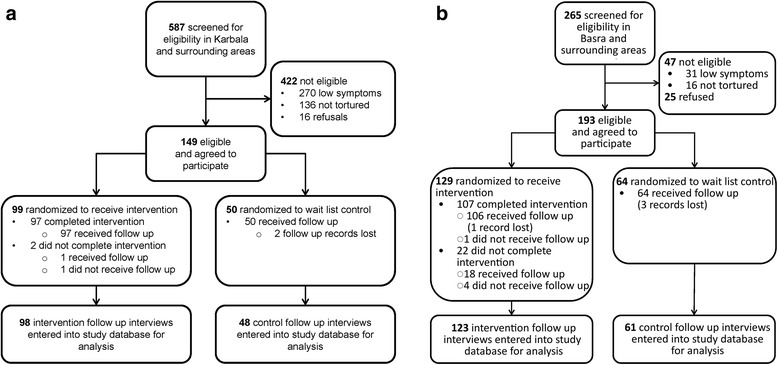
BACKGROUND: Systematic violence is a long-standing problem in Iraq. Research indicates that survivors often experience multiple mental health problems, and that there is a need for more rigorous research that targets symptoms beyond post-traumatic stress (PTS). Our objective was to test the effectiveness of two counseling therapies in Southern Iraq in addressing multiple mental health problems among survivors of systematic violence: (1) a transdiagnostic intervention (Common Elements Treatment Approach or CETA); and (2) cognitive processing therapy (CPT). The therapies were provided by non-specialized health workers since few MH professionals are available to provide therapy in Iraq. METHODS: This was a randomized, parallel, two site, two-arm (1:1 allocation), single-blinded, wait-list controlled (WLC) trial of CETA in one site (99 CETA, 50 WLC), and CPT in a second site (129 CPT, 64 WLC). Eligibility criteria were elevated trauma symptoms and experience of systematic violence. The primary and secondary outcomes were trauma symptoms and dysfunction, respectively, with additional assessment of depression and anxiety symptoms. Non-specialized health workers (community mental health worker, CMHW) provided the interventions in government-run primary health centers. Treatment effects were determined using longitudinal, multilevel models with CMHW and client as random effects, and a time by group interaction with robust variance estimation, to test for the net difference in mean score for each outcome between the baseline and follow up interview. Multiple imputation techniques were used to account for missingness at the item level and the participant level. All analyses were conducted using Stata 12. RESULTS: The CETA intervention showed large effect sizes for all outcomes. The CPT intervention showed moderate effects sizes for trauma and depression, with small to no effect for anxiety or dysfunction, respectively. CONCLUSIONS: Both CETA and CPT appear to benefit survivors of systematic violence in Southern Iraq by reducing multiple mental health symptoms, with CETA providing a very large benefit across a range of symptoms. Non-specialized health workers were able to treat comorbid symptoms of trauma, depression and anxiety, and dysfunction among survivors of systematic violence who have limited access to mental health professionals. The trial further supports the use of evidence-based therapies in lower-resource settings. TRIAL REGISTRATION AND PROTOCOL: This trial was registered at ClinicalTrials.gov on 16 July 2010 with an identifier of NCT01177072 as the Study of Effectiveness of Mental Health Interventions among Torture Survivors in Southern Iraq. The study protocol can be downloaded from the following website: http://tinyurl.com/CETA-Iraq-Protocol . In the protocol, the CETA intervention is given a different name: components-based intervention or CBI.
Overview
The claims and statistics of this paper haven’t been checked yet.
Free: it reads the open-access text and checks the first 5 claims that cite a source we can check. Create a free account to check every claim.
Integrity signals
Registry
Cites
Statistics
Figures
Verification
Claims the paper makes
The claims and statistics of this paper haven’t been checked yet.
Free: it reads the open-access text and checks the first 5 claims that cite a source we can check. Create a free account to check every claim.
Claims other papers make about this one
Each is checked against this paper’s own text: does it say what the citing paper says it does?
The source backs part of the claim, not all of it — or backs it for a different population, condition or comparison.
In the citing paper
“RCTs for the CETA conducted in Thailand [32], Zambia [33], Iraq [34], Iraqi Kurdistan [35], Colombia [36], and Somalia [37] have all indicated significant positive effects on mental health outcomes for men, women and children.”
From Psychological Interventions for Survivors of Intimate Partner Violence in Humanitarian Settings: An Overview of the Evidence and Implementation Considerations (2022) · cites this paper as [34]
Experimental — accuracy not yet measuredThe cited source says what the claim attributes to it.
In the citing paper
“Task sharing with non-specialists has been a key strategy 5 also in humanitarian settings. 5-7”
From Guided self-help to reduce psychological distress in South Sudanese female refugees in Uganda: A cluster randomised trial (2020) · cites this paper as [6]
The cited source says what the claim attributes to it.
In the citing paper
“others have used a modular approach that tailors key strategies to the primary problems that a person is experiencing 190,191 .”
From Post‐traumatic stress disorder: a state‐of‐the‐art review of evidence and challenges (2019) · cites this paper as [190]
Self-check
Percentages, sums and reported differences re-computed from the paper’s own numbers.
The self-check needs the paper’s full text.
Citations
Cites
Statistical Power Analysis for the Behavioral Sciences
Muller, K. (1989) · Technometrics · doi:10.1080/00401706.1989.10488618 · Cited by 99,167
Statistical power analysis for the behavioral sciences
(1990) · Computers, Environment and Urban Systems · doi:10.1016/0198-9715(90)90050-4 · Cited by 65,269
Multiple Imputation for Nonresponse in Surveys
Rubin, D. B. (1987) · Wiley Series in Probability and Statistics · doi:10.1002/9780470316696 · Cited by 20,701
Specification Tests in Econometrics
Hausman, J. A. (1978) · Econometrica · doi:10.2307/1913827 · Cited by 18,820 · cited 1×
“05 [52].”
Multiple imputation by chained equations: what is it and how does it work?
Azur, M. J., Stuart, E. A., Frangakis, C., & Leaf, P. J. (2011) · International Journal of Methods in Psychiatric Research · doi:10.1002/mpr.329 · Cited by 3,542 · cited 1×
“Missing data, including information about participants who were lost to follow-up, were imputed using STATA’s chained equations command for multiple imputation (MI) using Rubin’s rules for pooling data [50, 51].”
MethodSteel, Z., Chey, T., Silove, D., Marnane, C., Bryant, R. A., & van Ommeren, M. (2009) · JAMA · doi:10.1001/jama.2009.1132 · Cited by 2,246 · cited 1×
“[6] found that those who reported torture had twice the odds of posttraumatic stress disorder (PTSD) and one and half times the odds of depression.”
BackgroundMollica, R. F., Caspi-Yavin, Y., Bollini, P., Truong, T., Tor, S., & Lavelle, J. (1992) · PubMed · Cited by 1,551
Cognitive processing therapy for sexual assault victims.
Resick, P. A., & Schnicke, M. K. (1992) · Journal of Consulting and Clinical Psychology · doi:10.1037/0022-006x.60.5.748 · Cited by 1,490 · cited 1×
“Cognitive Processing Therapy (CPT) is an evidencedbased cognitive behavioral psychotherapy originally developed for treatment of PTS or PTS with comorbid depression [40, 41].”
BackgroundMOLLICA, R. F., CASPI-YAVIN, Y., BOLLINI, P., TRUONG, T., TOR, S., & LAVELLE, J. (1992) · The Journal of Nervous and Mental Disease · doi:10.1097/00005053-199202000-00008 · Cited by 1,489 · cited 1×
“The study instrument included the symptom section of the Harvard Trauma Questionnaire (HTQ) to assess trauma symptoms, the Hopkins Symptom Checklist for Depression and Anxiety (HSCL-25), and a separate section containing 20 frequently mentioned mental health symptoms from the qualitative study (described above) not al…”
MethodResick, P. A., Nishith, P., Weaver, T. L., Astin, M. C., & Feuer, C. A. (2002) · Journal of Consulting and Clinical Psychology · doi:10.1037/0022-006x.70.4.867 · Cited by 1,294 · cited 1×
“The therapy has been highly effective at reducing symptoms of PTS, depression, and anxiety across several RCTs and efficacy studies across a range of trauma exposed populations including sexual assault, child sexual abuse, domestic violence, and combat [25, 41–45].”
Background
Research works printed but not linked: 10
- 3. International A. Iraq: a decade of abuses. London: Amnesty International; 2013.
- 4. Human Rights Watch. The road to Abu Ghraib. New York City, United States: Human Rights Watch; 2004.
- 27. Applied Mental Health Research Group. Design, implementation monitoring, and evaluation of mental health and psychosocial assistance programs for trauma survivors in Low resource countries: a user's manual for researchers and program implementers (adult version), Module 1: qualitative assessment. United States: Johns Hopkins University Bloomberg School of Public Health; 2013.
- 29. Weiss W, Bolton P. Qualitative assessment of persons affected by torture and related violence in Southern Iraq: a research report of the Johns Hopkins University and Heartland Alliance International. 2010.
- 31. Hesbacher PT, Rickels K, Morris RJ, Newman H, Rosenfeld H. Psychiatric illness in family practice. J Clin Psychiatry. 1980;41:6-10.
- 33. Applied Mental Health Research Group. Design, implementation monitoring, and evaluation of mental health and psychosocial assistance programs for trauma survivors in Low resource countries: a user's manual for researchers and program implementers (adult version), Module 2: developing quantitative tools. United States: Johns Hopkins University Bloomberg School of Public Health; 2013.
- 34. Weiss W, Bolton P. Assessment of torture survivors in Southern Iraq - development and testing of a locally-adapted psychosocial assessment instrument. A research report of the Johns Hopkins University and Heartland Alliance international. 2010.
- 35. Nunnally JC. Psychometric theory. New York: McGraw-Hill; 1978.
- 39. Applied Mental Health Research Group. Design, implementation monitoring, and evaluation of mental health and psychosocial assistance programs for trauma survivors in low resource countries: a user's manual for researchers and program implementers (adult version), Module 5: intervention selection, adaptation, and implementation. United States: Johns Hopkins University Bloomberg School of Public Health; 2013.
- 49. StataCorp. Stata statistical software: release 12. College Station, TX: StataCorp LP; 2011.
Cited by
Lund, C., Brooke-Sumner, C., Baingana, F., Baron, E. C., Breuer, E., Chandra, P., Haushofer, J., Herrman, H., Jordans, M., Kieling, C., et al. (2018) · The Lancet Psychiatry · doi:10.1016/s2215-0366(18)30060-9 · Cited by 1,147
Psychological Treatments for the World: Lessons from Low- and Middle-Income Countries
Singla, D. R., Kohrt, B. A., Murray, L. K., Anand, A., Chorpita, B. F., & Patel, V. (2017) · Annual Review of Clinical Psychology · doi:10.1146/annurev-clinpsy-032816-045217 · Cited by 913
Self-citationMental health and HIV/AIDS: the need for an integrated response
Remien, R. H., Stirratt, M. J., Nguyen, N., Robbins, R. N., Pala, A. N., & Mellins, C. A. (2019) · AIDS · doi:10.1097/qad.0000000000002227 · Cited by 727
“Outside of HIV, randomized trials found that a transdiagnostic psychotherapy toolkit delivered by lay counselors successfully treated symptomatology from multiple trauma-related disorders among Burmese refugees [127] as well as survivors of violence in Iraq [128].”
BackgroundPost‐traumatic stress disorder: a state‐of‐the‐art review of evidence and challenges
Bryant, R. A. (2019) · World Psychiatry · doi:10.1002/wps.20656 · Cited by 528
Barnett, M. L., Gonzalez, A., Miranda, J., Chavira, D. A., & Lau, A. S. (2018) · Administration and Policy in Mental Health and Mental Health Services Research · doi:10.1007/s10488-017-0815-0 · Cited by 431
“Weiss et al. (2015)* EBT & evidence-informed dWLC 342 (228) Yes 28.”
BackgroundCommunity Interventions to Promote Mental Health and Social Equity
Castillo, E. G., Ijadi-Maghsoodi, R., Shadravan, S., Moore, E., Mensah, M. O., Docherty, M., Aguilera Nunez, M. G., Barcelo, N., Goodsmith, N., Halpin, L. E., et al. (2019) · Current Psychiatry Reports · doi:10.1007/s11920-019-1017-0 · Cited by 387
Coventry, P. A., Meader, N., Melton, H., Temple, M., Dale, H., Wright, K., Cloitre, M., Karatzias, T., Bisson, J., Roberts, N. P., et al. (2020) · PLoS Medicine · doi:10.1371/journal.pmed.1003262 · Cited by 358
“The complex-trauma subgroups of the included studies were categorised as follows: post–combat deployment veterans (55 studies) [32–35, 37, 39–41, 43–48, 50–54, 56, 58, 60–63, 66–71, 73, 74, 76, 77, 82, 90, 100, 103, 104, 106–108, 115, 116, 121, 123, 124, 127, 128, 132, 133, 136, 143]; war-related (16 studies; 15 paper…”
Bryant, R. A., Schafer, A., Dawson, K. S., Anjuri, D., Mulili, C., Ndogoni, L., Koyiet, P., Sijbrandij, M., Ulate, J., Harper Shehadeh, M., et al. (2017) · PLOS Medicine · doi:10.1371/journal.pmed.1002371 · Cited by 321
“previous trial of psychotherapy in individuals who had experienced sexual violence in Congo that reported a large effect size in relation to PTSD symptom reduction [10]; it is possible that this difference between studies occurred because PM+ did not include emotional processing strategies, which are foundational in m…”
BackgroundTol, W. A., Leku, M. R., Lakin, D. P., Carswell, K., Augustinavicius, J., Adaku, A., Au, T. M., Brown, F. L., Bryant, R. A., Garcia-Moreno, C., et al. (2020) · The Lancet Global Health · doi:10.1016/s2214-109x(19)30504-2 · Cited by 249
Purgato, M., Gastaldon, C., Papola, D., van Ommeren, M., Barbui, C., & Tol, W. A. (2018) · Cochrane Database of Systematic Reviews · doi:10.1002/14651858.cd011849.pub2 · Cited by 215
“…torture and witness to violence or atrocities in 11 studies (Ahmadizadeh 2013; Azad Marzabadi 2014; Bass 2016; Bolton 2014a; Connolly 2011; Connolly 2013; Hermenau 2013; Jacob 2014; McMullen 2013; Wang 2013a; Weiss 2015a); and compound stressors or other types of stressors in the remaining studies.”
BackgroundMethodInfluentialvan Ginneken, N., Chin, W. Y., Lim, Y. C., Ussif, A., Singh, R., Shahmalak, U., Purgato, M., Rojas-García, A., Uphoff, E., McMullen, S., et al. (2021) · Cochrane Database of Systematic Reviews · doi:10.1002/14651858.cd009149.pub3 · Cited by 188
Barnett, M. L., Lau, A. S., & Miranda, J. (2018) · Annual Review of Clinical Psychology · doi:10.1146/annurev-clinpsy-050817-084825 · Cited by 182
“…traumatic stress in children (Murray et al. 2015), Interpersonal Psychotherapy for depression (Bolton et al. 2003, Petersen et al. 2012), Behavioral Activation for depression (Bolton et al. 2014a), and Cognitive Processing Therapy for traumatic stress (Bolton et al. 2014a, Weiss et al. 2015).”
BackgroundInfluentialConnery, H. S., McHugh, R. K., Reilly, M. E., Shin, S., & Greenfield, S. F. (2020) · Harvard Review of Psychiatry · doi:10.1097/hrp.0000000000000271 · Cited by 177
Chronic pain and mental health: integrated solutions for global problems
Kohrt, B. A., Griffith, J. L., & Patel, V. (2018) · Pain · doi:10.1097/j.pain.0000000000001296 · Cited by 161
“Once a provider learns how to deliver a parsimonious set of elements, they can apply it to a range of presentations bymatching the element to the dominant clinical concern, typically defined by the patient.(9,83) These findings from LMICs complement the emerging”
CBT at the crossroads: the rise of transdiagnostic treatments.
Schaeuffele, C., Schulz, A., Knaevelsrud, C., Renneberg, B., & Boettcher, J. (2021) · International Journal of Cognitive Therapy · doi:10.1007/s41811-020-00095-2 · Cited by 150
Murray, L. K., Kane, J. C., Glass, N., Skavenski van Wyk, S., Melendez, F., Paul, R., Kmett Danielson, C., Murray, S. M., Mayeya, J., Simenda, F., et al. (2020) · PLOS Medicine · doi:10.1371/journal.pmed.1003056 · Cited by 139
Self-citationMurray, L. K., Tol, W., Jordans, M., Sabir, G., Amin, A. M., Bolton, P., Bass, J., Bonilla-Escobar, F. J., & Thornicroft, G. (2014) · Intervention · doi:10.1097/wtf.0000000000000070 · Cited by 118
Self-citationO’Keefe, V. M., Cwik, M. F., Haroz, E. E., & Barlow, A. (2021) · Psychological Services · doi:10.1037/ser0000358 · Cited by 135
“…task-shifted mental health interventions that have been delivered in a variety of settings including with refugees, in settings of ongoing conflict (Weiss et al., 2015), among HIV affected populations (Kane et al., 2017; Murray et al., 2013), in low-resource contexts generally (Chowdhary et al.,…”
BackgroundBonilla-Escobar, F. J., Fandiño-Losada, A., Martínez-Buitrago, D. M., Santaella-Tenorio, J., Tobón-García, D., Muñoz-Morales, E. J., Escobar-Roldán, I. D., Babcock, L., Duarte-Davidson, E., Bass, J. K., et al. (2018) · PLOS ONE · doi:10.1371/journal.pone.0208483 · Cited by 108
Self-citationBrown, F. L., de Graaff, A. M., Annan, J., & Betancourt, T. S. (2017) · Journal of Child Psychology and Psychiatry · doi:10.1111/jcpp.12671 · Cited by 107
“from studies with adult trauma survivors on the ThaiBurma border and southern Iraq demonstrate the ability of lay counselors to maintain fidelity and achieve significant outcomes in multiple domains using this approach (Bolton et al., 2014; Weiss et al., 2015).”
BackgroundMarques, L., Valentine, S. E., Kaysen, D., Mackintosh, M.-A., Dixon De Silva, L. E., Ahles, E. M., Youn, S. J., Shtasel, D. L., Simon, N. M., & Wiltsey-Stirman, S. (2019) · Journal of Consulting and Clinical Psychology · doi:10.1037/ccp0000384 · Cited by 110
“…when they receive adapted forms of CPT (Bass et al., 2013; Galovski, Blain, Mott, Elwood, & Houle, 2012; Schulz, Resick, Huber, & Griffin, 2006; Weiss et al., 2015), no studies have examined the association between provider modifications to EBPs delivered in routine care and clinical outcomes.”
Self-citationBangpan, M., Felix, L., & Dickson, K. (2019) · BMJ Global Health · doi:10.1136/bmjgh-2019-001484 · Cited by 108
“…in Pakistan 45 ; a transdiagnostic intervention,Common Elements Treatment Approach (CETA) and CPT compared with a wait-list controlled group 46 ; a trauma-focused CBT adults in postconflict Timor-Leste 60 ; and a culturally sensitive CBT-based intervention (EMPOWER) designed for…”
Kemp, C. G., Petersen, I., Bhana, A., & Rao, D. (2019) · Global Health: Science and Practice · doi:10.9745/ghsp-d-18-00337 · Cited by 93
Posttraumatic Stress Disorder in Refugees
Bryant, R. A., Nickerson, A., Morina, N., & Liddell, B. J. (2023) · Annual Review of Clinical Psychology · doi:10.1146/annurev-clinpsy-080921-080359 · Cited by 105
Kiss, L., Quinlan-Davidson, M., Pasquero, L., Tejero, P. O., Hogg, C. L., Theis, J., Park, A., Zimmerman, C., & Hossain, M. (2020) · Conflict and Health · doi:10.1186/s13031-020-0254-5 · Cited by 98
Morina, N., Malek, M., Nickerson, A., & Bryant, R. A. (2017) · Depression and Anxiety · doi:10.1002/da.22618 · Cited by 85
“Of the 12 trials assessing symptoms of both PTSD and depression, seven trials had focused on both PTSD and depression (Acarturk et al., 2016; Acarturk et al., 2015; Bass et al., 2016; Bass et al., 2013; Bolton et al., 2014; Meffert et al., 2014; Weiss et al., 2015), four reported treatment of PTSD as the major focus a…”
BackgroundAn evaluation of a common elements treatment approach for youth in Somali refugee camps
Murray, L. K., Hall, B. J., Dorsey, S., Ugueto, A. M., Puffer, E. S., Sim, A., Ismael, A., Bass, J., Akiba, C., Lucid, L., et al. (2018) · Global Mental Health · doi:10.1017/gmh.2018.7 · Cited by 85
“…paper reports on: (1) an evaluation of a common elements treatment approach (CETA) (Bolton et al., 2007; Bolton et al., 2014; Murray et al., 2014a; Weisz et al., 2015) developed for comorbid presentations of depression, anxiety, post traumatic stress, and/or externalizing symptoms among children…”
BackgroundInfluentialSelf-citationMurray, L. K., & Jordans, M. J. D. (2016) · BMC Psychiatry · doi:10.1186/s12888-016-0938-y · Cited by 71
“Two trials (Iraq and Thailand/Myanmar border) on adult populations that were trauma-affected were completed with CETA - both showing strong effectiveness on symptoms of depression, trauma and anxiety with effect sizes >1) [52, 53].”
BackgroundSelf-citationWagenaar, B. H., Hammett, W. H., Jackson, C., Atkins, D. L., Belus, J. M., & Kemp, C. G. (2020) · Global Mental Health · doi:10.1017/gmh.2020.1 · Cited by 71
Bentley, J. A., Feeny, N. C., Dolezal, M. L., Klein, A. B., Marks, L. H., Graham, B., & Zoellner, L. A. (2020) · Cognitive and Behavioral Practice · doi:10.1016/j.cbpra.2020.10.005 · Cited by 86
Community health workers in humanitarian settings: Scoping review
Miller, N. P., Ardestani, F. B., Dini, H. S., Shafique, F., & Zunong, N. (2020) · Journal of Global Health · doi:10.7189/jogh.10.020602 · Cited by 72
Dorsey, S., Gray, C. L., Wasonga, A. I., Amanya, C., Weiner, B. J., Belden, C. M., Martin, P., Meza, R. D., Weinhold, A., Soi, C., et al. (2020) · BMC Psychiatry · doi:10.1186/s12888-019-2364-4 · Cited by 76
“, Zambia [8], Uganda [9, 10], India [11], Southern Iraq [12]) and populations of focus (e.”
BackgroundSelf-citationEmergence of Transdiagnostic Treatments for PTSD and Posttraumatic Distress
Gutner, C. A., Galovski, T., Bovin, M. J., & Schnurr, P. P. (2016) · Current Psychiatry Reports · doi:10.1007/s11920-016-0734-x · Cited by 70
Bogdanov, S., Augustinavicius, J., Bass, J., Metz, K. L., Skavenski, S. V. W., Singh, N. S., Moore, Q., Haroz, E. E., Kane, J. C., Doty, B., et al. (2021) · Cambridge Prisms Global Mental Health · doi:10.1017/gmh.2021.27 · Cited by 73
“While CETA has been shown effective in other LMIC settings including Iraq (Weiss et al., 2015), Thailand (Bolton et al., 2014), Zambia (Murray et al., 2020), Colombia (Bonilla-Escobar et al., 2018) and Ethiopia (Murray et al., 2018b), it has not been used or tested in the former Soviet Union.”
BackgroundSelf-citationMeffert, S. M., Neylan, T. C., McCulloch, C. E., Blum, K., Cohen, C. R., Bukusi, E. A., Verdeli, H., Markowitz, J. C., Kahn, J. G., Bukusi, D., et al. (2021) · PLOS Medicine · doi:10.1371/journal.pmed.1003468 · Cited by 67
Rosen, R. C., Ruzek, J. I., & Karlin, B. E. (2017) · Behaviour Research and Therapy · doi:10.1016/j.brat.2016.07.009 · Cited by 68
Cubillos, L., Bartels, S. M., Torrey, W. C., Naslund, J. A., Uribe-Restrepo, J. M., Gaviola, C., Castro, S., John, D. T., Williams, M. J., Cepeda, M., et al. (2020) · BJPsych Bulletin · doi:10.1192/bjb.2020.35 · Cited by 73
Pedersen, G. A., Lakshmin, P., Schafer, A., Watts, S., Carswell, K., Willhoite, A., Ottman, K. E., Hof, E. V., & Kohrt, B. A. (2020) · Journal of Behavioral and Cognitive Therapy · doi:10.1016/j.jbct.2020.06.001 · Cited by 67
Singh, N. S., Bogdanov, S., Doty, B., Haroz, E. E., Girnyk, A., Чернобровкіна, В., Murray, L. K., Bass, J., & Bolton, P. A. (2021) · American Journal of Orthopsychiatry · doi:10.1037/ort0000537 · Cited by 71
Self-citationNaeem, F. (2019) · The Cognitive Behaviour Therapist · doi:10.1017/s1754470x19000278 · Cited by 71
“…in lower resource countries (Murray et al., 2019) Murray and colleagues (2019) present data from two previously conducted RCTs (Bolton et al., 2014; Weiss et al., 2015) in which they tested a modular, multi-problem, transdiagnostic manual using the common elements treatment approach (CETA).”
BackgroundLange, K. W. (2021) · Global Health Journal · doi:10.1016/j.glohj.2021.07.001 · Cited by 68
Miller, K. E., Jordans, M. J. D., Tol, W. A., & Galappatti, A. (2021) · Epidemiology and Psychiatric Sciences · doi:10.1017/s2045796020001110 · Cited by 61
“This approach has been shown to be helpful in addressing the post-traumatic effects of sexual assault, torture and other forms of traumatic stress that are tragically common in settings of organised violence (Weiss et al., 2015; Bangpan et al., 2017; Nosè et al., 2017).”
Ruzek, J. I., & Yeager, C. M. (2017) · Global Mental Health · doi:10.1017/gmh.2017.11 · Cited by 54
“Mental health disorders are the leading cause of global disability burden (Whiteford et al. 2015), accounting for about 14% of the global burden of disease (World Health Organization, 2010).”
BackgroundMartin, P., Murray, L. K., Darnell, D., & Dorsey, S. (2018) · Clinical Psychology: Science and Practice · doi:10.1111/cpsp.12270 · Cited by 53
“According to Weiss et al. (2015), “most EBTs are more narrowly focused, and more linear in design, than the everyday clinical practice they are designed to enhance” (p. 150).”
InfluentialSelf-citationEnnis, N., Sijercic, I., & Monson, C. M. (2021) · Clinical Psychology Review · doi:10.1016/j.cpr.2021.102049 · Cited by 55
Kane, J. C., Sharma, A., Murray, L. K., Chander, G., Kanguya, T., Skavenski, S., Chitambi, C., Lasater, M. E., Paul, R., Cropsey, K., et al. (2022) · AIDS and Behavior · doi:10.1007/s10461-021-03408-4 · Cited by 49
Self-citationMelton, H., Meader, N., Dale, H. E., Wright, K. E., Jones-Diette, J. S., Temple, M., Shah, I., Lovell, K., McMillan, D., Churchill, R. C., et al. (2020) · Health Technology Assessment · doi:10.3310/hta24430 · Cited by 53
Fine, S. L., Malik, A., Guimond, M.-F., Nemiro, A., Temu, G., Likindikoki, S. L., Annan, J. R., & Tol, W. A. (2021) · Behaviour Research and Therapy · doi:10.1016/j.brat.2021.103944 · Cited by 50
Assessing and treating complex mental health needs among homeless youth in a shelter-based clinic
Winiarski, D. A., Rufa, A. K., Bounds, D. T., Glover, A. C., Hill, K., & Karnik, N. S. (2020) · BMC Health Services Research · doi:10.1186/s12913-020-4953-9 · Cited by 50
The role of community health worker-based care in post-conflict settings: a systematic review
Werner, K., Kak, M., Herbst, C. H., & Lin, T. K. (2022) · Health Policy and Planning · doi:10.1093/heapol/czac072 · Cited by 48
Dawson, K. S., Schafer, A., Anjuri, D., Ndogoni, L., Musyoki, C., Sijbrandij, M., van Ommeren, M., & Bryant, R. A. (2016) · BMC Psychiatry · doi:10.1186/s12888-016-1117-x · Cited by 43
“This study adds to the growing evidence in support of task-shifting approaches in the delivery of evidenceinformed psychological interventions [12, 36, 37].”
ResultState of the Science of Cognitive Processing Therapy
Resick, P. A., LoSavio, S. T., Monson, C. M., Kaysen, D. L., Wachen, J. S., Galovski, T. E., Stirman, S. W., Nixon, R. D. V., & Chard, K. M. (2024) · Behavior Therapy · doi:10.1016/j.beth.2024.04.003 · Cited by 43
“…and community activities (Bass et al., 2013; Bolton et al., 2014), depression (Bass et al., 2013, Elbarazi et al., 2022; Greene et al., 2021; Weiss et al., 2015), anxiety (Bass et al., 2013; Greene et al., 2021), perceived stigma (Murray et al., 2018), traumatic grief (Bolton et al., 2014),…”
Self-citationBrakemeier, E., & Herpertz, S. C. (2019) · Der Nervenarzt · doi:10.1007/s00115-019-00808-9 · Cited by 42
Mahmuda, M. (2023) · doi:10.63125/4gwwbv38 · Cited by 41
Al-Tamimi, S. A. G. A., & Leavey, G. (2021) · Journal of Child & Adolescent Trauma · doi:10.1007/s40653-021-00373-x · Cited by 42
Engell, T., Stadnick, N. A., Aarons, G. A., & Barnett, M. L. (2023) · Global Implementation Research and Applications · doi:10.1007/s43477-023-00077-4 · Cited by 37
“Common elements approaches have been linked with a range of benefits for implementation that can counter such issues (Barth et al., 2020; Bolton et al., 2014; Conroy et al., 2019; Murray et al., 2020; Weiss et al., 2015; Weisz et al., 2012).”
BackgroundInterventions for treating persistent pain in survivors of torture
Baird, E., Williams, A. C. D. C., Hearn, L., & Amris, K. (2017) · Cochrane Database of Systematic Reviews · doi:10.1002/14651858.cd012051.pub2 · Cited by 40
Ryan, G. K., Bauer, A., Endale, T., Qureshi, O., Doukani, A., Pashoja, A. C., Brar, S. K., Eaton, J., & Bass, J. (2021) · Conflict and Health · doi:10.1186/s13031-021-00363-8 · Cited by 41
“Similarly, trials of CETA in Southern Iraq and Thailand are both described by Murray et al. (2019) as using “lay counsellors” [77, 93]; however, Weiss et al. (2015) explain that in Iraq, these are nurses or medics working in primary health centres [97].”
BackgroundSelf-citationKayrouz, R., Dear, B. F., Kayrouz, B., Karin, E., Gandy, M., & Titov, N. (2018) · Cognitive Behaviour Therapy · doi:10.1080/16506073.2018.1445124 · Cited by 33
“11–40 participants), except three studies that had 159 (Knaevelsrud, Brand, Lange, Ruwaard, & Wagner, 2015), 149 (Weiss et al., 2015) and 84 participants (Hamdan-Mansour, Puskar, & Bandak, 2009).”
MethodInfluentialMurray, L. K., Haroz, E. E., Doty, B., Singh, N. S., Bogdanov, S., Bass, J., Dorsey, S., & Bolton, P. (2018) · Trials · doi:10.1186/s13063-018-2752-y · Cited by 30
“Thailand, demonstrating that providers with minimal or no formal mental health training could provide CETA with fidelity and achieve positive outcomes with their clients (large effect sizes across outcomes) [2, 26].”
BackgroundInfluentialSelf-citationCommunity Interventions to Promote Mental Health and Social Equity
Castillo, E. G., Ijadi‐Maghsoodi, R., Shadravan, S. M., Moore, E. M., Mensah, M. O., Docherty, M. J., Nunez, M. G. A., Barceló, N. E., Goodsmith, N., Halpin, L. E., et al. (2020) · FOCUS The Journal of Lifelong Learning in Psychiatry · doi:10.1176/appi.focus.18102 · Cited by 37
Windarwati, H. D., Susanti, H., Brooks, H. L., Wardani, I. Y., Hasniah, Raya, M., Ati, N. A. L., & Sari, H. (2023) · PLoS ONE · doi:10.1371/journal.pone.0289943 · Cited by 38
“Health workers provide support in the form of assistance to cadres every time they carry out tasks such as counseling and treatment for patients with severe mental disorders [63].”
BackgroundTriplett, N. S., Munson, S., Mbwayo, A., Mutavi, T., Weiner, B. J., Collins, P., Amanya, C., & Dorsey, S. (2021) · Implementation Science Communications · doi:10.1186/s43058-020-00102-9 · Cited by 30
“A growing body of evidence [5 – 9], including a Cochrane Review [10], supports the effectiveness of task-shifting to deliver evidence-based practices (EBPs) for mental, neurological, and substance use disorders in LMIC.”
BackgroundSelf-citationTsur, N., Defrin, R., & Ginzburg, K. (2017) · Psychosomatic Medicine · doi:10.1097/psy.0000000000000461 · Cited by 31
Dorsey, S., Meza, R. D., Martin, P., Gray, C. L., Triplett, N. S., Soi, C., Woodard, G. S., Lucid, L., Amanya, C., Wasonga, A. I., et al. (2019) · Frontiers in Psychiatry · doi:10.3389/fpsyt.2019.00860 · Cited by 34
Self-citationMurray, L. K., Haroz, E. E., Dorsey, S., Kane, J. C., Bolton, P. A., & Pullmann, M. D. (2019) · Behaviour Research and Therapy · doi:10.1016/j.brat.2019.103430 · Cited by 32
“Setting The trial in Thailand took place in the town of Mae Sot in Northwest Thailand among refugees, former political prisoners and migrants who had experienced past trauma when fleeing Myanmar and ongoing stressors related to living illegally in Thailand (Bolton, Lee, et al., 2014).”
BackgroundMethodInfluentialSelf-citationEvidence-Based Strategies for Treatment Personalization: A Review
Stumpp, N. E., & Sauer-Zavala, S. (2022) · Cognitive and Behavioral Practice · doi:10.1016/j.cbpra.2021.10.004 · Cited by 29
“Further, CETA demonstrated greater global reductions in mental health problems compared to CPT (Weiss et al., 2015).”
BackgroundMethodHamid, A., Patel, N., & Williams, A. C. D. C. (2019) · PLoS Medicine · doi:10.1371/journal.pmed.1002919 · Cited by 31
“Given the large CI, the precision of estimate was low, and all but one study [22] appeared to be underpowered.”
BackgroundHaroz, E. E., Kane, J. C., Nguyen, A. J., Bass, J., Murray, L. K., & Bolton, P. A. (2020) · Cambridge Prisms Global Mental Health · doi:10.1017/gmh.2019.30 · Cited by 33
“Background Interest in the provision of mental health and psychosocial interventions for populations in low- and middle-income countries (LMIC) has dramatically increased over the past decade.”
BackgroundMethodSelf-citationPotluri, S., & Patel, A. (2021) · Journal of Traumatic Stress · doi:10.1002/jts.22699 · Cited by 28
Scalable interventions for refugees
Bryant, R. A. (2023) · Cambridge Prisms Global Mental Health · doi:10.1017/gmh.2022.59 · Cited by 30
“Evaluations of scalable interventions have tended to use a variety of comparison conditions, including wait list (Weiss et al., 2015; Bogdanov et al., 2021) and treatment-as-usual comparison (Rahman et al., 2016; Bryant et al., 2017, 2022a) groups.”
Tesema, A. G., Mabunda, S. A., Chaudhri, K., Sunjaya, A. P., Thio, S., Yakubu, K., Jeyakumar, R., Godinho, M. A., John, R., Eltigany, M., et al. (2025) · PLOS Global Public Health · doi:10.1371/journal.pgph.0004289 · Cited by 30
Dealing with Complexity and Comorbidity: Opportunity for Transdiagnostic Treatment for PTSD
Gutner, C. A., & Presseau, C. (2019) · Current Treatment Options in Psychiatry · doi:10.1007/s40501-019-00170-2 · Cited by 26
Zemestani, M., Mohammed, A. F., Ismail, A. A., & Vujanovic, A. A. (2022) · Behavior Therapy · doi:10.1016/j.beth.2022.01.009 · Cited by 27
Bolton, P. A. (2019) · Elsevier eBooks · doi:10.1016/b978-0-12-814932-4.00001-x · Cited by 28
Self-citationvan de Water, T., Rossouw, J., Yadin, E., & Seedat, S. (2017) · Child and Adolescent Psychiatry and Mental Health · doi:10.1186/s13034-017-0187-y · Cited by 24
“Task-shifting has been used to treat PTSD: (i) in adult refugees placed in Uganda by applying narrative exposure therapy and trauma counselling [15], (ii) adult survivors of systematic violence in Thailand and Iraq using Common Elements Treatment Approach (CETA) [16], (iii) adult survivors of torture in Iraq using Cog…”
MethodKaminer, D., Booysen, D. D., Ellis, K., Kristensen, C. H., Patel, A., Robjant, K., & Sardana, S. M. (2024) · Journal of Traumatic Stress · doi:10.1002/jts.23031 · Cited by 26
Sørensen, C. W., Bæk, O., Kallestrup, P., & Carlsson, J. M. (2016) · Nordic Journal of Psychiatry · doi:10.1080/08039488.2016.1245784 · Cited by 23
“Recent studies on the Common Elements Treatment Approach (CETA), a flexible therapeutic treatment, that is non-diagnose-specific, delivered by CHWs in low resource settings, show positive results treating Burmese refugees in Thailand and survivors of systematic violence in Iraq (24,25).”
Böttche, M., Kampisiou, C., Stammel, N., El-Haj-Mohamad, R., Heeke, C., Burchert, S., Heim, E., Wagner, B., Renneberg, B., Böttcher, J., et al. (2021) · Clinical Psychology in Europe · doi:10.32872/cpe.4623 · Cited by 21
“CETA has proven to be effective in reducing common mental health problems in cultur ally diverse settings in low- and middle-income countries (e.g. Zambia: Kane et al., 2017; Iraq: Weiss et al., 2015).”
BackgroundSelf-citationHousen, T., Ara, S., Shah, A., Shah, S., Lenglet, A., & Pintaldi, G. (2019) · Conflict and Health · doi:10.1186/s13031-019-0243-8 · Cited by 23
Clinician Concerns About Cognitive Processing Therapy: A Review of the Evidence
LoSavio, S. T., Holder, N. D., Wells, S. Y., & Resick, P. A. (2022) · Cognitive and Behavioral Practice · doi:10.1016/j.cbpra.2022.08.005 · Cited by 22
Lyon, A. R., Stanick, C., & Pullmann, M. D. (2018) · Clinical Psychology Science and Practice · doi:10.1111/cpsp.12265 · Cited by 21
Murray, L. K., Haroz, E. E., Pullmann, M. D., Dorsey, S., Kane, J. C., Augustinavicius, J., Lee, C., & Bolton, P. A. (2019) · The Cognitive Behaviour Therapist · doi:10.1017/s1754470x18000144 · Cited by 20
“In Iraq (n = 149), treatment effect sizes (Cohen’s d) were 2.38 for trauma symptoms, 1.56 for anxiety, and 1.78 for depression (Weiss et al., 2015).”
BackgroundMethodInfluentialSelf-citationKaysen, D. L., van Stolk‐Cooke, K., Kaminer, D., Greene, M. C., López‐Castro, T., & Kane, J. C. (2022) · Cambridge Prisms Global Mental Health · doi:10.1017/gmh.2022.63 · Cited by 21
“…six LMIC-based randomized-controlled trials (RCTs) of CETA, the treatment has demonstrated robust evidence for treating PTSD among trauma-affected populations (Bolton et al., 2014; Weiss et al., 2015; Bonilla-Escobar et al., 2018; Murray et al., 2020; Bogdanov et al., 2021; Kane et al., 2022).”
BackgroundSelf-citationPapola, D., Prina, E., Ceccarelli, C., Cadorin, C., Gastaldon, C., Ferreira, M. C., Tol, W. A., van Ommeren, M., Barbui, C., & Purgato, M. (2024) · Cochrane Database of Systematic Reviews · doi:10.1002/14651858.cd014300.pub2 · Cited by 23
Kaysen, D. L., Stappenbeck, C. A., Carroll, H. A., Fukunaga, R., Robinette, K., Dworkin, E. R., Murray, S. M., Tol, W. A., Annan, J. R., Bolton, P. A., et al. (2020) · European Journal of Psychotraumatology · doi:10.1080/20008198.2020.1735162 · Cited by 21
Self-citationLakin, D. P., García-Moreno, C., & Roesch, E. (2022) · International Journal of Environmental Research and Public Health · doi:10.3390/ijerph19052916 · Cited by 18
“• Reduced depression and PTS symptoms among men and women exposed to conflict in southern Iraq.”
BackgroundFalahat, K., Eftekhari, M. B., Dejman, M., Forouzan, A. S., Mahmoodi, Z., Padyab, M., & Tavassoli, S. (2022) · Brain and Behavior · doi:10.1002/brb3.2551 · Cited by 18
“The increasing number of studies regarding CBTs suggests that this type of treatment is transferable, adaptable, acceptable, and effective (Bolton et al., 2014;Murray et al., 2014;Weiss et al., 2015).”
Backgroundvan de Water, T., Rossouw, J., Yadin, E., & Seedat, S. (2018) · PLoS ONE · doi:10.1371/journal.pone.0199816 · Cited by 20
Brockie, T., Haroz, E. E., Nelson, K. E., Cwik, M. F., Decker, E., Ricker, A., Littlepage, S., Mayhew, J., Wilson, D. H., Wetsit, L., et al. (2021) · BMC Public Health · doi:10.1186/s12889-021-12272-9 · Cited by 19
Murray, S. M., Skavenski, S. V. W., Metz, K. L., Munthali, S., Mwenge, M., Kane, J. C., Alto, M. E., Venturo‐Conerly, K. E., Wasil, A. R., Fine, S. L., et al. (2020) · Social Science & Medicine · doi:10.1016/j.socscimed.2020.113458 · Cited by 19
Self-citationhAnrachtaigh, É. Ó., Brown, G. P., Beck, A. F., Conway, R., Jones, H. G., & Angelakis, I. (2024) · Depression and Anxiety · doi:10.1155/2024/5037662 · Cited by 17
Zubieta, C. S., Lichtl, A. J., Trautman, K., Mentor, S., Cagliero, D., Mensa‐Kwao, A., Paige, O., McCarthy, S. H., Walmer, D. K., & Kaiser, B. N. (2019) · Culture Medicine and Psychiatry · doi:10.1007/s11013-019-09640-x · Cited by 17
Chen, J. A., Olin, C. C., Stirman, S. W., & Kaysen, D. L. (2016) · Current Opinion in Psychology · doi:10.1016/j.copsyc.2016.11.007 · Cited by 17
Self-citationPeterson, R. S., Darnell, D. A., Berliner, L., Dorsey, S., Murray, L. K., & Monroe‐DeVita, M. (2018) · The Journal of Behavioral Health Services & Research · doi:10.1007/s11414-018-9631-x · Cited by 16
Self-citationImproving and sustaining livelihoods through group-based interventions: mapping the evidence
(3ie), I. I. F. I. E., Barooah, B., Chinoy, S. L., 3ie, Dubey, P., 3ie, Sarkar, R., 3ie, Bagai, A., 3ie, et al. (2019) · doi:10.23846/egm013 · Cited by 17
Dixon, L. E., Ahles, E. M., & Marques, L. M. (2016) · Current Psychiatry Reports · doi:10.1007/s11920-016-0748-4 · Cited by 17
Gupta, S. L., Wijk, K., Warner, G., & Sarkadi, A. (2021) · International Journal of Environmental Research and Public Health · doi:10.3390/ijerph18041486 · Cited by 14
“Supervision is important to support lay counsellors [23,43]; however, adequate supervision should include both management of clients and specifically inquiring about counsellors’ own emotions to address the particular risk of indirect traumatization [44].”
BackgroundKane, J. C., Sharma, A., Murray, L. K., Chander, G., Kanguya, T., Lasater, M. E., Skavenski, S., Paul, R., Mayeya, J., Kmett Danielson, C., et al. (2020) · Addictive Behaviors Reports · doi:10.1016/j.abrep.2020.100278 · Cited by 13
“Randomized controlled trials in Iraq and Thailand demonstrated effectiveness for a range of mental health problems (Bolton et al., 2014; Weiss et al., 2015).”
BackgroundSelf-citationUsing Layperson-Delivered Cognitive-Behavioral Therapy to Address Mental Health Disparities
Winiarski, D. A., Rufa, A. K., & Karnik, N. S. (2019) · Psychiatric Annals · doi:10.3928/00485713-20190711-02 · Cited by 12
Metadata
- Authors
- Weiss, W. M., Murray, L. K., Zangana, G. A. S., Mahmooth, Z., Kaysen, D., Dorsey, S., Lindgren, K., Gross, A., Murray, S. M., Bass, J. K., & Bolton, P.
- Affiliations
- Johns Hopkins University (US)
- Heartland Alliance (US)
- University of Washington (US)
- Corresponding author
- Weiss, William M.
- Bolton, Paul
- ORCID
- Venue
- BMC Psychiatry
- Published
- 2015-10-14
- Volume
- 15
- Issue
- 1
- Pages
- 249-249
- ISSN
- 1471-244X (ISSN-L)
- PMC
- PMC4605204
- OpenAlex
- W1900997796
- Semantic Scholar
- fad27238038fabc76a4e09c61f566510be10ef00
- Cited by
- 206
- References
- 54
- Citations by year
- 2026: 5 · 2025: 11 · 2024: 15 · 2023: 14 · 2022: 39 · 2021: 28 · 2020: 28 · 2019: 26 · 2018: 19 · 2017: 11 · 2016: 9
- FWCI
- 16.14
- Type
- journal article
- Language
- en
- Open access
- gold
- doi.org
- Licence
- Locations
- BMC Psychiatry (publishedVersion, cc-by)
- Europe PMC (PubMed Central) (publishedVersion, cc-by)
- PubMed Central (publishedVersion, cc-by)
- PubMed (publishedVersion)
- Funders
- United States Agency for International Development (DFD-A-00-08-00308-00)
- Topics
- Social Sciences › Psychology › Clinical Psychology › Posttraumatic Stress Disorder Research
- Social Sciences › Psychology › Clinical Psychology › Migration, Health and Trauma
- Social Sciences › Psychology › Clinical Psychology › Psychotherapy Techniques and Applications
- Keywords
- community mental health workers, torture survivors, systematic violence, post-traumatic stress, Common Elements Treatment Approach, cognitive processing therapy, transdiagnostic treatment, trauma symptoms, depression, anxiety, comorbid symptoms, resource-limited settings, southern Iraq, primary health centers, waitlist control, multiple imputation, missing data, treatment effectiveness
- MeSH terms
- War Exposure, Adult, Anxiety, Community Mental Health Services, Depression, Female, Humans, Iraq, Male, Middle Aged, Psychotherapy, Torture, Violence, Cognitive Behavioral Therapy, Single-Blind Method, Survivors
About these checks
Registry, retraction, Cites and statistics results are computed, not judged, with one exception: a printed reference that no index lists is read once by a model before it counts as a citation error. Claims are extracted by a model and kept only when their quote appears verbatim in the text; each cited source is then checked, with a model’s help, for whether it says what the claim relies on. Those verdicts can be wrong — read the claim’s quote and the cited source before relying on one.
Statistics and arithmetic are recomputed, not judged.
Confidence bands are shown only for fields calibrated on our annotated test set. None is calibrated yet, so no band is shown.
What counts as a claim ›How we measure confidence ›How we check this ›
Are you an author, or do you see a problem with this page? Request a review
Data sources
Bibliographic data: Semantic Scholar, OpenAlex, Crossref.
Contains information from the Semantic Scholar Academic Graph Datasets, made available under the ODC Attribution License (ODC-BY 1.0).
Semantic Scholar’s data is described in: Kinney, R., et al. (2023). The Semantic Scholar Open Data Platform. arXiv:2301.10140.
