

A randomized trial to identify accurate and cost-effective fidelity measurement methods for cognitive-behavioral therapy: project FACTS study protocol
Open accessThe DOI matches its Crossref record; 51 of the 51 references it cites were found in a registry or an index.
Abstract
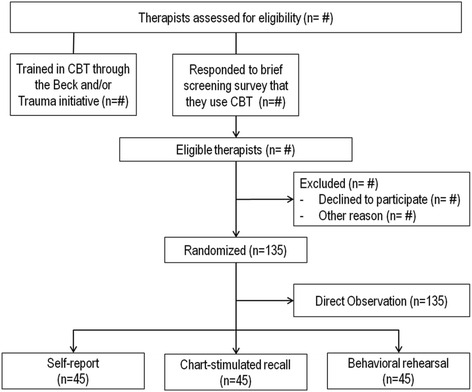
BACKGROUND: This randomized trial will compare three methods of assessing fidelity to cognitive-behavioral therapy (CBT) for youth to identify the most accurate and cost-effective method. The three methods include self-report (i.e., therapist completes a self-report measure on the CBT interventions used in session while circumventing some of the typical barriers to self-report), chart-stimulated recall (i.e., therapist reports on the CBT interventions used in session via an interview with a trained rater, and with the chart to assist him/her) and behavioral rehearsal (i.e., therapist demonstrates the CBT interventions used in session via a role-play with a trained rater). Direct observation will be used as the gold-standard comparison for each of the three methods. METHODS/DESIGN: This trial will recruit 135 therapists in approximately 12 community agencies in the City of Philadelphia. Therapists will be randomized to one of the three conditions. Each therapist will provide data from three unique sessions, for a total of 405 sessions. All sessions will be audio-recorded and coded using the Therapy Process Observational Coding System for Child Psychotherapy-Revised Strategies scale. This will enable comparison of each measurement approach to direct observation of therapist session behavior to determine which most accurately assesses fidelity. Cost data associated with each method will be gathered. To gather stakeholder perspectives of each measurement method, we will use purposive sampling to recruit 12 therapists from each condition (total of 36 therapists) and 12 supervisors to participate in semi-structured qualitative interviews. DISCUSSION: Results will provide needed information on how to accurately and cost-effectively measure therapist fidelity to CBT for youth, as well as important information about stakeholder perspectives with regard to each measurement method. Findings will inform fidelity measurement practices in future implementation studies as well as in clinical practice. TRIAL REGISTRATION: NCT02820623 , June 3rd, 2016.
Overview
The claims and statistics of this paper haven’t been checked yet.
Free: it reads the open-access text and checks the first 5 claims that cite a source we can check. Create a free account to check every claim.
Integrity signals
Registry
Cites
Statistics
Figures
Verification
Claims the paper makes
The claims and statistics of this paper haven’t been checked yet.
Free: it reads the open-access text and checks the first 5 claims that cite a source we can check. Create a free account to check every claim.
Claims other papers make about this one
Each is checked against this paper’s own text: does it say what the citing paper says it does?
In the citing paper
“These and other research efforts [12, 39] aim to demonstrate the relevance and practical utility of behavioral economic concepts such as bounded rationality for implementation research and, in particular when considering the decision-making approaches and perspectives of different stakeholders.”
From Implementation science issues in understanding, collecting, and using cost estimates: A multi-stakeholder perspective (2021) · cites this paper as [39]
Self-check
Percentages, sums and reported differences re-computed from the paper’s own numbers.
The self-check needs the paper’s full text.
Citations
Cites
How Many Interviews Are Enough?: An Experiment with Data Saturation and Variability
Guest, G., Bunce, A., & Johnson, L. (2006) · Field Methods · doi:10.1177/1525822x05279903 · Cited by 20,808
Proctor, E., Silmere, H., Raghavan, R., Hovmand, P., Aarons, G., Bunger, A., Griffey, R., & Hensley, M. (2011) · Administration and Policy in Mental Health and Mental Health Services Research · doi:10.1007/s10488-010-0319-7 · Cited by 8,721 · cited 2×
“Although use of these economic evaluation methods is widespread in medicine [29], they are rarely utilized in implementation studies [5].”
BackgroundMethodIntention—Behavior Relations: A Conceptual and Empirical Review
Sheeran, P. (2002) · European Review of Social Psychology · doi:10.1080/14792772143000003 · Cited by 3,688 · cited 2×
“These measures have demonstrated predictive, face, and construct validity [45].”
BackgroundInfluence : science and practice
Cialdini, R. B. (1985) · Cited by 3,581
Advancing a Conceptual Model of Evidence-Based Practice Implementation in Public Service Sectors
Aarons, G. A., Hurlburt, M., & Horwitz, S. M. (2011) · Administration and Policy in Mental Health and Mental Health Services Research · doi:10.1007/s10488-010-0327-7 · Cited by 3,240 · cited 2×
“has been identified in implementation science frameworks as the mechanism by which desired outcomes are achieved [3–5], and as an indicator of quality of care [6].”
BackgroundPredicting and Changing Behavior
Fishbein, M., & Ajzen, I. (2011) · doi:10.4324/9780203838020 · Cited by 2,807
Empirically supported psychological interventions: Controversies and evidence
Chambless, D. L., & Ollendick, T. H. (2001) · Annual Review of Psychology · doi:10.1146/annurev.psych.52.1.685 · Cited by 2,097
Assessment in medical education
Epstein, R. M. (2007) · New England Journal of Medicine · doi:10.1056/nejmra054784 · Cited by 1,872
Research synthesis: the practice of cognitive interviewing
Beatty, P. C., & Willis, G. B. (2007) · Public Opinion Quarterly · doi:10.1093/poq/nfm006 · Cited by 1,615 · cited 1×
“All of the measures will be piloted and cognitive response testing will be used to identify ambiguous wording [50].”
MethodComparing effect sizes in follow-up studies: ROC Area, Cohen's d, and r.
Rice, M. E., & Harris, G. T. (2005) · Law and Human Behavior · doi:10.1007/s10979-005-6832-7 · Cited by 1,608
Research works printed but not linked: 1
- Sherill J Pragmatic Strategies for Assessing Psychotherapy Quality in Practice 2015 Washington National Institutes of Mental Health
Cited by
Eisman, A. B., Quanbeck, A., Bounthavong, M., Panattoni, L., & Glasgow, R. E. (2021) · Implementation Science · doi:10.1186/s13012-021-01143-x · Cited by 126
“These and other research efforts [12, 39] aim to demonstrate the relevance and practical utility of behavioral economic concepts such as bounded rationality for implementation research and, in particular when”
BackgroundAlley, Z. M., Chapman, J. E., Schaper, H., & Saldana, L. (2023) · Implementation Science · doi:10.1186/s13012-023-01285-0 · Cited by 86
“More specifically, intervention fidelity is defined as adherence to key treatment components, where those components are delivered with competence [7, 8].”
BackgroundThe case for prioritizing implementation strategy fidelity measurement: benefits and challenges
Akiba, C. F., Powell, B. J., Pence, B. W., Nguyen, M. X. B., Golin, C., & Go, V. (2022) · Translational Behavioral Medicine · doi:10.1093/tbm/ibab138 · Cited by 59
What is the Status of Multi-Informant Treatment Fidelity Research?
McLeod, B. D., Porter, N., Hogue, A., Becker‐Haimes, E. M., & Jensen‐Doss, A. (2022) · Journal of Clinical Child & Adolescent Psychology · doi:10.1080/15374416.2022.2151713 · Cited by 68
Self-citationDorsey, S., Kerns, S. E. U., Lucid, L., Pullmann, M. D., Harrison, J. P., Berliner, L., Thompson, K., & Deblinger, E. (2018) · Implementation Science · doi:10.1186/s13012-017-0708-3 · Cited by 67
Self-citationBeidas, R. S., Becker-Haimes, E. M., Adams, D. R., Skriner, L., Stewart, R. E., Wolk, C. B., Buttenheim, A. M., Williams, N. J., Inacker, P., Richey, E., et al. (2017) · Implementation Science · doi:10.1186/s13012-017-0684-7 · Cited by 40
“Future studies will include an extra week, prior to the baseline week, to facilitate client engagement either in person or by obtaining permission from the IRB to conduct verbal consent with guardians over the telephone as we did in a recent study [41].”
BackgroundSelf-citationJohnson, J. E., Stirman, S. W., Sikorskii, A. E., Miller, T. R., King, A., Blume, J. L., Pham, X., Simas, T. A. M., Poleshuck, E. L., Weinberg, R. J., et al. (2018) · Implementation Science · doi:10.1186/s13012-018-0807-9 · Cited by 48
Fidelity monitoring in complex interventions: a case study of the WISE intervention
Swindle, T., Selig, J. P., Rutledge, J. M., Whiteside-Mansell, L., & Curran, G. M. (2018) · Archives of Public Health · doi:10.1186/s13690-018-0292-2 · Cited by 49
Becker‐Haimes, E. M., Marcus, S. C., Klein, M. R., Schoenwald, S. K., Fugo, P. B., McLeod, B. D., Dorsey, S., Williams, N. J., Mandell, D. S., & Beidas, R. S. (2022) · Behavior Therapy · doi:10.1016/j.beth.2022.06.001 · Cited by 35
Self-citationSchriger, S. H., Becker‐Haimes, E. M., Skriner, L. C., & Beidas, R. S. (2020) · Community Mental Health Journal · doi:10.1007/s10597-020-00681-w · Cited by 33
Self-citationFrank, H. E., Becker‐Haimes, E. M., Rifkin, L. S., Norris, L. A., Ollendick, T. H., Olino, T. M., Kratz, H. E., Beidas, R. S., & Kendall, P. C. (2020) · Journal of Anxiety Disorders · doi:10.1016/j.janxdis.2020.102308 · Cited by 33
Self-citationWilliams, N. J., Becker‐Haimes, E. M., Schriger, S. H., & Beidas, R. S. (2022) · Implementation Science Communications · doi:10.1186/s43058-022-00309-y · Cited by 34
“Study 2 Data for the second study (“study 2”) were collected from 2016 to 2020 in an independently sampled but partially overlapping set of 27 behavioral health agencies in the greater Philadelphia region that agreed to participate in a trial evaluating methods for assessing clinicians’ adherence to CBT for youth [22].”
BackgroundMethodInfluentialSelf-citationAkiba, C. F., Powell, B. J., Pence, B. W., Muessig, K. E., Golin, C. E., & Go, V. F.-L. (2022) · Implementation Science Communications · doi:10.1186/s43058-022-00365-4 · Cited by 29
“Efforts to improve intervention fidelity have utilized technological innovations and other means to facilitate efficient data collection [48, 49].”
BackgroundMonitoring Fidelity to an Evidence-Based Treatment: Practitioner Perspectives
Kimber, M., Barac, R., & Barwick, M. A. (2017) · Clinical Social Work Journal · doi:10.1007/s10615-017-0639-0 · Cited by 26
Cooper, Z., Doll, H., Bailey‐Straebler, S., Bohn, K., de Vries, D., Murphy, R., O'Connor, M. E., & Fairburn, C. G. (2017) · JMIR Mental Health · doi:10.2196/mental.7704 · Cited by 25
“Indeed, this method has just begun to be used to assess skill acquisition following psychological treatment training [18-21].”
InfluentialRudd, B. N., Last, B. S., Gregor, C., Jackson, K., Berkowitz, S., Zinny, A., Kratz, H. E., Cliggitt, L., Adams, D. R., Walsh, L. M., et al. (2019) · American Journal of Community Psychology · doi:10.1002/ajcp.12370 · Cited by 24
Self-citationSibley, M. H., Bickman, L., Atkins, D. C., Tanana, M., Coxe, S. J., Ortiz, M., Martin, P., King, J., Monroy, J. M., Ponce, T., et al. (2023) · Cognitive and Behavioral Practice · doi:10.1016/j.cbpra.2023.02.001 · Cited by 22
Becker‐Haimes, E. M., Klein, M. R., McLeod, B. D., Schoenwald, S. K., Dorsey, S., Hogue, A., Fugo, P. B., Phan, M. L., Hoffacker, C. P., & Beidas, R. S. (2021) · Implementation Research and Practice · doi:10.1177/2633489521992553 · Cited by 21
“Experts rated how similar each item on the TPOCSSeRTIFY were to the items on the TPOCS-RS on a sevenpoint scale (1 = Not At All Similar to 7 = Extremely Similar).”
MethodSelf-citationFidelity Assessment in Community Programs: An Approach to Validating Simplified Methodology
Suhrheinrich, J., Dickson, K. S., Chan, N., Chan, J., Wang, T., & Stahmer, A. C. (2019) · Behavior Analysis in Practice · doi:10.1007/s40617-019-00337-6 · Cited by 22
Marriott, B. R., Cho, E., Tugendrajch, S. K., Kliethermes, M. D., McMillen, J. C., Proctor, E. K., & Hawley, K. M. (2021) · Administration and Policy in Mental Health and Mental Health Services Research · doi:10.1007/s10488-021-01169-9 · Cited by 18
Development of an observational tool to assess health coaching fidelity
Sohl, S. J., Lee, D., Davidson, H. A., Morriss, B., Weinand, R., Costa, K., Ip, E. H., Lovato, J. F., Rothman, R. L., & Wolever, R. Q. (2020) · Patient Education and Counseling · doi:10.1016/j.pec.2020.08.040 · Cited by 17
Davis, M., Wolk, C. B., Jager‐Hyman, S., Beidas, R. S., Young, J. F., Mautone, J. A., Buttenheim, A. M., Mandell, D. S., Volpp, K. G. M., Wislocki, K. E., et al. (2020) · Pilot and Feasibility Studies · doi:10.1186/s40814-020-00686-y · Cited by 17
Self-citationEnhancing Quality of Care Through Evidence-Based Practice: Training and Supervision Experiences
Seegan, P. L., Miller, L., Young, A. S., Parrish, C., Cullen, B., & Reynolds, E. K. (2023) · American Journal of Psychotherapy · doi:10.1176/appi.psychotherapy.20220015 · Cited by 17
Becker‐Haimes, E. M., Lushin, V., Creed, T. A., & Beidas, R. S. (2019) · BMC Psychiatry · doi:10.1186/s12888-019-2234-0 · Cited by 17
Self-citationBecker‐Haimes, E. M., Mandell, D. S., Fishman, J., Williams, N. J., Wolk, C. B., Wislocki, K. E., Reich, D., Schaechter, T., Brady, M., Maples, N. J., et al. (2021) · Implementation Science Communications · doi:10.1186/s43058-021-00245-3 · Cited by 12
“To further incentivize recording, Texas clinicians also will receive a brief, 1–2 page feedback report from study staff on their CBT delivery, a clinician recruitment incentive which has been successful in several of our prior studies [42, 43].”
BackgroundMethodSelf-citationAalsma, M. C., Adams, Z. W., Smoker, M. P., Marriott, B. R., Ouyang, F., Meudt, E., & Hulvershorn, L. A. (2023) · The Journal of Behavioral Health Services & Research · doi:10.1007/s11414-023-09833-8 · Cited by 12
Berkel, C., Knox, D., Flemotomos, N., Martínez, V. R., Atkins, D. C., Narayanan, S. S., Rodriguez, L. A., Gallo, C. G., & Smith, J. D. (2023) · Implementation Research and Practice · doi:10.1177/26334895231187906 · Cited by 9
“There is a growing focus on developing innovative methods to address the limited feasibility of goldstandard observational methods and the limited validity of self-report (Beidas et al., 2016; Berkel et al., 2019; Wiltsey Stirman et al., 2018).”
BackgroundBasha, S. A. J., Kim, J. J., Cai, Q., Kuckertz, M., & Gewirtz, A. H. (2024) · Clinical Psychology Review · doi:10.1016/j.cpr.2024.102531 · Cited by 9
Dickson, K. S., & Suhrheinrich, J. (2021) · Journal of Child and Family Studies · doi:10.1007/s10826-020-01877-0 · Cited by 7
Psychometric evaluation of a pragmatic measure of clinical supervision as an implementation strategy
Choy-Brown, M., Williams, N. J., Vega, N. R., & Esp, S. M. (2023) · Implementation Science Communications · doi:10.1186/s43058-023-00419-1 · Cited by 7
“In addition, behavioral rehearsal within supervision is a pragmatic and valid method for evaluating clinicians’ fidelity [35, 39].”
MethodKopelovich, S. L., Brian, R., Tanana, M., Slevin, R., Pace, B. T., Stewart, S. K., Shepard, V., Ben‐Zeev, D., Baldwin, S. A., Soma, C. S., et al. (2025) · Psychotherapy · doi:10.1037/pst0000548 · Cited by 8
Donnelly, H. K., Brown, G. K., Green, K. L., Vurgun, U., Hwang, S., Schriver, E., Steinberg, M., Reilly, M. E., Mehta, H. T., Labouliere, C. D., et al. (2026) · JMIR Mental Health · doi:10.2196/79010 · Cited by 5
“While an alternative approach of rating the quality of the written safety plan is more scalable, using human coders still requires significant time and training [8].”
Self-citationPerformance of a Supervisor Observational Coding System and an Audit and Feedback Intervention
Chapman, J. E., Schoenwald, S. K., Sheidow, A. J., & Cunningham, P. B. (2022) · Administration and Policy in Mental Health and Mental Health Services Research · doi:10.1007/s10488-022-01191-5 · Cited by 4
Self-citationShrinking the know–do gap in psychedelic-assisted therapy
Nicol, G. E., Adams, D. R., Lenze, E. J., & Cabassa, L. J. (2025) · Nature Human Behaviour · doi:10.1038/s41562-025-02103-x · Cited by 4
“This can be captured through robust fidelity-monitoring paradigms, a variety of which have been validated and standardized for specific interventions (for example, cognitive behavioural therapy) 42,43 .”
Self-citationJohnson, J. E., Stirman, S. W., Sikorskii, A. E., Miller, T. R., Poleshuck, E. L., Simas, T. A. M., Carravallah, L. A., Miller, R., & Zlotnick, C. (2025) · Implementation Science · doi:10.1186/s13012-025-01420-z · Cited by 5
Keleş, S., Bringedal, G., & Idsøe, T. (2021) · Journal of Rational-Emotive & Cognitive-Behavior Therapy · doi:10.1007/s10942-021-00427-x · Cited by 4
Dissemination and Implementation Research
Barnett, M. L., Dickson, K. S., Becker‐Haimes, E. M., & Stadnick, N. A. (2021) · Elsevier eBooks · doi:10.1016/b978-0-12-818697-8.00170-9 · Cited by 4
Self-citationSchriger, S. H., Marcus, S. C., Becker‐Haimes, E. M., & Beidas, R. S. (2024) · Administration and Policy in Mental Health and Mental Health Services Research · doi:10.1007/s10488-024-01421-y · Cited by 3
“Salaried employees also have endorsed more positive attitudes and greater knowledge of CBT compared to independent contractors (Beidas et al., 2016 ).”
Self-citationCharacterizing Fidelity Monitoring Practices in Community Behavioral Health Care
Marriott, B. R., Meyer, A. E., Feagans, A. C., Batch, B. L., & Adams, Z. W. (2025) · The Journal of Behavioral Health Services & Research · doi:10.1007/s11414-025-09967-x · Cited by 6
“11,12,40 In the first question, participants were asked if their agency currently monitors what practices or therapies are being delivered (yes or no).”
Tagavi, D. M., Ahlers, K. P., Bravo, A., McVey, A. J., & Locke, J. J. (2023) · Implementation Research and Practice · doi:10.1177/26334895231154289 · Cited by 3
Sohl, S. J., Brenes, G. A., Krucoff, C., Hargis, G., Anderson, A., Miller, M. E., & Danhauer, S. C. (2021) · The Journal of Alternative and Complementary Medicine · doi:10.1089/acm.2020.0476 · Cited by 3
“31”
Dorsey, S., Pullmann, M. D., Kerns, S. E. U., Deblinger, E., Lucid, L., Harrison, J. P., Thompson, K., & Berliner, L. (2018) · Implementation Science · doi:10.1186/s13012-018-0715-z · Cited by 2
Self-citationChapman, J. E., Alley, Z. M., & Schoenwald, S. K. (2022) · Implementation Research and Practice · doi:10.1177/26334895221135263 · Cited by 2
“This knowledge gap will begin to be remedied by the results of a randomized trial (Beidas et al., 2016), which compared the accuracy and cost-effectiveness of observational and other methods to measure fidelity to cognitive behavioral therapy (CBT) for children in community mental health settings.”
BackgroundSelf-citationAn Overview of Implementation Fidelity
Patterson, G. T. (2018) · Elsevier eBooks · doi:10.1016/b978-0-12-811381-3.00003-2 · Cited by 1
Donnelly, H. K., Brown, G. K., Green, K. L., Vurgun, U., Hwang, S., Schriver, E., Steinberg, M. B., Reilly, M., Mehta, H. T., Labouliere, C. D., et al. (2025) · doi:10.2196/preprints.79010 · Cited by 1
Self-citationDonnelly, H. K., Brown, G. K., Green, K. L., Vurgun, U., Hwang, S., Schriver, E., Steinberg, M. B., Reilly, M., Mehta, H. T., Labouliere, C. D., et al. (2025) · medRxiv · doi:10.1101/2025.03.26.25324610
“Manually evaluating and providing feedback on safety plan quality requires significant time and specialized training 8 .”
Self-citationEvaluation of a Supervisor Toolkit to Support Autism Provider Use of Pivotal Response Training
Jobin, A., Suhrheinrich, J., Oliver, K., Chan, J., & Stahmer, A. C. (2025) · Journal of Autism and Developmental Disorders · doi:10.1007/s10803-025-06849-1
“Indeed, research has indicated promising outcomes associated with adapted fidelity monitoring procedures tailored to program and provider needs (Beidas et al., 2016).”
Schriger, S. H., Marcus, S. C., Becker‐Haimes, E. M., Dorsey, S., Mandell, D. S., McLeod, B. D., Schoenwald, S. K., & Beidas, R. S. (2025) · Implementation Research and Practice · doi:10.1177/26334895251369899 · Cited by 1
“…recall (CSR; i.e., clinicians report which techniques they used through a structured interview, referring to the client chart to aid in the recall; Beidas et al., 2016; Guerra et al., 2007; Sinnott et al., 2017) and behavioral rehearsal (BR; i.e., clinicians demonstrate the techniques delivered…”
Self-citationChoy-Brown, M., Williams, N. J., Ramirez, N., & Esp, S. M. (2024) · Figshare · doi:10.6084/m9.figshare.26580929
Choy-Brown, M., Williams, N. J., Ramirez, N., & Esp, S. M. (2024) · Figshare · doi:10.6084/m9.figshare.26580926
Pourkhalili, A. (2023) · VTechWorks (Virginia Tech)
Irobereachi, E. J. (2026) · ScholarWorks (Walden University)
Metadata
- Authors
- Beidas, R. S., Maclean, J. C., Fishman, J., Dorsey, S., Schoenwald, S. K., Mandell, D. S., Shea, J. A., McLeod, B. D., French, M. T., Hogue, A., Adams, D. R., Lieberman, A., Becker-Haimes, E. M., & Marcus, S. C.
- Affiliations
- University of Pennsylvania (US)
- National Bureau of Economic Research (US)
- University of Washington (US)
- Medical University of South Carolina (US)
- Virginia Commonwealth University (US)
- University of Miami (US)
- National Center on Addiction and Substance Abuse at Columbia University (US)
- Corresponding author
- Beidas, Rinad S.
- ORCID
- Venue
- BMC Psychiatry
- Published
- 2016-09-15
- Volume
- 16
- Issue
- 1
- Pages
- 323-323
- ISSN
- 1471-244X (ISSN-L)
- PMC
- PMC5025620
- OpenAlex
- W2518941648
- Cited by
- 50
- References
- 50
- Citations by year
- 2025: 8 · 2024: 4 · 2023: 7 · 2022: 7 · 2021: 9 · 2020: 4 · 2019: 3 · 2018: 5 · 2017: 3
- FWCI
- 4.91
- Type
- journal article
- Language
- en
- Open access
- gold
- doi.org
- Licence
- cc-by
- creativecommons.org/licenses/by/4.0/ (tdm)
- creativecommons.org/licenses/by/4.0/ (vor)
- Locations
- BMC Psychiatry (publishedVersion, cc-by)
- PubMed Central (publishedVersion, cc-by)
- PubMed (publishedVersion)
- ScholarlyCommons (University of Pennsylvania) (submittedVersion, cc-by)
- TUScholarShare (Temple University) (submittedVersion, cc-by)
- Funders
- National Institute of Mental Health (R01 MH108551)
- Topics
- Social Sciences › Psychology › Clinical Psychology › Psychotherapy Techniques and Applications
- Health Sciences › Health Professions › General Health Professions › Health Policy Implementation Science
- Social Sciences › Psychology › Clinical Psychology › Counseling Practices and Supervision
- Keywords
- intervention fidelity, cognitive behavioral therapy, adolescent psychotherapy, behavioral rehearsal, role play, direct observation, cost-effectiveness, therapist supervision, stakeholder perspectives, child psychotherapy
- MeSH terms
- Adolescent, Adult, Mental Disorders, Child, Cost-Benefit Analysis, Female, Humans, Male, Research Design, Philadelphia, Reproducibility of Results, Cognitive Behavioral Therapy, Young Adult, Self Report
About these checks
Registry, retraction, Cites and statistics results are computed, not judged, with one exception: a printed reference that no index lists is read once by a model before it counts as a citation error. Claims are extracted by a model and kept only when their quote appears verbatim in the text; each cited source is then checked, with a model’s help, for whether it says what the claim relies on. Those verdicts can be wrong — read the claim’s quote and the cited source before relying on one.
Statistics and arithmetic are recomputed, not judged.
Confidence bands are shown only for fields calibrated on our annotated test set. None is calibrated yet, so no band is shown.
What counts as a claim ›How we measure confidence ›How we check this ›
Are you an author, or do you see a problem with this page? Request a review
Data sources
Bibliographic data: Semantic Scholar, OpenAlex, Crossref.
Contains information from the Semantic Scholar Academic Graph Datasets, made available under the ODC Attribution License (ODC-BY 1.0).
Semantic Scholar’s data is described in: Kinney, R., et al. (2023). The Semantic Scholar Open Data Platform. arXiv:2301.10140.
