

A randomized trial to identify accurate and cost-effective fidelity measurement methods for cognitive-behavioral therapy: project FACTS study protocol
Open accessThe DOI matches its Crossref record; 51 of the 51 references it cites were found in a registry or an index.
Abstract
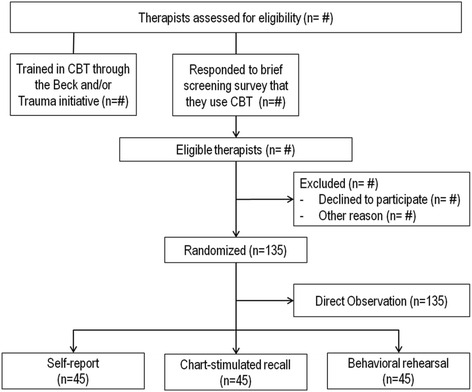
BACKGROUND: This randomized trial will compare three methods of assessing fidelity to cognitive-behavioral therapy (CBT) for youth to identify the most accurate and cost-effective method. The three methods include self-report (i.e., therapist completes a self-report measure on the CBT interventions used in session while circumventing some of the typical barriers to self-report), chart-stimulated recall (i.e., therapist reports on the CBT interventions used in session via an interview with a trained rater, and with the chart to assist him/her) and behavioral rehearsal (i.e., therapist demonstrates the CBT interventions used in session via a role-play with a trained rater). Direct observation will be used as the gold-standard comparison for each of the three methods. METHODS/DESIGN: This trial will recruit 135 therapists in approximately 12 community agencies in the City of Philadelphia. Therapists will be randomized to one of the three conditions. Each therapist will provide data from three unique sessions, for a total of 405 sessions. All sessions will be audio-recorded and coded using the Therapy Process Observational Coding System for Child Psychotherapy-Revised Strategies scale. This will enable comparison of each measurement approach to direct observation of therapist session behavior to determine which most accurately assesses fidelity. Cost data associated with each method will be gathered. To gather stakeholder perspectives of each measurement method, we will use purposive sampling to recruit 12 therapists from each condition (total of 36 therapists) and 12 supervisors to participate in semi-structured qualitative interviews. DISCUSSION: Results will provide needed information on how to accurately and cost-effectively measure therapist fidelity to CBT for youth, as well as important information about stakeholder perspectives with regard to each measurement method. Findings will inform fidelity measurement practices in future implementation studies as well as in clinical practice. TRIAL REGISTRATION: NCT02820623 , June 3rd, 2016.
Overview
The claims and statistics of this paper haven’t been checked yet.
Free: it reads the open-access text and checks the first 5 claims that cite a source we can check. Create a free account to check every claim.
Integrity signals
Registry
Cites
Statistics
Figures
Verification
Claims the paper makes
The claims and statistics of this paper haven’t been checked yet.
Free: it reads the open-access text and checks the first 5 claims that cite a source we can check. Create a free account to check every claim.
Claims other papers make about this one
Each is checked against this paper’s own text: does it say what the citing paper says it does?
In the citing paper
“These and other research efforts [12, 39] aim to demonstrate the relevance and practical utility of behavioral economic concepts such as bounded rationality for implementation research and, in particular when considering the decision-making approaches and perspectives of different stakeholders.”
From Implementation science issues in understanding, collecting, and using cost estimates: A multi-stakeholder perspective (2021) · cites this paper as [39]
Self-check
Percentages, sums and reported differences re-computed from the paper’s own numbers.
The self-check needs the paper’s full text.
Citations
Cites
How Many Interviews Are Enough?: An Experiment with Data Saturation and Variability
Guest, G., Bunce, A., & Johnson, L. (2006) · Field Methods · doi:10.1177/1525822x05279903 · Cited by 20,808
Proctor, E., Silmere, H., Raghavan, R., Hovmand, P., Aarons, G., Bunger, A., Griffey, R., & Hensley, M. (2011) · Administration and Policy in Mental Health and Mental Health Services Research · doi:10.1007/s10488-010-0319-7 · Cited by 8,721 · cited 2×
“Although use of these economic evaluation methods is widespread in medicine [29], they are rarely utilized in implementation studies [5].”
BackgroundMethodIntention—Behavior Relations: A Conceptual and Empirical Review
Sheeran, P. (2002) · European Review of Social Psychology · doi:10.1080/14792772143000003 · Cited by 3,688 · cited 2×
“These measures have demonstrated predictive, face, and construct validity [45].”
BackgroundInfluence : science and practice
Cialdini, R. B. (1985) · Cited by 3,581
Advancing a Conceptual Model of Evidence-Based Practice Implementation in Public Service Sectors
Aarons, G. A., Hurlburt, M., & Horwitz, S. M. (2011) · Administration and Policy in Mental Health and Mental Health Services Research · doi:10.1007/s10488-010-0327-7 · Cited by 3,240 · cited 2×
“has been identified in implementation science frameworks as the mechanism by which desired outcomes are achieved [3–5], and as an indicator of quality of care [6].”
BackgroundPredicting and Changing Behavior
Fishbein, M., & Ajzen, I. (2011) · doi:10.4324/9780203838020 · Cited by 2,807
Empirically supported psychological interventions: Controversies and evidence
Chambless, D. L., & Ollendick, T. H. (2001) · Annual Review of Psychology · doi:10.1146/annurev.psych.52.1.685 · Cited by 2,097
Assessment in medical education
Epstein, R. M. (2007) · New England Journal of Medicine · doi:10.1056/nejmra054784 · Cited by 1,872
Research synthesis: the practice of cognitive interviewing
Beatty, P. C., & Willis, G. B. (2007) · Public Opinion Quarterly · doi:10.1093/poq/nfm006 · Cited by 1,615 · cited 1×
“All of the measures will be piloted and cognitive response testing will be used to identify ambiguous wording [50].”
MethodComparing effect sizes in follow-up studies: ROC Area, Cohen's d, and r.
Rice, M. E., & Harris, G. T. (2005) · Law and Human Behavior · doi:10.1007/s10979-005-6832-7 · Cited by 1,608
The Role of Theory in Developing Effective Health Communications
Fishbein, M., & Cappella, J. N. (2006) · Journal of Communication · doi:10.1111/j.1460-2466.2006.00280.x · Cited by 864 · cited 1×
“Extensive evidence shows that motivation can be strengthened by theory-based efforts designed to target perceived barriers and facilitators [46, 47].”
BackgroundPerepletchikova, F., Treat, T. A., & Kazdin, A. E. (2007) · Journal of Consulting and Clinical Psychology · doi:10.1037/0022-006x.75.6.829 · Cited by 533 · cited 1×
“the components are implemented and how responsive the therapist is to the client and situation [2].”
BackgroundToward the Effective and Efficient Measurement of Implementation Fidelity
Schoenwald, S. K., Garland, A. F., Chapman, J. E., Frazier, S. L., Sheidow, A. J., & Southam-Gerow, M. A. (2011) · Administration and Policy in Mental Health and Mental Health Services Research · doi:10.1007/s10488-010-0321-0 · Cited by 422 · cited 2×
“, measure what they intend) and cost-effective [7].”
BackgroundSelf-citationCarroll, K. (2000) · Drug and Alcohol Dependence · doi:10.1016/s0376-8716(99)00049-6 · Cited by 386 · cited 1×
“Further, we hypothesize behavioral rehearsal will be superior in capturing competence because the trained individual observing the therapist role-playing particular CBT interventions evaluates the therapist’s skillfullness and responsiveness, which represent core competence domains [22].”
BackgroundGlasgow, R. E., & Riley, W. T. (2013) · American Journal of Preventive Medicine · doi:10.1016/j.amepre.2013.03.010 · Cited by 318 · cited 1×
“In addition to the potential contribution that the identification of accurate and cost-effective fidelity measurement methods can make to the broader implementation science literature, this work will also produce pragmatic measures [41] that can be useful for community mental health agencies.”
BackgroundPay for Performance at the Tipping Point
Epstein, A. M. (2007) · New England Journal of Medicine · doi:10.1056/nejme078002 · Cited by 276
Common methodological flaws in economic evaluations
Drummond, M., & Sculpher, M. (2005) · Medical Care · doi:10.1097/01.mlr.0000170001.10393.b7 · Cited by 204 · cited 1×
“Although use of these economic evaluation methods is widespread in medicine [29], they are rarely utilized in implementation studies [5].”
MethodTrajectories of change in youth anxiety during cognitive—behavior therapy.
Peris, T. S., Compton, S. N., Kendall, P. C., Birmaher, B., Sherrill, J., March, J., Gosch, E., Ginsburg, G., Rynn, M., McCracken, J. T., et al. (2015) · Journal of Consulting and Clinical Psychology · doi:10.1037/a0038402 · Cited by 191
Weersing, V. R., Weisz, J. R., & Donenberg, G. R. (2002) · Journal of Clinical Child and Adolescent Psychology · doi:10.1207/153744202753604458 · Cited by 190 · cited 1×
“For example, one item from a commonly used self-report instrument, “Did you use systematic desensitization, with imagined or real exposure to feared objects or situations, with your client?” [20] includes several technical terms.”
MethodPredictors of Community Therapists’ Use of Therapy Techniques in a Large Public Mental Health System
Beidas, R. S., Marcus, S., Aarons, G. A., Hoagwood, K. E., Schoenwald, S., Evans, A. C., Hurford, M. O., Hadley, T., Barg, F. K., Walsh, L. M., et al. (2015) · JAMA Pediatrics · doi:10.1001/jamapediatrics.2014.3736 · Cited by 177
Self-citationShow Me, Don’t Tell Me: Behavioral Rehearsal as a Training and Analogue Fidelity Tool
Beidas, R. S., Cross, W., & Dorsey, S. (2014) · Cognitive and Behavioral Practice · doi:10.1016/j.cbpra.2013.04.002 · Cited by 171 · cited 2×
“When fidelity is measured in community settings, which occurs rarely, the most commonly used method is therapists’ self-report [10].”
MethodSelf-citationSchoenwald, S. K., Chapman, J. E., Kelleher, K., Hoagwood, K. E., Landsverk, J., Stevens, J., Glisson, C., Rolls-Reutz, J., & The Research Network on Youth Mental Health (2008) · Administration and Policy in Mental Health and Mental Health Services Research · doi:10.1007/s10488-007-0147-6 · Cited by 149 · cited 1×
“These fidelity measurement methods can be integrated as quality assurance tools by supervisors during supervision, given the literature suggesting that most therapists receive supervision in community mental health [26, 42, 43].”
BackgroundSelf-citationDisseminating and Implementing Trauma-Focused CBT in Community Settings
Cohen, J., & Mannarino, A. P. (2008) · Trauma, Violence, & Abuse · doi:10.1177/1524838008324336 · Cited by 138 · cited 3×
“Community mental health agencies We will recruit community mental health agencies that are participating in at least one of two initiatives to implement CBT for youth (i.e., Beck Community Initiative [23] and the Philadelphia Alliance for Child Trauma Services Initiative [24]).”
BackgroundInfluentialCost-effectiveness analysis of addiction treatment: paradoxes of multiple outcomes
Sindelar, J. L., Jofre‐Bonet, M., French, M. T., & McLellan, A. T. (2003) · Drug and Alcohol Dependence · doi:10.1016/j.drugalcdep.2003.09.002 · Cited by 125 · cited 1×
“studies, including mental health services interventions [30–39].”
Self-citationChild and Family Therapy Process: Concordance of Therapist and Observational Perspectives
Hurlburt, M. S., Garland, A. F., Nguyen, K., & Brookman-Frazee, L. (2010) · Administration and Policy in Mental Health and Mental Health Services Research · doi:10.1007/s10488-009-0251-x · Cited by 124 · cited 1×
“Unfortunately, concordance between observation and self-report is low [11].”
BackgroundFrench, M. T., Salomé, H. J., Sindelar, J. L., & Thomas McLellan, A. (2002) · Health Services Research · doi:10.1111/1475-6773.031 · Cited by 122
Self-citationThe Therapy Process Observational Coding System for Child Psychotherapy Strategies Scale
McLeod, B. D., & Weisz, J. R. (2010) · Journal of Clinical Child & Adolescent Psychology · doi:10.1080/15374411003691750 · Cited by 118 · cited 11×
“Subsequently, all three sessions will be coded using the TPOCS-RS [19].”
BackgroundMethodInfluentialSelf-citationMcLeod, B. D., Southam-Gerow, M. A., Tully, C. B., Rodríguez, A., & Smith, M. M. (2013) · Clinical Psychology: Science and Practice · doi:10.1111/cpsp.12020 · Cited by 117
Self-citationA review of treatment adherence measurement methods.
Schoenwald, S. K., & Garland, A. F. (2013) · Psychological Assessment · doi:10.1037/a0029715 · Cited by 109 · cited 2×
“Self-report refers to therapist completion of a brief questionnaire with regard to CBT interventions used with a client in session [9].”
BackgroundMethodSelf-citationChambers, D. A., & Azrin, S. T. (2013) · Psychiatric Services · doi:10.1176/appi.ps.201300032 · Cited by 101
Evidence-based practices addressed in community-based children's mental health clinical supervision.
Accurso, E. C., Taylor, R. M., & Garland, A. F. (2011) · Training and Education in Professional Psychology · doi:10.1037/a0023537 · Cited by 86 · cited 1×
“These fidelity measurement methods can be integrated as quality assurance tools by supervisors during supervision, given the literature suggesting that most therapists receive supervision in community mental health [26, 42, 43].”
BackgroundPolicy to implementation: evidence-based practice in community mental health – study protocol
Beidas, R. S., Aarons, G., Barg, F., Evans, A., Hadley, T., Hoagwood, K., Marcus, S., Schoenwald, S., Walsh, L., & Mandell, D. S. (2013) · Implementation Science · doi:10.1186/1748-5908-8-38 · Cited by 81
Self-citationGuerra, C. E., Jacobs, S. E., Holmes, J. H., & Shea, J. A. (2007) · Journal of General Internal Medicine · doi:10.1007/s11606-007-0142-3 · Cited by 78 · cited 1×
“Chart-stimulated recall refers to a brief structured interview with a therapist about a client session during which the therapist reviews the client’s file to aid recall of specific CBT interventions used [18].”
BackgroundSelf-citationDATStats: results from 85 studies using the Drug Abuse Treatment Cost Analysis Program (DATCAP)
Roebuck, M. C., French, M. T., & McLellan, A. T. (2003) · Journal of Substance Abuse Treatment · doi:10.1016/s0740-5472(03)00067-9 · Cited by 72 · cited 1×
“studies, including mental health services interventions [30–39].”
Self-citationSoutham-Gerow, M. A., & McLeod, B. D. (2013) · Clinical Psychology: Science and Practice · doi:10.1111/cpsp.12019 · Cited by 70 · cited 1×
“has been identified in implementation science frameworks as the mechanism by which desired outcomes are achieved [3–5], and as an indicator of quality of care [6].”
BackgroundSelf-citationFrench, M. T., Roebuck, M. C., Dennis, M. L., Diamond, G., Godley, S. H., Tims, F., Webb, C., & Herrell, J. M. (2002) · Addiction · doi:10.1046/j.1360-0443.97.s01.4.x · Cited by 66 · cited 1×
“studies, including mental health services interventions [30–39].”
Self-citationStirman, S. W., Bhar, S. S., Spokas, M., Brown, G. K., Creed, T. A., Perivoliotis, D., Farabaugh, D. T., Grant, P. M., & Beck, A. T. (2010) · Professional Psychology: Research and Practice · doi:10.1037/a0018099 · Cited by 63
Jennett, P., & Affleck, L. (1998) · Journal of Continuing Education in the Health Professions · doi:10.1002/chp.1340180306 · Cited by 63 · cited 1×
“patient chart to stimulate their memory of their treatment plan [16].”
BackgroundLetter: Estimating the economic cost of substance abuse treatment
French, M. T., & McGeary, K. A. (1997) · Health Economics · doi:10.1002/(sici)1099-1050(199709)6:5<539::aid-hec295>3.0.co;2-0 · Cited by 63
The effect of presentation order in clinical decision making
Cunnington, J. P. W., Turnbull, J., Regehr, G., Marriott, M., & Norman, G. R. (1997) · Academic Medicine · doi:10.1097/00001888-199710001-00014 · Cited by 59
Outpatient Marijuana Treatment for Adolescents: Economic Evaluation of a Multisite Field Experiment
French, M. T., Roebuck, M. C., Dennis, M. L., Godley, S. H., Liddle, H. A., & Tims, F. M. (2003) · Evaluation Review · doi:10.1177/0193841x03254349 · Cited by 59
Self-citationDefensible assessment of the competency of the practicing physician.
Cunnington, J. P. W., Hanna, E., Turnhbull, J., Kaigas, T., & Norman, G. R. (1997) · PubMed · Cited by 57
Salomé, H. J., French, M. T., Miller, M., & McLellan, A. T. (2003) · Drug and Alcohol Dependence · doi:10.1016/s0376-8716(03)00133-9 · Cited by 55 · cited 1×
“studies, including mental health services interventions [30–39].”
Goulet, F., Jacques, A., Gagnon, R., Racette, P., & Sieber, W. (2007) · Evaluation & the Health Professions · doi:10.1177/0163278707307924 · Cited by 52 · cited 2×
“sessment tool in medicine, where it has demonstrated reliability and validity with respect to physician behavior [12–16].”
BackgroundMiddlestadt, S. E. (2012) · The Annals of the American Academy of Political and Social Science · doi:10.1177/0002716211425015 · Cited by 43
McCollister, K. E., French, M. T., Sheidow, A. J., Henggeler, S. W., & Halliday‐Boykins, C. A. (2008) · The Journal of Behavioral Health Services & Research · doi:10.1007/s11414-007-9094-y · Cited by 36 · cited 1×
“studies, including mental health services interventions [30–39].”
Self-citationMiller, P. A., Nayer, M., & Eva, K. W. (2010) · Physical Therapy · doi:10.2522/ptj.20080137 · Cited by 26 · cited 2×
“sessment tool in medicine, where it has demonstrated reliability and validity with respect to physician behavior [12–16].”
BackgroundCost estimation when time and resources are limited: The Brief DATCAP
French, M. T., Roebuck, M. C., & McLellan, A. T. (2004) · Journal of Substance Abuse Treatment · doi:10.1016/j.jsat.2004.07.001 · Cited by 23 · cited 1×
“studies, including mental health services interventions [30–39].”
Self-citationUsing Cost and Financing Instruments for Economic Evaluation of Substance Abuse Treatment Services
Salomé, H. J., & French, M. T. (2002) · Springer eBooks · doi:10.1007/978-0-306-47193-3_14 · Cited by 22 · cited 1×
“studies, including mental health services interventions [30–39].”
Self-citationSalvatori, P. S., Simonavicius, N., Moore, J., Rimmer, G., & Patterson, M. M. (2008) · Canadian Journal of Occupational Therapy · doi:10.1177/000841740807500109 · Cited by 19 · cited 2×
“sessment tool in medicine, where it has demonstrated reliability and validity with respect to physician behavior [12–16].”
Background
Research works printed but not linked: 1
- Sherill J Pragmatic Strategies for Assessing Psychotherapy Quality in Practice 2015 Washington National Institutes of Mental Health
Cited by
Eisman, A. B., Quanbeck, A., Bounthavong, M., Panattoni, L., & Glasgow, R. E. (2021) · Implementation Science · doi:10.1186/s13012-021-01143-x · Cited by 126
“These and other research efforts [12, 39] aim to demonstrate the relevance and practical utility of behavioral economic concepts such as bounded rationality for implementation research and, in particular when”
BackgroundAlley, Z. M., Chapman, J. E., Schaper, H., & Saldana, L. (2023) · Implementation Science · doi:10.1186/s13012-023-01285-0 · Cited by 86
“More specifically, intervention fidelity is defined as adherence to key treatment components, where those components are delivered with competence [7, 8].”
BackgroundThe case for prioritizing implementation strategy fidelity measurement: benefits and challenges
Akiba, C. F., Powell, B. J., Pence, B. W., Nguyen, M. X. B., Golin, C., & Go, V. (2022) · Translational Behavioral Medicine · doi:10.1093/tbm/ibab138 · Cited by 59
What is the Status of Multi-Informant Treatment Fidelity Research?
McLeod, B. D., Porter, N., Hogue, A., Becker‐Haimes, E. M., & Jensen‐Doss, A. (2022) · Journal of Clinical Child & Adolescent Psychology · doi:10.1080/15374416.2022.2151713 · Cited by 68
Self-citationDorsey, S., Kerns, S. E. U., Lucid, L., Pullmann, M. D., Harrison, J. P., Berliner, L., Thompson, K., & Deblinger, E. (2018) · Implementation Science · doi:10.1186/s13012-017-0708-3 · Cited by 67
Self-citation
Metadata
- Authors
- Beidas, R. S., Maclean, J. C., Fishman, J., Dorsey, S., Schoenwald, S. K., Mandell, D. S., Shea, J. A., McLeod, B. D., French, M. T., Hogue, A., Adams, D. R., Lieberman, A., Becker-Haimes, E. M., & Marcus, S. C.
- Affiliations
- University of Pennsylvania (US)
- National Bureau of Economic Research (US)
- University of Washington (US)
- Medical University of South Carolina (US)
- Virginia Commonwealth University (US)
- University of Miami (US)
- National Center on Addiction and Substance Abuse at Columbia University (US)
- Corresponding author
- Beidas, Rinad S.
- ORCID
- Venue
- BMC Psychiatry
- Published
- 2016-09-15
- Volume
- 16
- Issue
- 1
- Pages
- 323-323
- ISSN
- 1471-244X (ISSN-L)
- PMC
- PMC5025620
- OpenAlex
- W2518941648
- Cited by
- 50
- References
- 50
- Citations by year
- 2025: 8 · 2024: 4 · 2023: 7 · 2022: 7 · 2021: 9 · 2020: 4 · 2019: 3 · 2018: 5 · 2017: 3
- FWCI
- 4.91
- Type
- journal article
- Language
- en
- Open access
- gold
- doi.org
- Licence
- cc-by
- creativecommons.org/licenses/by/4.0/ (tdm)
- creativecommons.org/licenses/by/4.0/ (vor)
- Locations
- BMC Psychiatry (publishedVersion, cc-by)
- PubMed Central (publishedVersion, cc-by)
- PubMed (publishedVersion)
- ScholarlyCommons (University of Pennsylvania) (submittedVersion, cc-by)
- TUScholarShare (Temple University) (submittedVersion, cc-by)
- Funders
- National Institute of Mental Health (R01 MH108551)
- Topics
- Social Sciences › Psychology › Clinical Psychology › Psychotherapy Techniques and Applications
- Health Sciences › Health Professions › General Health Professions › Health Policy Implementation Science
- Social Sciences › Psychology › Clinical Psychology › Counseling Practices and Supervision
- Keywords
- intervention fidelity, cognitive behavioral therapy, adolescent psychotherapy, behavioral rehearsal, role play, direct observation, cost-effectiveness, therapist supervision, stakeholder perspectives, child psychotherapy
- MeSH terms
- Adolescent, Adult, Mental Disorders, Child, Cost-Benefit Analysis, Female, Humans, Male, Research Design, Philadelphia, Reproducibility of Results, Cognitive Behavioral Therapy, Young Adult, Self Report
About these checks
Registry, retraction, Cites and statistics results are computed, not judged, with one exception: a printed reference that no index lists is read once by a model before it counts as a citation error. Claims are extracted by a model and kept only when their quote appears verbatim in the text; each cited source is then checked, with a model’s help, for whether it says what the claim relies on. Those verdicts can be wrong — read the claim’s quote and the cited source before relying on one.
Statistics and arithmetic are recomputed, not judged.
Confidence bands are shown only for fields calibrated on our annotated test set. None is calibrated yet, so no band is shown.
What counts as a claim ›How we measure confidence ›How we check this ›
Are you an author, or do you see a problem with this page? Request a review
Data sources
Bibliographic data: Semantic Scholar, OpenAlex, Crossref.
Contains information from the Semantic Scholar Academic Graph Datasets, made available under the ODC Attribution License (ODC-BY 1.0).
Semantic Scholar’s data is described in: Kinney, R., et al. (2023). The Semantic Scholar Open Data Platform. arXiv:2301.10140.
