

Associations between loneliness and perceived social support and outcomes of mental health problems: a systematic review
Open accessThe DOI matches its Crossref record; 91 of the 91 references it cites were found in a registry or an index; 10 of the 79 sources its claims cite were checked for support.
Abstract
BACKGROUND: The adverse effects of loneliness and of poor perceived social support on physical health and mortality are established, but no systematic synthesis is available of their relationship with the outcomes of mental health problems over time. In this systematic review, we aim to examine the evidence on whether loneliness and closely related concepts predict poor outcomes among adults with mental health problems. METHODS: We searched six databases and reference lists for longitudinal quantitative studies that examined the relationship between baseline measures of loneliness and poor perceived social support and outcomes at follow up. Thirty-four eligible papers were retrieved. Due to heterogeneity among included studies in clinical populations, predictor measures and outcomes, a narrative synthesis was conducted. RESULTS: We found substantial evidence from prospective studies that people with depression who perceive their social support as poorer have worse outcomes in terms of symptoms, recovery and social functioning. Loneliness has been investigated much less than perceived social support, but there is some evidence that greater loneliness predicts poorer depression outcome. There is also some preliminary evidence of associations between perceived social support and outcomes in schizophrenia, bipolar disorder and anxiety disorders. CONCLUSIONS: Loneliness and quality of social support in depression are potential targets for development and testing of interventions, while for other conditions further evidence is needed regarding relationships with outcomes.
Overview
CoChat Summary
TL;DR
This systematic review of 34 longitudinal studies found substantial evidence that poorer perceived social support predicts worse symptom, recovery and functional outcomes in depression, with preliminary evidence in bipolar disorder, anxiety disorders and schizophrenia. Loneliness was much less studied, but available evidence suggested greater loneliness predicts poorer depression outcomes.
Key findings
- Across 23 depression papers, 11 of 13 studies assessing symptom severity found baseline poorer perceived social support or greater loneliness significantly predicted higher depressive symptom severity; 8 of 9 multivariable analyses adjusting for baseline depression severity remained significant. In the only loneliness-predictor depression study, a 1-point higher baseline loneliness score predicted a 0.61-point higher depressive symptom severity score at follow-up (Beta = 0.61, 95% CI 0.12–1.11), and very severely lonely respondents were less likely to achieve remission than non-lonely respondents (OR = 0.25, 95% CI 0.08–0.80).
- For depression recovery/remission, 6 of 7 articles found lower perceived social support or higher loneliness at baseline predicted lower recovery/remission; poorer perceived social support predicted poorer recovery one year later (OR = 1.21, 95% CI 1.09–1.35) and longer time-to-remission (Hazard Ratio = 0.47, 95% CI 0.31–0.71).
- In bipolar disorder, lower perceived social support predicted greater depression over time (beta −0.14 to −0.25; regression coefficient −1.33), and greater perceived social support reduced risk of recurrence of any type at one year (OR = 0.92, 95% CI 0.85–0.99). In anxiety disorders, all three studies reported significant associations; greater perceived social support predicted higher remission at 6 months in generalised anxiety disorder (OR = 1.38, 95% CI 1.09–1.75).
- In schizophrenia/schizoaffective disorders, greater support from friends at baseline predicted better satisfaction with life quality after 16 months, accounting for 2.9% of quality-of-life index scores at follow-up. Only two included studies directly assessed loneliness.
Methods
- Systematic review registered on PROSPERO (CRD42015014784); searched Medline, PsycINFO, Embase, Web of Science, CINAHL and Cochrane Library (1891 to April 2016), plus reference lists and grey literature, for longitudinal quantitative studies in adults with mental illness examining baseline loneliness or poor perceived social support and follow-up outcomes.
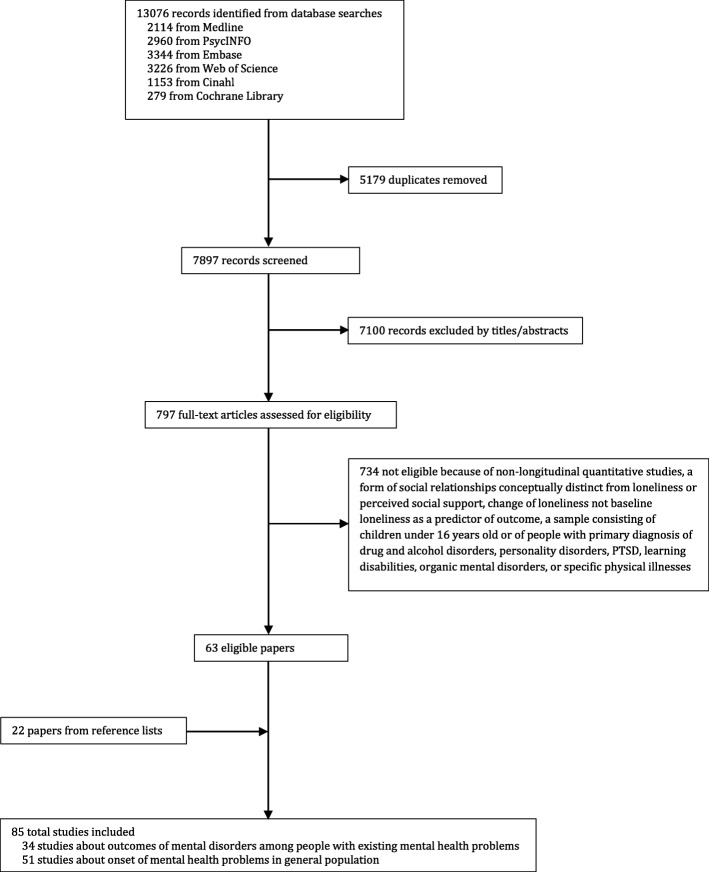
- The search retrieved 13,076 records; 797 full-text articles were assessed, and 34 eligible papers were included. Included studies covered depression (n = 23), schizophrenia/schizoaffective disorders (n = 2), bipolar disorder (n = 4), anxiety disorders (n = 3), and mixed samples (n = 2).
- Due to heterogeneity in populations, predictor measures and outcomes, a narrative synthesis was conducted; methodological quality was assessed with the Mixed Methods Appraisal Tool (MMAT), with scores ranging from * to .
Limitations
- Stated by the authors: many included studies did not report complete outcome data, response rate or follow-up rate, lowering quality ratings; some did not adjust for baseline outcome measures; the relationship may be circular; the search may not be exhaustive; eligible studies came from only seven countries, mostly North America; few non-English papers could be included; reporting bias is uncertain; the review was restricted to common mental disorders and examined only one direction of causation.
- Evident from the text: only two studies directly assessed loneliness, most evidence concerned depression, only five studies had follow-up over two years, and most samples were under 400 participants, with six studies under 100.
Model-written summary. Check it against the paper before relying on it.
Integrity signals
Registry
Cites
Statistics
Figures
Verification
Claims the paper makes
10 Valid · 2 Not valid · 43 Not checked · 61 Own results and interpretations
The cited sources support only part of this claim — read each source’s verdict below.
In the paper
“Feelings of loneliness are more prevalent among people with mental illness than in the general population [23, 24].”
§ Associations between loneliness and perceived social support and outcomes of mental health problems: a systematic review > Background
What the sources say
- Not checked yetcites [23] Borge L Martinsen EW Ruud T Watne O Friis S Quality of life, loneliness, and social contact among long-term psychiatric patients Psychiatr Serv 1999 50 1 81 84 10.1176/ps.50.1.81 9890584 source
- Partly supportedcites [24] Lauder W Sharkey S Mummery K A community survey of loneliness J Adv Nurs 2004 46 1 88 94 10.1111/j.1365-2648.2003.02968.x 15030445 sourceExperimental — accuracy not yet measured
The only passage in our copy touching mental illness is in the Background: 'It has also been suggested that feelings of loneliness increase during periods of mental illness when positive psychotic symptoms are experienced. A cycle develops in which there is a loss of reciprocal ties and less satisfaction with social relationships (Angell & Test 2002)' — a hedged statement about periods of psychotic symptoms, credited by Lauder et al. to another work, not a claim of higher prevalence than in the general population. The comparative element of the citing sentence is absent: the paper's own data are a community survey (Central Queensland Social Survey, n = 1241), and its prevalence figures (Conclusion: 'over one third of all respondents reported some level of loneliness'; Additional information: 'nearly two thirds of the community study sample') describe the general sample, with no mental-illness comparison group measured. The Additional information bullet 'Loneliness is associated with an increased incidence of physical and mental health problems' supports only a general association, so the sentence states as an established comparative fact what this source hedges and borrows. (LLM, conf=0.72)
plainstates an association- Asserted: passes — The authors put it forward as true.
- Checkable: passes — It can be checked against evidence.
- Load-bearing: unclear — It is unclear whether the paper’s conclusions depend on it.
- Based: passes — The paper gives a reason why it holds.
The cited sources support only part of this claim — read each source’s verdict below.
In the paper
“One further review looked at the relationship between social networks and support and early psychosis in people with first episode psychosis and in general population samples, but included no prospective studies [46].”
§ Associations between loneliness and perceived social support and outcomes of mental health problems: a systematic review > Background
What the sources say
- Partly supportedcites [46] Gayer-Anderson C Morgan C Social networks, support and early psychosis: a systematic review Epidemiol Psychiatr Sci 2013 22 2 131 146 10.1017/S2045796012000406 22831843 PMC6998121 sourceExperimental — accuracy not yet measured
The subject and populations attributed to this source match exactly: the Method (inclusion criteria) and Abstract describe a systematic review of social networks and support in first-episode psychosis samples and in general population samples with psychotic experiences or schizotypy (38 papers). However, on study design the source hedges rather than ruling out prospective work: the Discussion (methodological issues) states that 'almost invariably studies were cross-sectional making it difficult to disentangle cause and effect', and Table 1 (Results) lists each included study's time period as cross-sectional or retrospective (e.g. 'previous year', 'prodrome', 'two months pre-onset', 'year pre-contact') with no prospective/cohort design shown, while the Discussion's future-research section argues for the feasibility of informative cohort studies as something still to be done. The citing sentence converts this 'almost invariably cross-sectional' into the absolute 'included no prospective studies'. (LLM, conf=0.70)
plain- Asserted: passes — The authors put it forward as true.
- Checkable: passes — It can be checked against evidence.
- Load-bearing: passes — The paper’s conclusions depend on it.
- Based: passes — The paper gives a reason why it holds.
- Partly supported
The sources with a verdict support this claim; the rest weren’t checked yet, have no full text we could read, or their verdicts aren’t rated yet.
In the paper
“Three previous systematic reviews have explored the relationship between social relations and depression in general population [43, 44], or older adults [45], but included both cross-sectional and prospective studies.”
§ Associations between loneliness and perceived social support and outcomes of mental health problems: a systematic review > Background
What the sources say
- Supportedcites [43] Gariepy G Honkaniemi H Quesnel-Vallee A Social support and protection from depression: systematic review of current findings in western countries Br J Psychiatry 2016 209 4 286 295 10.1192/bjp.bp.115.169094 27445355 source
Our copy is itself a systematic review (with meta-analysis) of observational studies from the general population, Western countries, assessing social support/social relations and protection from depression (Study selection; Method), so it is the kind of review the citing sentence identifies for the general-population citations. It pooled both cross-sectional and cohort (prospective) studies, as shown by the comparisons 'Cross-sectional studies found significant results more often than cohort studies' (Older adults, p. ~6) and the Future research discussion of 'the contrast in magnitude and significance of effects between cohort and cross-sectional studies'. Note only that the paper states in its Background that no prior systematic review existed on this topic, so it is one of the reviews referred to rather than a source describing three predecessors. (LLM, conf=0.85)
- Not checked yetcites [44] Santini ZI Koyanagi A Tyrovolas S Mason C Haro JM The association between social relationships and depression: a systematic review J Affect Disord 2015 175 53 65 10.1016/j.jad.2014.12.049 25594512 source
- Not checked yetcites [45] Schwarzbach M Luppa M Forstmeier S Konig HH Riedel-Heller SG Social relations and depression in late life - a systematic review Int J Geriatr Psychiatry 2014 29 1 1 21 10.1002/gps.3971 23720299 source
plainstates an association- Asserted: passes — The authors put it forward as true.
- Checkable: passes — It can be checked against evidence.
- Load-bearing: passes — The paper’s conclusions depend on it.
- Based: passes — The paper gives a reason why it holds.
- Supported
The cited sources support only part of this claim — read each source’s verdict below.
In the paper
“They found that loneliness at baseline predicted depression and anxiety severity and remission from depression [25, 66].”
§ Associations between loneliness and perceived social support and outcomes of mental health problems: a systematic review > Discussion > Research implications
What the sources say
- Not checked yetcites [25] Holvast F Burger H de Waal MMW van Marwijk HWJ Comijs HC Verhaak PFM Loneliness is associated with poor prognosis in late-life depression: longitudinal analysis of the Netherlands study of depression in older persons J Affect Disord 2015 185 1 7 10.1016/j.jad.2015.06.036 26142687 source
- Partly supportedcites [66] van Beljouw IM Verhaak PF Cuijpers P van Marwijk HW Penninx BW The course of untreated anxiety and depression, and determinants of poor one-year outcome: a one-year cohort study BMC Psychiatry 2010 10 86 10.1186/1471-244X-10-86 20961414 PMC2974663 sourceExperimental — accuracy not yet measured
Our copy supports the severity part: in 'Determinants of a poor clinical outcome', baseline loneliness was positively associated with symptom severity at one-year follow-up in anxiety (β = .40, SE = .12, p < .01, univariate) and in depression both univariate (b = .89, p < .001) and multivariate after controlling baseline severity (β = .39, p < .05), a point the Discussion highlights as novel for a community sample. However, the paper's outcomes were continuous IDS and BAI scale scores; no passage in our copy (searched: remission, recovery, proportion of patients no longer meeting criteria) reports remission from depression as an outcome or tests loneliness against it, so the 'predicted remission from depression' element attributed here is not supported by this source. Also note that for anxiety the loneliness effect held only in univariate analysis, since in the multivariate model baseline symptom severity was the sole predictor. (LLM, conf=0.78)
plainstates a cause- Asserted: passes — The authors put it forward as true.
- Checkable: passes — It can be checked against evidence.
- Load-bearing: passes — The paper’s conclusions depend on it.
- Based: passes — The paper gives a reason why it holds.
The cited sources support only part of this claim — read each source’s verdict below.
In the paper
“They found that loneliness at baseline predicted depression and anxiety severity and remission from depression [25, 66].”
§ Associations between loneliness and perceived social support and outcomes of mental health problems: a systematic review > Discussion > Research implications
What the sources say
- Not checked yetcites [25] Holvast F Burger H de Waal MMW van Marwijk HWJ Comijs HC Verhaak PFM Loneliness is associated with poor prognosis in late-life depression: longitudinal analysis of the Netherlands study of depression in older persons J Affect Disord 2015 185 1 7 10.1016/j.jad.2015.06.036 26142687 source
- Partly supportedcites [66] van Beljouw IM Verhaak PF Cuijpers P van Marwijk HW Penninx BW The course of untreated anxiety and depression, and determinants of poor one-year outcome: a one-year cohort study BMC Psychiatry 2010 10 86 10.1186/1471-244X-10-86 20961414 PMC2974663 sourceExperimental — accuracy not yet measured
Our copy supports the severity part: baseline loneliness was positively associated with one-year symptom severity in anxiety (β = .40, SE = .12, p < .01) and in depression (univariate β = .89, p < .001; multivariate β = .39, p < .05) — 'Determinants of a poor clinical outcome' and Tables 2/3. However, the Discussion notes that in anxiety only baseline symptom severity survived multivariate adjustment, so loneliness predicted anxiety severity solely in univariate models. Nothing in our copy reports 'remission from depression': the outcome measures are continuous BAI and IDS scale scores at T1 ('Statistical analysis'), and no remission/recovery analysis appears anywhere in the text, so that part of the citing sentence is not supported by this source. (LLM, conf=0.78)
plainstates a cause- Asserted: passes — The authors put it forward as true.
- Checkable: passes — It can be checked against evidence.
- Load-bearing: passes — The paper’s conclusions depend on it.
- Based: passes — The paper gives a reason why it holds.
55 more claims · 4 with their cited sources checked
Create a free account to see all 116 claims and to verify the 69 references still open.
- Probably not a substantial claim. 26
- It may state two separate claims as one. 38
Claims other papers make about this one
Each is checked against this paper’s own text: does it say what the citing paper says it does?
The source backs part of the claim, not all of it — or backs it for a different population, condition or comparison.
In the citing paper
“Research shows that loneliness can lead to a lack of social support and meaningful connections, further exacerbating feelings of distress and contributing to the onset of anxiety and depression [15].”
From The prospective association of adolescent loneliness and low resilience with anxiety and depression in young adulthood: The HUNT study (2025) · cites this paper as [15]
Experimental — accuracy not yet measuredThe cited source says what the claim attributes to it.
In the citing paper
“Indeed, social proximity and interpersonal interactions are relevant factors in developing and fostering social ties [90–92] and maintaining mental health [93].”
From Psychological correlates of perceived loneliness in college students before and during the COVID-19 stay-at-home period: a longitudinal study (2023) · cites this paper as [93]
Statistics recomputed
Every reported test result, recomputed from its test statistic and degrees of freedom. A result shows as not adding up only once an independent check has confirmed it.
- Consistentχ²(5) = 16.35reported p = .006 · recomputed p = .006
“x2 (5) = 16.35, p = .006”
Self-check
Percentages, sums and reported differences re-computed from the paper’s own numbers.
Each contradiction between two passages listed here was confirmed by an independent check.
Rated minor: it would not touch a result — a value no result rests on, a p-value that stays on the same side of the significance level, or a conflict that is clerical, resolved elsewhere in the paper, or outside its own findings.
In the paper
§ Associations between loneliness and perceived social support and outcomes of mental health problems: a systematic review > Results > Depression
“In eight of these nine papers, the relationship between baseline loneliness and depressive symptom outcome remained significant.”
§ Associations between loneliness and perceived social support and outcomes of mental health problems: a systematic review > Results > Eligible papers
“Depression (n = 23) | Perceived social support (n = 22)Loneliness (n = 1)”
Citations
Cites
The Multidimensional Scale of Perceived Social Support
Zimet, G. D., Dahlem, N. W., Zimet, S. G., & Farley, G. K. (1988) · Journal of Personality Assessment · doi:10.1207/s15327752jpa5201_2 · Cited by 13,339
Social Relationships and Mortality Risk: A Meta-analytic Review
Holt-Lunstad, J., Smith, T. B., & Layton, J. B. (2010) · PLoS Medicine · doi:10.1371/journal.pmed.1000316 · Cited by 7,272 · cited 1×
“For instance, two meta-analytic reviews have reported that loneliness and poor social support are associated with higher mortality rates, and that the effect is comparable with some well-established risk factors such as obesity, physical inactivity, and smoking [5, 6].”
BackgroundSocial Relationships and Health
House, J. S., Landis, K. R., & Umberson, D. (1988) · Science · doi:10.1126/science.3399889 · Cited by 7,073
Loneliness and Social Isolation as Risk Factors for Mortality: A Meta-Analytic Review
Holt-Lunstad, J., Smith, T. B., Baker, M., Harris, T., & Stephenson, D. (2015) · Perspectives on Psychological Science · doi:10.1177/1745691614568352 · Cited by 6,043
UCLA loneliness scale (version 3): reliability, validity, and factor structure
Russell, D. W. (1996) · Journal of Personality Assessment · doi:10.1207/s15327752jpa6601_2 · Cited by 5,800 · cited 2×
“(PDF 280 kb) Abbreviations CES-D: Center for Epidemiologic Studies Depression Scale; DSM: Diagnostic and Statistical Manual of Mental Disorder; HoNOS: Health of the Nation Outcome Scales; ICD: International Classification of Diseases; M.I.N.I. : MiniInternational Neuropsychiatric Interview; MMAT: Mixed Methods Apprais…”
MethodPsychometric Characteristics of the Multidimensional Scale of Perceived Social Support
Zimet, G. D., Powell, S. S., Farley, G. K., Werkman, S., & Berkoff, K. A. (1990) · Journal of Personality Assessment · doi:10.1080/00223891.1990.9674095 · Cited by 4,855
Psychometric Characteristics of the Multidimensional Scale of Perceived Social Support
Zimet, G., Powell, S., Farley, G., Werkman, S., & Berkoff, K. (1990) · Journal of Personality Assessment · doi:10.1207/s15327752jpa5503&4_17 · Cited by 4,854
Loneliness matters: a theoretical and empirical review of consequences and mechanisms
Hawkley, L. C., & Cacioppo, J. T. (2010) · Annals of Behavioral Medicine · doi:10.1007/s12160-010-9210-8 · Cited by 4,782 · cited 1×
“The effect of loneliness on physical health may be via biological, psychological and/or behavioural mechanisms, including physiological functioning, neuroendocrine effects, gene effects, immune functioning, perception of stressful events, health behaviours and sleep quality [2, 12, 13].”
BackgroundSocial relationships and health a flashpoint for health policy
Umberson, D., & Karas Montez, J. (2010) · Journal of Health and Social Behavior · doi:10.1177/0022146510383501 · Cited by 2,639 · cited 1×
“There is increasing interest in the effects of social relations on health, and in the service delivery and policy implications of such effects [1].”
BackgroundLoneliness: the experience of emotional and social isolation
Weiss, R. S. (1974) · Cited by 2,513
Research works printed but not linked: 4
- Pluye P Robert E Cargo M Bartlett G O’Cathain A Griffiths F Boardman F Gagnon MP Rousseau MC Proposal: A Mixed Methods Appraisal Tool for Systematic Mixed Studies Reviews 2011 Canada Department of Family Medicine, McGill University, Montreal
- Daniels RE. Psychosocial predictors of symptom severity and functioning in adults with bipolar disorder A three-month prospective study Diss Abstr Int B Sci Eng 2000 60 8-B 4213
- Psychosis and schizophrenia in adults: prevention and management. National Institute for Health and Care Excellence (NICE). 2014. https://www.nice.org.uk/guidance/cg178. Accessed 19 Oct 2016. 32207892
- Report of the Annual Social Prescribing Network Conference. London: University of Westminster; 2016.
Cited by
Items 901–1,000 of 1,002
Mindful Self-Care Scale (MSCS)
Cook‐Cottone, C. P., & Guyker, W. M. (2024) · Springer eBooks · doi:10.1007/978-3-030-77644-2_90-1 · Cited by 3
The Pandemic of Invisible Victims in American Mental Health
Appel, J. M. (2024) · The Hastings Center Report · doi:10.1002/hast.1573 · Cited by 3
Social support and trauma experiences of imprisoned men in Northern Ireland
McFadden, D., Davidson, G., & Butler, M. (2024) · International Journal of Law and Psychiatry · doi:10.1016/j.ijlp.2024.102005 · Cited by 6
Marziali, M. E., Hogg, R. S., Hu, A. T., & Card, K. G. (2024) · BMC Public Health · doi:10.1186/s12889-024-19805-y · Cited by 3
“Loneliness is associated with increased risk of mortality [38, 39] and adverse health outcomes, including but not limited to psychiatric disorders [40] and cardiovascular diseases [41].”
Oltean, L.-E., Canache, M., PATRICHI, A., Rîmbu, R., SÎNTOMA, D., Miu, A. C., & SZENTÁGOTAI-TĂTAR, A. (2024) · Journal of Evidence-Based Psychotherapies · doi:10.24193/jebp.2024.2.14 · Cited by 3
Beukes, E. W., Andersson, G., & Manchaiah, V. K. C. (2024) · Audiology Research · doi:10.3390/audiolres14050068 · Cited by 3
“The impact of social and family support is also now increasingly acknowledged [4–6].”
BackgroundExploring youth sport participation and parental perceptions of social support
Sutcliffe, J., Kelly, P. J., & Vella, S. A. (2024) · Leisure/Loisir · doi:10.1080/14927713.2024.2410165 · Cited by 5
“In fact, studies have reported promising findings when examining social support as a moderator of the effects of daily stress on mental health outcomes (e.g., Wang et al., 2018).”
Gabarrell‐Pascuet, A., Coll‐Planas, L., Alias, S. B., Pascual, R. M., Haro, J. M., & Domènech‐Abella, J. (2024) · PLoS ONE · doi:10.1371/journal.pone.0311883 · Cited by 8
Social Connectedness, Social Support, Social Capital and Health
Zaid, F. A., & Liamputtong, P. (2024) · Springer eBooks · doi:10.1007/978-981-97-0821-5_19-1 · Cited by 6
Schönthaler, E. M. D., Dalkner, N., Stross, T. M., Bengesser, S., Ilic, J., Fellendorf, F. T., Finner, A., Fleischmann, E., Häussl, A., Georgi, J., et al. (2025) · Frontiers in Human Neuroscience · doi:10.3389/fnhum.2025.1479648 · Cited by 3
Digital barrier and depressive disorders in older Chinese adults: Policy implications
Qi, Y., Hu, X., Yao, Y., & Li, C. (2025) · The Innovation Medicine · doi:10.59717/j.xinn-med.2025.100127 · Cited by 3
Fatima, H., Zeb, S., & Kamran, A. (2025) · Journal of Health and Quality of Life · doi:10.37934/jhqol.6.1.112 · Cited by 3
“Studies by Meltzer et al., [13] and Teo et al., [12] also suggested that those with social anxiety disorders have a greater frequency of loneliness.”
Coulombe, S., Krzesni, D. A., Jones, S., & Boyd, M. H. (2018) · Journal of Psychosocial Rehabilitation and Mental Health · doi:10.1007/s40737-018-0125-1 · Cited by 3
Muralidharan, S., & Ferle, C. L. (2020) · Journal of Nonprofit & Public Sector Marketing · doi:10.1080/10495142.2020.1798860 · Cited by 4
“In healthcare, perceived social support has multitude of benefits like – acting as a buffer against loneliness, further mitigating depression (Wang et al., 2018), having a positive impact on the health of both cancer patients and their caregivers (Kelley et al., 2019), and lowering the odds of…”
BackgroundEnsamhet bland äldre personer i Norden
Dahlberg, L., Frank, A., Lennartsson, C., & McKee, K. (2020) · TemaNord · doi:10.6027/temanord2020-517 · Cited by 13
Perceptions of family support and college support: the mediating roles of hope and peer support
George‐Levi, S., Laslo‐Roth, R., Bareket‐Bojmel, L., & Margalit, M. (2021) · Journal of Further and Higher Education · doi:10.1080/0309877x.2021.1906850 · Cited by 7
“Indeed, social support has been linked to numerous positive outcomes, including physical and mental health, in both ordinary and stressful times (for reviews see Wang et al. 2018).”
BackgroundRusca, R., Onwuchekwa, I.-F., Kinane, C., & MacInnes, D. L. (2021) · International Journal of Social Psychiatry · doi:10.1177/00207640211017590 · Cited by 3
“Wang et al. (2018) also found that people with depression who perceive their social support as poorer have worse outcomes and there is preliminary evidence of an association between reduced social support and increased rates of schizophrenia, bipolar and anxiety disorders.”
Background‘Kindness by Post’: A Mixed-Methods Evaluation of a Participatory Public Mental Health Project
Wang, C., Pearce, E., Jones, R., & Lloyd‐Evans, B. (2022) · Frontiers in Psychology · doi:10.3389/fpsyg.2021.813432 · Cited by 3
Self-citationYaacob, Y. M., Razali, S., & Ahmad, Y. (2022) · The Prison Journal · doi:10.1177/00328855221121114 · Cited by 5
“Second, research has shown that females are associated with higher depression rates due to gender role determinants, and not due to biological factors (Wang et al., 2018).”
BackgroundDesrosiers, A., Bond, L., Hoffman, M., Kumar, P., Schafer, C., Metzger, I. W., Vandi, A., Hinton, M., & Betancourt, T. S. (2023) · International Journal of Environmental Research and Public Health · doi:10.3390/ijerph20054059 · Cited by 3
“Given that informal peer support has been positively related to mental health and well-being [20,21], harnessing personal network characteristics that facilitate the peer-to-peer transfer of adaptive behaviors could further promote mental health across a wider segment of the population.”
Recognizing Zooeyia to Promote Companion Animal Welfare in Urban Bangladesh
Kamal, A.-H. M., Dell, C. A., & Kang, T. (2023) · Animals · doi:10.3390/ani13091523 · Cited by 4
Slezáčková, A., Stecz, P., & Millová, K. (2023) · Cross-cultural advancements in positive psychology · doi:10.1007/978-3-031-24412-4_7 · Cited by 6
Barbieri, M., Mercado, E., Gubrium, A., & Valdez, L. A. (2025) · Cultural Diversity & Ethnic Minority Psychology · doi:10.1037/cdp0000604 · Cited by 3
Lim, J., Park, H. H., & Kim, M. J. (2023) · Journal of Public Health · doi:10.1093/pubmed/fdad118 · Cited by 4
Yuan, R. K., Kim, Y. A., Cain, S. W., Münch, M. Y., Ronda, J. M., Wang, W., Czeisler, C. A., & Duffy, J. F. (2023) · Sleep Health · doi:10.1016/j.sleh.2023.08.011 · Cited by 3
The Black-White paradox of mental health in college students
Mushonga, D. R., & Henneberger, A. K. (2023) · Children and Youth Services Review · doi:10.1016/j.childyouth.2023.107414 · Cited by 9
Padmanabhanunni, A., Pretorius, T. B., & Isaacs, S. A. (2024) · South African Journal of Psychology · doi:10.1177/00812463231224045 · Cited by 5
“Perceived support has been more strongly associated with mental health outcomes than actual received support (Harandi et al., 2017; Wang et al., 2018).”
BackgroundChandler, G., & Maclean, E. (2022) · Approaches An Interdisciplinary Journal of Music Therapy · doi:10.56883/aijmt.2024.63 · Cited by 6
Tin, T. T. (2024) · Pakistan Journal of Life and Social Sciences (PJLSS) · doi:10.57239/pjlss-2024-22.2.001160 · Cited by 3
Effects of Physical Activity Intervention for Chinese People With Severe Mental Illness
Young, D. K. W., Petrus Yat-nam, N. G., Cheng, D., & Hong, L. C. (2018) · Research on Social Work Practice · doi:10.1177/1049731518804900 · Cited by 7
Luo, T., Yan, C., & Zhang, X. (2022) · Frontiers in Public Health · doi:10.3389/fpubh.2022.811165 · Cited by 3
Robles, G., Lee, J. J.-H., Yu, M., & Starks, T. J. (2023) · Journal of Racial and Ethnic Health Disparities · doi:10.1007/s40615-023-01637-y · Cited by 5
“Social support is a well-established protective factor against negative health outcomes [28, 29].”
Psychedelic drugs as a long-needed innovation in psychiatryPreprint
Oña, G., & Bouso, J. C. (2020) · Qeios · doi:10.32388/t3em5e.2 · Cited by 3
“T his approach is sensible considering that social isolation and loneliness are now considered major public health concerns, with some studies concluding that extreme loneliness predicts greater severity of symptoms, a slower recovery, and worse treatment outcomes in people affected by depression, bipolar disorder, an…”
BackgroundLoneliness in COVID-19, Life, and the LawPreprint
Ash, O., & Huang, P. H. (2021) · SSRN Electronic Journal · doi:10.2139/ssrn.3793900 · Cited by 4
Davidson, R. D., & Zhou, E. S. (2020) · Springer eBooks · doi:10.1007/978-3-319-69909-7_2789-2 · Cited by 3
Concept analysis of loneliness in older adults: A hybrid modelPreprint
Bandari, R., Shahboulaghi, F. M., Khankeh, H. R., Ebadi, A., & Montazeri, A. (2020) · Research Square · doi:10.21203/rs.3.rs-26446/v1 · Cited by 7
“These included morbidity and mortality [38-40], poor physiological health outcomes [4,41], poor psychological health and wellbeing [42, 43], defective immune functioning [44,45], hypertension[46, 47], coronary heart disease (CHD) [48, 49], stroke [50, 51], increased risk of physical inactivity and smoking [52], dement…”
BackgroundThe impact of the COVID-19 pandemic on social isolation and loneliness – A Nordic research review
Aartsen, M., & Rothe, F. (2023) · doi:10.52746/egpo9288 · Cited by 9
Andualem, F., Derbie, T., Seid, J., & Fasil, L. (2022) · Research Square · doi:10.21203/rs.3.rs-1646150/v1 · Cited by 3
Stopping the Harm: Psychosocial Outcomes of Families Affected by Drug Use
Coady, A., Johnston, C., Koersen, B., & Piercy, J. C. (2022) · The Canadian Journal of Addiction · doi:10.1097/cxa.0000000000000163 · Cited by 3
Sense of mastery in first-episode psychosis—a one-year follow-up study
Lindgren, M., Therman, S., From, T., Hietala, J. A., Laurikainen, H., Salokangas, R. K. R., & Suvisaari, J. (2023) · Frontiers in Psychiatry · doi:10.3389/fpsyt.2023.1200669 · Cited by 3
An Exploration of the Social Support of Women in Sex Work in Cúcuta, Colombia
Fabbri, M., Niño, M. A., Karandikar, S., Padilla, Y. A., Coronel, V., Pineda, M. A., & Díaz, Y. (2023) · Journal of Social Service Research · doi:10.1080/01488376.2023.2271052 · Cited by 3
“The lack of support among the women could potentially cause negative implications on overall mental health and well-being in the workplace (J. Wang et al., 2018).”
BackgroundBlasi, Z. D., O’Doherty, M., & van Zyl, L. E. (2024) · International Journal of Applied Positive Psychology · doi:10.1007/s41042-023-00138-x · Cited by 2
“Considering how loneliness is closely linked to mental health (Wang et al., 2018), as we move into greater socialization, our finding emphasises the importance of socialising and particularly, in person social interactions.”
Gill, J., Jones, A., Price, K., Goodison, E., & Tyson, P. J. (2024) · Journal of Child and Adolescent Psychiatric Nursing · doi:10.1111/jcap.12459 · Cited by 2
Kao, J., Ma, H.-Y., Rui-Hsin, K., & Cho, C.-C. (2024) · Policing: An International Journal · doi:10.1108/pijpsm-06-2023-0081 · Cited by 2
Abdullah, N., Kueh, Y. C., Kuan, G., Wong, M. S., Tee, V., Alang, T. A. I. T., Hamid, N., & Lee, Y. Y. (2024) · PeerJ · doi:10.7717/peerj.17265 · Cited by 2
“…in the literature, demonstrating improvements in health symptoms among different populations, such as older women, individuals with osteoporosis, those with eating disorders, diabetes, fatigue symptoms in multiple sclerosis, and mental health issues ( Hirai et al., 2020 ; Wang et al., 2018 ).”
BackgroundRoberts, S. B., Colacci, M., Shi, J., Brown, H. K., Asrhaf, M., Stukel, T. A., Razak, F. A., & Verma, A. A. (2024) · American Journal of Epidemiology · doi:10.1093/aje/kwae401 · Cited by 2
Towards a Model for Haptics as a Co-regulation Adjunct in Cognitive Reappraisal
Vyas, P., Uusberg, A., & MacLean, K. E. (2024) · Lecture notes in computer science · doi:10.1007/978-3-031-70061-3_15 · Cited by 5
Tsai, J., Lai, H., & Maroufy, V. (2024) · International Journal of Social Psychiatry · doi:10.1177/00207640241299321 · Cited by 2
“The relation between social support and mental health functioning is likely bi-directional (Wang et al., 2018).”
Psychosocial Predictors of Gastrointestinal Symptomology in Adults
Niazi, S., Butt, Z., Adil, A., Ghayas, S., & Yousaf, A. (2024) · Springer eBooks · doi:10.1007/978-3-031-32035-4_161-1 · Cited by 2
Tian, M., Lv, W., Zhao, C., Ma, X., Zhou, L., Juan, C., Ding, W., & Li, J. (2025) · Journal of Affective Disorders · doi:10.1016/j.jad.2025.03.051 · Cited by 2
Peralta, V., de Jalón, E. G., Moreno-Izco, L., Sánchez-Torres, A. M., Gil‐Berrozpe, G. J., Peralta, D., Janda, L., & Cuesta, M. J. (2025) · Schizophrenia Research · doi:10.1016/j.schres.2025.02.009 · Cited by 2
Maas, T., Herber-Gast, G.-C. M., Verschuren, W. M. M., & Picavet, H. S. J. (2025) · Journal of Epidemiology & Community Health · doi:10.1136/jech-2024-222099 · Cited by 3
“12 These studies mainly focused on the association between loneliness and mental health disorders, with little attention on general mental health measures, for example, as defined by the 5-item Mental Health Inventory (MHI-5), which is often used in cohort studies.”
Skoge, M., Aminoff, S. R., Barrett, E. A., Bryhni, G. E., Kling, K., Kværner, K. J., Melle, I. S., Mork, E., Simonsen, C., Støme, L. N., et al. (2025) · JMIR Human Factors · doi:10.2196/68813 · Cited by 3
Carniel, B. P., Alexandrino, G. B., Burin, L. M., Portal, P. H. G., & da Rocha, N. S. (2025) · BMC Psychiatry · doi:10.1186/s12888-025-07039-0 · Cited by 2
“Patients with UD who report lower SS levels have worse outcomes regarding symptom severity, recovery, and overall functioning [16].”
Mohiyeddini, C. (2025) · Frontiers in Psychology · doi:10.3389/fpsyg.2025.1470425 · Cited by 4
Yu, C., Muratov, M., Mulligan, K., Welch, V. A., Nelson, M. L. A., Hébert, P. C., Biswas, S., Hsiung, S., & Card, K. G. (2025) · International Journal of Community Well-Being · doi:10.1007/s42413-025-00268-x · Cited by 5
“Additionally, research has shown that loneliness is also linked to negative impacts on mental health, leading to higher rates of depression (Wang et al., 2018 ).”
El‐Haj‐Mohamad, R., Stein, J., Stammel, N., Nesterko, Y., Wagner, B., Böttche, M., & Knaevelsrud, C. (2025) · PLOS mental health. · doi:10.1371/journal.pmen.0000149 · Cited by 3
“This corresponds to several reviews with Western samples [18,22], mixed samples [20], and Southwest Asian samples [32,89], which likewise indicated associations between high depressive severity and low perceived social support.”
Talbert, L. D., Allen, W., Wheeler, A., Hartwell, B., Jensen, T., Young, E., Baldwin, T., Olpin, K., Baldwin, S. A., Hopkins, R. O., et al. (2025) · Applied Psychophysiology and Biofeedback · doi:10.1007/s10484-025-09734-w · Cited by 3
“Expectancy effects (Rossettini et al., 2018), social support from interactions with trained facilita - tors (Wang et al., 2018), and relaxation practices like paced breathing or mindfulness (Prakash, 2021) could have con - tributed to outcomes in both groups.”
Universidad Nacional Mayor de San Marcos, F. D. P. L., & Salas, R. J. A. (2025) · Avances en Psicología · doi:10.33539/avpsicol.2025.v33n2.3515 · Cited by 2
Stynes, G., Stapleton, A., MOORE, B. J., Russell, T., O’Connor, M., Richardson, N., Ruiz, F. J., & McHugh, L. (2025) · Journal of Contextual Behavioral Science · doi:10.1016/j.jcbs.2025.100932 · Cited by 3
Shin, Y. (2025) · Cities & Health · doi:10.1080/23748834.2025.2544095 · Cited by 2
“2017, Wang et al .”
Hsu, Y., Kostakis, K., Muhammad, S., & Ransome, Y. (2025) · Social Science & Medicine · doi:10.1016/j.socscimed.2025.118585 · Cited by 3
“…in jobs (Wilson, 2019a,b), residential segregation (Williams and Collins, 2001, Darden et al., 2010; Do et al., 2019), and health inequities, including lower access to quality healthcare and higher exposure to discriminatory environments (Rios et al., 2012; Bailey et al., 2017; Wang et al., 2018).”
Akinyemi, O. Y. (2025) · NIU journal of social sciences. · doi:10.58709/niujss.v11i3.2247 · Cited by 8
Lv, F., Feng, R., Tan, J., Li, J., Liu, Y., & Gao, D. (2025) · Frontiers in Psychiatry · doi:10.3389/fpsyt.2025.1512074 · Cited by 2
Wong, C. Y., Ngan, S. T. J., Cheng, P. W. C., Tang, W. K., Chow, L. Y., & Kam, W. K. (2026) · Frontiers in Psychiatry · doi:10.3389/fpsyt.2025.1709778 · Cited by 3
The demography of loneliness: Rethinking social connections in population research
Passarelli-Araújo, H. (2026) · Demographic Research · doi:10.4054/demres.2026.54.5 · Cited by 3
“By contrast, loneliness can exacerbate the burden of chronic illness and speed the transition into institutional care when support from family or friends is limited (Hawkley et al. 2008; Steptoe et al. 2013; Wang et al. 2018).”
Yang, K. H., Kepner, W. E., Satybaldiyeva, N., Bergstrom, J., Moore, A. A., & Lee, E. E. (2026) · Aging & Mental Health · doi:10.1080/13607863.2026.2612734 · Cited by 5
“…or loss of interest that interfere with daily functioning) (Courtin & Knapp, 2017; Leigh-Hunt et al., 2017; Park et al., 2020; Solmi et al., 2020; Wang et al., 2018) and suicidal ideation (thoughts about ending one’s own life) (Leigh-Hunt et al., 2017; Park et al., 2020; Solmi et al., 2020).”
Hsu, Y., Song, Z., Villalonga-Olives, E., Rice, B. M., Taggart, T., Williams, D. R., & Ransome, Y. (2026) · Journal of Affective Disorders · doi:10.1016/j.jad.2026.121235 · Cited by 2
“…due to the negative effects of systemic racism, hyper-incarceration, employment divestment (Wilson, 2019a, 2019b), residential segregation (Darden et al., 2010; Do et al., 2019; Williams and Collins, 2001), and healthcare disparities (Bailey et al., 2017; Rios et al., 2012; Wang et al., 2018).”
A systematic review of global mental health service utilisation in young refugees and asylum seekers
Seif, N. A., Ching, B. C. F., Billings, J., Argyriou, A., Pile, V., & Smith, P. (2026) · BJPsych Open · doi:10.1192/bjo.2025.10963 · Cited by 3
Reimagining belonging: a post-pandemic exploration of student perspectives
Dost, G. (2026) · Journal of Further and Higher Education · doi:10.1080/0309877x.2026.2622993 · Cited by 2
“These consequences entail depression (Matthews et al. 2016), poor physical health (Wang et al. 2018), self-harm behaviours (John et al. 2021), as well as involvement in unhealthy behaviours, such as smoking and alcohol consumption (Algren et al. 2020).”
Conceptualisation and operationalisation of social support in health interventions: a scoping review
Kersey, J., Lee, S., Connor, L. T., Shyres, S., Alimi, E., Serrano, N. R., Kim, M. Y., Sang, P. V., Casem, N., Le, C., et al. (2026) · BMJ Public Health · doi:10.1136/bmjph-2025-003444 · Cited by 4
Affective Wearable Haptic Interventions: A Systematic Literature Review
Lee, J. H., Röddiger, T., Makarem, S., Riedel, T., Kunze, K., & Beigl, M. (2026) · Proceedings of the ACM on Interactive Mobile Wearable and Ubiquitous Technologies · doi:10.1145/3790116 · Cited by 3
Sun, Y., Guo, Y., Niu, X., Chong, X., Li, S., Wang, Y., Zheng, Y., Mu, F., Wang, L., Zhu, G., et al. (2026) · Child Abuse & Neglect · doi:10.1016/j.chiabu.2026.108021 · Cited by 2
Generalized anxiety and loneliness among the general population in Saudi Arabia
Alhazmi, R., & Alhazmi, R. (2026) · BMC Psychiatry · doi:10.1186/s12888-026-08080-3 · Cited by 2
“This result is consistent with previous studies reporting associations between social support and loneliness [9] and between social support and anxiety [26].”
Social connection and cognitive health: A review of concepts, measures, and research priorities
DeAngelis, R. T., Burnside, L., Donnell, D. O., Hicken, M. T., Umberson, D., & Perry, B. L. (2026) · Alzheimer s & Dementia · doi:10.1002/alz.71517 · Cited by 2
“56 59 Fourth, our social connections also enforce norms and obligations that can encourage regulation of healthy behaviors .”
Zheng, X., Wang, H., & 刘乾才 (2026) · Frontiers in Psychology · doi:10.3389/fpsyg.2026.1887477 · Cited by 2
Psychological consequences of AI-assisted training and the buffering role of mindfulness
Zhang, W., Zhang, Z., Chang, P., Zhu, Q., & Wang, D. (2026) · Acta Psychologica · doi:10.1016/j.actpsy.2026.107595 · Cited by 2
Luo, L., Hu, R., Cao, L. S., Zhang, M., Wang, X., & Xu, J. (2020) · AIDS Care · doi:10.1080/09540121.2020.1842848 · Cited by 2
“A recent metaanalysis about the effects of social support on mental health suggested that more perceived social support, less occurred mental health problems (J. Wang et al., 2018).”
BackgroundTariku, M., Ali, T., Misgana, T., Hajure, M., & Asfaw, H. (2021) · Depression Research and Treatment · doi:10.1155/2021/6697339 · Cited by 2
“This could be justified by poor social support which is one of the determinant factors among patients with mental disorders to develop co-occurring of depressive disorder [33].”
BackgroundKonrad, A. C., Förster, K., Kurtz, M., Endraß, T., Jauk, E., & Kanske, P. (2022) · Frontiers in Psychology · doi:10.3389/fpsyg.2022.849650 · Cited by 4
Social Support, Social Isolation and Mastery Among Adults Exposed to Traumatic Events
Revranche, M., Hauw, M. E., Kovess–Masféty, V., & Husky, M. M. (2022) · Journal of Aggression Maltreatment & Trauma · doi:10.1080/10926771.2022.2112340 · Cited by 5
“A low level of perceived social support has been shown to be associated with psychiatric conditions, suicidal thoughts and behaviors (Stickley & Koyanagi, 2016), as well as with greater symptom severity, poorer remission and functional impairment among persons with mood disorder or anxiety disorders (Wang et al., 2018…”
BackgroundLoneliness as a risk factor for dementia and other adverse health outcomes
Na, P. J., Lim, Y. Y., & Pietrzak, R. H. (2023) · International Psychogeriatrics · doi:10.1017/s104161022300011x · Cited by 2
Jones, G. M., Lipson, J., & Wang, E. (2023) · Scientific Reports · doi:10.1038/s41598-023-29763-x · Cited by 4
Esteve, R., Serrano‐Ibáñez, E. R., Castillo-Real, S., Ramírez‐Maestre, C., & López-Martínez, A. E. (2023) · Advances in Health Sciences Education · doi:10.1007/s10459-023-10291-2 · Cited by 3
“The results are in line with those of previous research which have demonstrated the relevance of social interactions within the health-disease dichotomy (Cacioppo & Cacioppo, 2014; Holt-Lunstad et al., 2010 ; Wang et al., 2018 ).”
ResultLee, J. S., Rose, L., Borgundvaag, B., McLeod, S. L., Melady, D., Mohindra, R., Sinha, S. K., Wesson, V. A., Wiesenfeld, L. A., Kolker, S., et al. (2024) · BMJ Open · doi:10.1136/bmjopen-2021-056839 · Cited by 2
Grech, A. M., Sharma, S., Kizirian, N. V., & Gordon, A. (2024) · Australian and New Zealand Journal of Public Health · doi:10.1016/j.anzjph.2024.100127 · Cited by 3
Anticipated chilly climate for women: the development and validation of a measure
Puncheva-Michelotti, P. Y., Hudson, S. A., & Hennekam, S. (2024) · Employee Relations · doi:10.1108/er-01-2023-0017 · Cited by 3
Bitting, K. S., Ryker, K. D., & Teasdale, R. (2024) · Journal of Geoscience Education · doi:10.1080/10899995.2024.2359318 · Cited by 3
“Lack of social support and loneliness are also associated with depression (Wang et al., 2018), which by definition includes loss of interest (American Psychiatric Association, 2013).”
Risk factors associated with loneliness among mexican-origin adults in southern Arizona
Morales, M., Wilkinson‐Lee, A. M., Ingram, M., Nuño, T., de Zapien, J. G., Sepulveda, R., & Carvajal, S. C. (2024) · BMC Public Health · doi:10.1186/s12889-024-19199-x · Cited by 2
“Social support, encompassing the presence of individuals available to offer aid during challenging situations [27], functions as a safeguard against the onset of lone-liness symptoms [28, 29].”
BackgroundClaing, A., Dugal, C., Brassard, A., Lafontaine, M., Savard, C., & Godbout, N. (2024) · Violence and Victims · doi:10.1891/vv-2021-0204 · Cited by 3
Holzworth, J., Brdar, N. M., & Bornheimer, L. A. (2024) · Mental Health Science · doi:10.1002/mhs2.80 · Cited by 2
Cruz, V. P. D., Lelis, D. D. F., Andrade, J. M. O., Ribeiro, N. G., Baldo, T. D. O. F., & Baldo, M. P. (2024) · International Journal of Developmental Disabilities · doi:10.1080/20473869.2024.2414133 · Cited by 3
Bondarchuk, C. P., Lemon, T., Medina‐Marino, A., Rousseau, E., Sindelo, S., Sibanda, P., Bekker, L., Butler, L., Earnshaw, V. A., & Katz, I. T. (2024) · AIDS and Behavior · doi:10.1007/s10461-024-04552-3 · Cited by 2
“Nevertheless, while social support has been reliably related to lower over-all mortality [27–28], morbidity [29], and improved psycho-social well-being [30–32], including in patients with HIV [33–34 ], significant disparities in perceived social support during the pandemic have been reported…”
Psychological Well-Being in Adults Across the COVID-19 Pandemic: A Two-Year Longitudinal Study
Ehrler, M., Vogt, A. J., Eichelberger, D. A., Greutmann, M., Hagmann, C. F., Jenni, O. G., Kretschmar, O., Landolt, M. A., Latal, B., & Wehrle, F. M. (2025) · International Journal of Public Health · doi:10.3389/ijph.2025.1608347 · Cited by 2
“While these demographic and social risk factors may not be speci fi c to the COVID-19 pandemic and have been associated with lower psychological well-being in other contexts [52, 53]), we identi fi ed additional risk factors that may be unique to the pandemic.”
de Madrid, U. A., Gutiérrez-Misis, A., González-Fernández, M., de Madrid, U. A., Castell-Alcalá, M. V., & de Madrid, U. A. (2020) · Papeles de Población · doi:10.22185/24487147.2020.103.08 · Cited by 3
Anesthesiology Residency and Relationship Health
Vogeli, J. M., & Abraham, D. (2022) · Anesthesiology Clinics · doi:10.1016/j.anclin.2022.01.006 · Cited by 3
El apoyo social promueve la salud mental durante la pandemia COVID-19
Brito-Rhor, M. D., & Herrera, P. (2022) · aDResearch ESIC International Journal of Communication Research · doi:10.7263/adresic-28-217 · Cited by 2
The Effect of Perceived Social Support on Psychological Well-Being in COVID-19 Patients
Kaynak, S., Ergün, S., Karadaş, A., Karaca, P. P., & Duran, S. (2022) · Eurasian Journal of Family Medicine · doi:10.33880/ejfm.2022110205 · Cited by 2
“Second, it has a healing effect on life stressors, especially for individuals under greater stress (12).”
Background范, 琳. (2022) · Advances in Social Sciences · doi:10.12677/ass.2022.1112716 · Cited by 2
Optimism, Sociability, and the Risk of Future Suicide Attempt among U.S. Army Soldiers
Naifeh, J. A., Ursano, R. J., Stein, M. B., Mash, H. B. H., Aliaga, P. A., Fullerton, C. S., Shor, R., Kao, T., Sampson, N. A., & Kessler, R. C. (2023) · Military Medicine · doi:10.1093/milmed/usad457 · Cited by 2
Metadata
- Authors
- Wang, J., Mann, F., Lloyd-Evans, B., Ma, R., & Johnson, S.
- Affiliations
- University College London (GB)
- St Pancras Hospital (GB)
- Corresponding author
- Johnson, Sonia
- Venue
- BMC Psychiatry
- Published
- 2018-05-29
- Volume
- 18
- Issue
- 1
- Pages
- 156-156
- ISSN
- 1471-244X (ISSN-L)
- PMC
- PMC5975705
- OpenAlex
- W2805201924
- Semantic Scholar
- c12bc3c6314a3431ea2e8aa59556e4ad8bab8a87
- Cited by
- 1,494
- References
- 90
- Citations by year
- 2026: 170 · 2025: 246 · 2024: 290 · 2023: 201 · 2022: 235 · 2021: 186 · 2020: 119 · 2019: 34 · 2018: 12
- FWCI
- 14.60
- Type
- journal article
- Language
- en
- Open access
- gold
- doi.org
- Licence
- cc-by
- creativecommons.org/licenses/by/4.0/ (tdm)
- Locations
- BMC Psychiatry (publishedVersion, cc-by)
- PubMed Central (publishedVersion, cc-by)
- PubMed (publishedVersion)
- Research Portal (King's College London) (publishedVersion, cc-by)
- DOAJ (DOAJ: Directory of Open Access Journals) (submittedVersion, cc-by-sa)
- UCL Discovery (University College London) (submittedVersion)
- Funders
- Wellcome Trust (203618/Z/16/Z)
- Topics
- Social Sciences › Health › Health disparities and outcomes
- Health Sciences › Medicine › Psychiatry and Mental health › Mental Health Treatment and Access
- Social Sciences › Psychology › Experimental and Cognitive Psychology › Anxiety, Depression, Psychometrics, Treatment, Cognitive Processes
- Keywords
- loneliness, perceived social support, mental health outcomes, depression, schizophrenia, bipolar disorder, anxiety disorders, social functioning, recovery, longitudinal outcomes
- MeSH terms
- Depression, Humans, Loneliness, Prognosis, Social Perception, Social Support, Outcome Assessment, Health Care, Recovery of Function, Social Participation
About these checks
Registry, retraction, Cites and statistics results are computed, not judged, with one exception: a printed reference that no index lists is read once by a model before it counts as a citation error. Claims are extracted by a model and kept only when their quote appears verbatim in the text; each cited source is then checked, with a model’s help, for whether it says what the claim relies on. Those verdicts can be wrong — read the claim’s quote and the cited source before relying on one.
The claim verdicts this report counts are experimental: their accuracy is not yet measured.
A language model drew the claims from the paper on 2026-10-08, under version 3 of the claim definition (model deepseek-v4.1-flash, prompt extract-v3).
A second model labelled each claim on 2026-10-08 (model jev-1.13-20260917, definition revision gold-guideline-v0.2).
Cited sources are checked with a language model’s help (qwen3.8-omni-flash).
Statistics and arithmetic are recomputed, not judged.
Confidence bands are shown only for fields calibrated on our annotated test set. None is calibrated yet, so no band is shown.
What counts as a claim ›How we measure confidence ›How we check this ›
Are you an author, or do you see a problem with this page? Request a review
Data sources
Bibliographic data: Semantic Scholar, OpenAlex, Crossref.
Contains information from the Semantic Scholar Academic Graph Datasets, made available under the ODC Attribution License (ODC-BY 1.0).
Semantic Scholar’s data is described in: Kinney, R., et al. (2023). The Semantic Scholar Open Data Platform. arXiv:2301.10140.
