

Associations between loneliness and perceived social support and outcomes of mental health problems: a systematic review
Open accessThe DOI matches its Crossref record; 91 of the 91 references it cites were found in a registry or an index; 10 of the 79 sources its claims cite were checked for support.
Abstract
BACKGROUND: The adverse effects of loneliness and of poor perceived social support on physical health and mortality are established, but no systematic synthesis is available of their relationship with the outcomes of mental health problems over time. In this systematic review, we aim to examine the evidence on whether loneliness and closely related concepts predict poor outcomes among adults with mental health problems. METHODS: We searched six databases and reference lists for longitudinal quantitative studies that examined the relationship between baseline measures of loneliness and poor perceived social support and outcomes at follow up. Thirty-four eligible papers were retrieved. Due to heterogeneity among included studies in clinical populations, predictor measures and outcomes, a narrative synthesis was conducted. RESULTS: We found substantial evidence from prospective studies that people with depression who perceive their social support as poorer have worse outcomes in terms of symptoms, recovery and social functioning. Loneliness has been investigated much less than perceived social support, but there is some evidence that greater loneliness predicts poorer depression outcome. There is also some preliminary evidence of associations between perceived social support and outcomes in schizophrenia, bipolar disorder and anxiety disorders. CONCLUSIONS: Loneliness and quality of social support in depression are potential targets for development and testing of interventions, while for other conditions further evidence is needed regarding relationships with outcomes.
Overview
CoChat Summary
TL;DR
This systematic review of 34 longitudinal studies found substantial evidence that poorer perceived social support predicts worse symptom, recovery and functional outcomes in depression, with preliminary evidence in bipolar disorder, anxiety disorders and schizophrenia. Loneliness was much less studied, but available evidence suggested greater loneliness predicts poorer depression outcomes.
Key findings
- Across 23 depression papers, 11 of 13 studies assessing symptom severity found baseline poorer perceived social support or greater loneliness significantly predicted higher depressive symptom severity; 8 of 9 multivariable analyses adjusting for baseline depression severity remained significant. In the only loneliness-predictor depression study, a 1-point higher baseline loneliness score predicted a 0.61-point higher depressive symptom severity score at follow-up (Beta = 0.61, 95% CI 0.12–1.11), and very severely lonely respondents were less likely to achieve remission than non-lonely respondents (OR = 0.25, 95% CI 0.08–0.80).
- For depression recovery/remission, 6 of 7 articles found lower perceived social support or higher loneliness at baseline predicted lower recovery/remission; poorer perceived social support predicted poorer recovery one year later (OR = 1.21, 95% CI 1.09–1.35) and longer time-to-remission (Hazard Ratio = 0.47, 95% CI 0.31–0.71).
- In bipolar disorder, lower perceived social support predicted greater depression over time (beta −0.14 to −0.25; regression coefficient −1.33), and greater perceived social support reduced risk of recurrence of any type at one year (OR = 0.92, 95% CI 0.85–0.99). In anxiety disorders, all three studies reported significant associations; greater perceived social support predicted higher remission at 6 months in generalised anxiety disorder (OR = 1.38, 95% CI 1.09–1.75).
- In schizophrenia/schizoaffective disorders, greater support from friends at baseline predicted better satisfaction with life quality after 16 months, accounting for 2.9% of quality-of-life index scores at follow-up. Only two included studies directly assessed loneliness.
Methods
- Systematic review registered on PROSPERO (CRD42015014784); searched Medline, PsycINFO, Embase, Web of Science, CINAHL and Cochrane Library (1891 to April 2016), plus reference lists and grey literature, for longitudinal quantitative studies in adults with mental illness examining baseline loneliness or poor perceived social support and follow-up outcomes.
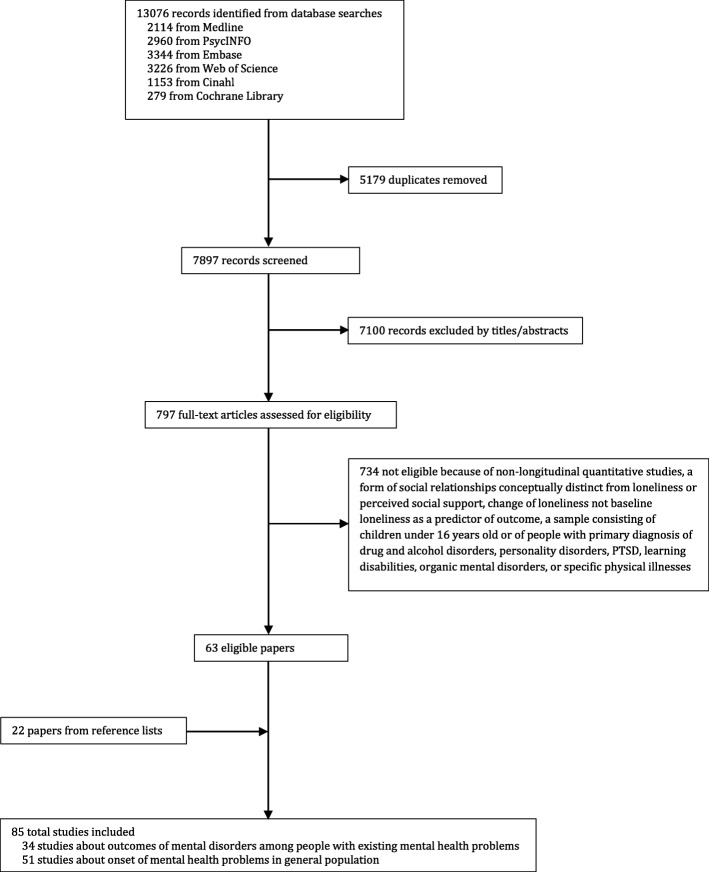
- The search retrieved 13,076 records; 797 full-text articles were assessed, and 34 eligible papers were included. Included studies covered depression (n = 23), schizophrenia/schizoaffective disorders (n = 2), bipolar disorder (n = 4), anxiety disorders (n = 3), and mixed samples (n = 2).
- Due to heterogeneity in populations, predictor measures and outcomes, a narrative synthesis was conducted; methodological quality was assessed with the Mixed Methods Appraisal Tool (MMAT), with scores ranging from * to .
Limitations
- Stated by the authors: many included studies did not report complete outcome data, response rate or follow-up rate, lowering quality ratings; some did not adjust for baseline outcome measures; the relationship may be circular; the search may not be exhaustive; eligible studies came from only seven countries, mostly North America; few non-English papers could be included; reporting bias is uncertain; the review was restricted to common mental disorders and examined only one direction of causation.
- Evident from the text: only two studies directly assessed loneliness, most evidence concerned depression, only five studies had follow-up over two years, and most samples were under 400 participants, with six studies under 100.
Model-written summary. Check it against the paper before relying on it.
Integrity signals
Registry
Cites
Statistics
Figures
Verification
Claims the paper makes
10 Valid · 2 Not valid · 43 Not checked · 61 Own results and interpretations
The cited sources support only part of this claim — read each source’s verdict below.
In the paper
“Feelings of loneliness are more prevalent among people with mental illness than in the general population [23, 24].”
§ Associations between loneliness and perceived social support and outcomes of mental health problems: a systematic review > Background
What the sources say
- Not checked yetcites [23] Borge L Martinsen EW Ruud T Watne O Friis S Quality of life, loneliness, and social contact among long-term psychiatric patients Psychiatr Serv 1999 50 1 81 84 10.1176/ps.50.1.81 9890584 source
- Partly supportedcites [24] Lauder W Sharkey S Mummery K A community survey of loneliness J Adv Nurs 2004 46 1 88 94 10.1111/j.1365-2648.2003.02968.x 15030445 sourceExperimental — accuracy not yet measured
The only passage in our copy touching mental illness is in the Background: 'It has also been suggested that feelings of loneliness increase during periods of mental illness when positive psychotic symptoms are experienced. A cycle develops in which there is a loss of reciprocal ties and less satisfaction with social relationships (Angell & Test 2002)' — a hedged statement about periods of psychotic symptoms, credited by Lauder et al. to another work, not a claim of higher prevalence than in the general population. The comparative element of the citing sentence is absent: the paper's own data are a community survey (Central Queensland Social Survey, n = 1241), and its prevalence figures (Conclusion: 'over one third of all respondents reported some level of loneliness'; Additional information: 'nearly two thirds of the community study sample') describe the general sample, with no mental-illness comparison group measured. The Additional information bullet 'Loneliness is associated with an increased incidence of physical and mental health problems' supports only a general association, so the sentence states as an established comparative fact what this source hedges and borrows. (LLM, conf=0.72)
plainstates an association- Asserted: passes — The authors put it forward as true.
- Checkable: passes — It can be checked against evidence.
- Load-bearing: unclear — It is unclear whether the paper’s conclusions depend on it.
- Based: passes — The paper gives a reason why it holds.
The cited sources support only part of this claim — read each source’s verdict below.
In the paper
“One further review looked at the relationship between social networks and support and early psychosis in people with first episode psychosis and in general population samples, but included no prospective studies [46].”
§ Associations between loneliness and perceived social support and outcomes of mental health problems: a systematic review > Background
What the sources say
- Partly supportedcites [46] Gayer-Anderson C Morgan C Social networks, support and early psychosis: a systematic review Epidemiol Psychiatr Sci 2013 22 2 131 146 10.1017/S2045796012000406 22831843 PMC6998121 sourceExperimental — accuracy not yet measured
The subject and populations attributed to this source match exactly: the Method (inclusion criteria) and Abstract describe a systematic review of social networks and support in first-episode psychosis samples and in general population samples with psychotic experiences or schizotypy (38 papers). However, on study design the source hedges rather than ruling out prospective work: the Discussion (methodological issues) states that 'almost invariably studies were cross-sectional making it difficult to disentangle cause and effect', and Table 1 (Results) lists each included study's time period as cross-sectional or retrospective (e.g. 'previous year', 'prodrome', 'two months pre-onset', 'year pre-contact') with no prospective/cohort design shown, while the Discussion's future-research section argues for the feasibility of informative cohort studies as something still to be done. The citing sentence converts this 'almost invariably cross-sectional' into the absolute 'included no prospective studies'. (LLM, conf=0.70)
plain- Asserted: passes — The authors put it forward as true.
- Checkable: passes — It can be checked against evidence.
- Load-bearing: passes — The paper’s conclusions depend on it.
- Based: passes — The paper gives a reason why it holds.
- Partly supported
The sources with a verdict support this claim; the rest weren’t checked yet, have no full text we could read, or their verdicts aren’t rated yet.
In the paper
“Three previous systematic reviews have explored the relationship between social relations and depression in general population [43, 44], or older adults [45], but included both cross-sectional and prospective studies.”
§ Associations between loneliness and perceived social support and outcomes of mental health problems: a systematic review > Background
What the sources say
- Supportedcites [43] Gariepy G Honkaniemi H Quesnel-Vallee A Social support and protection from depression: systematic review of current findings in western countries Br J Psychiatry 2016 209 4 286 295 10.1192/bjp.bp.115.169094 27445355 source
Our copy is itself a systematic review (with meta-analysis) of observational studies from the general population, Western countries, assessing social support/social relations and protection from depression (Study selection; Method), so it is the kind of review the citing sentence identifies for the general-population citations. It pooled both cross-sectional and cohort (prospective) studies, as shown by the comparisons 'Cross-sectional studies found significant results more often than cohort studies' (Older adults, p. ~6) and the Future research discussion of 'the contrast in magnitude and significance of effects between cohort and cross-sectional studies'. Note only that the paper states in its Background that no prior systematic review existed on this topic, so it is one of the reviews referred to rather than a source describing three predecessors. (LLM, conf=0.85)
- Not checked yetcites [44] Santini ZI Koyanagi A Tyrovolas S Mason C Haro JM The association between social relationships and depression: a systematic review J Affect Disord 2015 175 53 65 10.1016/j.jad.2014.12.049 25594512 source
- Not checked yetcites [45] Schwarzbach M Luppa M Forstmeier S Konig HH Riedel-Heller SG Social relations and depression in late life - a systematic review Int J Geriatr Psychiatry 2014 29 1 1 21 10.1002/gps.3971 23720299 source
plainstates an association- Asserted: passes — The authors put it forward as true.
- Checkable: passes — It can be checked against evidence.
- Load-bearing: passes — The paper’s conclusions depend on it.
- Based: passes — The paper gives a reason why it holds.
- Supported
The cited sources support only part of this claim — read each source’s verdict below.
In the paper
“They found that loneliness at baseline predicted depression and anxiety severity and remission from depression [25, 66].”
§ Associations between loneliness and perceived social support and outcomes of mental health problems: a systematic review > Discussion > Research implications
What the sources say
- Not checked yetcites [25] Holvast F Burger H de Waal MMW van Marwijk HWJ Comijs HC Verhaak PFM Loneliness is associated with poor prognosis in late-life depression: longitudinal analysis of the Netherlands study of depression in older persons J Affect Disord 2015 185 1 7 10.1016/j.jad.2015.06.036 26142687 source
- Partly supportedcites [66] van Beljouw IM Verhaak PF Cuijpers P van Marwijk HW Penninx BW The course of untreated anxiety and depression, and determinants of poor one-year outcome: a one-year cohort study BMC Psychiatry 2010 10 86 10.1186/1471-244X-10-86 20961414 PMC2974663 sourceExperimental — accuracy not yet measured
Our copy supports the severity part: in 'Determinants of a poor clinical outcome', baseline loneliness was positively associated with symptom severity at one-year follow-up in anxiety (β = .40, SE = .12, p < .01, univariate) and in depression both univariate (b = .89, p < .001) and multivariate after controlling baseline severity (β = .39, p < .05), a point the Discussion highlights as novel for a community sample. However, the paper's outcomes were continuous IDS and BAI scale scores; no passage in our copy (searched: remission, recovery, proportion of patients no longer meeting criteria) reports remission from depression as an outcome or tests loneliness against it, so the 'predicted remission from depression' element attributed here is not supported by this source. Also note that for anxiety the loneliness effect held only in univariate analysis, since in the multivariate model baseline symptom severity was the sole predictor. (LLM, conf=0.78)
plainstates a cause- Asserted: passes — The authors put it forward as true.
- Checkable: passes — It can be checked against evidence.
- Load-bearing: passes — The paper’s conclusions depend on it.
- Based: passes — The paper gives a reason why it holds.
The cited sources support only part of this claim — read each source’s verdict below.
In the paper
“They found that loneliness at baseline predicted depression and anxiety severity and remission from depression [25, 66].”
§ Associations between loneliness and perceived social support and outcomes of mental health problems: a systematic review > Discussion > Research implications
What the sources say
- Not checked yetcites [25] Holvast F Burger H de Waal MMW van Marwijk HWJ Comijs HC Verhaak PFM Loneliness is associated with poor prognosis in late-life depression: longitudinal analysis of the Netherlands study of depression in older persons J Affect Disord 2015 185 1 7 10.1016/j.jad.2015.06.036 26142687 source
- Partly supportedcites [66] van Beljouw IM Verhaak PF Cuijpers P van Marwijk HW Penninx BW The course of untreated anxiety and depression, and determinants of poor one-year outcome: a one-year cohort study BMC Psychiatry 2010 10 86 10.1186/1471-244X-10-86 20961414 PMC2974663 sourceExperimental — accuracy not yet measured
Our copy supports the severity part: baseline loneliness was positively associated with one-year symptom severity in anxiety (β = .40, SE = .12, p < .01) and in depression (univariate β = .89, p < .001; multivariate β = .39, p < .05) — 'Determinants of a poor clinical outcome' and Tables 2/3. However, the Discussion notes that in anxiety only baseline symptom severity survived multivariate adjustment, so loneliness predicted anxiety severity solely in univariate models. Nothing in our copy reports 'remission from depression': the outcome measures are continuous BAI and IDS scale scores at T1 ('Statistical analysis'), and no remission/recovery analysis appears anywhere in the text, so that part of the citing sentence is not supported by this source. (LLM, conf=0.78)
plainstates a cause- Asserted: passes — The authors put it forward as true.
- Checkable: passes — It can be checked against evidence.
- Load-bearing: passes — The paper’s conclusions depend on it.
- Based: passes — The paper gives a reason why it holds.
55 more claims · 4 with their cited sources checked
Create a free account to see all 116 claims and to verify the 69 references still open.
- Probably not a substantial claim. 26
- It may state two separate claims as one. 38
Claims other papers make about this one
Each is checked against this paper’s own text: does it say what the citing paper says it does?
The source backs part of the claim, not all of it — or backs it for a different population, condition or comparison.
In the citing paper
“Research shows that loneliness can lead to a lack of social support and meaningful connections, further exacerbating feelings of distress and contributing to the onset of anxiety and depression [15].”
From The prospective association of adolescent loneliness and low resilience with anxiety and depression in young adulthood: The HUNT study (2025) · cites this paper as [15]
Experimental — accuracy not yet measuredThe cited source says what the claim attributes to it.
In the citing paper
“Indeed, social proximity and interpersonal interactions are relevant factors in developing and fostering social ties [90–92] and maintaining mental health [93].”
From Psychological correlates of perceived loneliness in college students before and during the COVID-19 stay-at-home period: a longitudinal study (2023) · cites this paper as [93]
Statistics recomputed
Every reported test result, recomputed from its test statistic and degrees of freedom. A result shows as not adding up only once an independent check has confirmed it.
- Consistentχ²(5) = 16.35reported p = .006 · recomputed p = .006
“x2 (5) = 16.35, p = .006”
Self-check
Percentages, sums and reported differences re-computed from the paper’s own numbers.
Each contradiction between two passages listed here was confirmed by an independent check.
Rated minor: it would not touch a result — a value no result rests on, a p-value that stays on the same side of the significance level, or a conflict that is clerical, resolved elsewhere in the paper, or outside its own findings.
In the paper
§ Associations between loneliness and perceived social support and outcomes of mental health problems: a systematic review > Results > Depression
“In eight of these nine papers, the relationship between baseline loneliness and depressive symptom outcome remained significant.”
§ Associations between loneliness and perceived social support and outcomes of mental health problems: a systematic review > Results > Eligible papers
“Depression (n = 23) | Perceived social support (n = 22)Loneliness (n = 1)”
Citations
Cites
The Multidimensional Scale of Perceived Social Support
Zimet, G. D., Dahlem, N. W., Zimet, S. G., & Farley, G. K. (1988) · Journal of Personality Assessment · doi:10.1207/s15327752jpa5201_2 · Cited by 13,339
Social Relationships and Mortality Risk: A Meta-analytic Review
Holt-Lunstad, J., Smith, T. B., & Layton, J. B. (2010) · PLoS Medicine · doi:10.1371/journal.pmed.1000316 · Cited by 7,272 · cited 1×
“For instance, two meta-analytic reviews have reported that loneliness and poor social support are associated with higher mortality rates, and that the effect is comparable with some well-established risk factors such as obesity, physical inactivity, and smoking [5, 6].”
BackgroundSocial Relationships and Health
House, J. S., Landis, K. R., & Umberson, D. (1988) · Science · doi:10.1126/science.3399889 · Cited by 7,073
Loneliness and Social Isolation as Risk Factors for Mortality: A Meta-Analytic Review
Holt-Lunstad, J., Smith, T. B., Baker, M., Harris, T., & Stephenson, D. (2015) · Perspectives on Psychological Science · doi:10.1177/1745691614568352 · Cited by 6,043
UCLA loneliness scale (version 3): reliability, validity, and factor structure
Russell, D. W. (1996) · Journal of Personality Assessment · doi:10.1207/s15327752jpa6601_2 · Cited by 5,800 · cited 2×
“(PDF 280 kb) Abbreviations CES-D: Center for Epidemiologic Studies Depression Scale; DSM: Diagnostic and Statistical Manual of Mental Disorder; HoNOS: Health of the Nation Outcome Scales; ICD: International Classification of Diseases; M.I.N.I. : MiniInternational Neuropsychiatric Interview; MMAT: Mixed Methods Apprais…”
MethodPsychometric Characteristics of the Multidimensional Scale of Perceived Social Support
Zimet, G. D., Powell, S. S., Farley, G. K., Werkman, S., & Berkoff, K. A. (1990) · Journal of Personality Assessment · doi:10.1080/00223891.1990.9674095 · Cited by 4,855
Psychometric Characteristics of the Multidimensional Scale of Perceived Social Support
Zimet, G., Powell, S., Farley, G., Werkman, S., & Berkoff, K. (1990) · Journal of Personality Assessment · doi:10.1207/s15327752jpa5503&4_17 · Cited by 4,854
Loneliness matters: a theoretical and empirical review of consequences and mechanisms
Hawkley, L. C., & Cacioppo, J. T. (2010) · Annals of Behavioral Medicine · doi:10.1007/s12160-010-9210-8 · Cited by 4,782 · cited 1×
“The effect of loneliness on physical health may be via biological, psychological and/or behavioural mechanisms, including physiological functioning, neuroendocrine effects, gene effects, immune functioning, perception of stressful events, health behaviours and sleep quality [2, 12, 13].”
BackgroundSocial relationships and health a flashpoint for health policy
Umberson, D., & Karas Montez, J. (2010) · Journal of Health and Social Behavior · doi:10.1177/0022146510383501 · Cited by 2,639 · cited 1×
“There is increasing interest in the effects of social relations on health, and in the service delivery and policy implications of such effects [1].”
BackgroundLoneliness: the experience of emotional and social isolation
Weiss, R. S. (1974) · Cited by 2,513
Research works printed but not linked: 4
- Pluye P Robert E Cargo M Bartlett G O’Cathain A Griffiths F Boardman F Gagnon MP Rousseau MC Proposal: A Mixed Methods Appraisal Tool for Systematic Mixed Studies Reviews 2011 Canada Department of Family Medicine, McGill University, Montreal
- Daniels RE. Psychosocial predictors of symptom severity and functioning in adults with bipolar disorder A three-month prospective study Diss Abstr Int B Sci Eng 2000 60 8-B 4213
- Psychosis and schizophrenia in adults: prevention and management. National Institute for Health and Care Excellence (NICE). 2014. https://www.nice.org.uk/guidance/cg178. Accessed 19 Oct 2016. 32207892
- Report of the Annual Social Prescribing Network Conference. London: University of Westminster; 2016.
Cited by
Items 201–300 of 1,002
Weitzel, E. C., Löbner, M., Glaesmer, H., Hinz, A., Zeynalova, S., Henger, S., Engel, C., Reyes, N., Wirkner, K., Löffler, M., et al. (2022) · International Journal of Environmental Research and Public Health · doi:10.3390/ijerph192315944 · Cited by 36
Digital Humans to Combat Loneliness and Social Isolation: Ethics Concerns and Policy Recommendations
Jecker, N. S., Sparrow, R., Lederman, Z., & Ho, A. (2024) · The Hastings Center Report · doi:10.1002/hast.1562 · Cited by 34
Xiong, W., Quinney, B. A., King, D. L., Ali, K., Radünz, M., Zhao, Y., Kyrios, M., & Fassnacht, D. B. (2025) · Journal of Affective Disorders · doi:10.1016/j.jad.2025.01.082 · Cited by 43
What is bipolar disorder? A disease model of dysregulated energy expenditure
Mansur, R. B., Lee, Y. L., McIntyre, R. S., & Brietzke, E. M. (2020) · Neuroscience & Biobehavioral Reviews · doi:10.1016/j.neubiorev.2020.04.006 · Cited by 37
Alasmawi, K., Mann, F., Lewis, G., White, S. J., Mezey, G., & Lloyd‐Evans, B. (2020) · International Journal of Mental Health Nursing · doi:10.1111/inm.12727 · Cited by 39
“Contrary to previous studies, we found that affective symptoms were not closely related to loneliness (Cacioppo et al., 2006; Lim et al., 2018; Wang et al., 2018): affect appears to drive loneliness less in our study population of secondary mental health service users than for people in primary…”
Self-citationThe importance of social activity to risk of major depression in older adults
Ryu, E., Jenkins, G. D., Wang, Y., Olfson, M., Talati, A., Lepow, L., Coombes, B. J., Charney, A. W., Glicksberg, B. S., Mann, J. J., et al. (2021) · Psychological Medicine · doi:10.1017/s0033291721004566 · Cited by 36
Ikhtabi, S., Pitman, A., Toh, G., Birken, M., Pearce, E., & Johnson, S. (2022) · BMC Psychiatry · doi:10.1186/s12888-022-03767-9 · Cited by 40
Self-citationNa, P. J., Straus, E., Tsai, J., Norman, S. B., Southwick, S. M., & Pietrzak, R. H. (2022) · Journal of Psychiatric Research · doi:10.1016/j.jpsychires.2022.05.042 · Cited by 34
Social Support and Depression among Stroke Patients: A Topical Review
Zhou, H., & Kulick, E. R. (2023) · International Journal of Environmental Research and Public Health · doi:10.3390/ijerph20247157 · Cited by 41
Exploring the societal implications of digital mental health technologies: A critical review
Stein, O. A., & Prost, A. (2024) · SSM - Mental Health · doi:10.1016/j.ssmmh.2024.100373 · Cited by 39
Analyzing factors affecting quality of life in patients hospitalized with chronic wound
Yan, R., Yu, F., Strandlund, K., Han, J., Lei, N., & Song, Y. (2020) · Wound Repair and Regeneration · doi:10.1111/wrr.12870 · Cited by 41
“The main effect of social support refers to the direct positive effect of social support on various health parameters without considering stress factors, and the buffering effect is understood as reducing the negative effect of stress on health through social support.(32) One study of the relationship between social s…”
BackgroundLin, Y., Jia, G., Zhao, Z., Li, M., & Cao, G. (2024) · Frontiers in Psychology · doi:10.3389/fpsyg.2024.1308804 · Cited by 37
Ip, H., Suen, Y. N., Hui, C. L. M., Cheung, C., Wong, S. M. Y., & Chen, E. Y. H. (2024) · Scientific Reports · doi:10.1038/s41598-024-75739-w · Cited by 37
“The Chinese UCLA-LSV3, adopted in the current study was translated by Wang et al. 7 .”
Beresford, B., Mukherjee, S., Mayhew, E., Heavey, E., Park, A., Stuttard, L., Allgar, V. L., & Knapp, M. R. J. (2020) · Health Services and Delivery Research · doi:10.3310/hsdr08480 · Cited by 47
Ho, C. S. H., Chan, Y. L., Tan, T. W. K., Tay, G. W. N., & Tang, T. B. (2022) · Journal of Psychiatric Research · doi:10.1016/j.jpsychires.2022.01.026 · Cited by 32
The effect of fear of missing out on mental health: differences in different solitude behaviors
Liu, X., Liu, T., Zhou, Z., & Wan, F. (2023) · BMC Psychology · doi:10.1186/s40359-023-01184-5 · Cited by 57
“Then the reduction of such negative experiences in turn improves mental health [43, 44].”
BackgroundDai, P., Guoguo, Y., Qian, D., Wu, Z. B., Fu, M., & Peng, H. (2023) · Psychology Research and Behavior Management · doi:10.2147/prbm.s405580 · Cited by 39
“schizophrenia.(91) In addition, as other studies have demonstrated, social support not only contributes to the mental health of the general population but also plays a role in helping patients with respiratory diseases cope with dyspnea crisis.”
BackgroundAltered reward network responses to social touch in major depression
Mielacher, C., Scheele, D., Kiebs, M., Schmitt, L., Dellert, T., Philipsen, A., Lamm, C., & Hurlemann, R. (2023) · Psychological Medicine · doi:10.1017/s0033291723001617 · Cited by 32
Loneliness and Personality Profiles Involved in Bullying Victimization and Aggressive Behavior
Machimbarrena, J. M., Álvarez-Bardón, A., Mejía, A. L., Gutiérrez‐Ortega, M., Cabrales, A. C., & González‐Cabrera, J. M. (2019) · School Mental Health · doi:10.1007/s12310-019-09328-y · Cited by 32
“In this way, bullying and loneliness have not only been shown to be related to various mental problems (Acquah et al., 2016; Cook et al., 2010; Hawkley & Cacioppo, 2010; Qualter et al., 2013; Wang et al., 2018), but they can also influence each other mutually.”
BackgroundYouth sport participation and parental mental health
Sutcliffe, J., Kelly, P. J., & Vella, S. A. (2020) · Psychology of sport and exercise · doi:10.1016/j.psychsport.2020.101832 · Cited by 33
Disability, Loneliness and Health in the UK: cross-sectional survey
Emerson, E., Stancliffe, R. J., Fortune, N., & Llewellyn, G. M. (2021) · European Journal of Public Health · doi:10.1093/eurpub/ckab018 · Cited by 32
Hayes, S., Carlyle, M., Haslam, S. A., Haslam, C., & Dingle, G. A. (2022) · British Journal of Clinical Psychology · doi:10.1111/bjc.12358 · Cited by 44
Makri, E., Michopoulos, I., & Gonidakis, F. (2022) · Psychiatry International · doi:10.3390/psychiatryint3020012 · Cited by 43
“This finding does not come as a surprise, as loneliness and perceived social support have been described as conceptually related and a strong association has been observed between the two (see [69]).”
BackgroundResultLoneliness in Young People with ADHD: A Systematic Review and Meta-Analysis
Jong, A., Odoi, C. M., Lau, J., & J.Hollocks, M. (2024) · Journal of Attention Disorders · doi:10.1177/10870547241229096 · Cited by 29
“In the general population, studies have shown that loneliness predicts depressive and anxious symptoms (S. L. Lee et al., 2021; Wang et al., 2018), with some showing bidirectional associations (Cacioppo et al., 2006).”
BackgroundBeller, J. (2024) · SAGE Open · doi:10.1177/21582440241281408 · Cited by 32
“…has been linked to an increased risk of depression, anxiety, cognitive decline, inflammation, reduced immune-function, and cardiovascular disease (Boss et al., 2015; Erzen & C x ikrikci, 2018; Jaremka et al., 2013; Lara et al., 2019; Smith et al., 2020; Valtorta et al., 2018; Wang et al., 2018).”
Loneliness and ED Visits in Chronic Obstructive Pulmonary Disease
Marty, P. K., Novotny, P. J., & Benzo, R. P. (2019) · Mayo Clinic Proceedings Innovations Quality & Outcomes · doi:10.1016/j.mayocpiqo.2019.05.002 · Cited by 29
Lu, M., Wang, R., Huan, L., Pang, F., & Chen, X. (2021) · Research in Autism · doi:10.1016/j.rasd.2021.101829 · Cited by 38
Oña, G., Berrada, A., & Bouso, J. C. (2021) · Transcultural Psychiatry · doi:10.1177/13634615211038416 · Cited by 36
“There is substantial evidence that a perceived lack of social support predicts greater severity of symptoms, slower recovery, and worse treatment outcomes in people affected by depression, bipolar disorder, and anxiety (Wang et al., 2018).”
BackgroundChae, W. R., Schienkiewitz, A., Du, Y., Hapke, U., Otte, C., & Michalski, N. (2021) · Journal of Affective Disorders · doi:10.1016/j.jad.2021.12.025 · Cited by 38
Liu, G., Li, S., & Kong, F. (2022) · BMJ Open · doi:10.1136/bmjopen-2021-060510 · Cited by 32
Wang, Y., & Ma, Q. (2024) · Frontiers in Psychology · doi:10.3389/fpsyg.2024.1391415 · Cited by 37
Navarro-Nolasco, D. A., Chi-Castañeda, D., López‐Meraz, M. L., Beltrán‐Parrazal, L., & Morgado‐Valle, C. (2025) · BMC Psychology · doi:10.1186/s40359-025-02449-x · Cited by 37
“Their research revealed that the subjective perception of social support not only has a significant impact on mental health but that this effect is even stronger than that of received social support [22, 23].”
Social capital and psychological distress during Colombian coronavirus disease lockdown
Caballero‐Domínguez, C. C., Luque‐Salcedo, J. G. D., & Campo‐Arias, A. (2020) · Journal of Community Psychology · doi:10.1002/jcop.22487 · Cited by 33
Hill, E. M., & Frost, A. (2021) · Journal of Clinical Psychology in Medical Settings · doi:10.1007/s10880-021-09789-x · Cited by 33
Oh, H. Y., Du, J., Smith, L., & Koyanagi, A. (2022) · International Journal of Social Psychiatry · doi:10.1177/00207640221135817 · Cited by 33
“Loneliness has been strongly linked to a broad range of health consequences (Leigh-Hunt et al., 2017; Wang et al., 2018), and languishing is a critical but relatively underresearched aspect of mental wellness that reflects a person’s sense of meaning and purpose in life (Keyes, 2002).”
BackgroundSamuel, T., Nigussie, K., Mirkena, Y., & Azale, T. (2022) · Frontiers in Psychiatry · doi:10.3389/fpsyt.2022.980614 · Cited by 32
“A systematic review showed that loneliness and perceived poor social support were related to poor outcomes in mental health problems such as schizophrenia, bipolar I disorder, depression, and anxiety disorder (11).”
BackgroundLoneliness and mood disorders: consequence, cause and/or unholy alliance?
Giacco, D. (2022) · Current Opinion in Psychiatry · doi:10.1097/yco.0000000000000832 · Cited by 36
“A systematic review published in 2018, which assessed evidence on loneliness and perceived social support in people with severe mental illness, identified only four studies focusing on people with bipolar disorder [46].”
BackgroundWang, X., Xie, R., Ding, W., Song, S., Wu, W., Wang, X., & Li, W. (2023) · Journal of Child and Family Studies · doi:10.1007/s10826-022-02486-9 · Cited by 36
“Among them, perceived social support and loneliness are two internal factors closely related to social relations (Wang et al., 2018).”
BackgroundPadmanabhanunni, A., Pretorius, T. B., & Isaacs, S. A. (2023) · International Journal of Environmental Research and Public Health · doi:10.3390/ijerph20043179 · Cited by 40
“While perceived social support refers to subjective appraisals of the availability, accessibility, and adequacy of social support networks, received social support entails the actual quantity of social support received [20].”
BackgroundBarton, S., Zovko, A., Müller, C., Krabichler, Q., Schulze, J., Wagner, S., Grinevich, V., Shamay‐Tsoory, S., & Hurlemann, R. (2024) · Neuroscience & Biobehavioral Reviews · doi:10.1016/j.neubiorev.2024.105734 · Cited by 33
“…shown to be associated with better subjective quality of life in schizophrenic and schizoaffective patients, whereas less social support is a predictor of greater symptom severity and worse remission in depressed patients, as well as patients with anxiety or bipolar disorders (Wang et al., 2018).”
Damatac, C. G., ter Avest, M. J., Wilderjans, T. F., Gucht, V. D., Woestenburg, D. H. A., Landeweerd, L., Galesloot, T. E., Geerligs, L., Homberg, J. R., & Greven, C. U. (2024) · Current Research in Behavioral Sciences · doi:10.1016/j.crbeha.2024.100165 · Cited by 37
Schmitt, A., Brenner, A. M., Alves, L. P. D. C., Claudino, F. C. D. A., Fleck, M. P. D. A., & da Rocha, N. S. (2021) · Journal of Affective Disorders · doi:10.1016/j.jad.2020.12.203 · Cited by 33
“This is congruent with current literature since systematic reviews report associations of lower levels of depression with higher levels of spirituality (Braam and Koenig, 2019), social support (Wang et al., 2018), and quality of life (Johnston et al.”
Community and Social Context: An Important Social Determinant of Cardiovascular Disease
SINGH, R. K., Javed, Z., Yahya, T., Elizondo, J. V., Acquah, I., Hyder, A. A., Maqsood, M. H., Amin, Z., Al-Kindi, S. G., Cainzos‐Achirica, M., et al. (2021) · Methodist DeBakey Cardiovascular Journal · doi:10.14797/mdcvj.846 · Cited by 38
The role of social factors in the successful ageing – Systematic review
Takács, J., & Nyakas, C. J. (2021) · Developments in Health Sciences · doi:10.1556/2066.2021.00044 · Cited by 34
“In depressive disorders, poorer perceived social support is associated with poorer symptoms, recovery, and functioning [58].”
BackgroundBedaso, A., Adams, J., Peng, W., & Sibbritt, D. W. (2021) · Reproductive Health · doi:10.1186/s12978-021-01305-6 · Cited by 34
Resilience in mothers during the COVID-19 pandemic.
Jones, L. B., Kiel, E. J., Luebbe, A. M., & Hay, M. C. (2022) · Journal of Family Psychology · doi:10.1037/fam0000985 · Cited by 32
Chen, T.-Y., Geng, J., Chen, S., & Lee, J. (2022) · Frontiers in Public Health · doi:10.3389/fpubh.2022.1054615 · Cited by 33
“Poor psychological well-being has been linked to objective social isolation (51) and subjectively perceived social support, such as loneliness (52).”
BackgroundPatterns and Challenges in Help-Seeking for Addiction among Men: A Systematic Review
Camacho-Ruiz, J. A., Galvez-Sánchez, C. M., Galli, F., & Gras, R. M. L. (2024) · Journal of Clinical Medicine · doi:10.3390/jcm13206086 · Cited by 31
“Support from others can help mitigate stress and might also boost self-efficacy [40].”
BackgroundFilia, K., Teo, S. M., Brennan, N., Freeburn, T., Baker, D., Browne, V., Watson, A., Menssink, J. M., Prasad, A., Killackey, E. J., et al. (2025) · Epidemiology and Psychiatric Sciences · doi:10.1017/s2045796024000878 · Cited by 37
“Unsurprisingly, an adolescent’s vulnerability to mental health difficulties increases their vulnerability to social exclusion (Berry and Greenwood, 2018).”
Tsai, M., Hardebeck, E. J., Ramos, F. P., Turlove, H., Nordal‐Jonsson, K., Vongdala, A., Zhang, W., & Kohlenberg, R. J. (2020) · Applied Psychology Health and Well-Being · doi:10.1111/aphw.12241 · Cited by 33
Dai, P., Wang, N., Kong, L., Dong, X., & Tian, L. (2021) · Current Psychology · doi:10.1007/s12144-021-01458-4 · Cited by 34
Investigating pathological narcissism and loneliness, and the link with life satisfaction
Kealy, D., Woolgar, S. R., & Hewitt, J. M. A. (2021) · Scandinavian Journal of Psychology · doi:10.1111/sjop.12773 · Cited by 32
Social connectedness among parents raising children in low‐income communities: An integrative review
Plesko, C. M., Yu, Z., Tobin, K. E., & Gross, D. A. (2021) · Research in Nursing & Health · doi:10.1002/nur.22189 · Cited by 34
“Both focus on the qualities of people's relationships with others and have been associated with mental health outcomes (Ozbay et al., 2007; Wang et al., 2018).”
BackgroundCalarco, C. A., Fox, M. E., Terheyden, S. V., Turner, M. D., Alipio, J. B., Chandra, R., & Lobo, M. K. (2021) · Frontiers in Psychiatry · doi:10.3389/fpsyt.2021.737389 · Cited by 29
Yu, T., & Hu, J. (2022) · Frontiers in Psychiatry · doi:10.3389/fpsyt.2022.822699 · Cited by 32
Qi, H., Kang, Q., & Bi, C. (2022) · Frontiers in Psychology · doi:10.3389/fpsyg.2022.886168 · Cited by 34
Kjellstrand, J., Clark, M. G., Mannan, I. A., & Loan, C. M. (2022) · American Journal of Criminal Justice · doi:10.1007/s12103-022-09685-6 · Cited by 33
“Most research focuses on the impact of social support on mental health (e.g., Gariepy et al., 2016; Rueger et al., 1 3 2016; Wang et al., 2018).”
BackgroundResultInfluentialWenig, V., Heumann, E., Stock, C., Busse, H., Negash, S., Pischke, C. R., & Heinrichs, K. (2023) · Frontiers in Public Health · doi:10.3389/fpubh.2023.1284460 · Cited by 33
“An important consideration in interpreting the results is that depression is likely to make people rate their social support as insufficient, to let them withdraw from their social network, and to make them feel lonely (10).”
BackgroundPerceived social support, loneliness, and later life telomere length following wartime captivity.
Stein, J. Y., Levin, Y., Lahav, Y., Uziel, O., Abumock, H., & Solomon, Z. (2018) · Health Psychology · doi:10.1037/hea0000669 · Cited by 28
Nguyen, A. W., Taylor, H. O., Taylor, R. J., Ambroise, A. Z., Hamler, T. C., Qin, W., & Chatters, L. M. (2024) · BMC Public Health · doi:10.1186/s12889-024-18233-2 · Cited by 32
“Another systematic review indicated that people who received more social support reported decreased depression severity, less severe anxiety symptoms, and higher rates of remission from an anxiety disorder [22].”
BackgroundGutiérrez‐Sánchez, B., López‐Martínez, C., da-Silva-Domingues, H., & Casado, R. D. P. (2024) · Nursing Reports · doi:10.3390/nursrep14040252 · Cited by 32
“Numerous studies link social support to better mental or psychological health [4–6].”
Coping in the Time of COVID-19: Buffering Stressors With Coping Strategies
Okafor, C. N., Bautista, K. J., Asare, M., & Opara, I. (2021) · Journal of Loss and Trauma · doi:10.1080/15325024.2021.1914987 · Cited by 29
“Our finding related to use of emotional social support is at odds with prior research (Gari epy et al., 2016; Santini et al., 2020; Wang et al., 2018).”
ResultZhou, X., & Taylor, Z. (2022) · Journal of Affective Disorders Reports · doi:10.1016/j.jadr.2022.100319 · Cited by 38
“More broadly speaking, social support intervention can be a potentially low-cost, scalable group intervention for diverse clinical and non-clinical populations, including single mothers (Dam et al., 2016; Wang et al., 2018).”
Schieß-Jokanovic, J., Knefel, M., Kantor, V., Weindl, D., Schäfer, I., & Lueger‐Schuster, B. (2022) · Conflict and Health · doi:10.1186/s13031-022-00455-z · Cited by 29
“Overall, refugees have a higher risk of loneliness and low social support, factors that have been repeatedly related to higher levels of mental distress [62], CPTSD [63] and lower quality of life [64].”
BackgroundWalker, I., Asher, L., Pari, A. A. A., Attride‐Stirling, J., Oyinloye, A., Simmons, C., Potter, I., Rubaine, V., Samuel, J. M., Andrewin, A., et al. (2022) · International Journal of Mental Health Systems · doi:10.1186/s13033-022-00552-9 · Cited by 31
“Furthermore, the increased potential for social isolation on remote islands could conceivably heighten established associations between loneliness and mental health outcomes [13, 14].”
BackgroundMacalli, M., Kinouani, S., Texier, N., Schück, S., & Tzourio, C. (2022) · Scientific Reports · doi:10.1038/s41598-022-21288-z · Cited by 29
Selman, L. E., FARNELL, D. J. J., Longo, M., Goss, S., Torrens‐Burton, A., Seddon, K., Mayland, C. R., Machin, L., Byrne, A., & Harrop, E. (2022) · OMEGA - Journal of Death and Dying · doi:10.1177/00302228221144925 · Cited by 34
Zhou, J., Zhang, Y., Ren, Q., Li, T., Lin, G.-D., Liao, M.-Y., Chen, S., Tong, P., & Gao, Y. (2023) · Frontiers in Public Health · doi:10.3389/fpubh.2023.1079593 · Cited by 35
van der Velden, P. G., Contino, C., Muffels, R. J. A., Verheijen, M. S., & Das, M. (2023) · Journal of Anxiety Disorders · doi:10.1016/j.janxdis.2023.102714 · Cited by 28
Yang, X., Xiong, Z., Li, Z., Xiao, L., Xiang, W., Yuan, Y., & Li, Z. (2020) · PLoS ONE · doi:10.1371/journal.pone.0243605 · Cited by 32
“Poor social support has been associated with many mental health problems such as depression [33], anxiety disorders [34], and suicide [35], as well as higher rates of PTSD symptomatology [36].”
BackgroundKohek, M., Ona, G., van Elk, M., Dos Santos, R. G., Hallak, J. E. C., Alcázar-Córcoles, M. Á., & Bouso, J. C. (2023) · Journal of Psychoactive Drugs · doi:10.1080/02791072.2022.2077155 · Cited by 24
“Retrieved July 25th 2021 from https://www.volksgezondheidenzorg.info/ onderwerp/cholesterol/cijfers-context/huidige-situatie and loss of community bonds is being increasingly highlighted as a primary risk factor for mental disorders (Wang et al. 2018).”
BackgroundJia, H., Zhang, M., Yiyun, C., Zhiguo, W., Su, Y., Feng, J., Zhu, N., Fang, Y., & Daihui, P. (2023) · Journal of Affective Disorders · doi:10.1016/j.jad.2023.11.051 · Cited by 25
The relationship of social contacts with prisoners' mental health: a systematic review
Machado, N. I., Abreo, L., Petkari, E., & da Costa, M. P. (2024) · Public Health · doi:10.1016/j.puhe.2024.06.013 · Cited by 29
Purgato, M., Tedeschi, F., Turrini, G., Cadorin, C., Compri, B., Muriago, G., Ostuzzi, G., Pinucci, I., Prina, E., Serra, R., et al. (2025) · World Psychiatry · doi:10.1002/wps.21281 · Cited by 30
“This is attributed to the fact that online interventions heavily depend on self-motivation and the completion of activities even in the absence of direct or long therapist interaction 44,46 .”
Rinaudo, C. M., de Velde, M. V., Steyaert, A., & Mouraux, A. (2025) · PLoS ONE · doi:10.1371/journal.pone.0321750 · Cited by 31
“Higher levels of PSS have been associated in the literature with better mental health [21], physical health, and lower mortality [22].”
Social Connections and Loneliness in OECD Countries
OECD (2025) · OECD eBooks · doi:10.1787/6df2d6a0-en · Cited by 40
Winterton, A., Rødevand, L. N., Westlye, L. T., Steen, N. E., Andreassen, O. A., & Quintana, D. S. (2020) · Systematic Reviews · doi:10.1186/s13643-020-01369-8 · Cited by 28
Maitland, D. W. M. (2020) · Journal of Contextual Behavioral Science · doi:10.1016/j.jcbs.2020.10.002 · Cited by 29
Let’s teach peer support skills to all college students: Here’s how and why
Caporale-Berkowitz, N. A. (2020) · Journal of American College Health · doi:10.1080/07448481.2020.1841775 · Cited by 30
Mayerl, H., Stolz, E., & Freidl, W. (2021) · Public Health · doi:10.1016/j.puhe.2021.09.009 · Cited by 29
Komro, K. A., D’Amico, E. J., Dickerson, D. L., Skinner, J. R., Johnson, C. L., Kominsky, T. K., & Etz, K. (2022) · Prevention Science · doi:10.1007/s11121-022-01396-y · Cited by 28
“Indeed, empirical research has documented that social support is protective against mental health problems (Wang et al., 2018) and poor psychosocial outcomes among adolescents, including substance use (Heerde & Hemphill, 2018), and is positively associated with resilience among AI adolescents…”
BackgroundLin, L., Cao, B., Chen, W., Li, J., Zhang, Y., & Guo, V. Y. (2022) · Social Psychiatry and Psychiatric Epidemiology · doi:10.1007/s00127-022-02384-x · Cited by 25
“Childhood deprivation was associated with poor perceived social support [44], which could exert negative impacts on mental outcomes [45].”
BackgroundPerkins, R., Spiro, N., & Waddell, G. (2023) · Public Health · doi:10.1016/j.puhe.2023.04.017 · Cited by 28
Lu, Z., Wang, S., Ling, W., & Guo, Y. (2023) · Social Science & Medicine · doi:10.1016/j.socscimed.2023.116281 · Cited by 28
Filia, K. M., Teo, S. M., Brennan, N., Freeburn, T., Baker, D., Browne, V., Watson, A. E., Prasad, A., Killackey, E., McGorry, P., et al. (2023) · doi:10.31234/osf.io/4zgcy · Cited by 24
Relational rights: a vision for law and society scholarship
Nielsen, L. B. (2024) · Law & Society Review · doi:10.1017/lsr.2023.10 · Cited by 25
Prolonged Grief Symptoms Predict Social and Emotional Loneliness and Depression Symptoms
Eisma, M. C., & Büyükcan-Tetik, A. (2024) · Behavior Therapy · doi:10.1016/j.beth.2024.04.014 · Cited by 27
Xu, M. K., & Zhang, J. (2025) · Frontiers in Psychology · doi:10.3389/fpsyg.2025.1510543 · Cited by 33
Wu, M., Wang, W., Zhang, X., & Li, J. (2022) · Scientific Reports · doi:10.1038/s41598-022-11855-9 · Cited by 25
Wang, L., Li, M., Jiang, X., Han, Y., Liu, J., Xiang, T.-T., & Zhu, Z.-M. (2022) · Neuropsychiatric Disease and Treatment · doi:10.2147/ndt.s368695 · Cited by 23
Bui, B. K. H. (2020) · Psychogeriatrics · doi:10.1111/psyg.12530 · Cited by 28
Nowakowska, I. (2020) · Current Issues in Personality Psychology · doi:10.5114/cipp.2020.97289 · Cited by 28
Abrahamson, V., Zhang, W., Wilson, P. M., Farr, W. J., Reddy, V., Parr, J. R., Peckham, A., & Male, I. (2021) · BMJ Open · doi:10.1136/bmjopen-2021-051241 · Cited by 29
Stewart, R. A., Patel, T. A., McDermott, K. A., & Cougle, J. R. (2022) · Journal of Affective Disorders · doi:10.1016/j.jad.2022.04.026 · Cited by 22
Hai, W., Liu, Q., & Pan, Y. (2025) · BMC Sports Science Medicine and Rehabilitation · doi:10.1186/s13102-025-01058-w · Cited by 22
Switsers, L., Dierckx, E., Domènech‐Abella, J., Donder, L. D., & Dury, S. (2021) · International Psychogeriatrics · doi:10.1017/s1041610220004196 · Cited by 27
Lee, C. N., Huang, Y., Chang, H. H., Kuo, C. Y., Lu, T., Hsieh, Y., Chang, W. H., Yang, Y. K., Chen, P. S., & Tseng, H. (2022) · The Kaohsiung Journal of Medical Sciences · doi:10.1002/kjm2.12539 · Cited by 23
“Loneliness has been defined as the absence of socially integrative relationships and of intimate relationships.(12) Previous studies revealed that lower perceived social support was found to be a significant predictor of greater impairment in functioning in BD,(12) but less literature has directly reported an associat…”
The illusion of knowledge in the emerging field of psychedelic research
Oña, G., Kohek, M., & Bouso, J. C. (2022) · New Ideas in Psychology · doi:10.1016/j.newideapsych.2022.100967 · Cited by 28
Loneliness in Elderly Inpatients
Just, S. A., Seethaler, M., Sarpeah, R., Waßmuth, N., Bermpohl, F., & Brandl, E. J. (2022) · Psychiatric Quarterly · doi:10.1007/s11126-022-10006-7 · Cited by 31
Social support and (complex) posttraumatic stress symptom severity: does gender matter?
Fares‐Otero, N. E., Sharp, T. H., Karthikeyan, S., Balle, S. R., Quaatz, S. M., Vieta, E., Åhs, F., Allgaier, A., Arévalo, A., Bachem, R., et al. (2024) · European Journal of Psychotraumatology · doi:10.1080/20008066.2024.2398921 · Cited by 27
“Fourth, our analyses did not take account of the possible presence of commonly co-occurring mental health conditions, such as major depressive disorder or anxiety disorders, which are also linked to lower perceived social support (Wang et al., 2018).”
Metadata
- Authors
- Wang, J., Mann, F., Lloyd-Evans, B., Ma, R., & Johnson, S.
- Affiliations
- University College London (GB)
- St Pancras Hospital (GB)
- Corresponding author
- Johnson, Sonia
- Venue
- BMC Psychiatry
- Published
- 2018-05-29
- Volume
- 18
- Issue
- 1
- Pages
- 156-156
- ISSN
- 1471-244X (ISSN-L)
- PMC
- PMC5975705
- OpenAlex
- W2805201924
- Semantic Scholar
- c12bc3c6314a3431ea2e8aa59556e4ad8bab8a87
- Cited by
- 1,494
- References
- 90
- Citations by year
- 2026: 170 · 2025: 246 · 2024: 290 · 2023: 201 · 2022: 235 · 2021: 186 · 2020: 119 · 2019: 34 · 2018: 12
- FWCI
- 14.60
- Type
- journal article
- Language
- en
- Open access
- gold
- doi.org
- Licence
- cc-by
- creativecommons.org/licenses/by/4.0/ (tdm)
- Locations
- BMC Psychiatry (publishedVersion, cc-by)
- PubMed Central (publishedVersion, cc-by)
- PubMed (publishedVersion)
- Research Portal (King's College London) (publishedVersion, cc-by)
- DOAJ (DOAJ: Directory of Open Access Journals) (submittedVersion, cc-by-sa)
- UCL Discovery (University College London) (submittedVersion)
- Funders
- Wellcome Trust (203618/Z/16/Z)
- Topics
- Social Sciences › Health › Health disparities and outcomes
- Health Sciences › Medicine › Psychiatry and Mental health › Mental Health Treatment and Access
- Social Sciences › Psychology › Experimental and Cognitive Psychology › Anxiety, Depression, Psychometrics, Treatment, Cognitive Processes
- Keywords
- loneliness, perceived social support, mental health outcomes, depression, schizophrenia, bipolar disorder, anxiety disorders, social functioning, recovery, longitudinal outcomes
- MeSH terms
- Depression, Humans, Loneliness, Prognosis, Social Perception, Social Support, Outcome Assessment, Health Care, Recovery of Function, Social Participation
About these checks
Registry, retraction, Cites and statistics results are computed, not judged, with one exception: a printed reference that no index lists is read once by a model before it counts as a citation error. Claims are extracted by a model and kept only when their quote appears verbatim in the text; each cited source is then checked, with a model’s help, for whether it says what the claim relies on. Those verdicts can be wrong — read the claim’s quote and the cited source before relying on one.
The claim verdicts this report counts are experimental: their accuracy is not yet measured.
A language model drew the claims from the paper on 2026-10-08, under version 3 of the claim definition (model deepseek-v4.1-flash, prompt extract-v3).
A second model labelled each claim on 2026-10-08 (model jev-1.13-20260917, definition revision gold-guideline-v0.2).
Cited sources are checked with a language model’s help (qwen3.8-omni-flash).
Statistics and arithmetic are recomputed, not judged.
Confidence bands are shown only for fields calibrated on our annotated test set. None is calibrated yet, so no band is shown.
What counts as a claim ›How we measure confidence ›How we check this ›
Are you an author, or do you see a problem with this page? Request a review
Data sources
Bibliographic data: Semantic Scholar, OpenAlex, Crossref.
Contains information from the Semantic Scholar Academic Graph Datasets, made available under the ODC Attribution License (ODC-BY 1.0).
Semantic Scholar’s data is described in: Kinney, R., et al. (2023). The Semantic Scholar Open Data Platform. arXiv:2301.10140.
