

Associations between loneliness and perceived social support and outcomes of mental health problems: a systematic review
Open accessThe DOI matches its Crossref record; 90 of the 91 references it cites were found in a registry or an index; 10 of the 79 sources its claims cite were checked for support.
Abstract
BACKGROUND: The adverse effects of loneliness and of poor perceived social support on physical health and mortality are established, but no systematic synthesis is available of their relationship with the outcomes of mental health problems over time. In this systematic review, we aim to examine the evidence on whether loneliness and closely related concepts predict poor outcomes among adults with mental health problems. METHODS: We searched six databases and reference lists for longitudinal quantitative studies that examined the relationship between baseline measures of loneliness and poor perceived social support and outcomes at follow up. Thirty-four eligible papers were retrieved. Due to heterogeneity among included studies in clinical populations, predictor measures and outcomes, a narrative synthesis was conducted. RESULTS: We found substantial evidence from prospective studies that people with depression who perceive their social support as poorer have worse outcomes in terms of symptoms, recovery and social functioning. Loneliness has been investigated much less than perceived social support, but there is some evidence that greater loneliness predicts poorer depression outcome. There is also some preliminary evidence of associations between perceived social support and outcomes in schizophrenia, bipolar disorder and anxiety disorders. CONCLUSIONS: Loneliness and quality of social support in depression are potential targets for development and testing of interventions, while for other conditions further evidence is needed regarding relationships with outcomes.
Overview
CoChat Summary
TL;DR
This systematic review of 34 longitudinal studies found substantial evidence that poorer perceived social support predicts worse symptom, recovery and functional outcomes in depression, with preliminary evidence in bipolar disorder, anxiety disorders and schizophrenia. Loneliness was much less studied, but available evidence suggested greater loneliness predicts poorer depression outcomes.
Key findings
- Across 23 depression papers, 11 of 13 studies assessing symptom severity found baseline poorer perceived social support or greater loneliness significantly predicted higher depressive symptom severity; 8 of 9 multivariable analyses adjusting for baseline depression severity remained significant. In the only loneliness-predictor depression study, a 1-point higher baseline loneliness score predicted a 0.61-point higher depressive symptom severity score at follow-up (Beta = 0.61, 95% CI 0.12–1.11), and very severely lonely respondents were less likely to achieve remission than non-lonely respondents (OR = 0.25, 95% CI 0.08–0.80).
- For depression recovery/remission, 6 of 7 articles found lower perceived social support or higher loneliness at baseline predicted lower recovery/remission; poorer perceived social support predicted poorer recovery one year later (OR = 1.21, 95% CI 1.09–1.35) and longer time-to-remission (Hazard Ratio = 0.47, 95% CI 0.31–0.71).
- In bipolar disorder, lower perceived social support predicted greater depression over time (beta −0.14 to −0.25; regression coefficient −1.33), and greater perceived social support reduced risk of recurrence of any type at one year (OR = 0.92, 95% CI 0.85–0.99). In anxiety disorders, all three studies reported significant associations; greater perceived social support predicted higher remission at 6 months in generalised anxiety disorder (OR = 1.38, 95% CI 1.09–1.75).
- In schizophrenia/schizoaffective disorders, greater support from friends at baseline predicted better satisfaction with life quality after 16 months, accounting for 2.9% of quality-of-life index scores at follow-up. Only two included studies directly assessed loneliness.
Methods
- Systematic review registered on PROSPERO (CRD42015014784); searched Medline, PsycINFO, Embase, Web of Science, CINAHL and Cochrane Library (1891 to April 2016), plus reference lists and grey literature, for longitudinal quantitative studies in adults with mental illness examining baseline loneliness or poor perceived social support and follow-up outcomes.
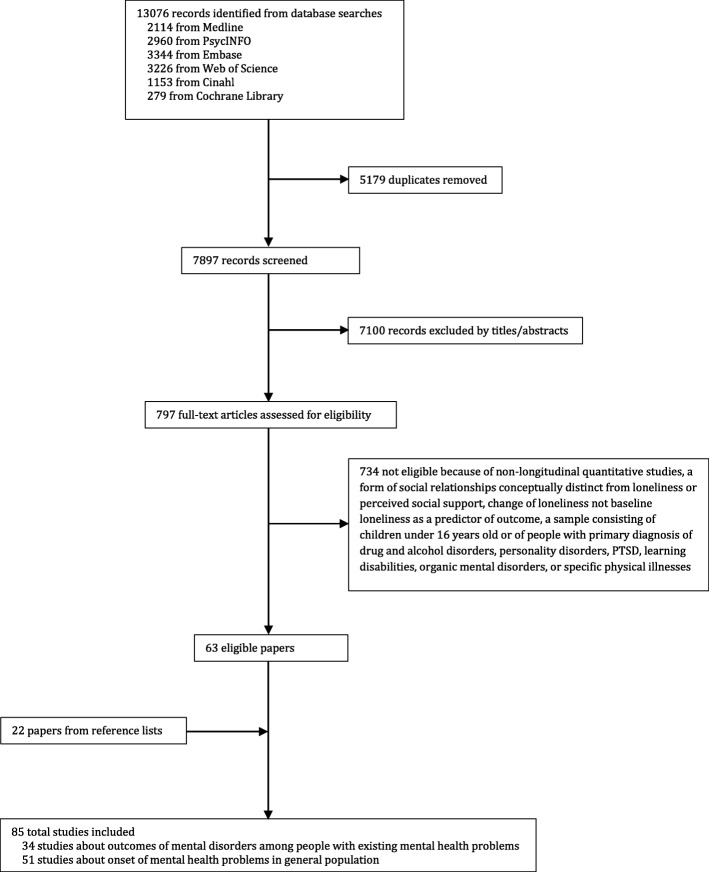
- The search retrieved 13,076 records; 797 full-text articles were assessed, and 34 eligible papers were included. Included studies covered depression (n = 23), schizophrenia/schizoaffective disorders (n = 2), bipolar disorder (n = 4), anxiety disorders (n = 3), and mixed samples (n = 2).
- Due to heterogeneity in populations, predictor measures and outcomes, a narrative synthesis was conducted; methodological quality was assessed with the Mixed Methods Appraisal Tool (MMAT), with scores ranging from * to .
Limitations
- Stated by the authors: many included studies did not report complete outcome data, response rate or follow-up rate, lowering quality ratings; some did not adjust for baseline outcome measures; the relationship may be circular; the search may not be exhaustive; eligible studies came from only seven countries, mostly North America; few non-English papers could be included; reporting bias is uncertain; the review was restricted to common mental disorders and examined only one direction of causation.
- Evident from the text: only two studies directly assessed loneliness, most evidence concerned depression, only five studies had follow-up over two years, and most samples were under 400 participants, with six studies under 100.
Model-written summary. Check it against the paper before relying on it.
Integrity signals
Registry
Cites
Statistics
Figures
Verification
Claims the paper makes
10 Valid · 2 Not valid · 43 Not checked · 61 Own results and interpretations
The cited sources support only part of this claim — read each source’s verdict below.
In the paper
“Feelings of loneliness are more prevalent among people with mental illness than in the general population [23, 24].”
§ Associations between loneliness and perceived social support and outcomes of mental health problems: a systematic review > Background
What the sources say
- Not checked yetcites [23] Borge L Martinsen EW Ruud T Watne O Friis S Quality of life, loneliness, and social contact among long-term psychiatric patients Psychiatr Serv 1999 50 1 81 84 10.1176/ps.50.1.81 9890584 source
- Partly supportedcites [24] Lauder W Sharkey S Mummery K A community survey of loneliness J Adv Nurs 2004 46 1 88 94 10.1111/j.1365-2648.2003.02968.x 15030445 sourceExperimental — accuracy not yet measured
The only passage in our copy touching mental illness is in the Background: 'It has also been suggested that feelings of loneliness increase during periods of mental illness when positive psychotic symptoms are experienced. A cycle develops in which there is a loss of reciprocal ties and less satisfaction with social relationships (Angell & Test 2002)' — a hedged statement about periods of psychotic symptoms, credited by Lauder et al. to another work, not a claim of higher prevalence than in the general population. The comparative element of the citing sentence is absent: the paper's own data are a community survey (Central Queensland Social Survey, n = 1241), and its prevalence figures (Conclusion: 'over one third of all respondents reported some level of loneliness'; Additional information: 'nearly two thirds of the community study sample') describe the general sample, with no mental-illness comparison group measured. The Additional information bullet 'Loneliness is associated with an increased incidence of physical and mental health problems' supports only a general association, so the sentence states as an established comparative fact what this source hedges and borrows. (LLM, conf=0.72)
plainstates an association- Asserted: passes — The authors put it forward as true.
- Checkable: passes — It can be checked against evidence.
- Load-bearing: unclear — It is unclear whether the paper’s conclusions depend on it.
- Based: passes — The paper gives a reason why it holds.
The cited sources support only part of this claim — read each source’s verdict below.
In the paper
“One further review looked at the relationship between social networks and support and early psychosis in people with first episode psychosis and in general population samples, but included no prospective studies [46].”
§ Associations between loneliness and perceived social support and outcomes of mental health problems: a systematic review > Background
What the sources say
- Partly supportedcites [46] Gayer-Anderson C Morgan C Social networks, support and early psychosis: a systematic review Epidemiol Psychiatr Sci 2013 22 2 131 146 10.1017/S2045796012000406 22831843 PMC6998121 sourceExperimental — accuracy not yet measured
The subject and populations attributed to this source match exactly: the Method (inclusion criteria) and Abstract describe a systematic review of social networks and support in first-episode psychosis samples and in general population samples with psychotic experiences or schizotypy (38 papers). However, on study design the source hedges rather than ruling out prospective work: the Discussion (methodological issues) states that 'almost invariably studies were cross-sectional making it difficult to disentangle cause and effect', and Table 1 (Results) lists each included study's time period as cross-sectional or retrospective (e.g. 'previous year', 'prodrome', 'two months pre-onset', 'year pre-contact') with no prospective/cohort design shown, while the Discussion's future-research section argues for the feasibility of informative cohort studies as something still to be done. The citing sentence converts this 'almost invariably cross-sectional' into the absolute 'included no prospective studies'. (LLM, conf=0.70)
plain- Asserted: passes — The authors put it forward as true.
- Checkable: passes — It can be checked against evidence.
- Load-bearing: passes — The paper’s conclusions depend on it.
- Based: passes — The paper gives a reason why it holds.
- Partly supported
The sources with a verdict support this claim; the rest weren’t checked yet, have no full text we could read, or their verdicts aren’t rated yet.
In the paper
“Three previous systematic reviews have explored the relationship between social relations and depression in general population [43, 44], or older adults [45], but included both cross-sectional and prospective studies.”
§ Associations between loneliness and perceived social support and outcomes of mental health problems: a systematic review > Background
What the sources say
- Supportedcites [43] Gariepy G Honkaniemi H Quesnel-Vallee A Social support and protection from depression: systematic review of current findings in western countries Br J Psychiatry 2016 209 4 286 295 10.1192/bjp.bp.115.169094 27445355 source
Our copy is itself a systematic review (with meta-analysis) of observational studies from the general population, Western countries, assessing social support/social relations and protection from depression (Study selection; Method), so it is the kind of review the citing sentence identifies for the general-population citations. It pooled both cross-sectional and cohort (prospective) studies, as shown by the comparisons 'Cross-sectional studies found significant results more often than cohort studies' (Older adults, p. ~6) and the Future research discussion of 'the contrast in magnitude and significance of effects between cohort and cross-sectional studies'. Note only that the paper states in its Background that no prior systematic review existed on this topic, so it is one of the reviews referred to rather than a source describing three predecessors. (LLM, conf=0.85)
- Not checked yetcites [44] Santini ZI Koyanagi A Tyrovolas S Mason C Haro JM The association between social relationships and depression: a systematic review J Affect Disord 2015 175 53 65 10.1016/j.jad.2014.12.049 25594512 source
- Not checked yetcites [45] Schwarzbach M Luppa M Forstmeier S Konig HH Riedel-Heller SG Social relations and depression in late life - a systematic review Int J Geriatr Psychiatry 2014 29 1 1 21 10.1002/gps.3971 23720299 source
plainstates an association- Asserted: passes — The authors put it forward as true.
- Checkable: passes — It can be checked against evidence.
- Load-bearing: passes — The paper’s conclusions depend on it.
- Based: passes — The paper gives a reason why it holds.
- Supported
The cited sources support only part of this claim — read each source’s verdict below.
In the paper
“They found that loneliness at baseline predicted depression and anxiety severity and remission from depression [25, 66].”
§ Associations between loneliness and perceived social support and outcomes of mental health problems: a systematic review > Discussion > Research implications
What the sources say
- Not checked yetcites [25] Holvast F Burger H de Waal MMW van Marwijk HWJ Comijs HC Verhaak PFM Loneliness is associated with poor prognosis in late-life depression: longitudinal analysis of the Netherlands study of depression in older persons J Affect Disord 2015 185 1 7 10.1016/j.jad.2015.06.036 26142687 source
- Partly supportedcites [66] van Beljouw IM Verhaak PF Cuijpers P van Marwijk HW Penninx BW The course of untreated anxiety and depression, and determinants of poor one-year outcome: a one-year cohort study BMC Psychiatry 2010 10 86 10.1186/1471-244X-10-86 20961414 PMC2974663 sourceExperimental — accuracy not yet measured
Our copy supports the severity part: in 'Determinants of a poor clinical outcome', baseline loneliness was positively associated with symptom severity at one-year follow-up in anxiety (β = .40, SE = .12, p < .01, univariate) and in depression both univariate (b = .89, p < .001) and multivariate after controlling baseline severity (β = .39, p < .05), a point the Discussion highlights as novel for a community sample. However, the paper's outcomes were continuous IDS and BAI scale scores; no passage in our copy (searched: remission, recovery, proportion of patients no longer meeting criteria) reports remission from depression as an outcome or tests loneliness against it, so the 'predicted remission from depression' element attributed here is not supported by this source. Also note that for anxiety the loneliness effect held only in univariate analysis, since in the multivariate model baseline symptom severity was the sole predictor. (LLM, conf=0.78)
plainstates a cause- Asserted: passes — The authors put it forward as true.
- Checkable: passes — It can be checked against evidence.
- Load-bearing: passes — The paper’s conclusions depend on it.
- Based: passes — The paper gives a reason why it holds.
The cited sources support only part of this claim — read each source’s verdict below.
In the paper
“They found that loneliness at baseline predicted depression and anxiety severity and remission from depression [25, 66].”
§ Associations between loneliness and perceived social support and outcomes of mental health problems: a systematic review > Discussion > Research implications
What the sources say
- Not checked yetcites [25] Holvast F Burger H de Waal MMW van Marwijk HWJ Comijs HC Verhaak PFM Loneliness is associated with poor prognosis in late-life depression: longitudinal analysis of the Netherlands study of depression in older persons J Affect Disord 2015 185 1 7 10.1016/j.jad.2015.06.036 26142687 source
- Partly supportedcites [66] van Beljouw IM Verhaak PF Cuijpers P van Marwijk HW Penninx BW The course of untreated anxiety and depression, and determinants of poor one-year outcome: a one-year cohort study BMC Psychiatry 2010 10 86 10.1186/1471-244X-10-86 20961414 PMC2974663 sourceExperimental — accuracy not yet measured
Our copy supports the severity part: baseline loneliness was positively associated with one-year symptom severity in anxiety (β = .40, SE = .12, p < .01) and in depression (univariate β = .89, p < .001; multivariate β = .39, p < .05) — 'Determinants of a poor clinical outcome' and Tables 2/3. However, the Discussion notes that in anxiety only baseline symptom severity survived multivariate adjustment, so loneliness predicted anxiety severity solely in univariate models. Nothing in our copy reports 'remission from depression': the outcome measures are continuous BAI and IDS scale scores at T1 ('Statistical analysis'), and no remission/recovery analysis appears anywhere in the text, so that part of the citing sentence is not supported by this source. (LLM, conf=0.78)
plainstates a cause- Asserted: passes — The authors put it forward as true.
- Checkable: passes — It can be checked against evidence.
- Load-bearing: passes — The paper’s conclusions depend on it.
- Based: passes — The paper gives a reason why it holds.
55 more claims · 4 with their cited sources checked
Create a free account to see all 116 claims and to verify the 69 references still open.
- Probably not a substantial claim. 26
- It may state two separate claims as one. 38
Claims other papers make about this one
Each is checked against this paper’s own text: does it say what the citing paper says it does?
The source backs part of the claim, not all of it — or backs it for a different population, condition or comparison.
In the citing paper
“Research shows that loneliness can lead to a lack of social support and meaningful connections, further exacerbating feelings of distress and contributing to the onset of anxiety and depression [15].”
From The prospective association of adolescent loneliness and low resilience with anxiety and depression in young adulthood: The HUNT study (2025) · cites this paper as [15]
Experimental — accuracy not yet measuredThe cited source says what the claim attributes to it.
In the citing paper
“Indeed, social proximity and interpersonal interactions are relevant factors in developing and fostering social ties [90–92] and maintaining mental health [93].”
From Psychological correlates of perceived loneliness in college students before and during the COVID-19 stay-at-home period: a longitudinal study (2023) · cites this paper as [93]
Statistics recomputed
Every reported test result, recomputed from its test statistic and degrees of freedom. A result shows as not adding up only once an independent check has confirmed it.
- Consistentχ²(5) = 16.35reported p = .006 · recomputed p = .006
“x2 (5) = 16.35, p = .006”
Self-check
Percentages, sums and reported differences re-computed from the paper’s own numbers.
Each contradiction between two passages listed here was confirmed by an independent check.
Rated minor: it would not touch a result — a value no result rests on, a p-value that stays on the same side of the significance level, or a conflict that is clerical, resolved elsewhere in the paper, or outside its own findings.
In the paper
§ Associations between loneliness and perceived social support and outcomes of mental health problems: a systematic review > Results > Depression
“In eight of these nine papers, the relationship between baseline loneliness and depressive symptom outcome remained significant.”
§ Associations between loneliness and perceived social support and outcomes of mental health problems: a systematic review > Results > Eligible papers
“Depression (n = 23) | Perceived social support (n = 22)Loneliness (n = 1)”
Citations
Cites
The Multidimensional Scale of Perceived Social Support
Zimet, G. D., Dahlem, N. W., Zimet, S. G., & Farley, G. K. (1988) · Journal of Personality Assessment · doi:10.1207/s15327752jpa5201_2 · Cited by 13,339
Social Relationships and Mortality Risk: A Meta-analytic Review
Holt-Lunstad, J., Smith, T. B., & Layton, J. B. (2010) · PLoS Medicine · doi:10.1371/journal.pmed.1000316 · Cited by 7,272 · cited 1×
“For instance, two meta-analytic reviews have reported that loneliness and poor social support are associated with higher mortality rates, and that the effect is comparable with some well-established risk factors such as obesity, physical inactivity, and smoking [5, 6].”
BackgroundSocial Relationships and Health
House, J. S., Landis, K. R., & Umberson, D. (1988) · Science · doi:10.1126/science.3399889 · Cited by 7,073
Loneliness and Social Isolation as Risk Factors for Mortality: A Meta-Analytic Review
Holt-Lunstad, J., Smith, T. B., Baker, M., Harris, T., & Stephenson, D. (2015) · Perspectives on Psychological Science · doi:10.1177/1745691614568352 · Cited by 6,043
UCLA loneliness scale (version 3): reliability, validity, and factor structure
Russell, D. W. (1996) · Journal of Personality Assessment · doi:10.1207/s15327752jpa6601_2 · Cited by 5,800 · cited 2×
“(PDF 280 kb) Abbreviations CES-D: Center for Epidemiologic Studies Depression Scale; DSM: Diagnostic and Statistical Manual of Mental Disorder; HoNOS: Health of the Nation Outcome Scales; ICD: International Classification of Diseases; M.I.N.I. : MiniInternational Neuropsychiatric Interview; MMAT: Mixed Methods Apprais…”
MethodPsychometric Characteristics of the Multidimensional Scale of Perceived Social Support
Zimet, G. D., Powell, S. S., Farley, G. K., Werkman, S., & Berkoff, K. A. (1990) · Journal of Personality Assessment · doi:10.1080/00223891.1990.9674095 · Cited by 4,855
Psychometric Characteristics of the Multidimensional Scale of Perceived Social Support
Zimet, G., Powell, S., Farley, G., Werkman, S., & Berkoff, K. (1990) · Journal of Personality Assessment · doi:10.1207/s15327752jpa5503&4_17 · Cited by 4,854
Loneliness matters: a theoretical and empirical review of consequences and mechanisms
Hawkley, L. C., & Cacioppo, J. T. (2010) · Annals of Behavioral Medicine · doi:10.1007/s12160-010-9210-8 · Cited by 4,782 · cited 1×
“The effect of loneliness on physical health may be via biological, psychological and/or behavioural mechanisms, including physiological functioning, neuroendocrine effects, gene effects, immune functioning, perception of stressful events, health behaviours and sleep quality [2, 12, 13].”
BackgroundSocial relationships and health a flashpoint for health policy
Umberson, D., & Karas Montez, J. (2010) · Journal of Health and Social Behavior · doi:10.1177/0022146510383501 · Cited by 2,639 · cited 1×
“There is increasing interest in the effects of social relations on health, and in the service delivery and policy implications of such effects [1].”
BackgroundLoneliness: the experience of emotional and social isolation
Weiss, R. S. (1974) · Cited by 2,513
Research works printed but not linked: 4
- Pluye P Robert E Cargo M Bartlett G O’Cathain A Griffiths F Boardman F Gagnon MP Rousseau MC Proposal: A Mixed Methods Appraisal Tool for Systematic Mixed Studies Reviews 2011 Canada Department of Family Medicine, McGill University, Montreal
- Daniels RE. Psychosocial predictors of symptom severity and functioning in adults with bipolar disorder A three-month prospective study Diss Abstr Int B Sci Eng 2000 60 8-B 4213
- Psychosis and schizophrenia in adults: prevention and management. National Institute for Health and Care Excellence (NICE). 2014. https://www.nice.org.uk/guidance/cg178. Accessed 19 Oct 2016. 32207892
- Report of the Annual Social Prescribing Network Conference. London: University of Westminster; 2016.
Cited by
The social determinants of mental health and disorder: evidence, prevention and recommendations
Kirkbride, J. B., Anglin, D. M., Colman, I., Dykxhoorn, J., Jones, P. B., Patalay, P., Pitman, A., Soneson, E., Steare, T., Wright, T., et al. (2024) · World Psychiatry · doi:10.1002/wps.21160 · Cited by 1,253
“The majority of studies investigating longitudinal associations be tween loneliness or social isolation and mental health have fo cused on depression, reporting a longitudinal (and bidirectional 222224 ) association of loneliness with depression onset 214 , sever ity 225 and recovery 226 .”
BackgroundThe prevalence of loneliness across 113 countries: systematic review and meta-analysis
Surkalim, D. L., Luo, M., Eres, R., Gebel, K., van Buskirk, J., Bauman, A., & Ding, D. (2022) · BMJ · doi:10.1136/bmj-2021-067068 · Cited by 821
Social isolation and loneliness among older adults in the context of COVID-19: a global challenge
Wu, B. (2020) · Global Health Research and Policy · doi:10.1186/s41256-020-00154-3 · Cited by 630
Loneliness, isolation, and social support factors in post-COVID-19 mental health.
Saltzman, L. Y., Hansel, T. C., & Bordnick, P. S. (2020) · Psychological Trauma: Theory, Research, Practice, and Policy · doi:10.1037/tra0000703 · Cited by 618
The Effect of Loneliness on Distinct Health Outcomes: A Comprehensive Review and Meta-Analysis
Park, C., Majeed, A., Gill, H., Tamura, J., Ho, R. C., Mansur, R. B., Nasri, F., Lee, Y., Rosenblat, J. D., Wong, E., et al. (2020) · Psychiatry Research · doi:10.1016/j.psychres.2020.113514 · Cited by 604
The role of perceived social support on depression and sleep during the COVID-19 pandemic
Grey, I., Arora, T., Thomas, J., Saneh, A., Tohme, P., & Abi-Habib, R. (2020) · Psychiatry Research · doi:10.1016/j.psychres.2020.113452 · Cited by 587
“Furthermore, inverse associations have been observed between social support and depression, and tentatively with schizophrenia, bipolar disorder and anxiety disorders (Wang et al., 2018).”
Social support and mental health: the mediating role of perceived stress
Acoba, E. F. (2024) · Frontiers in Psychology · doi:10.3389/fpsyg.2024.1330720 · Cited by 458
“…prior and more recent research conducted across various cultural and demographic settings (Chu et al., 2010; Gülaçtı, 2010; Gariepy et al., 2016; Wang et al., 2018; Bender et al., 2019; Mohd et al., 2019; Watson et al., 2019; Alshehri et al., 2020; Cobo-Rendón et al., 2020; Grey et al., 2020;…”
BackgroundInfluentialDomènech-Abella, J., Mundó, J., Haro, J. M., & Rubio-Valera, M. (2019) · Journal of Affective Disorders · doi:10.1016/j.jad.2018.12.043 · Cited by 469
Bu, F., Steptoe, A., & Fancourt, D. (2020) · Social Science & Medicine · doi:10.1016/j.socscimed.2020.113521 · Cited by 462
“Similarly, our finding that people with a diagnosed mental illness had higher odds of being lonelier aligns with research showing a bidirectional link between loneliness and mental health (Wang et al., 2018).”
BackgroundLoneliness and the onset of new mental health problems in the general population
Mann, F., Wang, J., Pearce, E., Ma, R., Schlief, M., Lloyd-Evans, B., Ikhtabi, S., & Johnson, S. (2022) · Social Psychiatry and Psychiatric Epidemiology · doi:10.1007/s00127-022-02261-7 · Cited by 387
“The initial search was conducted in May 2016, as part of a broader search to include longitudinal studies on loneliness in people with established mental health problems (recently published as a separate, related review [16]).”
Self-citationOh, H. J., Kim, J., Chang, J. J. C., Park, N., & Lee, S. (2023) · Computers in Human Behavior · doi:10.1016/j.chb.2022.107498 · Cited by 390
Emerson, E., Fortune, N., Llewellyn, G., & Stancliffe, R. (2021) · Disability and Health Journal · doi:10.1016/j.dhjo.2020.100965 · Cited by 373
Jia, R., Ayling, K., Chalder, T., Massey, A., Broadbent, E., Coupland, C., & Vedhara, K. (2020) · BMJ Open · doi:10.1136/bmjopen-2020-040620 · Cited by 329
“Successive systematic reviews demonstrate poorer mental health outcomes and increased morbidity and mortality in individuals who perceive themselves to be more lonely and lacking in support.(15) ,16 Positive mood,”
BackgroundHoang, P., King, J. A., Moore, S., Moore, K., Reich, K., Sidhu, H., Tan, C. V., Whaley, C., & McMillan, J. (2022) · JAMA Network Open · doi:10.1001/jamanetworkopen.2022.36676 · Cited by 315
Scardera, S., Perret, L. C., Ouellet-Morin, I., Gariépy, G., Juster, R.-P., Boivin, M., Turecki, G., Tremblay, R. E., Côté, S., & Geoffroy, M.-C. (2020) · JAMA Network Open · doi:10.1001/jamanetworkopen.2020.27491 · Cited by 268
Achterbergh, L., Pitman, A., Birken, M., Pearce, E., Sno, H., & Johnson, S. (2020) · BMC Psychiatry · doi:10.1186/s12888-020-02818-3 · Cited by 254
Self-citationA revitalized biopsychosocial model: core theory, research paradigms, and clinical implications
Bolton, D. (2023) · Psychological Medicine · doi:10.1017/s0033291723002660 · Cited by 192
Christiansen, J., Qualter, P., Friis, K., Pedersen, S., Lund, R., Andersen, C., Bekker-Jeppesen, M., & Lasgaard, M. (2021) · Perspectives in Public Health · doi:10.1177/17579139211016077 · Cited by 241
Factors Associated With Loneliness: An Umbrella Review Of Observational Studies
Solmi, M., Veronese, N., Galvano, D., Favaro, A., Ostinelli, E. G., Noventa, V., Favaretto, E., Tudor, F., Finessi, M., Shin, J. I., et al. (2020) · Journal of Affective Disorders · doi:10.1016/j.jad.2020.03.075 · Cited by 227
Walker, S., Mackay, E., Barnett, P., Sheridan Rains, L., Leverton, M., Dalton-Locke, C., Trevillion, K., Lloyd-Evans, B., & Johnson, S. (2019) · The Lancet Psychiatry · doi:10.1016/s2215-0366(19)30406-7 · Cited by 221
Self-citationSocial support and recovery from mental health problems: a scoping review
Bjørlykhaug, K. I., Karlsson, B., Hesook, S. K., & Kleppe, L. C. (2022) · Nordic Social Work Research · doi:10.1080/2156857x.2020.1868553 · Cited by 189
“…with the notion that social support plays a substantial role in attaining and maintaining good mental health, in the prevention of and recovery from mental health problems (Topor et al. 2011; UN 2020; Wang et al. 2018) and have a potential in reducing inequalities in health (Stoltenberg 2015).”
BackgroundInfluentialKupferberg, A., & Hasler, G. (2023) · Journal of Affective Disorders Reports · doi:10.1016/j.jadr.2023.100631 · Cited by 170
Ma, R., Mann, F., Wang, J., Lloyd-Evans, B., Terhune, J., Al-Shihabi, A., & Johnson, S. (2020) · Social Psychiatry and Psychiatric Epidemiology · doi:10.1007/s00127-019-01800-z · Cited by 195
“Moreover, loneliness is associated with poorer quality of life [17] and personal recovery [18], and with more severe mental health symptoms [19].”
BackgroundSelf-citationSocial Support—A Protective Factor for Depressed Perinatal Women?
Milgrom, J., Hirshler, Y., Reece, J., Holt, C., & Gemmill, A. W. (2019) · International Journal of Environmental Research and Public Health · doi:10.3390/ijerph16081426 · Cited by 179
Drageset, J. (2021) · Springer eBooks · doi:10.1007/978-3-030-63135-2_11 · Cited by 293
Loneliness in autistic adults: A systematic review
Umagami, K., Remington, A., Lloyd-Evans, B., Davies, J., & Crane, L. (2022) · Autism · doi:10.1177/13623613221077721 · Cited by 179
“The consequences of loneliness are varied but often include physical and mental health problems (Cacioppo et al., 2006; Holt-Lunstad et al., 2010, 2015; O’Connell et al., 2004; Wang et al., 2018).”
BackgroundSelf-citationMarx, W., Manger, S. H., Blencowe, M., Murray, G., Ho, F. Y.-Y., Lawn, S., Blumenthal, J. A., Schuch, F., Stubbs, B., Ruusunen, A., et al. (2023) · The World Journal of Biological Psychiatry · doi:10.1080/15622975.2022.2112074 · Cited by 179
Mehrabi, F., & Béland, F. (2020) · Archives of Gerontology and Geriatrics · doi:10.1016/j.archger.2020.104119 · Cited by 176
Gabbiadini, A., Baldissarri, C., Durante, F., Valtorta, R. R., De Rosa, M., & Gallucci, M. (2020) · Frontiers in Psychology · doi:10.3389/fpsyg.2020.554678 · Cited by 166
“On the contrary, the perception of lacking social support is strictly associated with loneliness (Lin et al., 2020), irritability and anger (e.g., Arslan, 2009), boredom and depression (Gariepy et al., 2016), and anxiety (e.g., Wang et al., 2018).”
BackgroundKillaspy, H., Harvey, C., Brasier, C., Brophy, L., Ennals, P., Fletcher, J., & Hamilton, B. (2022) · World Psychiatry · doi:10.1002/wps.20940 · Cited by 173
Tzouvara, V., Kupdere, P., Wilson, K., Matthews, L., Simpson, A., & Foye, U. (2023) · Child Abuse & Neglect · doi:10.1016/j.chiabu.2023.106092 · Cited by 167
What is good grief support? Exploring the actors and actions in social support after traumatic grief
Cacciatore, J., Thieleman, K., Fretts, R., & Jackson, L. B. (2021) · PLOS ONE · doi:10.1371/journal.pone.0252324 · Cited by 141
Bruce, L. D., Wu, J. S., Lustig, S. L., Russell, D. W., & Nemecek, D. A. (2019) · American Journal of Health Promotion · doi:10.1177/0890117119856551 · Cited by 166
“Veteran status Veteran 2088 (10) 2320 (12) Nonveteran 18 008 (90) 17 776 (88) Education High school 4123 (21) 3692 (19) Some college 5018 (26) 4749 (24) College degree 7529 (38) 7699 (39) Graduate degree 2911 (15) 3448 (18) Employment status Employed 11 104 (57) 12 134 (63) Unemployed 2422 (13) 2100 (11) Homemaker 169…”
MethodWu, A., Scult, M. A., Barnes, E. D., Betancourt, J. A., Falk, A., & Gunning, F. M. (2021) · npj Digital Medicine · doi:10.1038/s41746-021-00386-8 · Cited by 161
Hards, E., Loades, M. E., Higson‐Sweeney, N., Shafran, R., Serafimova, T., Brigden, A., Reynolds, S., Crawley, E., Chatburn, E., Linney, C., et al. (2022) · British Journal of Clinical Psychology · doi:10.1111/bjc.12331 · Cited by 162
“A systematic review found some evidence that loneliness is associated with worse mental health outcomes over time, including worse depression and anxiety symptoms and poorer remission of depression (Wang et al., 2018).”
BackgroundResultSaunders, R., Buckman, J. E. J., Fonagy, P., & Fancourt, D. (2022) · Psychological Medicine · doi:10.1017/s0033291721000957 · Cited by 156
Hasan, S. I., Yee, A. H. A., Rinaldi, A., Azham, A. A., Hairi, F. M., & Nordin, A. S. A. (2021) · PLoS ONE · doi:10.1371/journal.pone.0260221 · Cited by 178
“Social support has been found to promote the mental well-being [25, 26] including in immigrants [27, 28] and refugees [29].”
BackgroundTahara, M., Mashizume, Y., & Takahashi, K. (2020) · International Journal of Environmental Research and Public Health · doi:10.3390/ijerph18010131 · Cited by 129
“To minimize social isolation and loneliness, which were identified as risk factors for poor mental health [47], participants incorporated new activities, such as online communication, into their routines.”
BackgroundBauer, A., Stevens, M., Purtscheller, D., Knapp, M. R. J., Fonagy, P., Evans-Lacko, S. E., & Paul, J. L. (2021) · PLoS ONE · doi:10.1371/journal.pone.0251750 · Cited by 161
“Increasing perceived social support, which is considered to be equivalent to reducing loneliness [80,81], might help prevent or reduce mental health problems in young people [82,83].”
BackgroundShifera, N., Ayenew, M., & Mekuria, R. M. (2020) · Psychology Research and Behavior Management · doi:10.2147/prbm.s275593 · Cited by 163
Latikka, R., Hernández, R. R., Lohan, E. S., Rantala, J., Fernández, F. N., Laitinen, A., & Oksanen, A. (2021) · Journal of Medical Internet Research · doi:10.2196/28022 · Cited by 149
“For instance, loneliness is associated with poorer cardiovascular health [28], lower cognitive function [29,30], depression [31,32], anxiety, suicide ideation [33], higher psychological distress [34,35], lower self-esteem [36], sleep and stress problems [37,38], and health behaviors such as lower…”
BackgroundTindle, R., Hemi, A., & Moustafa, A. A. (2022) · Scientific Reports · doi:10.1038/s41598-022-12262-w · Cited by 125
Problematic internet use and feelings of loneliness
Costa, R. M., Patrão, I., & Machado, M. (2019) · International Journal of Psychiatry in Clinical Practice · doi:10.1080/13651501.2018.1539180 · Cited by 124
Papadopoulos, C., Castro, N., Nigath, A., Davidson, R., Faulkes, N., Menicatti, R., Khaliq, A. A., Recchiuto, C., Battistuzzi, L., Randhawa, G., et al. (2022) · International Journal of Social Robotics · doi:10.1007/s12369-021-00781-x · Cited by 117
Elhai, J. D., McKay, D., Yang, H., Minaya, C., Montag, C., & Asmundson, G. J. G. (2021) · Human Behavior and Emerging Technologies · doi:10.1002/hbe2.227 · Cited by 115
Loneliness and mental health: The mediating effect of perceived social support
Hutten, E., Jongen, E. M. M., Vos, A. E. C. C., van den Hout, A. J. H. C., & van Lankveld, J. J. D. M. (2021) · International Journal of Environmental Research and Public Health · doi:10.3390/ijerph182211963 · Cited by 117
“Consistent with these models, social support has been associated with physical [50] and mental [19] health.”
BackgroundAcademic burnout among medical students: respective importance of risk and protective factors
Kilic, R., Nasello, J., Melchior, V., & Triffaux, J. (2021) · Public Health · doi:10.1016/j.puhe.2021.07.025 · Cited by 161
Preez, A. D., Law, T., Onorato, D., Lim, Y. M., Eiben, P., Musaelyan, K., Egeland, M. T., Hye, A., Zunszain, P. A., Thuret, S., et al. (2020) · Translational Psychiatry · doi:10.1038/s41398-020-01000-3 · Cited by 131
Zhao, Y., Zhao, M., & Song, S. (2022) · Journal of Medical Internet Research · doi:10.2196/42447 · Cited by 140
“Social support has been extensively examined in health-related fields, with many studies finding positive associations between social support and people’s physical and mental health [43,44].”
Vaingankar, J. A., Abdin, E., Chong, S. A., Shafie, S., Sambasivam, R., Zhang, Y. J., Chang, S. S. H., Chua, B. Y., Shahwan, S., Jeyagurunathan, A., et al. (2020) · Archives of Public Health · doi:10.1186/s13690-020-00476-1 · Cited by 129
The Impact of Social Support and Pregnancy on Subjective Well-Being: A Systematic Review
Battulga, B., Benjamin, M. R., Chen, H., & Bat-Enkh, E. (2021) · Frontiers in Psychology · doi:10.3389/fpsyg.2021.710858 · Cited by 136
Self-Esteem, Anxiety, and Depression in Older People in Nursing Homes
Šare, S., Ljubičić, M., Gusar, I., Čanović, S., & Konjevoda, S. (2021) · Healthcare · doi:10.3390/healthcare9081035 · Cited by 133
Nuyen, J., Tuithof, M., de Graaf, R., van Dorsselaer, S., Kleinjan, M., & ten Have, M. (2019) · Social Psychiatry and Psychiatric Epidemiology · doi:10.1007/s00127-019-01778-8 · Cited by 127
Lin, J., Su, Y., Lv, X., Liu, Q., Wang, G., Wei, J., Zhu, G., Chen, Q., Tian, H., Zhang, K., et al. (2020) · Journal of Affective Disorders · doi:10.1016/j.jad.2020.01.026 · Cited by 98
The relationship between psychological health and social support: Evidence from physicians in China
Sun, J., Sun, R., Jiang, Y., Chen, X., Li, Z., Ma, Z., Wei, J., He, C., & Zhang, L. (2020) · PLoS ONE · doi:10.1371/journal.pone.0228152 · Cited by 108
Experiencing loneliness in parenthood: a scoping review
Nowland, R. A., Thomson, G., McNally, L., Smith, T. D. H., & Whittaker, K. A. (2021) · Perspectives in Public Health · doi:10.1177/17579139211018243 · Cited by 133
“Am J Orthopsychiatry 2011;81(3):327–36.”
BackgroundInfluentialLi, S., & Xu, Q. (2020) · Journal of Health Psychology · doi:10.1177/1359105320971697 · Cited by 125
“…loneliness is also comorbid with a host of psychological problems and health related behaviors, including depression and anxiety (Beutel et al., 2017; Wang et al., 2018), lower levels of subjective well-being (Kong and You, 2013), as well as negative coping strategies (Cacioppo et al, 2003).”
BackgroundCOVID-19 Mental Health Disparities
Saltzman, L. Y., Lesen, A. E., Henry, V., Hansel, T. C., & Bordnick, P. S. (2021) · Health Security · doi:10.1089/hs.2021.0017 · Cited by 115
“2,12,13 Additionally, financial and household strain could increase many of these long-lasting mental health effects.”
Burton, A., McKinlay, A., Aughterson, H., & Fancourt, D. (2023) · Journal of Mental Health · doi:10.1080/09638237.2021.1952953 · Cited by 84
“Our study also found that perceived social support and connecting with family and friends were important buffers against relapse in line with previous research (Wang et al., 2018).”
ResultSun, S., Hou, J., Chen, Y., Lu, Y., Brown, L. K., & Operario, D. (2020) · AIDS and Behavior · doi:10.1007/s10461-020-02903-4 · Cited by 93
Han, X., Han, W., Qu, J., Li, B., & Zhu, Q. (2019) · Computers in Human Behavior · doi:10.1016/j.chb.2018.12.011 · Cited by 87
Fong, P., Cruwys, T., Robinson, S. L., Haslam, S. A., Haslam, C., Mance, P. L., & Fisher, C. (2021) · Social Science & Medicine · doi:10.1016/j.socscimed.2021.113909 · Cited by 111
Igbokwe, C. C., Ejeh, V. J., Agbaje, O. S., Umoke, P. I. C., Iweama, C. N., & Ozoemena, E. L. (2020) · BMC Geriatrics · doi:10.1186/s12877-020-01561-4 · Cited by 78
Yang, C., Gao, H., Li, Y., Wang, E., Wang, N., & Wang, Q. (2022) · Frontiers in Psychology · doi:10.3389/fpsyg.2022.1064898 · Cited by 120
“Additionally, studies reveal that levels of PSS are strongly linked to metrics of lowered stress and mental distress along with enhanced well-being (Wang et al., 2018).”
BackgroundDonovan, M., Mackey, C. S., Platt, G. N., Rounds, J., Brown, A. N., Trickey, D. J., Liu, Y., Jones, K. M., & Wang, Z. (2020) · Neurobiology of Stress · doi:10.1016/j.ynstr.2020.100278 · Cited by 85
“For example, social isolation and loneliness results in increased rates of depression and anxiety in humans (Domènech-Abella et al., 2019; Ge et al., 2017; Wang et al., 2018).”
Pan, Y., Yang, Z., Han, X., & Qi, S. (2020) · Personality and Individual Differences · doi:10.1016/j.paid.2020.110490 · Cited by 105
“It is associated with negative mental health outcomes (Heinrich & Gullone, 2006; Victor & Yang, 2012) such as anxiety, depression, suicidality, and reduced positive emotions, as well as physiological changes (Beutel et al., 2017; Wang et al., 2018).”
BackgroundNenov-Matt, T., Barton, B. B., Dewald‐Kaufmann, J., Goerigk, S. A., Rek, S. V., Zentz, K., Musil, R., Jobst, A., Padberg, F., & Reinhard, M. A. (2020) · Frontiers in Psychiatry · doi:10.3389/fpsyt.2020.608476 · Cited by 100
Loneliness, ageism, and mental health: The buffering role of resilience in seniors
Ribeiro-Gonçalves, J. A., Costa, P. A., & Leal, I. M. P. (2022) · International Journal of Clinical and Health Psychology · doi:10.1016/j.ijchp.2022.100339 · Cited by 106
Gabarrell‐Pascuet, A., García‐Mieres, H., Giné-Vázquez, I., Moneta, M. V., Koyanagi, A., Haro, J. M., & Domènech‐Abella, J. (2023) · International Journal of Environmental Research and Public Health · doi:10.3390/ijerph20042765 · Cited by 108
“42), whereas the association between social support and anxiety was seen to be less clear [17].”
Bock, C., Heitland, I., Zimmermann, T., Winter, L., & Kahl, K. G. (2020) · Frontiers in Psychiatry · doi:10.3389/fpsyt.2020.00298 · Cited by 108
Adlington, K., Vasquez, C., Pearce, E., Wilson, C. A., Nowland, R. A., Taylor, B. L., Spring, S., & Johnson, S. (2023) · BMC Psychiatry · doi:10.1186/s12888-023-04532-2 · Cited by 107
“Findings in context of other studies Existing qualitative and quantitative studies have already demonstrated an association between depression and loneliness and between parenthood and loneliness [13, 22].”
BackgroundResultSelf-citationSocial isolation and social support in good times and bad times
Gable, S. L., & Bedrov, A. (2021) · Current Opinion in Psychology · doi:10.1016/j.copsyc.2021.08.027 · Cited by 100
Changing the narrative: Loneliness as a social justice issue
Barreto, M., Doyle, D. M., & Qualter, P. (2024) · Political Psychology · doi:10.1111/pops.12965 · Cited by 93
“…shows that loneliness leads to poor physical (e.g., Hawkley et al., 2022; Hawkley & Capitanio, 2015), mental (e.g., Cacioppo & Cacioppo, 2015; Wang et al., 2018), and brain health (Karelina et al., 2009), with impressive evidence pointing to how loneliness increases the risk of early…”
BackgroundOna, G., Kohek, M., Massaguer, T., Gomariz, A., Jiménez, D. F., Dos Santos, R. G., Hallak, J. E. C., Alcázar-Córcoles, M. Á., & Bouso, J. C. (2019) · Journal of Psychoactive Drugs · doi:10.1080/02791072.2019.1567961 · Cited by 76
“…MacRae 1998; Talin and Sanabria 2017), thus strengthening social bonds (Andritzky 1989; Cavnar 2014; Kavenská and Simonová 2015; Prat et al. 2012), an aspect that is particularly important for the maintenance of a positive mental health status (Berkman 1995; Ozbay et al. 2007; Wang et al. 2018).”
BackgroundWalsh, N. A., Repa, L. M., & Garland, S. N. (2021) · Journal of Sleep Research · doi:10.1111/jsr.13442 · Cited by 85
“Research clearly indicates that perceived social support is associated with mental health (Harandi et al., 2017; Wang et al., 2018), such that individuals with depression are more likely to report low levels of social support.”
Background‘It's a lonely old world’: Developing a multidimensional understanding of loneliness in farming
Wheeler, R., Lobley, M., McCann, J., & Phillimore, A. (2023) · Sociologia Ruralis · doi:10.1111/soru.12399 · Cited by 67
Use of virtual reality in the inpatient rehabilitation of COVID-19 patients
Kolbe, L., Jaywant, A., Gupta, A., Vanderlind, W. M., & Jabbour, G. (2021) · General Hospital Psychiatry · doi:10.1016/j.genhosppsych.2021.04.008 · Cited by 74
“…prevention measures that make on-site family visits or travel “ off unit ” difficult or contraindicated, worsens social isolation and loneliness [1], which are known to heighten risk of dementia [2], cognitive decline [3], poor psychiatric outcomes [4], and premature death from every cause [5].”
BackgroundZhu, W., Wei, Y., Meng, X., & Li, J. (2020) · BMC Health Services Research · doi:10.1186/s12913-020-05871-6 · Cited by 82
“The positive effects of sufficient social support on anxiety has been proven in previous studies [17, 18].”
ResultWeber, M., Schulze, L., Bolzenkötter, T., Niemeyer, H., & Renneberg, B. (2022) · Frontiers in Psychiatry · doi:10.3389/fpsyt.2022.848645 · Cited by 89
Hughes, J. L., Camden, A. A., Yangchen, T., Smith, G. P. A., Rodríguez, M. M. D., Rouse, S. V., McDonald, C. P., & Lopez, S. G. (2022) · Psi Chi Journal of Psychological Research · doi:10.24839/2325-7342.jn27.4.232 · Cited by 115
Lorant, V., Smith, P., den Broeck, K. V., & Nicaise, P. (2021) · BMC Psychiatry · doi:10.1186/s12888-021-03109-1 · Cited by 81
Pearce, E., Birken, M., Pais, S., Tamworth, M., Ng, Y., Wang, J., Chipp, B., Crane, E., Schlief, M., Yang, J., et al. (2023) · BMC Psychiatry · doi:10.1186/s12888-023-05069-0 · Cited by 101
“People with eating disorders were found to report receiving less emotional and/or practical social support than general population controls.”
BackgroundInfluentialSelf-citationHammoud, R., Tognin, S., Bakolis, I., Ivanova, D., Fitzpatrick, N., Burgess, L. C., Smythe, M., Gibbons, J., Davidson, N., & Mechelli, A. (2021) · Scientific Reports · doi:10.1038/s41598-021-03398-2 · Cited by 89
Advancing our understanding of loneliness and mental health problems in young people
Pitman, A., Mann, F., & Johnson, S. (2018) · The Lancet Psychiatry · doi:10.1016/s2215-0366(18)30436-x · Cited by 68
Self-citationJokela, M. M. (2022) · Personality and Individual Differences · doi:10.1016/j.paid.2022.111592 · Cited by 68
Iguacel, I., Gasch‐Gallén, À., Ayala‐Marín, A. M., Miguel‐Etayo, P. D., & Moreno, L. A. (2020) · International Journal of Obesity · doi:10.1038/s41366-020-00697-y · Cited by 93
“The absence of close, confiding relationships predicts depression, and anxiety [40], which negatively affect lifestyle and health by regulating thoughts, feelings and behaviors to promote health and by easing healthy lifestyles [31].”
BackgroundRisk Factors Underlying COVID-19 Lockdown-Induced Mental Distress
Novotný, J. S., Gonzalez-Rivas, J. P., Kunzová, Š., Skladaná, M., Pospíšilová, A., Polcrová, A., Medina-Inojosa, J. R., Lopez-Jimenez, F., Geda, Y. E., & Stokin, G. B. (2020) · Frontiers in Psychiatry · doi:10.3389/fpsyt.2020.603014 · Cited by 69
Epidemiology of depression among displaced people: A systematic review and meta-analysis
Bedaso, A., & Duko, B. (2022) · Psychiatry Research · doi:10.1016/j.psychres.2022.114493 · Cited by 77
Jiménez-Labaig, P., Aymerich, C., Braña, I., Rullan, A., Cacicedo, J., Torres, M. Á. G., Harrington, K. J., & Catalán, A. (2024) · JNCI Cancer Spectrum · doi:10.1093/jncics/pkae031 · Cited by 81
Depression in older adults during the COVID ‐19 pandemic: A systematic review
Silva, C., da Fonseca, C. J. V., Ferreira, R., Weidner, A., Morgado, B., Lopes, M. J., Moritz, S., Jelinek, L., Schneider, B. C., & de Pinho, L. G. (2023) · Journal of the American Geriatrics Society · doi:10.1111/jgs.18363 · Cited by 78
“Social support and loneliness Differing from feelings of loneliness, perceived social support refers to people's beliefs about how much support is potentially available from their relationships and social contacts as well as the perceived quality of this support.(108) In our review, we found evidence for an associatio…”
BackgroundOuyang, M., Gui, D., Cai, X., Yin, Y., Mao, X., Huang, S., Zeng, P., & Wang, P. (2021) · Frontiers in Psychology · doi:10.3389/fpsyg.2020.603511 · Cited by 61
Chen, Z., Song, X., Lee, T. M. C., & Zhang, R. (2023) · Journal of Affective Disorders · doi:10.1016/j.jad.2023.09.035 · Cited by 78
Three-item loneliness scale: psychometric properties and normative data of the Spanish version
Trucharte, A., Calderón, L., Cerezo, E., Contreras, A., Peinado, V., & Valiente, C. (2023) · Current Psychology · doi:10.1007/s12144-021-02110-x · Cited by 63
“Lack of social support and loneliness have been associated with many negative physical and psychological consequences (Valtorta et al., 2016; Wang et al., 2018).”
BackgroundWang, J., Lloyd-Evans, B., Marston, L., Mann, F., Ma, R., & Johnson, S. (2020) · BMC Psychiatry · doi:10.1186/s12888-020-02665-2 · Cited by 57
Self-citationRødevand, L. N., Bahrami, S., Frei, O., Lin, A., Gani, O., Shadrin, A. A., Smeland, O. B., Connell, K. S. O., Elvsåshagen, T., Winterton, A., et al. (2021) · Translational Psychiatry · doi:10.1038/s41398-020-01142-4 · Cited by 79
Barriers and facilitators to mental health care: A systematic review in Pakistan
Choudhry, F. R., Khan, N., & Munawar, K. (2021) · International Journal of Mental Health · doi:10.1080/00207411.2021.1941563 · Cited by 91
“…line with present review, prior studies have shown an association of perceived social support and positive mental health outcomes in a variety of mental health problems (Brekke et al., 2005; Cohen et al., 2004; Gariepy et al., 2016; Ryts€al€a et al., 2006; Santini et al., 2015; Wang et al., 2018).”
ResultGrover, S., Avasthi, A., Sahoo, S., Lakdawala, B. M., Dan, A., Nebhinani, N., Dutt, A., Tiwari, S., Gania, A., Subramanyam, A. A., et al. (2018) · Journal of Geriatric Mental Health · doi:10.4103/jgmh.jgmh_26_18 · Cited by 71
Lloyd‐Evans, B., Frerichs, J., Stefanidou, T., Bone, J. K., Pinfold, V., Lewis, G., Billings, J., Barber, N., Chhapia, A., Chipp, B., et al. (2020) · PLoS ONE · doi:10.1371/journal.pone.0233535 · Cited by 67
Self-citationWang, J., Wang, H., Lin, H., Richards, M., Yang, S., Liang, H., Chen, X., & Fu, C. (2021) · Globalization and Health · doi:10.1186/s12992-021-00693-5 · Cited by 65
“, self-efficacy and loneliness) [5, 34], physiological (e.”
Self-citationSteen, O. D., Ori, A. P. S., Wardenaar, K. J., & van Loo, H. M. (2022) · Scientific Reports · doi:10.1038/s41598-022-13049-9 · Cited by 80
Metadata
- Authors
- Wang, J., Mann, F., Lloyd-Evans, B., Ma, R., & Johnson, S.
- Affiliations
- University College London (GB)
- St Pancras Hospital (GB)
- Corresponding author
- Johnson, Sonia
- Venue
- BMC Psychiatry
- Published
- 2018-05-29
- Volume
- 18
- Issue
- 1
- Pages
- 156-156
- ISSN
- 1471-244X (ISSN-L)
- PMC
- PMC5975705
- OpenAlex
- W2805201924
- Semantic Scholar
- c12bc3c6314a3431ea2e8aa59556e4ad8bab8a87
- Cited by
- 1,494
- References
- 90
- Citations by year
- 2026: 170 · 2025: 246 · 2024: 290 · 2023: 201 · 2022: 235 · 2021: 186 · 2020: 119 · 2019: 34 · 2018: 12
- FWCI
- 14.60
- Type
- journal article
- Language
- en
- Open access
- gold
- doi.org
- Licence
- cc-by
- creativecommons.org/licenses/by/4.0/ (tdm)
- Locations
- BMC Psychiatry (publishedVersion, cc-by)
- PubMed Central (publishedVersion, cc-by)
- PubMed (publishedVersion)
- Research Portal (King's College London) (publishedVersion, cc-by)
- DOAJ (DOAJ: Directory of Open Access Journals) (submittedVersion, cc-by-sa)
- UCL Discovery (University College London) (submittedVersion)
- Funders
- Wellcome Trust (203618/Z/16/Z)
- Topics
- Social Sciences › Health › Health disparities and outcomes
- Health Sciences › Medicine › Psychiatry and Mental health › Mental Health Treatment and Access
- Social Sciences › Psychology › Experimental and Cognitive Psychology › Anxiety, Depression, Psychometrics, Treatment, Cognitive Processes
- Keywords
- loneliness, perceived social support, mental health outcomes, depression, schizophrenia, bipolar disorder, anxiety disorders, social functioning, recovery, longitudinal outcomes
- MeSH terms
- Depression, Humans, Loneliness, Prognosis, Social Perception, Social Support, Outcome Assessment, Health Care, Recovery of Function, Social Participation
About these checks
Registry, retraction, Cites and statistics results are computed, not judged, with one exception: a printed reference that no index lists is read once by a model before it counts as a citation error. Claims are extracted by a model and kept only when their quote appears verbatim in the text; each cited source is then checked, with a model’s help, for whether it says what the claim relies on. Those verdicts can be wrong — read the claim’s quote and the cited source before relying on one.
The claim verdicts this report counts are experimental: their accuracy is not yet measured.
A language model drew the claims from the paper on 2026-10-08, under version 3 of the claim definition (model deepseek-v4.1-flash, prompt extract-v3).
A second model labelled each claim on 2026-10-08 (model jev-1.13-20260917, definition revision gold-guideline-v0.2).
Cited sources are checked with a language model’s help (qwen3.8-omni-flash).
Statistics and arithmetic are recomputed, not judged.
Confidence bands are shown only for fields calibrated on our annotated test set. None is calibrated yet, so no band is shown.
What counts as a claim ›How we measure confidence ›How we check this ›
Are you an author, or do you see a problem with this page? Request a review
Data sources
Bibliographic data: Semantic Scholar, OpenAlex, Crossref.
Contains information from the Semantic Scholar Academic Graph Datasets, made available under the ODC Attribution License (ODC-BY 1.0).
Semantic Scholar’s data is described in: Kinney, R., et al. (2023). The Semantic Scholar Open Data Platform. arXiv:2301.10140.
