

The DOI matches its Crossref record; 69 of the 69 references it cites were found in a registry or an index.
The role of oxytocin receptor gene (OXTR) DNA methylation (DNAm) in human social and emotional functioning: a systematic narrative review
Open accessAbstract
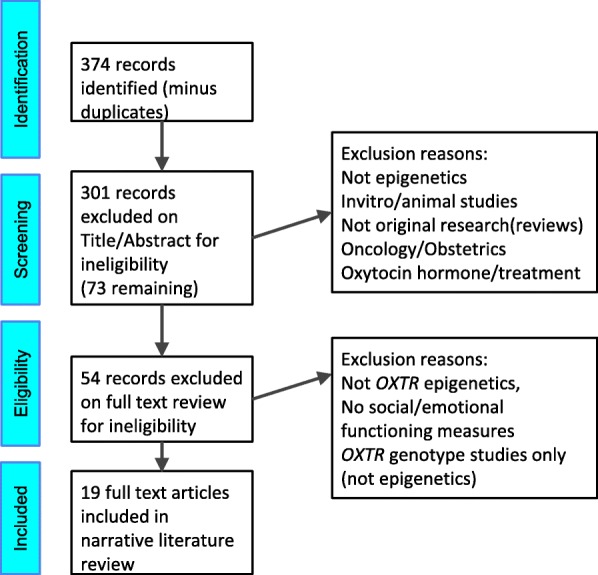
BACKGROUND: The neuropeptide Oxytocin (OXT) plays a central role in birthing, mother-infant bonding and a broad range of related social behaviours in mammals. More recently, interest has extended to epigenetic programming of genes involved in oxytocinergic neurotransmission. This review brings together early findings in a rapidly developing field of research, examining relationships between DNA methylation (DNAm) of the Oxytocin Receptor Gene (OXTR) and social and emotional behaviour in human populations. METHOD: A systematic search across Web of Knowledge/Science, Scopus, Medline and EMBASE captured all published studies prior to June 2017 examining the association between OXTR DNAm and human social and emotional outcomes. Search terms included 'oxytocin gene' or 'oxytocin receptor gene' and 'epigenetics' or 'DNA methylation'. Any article with a focus on social and emotional functioning was then identified from this set by manual review. RESULTS: Nineteen studies met eligibility criteria. There was considerable heterogeneity of study populations, tissue samples, instrumentation, measurement, and OXTR site foci. Only three studies examined functional consequences of OXTR DNAm on gene expression and protein synthesis. Increases in OXTR DNAm were associated with callous-unemotional traits in youth, social cognitive deficits in Autistic Spectrum Disorder (ASD), rigid thinking in anorexia nervosa, affect regulation problems, and problems with facial and emotional recognition. In contrast, reductions in DNAm were associated with perinatal stress, postnatal depression, social anxiety and autism in children. CONCLUSIONS: Consistent with an emerging field of inquiry, there is not yet sufficient evidence to draw conclusions about the role of OXTR DNAm in human social and emotional behaviour. However, taken together, findings point to increased OXTR DNAm in general impairments in social, cognitive and emotional functioning, and decreased OXTR DNAm in specific patterns of impairment related to mood and anxiety disorders (but not in all). Future progress in this field would be enhanced by adequately powered designs, greater phenotypic precision, and methodological improvements including longitudinal studies with multiple time-points to facilitate causal inference.
Overview
The claims and statistics of this paper haven’t been checked yet.
Run the check — free, no account needed. It reads the open-access text and checks the sources it cites.
Integrity signals
Registry
Cites
Statistics
Figures
Verification
Claims the paper makes
The claims and statistics of this paper haven’t been checked yet.
Run the check — free, no account needed. It reads the open-access text and checks the sources it cites.
Claims other papers make about this one
Each is checked against this paper’s own text: does it say what the citing paper says it does?
The cited source says what the claim attributes to it.
In the citing paper
“In the endocrine system, OXT is secreted by the posterior pituitary into the bloodstream to support reproductive processes like uterine contraction and lactation (Grewen et al., 2010; Maud et al., 2018).”
From Music's context-dependent influence on oxytocin, social bonding, and emotion regulation: a systematic review (2026) · cites this paper as Maud et al., 2018
Self-check
Percentages, sums and reported differences re-computed from the paper’s own numbers.
The self-check needs the paper’s full text.
Citations
Cites
Oxytocin increases trust in humans
Kosfeld, M., Heinrichs, M., Zak, P. J., Fischbacher, U., & Fehr, E. (2005) · Nature · doi:10.1038/nature03701 · Cited by 3,690 · cited 1×
“Further, intranasal OXT increased trust and willingness to accept social risks amongst healthy volunteers involved in an experimental game [11], as well as the reduction of the short-term stress response demonstrated by reduced cortisol release”
BackgroundThe oxytocin receptor system: structure, function, and regulation
Gimpl, G., & Fahrenholz, F. (2001) · Physiological Reviews · doi:10.1152/physrev.2001.81.2.629 · Cited by 3,089 · cited 1×
“The oxytocin receptor is a 389-amino acid G-protein coupled transmembrane receptor, enabling the activation of a number of different intracellular secondary messengers facilitating the oxytocin pathway [22].”
BackgroundBird, A. (2007) · Nature · doi:10.1038/nature05913 · Cited by 3,011
Boyd, A., Golding, J., Macleod, J., Lawlor, D. A., Fraser, A., Henderson, J., Molloy, L., Ness, A., Ring, S., & Davey Smith, G. (2013) · International Journal of Epidemiology · doi:10.1093/ije/dys064 · Cited by 2,996 · cited 1×
“longitudinal cohort studies for epigenetic analysis [63].”
Heinrichs, M., Baumgartner, T., Kirschbaum, C., & Ehlert, U. (2003) · Biological Psychiatry · doi:10.1016/s0006-3223(03)00465-7 · Cited by 2,091
Ainsworth, M. D. S., & Bell, S. M. (1970) · Child Development · doi:10.2307/1127388 · Cited by 1,764 · cited 1×
“using gold-standard protocols, for example, human attachment behaviour, within observational designs [65].”
MethodOxytocin and vasopressin in the human brain: social neuropeptides for translational medicine
Meyer-Lindenberg, A., Domes, G., Kirsch, P., & Heinrichs, M. (2011) · Nature Reviews Neuroscience · doi:10.1038/nrn3044 · Cited by 1,688 · cited 1×
“suprachiasmatic nucleus, bed nucleus of stria terminalis and brainstem - where they act as neuromodulators or neurotransmitters and thereby influence neurotransmission in these areas [19].”
BackgroundAn integrated model of emotion processes and cognition in social information processing
Lemerise, E. A., & Arsenio, W. F. (2000) · Child Development · doi:10.1111/1467-8624.00124 · Cited by 1,518 · cited 1×
“(2016) [44] 39 infants with mothers mean age 31.”
BackgroundIntranasal oxytocin improves emotion recognition for youth with autism spectrum disorders.
Guastella, A. J., Einfeld, S. L., Gray, K. M., Rinehart, N. J., Tonge, B. J., Lambert, T. J., & Hickie, I. B. (2010) · Biological Psychiatry · doi:10.1016/j.biopsych.2009.09.020 · Cited by 962 · cited 1×
“provements in adult social cognition [6] and youth emotional recognition [13].”
BackgroundNeumann, I. D., & Landgraf, R. (2012) · Trends in Neurosciences · doi:10.1016/j.tins.2012.08.004 · Cited by 954 · cited 1×
“proved emotional behaviours and mental health [15].”
Research works printed but not linked: 1
- Uvnas-Moberg K, Petersson M. Oxytocin, a mediator of anti-stress, well-being, social interaction, growth and healing. Z Psychosom Med Psychother. 2005;51(1):57–80.
Cited by
Sorted by citations
DNA methylation and regulation of gene expression: Guardian of our health
Dhar, G. A., Saha, S., Mitra, P., & Chaudhuri, R. N. (2021) · The Nucleus · doi:10.1007/s13237-021-00367-y · Cited by 260
Childhood maltreatment and DNA methylation: A systematic review
Cecil, C. A. M., Zhang, Y., & Nolte, T. (2020) · Neuroscience & Biobehavioral Reviews · doi:10.1016/j.neubiorev.2020.02.019 · Cited by 186
Advances in human oxytocin measurement: challenges and proposed solutions
Tabak, B. A., Leng, G., Szeto, A., Parker, K. J., Verbalis, J. G., Ziegler, T. E., Lee, M. R., Neumann, I. D., & Mendez, A. J. (2023) · Molecular Psychiatry · doi:10.1038/s41380-022-01719-z · Cited by 170
“Reviews of these approaches typically note that understanding interactions with endogenous oxytocin would be of significant value [68, 79, 86].”
BackgroundOxytocin and the Neurobiology of Prosocial Behavior
Marsh, N., Marsh, A. A., Lee, M. R., & Hurlemann, R. (2020) · The Neuroscientist · doi:10.1177/1073858420960111 · Cited by 159
The physiology and pharmacology of oxytocin in labor and in the peripartum period
Uvnäs-Moberg, K. (2024) · American Journal of Obstetrics and Gynecology · doi:10.1016/j.ajog.2023.04.011 · Cited by 118
Metadata
- Authors
- Maud, C., Ryan, J., McIntosh, J. E., & Olsson, C. A.
- Affiliations
- Deakin University (AU)
- Royal Children's Hospital (AU)
- Corresponding author
- Maud, Catherine
- Venue
- BMC Psychiatry
- Published
- 2018-05-29
- Volume
- 18
- Issue
- 1
- Pages
- 154-154
- ISSN
- 1471-244X (ISSN-L)
- PMC
- PMC5975530
- OpenAlex
- W2805059767
- Cited by
- 151
- References
- 68
- Citations by year
- 2026: 19 · 2025: 17 · 2024: 15 · 2023: 20 · 2022: 19 · 2021: 24 · 2020: 22 · 2019: 9 · 2018: 5
- FWCI
- 2.27
- Type
- journal article
- Language
- en
- Open access
- gold
- doi.org
- Licence
- Locations
- BMC Psychiatry (publishedVersion, cc-by)
- PubMed Central (publishedVersion, cc-by)
- PubMed (publishedVersion)
- Monash University Research Portal (Monash University) (submittedVersion, other-oa)
- Minerva Access (University of Melbourne) (submittedVersion, cc-by)
- DOAJ (DOAJ: Directory of Open Access Journals) (submittedVersion, cc-by-sa)
- Figshare (submittedVersion, cc-by)
- Topics
- Life Sciences › Neuroscience › Endocrine and Autonomic Systems › Neuroendocrine regulation and behavior
- Life Sciences › Biochemistry, Genetics and Molecular Biology › Molecular Biology › Epigenetics and DNA Methylation
- Life Sciences › Neuroscience › Cellular and Molecular Neuroscience › Neurotransmitter Receptor Influence on Behavior
- Keywords
- oxytocin receptor gene, oxytocin receptor, DNA methylation, epigenetics, oxytocin, social behavior, emotional functioning, callous-unemotional traits, autism spectrum disorder, anorexia nervosa, emotion regulation, perinatal stress, postpartum depression, social anxiety, mood disorders
- MeSH terms
- Cognition, Emotions, Humans, Synaptic Transmission, Oxytocin, Social Behavior, Receptors, Oxytocin, DNA Methylation, Gene Expression Profiling, Epigenomics
About these checks
Registry, retraction, Cites and statistics results are computed, not judged, with one exception: a printed reference that no index lists is read once by a model before it counts as a citation error. Claims are extracted by a model and kept only when their quote appears verbatim in the text; each cited source is then checked, with a model’s help, for whether it says what the claim relies on. Those verdicts can be wrong — read the claim’s quote and the cited source before relying on one.
Statistics and arithmetic are recomputed, not judged.
Confidence bands are shown only for fields calibrated on our annotated test set. None is calibrated yet, so no band is shown.
What counts as a claim ›How we measure confidence ›How we check this ›
Are you an author, or do you see a problem with this page? Request a review
