

The DOI matches its Crossref record; 69 of the 69 references it cites were found in a registry or an index.
The role of oxytocin receptor gene (OXTR) DNA methylation (DNAm) in human social and emotional functioning: a systematic narrative review
Open accessAbstract
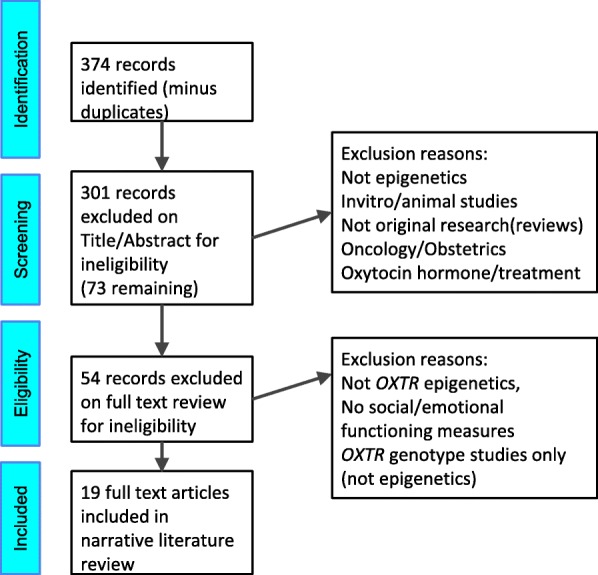
BACKGROUND: The neuropeptide Oxytocin (OXT) plays a central role in birthing, mother-infant bonding and a broad range of related social behaviours in mammals. More recently, interest has extended to epigenetic programming of genes involved in oxytocinergic neurotransmission. This review brings together early findings in a rapidly developing field of research, examining relationships between DNA methylation (DNAm) of the Oxytocin Receptor Gene (OXTR) and social and emotional behaviour in human populations. METHOD: A systematic search across Web of Knowledge/Science, Scopus, Medline and EMBASE captured all published studies prior to June 2017 examining the association between OXTR DNAm and human social and emotional outcomes. Search terms included 'oxytocin gene' or 'oxytocin receptor gene' and 'epigenetics' or 'DNA methylation'. Any article with a focus on social and emotional functioning was then identified from this set by manual review. RESULTS: Nineteen studies met eligibility criteria. There was considerable heterogeneity of study populations, tissue samples, instrumentation, measurement, and OXTR site foci. Only three studies examined functional consequences of OXTR DNAm on gene expression and protein synthesis. Increases in OXTR DNAm were associated with callous-unemotional traits in youth, social cognitive deficits in Autistic Spectrum Disorder (ASD), rigid thinking in anorexia nervosa, affect regulation problems, and problems with facial and emotional recognition. In contrast, reductions in DNAm were associated with perinatal stress, postnatal depression, social anxiety and autism in children. CONCLUSIONS: Consistent with an emerging field of inquiry, there is not yet sufficient evidence to draw conclusions about the role of OXTR DNAm in human social and emotional behaviour. However, taken together, findings point to increased OXTR DNAm in general impairments in social, cognitive and emotional functioning, and decreased OXTR DNAm in specific patterns of impairment related to mood and anxiety disorders (but not in all). Future progress in this field would be enhanced by adequately powered designs, greater phenotypic precision, and methodological improvements including longitudinal studies with multiple time-points to facilitate causal inference.
Overview
The claims and statistics of this paper haven’t been checked yet.
Run the check — free, no account needed. It reads the open-access text and checks the sources it cites.
Integrity signals
Registry
Cites
Statistics
Figures
Verification
Claims the paper makes
The claims and statistics of this paper haven’t been checked yet.
Run the check — free, no account needed. It reads the open-access text and checks the sources it cites.
Claims other papers make about this one
Each is checked against this paper’s own text: does it say what the citing paper says it does?
The cited source says what the claim attributes to it.
In the citing paper
“In the endocrine system, OXT is secreted by the posterior pituitary into the bloodstream to support reproductive processes like uterine contraction and lactation (Grewen et al., 2010; Maud et al., 2018).”
From Music's context-dependent influence on oxytocin, social bonding, and emotion regulation: a systematic review (2026) · cites this paper as Maud et al., 2018
Self-check
Percentages, sums and reported differences re-computed from the paper’s own numbers.
The self-check needs the paper’s full text.
Citations
Cites
Oxytocin increases trust in humans
Kosfeld, M., Heinrichs, M., Zak, P. J., Fischbacher, U., & Fehr, E. (2005) · Nature · doi:10.1038/nature03701 · Cited by 3,690 · cited 1×
“Further, intranasal OXT increased trust and willingness to accept social risks amongst healthy volunteers involved in an experimental game [11], as well as the reduction of the short-term stress response demonstrated by reduced cortisol release”
BackgroundThe oxytocin receptor system: structure, function, and regulation
Gimpl, G., & Fahrenholz, F. (2001) · Physiological Reviews · doi:10.1152/physrev.2001.81.2.629 · Cited by 3,089 · cited 1×
“The oxytocin receptor is a 389-amino acid G-protein coupled transmembrane receptor, enabling the activation of a number of different intracellular secondary messengers facilitating the oxytocin pathway [22].”
BackgroundBird, A. (2007) · Nature · doi:10.1038/nature05913 · Cited by 3,011
Boyd, A., Golding, J., Macleod, J., Lawlor, D. A., Fraser, A., Henderson, J., Molloy, L., Ness, A., Ring, S., & Davey Smith, G. (2013) · International Journal of Epidemiology · doi:10.1093/ije/dys064 · Cited by 2,996 · cited 1×
“longitudinal cohort studies for epigenetic analysis [63].”
Heinrichs, M., Baumgartner, T., Kirschbaum, C., & Ehlert, U. (2003) · Biological Psychiatry · doi:10.1016/s0006-3223(03)00465-7 · Cited by 2,091
Ainsworth, M. D. S., & Bell, S. M. (1970) · Child Development · doi:10.2307/1127388 · Cited by 1,764 · cited 1×
“using gold-standard protocols, for example, human attachment behaviour, within observational designs [65].”
MethodOxytocin and vasopressin in the human brain: social neuropeptides for translational medicine
Meyer-Lindenberg, A., Domes, G., Kirsch, P., & Heinrichs, M. (2011) · Nature Reviews Neuroscience · doi:10.1038/nrn3044 · Cited by 1,688 · cited 1×
“suprachiasmatic nucleus, bed nucleus of stria terminalis and brainstem - where they act as neuromodulators or neurotransmitters and thereby influence neurotransmission in these areas [19].”
BackgroundAn integrated model of emotion processes and cognition in social information processing
Lemerise, E. A., & Arsenio, W. F. (2000) · Child Development · doi:10.1111/1467-8624.00124 · Cited by 1,518 · cited 1×
“(2016) [44] 39 infants with mothers mean age 31.”
BackgroundIntranasal oxytocin improves emotion recognition for youth with autism spectrum disorders.
Guastella, A. J., Einfeld, S. L., Gray, K. M., Rinehart, N. J., Tonge, B. J., Lambert, T. J., & Hickie, I. B. (2010) · Biological Psychiatry · doi:10.1016/j.biopsych.2009.09.020 · Cited by 962 · cited 1×
“provements in adult social cognition [6] and youth emotional recognition [13].”
BackgroundNeumann, I. D., & Landgraf, R. (2012) · Trends in Neurosciences · doi:10.1016/j.tins.2012.08.004 · Cited by 954 · cited 1×
“proved emotional behaviours and mental health [15].”
Research works printed but not linked: 1
- Uvnas-Moberg K, Petersson M. Oxytocin, a mediator of anti-stress, well-being, social interaction, growth and healing. Z Psychosom Med Psychother. 2005;51(1):57–80.
Cited by
Sorted by citations
DNA methylation and regulation of gene expression: Guardian of our health
Dhar, G. A., Saha, S., Mitra, P., & Chaudhuri, R. N. (2021) · The Nucleus · doi:10.1007/s13237-021-00367-y · Cited by 260
Childhood maltreatment and DNA methylation: A systematic review
Cecil, C. A. M., Zhang, Y., & Nolte, T. (2020) · Neuroscience & Biobehavioral Reviews · doi:10.1016/j.neubiorev.2020.02.019 · Cited by 186
Advances in human oxytocin measurement: challenges and proposed solutions
Tabak, B. A., Leng, G., Szeto, A., Parker, K. J., Verbalis, J. G., Ziegler, T. E., Lee, M. R., Neumann, I. D., & Mendez, A. J. (2023) · Molecular Psychiatry · doi:10.1038/s41380-022-01719-z · Cited by 170
“Reviews of these approaches typically note that understanding interactions with endogenous oxytocin would be of significant value [68, 79, 86].”
BackgroundOxytocin and the Neurobiology of Prosocial Behavior
Marsh, N., Marsh, A. A., Lee, M. R., & Hurlemann, R. (2020) · The Neuroscientist · doi:10.1177/1073858420960111 · Cited by 159
The physiology and pharmacology of oxytocin in labor and in the peripartum period
Uvnäs-Moberg, K. (2024) · American Journal of Obstetrics and Gynecology · doi:10.1016/j.ajog.2023.04.011 · Cited by 118
Ellis, B. J., Horn, A. J., Carter, C. S., van IJzendoorn, M. H., & Bakermans‐Kranenburg, M. J. (2021) · Clinical Psychology Review · doi:10.1016/j.cpr.2021.101985 · Cited by 103
Glucocorticoid Signaling and Epigenetic Alterations in Stress-Related Disorders
Mourtzi, N., Sertedaki, A., & Charmandari, E. (2021) · International Journal of Molecular Sciences · doi:10.3390/ijms22115964 · Cited by 95
“The OXTR protein plays an important role in the regulation of social cognition (feelings of attachment and social recognition), as well as in the regulation of anxiety-related and social behaviors [79].”
BackgroundLuo, F., Liu, L., Guo, M., Liang, J., Chen, L., Shi, X., Liu, H., Cheng, Y., & Du, Y. (2024) · Research · doi:10.34133/research.0537 · Cited by 63
Maternal caregiving and DNA methylation in human infants and children: systematic review
Provenzi, L., Brambilla, M., Scotto di Minico, G., Montirosso, R., & Borgatti, R. (2020) · Genes, Brain and Behavior · doi:10.1111/gbb.12616 · Cited by 60
Roles of the Oxytocin Receptor (OXTR) in Human Diseases
Pierzynowska, K., Gaffke, L., Żabińska, M., Cyske, Z., Rintz, E., Wiśniewska, K., Podlacha, M., & Węgrzyn, G. (2023) · International Journal of Molecular Sciences · doi:10.3390/ijms24043887 · Cited by 64
“One of the processes modulating the efficiency of the expression of OXTR is epigenetic modification, especially DNA methylation, which can probably affect the course of autism [55].”
BackgroundOxytocin as Treatment for Social Cognition, Not There Yet
Erdozain, A. M., & Peñagarikano, O. (2020) · Frontiers in Psychiatry · doi:10.3389/fpsyt.2019.00930 · Cited by 62
Kraaijenvanger, E. J., He, Y., Spencer, H., Smith, A. K., Bos, P. A., & Boks, M. P. (2018) · Neuroscience & Biobehavioral Reviews · doi:10.1016/j.neubiorev.2018.11.016 · Cited by 63
Kohlhoff, J. R., Cibralic, S., Hawes, D. J., & Eapen, V. (2022) · Neuroscience & Biobehavioral Reviews · doi:10.1016/j.neubiorev.2022.104573 · Cited by 53
On social health: history, conceptualization, and population patterning
Doyle, D. M., & Link, B. G. (2024) · Health Psychology Review · doi:10.1080/17437199.2024.2314506 · Cited by 65
“Functioning of the oxytocinergic system is patterned in part by genetic variations (e.g., in the oxytocin-receptor gene), which are further subject to epigenetic regulation by social experiences (Kumsta et al., 2013), all of which in fl uences social functioning (Maud et al., 2018).”
DNA methylation differences associated with social anxiety disorder and early life adversity
Wiegand, A., Kreifelts, B., Munk, M. H. J., Geiselhart, N., Ramadori, K. E., MacIsaac, J. L., Fallgatter, A. J., Kobor, M. S., & Nieratschker, V. (2021) · Translational Psychiatry · doi:10.1038/s41398-021-01225-w · Cited by 49
Risk Factors for Postpartum Depression Based on Genetic and Epigenetic Interactions
Luo, F., Zhu, Z., Du, Y., Chen, L., & Cheng, Y. (2023) · Molecular Neurobiology · doi:10.1007/s12035-023-03313-y · Cited by 56
“In a systematic narrative review that discussed the role of DNA methylation of the OXTR gene in social and emotional functioning in humans, OXTR methylation levels were linked to postpartum depression [69].”
BackgroundFujiwara, T., Weisman, O., Ochi, M., Shirai, K., Matsumoto, K., Noguchi, E., & Feldman, R. (2018) · Psychoneuroendocrinology · doi:10.1016/j.psyneuen.2018.12.004 · Cited by 46
“These findings accord with research in animal models which indicates that parenting is both genetically and epigenetically is modulated by the OT system (Maud et al., 2018; Shahrokh et al., 2010).”
Early life stress and brain plasticity: from molecular alterations to aberrant memory and behavior
Lopatina, O. L., Panina, Y. A., Malinovskaya, N. A., & Salmina, A. B. (2020) · Reviews in the Neurosciences · doi:10.1515/revneuro-2020-0077 · Cited by 46
The Role of Stress in Obsessive-Compulsive Disorder: A Narrative Review
Raposo-Lima, C., & Morgado, P. (2020) · Harvard Review of Psychiatry · doi:10.1097/hrp.0000000000000274 · Cited by 37
Oxytocin receptor gene methylation in male and female PTSD patients and trauma-exposed controls
Nawijn, L., Krzyzewska, I. M., van Zuiden, M., Henneman, P., Koch, S. B. J., Mul, A. N. P. M., Frijling, J. L., Veltman, D. J., Mannens, M. M. A. M., & Olff, M. (2018) · European Neuropsychopharmacology · doi:10.1016/j.euroneuro.2018.10.006 · Cited by 41
Park, C. I., Kim, H. W., Jeon, S., Kang, J. I., & Kim, S. J. (2020) · Clinical Epigenetics · doi:10.1186/s13148-020-00890-w · Cited by 38
“A systematic narrative review of OXTR DNA methylation in human socioemotional functioning suggested that while OXTR hypermethylation may play a role in the general impairment of socio-emotional functioning, OXTR hypomethylation may play a role in specific patterns of impairment related to psychiatric disorders, such a…”
BackgroundDNA Methylation of the Oxytocin Receptor Across Neurodevelopmental Disorders
Siu, M. T., Goodman, S. J., Yellan, I., Butcher, D. T., Jangjoo, M., Grafodatskaya, D., Rajendram, R., Lou, Y., Zhang, R., Zhao, C., et al. (2021) · Journal of Autism and Developmental Disorders · doi:10.1007/s10803-020-04792-x · Cited by 38
Methylation of the OXTR gene in women with anorexia nervosa: Relationship to social behavior
Thaler, L., Brassard, S. L., Booij, L., Kahan, E., McGregor, K., Labbe, A., Israël, M., & Steiger, H. (2019) · European Eating Disorders Review · doi:10.1002/erv.2703 · Cited by 39
Moerkerke, M., Bonte, M.-L., Daniëls, N., Chubar, V., Alaerts, K., Steyaert, J. G., & Boets, B. (2021) · Research in Autism · doi:10.1016/j.rasd.2021.101785 · Cited by 36
Towers, A. J., Tremblay, M. W., Chung, L., Li, X.-L., Bey, A. L., Zhang, W., Cao, X., Wang, X., Wang, P., Duffney, L. J., et al. (2018) · JCI Insight · doi:10.1172/jci.insight.120592 · Cited by 31
Bellia, F., Vismara, M. E. M., Annunzi, E., Cifani, C., Benatti, B., Dell’Osso, B. M., & D’Addario, C. (2020) · Journal of Psychiatric Research · doi:10.1016/j.jpsychires.2020.10.040 · Cited by 33
Dysregulation of the oxytocin receptor gene in Williams syndrome
Kimura, R., Tomiwa, K., Inoüe, R., Suzuki, S., Nakata, M., Awaya, T., Kato, T., Okazaki, S., Heike, T., & Hagiwara, M. (2020) · Psychoneuroendocrinology · doi:10.1016/j.psyneuen.2020.104631 · Cited by 33
“A recent review suggested that increased levels of OXTR methylation was associated with general impairments in social, cognitive, and emotional functioning (Maud et al., 2018).”
Early Life Stress Induced DNA Methylation of Monoamine Oxidases Leads to Depressive-Like Behavior
Xu, Q., Jiang, M. C., Gu, S., Wang, F., & Yuan, B. (2020) · Frontiers in Cell and Developmental Biology · doi:10.3389/fcell.2020.582247 · Cited by 33
“Even identical twins show substantial individual differences, which might be produced epigenetically by the two-way interaction between the brain and hormones, the immune system mediator and the autonomic nervous system (McEwen and Bulloch, 2019).”
BackgroundFan, X., Yang, J., Dong, Y., Hou, Y., Liu, S., & Wu, C. (2018) · Addiction Biology · doi:10.1111/adb.12697 · Cited by 33
“ing lines of evidence suggest that epigenetic alterations in the oxytocinergic system occur across different psychotic disorders.(48,49) Our results showed that OT significantly increased DNMT1,”
ResultWilson, N., Robb, E., Gajwani, R., & Minnis, H. (2020) · Journal of Psychiatric Research · doi:10.1016/j.jpsychires.2020.12.025 · Cited by 38
Childhood Trauma and Epigenetics: State of the Science and Future
Gladish, N., Merrill, S. M., & Kobor, M. S. (2022) · Current Environmental Health Reports · doi:10.1007/s40572-022-00381-5 · Cited by 34
Therapeutic uses of oxytocin in stress-related neuropsychiatric disorders
Zhang, S., Zhang, Y., Shi, D., & Wang, Z. (2023) · Cell & Bioscience · doi:10.1186/s13578-023-01173-6 · Cited by 29
“Catherine et al. found that the reduction of OXTR gene DNA methylation is related to perinatal stress and post-natal depression, while the increase of DNA methylation is related to social cognition and emotional recognition disorders [132].”
BackgroundKogan, S. M., Bae, D., Cho, J., Smith, A. K., & Nishitani, S. (2019) · Psychological Science · doi:10.1177/0956797619854735 · Cited by 27
“Related research suggests that oxytocin expression influences cooperation as well as emotional recognition and processing (Maud et al., 2018).”
BackgroundDinçkol, Ö., Fuentes, B., Tartaglione, A. M., Pino, A., Calamandrei, G., & Ricceri, L. (2022) · NeuroToxicology · doi:10.1016/j.neuro.2022.05.007 · Cited by 26
The Role of Oxytocin in Alzheimer’s Disease and Its Relationship with Social Interaction
Takahashi, J., Yamada, D., Nagano, W., & Saitoh, A. (2023) · Cells · doi:10.3390/cells12202426 · Cited by 25
Voinsky, I., Bennuri, S. C., Svigals, J., Frye, R. E., Rose, S., & Gurwitz, D. (2019) · Scientific Reports · doi:10.1038/s41598-019-49617-9 · Cited by 25
Attachment-related dimensions in the epigenetic era: A systematic review of the human research
Craig, F., Tenuta, F., Rizzato, V., Costabile, A., Trabacca, A., & Montirosso, R. (2021) · Neuroscience & Biobehavioral Reviews · doi:10.1016/j.neubiorev.2021.03.006 · Cited by 23
Social Environment and Epigenetics
Merrill, S. M., Gladish, N., & Kobor, M. S. (2019) · Current topics in behavioral neurosciences · doi:10.1007/7854_2019_114 · Cited by 24
The role of oxytocin signaling in depression and suicidality in returning war veterans
Warrener, C., Valentin, E. M., Gallin, C., Richey, L., Ross, D. B., Hood, C. J., Lori, A., Cubells, J. F., Rauch, S. A. M., & Rilling, J. K. (2020) · Psychoneuroendocrinology · doi:10.1016/j.psyneuen.2020.105085 · Cited by 19
“Evidence is accumulating that OXTR methylation can have functional consequences in humans (Kader et al., 2018; Maud et al., 2018).”
BackgroundGenetic and Epigenetic Alterations in Autism Spectrum Disorder
Oztenekecioglu, B., Mavis, M., Osum, M., & Kalkan, R. (2021) · Global Medical Genetics · doi:10.1055/s-0041-1735540 · Cited by 24
Liu, J., Liang, Y., Jiang, X., Xu, J., Sun, Y., Wang, Z., Lin, L., Niu, Y., Song, S., Zhang, H., et al. (2021) · Frontiers in Neuroscience · doi:10.3389/fnins.2021.634781 · Cited by 21
Borie, A. M., Theofanopoulou, C., & Andari, E. (2021) · Handbook of clinical neurology · doi:10.1016/b978-0-12-819973-2.00009-5 · Cited by 19
“An increase in DNA methylation of the OTR was more generally associated with impairments in social, cognitive, and emotional cognition (Maud et al., 2018).”
BackgroundNance, M. G., Sullivan, K. M., & Puglia, M. H. (2024) · Pediatric Research · doi:10.1038/s41390-024-03563-z · Cited by 18
“Recent reviews have summarized how epigenetic alterations to OXTR contribute to differences in social behavior and pathology in humans 10,11,25 and animals.”
Roles of Epigenetics and Glial Cells in Drug-Induced Autism Spectrum Disorder
Csoka, A. B., Kouhen, N. E., Bennani, S., Getachew, B., Aschner, M., & Tizabi, Y. (2024) · Biomolecules · doi:10.3390/biom14040437 · Cited by 16
“Oxytocin is a neuropeptide that is extremely important during birth, mother–child bonding, and emotional functioning, as well as the development of social behaviors [161,167].”
BackgroundKogan, S. M., Bae, D., Cho, J., Smith, A. K., & Nishitani, S. (2020) · Development and Psychopathology · doi:10.1017/s0954579420000632 · Cited by 22
“Considerably more research is needed in this area to specify the effects of OXTR DNAm; heterogeneity in the loci assayed and the types of samples used also must be addressed (Maud et al., 2018).”
BackgroundKhodagholi, F., Maleki, A., Motamedi, F., Mousavi, M. A., Rafiei, S., & Moslemi, M. (2020) · Cellular and Molecular Neurobiology · doi:10.1007/s10571-020-01003-0 · Cited by 17
Laviola, G., Busdraghi, L. M., Meschino, G. J., Petrella, C., & Fiore, M. (2021) · International Journal of Molecular Sciences · doi:10.3390/ijms22095039 · Cited by 19
“Indeed, some clinical studies reported oxytocin receptor epigenetic variations or modifications in the circulating levels of OXT in individuals affected by autism and conduct disorders [79].”
BackgroundCardinal role of the environment in stress induced changes across life stages and generations
Pang, T. Y., Yaeger, J. D. W., Summers, C. H., & Mitra, R. (2021) · Neuroscience & Biobehavioral Reviews · doi:10.1016/j.neubiorev.2021.01.012 · Cited by 17
Lesemann, F. H. P., Spencer, H., Montoya, E. R., Kraaijenvanger, E. J., He, Y., Branje, S., Boks, M. P., & Bos, P. A. (2020) · European Neuropsychopharmacology · doi:10.1016/j.euroneuro.2020.08.008 · Cited by 14
Wigley, I. L. C. M., Mascheroni, E., Fontana, C., Giorda, R., Morandi, F., Bonichini, S., McGlone, F., Fumagalli, M., & Montirosso, R. (2021) · Developmental Psychobiology · doi:10.1002/dev.22218 · Cited by 15
Becerra, C. Y., Wells, R. K., Kunihiro, B. P., Lee, R. H., Umeda, L., Allan, N. P., Rubas, N. C., McCracken, T., Nunokawa, C. K. L., Lee, M.-H., et al. (2023) · Frontiers in Genetics · doi:10.3389/fgene.2023.1125217 · Cited by 14
“While previous studies have described epigenetic regulation of genes commonly linked with depressive symptoms (Carlberg et al., 2014; Booij et al., 2015; Murgatroyd et al., 2015; Maud et al., 2018), little is known about the relationships between epigenetic regulation of immune cell function and inflammation in the co…”
BackgroundAwalt, S. L., Boghean, L., Klinkebiel, D. L., & Strasser, R. (2024) · Developmental Psychobiology · doi:10.1002/dev.22482 · Cited by 13
Xie, S., Hu, Y., Fang, L., Chen, S., Botchway, B. O. A., Tan, X., Fang, M., & Hu, Z. (2021) · Reviews in the Neurosciences · doi:10.1515/revneuro-2020-0128 · Cited by 14
Antonucci, L. A., Pergola, G., Passiatore, R., Taurisano, P., Quarto, T., Dispoto, E., Rampino, A., Bertolino, A., Cassibba, R., & Blasi, G. (2019) · European Archives of Psychiatry and Clinical Neuroscience · doi:10.1007/s00406-019-01062-5 · Cited by 12
Rodrigues, F. D. S., Jantsch, J., Fraga, G. D. F., Milczarski, V. L. D. C., Dias, V. S., Scheid, C., Merib, J. D. O., Giovernardi, M., & Guedes, R. P. (2024) · Brain Behavior and Immunity · doi:10.1016/j.bbi.2024.04.010 · Cited by 13
Psychopathic Genes: A Multi-level Adaptive Dynamic Modelling Approach
Augustinus, F., Hendrikse, S. C. F., & Jan Treur, A. (2025) · Lecture notes in networks and systems · doi:10.1007/978-3-031-94770-4_38 · Cited by 12
Niego, A., & Benítez‐Burraco, A. (2020) · Autism · doi:10.1177/1362361320965074 · Cited by 12
de Assis, S. G., Tavares, P. H., Oliveira, N. C. D. S., Serpeloni, F., & Avanci, J. Q. (2025) · International Journal of Developmental Neuroscience · doi:10.1002/jdn.70042 · Cited by 15
“…functioning/regulation (Di Sante et al. 2018; Chen et al. 2012, 2019; Folger et al. 2019; Kogan et al. 2018; Alisch et al. 2014; Booij et al. 2015; Maud et al. 2018), social cognition (Milaniak et al. 2017), maternal care (Roth and David Sweatt 2011; Roth 2013; Conradt et al. 2016; Noro and Gon…”
Perini, S., Filosi, M., The Italian Autism Network, Allibrio, G., Basadonne, I., Benvenuto, A., Buono, S., Bravaccio, C., Casonato, C., Ceppi, E., et al. (2023) · Translational Psychiatry · doi:10.1038/s41398-023-02407-4 · Cited by 14
Epigenetics and Pharmacoepigenetics of Neurodevelopmental and Neuropsychiatric Disorders
Cacabelos, R. (2019) · Elsevier eBooks · doi:10.1016/b978-0-12-813939-4.00022-x · Cited by 11
Oxytocin Receptor Gene Polymorphism in Lactating Dogs
Ogi, A., Naef, V., Santorelli, F. M., Mariti, C., & Gazzano, A. (2021) · Animals · doi:10.3390/ani11113099 · Cited by 11
“Specifically, increased OXTR DNA methylation seems to be associated with a reduced OXTR expression and, consequently, with social cognition impairments [17].”
BackgroundEffects of human-animal interaction on salivary and urinary oxytocin in children and dogs
Gnanadesikan, G. E., King, K. M., Carranza, E., Flyer, A. C., Ossello, G., Smith, P. G., Steklis, N. G., Steklis, H. D., Carter, C. S., Connelly, J. J., et al. (2024) · Psychoneuroendocrinology · doi:10.1016/j.psyneuen.2024.107147 · Cited by 15
Nazzari, S., Grumi, S., Villa, M., Mambretti, F., Biasucci, G., Decembrino, L., Giacchero, R., Magnani, M. L., Nacinovich, R., Prefumo, F., et al. (2022) · Psychoneuroendocrinology · doi:10.1016/j.psyneuen.2022.105920 · Cited by 12
Senese, V. P., Shinohara, K., Venuti, P., Bornstein, M. H., Rosanio, V., Nasti, C., Neoh, M. J. Y., Maresca, M., & Esposito, G. (2022) · International Journal of Environmental Research and Public Health · doi:10.3390/ijerph19095566 · Cited by 9
“However, the effect of epigenetics of OXTR on social and emotional behaviour in human populations is still a relatively new field of inquiry pending firmly conclusive evidence [88].”
BackgroundDuclot, F., & Kabbaj, M. (2021) · Current topics in behavioral neurosciences · doi:10.1007/7854_2021_252 · Cited by 9
Lee, Y.-J., Lin, H., Chaudhary, M. A., Lee, Y., & Wang, D. (2021) · International Journal of Molecular Sciences · doi:10.3390/ijms22189847 · Cited by 8
“The methylation of the OXTR gene has attracted considerable attention in the research of inter-individual differences in maternal behavior and social cognition [17,20].”
BackgroundAnzani, S., Cannito, L., Bellia, F., Domenico, A. D., Dell’Osso, B. M., Palumbo, R., & D’Addario, C. (2022) · Brain Sciences · doi:10.3390/brainsci12010098 · Cited by 8
“For example, it was recently shown how a higher OXTR methylation level is linked to enhanced infants’ brain responses (as measured via fNIRS) to angry and fearful faces [55], while other evidence suggests that higher OXTR methylation is associated with problems with facial and emotional recognition [56].”
BackgroundHopkins, W. D., Staes, N., Guevara, E. E., Mulholland, M. M., Sherwood, C. C., & Bradley, B. J. (2023) · Autism Research · doi:10.1002/aur.2895 · Cited by 8
“There have been fewer studies of the role of OXTR DNA methylation and ASD or social cognition and behavior, and results have been contradictory; studies have reported both hypermethylation and hypomethylation (Maud et al., 2018; Moerkerke et al., 2021).”
ResultChu, T.-H., & Tsai, C.-G. (2026) · Frontiers in cognition · doi:10.3389/fcogn.2025.1678665 · Cited by 8
“In the endocrine system, OXT is secreted by the posterior pituitary into the bloodstream to support reproductive processes like uterine contraction and lactation (Grewen et al., 2010; Maud et al., 2018).”
Marzoratti, A., Liu, M. E., Krol, K. M., Sjobeck, G. R., Lipscomb, D., Hofkens, T. L., Boker, S. M., Pelphrey, K. A., Connelly, J. J., & Evans, T. M. (2023) · Developmental Cognitive Neuroscience · doi:10.1016/j.dcn.2023.101302 · Cited by 8
“Both oxytocinergic activity (Cecil et al., 2020; Gordon et al., 2011; Maud et al., 2018) and INS (Feldman et al.”
BackgroundWeinstein, S. R., Erickson, E. N., Molina, R., & Bell, A. F. (2023) · Comprehensive Psychoneuroendocrinology · doi:10.1016/j.cpnec.2023.100209 · Cited by 6
“The majority of research on genetic and epigenetic variations of OXT and OXTR has focused on psychological outcomes, linking OXTR methylation with conditions such as autism, obsessive-compulsive disorder, and impaired attachment [28,30].”
BackgroundTorres, G., Mourad, M., & Leheste, J. R. (2020) · Heliyon · doi:10.1016/j.heliyon.2020.e04047 · Cited by 7
“Oxytocin exposure at birth appears to be associated with epigenetic phenomena as methylation of the oxytocin GPCR in the fetal nervous system can result in long-term changes in behavior, including behaviors that have traditionally been linked to endogenous oxytocin signaling (e.g., social affiliative behavior; Maud et…”
BackgroundLudwig, B., Carlberg, L., Kienesberger, K., Swoboda, P., Swoboda, M. M. M., Bernegger, A., Koller, R., Inaner, M., Fuxjäger, M., Zotter, M., et al. (2022) · BMC Psychiatry · doi:10.1186/s12888-022-04031-w · Cited by 7
Huisman, L., Ong, C., van de Werken, M., & Jan Treur, A. (2024) · IFIP advances in information and communication technology · doi:10.1007/978-3-031-63211-2_18 · Cited by 7
The epigenetic regulation of synaptic genes contributes to the etiology of autism
Srančíková, A., Bačová, Z., & Bakoš, J. (2021) · Reviews in the Neurosciences · doi:10.1515/revneuro-2021-0014 · Cited by 7
Methylation of OXT and OXTR genes, central oxytocin, and social behavior in female macaques
Leon, D. D., Nishitani, S., Walum, H., McCormack, K. M., Wilson, M. E., Smith, A. K., Young, L. J., & Sánchez, M. M. (2020) · Hormones and Behavior · doi:10.1016/j.yhbeh.2020.104856 · Cited by 7
“Indeed, epigenetic reports of OXTR are still in their infancy and methods and findings are variable (Maud et al., 2018).”
BackgroundGilani, M., Abak, N., & Saberian, M. (2024) · Pharmacology Biochemistry and Behavior · doi:10.1016/j.pbb.2024.173897 · Cited by 6
Fiaz, T., Nadeem, M. S., Afzal, O., Altamimi, A. S. A., Alzarea, S. I., Almalki, W. H., Khan, H. A., Ul‐Haq, I., Hanook, S., Kazmi, I. A., et al. (2022) · International Journal of Molecular Sciences · doi:10.3390/ijms232214097 · Cited by 6
“The role of OXTR is also established in regulating the stress response [31].”
BackgroundSünnetçi, E., Durankuş, F., Albayrak, Y., Erdoğan, M. A., Atasoy, Ö., & Erbaş, O. (2021) · Clinical Psychopharmacology and Neuroscience · doi:10.9758/cpn.2021.19.1.84 · Cited by 6
“nasal oxytocin administration was demonstrated to improve social functioning and empathy in healthy individuals [47,49].”
BackgroundRung, J. M., Kidder, Q. A., Horta, M., Pournajafi‐Nazarloo, H., Carter, C. S., Berry, M. S., & Ebner, N. C. (2022) · Brain and Behavior · doi:10.1002/brb3.2425 · Cited by 6
The potentialities of oxytocin receptor inhibitors for endometriosis therapy
Yarmolinskaya, M. I., Khobets, V. V., Tral, T. G., & Tkachenko, N. N. (2020) · Gynecological Endocrinology · doi:10.1080/09513590.2020.1816722 · Cited by 6
On social health: Conceptualization, Correlates and PatterningPreprint
Doyle, D. M., & Link, B. G. (2022) · PsyArXiv (OSF Preprints) · doi:10.31234/osf.io/m2ypw · Cited by 6
Fonseca, P. A. D. S., Suárez‐Vega, A., Esteban‐Blanco, C., Marina, H., Pelayo, R., Gutiérrez‐Gil, B., & Arranz, J.-J. (2025) · BMC Genomics · doi:10.1186/s12864-025-11520-1 · Cited by 6
“In humans, the methylation of the OXTR is associated with a series of callous-unemo-tional traits in youth, such as rigid thinking in anorexia nervosa [82].”
Cheong, Y., Bae, J., Lee, S., Ro, J., Okazawa, H., Kosaka, H., & Jung, M. (2025) · Translational Psychiatry · doi:10.1038/s41398-025-03566-2 · Cited by 5
“By integrating neuroscience and epigenetics, remarkable break-throughs have been made in identifying reliable biomarkers [1, 2].”
Sun, Y., Qian, W., Zhang, L., Niu, H., Li, L., Li, L., Zhu, Y., Xiao, J., Liu, J., Han, X., et al. (2025) · Communications Biology · doi:10.1038/s42003-025-09208-z · Cited by 5
The role of protective caregiving in epigenetic regulation in human infants
Montirosso, R., Provenzi, L., & Mascheroni, E. (2020) · Elsevier eBooks · doi:10.1016/b978-0-12-819262-7.00008-8 · Cited by 5
Heseding, H. M., Jahn, K., Eberlein, C. K., Wieting, J., Maier, H. B., Proskynitopoulos, P. J., Glahn, A., Bleich, S., Frieling, H., & Deest, M. (2022) · Translational Psychiatry · doi:10.1038/s41398-022-02014-9 · Cited by 5
“Likewise, epigenetic modification of the OXTR gene has been studied in regard to a wide range of human socioemotional functioning and psychiatric illnesses [22].”
BackgroundGuoynes, C. D., & Marler, C. A. (2022) · General and Comparative Endocrinology · doi:10.1016/j.ygcen.2023.114230 · Cited by 5
Epigenetics of Stress in Farmed Fish
Guinand, B., & Σαμαράς, Α. (2023) · Wiley eBooks · doi:10.1002/9781119821946.ch12 · Cited by 5
Functional characterization of OXTR -associated enhancers
Cintrón, D. L., Sheng, R. R., & Ahituv, N. (2025) · Human Molecular Genetics · doi:10.1093/hmg/ddaf022 · Cited by 4
Exploring the role of OXTR gene methylation in attachment development: A longitudinal study
Cuyvers, B., Ein‐Dor, T., Houbrechts, M., Freson, K., Goossens, L., Noortgate, W. V. D., Leeuwen, K. G. V., Bijttebier, P., Claes, S. J., Turner, J. D., et al. (2024) · Developmental Psychobiology · doi:10.1002/dev.22496 · Cited by 4
Brown, C. K., Coster, L. D., Lee, J., Lin, L. D., Mathalon, D. H., & Woolley, J. D. (2024) · Psychoneuroendocrinology · doi:10.1016/j.psyneuen.2024.107228 · Cited by 4
Baptista, T. S. A., de Azeredo, L. A., Zaparte, A., Viola, T. W., Castro, S. C. C., Nagai, M. A., Mangone, F. R., Pavanelli, A. C., Schuch, J. B., Mardini, V., et al. (2021) · Frontiers in Cell and Developmental Biology · doi:10.3389/fcell.2021.639287 · Cited by 6
Braithwaite, E., Cole, J., Murgatroyd, C., Wright, N., O’Farrelly, C., Barker, B., & Ramchandani, P. G. (2023) · Frontiers in Child and Adolescent Psychiatry · doi:10.3389/frcha.2023.1175299 · Cited by 4
Leong, I. L., Wang, X., & Wu, H. (2026) · Neuroscience & Biobehavioral Reviews · doi:10.1016/j.neubiorev.2026.106566 · Cited by 5
Wu, W. (2023) · IntechOpen eBooks · doi:10.5772/intechopen.107645 · Cited by 3
Niego, A., & Benítez‐Burraco, A. (2020) · bioRxiv (Cold Spring Harbor Laboratory) · doi:10.1101/2020.03.15.992479 · Cited by 2
Understanding face processing in autism spectrum disorder: insights from cognitive neuroscience
Zhang, L., Guan, X., Wang, D., Wang, J., Liu, X., Liu, S., & Ming, D. (2025) · Cognitive Neurodynamics · doi:10.1007/s11571-025-10321-2 · Cited by 2
“These changes in oxytocin signaling can influence neural circuits involved in social behavior and emotional regulation, thereby contributing to the social difficulties commonly observed in individuals with ASD (Maud et al. 2018).”
Niego, A., & Benítez‐Burraco, A. (2022) · Biolinguistics · doi:10.5964/bioling.9319 · Cited by 3
Soussignan, R. (2023) · Enfance · doi:10.3917/enf2.233.0265 · Cited by 2
Metadata
- Authors
- Maud, C., Ryan, J., McIntosh, J. E., & Olsson, C. A.
- Affiliations
- Deakin University (AU)
- Royal Children's Hospital (AU)
- Corresponding author
- Maud, Catherine
- Venue
- BMC Psychiatry
- Published
- 2018-05-29
- Volume
- 18
- Issue
- 1
- Pages
- 154-154
- ISSN
- 1471-244X (ISSN-L)
- PMC
- PMC5975530
- OpenAlex
- W2805059767
- Cited by
- 151
- References
- 68
- Citations by year
- 2026: 19 · 2025: 17 · 2024: 15 · 2023: 20 · 2022: 19 · 2021: 24 · 2020: 22 · 2019: 9 · 2018: 5
- FWCI
- 2.27
- Type
- journal article
- Language
- en
- Open access
- gold
- doi.org
- Licence
- Locations
- BMC Psychiatry (publishedVersion, cc-by)
- PubMed Central (publishedVersion, cc-by)
- PubMed (publishedVersion)
- Monash University Research Portal (Monash University) (submittedVersion, other-oa)
- Minerva Access (University of Melbourne) (submittedVersion, cc-by)
- DOAJ (DOAJ: Directory of Open Access Journals) (submittedVersion, cc-by-sa)
- Figshare (submittedVersion, cc-by)
- Topics
- Life Sciences › Neuroscience › Endocrine and Autonomic Systems › Neuroendocrine regulation and behavior
- Life Sciences › Biochemistry, Genetics and Molecular Biology › Molecular Biology › Epigenetics and DNA Methylation
- Life Sciences › Neuroscience › Cellular and Molecular Neuroscience › Neurotransmitter Receptor Influence on Behavior
- Keywords
- oxytocin receptor gene, oxytocin receptor, DNA methylation, epigenetics, oxytocin, social behavior, emotional functioning, callous-unemotional traits, autism spectrum disorder, anorexia nervosa, emotion regulation, perinatal stress, postpartum depression, social anxiety, mood disorders
- MeSH terms
- Cognition, Emotions, Humans, Synaptic Transmission, Oxytocin, Social Behavior, Receptors, Oxytocin, DNA Methylation, Gene Expression Profiling, Epigenomics
About these checks
Registry, retraction, Cites and statistics results are computed, not judged, with one exception: a printed reference that no index lists is read once by a model before it counts as a citation error. Claims are extracted by a model and kept only when their quote appears verbatim in the text; each cited source is then checked, with a model’s help, for whether it says what the claim relies on. Those verdicts can be wrong — read the claim’s quote and the cited source before relying on one.
Statistics and arithmetic are recomputed, not judged.
Confidence bands are shown only for fields calibrated on our annotated test set. None is calibrated yet, so no band is shown.
What counts as a claim ›How we measure confidence ›How we check this ›
Are you an author, or do you see a problem with this page? Request a review
