

The DOI matches its Crossref record; 69 of the 69 references it cites were found in a registry or an index.
The role of oxytocin receptor gene (OXTR) DNA methylation (DNAm) in human social and emotional functioning: a systematic narrative review
Open accessAbstract
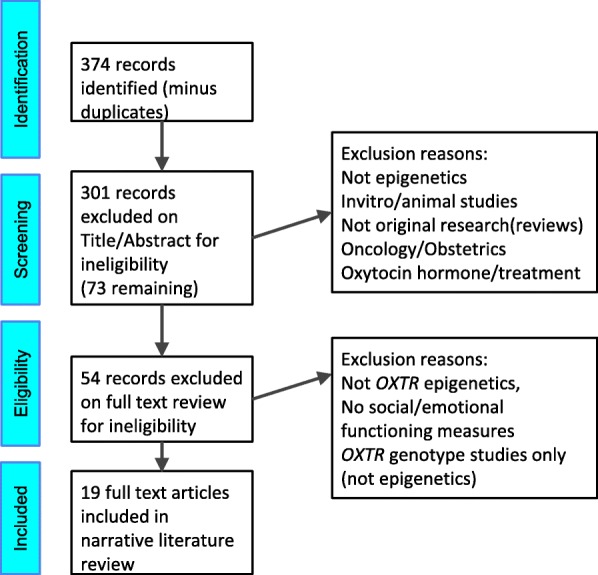
BACKGROUND: The neuropeptide Oxytocin (OXT) plays a central role in birthing, mother-infant bonding and a broad range of related social behaviours in mammals. More recently, interest has extended to epigenetic programming of genes involved in oxytocinergic neurotransmission. This review brings together early findings in a rapidly developing field of research, examining relationships between DNA methylation (DNAm) of the Oxytocin Receptor Gene (OXTR) and social and emotional behaviour in human populations. METHOD: A systematic search across Web of Knowledge/Science, Scopus, Medline and EMBASE captured all published studies prior to June 2017 examining the association between OXTR DNAm and human social and emotional outcomes. Search terms included 'oxytocin gene' or 'oxytocin receptor gene' and 'epigenetics' or 'DNA methylation'. Any article with a focus on social and emotional functioning was then identified from this set by manual review. RESULTS: Nineteen studies met eligibility criteria. There was considerable heterogeneity of study populations, tissue samples, instrumentation, measurement, and OXTR site foci. Only three studies examined functional consequences of OXTR DNAm on gene expression and protein synthesis. Increases in OXTR DNAm were associated with callous-unemotional traits in youth, social cognitive deficits in Autistic Spectrum Disorder (ASD), rigid thinking in anorexia nervosa, affect regulation problems, and problems with facial and emotional recognition. In contrast, reductions in DNAm were associated with perinatal stress, postnatal depression, social anxiety and autism in children. CONCLUSIONS: Consistent with an emerging field of inquiry, there is not yet sufficient evidence to draw conclusions about the role of OXTR DNAm in human social and emotional behaviour. However, taken together, findings point to increased OXTR DNAm in general impairments in social, cognitive and emotional functioning, and decreased OXTR DNAm in specific patterns of impairment related to mood and anxiety disorders (but not in all). Future progress in this field would be enhanced by adequately powered designs, greater phenotypic precision, and methodological improvements including longitudinal studies with multiple time-points to facilitate causal inference.
Overview
The claims and statistics of this paper haven’t been checked yet.
Run the check — free, no account needed. It reads the open-access text and checks the sources it cites.
Integrity signals
Registry
Cites
Statistics
Figures
Verification
Claims the paper makes
The claims and statistics of this paper haven’t been checked yet.
Run the check — free, no account needed. It reads the open-access text and checks the sources it cites.
Claims other papers make about this one
Each is checked against this paper’s own text: does it say what the citing paper says it does?
The cited source says what the claim attributes to it.
In the citing paper
“In the endocrine system, OXT is secreted by the posterior pituitary into the bloodstream to support reproductive processes like uterine contraction and lactation (Grewen et al., 2010; Maud et al., 2018).”
From Music's context-dependent influence on oxytocin, social bonding, and emotion regulation: a systematic review (2026) · cites this paper as Maud et al., 2018
Self-check
Percentages, sums and reported differences re-computed from the paper’s own numbers.
The self-check needs the paper’s full text.
Citations
Cites
Oxytocin increases trust in humans
Kosfeld, M., Heinrichs, M., Zak, P. J., Fischbacher, U., & Fehr, E. (2005) · Nature · doi:10.1038/nature03701 · Cited by 3,690 · cited 1×
“Further, intranasal OXT increased trust and willingness to accept social risks amongst healthy volunteers involved in an experimental game [11], as well as the reduction of the short-term stress response demonstrated by reduced cortisol release”
BackgroundThe oxytocin receptor system: structure, function, and regulation
Gimpl, G., & Fahrenholz, F. (2001) · Physiological Reviews · doi:10.1152/physrev.2001.81.2.629 · Cited by 3,089 · cited 1×
“The oxytocin receptor is a 389-amino acid G-protein coupled transmembrane receptor, enabling the activation of a number of different intracellular secondary messengers facilitating the oxytocin pathway [22].”
BackgroundBird, A. (2007) · Nature · doi:10.1038/nature05913 · Cited by 3,011
Boyd, A., Golding, J., Macleod, J., Lawlor, D. A., Fraser, A., Henderson, J., Molloy, L., Ness, A., Ring, S., & Davey Smith, G. (2013) · International Journal of Epidemiology · doi:10.1093/ije/dys064 · Cited by 2,996 · cited 1×
“longitudinal cohort studies for epigenetic analysis [63].”
Heinrichs, M., Baumgartner, T., Kirschbaum, C., & Ehlert, U. (2003) · Biological Psychiatry · doi:10.1016/s0006-3223(03)00465-7 · Cited by 2,091
Ainsworth, M. D. S., & Bell, S. M. (1970) · Child Development · doi:10.2307/1127388 · Cited by 1,764 · cited 1×
“using gold-standard protocols, for example, human attachment behaviour, within observational designs [65].”
MethodOxytocin and vasopressin in the human brain: social neuropeptides for translational medicine
Meyer-Lindenberg, A., Domes, G., Kirsch, P., & Heinrichs, M. (2011) · Nature Reviews Neuroscience · doi:10.1038/nrn3044 · Cited by 1,688 · cited 1×
“suprachiasmatic nucleus, bed nucleus of stria terminalis and brainstem - where they act as neuromodulators or neurotransmitters and thereby influence neurotransmission in these areas [19].”
BackgroundAn integrated model of emotion processes and cognition in social information processing
Lemerise, E. A., & Arsenio, W. F. (2000) · Child Development · doi:10.1111/1467-8624.00124 · Cited by 1,518 · cited 1×
“(2016) [44] 39 infants with mothers mean age 31.”
BackgroundIntranasal oxytocin improves emotion recognition for youth with autism spectrum disorders.
Guastella, A. J., Einfeld, S. L., Gray, K. M., Rinehart, N. J., Tonge, B. J., Lambert, T. J., & Hickie, I. B. (2010) · Biological Psychiatry · doi:10.1016/j.biopsych.2009.09.020 · Cited by 962 · cited 1×
“provements in adult social cognition [6] and youth emotional recognition [13].”
BackgroundNeumann, I. D., & Landgraf, R. (2012) · Trends in Neurosciences · doi:10.1016/j.tins.2012.08.004 · Cited by 954 · cited 1×
“proved emotional behaviours and mental health [15].”
Oxytocin receptor genetic variation relates to empathy and stress reactivity in humans
Rodrigues, S. M., Saslow, L. R., Garcia, N., John, O. P., & Keltner, D. (2009) · Proceedings of the National Academy of Sciences · doi:10.1073/pnas.0909579106 · Cited by 812 · cited 2×
“A specific OXTR SNP rs53576 with a G to A allele change, known to be associated with reduced pro-sociality and decreased empathy, was also investigated [29].”
BackgroundOxytocin attenuates amygdala responses to emotional faces regardless of valence
Domes, G., Heinrichs, M., Gläscher, J., Büchel, C., Braus, D. F., & Herpertz, S. C. (2007) · Biological Psychiatry · doi:10.1016/j.biopsych.2007.03.025 · Cited by 774 · cited 1×
“fMRI studies have shown that during a visual stress task, intranasal OXT administration is associated with reduced activation in the amygdala, which plays a key role in emotion and social behaviour regulation [14].”
BackgroundAdult attachment predicts maternal brain and oxytocin response to infant cues.
Strathearn, L., Fonagy, P., Amico, J., & Montague, P. R. (2009) · Neuropsychopharmacology · doi:10.1038/npp.2009.103 · Cited by 773 · cited 1×
“The physiological consequences of disrupted OXT release are thus significant during the perinatal period, however, there is also mounting evidence that disrupted OXT availability could be related to a broad range of social behaviours, including childhood autistic spectrum disorders (ASD) [6], attachment bonds in infan…”
BackgroundBell, J. T., Tsai, P.-C., Yang, T.-P., Pidsley, R., Nisbet, J. P., Glass, D., Mangino, M., Zhai, G., Zhang, F., Valdes, A. M., et al. (2012) · PLoS Genetics · doi:10.1371/journal.pgen.1002629 · Cited by 700 · cited 1×
“(2012) [42] 42 healthy adults (55% male) 18–30 yrs.”
Oxytocin Increases Retention of Social Cognition in Autism
Hollander, E., Bartz, J., Chaplin, W., Phillips, A., Sumner, J., Soorya, L., Anagnostou, E., & Wasserman, S. (2007) · Biological Psychiatry · doi:10.1016/j.biopsych.2006.05.030 · Cited by 693 · cited 16×
“Rs2254298 (G > A) has also been associated with autistic spectrum disorder (ASD) [24], depressed women and their families [25] and with smaller bilateral amygdala volumes and greater grey matter volumes in a brain imaging study [26], while rs237887 has been associated with human social recognition skills [27].”
BackgroundInfluentialIntroduction to Research Topic – Binocular Rivalry: A Gateway to Studying Consciousness
Maier, A., Panagiotaropoulos, T. I., Tsuchiya, N., & Keliris, G. A. (2012) · Frontiers in Human Neuroscience · doi:10.3389/fnhum.2012.00263 · Cited by 632
Structure and expression of a human oxytocin receptor
Kimura, T., Tanizawa, O., Mori, K., Brownstein, M., & Okayama, H. (1992) · Nature · doi:10.1038/356526a0 · Cited by 631
Developmental origins of disease paradigm: A mechanistic and evolutionary perspective
Gluckman, P. D., & Hanson, M. A. (2004) · Pediatric Research · doi:10.1203/01.pdr.0000135998.08025.fb · Cited by 607
Genomic and epigenetic evidence for oxytocin receptor deficiency in autism
Gregory, S. G., Connelly, J. J., Towers, A. J., Johnson, J., Biscocho, D., Markunas, C. A., Lintas, C., Abramson, R. K., Wright, H. H., Ellis, P., et al. (2009) · BMC Medicine · doi:10.1186/1741-7015-7-62 · Cited by 576
Oxytocin receptor (OXTR) and serotonin transporter (5-HTT) genes associated with observed parenting
Bakermans-Kranenburg, M. J., & van IJzendoorn, M. H. (2008) · Social Cognitive and Affective Neuroscience · doi:10.1093/scan/nsn004 · Cited by 474 · cited 1×
“G) has been associated with reduced positivity [28], reduced empathy [29] and decreased parental sensitivity [30] while rs1042778 has been associated with reduced parenting sensitivity [31] and rs237915 has been associated with brain responsiveness to social cues [32].”
BackgroundOxytocin and the development of parenting in humans
Gordon, I., Zagoory-Sharon, O., Leckman, J. F., & Feldman, R. (2010) · Biological Psychiatry · doi:10.1016/j.biopsych.2010.02.005 · Cited by 469 · cited 1×
“higher levels of gaze towards their infant’s face, positive affect and affectionate touch [4].”
BackgroundAssociation of the oxytocin receptor gene (OXTR) in Caucasian children and adolescents with autism
Jacob, S., Brune, C. W., Carter, C. S., Leventhal, B. L., Lord, C., & Cook, E. H. (2007) · Neuroscience Letters · doi:10.1016/j.neulet.2007.02.001 · Cited by 425 · cited 16×
“Rs2254298 (G > A) has also been associated with autistic spectrum disorder (ASD) [24], depressed women and their families [25] and with smaller bilateral amygdala volumes and greater grey matter volumes in a brain imaging study [26], while rs237887 has been associated with human social recognition skills [27].”
BackgroundInfluentialSensitive Parenting Is Associated with Plasma Oxytocin and Polymorphisms in the OXTR and CD38 Genes
Feldman, R., Zagoory-Sharon, O., Weisman, O., Schneiderman, I., Gordon, I., Maoz, R., Shalev, I., & Ebstein, R. P. (2012) · Biological Psychiatry · doi:10.1016/j.biopsych.2011.12.025 · Cited by 393 · cited 1×
“G) has been associated with reduced positivity [28], reduced empathy [29] and decreased parental sensitivity [30] while rs1042778 has been associated with reduced parenting sensitivity [31] and rs237915 has been associated with brain responsiveness to social cues [32].”
BackgroundHeinrichs, M., Meinlschmidt, G., Neumann, I., Wagner, S., Kirschbaum, C., Ehlert, U., & Hellhammer, D. H. (2001) · The Journal of Clinical Endocrinology & Metabolism · doi:10.1210/jcem.86.10.7919 · Cited by 386 · cited 1×
“Postpartum, the sucking stimulus by newborns increases OXT release in the mother and thus decreases plasma levels of stress hormones (ACTH and cortisol) [5].”
BackgroundFeldman, R., Monakhov, M., Pratt, M., & Ebstein, R. P. (2016) · Biological Psychiatry · doi:10.1016/j.biopsych.2015.08.008 · Cited by 352 · cited 2×
“Genetic variants, including single nucleotide polymorphisms (SNPs), in the OXTR have been shown to independently influence gene expression and been associated with human emotional responsiveness and social behaviour [23].”
BackgroundResultThe oxytocin receptor gene (OXTR) is associated with autism spectrum disorder: a meta-analysis
LoParo, D., & Waldman, I. D. (2015) · Molecular Psychiatry · doi:10.1038/mp.2014.77 · Cited by 343 · cited 1×
“with ASD reported associations with rs7632287, rs237887, rs2268491 and rs2254298 [33].”
ResultOxytocin enhances the experience of attachment security
Buchheim, A., Heinrichs, M., George, C., Pokorny, D., Koops, E., Henningsen, P., O’Connor, M.-F., & Gündel, H. (2009) · Psychoneuroendocrinology · doi:10.1016/j.psyneuen.2009.04.002 · Cited by 277 · cited 1×
“This has led to the development of OXT treatments including using nasal OXT to increase attachment security in healthy males with an insecure attachment pattern [9] and improved social engagement between fathers and their infants [10].”
BackgroundHeppner, P. S., Crawford, E. F., Haji, U. A., Afari, N., Hauger, R. L., Dashevsky, B. A., Horn, P. S., Nunnink, S. E., & Baker, D. G. (2009) · BMC Medicine · doi:10.1186/1741-7015-7-1 · Cited by 274
Apter-Levy, Y., Feldman, M., Vakart, A., Ebstein, R. P., & Feldman, R. (2013) · American Journal of Psychiatry · doi:10.1176/appi.ajp.2013.12121597 · Cited by 271 · cited 1×
“istic spectrum disorder (ASD) [24], depressed women and their families [25] and with smaller bilateral amygdala volumes and greater grey matter volumes in a brain”
BackgroundOxytocin receptor gene ( OXTR ) is related to psychological resources
Saphire-Bernstein, S., Way, B. M., Kim, H. S., Sherman, D. K., & Taylor, S. E. (2011) · Proceedings of the National Academy of Sciences · doi:10.1073/pnas.1113137108 · Cited by 262 · cited 1×
“G) has been associated with reduced positivity [28], reduced empathy [29] and decreased parental sensitivity [30] while rs1042778 has been associated with reduced parenting sensitivity [31] and rs237915 has been associated with brain responsiveness to social cues [32].”
BackgroundUnternaehrer, E., Luers, P., Mill, J., Dempster, E., Meyer, A. H., Staehli, S., Lieb, R., Hellhammer, D. H., & Meinlschmidt, G. (2012) · Translational Psychiatry · doi:10.1038/tp.2012.77 · Cited by 250 · cited 2×
“[52] examined the possibility of dynamically changing levels of DNA methylation in response to a social stress test within a longitudinal study design.”
BackgroundProspects for epigenetic epidemiology
Foley, D. L., Craig, J. M., Morley, R., Olsson, C. J., Dwyer, T., Smith, K., & Saffery, R. (2008) · American Journal of Epidemiology · doi:10.1093/aje/kwn380 · Cited by 244 · cited 1×
“etic data lack utility in attempting to understand developmental change or causation direction in epigenetic epidemiology [64].”
BackgroundSmith, A. K., Kilaru, V., Kocak, M., Almli, L. M., Mercer, K. B., Ressler, K. J., Tylavsky, F. A., & Conneely, K. N. (2014) · BMC Genomics · doi:10.1186/1471-2164-15-145 · Cited by 239 · cited 1×
“(2016) [43] 51 females postnatal depression: average 30.”
Dadds, M. R., Moul, C., Cauchi, A., Dobson-Stone, C., Hawes, D. J., Brennan, J., & Ebstein, R. E. (2014) · Development and Psychopathology · doi:10.1017/s0954579413000497 · Cited by 230 · cited 7×
“Two studies investigated a possible association between DNAm changes at the OXTR and subsequent oxytocin neuropeptide synthesis [47, 48].”
BackgroundInfluentialNaber, F., van IJzendoorn, M. H., Deschamps, P., van Engeland, H., & Bakermans-Kranenburg, M. J. (2010) · Psychoneuroendocrinology · doi:10.1016/j.psyneuen.2010.04.007 · Cited by 222 · cited 1×
“This has led to the development of OXT treatments including using nasal OXT to increase attachment security in healthy males with an insecure attachment pattern [9] and improved social engagement between fathers and their infants [10].”
BackgroundEvidence of dysregulated peripheral oxytocin release among depressed women
Cyranowski, J. M., Hofkens, T. L., Frank, E., Seltman, H., Cai, H.-M., & Amico, J. A. (2008) · Psychosomatic Medicine · doi:10.1097/psy.0b013e318188ade4 · Cited by 220 · cited 2×
“Disrupted peripheral OXT release has been found in non-perinatal women with depression during stress related tasks [8]”
BackgroundPuglia, M. H., Lillard, T. S., Morris, J. P., & Connelly, J. J. (2015) · Proceedings of the National Academy of Sciences · doi:10.1073/pnas.1422096112 · Cited by 216 · cited 2×
“(2015) [51] 220 adults: 110 unmedicated social anxiety (76 female & 34 male); 110 controls (77 female & 33 male) Excluded: medical, psychosis & substance use disorders.”
BackgroundSkuse, D. H., Lori, A., Cubells, J. F., Lee, I., Conneely, K. N., Puura, K., Lehtimäki, T., Binder, E. B., & Young, L. J. (2014) · Proceedings of the National Academy of Sciences · doi:10.1073/pnas.1302985111 · Cited by 207 · cited 1×
“imaging study [26], while rs237887 has been associated with human social recognition skills [27].”
BackgroundMaternal brain response to own baby‐cry is affected by cesarean section delivery
Swain, J. E., Tasgin, E., Mayes, L. C., Feldman, R., Todd Constable, R., & Leckman, J. F. (2008) · Journal of Child Psychology and Psychiatry · doi:10.1111/j.1469-7610.2008.01963.x · Cited by 206
Uvnäs‐Moberg, K., & Petersson, M. (2005) · Zeitschrift für psychosomatische Medizin und Psychotherapie · doi:10.13109/zptm.2005.51.1.57 · Cited by 200 · cited 1×
“This has led to the suggestion that OXT may be an important biomarker of stress exposures [16].”
BackgroundKusui, C., Kimura, T., Ogita, K., Nakamura, H., Matsumura, Y., Koyama, M., Azuma, C., & Murata, Y. (2001) · Biochemical and Biophysical Research Communications · doi:10.1006/bbrc.2001.6024 · Cited by 196
Carson, D. S., Berquist, S. W., Trujillo, T. H., Garner, J. P., Hannah, S. L., Hyde, S. A., Sumiyoshi, R. D., Jackson, L. P., Moss, J. K., Strehlow, M. C., et al. (2015) · Molecular Psychiatry · doi:10.1038/mp.2014.132 · Cited by 196 · cited 1×
“concentrations also correlate with cerebrospinal concentrations and with childhood anxiety [17].”
BackgroundOxytocin receptor gene methylation: converging multilevel evidence for a role in social anxiety
Ziegler, C., Dannlowski, U., Bräuer, D., Stevens, S., Laeger, I., Wittmann, H., Kugel, H., Dobel, C., Hurlemann, R., Reif, A., et al. (2015) · Neuropsychopharmacology · doi:10.1038/npp.2015.2 · Cited by 193 · cited 4×
“In contrast, reduced OXTR DNAm has been associated within indicators of perinatal stress [55], postnatal depression [56], social anxiety [53] and autism in children [60].”
BackgroundInfluentialDNA methylation of the oxytocin receptor gene predicts neural response to ambiguous social stimuli
Jack, A., Connelly, J. J., & Morris, J. P. (2012) · Frontiers in Human Neuroscience · doi:10.3389/fnhum.2012.00280 · Cited by 192 · cited 3×
“These include positive associations between OXTR DNAm and callous-unemotional traits in youth [47, 58], social cognitive deficits in ASD [45, 46], rigid thinking in anorexia nervosa [49], affect regulation problems [41, 57] and mood deficits [38–40] as well as limbic regions linked with facial and emotional recognitio…”
BackgroundCecil, C. A. M., Lysenko, L., Jaffee, S. R., Pingault, J., Smith, R. G., Relton, C. L., Woodward, G., McArdle, W. L., Mill, J. S., & Barker, E. D. (2014) · Molecular Psychiatry · doi:10.1038/mp.2014.95 · Cited by 189 · cited 4×
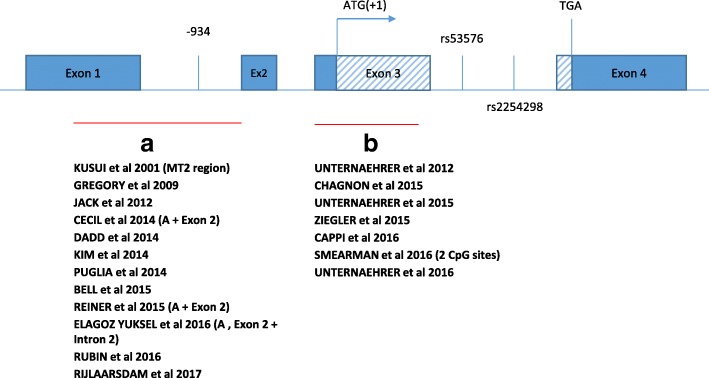
“Two studies measured peripheral blood OXTR DNAm in children and adolescents with conduct problems, with a particular focus on Callous Unemotional (CU) traits [47, 58].”
BackgroundMethodInfluentialUnternaehrer, E., Meyer, A. H., Burkhardt, S. C. A., Dempster, E., Staehli, S., Theill, N., Lieb, R., & Meinlschmidt, G. (2015) · Stress · doi:10.3109/10253890.2015.1038992 · Cited by 181 · cited 2×
“These include positive associations between OXTR DNAm and callous-unemotional traits in youth [47, 58], social cognitive deficits in ASD [45, 46], rigid thinking in anorexia nervosa [49], affect regulation problems [41, 57] and mood deficits [38–40] as well as limbic regions linked with facial and emotional recognitio…”
BackgroundSmearman, E. L., Almli, L. M., Conneely, K. N., Brody, G. H., Sales, J. M., Bradley, B., Ressler, K. J., & Smith, A. K. (2016) · Child Development · doi:10.1111/cdev.12493 · Cited by 173
Lowe, R., Gemma, C., Beyan, H., Hawa, M. I., Bazeos, A., Leslie, R. D., Montpetit, A., Rakyan, V. K., & Ramagopalan, S. V. (2013) · Epigenetics · doi:10.4161/epi.24362 · Cited by 160 · cited 1×
“The common embryological origin of brain and buccal cells suggests that these two cell types may have more in common than blood cells, and that using buccal cells as a peripheral biomarker might provide a closer approximation to central brain processes, relative to other cell types [61].”
BackgroundVariant in oxytocin receptor gene is associated with amygdala volume
Furman, D. J., Chen, M. C., & Gotlib, I. H. (2011) · Psychoneuroendocrinology · doi:10.1016/j.psyneuen.2010.12.004 · Cited by 151 · cited 1×
“imaging study [26], while rs237887 has been associated with human social recognition skills [27].”
BackgroundBell, A. F., Carter, C. S., Steer, C. D., Golding, J., Davis, J. M., Steffen, A. D., Rubin, L. H., Lillard, T. S., Gregory, S., Harris, J. C., et al. (2015) · Frontiers in Genetics · doi:10.3389/fgene.2015.00243 · Cited by 131 · cited 2×
“reported associations for mood disorders are in both direction, which may reflect striking differences between studies, including type of mood disorder under investigation, epigenome regions studied, underlying variation in genotypic and hormonal factors [39, 56] as well as the effect of aging [38].”
BackgroundResultOxytocin receptor DNA methylation in postpartum depression
Kimmel, M., Clive, M. L., Gispen, F. E., Guintivano, J., Brown, T., Cox, O., Beckmann, M. W., Kornhuber, J., Fasching, P. A., Osborne, L. M., et al. (2016) · Psychoneuroendocrinology · doi:10.1016/j.psyneuen.2016.04.008 · Cited by 118 · cited 3×
“reported associations for mood disorders are in both direction, which may reflect striking differences between studies, including type of mood disorder under investigation, epigenome regions studied, underlying variation in genotypic and hormonal factors [39, 56] as well as the effect of aging [38].”
BackgroundResultOxytocin indexes relational distress following interpersonal harms in women
Tabak, B. A., McCullough, M. E., Szeto, A., Mendez, A. J., & McCabe, P. M. (2011) · Psychoneuroendocrinology · doi:10.1016/j.psyneuen.2010.07.004 · Cited by 116 · cited 1×
“and with specific types of relationship stress in women [18].”
BackgroundPolymorphisms in the oxytocin receptor gene are associated with the development of psychopathy
Dadds, M. R., Moul, C., Cauchi, A., Dobson‐Stone, C., Hawes, D. J., Brennan, J., Urwin, R., & Ebstein, R. P. (2013) · Development and Psychopathology · doi:10.1017/s0954579413000485 · Cited by 112 · cited 1×
“Only rs1042778 replicated an association with high CU traits across sexes and between childhood versus adolescent age groups within 2 separated geographical groups [59].”
BackgroundChagnon, Y. C., Potvin, O., Hudon, C., & Préville, M. (2015) · Frontiers in Genetics · doi:10.3389/fgene.2015.00230 · Cited by 105 · cited 4×
“This finding is in contrast to the other studies of depression where associations were found between OXTR DNAm and depression risk for individuals with the rs53576 A allele [38, 40], possibly accounted for by hormonal differences compared to mood disorders at differing times in the life-cycle.”
BackgroundResultInfluentialMamrut, S., Harony‐Nicolas, H., Sood, R., Shahar-Gold, H., Gainer, H., Shi, Y.-J., Barki‐Harrington, L., & Wagner, S. (2013) · PLoS ONE · doi:10.1371/journal.pone.0056869 · Cited by 102 · cited 2×
“In mouse models, OXTR DNAm patterns have been correlated with differential OXTR expression in different body tissues [35].”
BackgroundRijlaarsdam, J., van IJzendoorn, M. H., Verhulst, F. C., Jaddoe, V. W. V., Felix, J. F., Tiemeier, H. W., & Bakermans‐Kranenburg, M. J. (2016) · Autism Research · doi:10.1002/aur.1681 · Cited by 98 · cited 20×
“Rs2254298 (G > A) has also been associated with autistic spectrum disorder (ASD) [24], depressed women and their families [25] and with smaller bilateral amygdala volumes and greater grey matter volumes in a brain imaging study [26], while rs237887 has been associated with human social recognition skills [27].”
BackgroundResultInfluentialKim, Y.-R., Kim, J.-H., Kim, M. J., & Treasure, J. (2014) · PLoS ONE · doi:10.1371/journal.pone.0088673 · Cited by 97 · cited 2×
“These include positive associations between OXTR DNAm and callous-unemotional traits in youth [47, 58], social cognitive deficits in ASD [45, 46], rigid thinking in anorexia nervosa [49], affect regulation problems [41, 57] and mood deficits [38–40] as well as limbic regions linked with facial and emotional recognitio…”
BackgroundThe role of longitudinal cohort studies in epigenetic epidemiology: challenges and opportunities
Ng, J. W. Y., Barrett, L. M., Wong, A., Kuh, D. J., Smith, G. D., & Relton, C. L. (2012) · Genome biology · doi:10.1186/gb-2012-13-6-246 · Cited by 97
Epigenetic evidence for involvement of the oxytocin receptor gene in obsessive–compulsive disorder
Cappi, C., Diniz, J. B., Requena, G. D. L., Lourenço, T., Lisbôa, B. C. G., Batistuzzo, M. C., Marques, A. H., Hoexter, M. Q., Pereira, C. A. D. B., Miguel, E. C., et al. (2016) · BMC Neuroscience · doi:10.1186/s12868-016-0313-4 · Cited by 84 · cited 1×
“gion from blood and anxiety disorders were identified [53, 54].”
BackgroundReiner, I., Van IJzendoorn, M. H., Bakermans-Kranenburg, M. J., Bleich, S., Beutel, M., & Frieling, H. (2015) · Journal of Psychiatric Research · doi:10.1016/j.jpsychires.2015.03.012 · Cited by 83 · cited 5×
“compared OXTR DNAm in PBMCs between depressed pre-menopausal women and non-depressed age-matched controls [40].”
BackgroundResultInfluentialMizumoto, Y., Kimura, T., & Ivell, R. (1997) · Molecular and Cellular Endocrinology · doi:10.1016/s0303-7207(97)00195-0 · Cited by 79 · cited 1×
“In human samples, a region within the OXTR third intron between regions encoding trans-membrane domains 6 and 7, has been shown to be hyper-methylated within non-expressing tissues, but hypo-methylated in the uterine myometrium at term, when OXT is up-regulated for the birthing process [21].”
BackgroundMaternal adversities during pregnancy and cord blood oxytocin receptor (OXTR) DNA methylation
Unternaehrer, E., Bolten, M., Nast, I., Staehli, S., Meyer, A. H., Dempster, E., Hellhammer, D. H., Lieb, R., & Meinlschmidt, G. (2016) · Social Cognitive and Affective Neuroscience · doi:10.1093/scan/nsw051 · Cited by 75 · cited 2×
“also investigated OXTR DNAm in the cord blood of 39 infants born to mothers who had completed psychological testing and saliva cortisol testing during the second and third trimesters of their pregnancies [55].”
BackgroundMethodRubin, L. H., Connelly, J. J., Reilly, J. L., Carter, C. S., Drogos, L. L., Pournajafi‐Nazarloo, H., Ruocco, A. C., Keedy, S., Matthew, I., Tandon, N., et al. (2015) · Biological Psychiatry Cognitive Neuroscience and Neuroimaging · doi:10.1016/j.bpsc.2015.10.003 · Cited by 72 · cited 5×
“Two studies investigated a possible association between DNAm changes at the OXTR and subsequent oxytocin neuropeptide synthesis [47, 48].”
BackgroundResultInfluentialThe altered promoter methylation of oxytocin receptor gene in autism
Yüksel, M. E., Yücetürk, B., Karataş, Ö. F., Özen, M., & Doğangün, B. (2016) · Journal of Neurogenetics · doi:10.1080/01677063.2016.1202951 · Cited by 68 · cited 3×
“In contrast, reduced OXTR DNAm has been associated within indicators of perinatal stress [55], postnatal depression [56], social anxiety [53] and autism in children [60].”
BackgroundResultLoth, E., Poline, J.-B., Thyreau, B., Jia, T., Tao, C., Lourdusamy, A., Stacey, D., Cattrell, A., Desrivières, S., Ruggeri, B., et al. (2014) · Biological Psychiatry · doi:10.1016/j.biopsych.2013.07.043 · Cited by 65 · cited 1×
“G) has been associated with reduced positivity [28], reduced empathy [29] and decreased parental sensitivity [30] while rs1042778 has been associated with reduced parenting sensitivity [31] and rs237915 has been associated with brain responsiveness to social cues [32].”
BackgroundHarony-Nicolas, H., Mamrut, S., Brodsky, L., Shahar-Gold, H., Barki-Harrington, L., & Wagner, S. (2014) · Psychoneuroendocrinology · doi:10.1016/j.psyneuen.2013.10.004 · Cited by 61 · cited 1×
“In different brain areas, differing DNAm at specific CpG regions within the OXTR occurred with differential expression of OXTR [36].”
BackgroundThe role of longitudinal cohort studies in epigenetic epidemiology: challenges and opportunities
Ng, J., Barrett, L. M., Wong, A., et al. (2012) · Genome biology · doi:10.1186/gb4029 · Cited by 48
Understanding the Oxytocin System and Its Relevance to Psychiatry
Shamay‐Tsoory, S., & Young, L. J. (2015) · Biological Psychiatry · doi:10.1016/j.biopsych.2015.10.014 · Cited by 41
Endocrinologic Control of Food Intake
Uvnäs‐Moberg, K. (2009) · Nutrition Reviews · doi:10.1111/j.1753-4887.1990.tb02906.x · Cited by 13
Research works printed but not linked: 1
- Uvnas-Moberg K, Petersson M. Oxytocin, a mediator of anti-stress, well-being, social interaction, growth and healing. Z Psychosom Med Psychother. 2005;51(1):57–80.
Cited by
Sorted by citations
DNA methylation and regulation of gene expression: Guardian of our health
Dhar, G. A., Saha, S., Mitra, P., & Chaudhuri, R. N. (2021) · The Nucleus · doi:10.1007/s13237-021-00367-y · Cited by 260
Childhood maltreatment and DNA methylation: A systematic review
Cecil, C. A. M., Zhang, Y., & Nolte, T. (2020) · Neuroscience & Biobehavioral Reviews · doi:10.1016/j.neubiorev.2020.02.019 · Cited by 186
Advances in human oxytocin measurement: challenges and proposed solutions
Tabak, B. A., Leng, G., Szeto, A., Parker, K. J., Verbalis, J. G., Ziegler, T. E., Lee, M. R., Neumann, I. D., & Mendez, A. J. (2023) · Molecular Psychiatry · doi:10.1038/s41380-022-01719-z · Cited by 170
“Reviews of these approaches typically note that understanding interactions with endogenous oxytocin would be of significant value [68, 79, 86].”
BackgroundOxytocin and the Neurobiology of Prosocial Behavior
Marsh, N., Marsh, A. A., Lee, M. R., & Hurlemann, R. (2020) · The Neuroscientist · doi:10.1177/1073858420960111 · Cited by 159
The physiology and pharmacology of oxytocin in labor and in the peripartum period
Uvnäs-Moberg, K. (2024) · American Journal of Obstetrics and Gynecology · doi:10.1016/j.ajog.2023.04.011 · Cited by 118
Metadata
- Authors
- Maud, C., Ryan, J., McIntosh, J. E., & Olsson, C. A.
- Affiliations
- Deakin University (AU)
- Royal Children's Hospital (AU)
- Corresponding author
- Maud, Catherine
- Venue
- BMC Psychiatry
- Published
- 2018-05-29
- Volume
- 18
- Issue
- 1
- Pages
- 154-154
- ISSN
- 1471-244X (ISSN-L)
- PMC
- PMC5975530
- OpenAlex
- W2805059767
- Cited by
- 151
- References
- 68
- Citations by year
- 2026: 19 · 2025: 17 · 2024: 15 · 2023: 20 · 2022: 19 · 2021: 24 · 2020: 22 · 2019: 9 · 2018: 5
- FWCI
- 2.27
- Type
- journal article
- Language
- en
- Open access
- gold
- doi.org
- Licence
- Locations
- BMC Psychiatry (publishedVersion, cc-by)
- PubMed Central (publishedVersion, cc-by)
- PubMed (publishedVersion)
- Monash University Research Portal (Monash University) (submittedVersion, other-oa)
- Minerva Access (University of Melbourne) (submittedVersion, cc-by)
- DOAJ (DOAJ: Directory of Open Access Journals) (submittedVersion, cc-by-sa)
- Figshare (submittedVersion, cc-by)
- Topics
- Life Sciences › Neuroscience › Endocrine and Autonomic Systems › Neuroendocrine regulation and behavior
- Life Sciences › Biochemistry, Genetics and Molecular Biology › Molecular Biology › Epigenetics and DNA Methylation
- Life Sciences › Neuroscience › Cellular and Molecular Neuroscience › Neurotransmitter Receptor Influence on Behavior
- Keywords
- oxytocin receptor gene, oxytocin receptor, DNA methylation, epigenetics, oxytocin, social behavior, emotional functioning, callous-unemotional traits, autism spectrum disorder, anorexia nervosa, emotion regulation, perinatal stress, postpartum depression, social anxiety, mood disorders
- MeSH terms
- Cognition, Emotions, Humans, Synaptic Transmission, Oxytocin, Social Behavior, Receptors, Oxytocin, DNA Methylation, Gene Expression Profiling, Epigenomics
About these checks
Registry, retraction, Cites and statistics results are computed, not judged, with one exception: a printed reference that no index lists is read once by a model before it counts as a citation error. Claims are extracted by a model and kept only when their quote appears verbatim in the text; each cited source is then checked, with a model’s help, for whether it says what the claim relies on. Those verdicts can be wrong — read the claim’s quote and the cited source before relying on one.
Statistics and arithmetic are recomputed, not judged.
Confidence bands are shown only for fields calibrated on our annotated test set. None is calibrated yet, so no band is shown.
What counts as a claim ›How we measure confidence ›How we check this ›
Are you an author, or do you see a problem with this page? Request a review
