

The DOI matches its Crossref record; 31 of the 31 references it cites were found in a registry or an index.
Psychometric properties of the perceived stress scale in a community sample of Chinese
Abstract
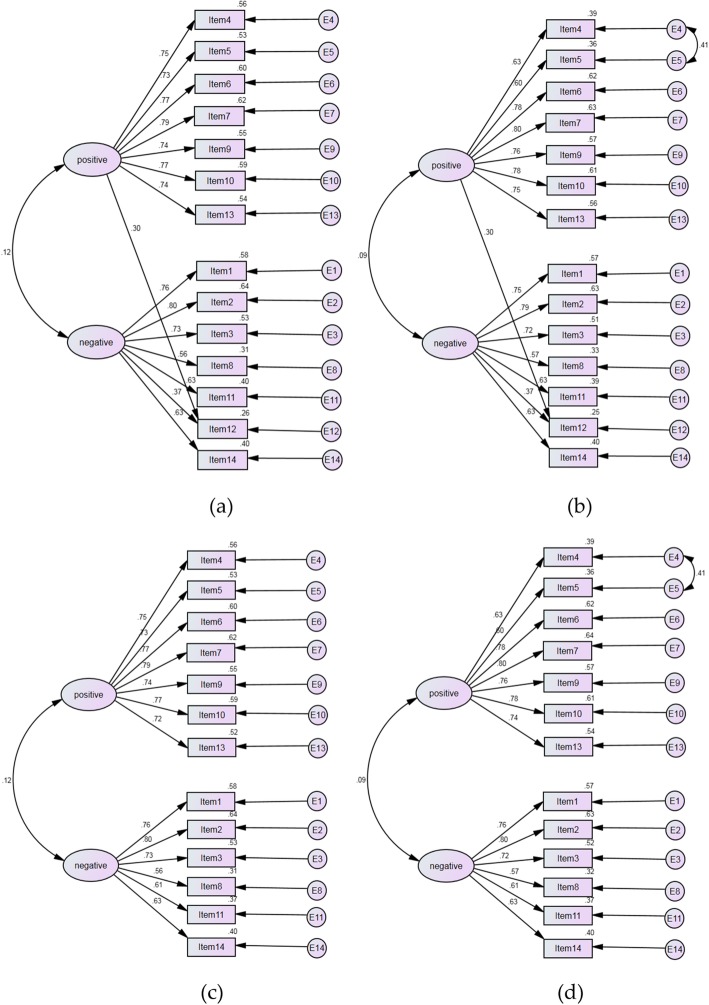
Background: The Perceived Stress Scale (PSS) is a globally used and self-report scale measuring perceived stress. Three versions of PSS (PSS-14, PSS-10 and PSS-4) are available which comprise 14, 10 and 4 items respectively. However, the Chinese version of the PSS has not yet been validated in a large community-based general population. The aims of this study were to evaluate the psychometric properties of the Chinese PSS in a large community-based general population and to compare the appropriateness of the three versions of PSS. Methods: A total of 9507 adults with at least a junior high school education and completed PSS-14 from the China Health and Nutrition Survey were involved in this study. The internal consistency reliability of PSS was assessed using Cronbach’s alpha coefficient and confirmatory factor analysis was employed to test the construct validity. Modification index was used for model extension and the critical ratio was used for model restriction. Results: The internal consistency coefficients were satisfactory for PSS-14 and PSS-10, but not for PSS-4. The corresponding Cronbach’s alpha were 0.830, 0.754 and 0.473 respectively. A 2-factor structure was confirmed for the PSS-14 and PSS-10, and all items’ standardized factor loadings exceeded 0.4 for either negative or positive factors. Given that item 12 loaded on both negative and positive factors for PSS-14 and the goodness of fit for PSS-14 was not acceptable, PSS-13 (PSS-14 excluding item 12) was studied. The construct validities of PSS-13 and PSS-10 were satisfactory, but the goodness of fit for PSS-10 were better than that for PSS-13. Conclusions: PSS-13 (PSS-14 excluding item 12) and PSS-10 have satisfactory psychometric properties. PSS-10 are more applicable to measure the perceived stress than PSS-13 in a large community-based general population in China.
Overview
The claims and statistics of this paper haven’t been checked yet.
Run the check — free, no account needed. It reads the open-access text and checks the sources it cites.
Integrity signals
Registry
Cites
Statistics
Figures
Verification
Claims the paper makes
The claims and statistics of this paper haven’t been checked yet.
Run the check — free, no account needed. It reads the open-access text and checks the sources it cites.
Claims other papers make about this one
Each is checked against this paper’s own text: does it say what the citing paper says it does?
In the citing paper
“The Chinese version of the scale has good reliability and validity.40,47”
Self-check
Percentages, sums and reported differences re-computed from the paper’s own numbers.
The self-check needs the paper’s full text.
Citations
Cites
A Global Measure of Perceived Stress
Cohen, S., Kamarck, T., & Mermelstein, R. (1983) · Journal of Health and Social Behavior · doi:10.2307/2136404 · Cited by 32,807
Review of the Psychometric Evidence of the Perceived Stress Scale
Lee, E.-H. (2012) · Asian Nursing Research · doi:10.1016/j.anr.2012.08.004 · Cited by 2,305
Popkin, B. M., Du, S., Zhai, F., & Zhang, B. (2010) · International Journal of Epidemiology · doi:10.1093/ije/dyp322 · Cited by 960
Self-citationKlein, E. M., Brähler, E., Dreier, M., Reinecke, L., Müller, K. W., Schmutzer, G., Wölfling, K., & Beutel, M. E. (2016) · BMC Psychiatry · doi:10.1186/s12888-016-0875-9 · Cited by 716
Perceived Stress Scale: Reliability and Validity Study in Brazil
Siqueira Reis, R., Ferreira Hino, A. A., & Romélio Rodriguez Añez, C. (2010) · Journal of Health Psychology · doi:10.1177/1359105309346343 · Cited by 698
Relationships between perceived stress and health behaviors in a sample of working adults
Ng, D. M., & Jeffery, R. W. (2003) · Health Psychology · doi:10.1037/0278-6133.22.6.638 · Cited by 663
Perceived Stress Scale: Reliability and Validity Study in Greece
Andreou, E., Alexopoulos, E. C., Lionis, C., Varvogli, L., Gnardellis, C., Chrousos, G. P., & Darviri, C. (2011) · International Journal of Environmental Research and Public Health · doi:10.3390/ijerph8083287 · Cited by 641
New, normative, English-sample data for the Short Form Perceived Stress Scale (PSS-4)
Warttig, S. L., Forshaw, M. J., South, J., & White, A. K. (2013) · Journal of Health Psychology · doi:10.1177/1359105313508346 · Cited by 611
Leung, D. Y., Lam, T.-H., & Chan, S. S. (2010) · BMC Public Health · doi:10.1186/1471-2458-10-513 · Cited by 562
Psychometric properties of the French versions of the Perceived Stress Scale
Lesage, F.-X., Berjot, S., & Deschamps, F. (2012) · International Journal of Occupational Medicine and Environmental Health · doi:10.2478/s13382-012-0024-8 · Cited by 341
Chaaya, M., Osman, H., Naassan, G., & Mahfoud, Z. (2010) · BMC Psychiatry · doi:10.1186/1471-244x-10-111 · Cited by 309
Perceived stress in survivors of suicide: psychometric properties of the Perceived Stress Scale.
Mitchell, A. M., Crane, P. A., & Kim, Y. (2008) · Research in Nursing & Health · doi:10.1002/nur.20284 · Cited by 283
The Thai version of the PSS-10: An Investigation of its psychometric properties
Wongpakaran, N., & Wongpakaran, T. (2010) · BioPsychoSocial Medicine · doi:10.1186/1751-0759-4-6 · Cited by 266
Psychometric Properties of the Chinese Version of the Perceived Stress Scale in Policewomen
Wang, Z., Chen, J., Ritsher, J. B., Zhang, H., Jia, X., Qiu, J., & Xiao, Z. (2011) · PLoS ONE · doi:10.1371/journal.pone.0028610 · Cited by 258
Self-citationValidation of the Perceived Stress Scale in a community sample of older adults
Ezzati, A., Jiang, J., Katz, M. J., Sliwinski, M. J., Zimmerman, M. E., & Lipton, R. B. (2014) · International Journal of Geriatric Psychiatry · doi:10.1002/gps.4049 · Cited by 253
Nordin, M., & Nordin, S. (2013) · Scandinavian Journal of Psychology · doi:10.1111/sjop.12071 · Cited by 252
Lu, W. H., Bian, Q., Wang, W., Wu, X., Wang, Z., & Zhao, M. (2017) · PLoS ONE · doi:10.1371/journal.pone.0189543 · Cited by 192
Self-citationLaugero, K. D., Falcón, L. M., & Tucker, K. L. (2010) · Appetite · doi:10.1016/j.appet.2010.11.001 · Cited by 174
Lee, E., Chung, B. Y., Suh, C., & Jung, J. (2015) · Scandinavian Journal of Caring Sciences · doi:10.1111/scs.12131 · Cited by 134
Mimura, C., & Griffiths, P. (2008) · BMC Psychiatry · doi:10.1186/1471-244x-8-85 · Cited by 131
Barrington, W. E., Ceballos, R. M., Bishop, S. K., McGregor, B. A., & Beresford, S. A. A. (2012) · Preventing Chronic Disease · doi:10.5888/pcd9.120001 · Cited by 128
Perceived Stress and Weight Gain in Adolescence: A Longitudinal Analysis
van Jaarsveld, C. H. M., Fidler, J. A., Steptoe, A., Boniface, D. R., & Wardle, J. (2009) · Obesity · doi:10.1038/oby.2009.183 · Cited by 126
Ng, S.-M. (2013) · BMC Psychology · doi:10.1186/2050-7283-1-9 · Cited by 121
Diggins, A. D., Woods‐Giscombé, C. L., & Waters, S. J. (2015) · Eating Behaviors · doi:10.1016/j.eatbeh.2015.09.006 · Cited by 94
Confirmatory Factor Analysis of the Perceived Stress Scale‐4 in a Community Sample
Ingram, P. B., Clarke, E. W., & Lichtenberg, J. W. (2014) · Stress and Health · doi:10.1002/smi.2592 · Cited by 92
González-Ramírez, M. T., Rodríguez-Ayán, M. N., & Hernández, R. L. (2013) · The Spanish Journal of Psychology · doi:10.1017/sjp.2013.35 · Cited by 91
Psychometric properties and factor structure of the Swedish version of the Perceived Stress Scale
Eklund, M., Bäckström, M., & Tuvesson, H. (2014) · Nordic Journal of Psychiatry · doi:10.3109/08039488.2013.877072 · Cited by 85
Validation of a Greek version of PSS-14; a global measure of perceived stress
Katsarou, A., Panagiotakos, D., Zafeiropoulou, A., Vryonis, M., Skoularigis, I., Tryposkiadis, F., & Papageorgiou, C. (2012) · Central European Journal of Public Health · doi:10.21101/cejph.a3698 · Cited by 84
Dao‐Tran, T., Anderson, D. J., & Seib, C. A. (2017) · BMC Psychiatry · doi:10.1186/s12888-017-1221-6 · Cited by 67
Jovanović, V., & Gavrilov‐Jerković, V. (2015) · Psihologija · doi:10.2298/psi1501005j · Cited by 57
Reliability and Validity of the 4‐Item Version of the Korean Perceived Stress Scale
Kim, H. (2016) · Research in Nursing & Health · doi:10.1002/nur.21745 · Cited by 21
Research works printed but not linked: 1
- Cohen S, Williamson G. Perceived stress in a probability sample of the United States. In: Spacapan S, Oskamp S, editors. The social psychology of health: Claremont symposium on applied social psychology. Newbury Park: Sage; 1988. p. 31–67.
Cited by
Kunzler, A. M., Röthke, N., Günthner, L., Stoffers-Winterling, J., Tüscher, O., Coenen, M., Rehfuess, E., Schwarzer, G., Binder, H., Schmucker, C., et al. (2021) · Globalization and Health · doi:10.1186/s12992-021-00670-y · Cited by 262
Xue, M., Yu, P., Gu, Z., & Sun, Y. (2025) · Brazilian Journal of Psychiatry · doi:10.47626/1516-4446-2024-3740 · Cited by 8
Metadata
- Authors
- Huang, F., Wang, H., Wang, Z., Zhang, J., Du, W., Su, C., Jia, X., Ouyang, Y., Wang, Y., Li, L., Jiang, H., & Zhang, B.
- Venue
- BMC Psychiatry
- Published
- 2020-03-20
- Volume
- 20
- Issue
- 1
- ISSN
- 1471-244X
- PMC
- PMC7082906
- Cited by
- 209
- References
- 31
- Language
- en
- Update notices
- correction (2020-05-25)
- Licence
- creativecommons.org/licenses/by/4.0/ (tdm)
- creativecommons.org/licenses/by/4.0/ (vor)
- Funders
- Carolina Population Center, University of North Carolina at Chapel Hill (5R24 HD050924)
- National Institutes of Health (R01-HD30880, DK056350, R24 HD050924 and R01-HD38700)
- Fogarty International Center (5D43TW007709 and 5D43TW009077)
About these checks
Registry, retraction, Cites and statistics results are computed, not judged, with one exception: a printed reference that no index lists is read once by a model before it counts as a citation error. Claims are extracted by a model and kept only when their quote appears verbatim in the text; each cited source is then checked, with a model’s help, for whether it says what the claim relies on. Those verdicts can be wrong — read the claim’s quote and the cited source before relying on one.
Statistics and arithmetic are recomputed, not judged.
Confidence bands are shown only for fields calibrated on our annotated test set. None is calibrated yet, so no band is shown.
What counts as a claim ›How we measure confidence ›How we check this ›
Are you an author, or do you see a problem with this page? Request a review
Data sources
Bibliographic data: Semantic Scholar, OpenAlex, Crossref.
Contains information from the Semantic Scholar Academic Graph Datasets, made available under the ODC Attribution License (ODC-BY 1.0).
Semantic Scholar’s data is described in: Kinney, R., et al. (2023). The Semantic Scholar Open Data Platform. arXiv:2301.10140.
