

The effects of emergency medical service work on the psychological, physical, and social well-being of ambulance personnel: a systematic review of qualitative research
Open accessThe DOI matches its Crossref record; 52 of the 53 references it cites were found in a registry or an index.
Abstract
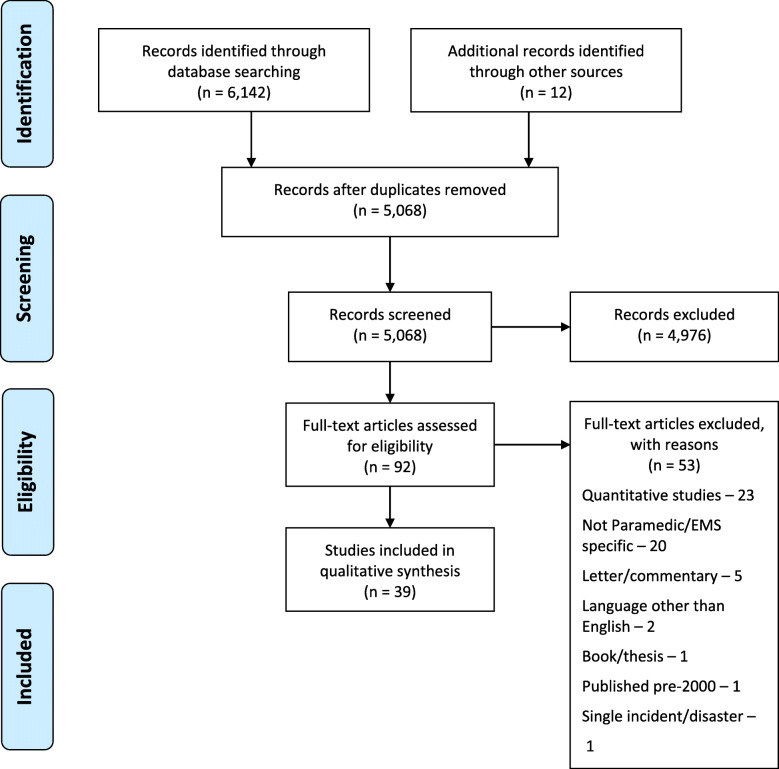
Background: High rates of mental distress, mental illness, and the associated physical effects of psychological injury experienced by ambulance personnel has been widely reported in quantitative research. However, there is limited understanding of how the nature of ambulance work contributes to this problem, the significant large toll that emergency medical response takes on the individual, and particularly about late and cumulative development of work-related distress among this first responder workforce. Methods: This study examined peer-reviewed qualitative research published from 2000 to 2018 to outline the effect of emergency medical response work on the psychological, psychosocial, and physical health of paramedics, ambulance officers, ambulance volunteers, and call-takers. Databases searched included: Ovid Medline, CINAHL, Ovid EMcare, PsychInfo and Scopus. The systematic review was organised around five key areas: impact of the work on psychological wellbeing; impact of psychological stress on physical wellbeing; how work-related well-being needs were articulated; effects of workflow and the nature of the work on well-being; and, effects of organisational structures on psychological and physical well-being. Results: Thirty-nine articles met the eligibility criteria. Several factors present in the day-to-day work of ambulance personnel, and in how organisational management acknowledge and respond, were identified as being significant and contributing to mental health and well-being, or increasing the risk for developing conditions such as PTSD, depression, and anxiety. Ambulance personnel articulated their well-being needs across four key areas: organisational support; informal support; use of humour; and individual mechanisms to cope such as detachment and external supports. Conclusions: Interactions between critical incidents and workplace culture and demands have an overwhelming impact on the psychological, physical and social well-being of ambulance personnel. These include day-to-day managerial actions and responses, the impact of shift work, poorly-managed rosters, and long hours of work with little time between for recovery. Mental health issues result from exposure to traumatic events, and the way managers and peers respond to worker distress. Ambulance personnel suffering from work-related stress feel abandoned by peers, management, and the service, during illness, in return-to-work, and post-retirement. Policy, programmes and interventions, and education need to occur at an individual, peer, organisational, and government level.
Overview
The claims and statistics of this paper haven’t been checked yet.
Free: it reads the open-access text and checks the first 5 claims that cite a source we can check. Create a free account to check every claim.
Integrity signals
Registry
Cites
Statistics
Figures
Verification
Claims the paper makes
The claims and statistics of this paper haven’t been checked yet.
Free: it reads the open-access text and checks the first 5 claims that cite a source we can check. Create a free account to check every claim.
Claims other papers make about this one
Each is checked against this paper’s own text: does it say what the citing paper says it does?
The cited source doesn’t support the claim as written.
In the citing paper
“with a very limited understanding in the literature of the key elements within the profession that contribute to the issue.”
From Understanding the Occupational Factors that Influence Paramedic Health and Wellbeing (2024) · cites this paper as Lawn et al., 2020
Checked by a reasoning model — may be wrong.
Experimental — accuracy not yet measuredThe source backs part of the claim, not all of it — or backs it for a different population, condition or comparison.
In the citing paper
“From a healthcare service perspective, emergency medical services (EMS) is a specific context; paramedics are often highly trained healthcare professionals on the front lines, involving autonomous decision making with limited outside hospital resources while working in unpredictable environments under emotional pressure [5–7].”
From Paramedics’ perceptions of job demands and resources in Finnish emergency medical services: a qualitative study (2022) · cites this paper as [7]
Experimental — accuracy not yet measuredThe source backs part of the claim, not all of it — or backs it for a different population, condition or comparison.
In the citing paper
“Lawn et al. (2020) further explain a high prevalence of physical and psychological ailments experienced by the paramedic workforce ultimately negatively impacting their wellbeing”
From Understanding the Occupational Factors that Influence Paramedic Health and Wellbeing (2024) · cites this paper as Lawn et al., 2020
Experimental — accuracy not yet measuredThe cited source says what the claim attributes to it.
In the citing paper
“All the while, paramedics are confronted with a variety of stressful elements [7, 8] or job demands”
From Paramedics’ perceptions of job demands and resources in Finnish emergency medical services: a qualitative study (2022) · cites this paper as [7]
The cited source says what the claim attributes to it.
In the citing paper
“Meanwhile, individual performance pressure [25], conflicts of an ethical nature [26] and social pressures [7], as well as continuously occurring emotional patient encounters [27], seem to be inherent phenomena within the EMS profession.”
From Paramedics’ perceptions of job demands and resources in Finnish emergency medical services: a qualitative study (2022) · cites this paper as [7]
3 more claims about this paper
Create a free account to see every claim other papers make about this one.
Self-check
Percentages, sums and reported differences re-computed from the paper’s own numbers.
The self-check needs the paper’s full text.
Citations
Cites
Utilization of the PICO framework to improve searching PubMed for clinical questions
Schardt, C., Adams, M. B., Owens, T., Keitz, S., & Fontelo, P. (2007) · BMC Medical Informatics and Decision Making · doi:10.1186/1472-6947-7-16 · Cited by 3,053
Popay, J., Roberts, H., Sowden, A., Petticrew, M., Arai, L., Rodgers, M., Britten, N., Roen, K., & Duffy, S. (2006) · Lancaster University · doi:10.13140/2.1.1018.4643 · Cited by 2,070
Mental Disorder Symptoms among Public Safety Personnel in Canada
Carleton, R. N., Afifi, T. O., Turner, S., Taillieu, T., Duranceau, S., LeBouthillier, D. M., Sareen, J., Ricciardelli, R., MacPhee, R. S., Groll, D., et al. (2018) · The Canadian Journal of Psychiatry · doi:10.1177/0706743717723825 · Cited by 558
Exposure to human tragedy, empathy, and trauma in ambulance paramedics.
Regehr, C., Goldberg, G., & Hughes, J. (2002) · American Journal of Orthopsychiatry · doi:10.1037/0002-9432.72.4.505 · Cited by 382
Petrie, K., Milligan-Saville, J., Gayed, A., Deady, M., Phelps, A., Dell, L., Forbes, D., Bryant, R. A., Calvo, R. A., Glozier, N., et al. (2018) · Social Psychiatry and Psychiatric Epidemiology · doi:10.1007/s00127-018-1539-5 · Cited by 382
Health status in the ambulance services: a systematic review
Sterud, T., Ekeberg, Ø., & Hem, E. (2006) · BMC Health Services Research · doi:10.1186/1472-6963-6-82 · Cited by 271
Work-related post-traumatic stress disorder
Skogstad, M., Skorstad, M., Lie, A., Conradi, H. S., Heir, T., & Weisaeth, L. (2013) · Occupational Medicine · doi:10.1093/occmed/kqt003 · Cited by 252
Multiple Dimensions of Work Intensity: Ambulance Work as Edgework
Granter, E., Wankhade, P., McCann, L., Hassard, J. S., & Hyde, P. (2018) · Work Employment and Society · doi:10.1177/0950017018759207 · Cited by 165
Posttraumatic stress disorder in police, firefighters, and emergency dispatchers
Klimley, K. E., Van Hasselt, V. B., & Stripling, A. M. (2018) · Aggression and Violent Behavior · doi:10.1016/j.avb.2018.08.005 · Cited by 159
Lewis-Schroeder, N. F., Kieran, K., Murphy, B. L., Wolff, J. D., Robinson, M. A., & Kaufman, M. L. (2018) · Harvard Review of Psychiatry · doi:10.1097/hrp.0000000000000176 · Cited by 132
Halpern, J., Gurevich, M., Schwartz, B., & Brazeau, P. (2009) · Work & Stress · doi:10.1080/02678370903057317 · Cited by 124
Hegg-Deloye, S., Brassard, P., Jauvin, N., Prairie, J., Larouche, D., Poirier, P., Tremblay, A., & Corbeil, P. (2014) · Emergency Medicine Journal · doi:10.1136/emermed-2012-201672 · Cited by 121
Exploring the nature of resilience in paramedic practice: A psycho-social study
Clompus, S. R., & Albarran, J. W. (2016) · International Emergency Nursing · doi:10.1016/j.ienj.2015.11.006 · Cited by 113
Occupational Risk Factors in the Emergency Medical Services
Donnelly, E., & Siebert, D. (2009) · Prehospital and Disaster Medicine · doi:10.1017/s1049023x00007251 · Cited by 107
Guilt, shame and need for a container: a study of post-traumatic stress among ambulance personnel
Jonsson, A., & Segesten, K. (2004) · Accident and Emergency Nursing · doi:10.1016/j.aaen.2004.05.001 · Cited by 101
Situation critical: High demand, low control, and low support in paramedic organizations.
Regehr, C., & Millar, D. (2007) · Traumatology · doi:10.1177/1534765607299912 · Cited by 99
Golding, S. E., Horsfield, C., Davies, A., Egan, B., Jones, M. C., Raleigh, M., Schofield, P., Squires, A. P., Start, K., Quinn, T., et al. (2017) · PeerJ · doi:10.7717/peerj.3735 · Cited by 97
First responder mental healthcare: Evidence-based prevention, postvention, and treatment.
Lanza, A. M., Roysircar, G., & Rodgers, S. E. (2018) · Professional Psychology Research and Practice · doi:10.1037/pro0000192 · Cited by 95
Interventions for critical incident stress in emergency medical services: a qualitative study
Halpern, J., Gurevich, M., Schwartz, B., & Brazeau, P. (2009) · Stress and Health · doi:10.1002/smi.1230 · Cited by 86
Pow, J., King, D. B., Stephenson, E., & DeLongis, A. (2017) · Journal of Occupational Health Psychology · doi:10.1037/a0040107 · Cited by 81
Paramedics’ Experiences and Coping Strategies When Encountering Critical Incidents
Avraham, N., Goldblatt, H., & Yafe, E. (2014) · Qualitative Health Research · doi:10.1177/1049732313519867 · Cited by 78
Operators' experiences of emergency calls
Forslund, K., Kihlgren, A. L., & Kihlgren, M. (2004) · Journal of Telemedicine and Telecare · doi:10.1258/1357633042026323 · Cited by 75
Adams, K., Shakespeare-Finch, J., & Armstrong, D. (2015) · Journal of Loss and Trauma · doi:10.1080/15325024.2014.949141 · Cited by 73
Development of a critical incident stress inventory for the emergency medical services.
Donnelly, E. A., & Bennett, M. (2014) · Traumatology: An International Journal · doi:10.1177/1534765613496646 · Cited by 73
The bargaining of professionalism in emergency care practice: NHS paramedics and higher education
Givati, A., Markham, C., & Street, K. (2018) · Advances in Health Sciences Education · doi:10.1007/s10459-017-9802-1 · Cited by 73
Paramedics and the effects of shift work on sleep: a literature review: Table 1
Sofianopoulos, S., Williams, B., & Archer, F. (2012) · Emergency Medicine Journal · doi:10.1136/emj.2010.094342 · Cited by 71
Larsson, G., Berglund, A. K., & Ohlsson, A. (2016) · Scandinavian Journal of Psychology · doi:10.1111/sjop.12303 · Cited by 64
Fatigue and mental health in Australian rural and regional ambulance personnel
Pyper, Z., & Paterson, J. L. (2016) · Emergency Medicine Australasia · doi:10.1111/1742-6723.12520 · Cited by 55
What paramedics think about when they think about fatigue: Contributing factors
Paterson, J. L., Sofianopoulos, S., & Williams, B. A. (2014) · Emergency Medicine Australasia · doi:10.1111/1742-6723.12216 · Cited by 52
Wolkow, A., Ferguson, S., Aisbett, B., & Main, L. (2015) · International Journal of Occupational Medicine and Environmental Health · doi:10.13075/ijomeh.1896.00227 · Cited by 50
Dropkin, J., Moline, J. M., Power, P. M., & Kim, H. S. (2015) · Work · doi:10.3233/wor-152139 · Cited by 50
Treating Psychological Trauma in First Responders: A Multi-Modal Paradigm
Flannery, R. B. (2015) · Psychiatric Quarterly · doi:10.1007/s11126-014-9329-z · Cited by 50
Coxon, A., Cropley, M., Schofield, P., Start, K., Horsfield, C., & Quinn, T. (2016) · Emergency Medicine Journal · doi:10.1136/emermed-2015-204841 · Cited by 46
Waddell, E., Lawn, S., Roberts, L., Henderson, J., Venning, A., & Redpath, P. (2020) · Health & Social Care in the Community · doi:10.1111/hsc.12998 · Cited by 46
Self-citationExploring physical health perceptions, fatigue and stress among health care professionals
Rice, V., Glass, N., Ogle, R., & Parsian, N. (2014) · Journal of Multidisciplinary Healthcare · doi:10.2147/jmdh.s59462 · Cited by 45
Work-Family Fit: The Impact of Emergency Medical Services Work on the Family System
Roth, S. G., & Moore, C. D. (2009) · Prehospital Emergency Care · doi:10.1080/10903120903144791 · Cited by 41
Management and the creation ofoccupational stressors in an Australian and a UK Ambulance Service
Mahony, K. L. (2001) · Australian Health Review · doi:10.1071/ah010135a · Cited by 34
(2007) · PubMed · Cited by 33
Research into Australian emergency services personnel mental health and wellbeing: An evidence map
Varker, T., Metcalf, O., Forbes, D., Chisolm, K., Harvey, S., Van Hooff, M., McFarlane, A., Bryant, R., & Phelps, A. J. (2018) · Australian & New Zealand Journal of Psychiatry · doi:10.1177/0004867417738054 · Cited by 31
Hugelius, K., Berg, S. W., Westerberg, E., Gifford, M., & Adolfsson, A. (2014) · Prehospital and Disaster Medicine · doi:10.1017/s1049023x14001071 · Cited by 30
Wiitavaara, B., Lundman, B. M., Barnekow‐Bergkvist, M., & Brulin, C. (2006) · International Journal of Nursing Studies · doi:10.1016/j.ijnurstu.2006.02.007 · Cited by 27
Occupational and Organizational Issues in Emergency Medical Services Behavioral Health
Gist, R., & Taylor, V. H. (2008) · Journal of Workplace Behavioral Health · doi:10.1080/15555240802243120 · Cited by 24
Mindfulness-based psychotherapy approaches for first responders: from research to clinical practice
Chopko, B. A., Papazoglou, K., & Schwartz, R. C. (2018) · American Journal of Psychotherapy · doi:10.1176/appi.psychotherapy.20180015 · Cited by 21
Retirement Policies and Support for Emergency Service Personnel: The Transition to Retirement
Bracken-Scally, M., McGilloway, S., & Mitchell, J. T. (2016) · Canadian Journal on Aging / La Revue canadienne du vieillissement · doi:10.1017/s0714980816000210 · Cited by 18
Willis, E., Lawn, S., Roberts, L., Couzner, L., Mohammadi, L., & Goble, E. (2020) · Australasian Journal of Paramedicine · doi:10.33151/ajp.17.801 · Cited by 15
Self-citationRestructuring and the production of occupational stressors in a corporatised ambulance service
Mahony, K. (2005) · Health Sociology Review · doi:10.5172/hesr.14.1.84 · Cited by 13
A Cognitive Behavioral Model of First Responder Posttraumatic Stress Disorder
Cheng, M. K.-F., Joseph, J., & Ferguson, D. (2018) · Journal of Cognitive Psychotherapy · doi:10.1891/0889-8391.32.3.184 · Cited by 13
Ambulance officers: the impact of exposure to occupational violence on mental and physical health
Mayhew, C., & Chappell, D. (2009) · bepress Legal Repository · Cited by 8
Wellbeing Across Occupations and in the Emergency Services: a Mixed Methods Study
Hamling, K. (2018) · Tuwhera (Auckland University of Technology) · Cited by 8
A new development in PTSD and the law: The case of Fairfax County v. Mottram
Lindahl, M. W. (2004) · Journal of Traumatic Stress · doi:10.1007/s10960-004-5804-x · Cited by 7
Improving referral to psychological support unit at Saudi Red Crescent Authority in Riyadh Region
Alzahrani, A. Y., Mahmod, S. A. A., Bakhamis, T. M., & Al-Surimi, K. M. (2017) · BMJ Open Quality · doi:10.1136/bmjoq-2017-000089 · Cited by 5
Beyond the debriefing debate: what should we be doing?
Bledsoe, B. E., & Barnes, D. (2003) · PubMed · Cited by 2
Research works printed but not linked: 3
- Phoenix Australia. St John Ambulance review of workplace mental health risks [Internet]. Melbourne, Australia: University of Melbourne;. p. 88. [cited 2019 Mar 22]. https://stjohnwacomau/docs/default-source/corporate-publications/phoenix-reportpdf?sfvrsn=2. Accessed 7 June 2019.
- Critical Appraisal Skills Program (CASP). Systematic review checklist 2018. https://casp-uk.net/. Accessed 7 June 2019.
- Goble EA The culture of coping in paramedics (doctoral dissertation) 2020 Adelaide Flinders University
Cited by
Factors preceding occupational distress in emergency nurses: An integrative review
Caulfield, R., Wiseman, T., Gullick, J. G., & Ogilvie, R. (2022) · Journal of Clinical Nursing · doi:10.1111/jocn.16461 · Cited by 94
Cameron, G., Mulvenna, M. D., Ennis, E., O’Neill, S. M., Bond, R., Cameron, D., & Bunting, A. (2024) · JMIR Mental Health · doi:10.2196/67785 · Cited by 81
de Lyra, R. L., McKenzie, S., Every‐Palmer, S., & Jenkin, G. L. S. (2021) · PLoS ONE · doi:10.1371/journal.pone.0251038 · Cited by 77
“Attending suicide calls is one of the critical incidents ambulance personnel describe as leading to an emotional toll and therefore contributes to their mental health and well-being [12].”
BackgroundHuang, G., Chu, H., Chen, R., Liu, D., Banda, K. J., O’Brien, A. P., Jen, H.-J., Chiang, K.-J., Chiou, J.-F., & Chou, K.-R. (2022) · Journal of Global Health · doi:10.7189/jogh.12.05028 · Cited by 64
Strandås, M., Vizcaya-Moreno, M. F., Ingstad, K., Sepp, J., Linnik, L., & Vaismoradi, M. (2024) · Journal of Multidisciplinary Healthcare · doi:10.2147/jmdh.s460194 · Cited by 64
Metadata
- Authors
- Lawn, S., Roberts, L., Willis, E., Couzner, L., Mohammadi, L., & Goble, E.
- Affiliations
- Flinders University (AU)
- Corresponding author
- Lawn, Sharon
- Venue
- BMC Psychiatry
- Published
- 2020-07-03
- Volume
- 20
- Issue
- 1
- Pages
- 348-348
- ISSN
- 1471-244X (ISSN-L)
- PMC
- PMC7332532
- OpenAlex
- W3038825886
- Cited by
- 304
- References
- 53
- Citations by year
- 2026: 43 · 2025: 67 · 2024: 71 · 2023: 47 · 2022: 48 · 2021: 26 · 2020: 2
- FWCI
- 7.56
- Type
- journal article
- Language
- en
- Open access
- gold
- doi.org
- Licence
- cc-by
- creativecommons.org/licenses/by/4.0 (tdm)
- creativecommons.org/licenses/by/4.0 (vor)
- Locations
- BMC Psychiatry (publishedVersion, cc-by)
- PubMed Central (publishedVersion, cc-by)
- PubMed (publishedVersion)
- Acquire (CQUniversity) (submittedVersion, cc-by)
- DOAJ (DOAJ: Directory of Open Access Journals) (submittedVersion, cc-by-sa)
- Figshare (submittedVersion, cc-by)
- Funders
- Ambulance Employees Association of South Australia (NA)
- Topics
- Health Sciences › Medicine › Public Health, Environmental and Occupational Health › Occupational Health and Performance
- Health Sciences › Medicine › Public Health, Environmental and Occupational Health › Occupational Health and Burnout
- Social Sciences › Psychology › Social Psychology › Stress and Burnout Research
- Keywords
- ambulance personnel, paramedics, emergency medical services, occupational stress, psychological well-being, physical health, social well-being, post-traumatic stress disorder, depression, anxiety, shift work, rostering, organizational support, organizational culture, coping strategies, return to work, first responders
- MeSH terms
- Occupational Stress, Allied Health Personnel, Ambulances, Emergency Medical Services, Health Status, Humans, Mental Health, Volunteers, Organizational Culture, Qualitative Research
About these checks
Registry, retraction, Cites and statistics results are computed, not judged, with one exception: a printed reference that no index lists is read once by a model before it counts as a citation error. Claims are extracted by a model and kept only when their quote appears verbatim in the text; each cited source is then checked, with a model’s help, for whether it says what the claim relies on. Those verdicts can be wrong — read the claim’s quote and the cited source before relying on one.
Statistics and arithmetic are recomputed, not judged.
Confidence bands are shown only for fields calibrated on our annotated test set. None is calibrated yet, so no band is shown.
What counts as a claim ›How we measure confidence ›How we check this ›
Are you an author, or do you see a problem with this page? Request a review
Data sources
Bibliographic data: Semantic Scholar, OpenAlex, Crossref.
Contains information from the Semantic Scholar Academic Graph Datasets, made available under the ODC Attribution License (ODC-BY 1.0).
Semantic Scholar’s data is described in: Kinney, R., et al. (2023). The Semantic Scholar Open Data Platform. arXiv:2301.10140.
