

Assessing psychological adjustment and cultural reintegration after military service: development and psychometric evaluation of the post-separation Military-Civilian Adjustment and Reintegration Measure (M-CARM)
Open accessThe DOI matches its Crossref record; 43 of the 43 references it cites were found in a registry or an index.
Abstract
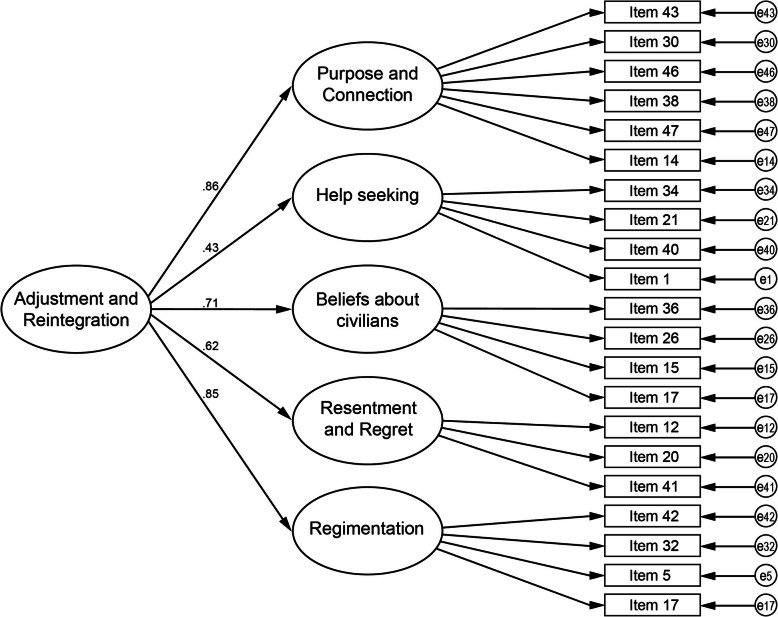
Background: The transition out of military service and subsequent reintegration to civilian life has been established as a period associated with an increased risk of psychological adjustment difficulties, psychiatric disorders and suicide risk, yet no tool exists to measure cultural and psychological adjustment following permanent separation from the military. This study describes the two-phase mixed-methods development and validation of the self-report Military-Civilian Adjustment and Reintegration Measure (M-CARM). Methods: In Phase I, four focus groups (n = 20) and semi-structured one-on-one interviews (n = 80) enabled thematic analysis and generation of 53 initial items that were reviewed by an expert multidisciplinary panel (n = 12) and piloted for clarity and relevance in an Australian service-veteran sample (n = 11). In Phase II, psychometric properties of the 47 items resulting from Phase I were evaluated with online assessment of a convenience sample of transitioned Australian Defence Force veterans (n = 725). Analyses included exploratory and confirmatory factor analyses, as well as evaluation of test-retest reliability, internal consistency, and convergent, divergent and discriminant validity. Results: Exploratory factor analysis on a randomized split-half sample (n = 357), resulted in a 21-item, five-factor solution of Purpose and Connection, Help seeking, Beliefs about civilians, Resentment and regret, and Regimentation, explaining 53.22% of the variance. Confirmatory factor analysis (n = 368) verified this factor structure without modification (χ2 = 304.96, df = 160; CFI = .96, TLI = .94, NFI = .91, RMSEA = .05). Strong convergent, divergent and discriminant validity was demonstrated as M-CARM scores significantly correlated with related constructs assessed by standardised clinical measures as well as differentiated groups based on three binary reintegration items, with large effect sizes (d = > 1). Strong test-retest reliability for the total score (n = 186, r = .93) and excellent internal consistency (n = 725, a = .90) were also found. Conclusions: Results provide promising evidence the M-CARM is a valid, reliable measure of psychological and cultural reintegration to civilian life, with potential for considerable clinical and research application.
Overview
The claims and statistics of this paper haven’t been checked yet.
Free: it reads the open-access text and checks the first 5 claims that cite a source we can check. Create a free account to check every claim.
Integrity signals
Registry
Cites
Statistics
Figures
Verification
Claims the paper makes
The claims and statistics of this paper haven’t been checked yet.
Free: it reads the open-access text and checks the first 5 claims that cite a source we can check. Create a free account to check every claim.
Claims other papers make about this one
Each is checked against this paper’s own text: does it say what the citing paper says it does?
The source backs part of the claim, not all of it — or backs it for a different population, condition or comparison.
In the citing paper
“Results also revealed that lower scores on each of these factors (i.e. more difficulties in that area) were significantly associated with higher mental health symptoms, lower quality of life, reduced functioning and poorer self-reported adjustment overall [5].”
From Feasibility, acceptability, and initial outcomes of a psychological adjustment and reintegration program for transitioned military veterans (2024) · cites this paper as [5]
Experimental — accuracy not yet measuredThe source backs part of the claim, not all of it — or backs it for a different population, condition or comparison.
In the citing paper
“between 48% and 78% among Australian veterans [4, 5]”
From Feasibility, acceptability, and initial outcomes of a psychological adjustment and reintegration program for transitioned military veterans (2024) · cites this paper as [5]
Experimental — accuracy not yet measuredThe source backs part of the claim, not all of it — or backs it for a different population, condition or comparison.
In the citing paper
“Difficulties with adjustment and reintegration are associated with poorer outcomes in mental health [5], social and family relationships [1, 9–11], employment and financial security [1,2,12), physical health [12] and stable housing [13, 14].”
From Feasibility, acceptability, and initial outcomes of a psychological adjustment and reintegration program for transitioned military veterans (2024) · cites this paper as [5]
Experimental — accuracy not yet measuredThe cited source says what the claim attributes to it.
In the citing paper
“The measure has strong psychometric properties [5].”
From Feasibility, acceptability, and initial outcomes of a psychological adjustment and reintegration program for transitioned military veterans (2024) · cites this paper as [5]
Self-check
Percentages, sums and reported differences re-computed from the paper’s own numbers.
The self-check needs the paper’s full text.
Citations
Cites
Hu, L., & Bentler, P. M. (1999) · Structural Equation Modeling A Multidisciplinary Journal · doi:10.1080/10705519909540118 · Cited by 108,788 · cited 1×
“90 and above indicate excellent fit to the data [47, 48].”
BackgroundCoefficient Alpha and the Internal Structure of Tests
Cronbach, L. J. (1951) · Psychometrika · doi:10.1007/bf02310555 · Cited by 43,931
Alternative Ways of Assessing Model Fit
Browne, M. W., & Cudeck, R. (1992) · Sociological Methods & Research · doi:10.1177/0049124192021002005 · Cited by 27,200
Comparative fit indexes in structural models.
Bentler, P. M. (1990) · Psychological Bulletin · doi:10.1037/0033-2909.107.2.238 · Cited by 25,266
Significance tests and goodness of fit in the analysis of covariance structures.
Bentler, P. M., & Bonett, D. G. (1980) · Psychological Bulletin · doi:10.1037//0033-2909.88.3.588 · Cited by 19,023 · cited 1×
“90 and above indicate excellent fit to the data [47, 48].”
Background(2017) · Cited by 16,319
Lovibond, P. F., & Lovibond, S. H. (1995) · Behaviour Research and Therapy · doi:10.1016/0005-7967(94)00075-u · Cited by 14,523 · cited 7×
“Strong correlations were found between the M-CARM and the DASS-21 Depression subscale (r = −.71), and the WRFIS (r = −.70) and moderate correlations with the Physical (r = .66), Social relationships (r = .62) and Environmental (r = .68) subscales of the WHO-QOL as well as the Stress (r = −.66) and Anxiety (r = −.59) s…”
BackgroundInfluentialApplied Multivariate Statistics for the Social Sciences
Stevens, J. P. (2012) · Routledge eBooks · doi:10.4324/9780203843130 · Cited by 10,648
(2014) · Medical Entomology and Zoology · Cited by 6,828
Blevins, C. A., Weathers, F. W., Davis, M. T., Witte, T. K., & Domino, J. L. (2015) · Journal of Traumatic Stress · doi:10.1002/jts.22059 · Cited by 5,233
Research works printed but not linked: 10
- Castro CA Dursun S Military veteran reintegration: approach, management, and assessment of military veterans transitioning to civilian life: academic press 2019
- Shields D Kuhl D Lutz K Frender J Baumann N Lopresti P Mental health and well-being of military veterans during the military to civilian transition: review and analysis of the recent literature 2016 Vancouver BC Report prepared for Veterans Affairs Canada and the Canadian Institute for Military and Veteran Health Research
- Taylor P Morin R Parker K Cohn DV Funk C Mokrzycki M War and sacrifice in the Post-9/11 era 2011 Pew Research Center The Military-Civilian Gap
- Van Til L Macintosh S Thompson J 2013 synthesis of life after service studies: veterans affairs Canada 2015
- Foreign Affairs Defence and Trade References Committee The constant battle: Suicide by veterans. Department of the Senate, Australian Government 2017
- Productivity Commission A better way to support veterans: Overview and recommendations (No. 93) 2019
- Department of Defence Defence Annual Report 2018–19. Australian Government 2019
- World Health Organization The world health organization quality of life (WHOQOL)-BREF. World Health Organization 2004
- Arbuckle JL Amos (version 21) 2012 Chicago SPSS
- International Ministerial 5-Eyes Conference on Veterans' Issues London 2017 [Internet]. Department of Veterans’ Affairs; 2017, July 21. Available from: http://minister.dva.gov.au/media_releases/2017/jul/5eyes.htm. Accessed 5 Nov 2019.
Cited by
Rattray, N. A., Flanagan, M., Salyers, M. P., Natividad, D. M., Do, A.-N., Frankel, R. M., Spontak, K., & Kukla, M. (2023) · Journal of Veterans Studies · doi:10.21061/jvs.v9i1.432 · Cited by 35
Veteran families with complex needs: a qualitative study of the veterans’ support system
Maguire, A. M., Keyser, J., Brown, K., Kivlahan, D. R., Romaniuk, M., Gardner, I. R., & Dwyer, M. (2022) · BMC Health Services Research · doi:10.1186/s12913-021-07368-2 · Cited by 32
Self-citationReintegration potential of veterans as a factor of successful reintegration of them into society
Захаріна, Т. І. (2023) · Social work and education · doi:10.25128/2520-6230.23.3.1 · Cited by 26
Geraci, J. C., Finley, E. P., Edwards, E. R., Frankfurt, S. B., Kurz, A. S., Kamdar, N. P., Vanneman, M. E., Lopoo, L. M., Patnaik, H. A., Yoon, J., et al. (2022) · Implementation Science · doi:10.1186/s13012-022-01212-9 · Cited by 20
“The M2C-Q was initially validated in a sample of Iraq and Afghanistan Veterans seeking VA healthcare services [54] and has since shown strong construct validity and internal reliability in numerous Veteran samples [10, 53].”
BackgroundRomaniuk, M., Kidd, C., Banfield, M., & Batterham, P. J. (2022) · Journal of Employment Counseling · doi:10.1002/joec.12199 · Cited by 19
Self-citationMcGlinchey, E., Spikol, E., Robinson, M., Ross, J., & Armour, C. (2024) · Journal of Military Veteran and Family Health · doi:10.3138/jmvfh-2023-0066 · Cited by 11
Kerr, N. C., Lane, S. J., Plotnikoff, R. C., & Ashby, S. (2023) · Journal of Veterans Studies · doi:10.21061/jvs.v9i1.407 · Cited by 10
Romaniuk, M., Fisher, G., Sunderland, M., & Batterham, P. J. (2023) · BMC Psychiatry · doi:10.1186/s12888-023-05032-z · Cited by 9
“The measure has excellent psychometric properties [6, 10].”
InfluentialSelf-citationRomaniuk, M., Saunders-Dow, E., Brown, K., & Batterham, P. J. (2024) · BMC Psychology · doi:10.1186/s40359-024-02097-7 · Cited by 7
“The measure has strong psychometric properties [5].”
BackgroundInfluentialSelf-citationCarra, K., Curtin, M., Fortune, T., & Gordon, B. (2023) · Military Psychology · doi:10.1080/08995605.2022.2120312 · Cited by 7
“, 2021) and others reporting no significant differences (Katz et al., 2010; MacLean et al., 2014; Romaniuk et al., 2020).”
BackgroundVeteran Perspectives on Family-Serving Recreation and Leisure Programs
Hicks, N. R., Sharaievska, I., Tsykalova, L., Townsend, J., & Miller, B. L. (2025) · Journal of Veterans Studies · doi:10.21061/jvs.v11i1.675 · Cited by 6
Carra, K. A., Curtin, M., Fortune, T., & Gordon, B. A. (2023) · Australian Occupational Therapy Journal · doi:10.1111/1440-1630.12858 · Cited by 6
Coppel, D. B., Barber, J. K., Temkin, N. R., & Donald, C. L. M. (2023) · Military Medicine · doi:10.1093/milmed/usad378 · Cited by 6
Alichniewicz, K., Hampton, S., Romaniuk, M., Bennett, D., & Guindalini, C. (2025) · JMIR Formative Research · doi:10.2196/60868 · Cited by 5
“…is based on previous research describing empirically derived psychological and cultural factors associated with adjustment and reintegration to civilian life, including (1) Purpose and Connection, (2) Help Seeking, (3) Beliefs About Civilians, (4) Resentment and Regret, and (5) Regimentation [18].”
InfluentialSelf-citationHiggins, A. (2025) · Journal of Veterans Studies · doi:10.21061/jvs.v11i2.758 · Cited by 5
Hodges, T. J., Bharwani, N. K., Manley, E., & Rodriguez, D. X. (2025) · Journal of Veterans Studies · doi:10.21061/jvs.v11i1.678 · Cited by 4
Reintegration of cyber veterans: challenges and strategies for post-war transition
Virtanen, T., Lassfolk, C., Davydiuk, A., & Noorma, M. (2024) · Frontiers in Psychology · doi:10.3389/fpsyg.2024.1373245 · Cited by 4
Batterham, P. J., Martin, M., Calear, A. L., Cherbuin, N., Romaniuk, M., Banfield, M., Butterworth, P., Burvill, M., & Massang, D. (2024) · Journal of Evaluation in Clinical Practice · doi:10.1111/jep.14085 · Cited by 4
Self-citationComputerised health interventions targeting Australian veterans and their families: A scoping review
McMahon, B., Guindalini, C., & Mellor, R. (2023) · Health Promotion Journal of Australia · doi:10.1002/hpja.832 · Cited by 4
Павловська-Кравчук, В. А. (2025) · Журнал соціальної та практичної психології · doi:10.32782/psy-2025-6-19 · Cited by 3
Prévost, D., Corbière, M., Lachance, J.-P., Lecomte, T., Wong, M., & Lysaker, P. H. (2025) · Disability and Rehabilitation · doi:10.1080/09638288.2025.2492310 · Cited by 2
“Examples include The Army post-deployment reintegration scale [32] and The Post-separation military-civilian adjustment and reintegration measure [33] that evaluate the impact on work and family and adjustment.”
“Have You Ever Served?”: Implications for Radiology Nurses Caring for Veterans
Schwartz, L. S., & Tackett, M. K. (2024) · Journal of Radiology Nursing · doi:10.1016/j.jradnu.2023.12.006 · Cited by 1
American Legion Participation Among Incarcerated Veterans
Stacer, M. J., & Solinas‐Saunders, M. (2024) · Victims & Offenders · doi:10.1080/15564886.2024.2389414 · Cited by 1
“…2007), with experts asserting that detachment from one’s unit can be destabilizing and lead to a host of negative consequences for veterans of the armed forces, due to difficulties in readjusting to civilian life or the presence of mental health disorders (Messecar, 2017; Romaniuk et al., 2020).”
Lina, Z., Zhang, M., Zhang, Z. L., & Guo, H. (2026) · Frontiers in Psychology · doi:10.3389/fpsyg.2026.1853613 · Cited by 1
“Existing empirical evidence suggests that many veterans experience reintegration difficulties, and these challenges are closely related to post-service occupational conditions (Romaniuk and Kidd, 2018; Romaniuk et al., 2020; Sayer et al., 2011).”
Mental health conditions among Australian defence force veterans: A systematic scoping review
Seymour, M., Parrella, N.-F., McFARLANE, A. C., Trew, S., Giallo, R., Main, L. C., Allender, S. E., Fogarty, A., Olsson, C. A., Sengelman, J. J., et al. (2026) · Australian & New Zealand Journal of Psychiatry · doi:10.1177/00048674261490047 · Cited by 1
Violence at Work: Reducing Assault and Abuse Experienced by Frontline Staff in Public Service Roles
Munns, S. (2023) · ANU Open Research (Australian National University) · doi:10.25911/4bak-z036 · Cited by 4
Laaksonen-Sherrin, S. (2025) · UNSWorks (University of New South Wales, Sydney, Australia) · doi:10.26190/unsworks/31563 · Cited by 1
蛋白関係 酸可溶性糖蛋白(ASP) (広範囲 血液・尿化学検査,免疫学的検査(第7版・1)その数値をどう読むか) -- (生化学的検査(1))
大谷, 慎. (2009) · 日本臨床
Slapakova, L., Bryan, E., Eken, M., & Dewaele, L. (2024) · RAND Corporation eBooks · doi:10.7249/rra2163-1
The Impact of Adversity on Body Mass Index as Veterans Transition to Civilian Life
McCarthy, K. J., Morgan, N. R., Aronson, K. R., Rudi, J. H., & Perkins, D. F. (2024) · Military Medicine · doi:10.1093/milmed/usae433
Geraci, J. C., Finley, E. P., Edwards, E. R., Frankfurt, S., Kurz, A. S., Kamdar, N., Vanneman, M. E., Lopoo, L. M., Patnaik, H. A., Yoon, J., et al. (2022) · Figshare · doi:10.6084/m9.figshare.20279254
Romaniuk, M., Fisher, G., Sunderland, M., & Batterham, P. J. (2023) · Figshare · doi:10.6084/m9.figshare.23908840
Self-citationNajar-Cabrera, A. (2023) · ScholarWorks (Walden University) · Cited by 1
Thiemke, K. (2024) · UWM Digital Commons (University of Wisconsin–Milwaukee)
Romaniuk, M. (2025) · ANU Open Research (Australian National University) · doi:10.25911/pat7-h143
Self-citationOperation Red-White-Blue: A Community Engagement Project Supporting Veteran Mental Health
Torres, A., & Krause‐Parello, C. A. (2026) · Journal of Community Engagement and Scholarship · doi:10.54656/ttx9dj47
Moral injury events, pain intensity, and functional mobility in post-9/11 U.S. combat veterans
Wild, M. G., Coppin, J. D., Greer, D., Mendoza, C., Herbert, M. S., Creech, S. K., & Frankfurt, S. B. (2026) · Journal of Pain · doi:10.1016/j.jpain.2026.106287
Perry, T. R. (2026) · Scholars Crossing (Liberty University) · Cited by 2
Verkamp, K. M., Angel, C. M., Richardson, W. F., Flores, B. E., Restrepo, M., & Berndt, A. (2026) · Military Psychology · doi:10.1080/08995605.2026.2659392
Alichniewicz, K., Fisher, G., Tabinga, A., & Guindalini, C. (2026) · Australian Journal of Psychology · doi:10.1080/00049530.2026.2664166
“…need for empirically grounded assessment of reintegration challenges, the Military to Civilian Adjustment and Reintegration Measure (M-CARM) was developed to assess key determinants of successful transition, with particular emphasis on cultural and psychological adjustment (Romaniuk et al., 2020).”
InfluentialSelf-citationRattray, N. A., Flanagan, M., Frankel, R. M., & Kukla, M. (2026) · Frontiers in Rehabilitation Sciences · doi:10.3389/fresc.2026.1720234
“The M2C-Q was developed with sample of U.S. military Veterans to assess reintegration difficulties within the past 30 days, distinguishing it from measures targeting psychological transition and cultural adjustment after permanent separation from military service (30, 31).”
Гриньова, М. В., Кононова, М., Бурлаков, А., & Гончарова, Н. (2026) · Наукові інновації та передові технології · doi:10.52058/2786-5274-2026-6(58)-1884-1893
Моделі підтримки ветеранів у бізнес-середовищі: політики працевлаштування, адаптації та менторства
Ткаліч, О. О. (2025) · Institutional Repository of National University of Food Technologies
Romaniuk, M., Fisher, G., & Batterham, P. J. (2026) · BMC Public Health · doi:10.1186/s12889-026-28967-w
Self-citationHu, J., Alichniewicz, K., Guindalini, C., Tan, W. L. A., & Rioseco, P. (2026) · Military Psychology · doi:10.1080/08995605.2026.2722597
Fisher, G., Cohen, A. B., Prguda, E., & Romaniuk, M. (2026) · Behavioral Sleep Medicine · doi:10.1080/15402002.2026.2729031
Self-citationПСИХОЛОГІЧНІ ОСОБЛИВОСТІ ПРОФЕСІЙНОЇ РЕАДАПТАЦІЇ ВЕТЕРАНІВ ІЗ ДОСВІДОМ ПОСТТРАВМАТИЧНОГО СТРЕСУ
Федінський, О. М. (2026) · Věda a perspektivy · doi:10.52058/2695-1592-2026-9(64)-272-288
Социально-психологические факторы интеграции ветеранов боевых действий к условиям мирной жизни
Анатольевна, К. Е., & Konstantinov, V. V. (2025) · Мир науки. Педагогика и психология
Metadata
- Authors
- Romaniuk, M., Fisher, G., Kidd, C., & Batterham, P. J.
- Affiliations
- Australian National University (AU)
- Greenslopes Private Hospital (AU)
- Corresponding author
- Romaniuk, Madeline
- Venue
- BMC Psychiatry
- Published
- 2020-11-10
- Volume
- 20
- Issue
- 1
- Pages
- 531-531
- ISSN
- 1471-244X (ISSN-L)
- PMC
- PMC7654614
- OpenAlex
- W3099070079
- Cited by
- 35
- References
- 42
- Citations by year
- 2026: 8 · 2025: 5 · 2024: 8 · 2023: 8 · 2022: 5
- FWCI
- 4.93
- Type
- journal article
- Language
- en
- Open access
- gold
- doi.org
- Licence
- cc-by
- creativecommons.org/licenses/by/4.0/ (tdm)
- creativecommons.org/licenses/by/4.0/ (vor)
- Locations
- BMC Psychiatry (publishedVersion, cc-by)
- PubMed Central (publishedVersion, cc-by)
- PubMed (publishedVersion)
- DOAJ (DOAJ: Directory of Open Access Journals) (submittedVersion, cc-by-sa)
- ANU Open Research (Australian National University) (submittedVersion, cc-by)
- Funders
- RSL Queensland
- Topics
- Social Sciences › Education › Education and Military Integration
- Social Sciences › Psychology › Clinical Psychology › Posttraumatic Stress Disorder Research
- Social Sciences › Decision Sciences › Management Science and Operations Research › Psychometric Methodologies and Testing
- Keywords
- psychological adjustment, veterans, scale development, psychometric validation, help-seeking, regimentation
- MeSH terms
- Emotional Adjustment, Australia, Factor Analysis, Statistical, Humans, Psychometrics, Surveys and Questionnaires, Reproducibility of Results
About these checks
Registry, retraction, Cites and statistics results are computed, not judged, with one exception: a printed reference that no index lists is read once by a model before it counts as a citation error. Claims are extracted by a model and kept only when their quote appears verbatim in the text; each cited source is then checked, with a model’s help, for whether it says what the claim relies on. Those verdicts can be wrong — read the claim’s quote and the cited source before relying on one.
Statistics and arithmetic are recomputed, not judged.
Confidence bands are shown only for fields calibrated on our annotated test set. None is calibrated yet, so no band is shown.
What counts as a claim ›How we measure confidence ›How we check this ›
Are you an author, or do you see a problem with this page? Request a review
Data sources
Bibliographic data: Semantic Scholar, OpenAlex, Crossref.
Contains information from the Semantic Scholar Academic Graph Datasets, made available under the ODC Attribution License (ODC-BY 1.0).
Semantic Scholar’s data is described in: Kinney, R., et al. (2023). The Semantic Scholar Open Data Platform. arXiv:2301.10140.
