

Assessing psychological adjustment and cultural reintegration after military service: development and psychometric evaluation of the post-separation Military-Civilian Adjustment and Reintegration Measure (M-CARM)
Open accessThe DOI matches its Crossref record; 43 of the 43 references it cites were found in a registry or an index.
Abstract
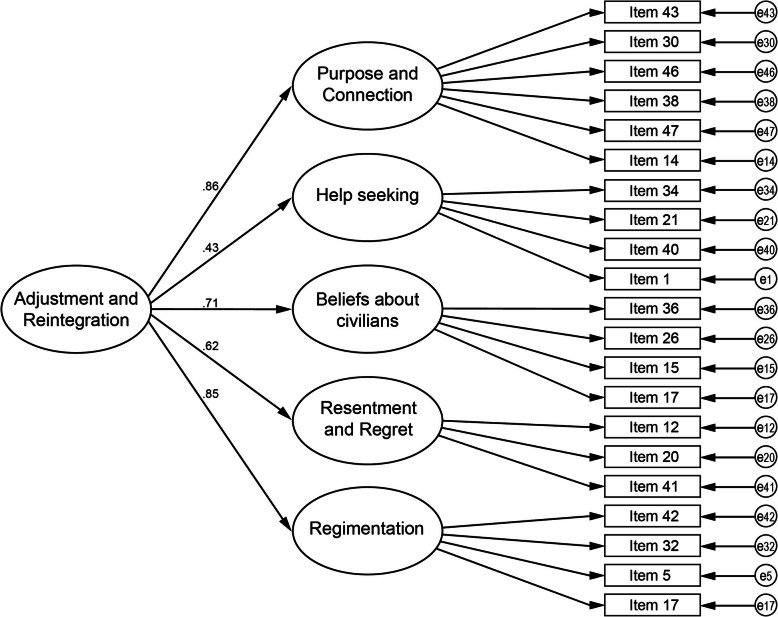
Background: The transition out of military service and subsequent reintegration to civilian life has been established as a period associated with an increased risk of psychological adjustment difficulties, psychiatric disorders and suicide risk, yet no tool exists to measure cultural and psychological adjustment following permanent separation from the military. This study describes the two-phase mixed-methods development and validation of the self-report Military-Civilian Adjustment and Reintegration Measure (M-CARM). Methods: In Phase I, four focus groups (n = 20) and semi-structured one-on-one interviews (n = 80) enabled thematic analysis and generation of 53 initial items that were reviewed by an expert multidisciplinary panel (n = 12) and piloted for clarity and relevance in an Australian service-veteran sample (n = 11). In Phase II, psychometric properties of the 47 items resulting from Phase I were evaluated with online assessment of a convenience sample of transitioned Australian Defence Force veterans (n = 725). Analyses included exploratory and confirmatory factor analyses, as well as evaluation of test-retest reliability, internal consistency, and convergent, divergent and discriminant validity. Results: Exploratory factor analysis on a randomized split-half sample (n = 357), resulted in a 21-item, five-factor solution of Purpose and Connection, Help seeking, Beliefs about civilians, Resentment and regret, and Regimentation, explaining 53.22% of the variance. Confirmatory factor analysis (n = 368) verified this factor structure without modification (χ2 = 304.96, df = 160; CFI = .96, TLI = .94, NFI = .91, RMSEA = .05). Strong convergent, divergent and discriminant validity was demonstrated as M-CARM scores significantly correlated with related constructs assessed by standardised clinical measures as well as differentiated groups based on three binary reintegration items, with large effect sizes (d = > 1). Strong test-retest reliability for the total score (n = 186, r = .93) and excellent internal consistency (n = 725, a = .90) were also found. Conclusions: Results provide promising evidence the M-CARM is a valid, reliable measure of psychological and cultural reintegration to civilian life, with potential for considerable clinical and research application.
Overview
The claims and statistics of this paper haven’t been checked yet.
Free: it reads the open-access text and checks the first 5 claims that cite a source we can check. Create a free account to check every claim.
Integrity signals
Registry
Cites
Statistics
Figures
Verification
Claims the paper makes
The claims and statistics of this paper haven’t been checked yet.
Free: it reads the open-access text and checks the first 5 claims that cite a source we can check. Create a free account to check every claim.
Claims other papers make about this one
Each is checked against this paper’s own text: does it say what the citing paper says it does?
The source backs part of the claim, not all of it — or backs it for a different population, condition or comparison.
In the citing paper
“Results also revealed that lower scores on each of these factors (i.e. more difficulties in that area) were significantly associated with higher mental health symptoms, lower quality of life, reduced functioning and poorer self-reported adjustment overall [5].”
From Feasibility, acceptability, and initial outcomes of a psychological adjustment and reintegration program for transitioned military veterans (2024) · cites this paper as [5]
Experimental — accuracy not yet measuredThe source backs part of the claim, not all of it — or backs it for a different population, condition or comparison.
In the citing paper
“between 48% and 78% among Australian veterans [4, 5]”
From Feasibility, acceptability, and initial outcomes of a psychological adjustment and reintegration program for transitioned military veterans (2024) · cites this paper as [5]
Experimental — accuracy not yet measuredThe source backs part of the claim, not all of it — or backs it for a different population, condition or comparison.
In the citing paper
“Difficulties with adjustment and reintegration are associated with poorer outcomes in mental health [5], social and family relationships [1, 9–11], employment and financial security [1,2,12), physical health [12] and stable housing [13, 14].”
From Feasibility, acceptability, and initial outcomes of a psychological adjustment and reintegration program for transitioned military veterans (2024) · cites this paper as [5]
Experimental — accuracy not yet measuredThe cited source says what the claim attributes to it.
In the citing paper
“The measure has strong psychometric properties [5].”
From Feasibility, acceptability, and initial outcomes of a psychological adjustment and reintegration program for transitioned military veterans (2024) · cites this paper as [5]
Self-check
Percentages, sums and reported differences re-computed from the paper’s own numbers.
The self-check needs the paper’s full text.
Citations
Cites
Hu, L., & Bentler, P. M. (1999) · Structural Equation Modeling A Multidisciplinary Journal · doi:10.1080/10705519909540118 · Cited by 108,788 · cited 1×
“90 and above indicate excellent fit to the data [47, 48].”
BackgroundCoefficient Alpha and the Internal Structure of Tests
Cronbach, L. J. (1951) · Psychometrika · doi:10.1007/bf02310555 · Cited by 43,931
Alternative Ways of Assessing Model Fit
Browne, M. W., & Cudeck, R. (1992) · Sociological Methods & Research · doi:10.1177/0049124192021002005 · Cited by 27,200
Comparative fit indexes in structural models.
Bentler, P. M. (1990) · Psychological Bulletin · doi:10.1037/0033-2909.107.2.238 · Cited by 25,266
Significance tests and goodness of fit in the analysis of covariance structures.
Bentler, P. M., & Bonett, D. G. (1980) · Psychological Bulletin · doi:10.1037//0033-2909.88.3.588 · Cited by 19,023 · cited 1×
“90 and above indicate excellent fit to the data [47, 48].”
Background(2017) · Cited by 16,319
Lovibond, P. F., & Lovibond, S. H. (1995) · Behaviour Research and Therapy · doi:10.1016/0005-7967(94)00075-u · Cited by 14,523 · cited 7×
“Strong correlations were found between the M-CARM and the DASS-21 Depression subscale (r = −.71), and the WRFIS (r = −.70) and moderate correlations with the Physical (r = .66), Social relationships (r = .62) and Environmental (r = .68) subscales of the WHO-QOL as well as the Stress (r = −.66) and Anxiety (r = −.59) s…”
BackgroundInfluentialApplied Multivariate Statistics for the Social Sciences
Stevens, J. P. (2012) · Routledge eBooks · doi:10.4324/9780203843130 · Cited by 10,648
(2014) · Medical Entomology and Zoology · Cited by 6,828
Blevins, C. A., Weathers, F. W., Davis, M. T., Witte, T. K., & Domino, J. L. (2015) · Journal of Traumatic Stress · doi:10.1002/jts.22059 · Cited by 5,233
Antony, M. M., Bieling, P. J., Cox, B. J., Enns, M. W., & Swinson, R. P. (1998) · Psychological Assessment · doi:10.1037/1040-3590.10.2.176 · Cited by 4,874
Skevington, S. M., Lotfy, M., & O'Connell, K. A. (2004) · Quality of Life Research · doi:10.1023/b:qure.0000018486.91360.00 · Cited by 4,686
Bovin, M. J., Marx, B. P., Weathers, F. W., Gallagher, M. W., Rodriguez, P., Schnurr, P. P., & Keane, T. M. (2016) · Psychological Assessment · doi:10.1037/pas0000254 · Cited by 2,532
Psychometric properties of the Depression Anxiety Stress Scales (DASS) in clinical samples
Brown, T. A., Chorpita, B. F., Korotitsch, W., & Barlow, D. H. (1997) · Behaviour Research and Therapy · doi:10.1016/s0005-7967(96)00068-x · Cited by 1,860
Weathers, F. W., Bovin, M. J., Lee, D. J., Sloan, D. M., Schnurr, P. P., Kaloupek, D. G., Keane, T. M., & Marx, B. P. (2018) · Psychological Assessment · doi:10.1037/pas0000486 · Cited by 1,799 · cited 9×
“Further, those that obtained a provisional diagnosis of PTSD on the PCL-5, also exhibited significantly lower scores on the M-CARM.”
BackgroundInfluentialWortmann, J. H., Jordan, A. H., Weathers, F. W., Resick, P. A., Dondanville, K. A., Hall-Clark, B., Foa, E. B., Young-McCaughan, S., Yarvis, J. S., Hembree, E. A., et al. (2016) · Psychological Assessment · doi:10.1037/pas0000260 · Cited by 913
Sayer, N. A., Noorbaloochi, S., Frazier, P., Carlson, K., Gravely, A., & Murdoch, M. (2010) · Psychiatric Services · doi:10.1176/ps.2010.61.6.589 · Cited by 527 · cited 1×
“investigation found that up to 56% of Iraq and Afghanistan veterans receiving Veteran Affairs medical care reported substantial difficulties reintegrating, with 96% of the sample expressing interest in services to help readjust to civilian life [10].”
BackgroundPerceived Stigma and Barriers to Mental Health Care Utilization Among OEF-OIF Veterans
Pietrzak, R. H., Johnson, D. C., Goldstein, M. B., Malley, J. C., & Southwick, S. M. (2009) · Psychiatric Services · doi:10.1176/ps.2009.60.8.1118 · Cited by 444 · cited 1×
“Similarly, in their study of US veterans Pietrzak and colleagues [18] found that social support for veterans during the reintegration to civilian life was negatively associated with suicidal ideation.”
BackgroundReger, M. A., Smolenski, D. J., Skopp, N. A., Metzger-Abamukang, M. J., Kang, H. K., Bullman, T. A., Perdue, S., & Gahm, G. A. (2015) · JAMA Psychiatry · doi:10.1001/jamapsychiatry.2014.3195 · Cited by 222 · cited 1×
“Results revealed an increased rate of suicide associated with separation from military service, while deployment itself was not associated with the rate of suicide [17].”
BackgroundNightmare frequency versus nightmare distress: Relations to psychopathology and cognitive style.
Belicki, K. (1992) · Journal of Abnormal Psychology · doi:10.1037//0021-843x.101.3.592 · Cited by 206 · cited 8×
“The NDQ [40] is a 13-item self-report questionnaire which yields a total score that evaluates the emotional disturbance attributed to nightmares as well as nightmare-related symptoms.”
BackgroundInfluentialSayer, N. A., Frazier, P., Orazem, R. J., Murdoch, M., Gravely, A., Carlson, K. F., Hintz, S., & Noorbaloochi, S. (2011) · Journal of Traumatic Stress · doi:10.1002/jts.20706 · Cited by 180 · cited 12×
“The questionnaire has demonstrated good psychometric properties in previous research [2, 25].”
BackgroundMethodInfluentialBerlim, M. T., Pavanello, D. P., Caldieraro, M. A. K., & Fleck, M. P. A. (2005) · Quality of Life Research · doi:10.1007/s11136-004-4694-y · Cited by 177
Psychiatric Status and Work Performance of Veterans of Operations Enduring Freedom and Iraqi Freedom
Adler, D. A., Possemato, K., Mavandadi, S., Lerner, D., Chang, H., Klaus, J. R., Tew, J. D., Barrett, D., Ingram, E. P., & Oslin, D. W. (2011) · Psychiatric Services · doi:10.1176/ps.62.1.pss6201_0039 · Cited by 145 · cited 2×
“All of these questionnaires were developed to evaluate the experiences of active duty military personnel returning from deployment [4, 21, 22, 25], or injured veterans specifically [24], not those permanently separating from the military – including both medical and voluntary separations.”
BackgroundMethodElnitsky, C. A., Fisher, M. P., & Blevins, C. L. (2017) · Frontiers in Psychology · doi:10.3389/fpsyg.2017.00369 · Cited by 125 · cited 2×
“The questionnaire has demonstrated good psychometric properties in previous research [2, 25].”
BackgroundMethodAppraising evidence on community integration following brain injury: a systematic review
Reistetter, T., & Abreu, B. C. (2005) · Occupational Therapy International · doi:10.1002/oti.8 · Cited by 108 · cited 1×
“Successful reintegration is holistic, culturally determined [2, 7], and involves complex interactions between the veteran and their environment [2, 6].”
BackgroundMilitary service member and veteran reintegration: A critical review and adapted ecological model.
Elnitsky, C. A., Blevins, C. L., Fisher, M. P., & Magruder, K. (2017) · American Journal of Orthopsychiatry · doi:10.1037/ort0000244 · Cited by 106
Psychiatric Status and Work Performance of Veterans of Operations Enduring Freedom and Iraqi Freedom
Adler, D. A., Possemato, K., Mavandadi, S., Lerner, D., Chang, H., Klaus, J. R., Tew, J. D., Barrett, D., Ingram, E. P., & Oslin, D. W. (2011) · Psychiatric Services · doi:10.1176/appi.ps.62.1.39 · Cited by 104
Development of CRIS: Measure of community reintegration of injured service members
Resnik, L., Plow, M., & Jette, A. (2009) · The Journal of Rehabilitation Research and Development · doi:10.1682/jrrd.2008.07.0082 · Cited by 87 · cited 2×
“All of these questionnaires were developed to evaluate the experiences of active duty military personnel returning from deployment [4, 21, 22, 25], or injured veterans specifically [24], not those permanently separating from the military – including both medical and voluntary separations.”
BackgroundMethodKatz, L. S., Bloor, L. E., Cojucar, G., & Draper, T. (2007) · Psychological Services · doi:10.1037/1541-1559.4.4.239 · Cited by 80 · cited 2×
“All of these questionnaires were developed to evaluate the experiences of active duty military personnel returning from deployment [4, 21, 22, 25], or injured veterans specifically [24], not those permanently separating from the military – including both medical and voluntary separations.”
BackgroundMethodSherman, M. D., Larsen, J. L., & Borden, L. M. (2015) · Professional Psychology Research and Practice · doi:10.1037/pro0000043 · Cited by 74 · cited 2×
“It was also predicted that the M-CARM would moderately to strongly negatively correlate with the DASS-21and WRFIS and positively with the WHO-QOL, as based on previous research it is empirically and clinically sound to expect that psychological adjustment to life after military service would be related to broad experi…”
MethodSayer, N. A., Orazem, R. J., Noorbaloochi, S., Gravely, A., Frazier, P., Carlson, K. F., Schnurr, P. P., & Oleson, H. (2015) · Administration and Policy in Mental Health and Mental Health Services Research · doi:10.1007/s10488-014-0564-2 · Cited by 70 · cited 1×
“study found these reintegration difficulties appear to persist, with up to 62% of veterans reporting difficulties, despite data being collected an average of six years after separation - demonstrating the importance of understanding reintegration difficulties beyond the transition period [15].”
BackgroundBöckermann, M., Gieselmann, A., & Pietrowsky, R. (2014) · Dreaming · doi:10.1037/a0037749 · Cited by 70 · cited 1×
“The questionnaire has demonstrated good psychometric properties in previous research [41].”
MethodThe Development and Validation of the Army Post-Deployment Reintegration Scale
Blais, A.-R., Thompson, M. M., & McCreary, D. R. (2009) · Military Psychology · doi:10.1080/08995600902914727 · Cited by 55 · cited 2×
“All of these questionnaires were developed to evaluate the experiences of active duty military personnel returning from deployment [4, 21, 22, 25], or injured veterans specifically [24], not those permanently separating from the military – including both medical and voluntary separations.”
BackgroundMethodInterian, A., Kline, A., Callahan, L., & Losonczy, M. (2012) · Psychiatric Services · doi:10.1176/appi.ps.201100337 · Cited by 53 · cited 1×
“study, up to 72% of veterans reported at least one significant readjustment stressor such as marital problems or financial issues [12].”
BackgroundMilitary-to-civilian transition theories and frameworks
Pedlar, D., Thompson, J. M., & Andrew Castro, C. (2019) · Military Veteran Reintegration · doi:10.1016/b978-0-12-815312-3.00003-6 · Cited by 49 · cited 1×
“Successful reintegration is holistic, culturally determined [2, 7], and involves complex interactions between the veteran and their environment [2, 6].”
BackgroundHerrell, R. K., Edens, E. N., Riviere, L. A., Thomas, J. L., Bliese, P. D., & Hoge, C. W. (2014) · Psychological Services · doi:10.1037/a0037347 · Cited by 47
Facilitating successful reintegration: Attending to the needs of military families.
Gil‐Rivas, V., Kilmer, R. P., Larson, J. C., & Armstrong, L. M. (2017) · American Journal of Orthopsychiatry · doi:10.1037/ort0000201 · Cited by 46
Post-Deployment Readjustment Inventory: Reliability, Validity, and Gender Differences
Katz, L. S., Cojucar, G., Davenport, C. T., Pedram, C., & Lindl, C. (2010) · Military Psychology · doi:10.1080/08995600903249222 · Cited by 40 · cited 1×
“These include: (1) Post-Deployment Reintegration Scale [21]; (2) Combat-to-Home Transition Scale [4]; (3) Iraq Readjustment Inventory [22]; (4) PostDeployment Readjustment Inventory [23]; (5) Community Reintegration of Service Members [24]; and (6) Military to Civilian Questionnaire [25].”
MethodKarstoft, K.-I., Armour, C., Andersen, S. B., Bertelsen, M., & Madsen, T. (2015) · Social Psychiatry and Psychiatric Epidemiology · doi:10.1007/s00127-014-0973-2 · Cited by 36 · cited 1×
“Additionally, a Danish study examining community reintegration among 454 Afghanistan veterans found that up to 18% experienced difficulties across multiple domains including social relationships, self-care, and general daily functioning [14].”
BackgroundRomaniuk, M., & Kidd, C. (2018) · Griffith Research Online · Cited by 22
Self-citationElnitsky, C., & Kilmer, R. P. (2017) · American Journal of Orthopsychiatry · doi:10.1037/ort0000252 · Cited by 19 · cited 1×
“While the literature suggests some veterans adjust to civilian society with little difficulty, a significant proportion of veterans experience reintegration challenges [5, 8, 9].”
BackgroundForbes, D., Hooff, M. V., Lawrence‐Wood, E., Sadler, N., Hodson, S., Benassi, H. P., Avery, J., Varker, T., O'Donnell, M. L., Phelps, A. J., et al. (2018) · Research Portal (King's College London) · Cited by 10
Military-to-civilian transition policies, processes, and program efforts
Fossey, M. J., Lazier, R., Lewis, M. N., Williamson, N., & Caddick, N. (2019) · Elsevier eBooks · doi:10.1016/b978-0-12-815312-3.00004-8 · Cited by 6 · cited 1×
“Future research on this measure may also include application and validation with other military cohorts globally including US, United Kingdom, Canada, and New Zealand, given the existing research, cultural similarities, and strong interest from these nations in improving transition and reintegration for their defence…”
Method
Research works printed but not linked: 10
- Castro CA Dursun S Military veteran reintegration: approach, management, and assessment of military veterans transitioning to civilian life: academic press 2019
- Shields D Kuhl D Lutz K Frender J Baumann N Lopresti P Mental health and well-being of military veterans during the military to civilian transition: review and analysis of the recent literature 2016 Vancouver BC Report prepared for Veterans Affairs Canada and the Canadian Institute for Military and Veteran Health Research
- Taylor P Morin R Parker K Cohn DV Funk C Mokrzycki M War and sacrifice in the Post-9/11 era 2011 Pew Research Center The Military-Civilian Gap
- Van Til L Macintosh S Thompson J 2013 synthesis of life after service studies: veterans affairs Canada 2015
- Foreign Affairs Defence and Trade References Committee The constant battle: Suicide by veterans. Department of the Senate, Australian Government 2017
- Productivity Commission A better way to support veterans: Overview and recommendations (No. 93) 2019
- Department of Defence Defence Annual Report 2018–19. Australian Government 2019
- World Health Organization The world health organization quality of life (WHOQOL)-BREF. World Health Organization 2004
- Arbuckle JL Amos (version 21) 2012 Chicago SPSS
- International Ministerial 5-Eyes Conference on Veterans' Issues London 2017 [Internet]. Department of Veterans’ Affairs; 2017, July 21. Available from: http://minister.dva.gov.au/media_releases/2017/jul/5eyes.htm. Accessed 5 Nov 2019.
Cited by
Rattray, N. A., Flanagan, M., Salyers, M. P., Natividad, D. M., Do, A.-N., Frankel, R. M., Spontak, K., & Kukla, M. (2023) · Journal of Veterans Studies · doi:10.21061/jvs.v9i1.432 · Cited by 35
Veteran families with complex needs: a qualitative study of the veterans’ support system
Maguire, A. M., Keyser, J., Brown, K., Kivlahan, D. R., Romaniuk, M., Gardner, I. R., & Dwyer, M. (2022) · BMC Health Services Research · doi:10.1186/s12913-021-07368-2 · Cited by 32
Self-citationReintegration potential of veterans as a factor of successful reintegration of them into society
Захаріна, Т. І. (2023) · Social work and education · doi:10.25128/2520-6230.23.3.1 · Cited by 26
Geraci, J. C., Finley, E. P., Edwards, E. R., Frankfurt, S. B., Kurz, A. S., Kamdar, N. P., Vanneman, M. E., Lopoo, L. M., Patnaik, H. A., Yoon, J., et al. (2022) · Implementation Science · doi:10.1186/s13012-022-01212-9 · Cited by 20
“The M2C-Q was initially validated in a sample of Iraq and Afghanistan Veterans seeking VA healthcare services [54] and has since shown strong construct validity and internal reliability in numerous Veteran samples [10, 53].”
BackgroundRomaniuk, M., Kidd, C., Banfield, M., & Batterham, P. J. (2022) · Journal of Employment Counseling · doi:10.1002/joec.12199 · Cited by 19
Self-citation
Metadata
- Authors
- Romaniuk, M., Fisher, G., Kidd, C., & Batterham, P. J.
- Affiliations
- Australian National University (AU)
- Greenslopes Private Hospital (AU)
- Corresponding author
- Romaniuk, Madeline
- Venue
- BMC Psychiatry
- Published
- 2020-11-10
- Volume
- 20
- Issue
- 1
- Pages
- 531-531
- ISSN
- 1471-244X (ISSN-L)
- PMC
- PMC7654614
- OpenAlex
- W3099070079
- Cited by
- 35
- References
- 42
- Citations by year
- 2026: 8 · 2025: 5 · 2024: 8 · 2023: 8 · 2022: 5
- FWCI
- 4.93
- Type
- journal article
- Language
- en
- Open access
- gold
- doi.org
- Licence
- cc-by
- creativecommons.org/licenses/by/4.0/ (tdm)
- creativecommons.org/licenses/by/4.0/ (vor)
- Locations
- BMC Psychiatry (publishedVersion, cc-by)
- PubMed Central (publishedVersion, cc-by)
- PubMed (publishedVersion)
- DOAJ (DOAJ: Directory of Open Access Journals) (submittedVersion, cc-by-sa)
- ANU Open Research (Australian National University) (submittedVersion, cc-by)
- Funders
- RSL Queensland
- Topics
- Social Sciences › Education › Education and Military Integration
- Social Sciences › Psychology › Clinical Psychology › Posttraumatic Stress Disorder Research
- Social Sciences › Decision Sciences › Management Science and Operations Research › Psychometric Methodologies and Testing
- Keywords
- psychological adjustment, veterans, scale development, psychometric validation, help-seeking, regimentation
- MeSH terms
- Emotional Adjustment, Australia, Factor Analysis, Statistical, Humans, Psychometrics, Surveys and Questionnaires, Reproducibility of Results
About these checks
Registry, retraction, Cites and statistics results are computed, not judged, with one exception: a printed reference that no index lists is read once by a model before it counts as a citation error. Claims are extracted by a model and kept only when their quote appears verbatim in the text; each cited source is then checked, with a model’s help, for whether it says what the claim relies on. Those verdicts can be wrong — read the claim’s quote and the cited source before relying on one.
Statistics and arithmetic are recomputed, not judged.
Confidence bands are shown only for fields calibrated on our annotated test set. None is calibrated yet, so no band is shown.
What counts as a claim ›How we measure confidence ›How we check this ›
Are you an author, or do you see a problem with this page? Request a review
Data sources
Bibliographic data: Semantic Scholar, OpenAlex, Crossref.
Contains information from the Semantic Scholar Academic Graph Datasets, made available under the ODC Attribution License (ODC-BY 1.0).
Semantic Scholar’s data is described in: Kinney, R., et al. (2023). The Semantic Scholar Open Data Platform. arXiv:2301.10140.
