

The D*Phase-study: study protocol for a pragmatic two-phased, randomised controlled (non-inferiority) trial that addresses treatment non-response and compares cognitive behavioural therapy and short-term psychodynamic supportive psychotherapy for major depression
Open accessThe DOI matches its Crossref record; 93 of the 94 references it cites were found in a registry or an index.
Abstract
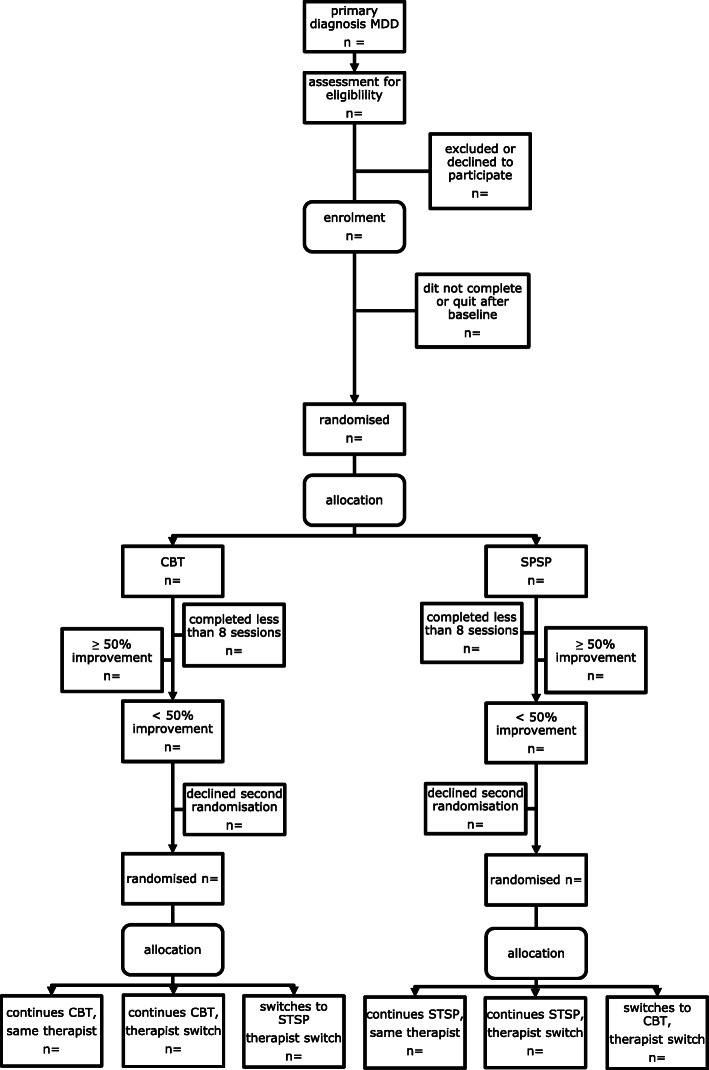
Background: Several evidence-based psychotherapeutic treatment options are available for depression, but the treatment results could be improved. The D*Phase study directly compares short-term psychodynamic supportive psychotherapy (SPSP) and cognitive behavioural therapy (CBT) for Major Depressive Disorder (MDD). The objectives are 1. to investigate if, from a group level perspective, SPSP is not inferior to CBT in the treatment of major depressive disorder, 2. to build a model that may help predict the optimal type of treatment for a specific individual; and 3. to determine whether a change of therapist or a change of therapist and treatment method are effective strategies to deal with non-response. Furthermore (4.), the effect of the therapeutic alliance, treatment integrity and therapist allegiance on treatment outcome will be investigated. Method: In this pragmatic randomised controlled trial, 308 patients with a primary diagnosis of MDD are being recruited from a specialised mental health care institution in the Netherlands. In the first phase, patients are randomised 1:1 to either SPSP or CBT. In case of treatment non-response, a second phase follows in which non-responders from treatment phase one are randomised 1:1:1 to one of three groups: continuing the initial treatment with the same therapist, continuing the initial treatment with another therapist or continuing the other type of treatment with another therapist. In both treatment phases, patients are offered sixteen twice-weekly psychotherapy sessions. The primary outcome is an improvement in depressive symptoms. Process variables, working alliance and depressive symptoms, are frequently measured. Comprehensive assessments take place before the start of the first phase (at baseline), in week one, two and four during the treatment, and directly after the treatment (week eight). Discussion: While the naturalistic setting of the study involves several challenges, we expect, by focusing on a large and diverse number of research variables, to generate important knowledge that may help enhance the effect of psychotherapeutic treatment for MDD. Trial registration: The study was registered on 26 August 2016 with the Netherlands Trial Register, part of the Dutch Cochrane Centre (NL5753),https://www.trialregister.nl/trial/5753
Overview
The claims and statistics of this paper haven’t been checked yet.
Free: it reads the open-access text and checks the first 5 claims that cite a source we can check. Create a free account to check every claim.
Integrity signals
Registry
Cites
Statistics
Figures
Verification
Claims the paper makes
The claims and statistics of this paper haven’t been checked yet.
Free: it reads the open-access text and checks the first 5 claims that cite a source we can check. Create a free account to check every claim.
Claims other papers make about this one
Each is checked against this paper’s own text: does it say what the citing paper says it does?
The cited source doesn’t support the claim as written.
In the citing paper
“To assess competence, a scale for SPSP will be used that was developed for previous research [59] on the basis of instruments used in other psychodynamic trials [13, 75].”
From Individual psychotherapy for cluster-C personality disorders: protocol of a pragmatic RCT comparing short-term psychodynamic supportive psychotherapy, affect phobia therapy and schema therapy (I-FORCE) (2023) · cites this paper as [75]
Checked by a reasoning model — may be wrong.
Experimental — accuracy not yet measured
Self-check
Percentages, sums and reported differences re-computed from the paper’s own numbers.
The self-check needs the paper’s full text.
Citations
Cites
Diagnostic and Statistical Manual of Mental Disorders
American Psychiatric Association (2013) · doi:10.1176/appi.books.9780890425596 · Cited by 116,369
Hamilton, M. (1960) · Journal of Neurology, Neurosurgery & Psychiatry · doi:10.1136/jnnp.23.1.56 · Cited by 32,817 · cited 1×
“A meta-analysis of the treatment outcomes of evidence-based forms of psychotherapy estimates that the number of patients that does not respond (as defined by an improvement of 50% or more on any given self-report depression-severity scale) is substantial (52%), while 57 to 59% do not achieve full remission after one t…”
BackgroundSociety and the Adolescent Self-Image
Rosenberg, M. (1965) · doi:10.1515/9781400876136 · Cited by 30,126
(1998) · The Journal of Clinical Psychiatry · Cited by 19,139
Guidelines for the process of cross-cultural adaptation of self-report measures
Beaton, D. E., Bombardier, C., Guillemin, F., & Ferraz, M. B. (2000) · Spine · doi:10.1097/00007632-200012150-00014 · Cited by 14,542
(1998) · PubMed · Cited by 10,216
The brief symptom inventory: an introductory report.
Derogatis, L. R., & Melisaratos, N. (1983) · Psychological Medicine · doi:10.1017/s0033291700048017 · Cited by 6,650 · cited 1×
“Symptoms: brief symptom inventory The Brief Symptom Inventory (BSI [77], Dutch translation [78]) is a Miggiels et al.”
BackgroundThe generalizability of the psychoanalytic concept of the working alliance.
Bordin, E. S. (1979) · Psychotherapy: Theory, Research & Practice · doi:10.1037/h0085885 · Cited by 5,238 · cited 1×
“and patient about the goals of therapy and the steps necessary to achieve them [36].”
BackgroundRumination reconsidered: a psychometric analysis.
Treynor, W., Gonzalez, R., & Nolen-Hoeksema, S. (2003) · Cognitive Therapy and Research · doi:10.1023/a:1023910315561 · Cited by 3,808 · cited 2×
“The RRS has good psychometric properties [83].”
BackgroundDevelopment and validation of the working alliance inventory
Horvath, A. O., & Greenberg, L. S. (1989) · Journal of Counseling Psychology · doi:10.1037//0022-0167.36.2.223 · Cited by 3,520 · cited 1×
“The client version of the Working Alliance Inventory (WAI [90], Dutch Translation [91]) measures the quality”
Research works printed but not linked: 6
- Hendriksen M Kool S Bockting C Peen J Personality disorders and the therapeutic alliance in short--term psychodynamic therapy for depression [Internet] 2014 VU Amsterdam research.vu.nl. [Amsterdam]
- Jonghe de F Handboek Kortdurende Psychoanalytische Steungevende Psychotherapie 2014 Amsterdam Benecke Beheer B.V
- Beck AT Rush AJ Shaw BF Emery G Cognitive Theory of Depression 1979 The Guilford Press
- De Beurs EDE Zitman FG The brief symptom inventory (BSI): reliability and validity of a practical alternative to SCL-90 Maandbl Geestelijke Volksgezond 2006 61 120 141
- Trijsburg van W Dam van K Van ’t, A S Duivenvoorden H Representeren de Afweerfunctieschaal (DSM-IV) en de Defense Style Questionnaire (DSQ-42) een hiërarchie van afweermechanismen? Tijdschr Psychoanal 1998 4 3 150 169
- Vertommen H Vervaeke GAC Vertaling voor experimenteel gebruik van de WAI (Horvart & Greenberg, 1986) 1990
Cited by
Miggiels, M. F., ten Klooster, P. M., Beekman, A. T. F., Bremer, S., Dekker, J., Janssen, C., & van Dijk, M. K. (2024) · Journal of Affective Disorders · doi:10.1016/j.jad.2024.10.122 · Cited by 11
Self-citationDaniëls, M., Van, H. L., van den Heuvel, B., Dekker, J. J. M., Peen, J., Bosmans, J., Arntz, A., & Huibers, M. J. H. (2023) · Trials · doi:10.1186/s13063-023-07136-z · Cited by 9
“To assess competence, a scale for SPSP will be used that was developed for previous research [59] on the basis of instruments used in other psychodynamic trials [13, 75].”
MethodSelf-citationMiggiels, M. F., ten Klooster, P. M., Beekman, A. T. F., Bremer, S., Dekker, J., Van, H. L., & van Dijk, M. K. (2025) · Journal of Affective Disorders · doi:10.1016/j.jad.2025.120556 · Cited by 1
Self-citationMiggiels, M. F., ten Klooster, P. M., Beekman, A. T. F., Bremer, S., Dekker, J., Van, R., & van Dijk, M. K. (2025) · SSRN Electronic Journal · doi:10.2139/ssrn.5209460
Self-citationBremer-Hoeve, S., van Bronswijk, S. C., Beekman, A. T. F., Miggiels, M. F., Stuiver, S. P., Driessen, E., & van Dijk, M. K. (2026) · Journal of Affective Disorders Reports · doi:10.1016/j.jadr.2026.101202
Self-citation
Metadata
- Authors
- Miggiels, M. F., ten Klooster, P. M., Bremer-Hoeve, S., Dekker, J. J. M., Huibers, M. J. H., Reefhuis, E., Van, H. L., & van Dijk, M. K.
- Affiliations
- Dimence (NL)
- Arkin (NL)
- Corresponding author
- Miggiels, M. F.
- Venue
- BMC Psychiatry
- Published
- 2021-05-04
- Volume
- 21
- Issue
- 1
- Pages
- 233-233
- ISSN
- 1471-244X (ISSN-L)
- PMC
- PMC8097891
- OpenAlex
- W3159707410
- Cited by
- 5
- References
- 94
- Citations by year
- 2026: 1 · 2025: 2 · 2024: 1 · 2023: 1
- FWCI
- 0.34
- Type
- journal article
- Language
- en
- Open access
- gold
- doi.org
- Licence
- cc-by
- creativecommons.org/licenses/by/4.0/ (tdm)
- creativecommons.org/licenses/by/4.0/ (vor)
- Locations
- BMC Psychiatry (publishedVersion, cc-by)
- PubMed Central (publishedVersion, cc-by)
- PubMed (publishedVersion)
- VU Research Portal (publishedVersion, other-oa)
- University of Twente Research Information (acceptedVersion, cc-by)
- DOAJ (DOAJ: Directory of Open Access Journals) (submittedVersion, cc-by-sa)
- Utrecht University Repository (Utrecht University) (submittedVersion, other-oa)
- University of Twente Research Information (submittedVersion, cc-by)
- Data Archiving and Networked Services (DANS) (submittedVersion, other-oa)
- Funders
- Dimence
- Topics
- Social Sciences › Psychology › Clinical Psychology › Psychotherapy Techniques and Applications
- Social Sciences › Psychology › Experimental and Cognitive Psychology › Anxiety, Depression, Psychometrics, Treatment, Cognitive Processes
- Health Sciences › Medicine › Pharmacology (medical) › Treatment of Major Depression
- Keywords
- major depressive disorder, cognitive behavioral therapy, treatment non-response, non-inferiority, therapist change, treatment switching, therapeutic relationship, implementation fidelity, treatment outcome prediction, psychotherapy comparison
- MeSH terms
- Equivalence Trials as Topic, Depression, Depressive Disorder, Major, Major Depressive Disorder, Humans, Netherlands, Psychotherapy, Cognitive Behavioral Therapy, Randomized Controlled Trials as Topic, Pragmatic Clinical Trials as Topic
About these checks
Registry, retraction, Cites and statistics results are computed, not judged, with one exception: a printed reference that no index lists is read once by a model before it counts as a citation error. Claims are extracted by a model and kept only when their quote appears verbatim in the text; each cited source is then checked, with a model’s help, for whether it says what the claim relies on. Those verdicts can be wrong — read the claim’s quote and the cited source before relying on one.
Statistics and arithmetic are recomputed, not judged.
Confidence bands are shown only for fields calibrated on our annotated test set. None is calibrated yet, so no band is shown.
What counts as a claim ›How we measure confidence ›How we check this ›
Are you an author, or do you see a problem with this page? Request a review
How to cite
Cite CoChat for the checks on this page, and the paper for its own findings.
- This page
- CoChat. (2026). Citation check: The D*Phase-study: study protocol for a pragmatic two-phased, randomised controlled (non-inferiority) trial that addresses treatment non-response and compares cognitive behavioural therapy and short-term psychodynamic supportive psychotherapy for major depression. https://app.cochat.ai/papers/10.1186/s12888-021-03156-8
- The paper
- Miggiels, M. F., ten Klooster, P. M., Bremer-Hoeve, S., Dekker, J. J. M., Huibers, M. J. H., Reefhuis, E., Van, H. L., & van Dijk, M. K. (2021). The D*Phase-study: study protocol for a pragmatic two-phased, randomised controlled (non-inferiority) trial that addresses treatment non-response and compares cognitive behavioural therapy and short-term psychodynamic supportive psychotherapy for major depression. BMC Psychiatry. https://doi.org/10.1186/s12888-021-03156-8
Data sources
Bibliographic data: Semantic Scholar, OpenAlex, Crossref.
Contains information from the Semantic Scholar Academic Graph Datasets, made available under the ODC Attribution License (ODC-BY 1.0).
Semantic Scholar’s data is described in: Kinney, R., et al. (2023). The Semantic Scholar Open Data Platform. arXiv:2301.10140.
