

The D*Phase-study: study protocol for a pragmatic two-phased, randomised controlled (non-inferiority) trial that addresses treatment non-response and compares cognitive behavioural therapy and short-term psychodynamic supportive psychotherapy for major depression
Open accessThe DOI matches its Crossref record; 93 of the 94 references it cites were found in a registry or an index.
Abstract
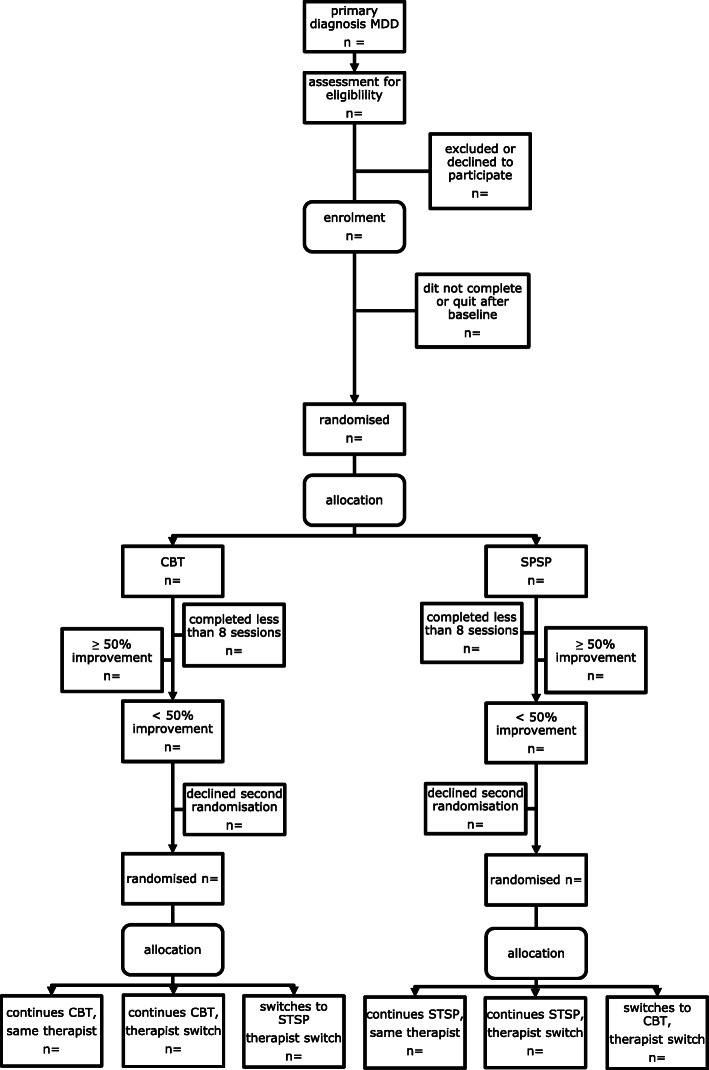
Background: Several evidence-based psychotherapeutic treatment options are available for depression, but the treatment results could be improved. The D*Phase study directly compares short-term psychodynamic supportive psychotherapy (SPSP) and cognitive behavioural therapy (CBT) for Major Depressive Disorder (MDD). The objectives are 1. to investigate if, from a group level perspective, SPSP is not inferior to CBT in the treatment of major depressive disorder, 2. to build a model that may help predict the optimal type of treatment for a specific individual; and 3. to determine whether a change of therapist or a change of therapist and treatment method are effective strategies to deal with non-response. Furthermore (4.), the effect of the therapeutic alliance, treatment integrity and therapist allegiance on treatment outcome will be investigated. Method: In this pragmatic randomised controlled trial, 308 patients with a primary diagnosis of MDD are being recruited from a specialised mental health care institution in the Netherlands. In the first phase, patients are randomised 1:1 to either SPSP or CBT. In case of treatment non-response, a second phase follows in which non-responders from treatment phase one are randomised 1:1:1 to one of three groups: continuing the initial treatment with the same therapist, continuing the initial treatment with another therapist or continuing the other type of treatment with another therapist. In both treatment phases, patients are offered sixteen twice-weekly psychotherapy sessions. The primary outcome is an improvement in depressive symptoms. Process variables, working alliance and depressive symptoms, are frequently measured. Comprehensive assessments take place before the start of the first phase (at baseline), in week one, two and four during the treatment, and directly after the treatment (week eight). Discussion: While the naturalistic setting of the study involves several challenges, we expect, by focusing on a large and diverse number of research variables, to generate important knowledge that may help enhance the effect of psychotherapeutic treatment for MDD. Trial registration: The study was registered on 26 August 2016 with the Netherlands Trial Register, part of the Dutch Cochrane Centre (NL5753),https://www.trialregister.nl/trial/5753
Overview
The claims and statistics of this paper haven’t been checked yet.
Free: it reads the open-access text and checks the first 5 claims that cite a source we can check. Create a free account to check every claim.
Integrity signals
Registry
Cites
Statistics
Figures
Verification
Claims the paper makes
The claims and statistics of this paper haven’t been checked yet.
Free: it reads the open-access text and checks the first 5 claims that cite a source we can check. Create a free account to check every claim.
Claims other papers make about this one
Each is checked against this paper’s own text: does it say what the citing paper says it does?
The cited source doesn’t support the claim as written.
In the citing paper
“To assess competence, a scale for SPSP will be used that was developed for previous research [59] on the basis of instruments used in other psychodynamic trials [13, 75].”
From Individual psychotherapy for cluster-C personality disorders: protocol of a pragmatic RCT comparing short-term psychodynamic supportive psychotherapy, affect phobia therapy and schema therapy (I-FORCE) (2023) · cites this paper as [75]
Checked by a reasoning model — may be wrong.
Experimental — accuracy not yet measured
Self-check
Percentages, sums and reported differences re-computed from the paper’s own numbers.
The self-check needs the paper’s full text.
Citations
Cites
Diagnostic and Statistical Manual of Mental Disorders
American Psychiatric Association (2013) · doi:10.1176/appi.books.9780890425596 · Cited by 116,369
Hamilton, M. (1960) · Journal of Neurology, Neurosurgery & Psychiatry · doi:10.1136/jnnp.23.1.56 · Cited by 32,817 · cited 1×
“A meta-analysis of the treatment outcomes of evidence-based forms of psychotherapy estimates that the number of patients that does not respond (as defined by an improvement of 50% or more on any given self-report depression-severity scale) is substantial (52%), while 57 to 59% do not achieve full remission after one t…”
BackgroundSociety and the Adolescent Self-Image
Rosenberg, M. (1965) · doi:10.1515/9781400876136 · Cited by 30,126
(1998) · The Journal of Clinical Psychiatry · Cited by 19,139
Guidelines for the process of cross-cultural adaptation of self-report measures
Beaton, D. E., Bombardier, C., Guillemin, F., & Ferraz, M. B. (2000) · Spine · doi:10.1097/00007632-200012150-00014 · Cited by 14,542
(1998) · PubMed · Cited by 10,216
The brief symptom inventory: an introductory report.
Derogatis, L. R., & Melisaratos, N. (1983) · Psychological Medicine · doi:10.1017/s0033291700048017 · Cited by 6,650 · cited 1×
“Symptoms: brief symptom inventory The Brief Symptom Inventory (BSI [77], Dutch translation [78]) is a Miggiels et al.”
BackgroundThe generalizability of the psychoanalytic concept of the working alliance.
Bordin, E. S. (1979) · Psychotherapy: Theory, Research & Practice · doi:10.1037/h0085885 · Cited by 5,238 · cited 1×
“and patient about the goals of therapy and the steps necessary to achieve them [36].”
BackgroundRumination reconsidered: a psychometric analysis.
Treynor, W., Gonzalez, R., & Nolen-Hoeksema, S. (2003) · Cognitive Therapy and Research · doi:10.1023/a:1023910315561 · Cited by 3,808 · cited 2×
“The RRS has good psychometric properties [83].”
BackgroundDevelopment and validation of the working alliance inventory
Horvath, A. O., & Greenberg, L. S. (1989) · Journal of Counseling Psychology · doi:10.1037//0022-0167.36.2.223 · Cited by 3,520 · cited 1×
“The client version of the Working Alliance Inventory (WAI [90], Dutch Translation [91]) measures the quality”
Lecrubier, Y., Sheehan, D., Weiller, E., Amorim, P., Bonora, I., Sheehan, K. H., Janavs, J., & Dunbar, G. (1997) · European Psychiatry · doi:10.1016/s0924-9338(97)83296-8 · Cited by 3,513 · cited 2×
“The Mini-international neuropsychiatric interview (MINI [57]), a structured interview for classifying DSMIV and DSM 5 disorders, is used to assess whether the criteria for a Major Depressive Episode have been met.”
BackgroundMethodMediators and Moderators of Treatment Effects in Randomized Clinical Trials
Kraemer, H. C., Wilson, G. T., Fairburn, C. G., & Agras, W. S. (2002) · Archives of General Psychiatry · doi:10.1001/archpsyc.59.10.877 · Cited by 2,562 · cited 1×
“A PAI can be built only by using data from an RCT comparing two active treatments [28, 29].”
MethodHayes, A. F., & Rockwood, N. J. (2017) · Behaviour Research and Therapy · doi:10.1016/j.brat.2016.11.001 · Cited by 2,350 · cited 1×
“Most moderator and mediation analysis regarding allegiance and adherence will be performed with regressionbased methods [98].”
MethodThe Inventory of Depressive Symptomatology (IDS): Psychometric properties
Rush, A. J., Gullion, C. M., Basco, M. R., Jarrett, R. B., & Trivedi, M. H. (1996) · Psychological Medicine · doi:10.1017/s0033291700035558 · Cited by 2,177 · cited 1×
“Depression: inventory of depressive symptomatology The self-report version of the Inventory of Depressive Symptomatology (IDS-SR; Dutch translation Altrecht GGZ [52, 65]) consists of 30 items that are scored on a four-point scale.”
MethodAlliance in individual psychotherapy
Horvath, A. O., Del Re, A. C., Flückiger, C., & Symonds, D. (2011) · Psychotherapy · doi:10.1037/a0022186 · Cited by 2,072
Psychometric Properties of the Life Events Checklist
Gray, M. J., Litz, B. T., Hsu, J. L., & Lombardo, T. W. (2004) · Assessment · doi:10.1177/1073191104269954 · Cited by 1,889 · cited 1×
“Psychometrics are not available for the LEC-5 but the similar LEC for DSM-IV has been shown to have adequate psychometric properties [76].”
MethodHow important are the common factors in psychotherapy? An update
Wampold, B. E. (2015) · World Psychiatry · doi:10.1002/wps.20238 · Cited by 1,728
Research summary on the therapeutic relationship and psychotherapy outcome.
Lambert, M. J., & Barley, D. E. (2001) · Psychotherapy: Theory, Research, Practice, Training · doi:10.1037/0033-3204.38.4.357 · Cited by 1,621
PRACTICE GUIDELINE FOR THE Treatment of Patients With Major Depressive Disorder
Gelenberg, A. J., Freeman, P. B., Markowitz, J. C., Rosenbaum, J. F., Thase, M. E., Trivedi, M. H., & Rhoads, R. S. (2010) · Cited by 1,521
Evaluating the psychometric properties of the mental health continuum-short form (MHC-SF)
Lamers, S. M. A., Westerhof, G. J., Bohlmeijer, E. T., ten Klooster, P. M., & Keyes, C. L. M. (2011) · Journal of Clinical Psychology · doi:10.1002/jclp.20741 · Cited by 1,402 · cited 2×
“Positive mental health: mental health continuumshort form The Mental Health Continuum-Short Form (MHC-SF, Dutch translation [70]) comprises 14 items.”
BackgroundHandbook of Psychiatric Measures
SALZMAN, C. (2001) · American Journal of Psychiatry · doi:10.1176/appi.ajp.158.8.1343 · Cited by 1,174
Brugha, T., Bebbington, P., Tennant, C., & Hurry, J. (1985) · Psychological Medicine · doi:10.1017/s003329170002105x · Cited by 1,107 · cited 2×
“Traumatic life-events (including recent): list of threatening experiences The List of Threatening Experiences [71, 72] (Dutch translation) consists of descriptions of 21 life events and an assessment of occurrence (yes or no) before and after the sixteenth year of life and during the past twelve months.”
BackgroundAssessing Psychiatric Impairment in Primary Care with the Sheehan Disability Scale
Leon, A. C., Olfson, M., Portera, L., Farber, L., & Sheehan, D. V. (1997) · The International Journal of Psychiatry in Medicine · doi:10.2190/t8em-c8yh-373n-1uwd · Cited by 987
TRIVEDI, M. H., RUSH, A. J., IBRAHIM, H. M., CARMODY, T. J., BIGGS, M. M., SUPPES, T., CRISMON, M. L., SHORES-WILSON, K., TOPRAC, M. G., DENNEHY, E. B., et al. (2004) · Psychological Medicine · doi:10.1017/s0033291703001107 · Cited by 968
The inventory for depressive symptomatology (IDS): Preliminary findings
John Rush, A., Giles, D. E., Schlesser, M. A., Fulton, C. L., Weissenburger, J., & Burns, C. (1986) · Psychiatry Research · doi:10.1016/0165-1781(86)90060-0 · Cited by 918 · cited 15×
“We use two potential moderators of outcome: severity (IDS-SR score 39 or ≥ 39) and duration of depression (longer or shorter than 2 years) as stratification variables.”
MethodInfluentialBrugha, T. S., & Cragg, D. (1990) · Acta Psychiatrica Scandinavica · doi:10.1111/j.1600-0447.1990.tb01360.x · Cited by 883 · cited 3×
“The checklist has shown to have high test-retest reliability and good agreement with informant information [71, 73].”
BackgroundThe National Collaborating Centre for Mental Health
Kendall, T., & Pilling, S. (2004) · UCL Discovery (University College London) · Cited by 840
Evidence-based therapy relationships: Research conclusions and clinical practices.
Norcross, J. C., & Wampold, B. E. (2011) · Psychotherapy · doi:10.1037/a0022161 · Cited by 813
McHugh, R. K., Whitton, S. W., Peckham, A. D., Welge, J. A., & Otto, M. W. (2013) · The Journal of Clinical Psychiatry · doi:10.4088/jcp.12r07757 · Cited by 800 · cited 1×
“Research suggests that most patients suffering from a psychiatric disorder prefer psychotherapy over medication [3].”
BackgroundThe Role of Common Factors in Psychotherapy Outcomes
Cuijpers, P., Reijnders, M., & Huibers, M. J. H. (2019) · Annual Review of Clinical Psychology · doi:10.1146/annurev-clinpsy-050718-095424 · Cited by 748 · cited 5×
“See for a comprehensive overview Cuijpers, Reijnders and Huibers [13].”
BackgroundInfluentialSelf-citationThe Defense Style Questionnaire
ANDREWS, G., SINGH, M., & BOND, M. (1993) · The Journal of Nervous and Mental Disease · doi:10.1097/00005053-199304000-00006 · Cited by 711 · cited 1×
“Defence mechanisms: defense style questionnaire The Defense Style Questionnaire (DSQ [85], Dutch translation [86]) is a self-report inventory that measures specific defence mechanisms.”
BackgroundTherapist adherence/competence and treatment outcome: A meta-analytic review.
Webb, C. A., DeRubeis, R. J., & Barber, J. P. (2010) · Journal of Consulting and Clinical Psychology · doi:10.1037/a0018912 · Cited by 657
The Lancet Psychiatry Commission on psychological treatments research in tomorrow's science
Holmes, E. A., Ghaderi, A., Harmer, C. J., Ramchandani, P. G., Cuijpers, P., Morrison, A. P., Roiser, J. P., Bockting, C. L. H., O'Connor, R. C., Shafran, R., et al. (2018) · The Lancet Psychiatry · doi:10.1016/s2215-0366(17)30513-8 · Cited by 624 · cited 1×
“apy over the years does not seem to have made treatment more effective [21].”
BackgroundCross-lagged panel correlation: A test for spuriousness.
Kenny, D. A. (1975) · Psychological Bulletin · doi:10.1037/0033-2909.82.6.887 · Cited by 609 · cited 1×
“Additionally, cross-lagged panel analysis will be used to investigate the directionality and reciprocity of the relations between working alliance (WAI) and symptoms (IDS-SR) over time [99, 100].”
MethodCuijpers, P., Karyotaki, E., Weitz, E., Andersson, G., Hollon, S. D., & van Straten, A. (2014) · Journal of Affective Disorders · doi:10.1016/j.jad.2014.02.026 · Cited by 586 · cited 14×
“Discussion: While the naturalistic setting of the study involves several challenges, we expect, by focusing on a large and diverse number of research variables, to generate important knowledge that may help enhance the effect of psychotherapeutic treatment for MDD. Trial registration: The study was registered on 26 Au…”
BackgroundInfluentialThe Dodo bird verdict is alive and well-mostly.
Luborsky, L., Rosenthal, R., Diguer, L., Andrusyna, T. P., Berman, J. S., Levitt, J. T., Seligman, D. A., & Krause, E. D. (2002) · Clinical Psychology: Science and Practice · doi:10.1093/clipsy.9.1.2 · Cited by 581
The researcher's own therapy allegiances: A "wild card" in comparisons of treatment efficacy.
Luborsky, L., Diguer, L., Seligman, D. A., Rosenthal, R., Krause, E. D., Johnson, S., Halperin, G., Bishop, M., Berman, J. S., & Schweizer, E. (1999) · Clinical Psychology: Science and Practice · doi:10.1093/clipsy.6.1.95 · Cited by 572 · cited 1×
“There is only limited amount of empirical research into the effects of researcher allegiance on the outcome of RCTs, but meta-analyses indicate that allegiance has a clear effect on study outcomes [48].”
BackgroundBarth, J., Munder, T., Gerger, H., Nüesch, E., Trelle, S., Znoj, H., Jüni, P., & Cuijpers, P. (2013) · PLoS Medicine · doi:10.1371/journal.pmed.1001454 · Cited by 569
Cross-lagged panel correlation: A test for spuriousness.
Kenny, D. A. (1975) · Psychological Bulletin · doi:10.1037//0033-2909.82.6.887 · Cited by 541
Cuijpers, P., Sijbrandij, M., Koole, S. L., Andersson, G., Beekman, A. T., & Reynolds, C. F. (2013) · World Psychiatry · doi:10.1002/wps.20038 · Cited by 540 · cited 1×
“Although cognitive behavioural therapy (CBT) has been studied most [5, 6], there is no robust evidence indicating that efficacy varies between CBT and other evidence-based types of psychotherapeutic treatment for MDD such as interpersonal psychotherapy, behavioural activation, problem-solving therapy and psychodynamic…”
BackgroundPerepletchikova, F., Treat, T. A., & Kazdin, A. E. (2007) · Journal of Consulting and Clinical Psychology · doi:10.1037/0022-006x.75.6.829 · Cited by 533
DeRubeis, R. J., Cohen, Z. D., Forand, N. R., Fournier, J. C., Gelfand, L. A., & Lorenzo-Luaces, L. (2014) · PLoS ONE · doi:10.1371/journal.pone.0083875 · Cited by 509
Crits-Christoph, P. (1999) · Archives of General Psychiatry · doi:10.1001/archpsyc.56.6.493 · Cited by 496 · cited 4×
“Adherence in CBT was measured with the Cognitive Therapy and Adherence Scale (CTACS) [95].”
BackgroundMethodInfluentialLewinsohn, P. M. (1986) · Medical Entomology and Zoology · Cited by 472
Treatment selection in depression.
Cohen, Z. D., & DeRubeis, R. J. (2018) · Annual Review of Clinical Psychology · doi:10.1146/annurev-clinpsy-050817-084746 · Cited by 435 · cited 1×
“In this approach, the effect of one kind of psychotherapy for a specific individual by comparison with another kind of psychotherapy is predicted on the basis of an algorithm that is developed using advanced statistical methods [25, 27].”
MethodRush, A. J., Carmody, T., & Reimitz, P. (2000) · International Journal of Methods in Psychiatric Research · doi:10.1002/mpr.79 · Cited by 427
Multidimensional perception of counselor behavior.
Barak, A., & LaCrosse, M. B. (1975) · Journal of Counseling Psychology · doi:10.1037//0022-0167.22.6.471 · Cited by 422 · cited 4×
“Therapist characteristics: Counsellor rating formshort version (CRF-S) The CRF-S [40] measures the reliability and expertise of the therapist as perceived by the patient.”
BackgroundInfluentialJohnsen, T. J., & Friborg, O. (2015) · Psychological Bulletin · doi:10.1037/bul0000015 · Cited by 331 · cited 1×
“Although cognitive behavioural therapy (CBT) has been studied most [5, 6], there is no robust evidence indicating that efficacy varies between CBT and other evidence-based types of psychotherapeutic treatment for MDD such as interpersonal psychotherapy, behavioural activation, problem-solving therapy and psychodynamic…”
BackgroundLenzenweger, M. F., Clarkin, J. F., Kernberg, O. F., & Foelsch, P. A. (2001) · Psychological Assessment · doi:10.1037//1040-3590.13.4.577 · Cited by 314 · cited 1×
“Adequate internal consistency and good test-retest reliability have been reported [89].”
BackgroundA Conceptual and Methodological Analysis of the Nonspecifics Argument.
DeRubeis, R. J., Brotman, M. A., & Gibbons, C. J. (2005) · Clinical Psychology: Science and Practice · doi:10.1093/clipsy.bpi022 · Cited by 310 · cited 1×
“However, good alliances may just as well be the result of changes in symptoms (particularly early changes), rather than a cause [38].”
BackgroundTherapist competence ratings in relation to clinical outcome in cognitive therapy of depression.
Shaw, B. F., Elkin, I., Yamaguchi, J., Olmsted, M. P., Vallis, M., Dobson, K. S., Lowery, A., Sotsky, S. M., Watkins, J. T., & Imber, S. D. (1999) · Journal of Consulting and Clinical Psychology · doi:10.1037//0022-006x.67.6.837 · Cited by 308
Development and validation of revisions in the Counselor Rating Form.
Corrigan, J. D., & Schmidt, L. D. (1983) · Journal of Counseling Psychology · doi:10.1037/0022-0167.30.1.64 · Cited by 306 · cited 1×
“The reliability of the condensed version (CRF-S [41]) appeared to be comparable to the full version.”
Zilcha-Mano, S. (2017) · American Psychologist · doi:10.1037/a0040435 · Cited by 303 · cited 1×
“Mano [101] the relative speed of change in the quality of the working alliance for each patient will also be explored”
BackgroundDriessen, E., Van, H. L., Don, F. J., Peen, J., Kool, S., Westra, D., Hendriksen, M., Schoevers, R. A., Cuijpers, P., Twisk, J. W. R., et al. (2013) · American Journal of Psychiatry · doi:10.1176/appi.ajp.2013.12070899 · Cited by 241 · cited 3×
“To calculate the required sample size for the first phase of the study we used the original dataset provided by the authors of a similar study which was conducted in a similar setting and population [19].”
BackgroundMethodSelf-citationCuijpers, P. (2017) · Canadian Psychology / Psychologie canadienne · doi:10.1037/cap0000096 · Cited by 231
Psychometric Properties of the Dutch Rosenberg Self-Esteem Scale
Franck, E., De Raedt, R., Barbez, C., & Rosseel, Y. (2008) · Psychologica Belgica · doi:10.5334/pb-48-1-25 · Cited by 227 · cited 2×
“The RSES has good psychometric properties [81, 82].”
BackgroundHuibers, M. J. H., Cohen, Z. D., Lemmens, L. H. J. M., Arntz, A., Peeters, F. P. M. L., Cuijpers, P., & DeRubeis, R. J. (2015) · PLOS ONE · doi:10.1371/journal.pone.0140771 · Cited by 215 · cited 1×
“The aim is to build and validate a predictive model using machine learning techniques that combines multiple predictors and moderators to make predictions regarding the optimal, expected effectiveness of treatment for a specific patient on the basis of the interaction between patient characteristics and the type of tr…”
BackgroundSelf-citationLemmens, L. H. J. M., Müller, V. N. L. S., Arntz, A., & Huibers, M. J. H. (2016) · Clinical Psychology Review · doi:10.1016/j.cpr.2016.09.004 · Cited by 211 · cited 1×
“There is a scarcity of methodically robust studies that meet this temporality criterion [39].”
BackgroundSelf-citationResearcher allegiance and meta-analysis: The case of cognitive therapy for depression.
Gaffan, E. A., Tsaousis, I., & Kemp-Wheeler, S. M. (1995) · Journal of Consulting and Clinical Psychology · doi:10.1037/0022-006x.63.6.966 · Cited by 194 · cited 1×
“vestigator to a specific treatment method [47].”
Allegiance in psychotherapy outcome research: Separating association from bias.
Leykin, Y., & DeRubeis, R. J. (2009) · Clinical Psychology: Science and Practice · doi:10.1111/j.1468-2850.2009.01143.x · Cited by 170 · cited 9×
“The questionnaire is based on recommendations by Leykin and DeRubeis [51], which are partly based on research by Luborsky et al. [48, 94].”
BackgroundMethodInfluentialCuijpers, P., Reynolds, C. F., Donker, T., Li, J., Andersson, G., & Beekman, A. (2012) · Depression and Anxiety · doi:10.1002/da.21985 · Cited by 166 · cited 1×
“A PAI can be built only by using data from an RCT comparing two active treatments [28, 29].”
MethodHandbook of Research Methods in Abnormal and Clinical Psychology
Guha, M. (2008) · Reference Reviews · doi:10.1108/09504120810914349 · Cited by 152
Cohen, Z. D., Kim, T. T., Van, H. L., Dekker, J. J. M., & Driessen, E. (2020) · Psychotherapy Research · doi:10.1080/10503307.2018.1563312 · Cited by 120
Self-citationRosmalen, J. G. M., Bos, E. H., & de Jonge, P. (2012) · Psychological Medicine · doi:10.1017/s0033291712000608 · Cited by 116 · cited 1×
“The checklist has shown to have high test-retest reliability and good agreement with informant information [71, 73].”
Who benefits from psychotherapies for adult depression? A meta-analytic update of the evidence
Cuijpers, P., Karyotaki, E., Reijnders, M., & Huibers, M. J. H. (2018) · Cognitive Behaviour Therapy · doi:10.1080/16506073.2017.1420098 · Cited by 115
Self-citationde Maat, S., Dekker, J., Schoevers, R., van Aalst, G., Gijsbers-van Wijk, C., Hendriksen, M., Kool, S., Peen, J., Van, R., & de Jonghe, F. (2008) · Depression and Anxiety · doi:10.1002/da.20305 · Cited by 93 · cited 11×
“SPSP is a specific form of psychodynamic psychotherapy that has been tested in several RCTs in the Netherlands [18] and was found to be non-inferior to Cognitive Behavioural Therapy (CBT) for patients with major depressive disorder [19].”
BackgroundInfluentialSelf-citationFactor structure of the Counselor Rating Form--Short.
Tracey, T. J., Glidden, C. E., & Kokotovic, A. M. (1988) · Journal of Counseling Psychology · doi:10.1037//0022-0167.35.3.330 · Cited by 92
(2004) · World Pumps · doi:10.1016/s0262-1762(04)00136-1 · Cited by 92
Raes, F., Hermans, D., & Eelen, P. (2003) · Gedragstherapie. · Cited by 84
Falkenström, F., Markowitz, Jonker, H., Philips, B., & Holmqvist, R. (2013) · The Journal of Clinical Psychiatry · doi:10.4088/jcp.12r07848 · Cited by 78 · cited 1×
“A switch of therapy may require a switch of therapist because the initial therapist does not have the necessary expertise, but possibly also because a change in clinical stance is necessary, which could be less credible if delivered by the same person [35].”
BackgroundInventory of Personality Organization
Kernberg, O. F., & Clarkin, J. F. (1995) · PsycTESTS Dataset · doi:10.1037/t01122-000 · Cited by 78
Barber, J. P., Foltz, C., Crits‐Christoph, P., & Chittams, J. (2004) · Journal of Clinical Psychology · doi:10.1002/jclp.10186 · Cited by 77 · cited 1×
“The criterion validity of the scale is high [96, 97].”
BackgroundDunlop, B. W., LoParo, D., Kinkead, B., Mletzko-Crowe, T., Cole, S. P., Nemeroff, C. B., Mayberg, H. S., & Craighead, W. E. (2019) · American Journal of Psychiatry · doi:10.1176/appi.ajp.2018.18091075 · Cited by 67 · cited 1×
“One recent study does indeed conclude that adding antidepressant medication or CBT to initial monotherapy (CBT or medication) leads to an increased response rate [33].”
BackgroundPSYCHOANALYTIC SUPPORTIVE PSYCHOTHERAPY
JONGHE, F. D., RIJNIERSE, P., & JANSSEN, R. (1994) · Journal of the American Psychoanalytic Association · doi:10.1177/000306519404200205 · Cited by 58 · cited 7×
“De Jonghe F, De Maat S, Van R, Hendriksen M, Kool S, Van Aalst G, et al. Short-term psychoanalytic supportive psychotherapy for depressed patients.”
BackgroundInfluentialThe Inventory of Personality Organization–Revised: Construction of an Abridged Version
Smits, D. J. M., Vermote, R., Claes, L., & Vertommen, H. (2009) · European Journal of Psychological Assessment · doi:10.1027/1015-5759.25.4.223 · Cited by 54 · cited 1×
“Personality organisation: inventory of personality organisation The Inventory of Personality Organisation (IPO [87], Dutch translation [88]) is a self-report instrument intended to measure a patient’s level of personality organisation.”
BackgroundHeinonen, E., & Orlinsky, D. E. (2013) · Psychotherapy Research · doi:10.1080/10503307.2013.814926 · Cited by 52 · cited 1×
“Worldwide, a substantial number of psychotherapists practise psychotherapy from a psychoanalytic perspective [14, 15].”
BackgroundThe Efficacy of Intensive Behavioral Intervention for Children with Autism: A Matter of Allegiance?
Klintwall, L., Gillberg, C., Bölte, S., & Fernell, E. (2011) · Journal of Autism and Developmental Disorders · doi:10.1007/s10803-011-1223-z · Cited by 51 · cited 1×
“The sparse experimental research that has been done may indicate that a therapist delivers treatment better when he or she has confidence in the particular type of therapy and when he or she is in favour of the underlying principles [50].”
BackgroundNorcross, J. C., & Rogan, J. D. (2013) · Psychotherapy · doi:10.1037/a0033512 · Cited by 51
The agoraphobia scale: An evaluation of its reliability and validity
Öst, L. (1990) · Behaviour Research and Therapy · doi:10.1016/0005-7967(90)90084-v · Cited by 50
What to do when a psychotherapy fails
Markowitz, J. C., & Milrod, B. L. (2015) · The Lancet Psychiatry · doi:10.1016/s2215-0366(14)00119-9 · Cited by 48
Stinckens, N., Ulburghs, A., & Claes, L. (2009) · Cited by 47
Driessen, E., Van, H. L., Schoevers, R. A., Cuijpers, P., van Aalst, G., Don, F. J., Hendriksen, M., Kool, S., Molenaar, P. J., Peen, J., et al. (2007) · BMC Psychiatry · doi:10.1186/1471-244x-7-58 · Cited by 44 · cited 1×
“[19, 53] Accordingly, we adopted a non-inferiority”
Self-citationOlder and Younger Drivers' Reliance on Collision Warning Systems
Cotté, N., Meyer, J., & Coughlin, J. F. (2001) · Proceedings of the Human Factors and Ergonomics Society Annual Meeting · doi:10.1177/154193120104500402 · Cited by 42 · cited 2×
“In addition to this cognitive element, CBT has a behavioural component that is based on the notion that depression is partly caused or maintained by a lack of pleasant or satisfactory activities in line with the theory of Lewinsohn [62].”
MethodProtocollaire behandelingen voor volwassenen met psychische klachten, deel 2
Keijsers, G. P. J., van Minnen, A., Verbraak, M. J. P. M., Hoogduin, C. A. L., & Emmelkamp, P. M. G. (2017) · Radboud Repository (Radboud University) · Cited by 32
Spijker, J., Bockting, C., Meeuwissen, J. A. C., van Vliet, I. M., Emmelkamp, P. M. G., Hermens, M. L. M., & van Balkom, A. J. L. M. (2013) · University of Groningen research database (University of Groningen / Centre for Information Technology) · Cited by 31
Dennhag, I., Gibbons, M. B. C., Barber, J. P., Gallop, R., & Crits-Christoph, P. (2012) · Psychotherapy Research · doi:10.1080/10503307.2012.716528 · Cited by 30 · cited 1×
“The criterion validity of the scale is high [96, 97].”
BackgroundThe potential of cross‐lagged correlation analysis in field research
Clegg, C., Jackson, P. R., & Wall, T. D. (1977) · Journal of Occupational Psychology · doi:10.1111/j.2044-8325.1977.tb00374.x · Cited by 30 · cited 1×
“Additionally, cross-lagged panel analysis will be used to investigate the directionality and reciprocity of the relations between working alliance (WAI) and symptoms (IDS-SR) over time [99, 100].”
MethodThree cognitive theories of depression
Bebbington, P. (1985) · Psychological Medicine · doi:10.1017/s0033291700004992 · Cited by 29
Understanding why therapy allegiance is linked to clinical outcomes.
McLeod, B. D. (2009) · Clinical Psychology: Science and Practice · doi:10.1111/j.1468-2850.2009.01145.x · Cited by 28 · cited 1×
“It is plausible that, if allegiance affects the outcome of an investigation, similar effects will also be found in the treatment room [49].”
BackgroundAre personalised treatments of adult depression finally within reach?
Cuijpers, P. J., & Christensen, H. M. (2016) · Epidemiology and Psychiatric Sciences · doi:10.1017/s204579601600007x · Cited by 28 · cited 1×
“Another important approach in the quest to improve the results of psychotherapy would be to focus on the possibility that patients with specific characteristics respond differently to specific kinds of treatment; in other words, to learn more about which type of works best for which patients [22, 23].”
BackgroundShort-Term Psychoanalytic Supportive Psychotherapy for Depressed Patients
de Jonghe, F. E. R. E. R., de Maat, S. C. M., Van, R., Hendriksen, M., Kool, S., van Aalst, G., & Dekker, J. (2013) · Psychoanalytic Inquiry · doi:10.1080/07351690.2013.835184 · Cited by 27 · cited 9×
“De Jonghe F, De Maat S, Van R, Hendriksen M, Kool S, Van Aalst G, et al. Short-term psychoanalytic supportive psychotherapy for depressed patients.”
BackgroundInfluentialSelf-citationEveraert, J., Koster, E. H. W., Schacht, R., & Raedt, R. D. (2010) · Ghent University Academic Bibliography (Ghent University) · Cited by 26
Personalized treatment for functional outcome in depression
Cuijpers, P. (2014) · VU Research Portal · Cited by 11
Research works printed but not linked: 6
- Hendriksen M Kool S Bockting C Peen J Personality disorders and the therapeutic alliance in short--term psychodynamic therapy for depression [Internet] 2014 VU Amsterdam research.vu.nl. [Amsterdam]
- Jonghe de F Handboek Kortdurende Psychoanalytische Steungevende Psychotherapie 2014 Amsterdam Benecke Beheer B.V
- Beck AT Rush AJ Shaw BF Emery G Cognitive Theory of Depression 1979 The Guilford Press
- De Beurs EDE Zitman FG The brief symptom inventory (BSI): reliability and validity of a practical alternative to SCL-90 Maandbl Geestelijke Volksgezond 2006 61 120 141
- Trijsburg van W Dam van K Van ’t, A S Duivenvoorden H Representeren de Afweerfunctieschaal (DSM-IV) en de Defense Style Questionnaire (DSQ-42) een hiërarchie van afweermechanismen? Tijdschr Psychoanal 1998 4 3 150 169
- Vertommen H Vervaeke GAC Vertaling voor experimenteel gebruik van de WAI (Horvart & Greenberg, 1986) 1990
Cited by
Miggiels, M. F., ten Klooster, P. M., Beekman, A. T. F., Bremer, S., Dekker, J., Janssen, C., & van Dijk, M. K. (2024) · Journal of Affective Disorders · doi:10.1016/j.jad.2024.10.122 · Cited by 11
Self-citationDaniëls, M., Van, H. L., van den Heuvel, B., Dekker, J. J. M., Peen, J., Bosmans, J., Arntz, A., & Huibers, M. J. H. (2023) · Trials · doi:10.1186/s13063-023-07136-z · Cited by 9
“To assess competence, a scale for SPSP will be used that was developed for previous research [59] on the basis of instruments used in other psychodynamic trials [13, 75].”
MethodSelf-citationMiggiels, M. F., ten Klooster, P. M., Beekman, A. T. F., Bremer, S., Dekker, J., Van, H. L., & van Dijk, M. K. (2025) · Journal of Affective Disorders · doi:10.1016/j.jad.2025.120556 · Cited by 1
Self-citationMiggiels, M. F., ten Klooster, P. M., Beekman, A. T. F., Bremer, S., Dekker, J., Van, R., & van Dijk, M. K. (2025) · SSRN Electronic Journal · doi:10.2139/ssrn.5209460
Self-citationBremer-Hoeve, S., van Bronswijk, S. C., Beekman, A. T. F., Miggiels, M. F., Stuiver, S. P., Driessen, E., & van Dijk, M. K. (2026) · Journal of Affective Disorders Reports · doi:10.1016/j.jadr.2026.101202
Self-citation
Metadata
- Authors
- Miggiels, M. F., ten Klooster, P. M., Bremer-Hoeve, S., Dekker, J. J. M., Huibers, M. J. H., Reefhuis, E., Van, H. L., & van Dijk, M. K.
- Affiliations
- Dimence (NL)
- Arkin (NL)
- Corresponding author
- Miggiels, M. F.
- Venue
- BMC Psychiatry
- Published
- 2021-05-04
- Volume
- 21
- Issue
- 1
- Pages
- 233-233
- ISSN
- 1471-244X (ISSN-L)
- PMC
- PMC8097891
- OpenAlex
- W3159707410
- Cited by
- 5
- References
- 94
- Citations by year
- 2026: 1 · 2025: 2 · 2024: 1 · 2023: 1
- FWCI
- 0.34
- Type
- journal article
- Language
- en
- Open access
- gold
- doi.org
- Licence
- cc-by
- creativecommons.org/licenses/by/4.0/ (tdm)
- creativecommons.org/licenses/by/4.0/ (vor)
- Locations
- BMC Psychiatry (publishedVersion, cc-by)
- PubMed Central (publishedVersion, cc-by)
- PubMed (publishedVersion)
- VU Research Portal (publishedVersion, other-oa)
- University of Twente Research Information (acceptedVersion, cc-by)
- DOAJ (DOAJ: Directory of Open Access Journals) (submittedVersion, cc-by-sa)
- Utrecht University Repository (Utrecht University) (submittedVersion, other-oa)
- University of Twente Research Information (submittedVersion, cc-by)
- Data Archiving and Networked Services (DANS) (submittedVersion, other-oa)
- Funders
- Dimence
- Topics
- Social Sciences › Psychology › Clinical Psychology › Psychotherapy Techniques and Applications
- Social Sciences › Psychology › Experimental and Cognitive Psychology › Anxiety, Depression, Psychometrics, Treatment, Cognitive Processes
- Health Sciences › Medicine › Pharmacology (medical) › Treatment of Major Depression
- Keywords
- major depressive disorder, cognitive behavioral therapy, treatment non-response, non-inferiority, therapist change, treatment switching, therapeutic relationship, implementation fidelity, treatment outcome prediction, psychotherapy comparison
- MeSH terms
- Equivalence Trials as Topic, Depression, Depressive Disorder, Major, Major Depressive Disorder, Humans, Netherlands, Psychotherapy, Cognitive Behavioral Therapy, Randomized Controlled Trials as Topic, Pragmatic Clinical Trials as Topic
About these checks
Registry, retraction, Cites and statistics results are computed, not judged, with one exception: a printed reference that no index lists is read once by a model before it counts as a citation error. Claims are extracted by a model and kept only when their quote appears verbatim in the text; each cited source is then checked, with a model’s help, for whether it says what the claim relies on. Those verdicts can be wrong — read the claim’s quote and the cited source before relying on one.
Statistics and arithmetic are recomputed, not judged.
Confidence bands are shown only for fields calibrated on our annotated test set. None is calibrated yet, so no band is shown.
What counts as a claim ›How we measure confidence ›How we check this ›
Are you an author, or do you see a problem with this page? Request a review
Data sources
Bibliographic data: Semantic Scholar, OpenAlex, Crossref.
Contains information from the Semantic Scholar Academic Graph Datasets, made available under the ODC Attribution License (ODC-BY 1.0).
Semantic Scholar’s data is described in: Kinney, R., et al. (2023). The Semantic Scholar Open Data Platform. arXiv:2301.10140.
