

Associations of serum cystatin C with depressive symptoms and suicidal ideation in major depressive disorder
Open accessThe DOI matches its Crossref record; 56 of the 56 references it cites were found in a registry or an index.
Abstract
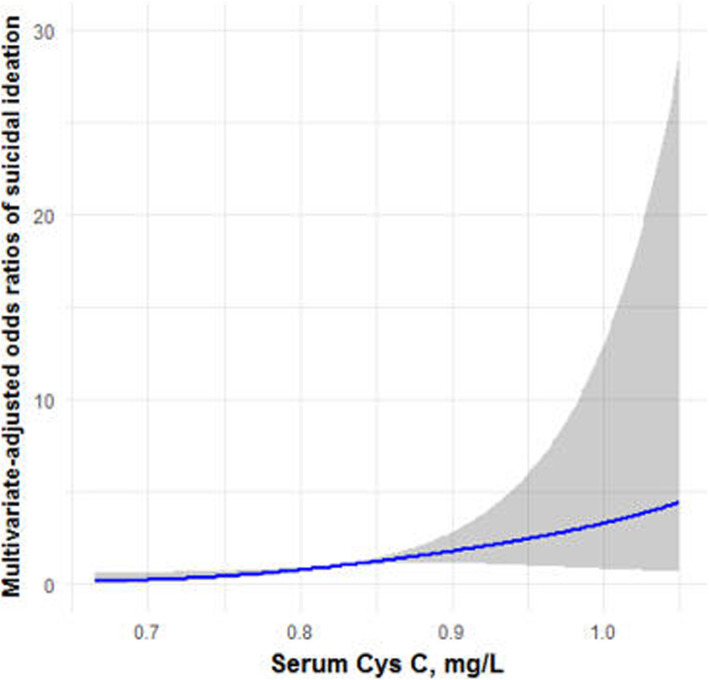
Background: Individuals with major depressive disorder (MDD) have high suicidal ideation. There is evidence that serum cystatin C (Cys C) may be involved in the pathophysiology of MDD. The present study aimed to investigate Cys C concentration in patients with MDD and clarify its possible association with depressive symptoms and suicidal ideation. Methods: An online cross-sectional survey of 159 patients diagnosed with MDD was conducted. Serum Cys C levels were measured using ADVIA 2400 biochemical analyzer. The 24-item Hamilton Depression Scale (HAMD-24) was administered to evaluate the depressive symptoms. Generalized linear regression, logistic regression and restricted cubic spline models were used to examine the association of serum Cys C levels with depressive symptoms and suicidal ideation. Results: Serum Cys C levels were higher in MDD patients than in controls (p = 0.001) and were positively associated with scores on HAMD-24 in unadjusted (gender distribution, age, smoking, alcohol consumption, family history of depression and traumatic life events; (p = 0.003) and fully adjusted linear regression model (p = 0.005). The fully adjusted regression coefficient with 95% confidence intervals for serum Cys C levels and HAMD-24 score was 30.339 (9.602 to 51.077). The level of Cys C in the suicidal ideation (SI) group was significantly higher than that in the non-suicide ideation (non-SI) group (p = 0.001). Serum Cys C levels were positively associated with suicidal ideation in each logistic regression model (all p < 0.05). Conclusion: Serum Cys C levels were elevated in MDD patients and appeared to be positively correlated with depressive symptoms and suicidal ideation. These findings suggest that the dysfunction of Cys C may be involved in the severity of depression and in the pathophysiological process of MDD. Thus, regulation of serum Cys C could potentially be an effective predictor of the severity of depression and potentially, play a role in reducing the risk of suicide in MDD patients.
Overview
The claims and statistics of this paper haven’t been checked yet.
Free: it reads the open-access text and checks the first 5 claims that cite a source we can check. Create a free account to check every claim.
Integrity signals
Registry
Cites
Statistics
Figures
Verification
Claims the paper makes
The claims and statistics of this paper haven’t been checked yet.
Free: it reads the open-access text and checks the first 5 claims that cite a source we can check. Create a free account to check every claim.
Claims other papers make about this one
Each is checked against this paper’s own text: does it say what the citing paper says it does?
The cited source says what the claim attributes to it.
In the citing paper
“Research reveals that patients experiencing depression exhibit considerably higher cystatin C levels compared to healthy individuals, which may be linked to immunological processes (22).”
From Investigation of serum cystatin C levels and their diagnostic value in combination with inflammatory ratios in patients with bipolar disorder (2025) · doi:10.3389/fpsyt.2025.1525091 · cites this paper as [22]
Self-check
Percentages, sums and reported differences re-computed from the paper’s own numbers.
The self-check needs the paper’s full text.
Citations
Cites
Hamilton, M. (1960) · Journal of Neurology, Neurosurgery & Psychiatry · doi:10.1136/jnnp.23.1.56 · Cited by 32,817 · cited 1×
“Depressive symptoms were assessed with the 24-item Hamilton Depression Scale (HAMD-24) by a long-term trained psychologist [31].”
MethodMalhi, G. S., & Mann, J. J. (2018) · The Lancet · doi:10.1016/s0140-6736(18)31948-2 · Cited by 4,099
Assessment of suicidal intention: The Scale for Suicide Ideation.
Beck, A. T., Kovacs, M., & Weissman, A. (1979) · Journal of Consulting and Clinical Psychology · doi:10.1037//0022-006x.47.2.343 · Cited by 3,419
Postmortem studies in mood disorders indicate altered numbers of neurons and glial cells
Rajkowska, G. (2000) · Biological Psychiatry · doi:10.1016/s0006-3223(00)00950-1 · Cited by 822
Nuclear factor-κB is a critical mediator of stress-impaired neurogenesis and depressive behavior
Koo, J. W., Russo, S. J., Ferguson, D., Nestler, E. J., & Duman, R. S. (2010) · Proceedings of the National Academy of Sciences · doi:10.1073/pnas.0910658107 · Cited by 607
Glial Loss in the Prefrontal Cortex Is Sufficient to Induce Depressive-like Behaviors
Banasr, M., & Duman, R. S. (2008) · Biological Psychiatry · doi:10.1016/j.biopsych.2008.06.008 · Cited by 602
Proinflammatory cytokines in the prefrontal cortex of teenage suicide victims
Pandey, G. N., Rizavi, H. S., Ren, X., Fareed, J., Hoppensteadt, D. A., Roberts, R. C., Conley, R. R., & Dwivedi, Y. (2012) · Journal of Psychiatric Research · doi:10.1016/j.jpsychires.2011.08.006 · Cited by 378
Biochemistry and Clinical Role of Human Cystatin C
Mussap, M., & Plebani, M. (2004) · Critical Reviews in Clinical Laboratory Sciences · doi:10.1080/10408360490504934 · Cited by 313
Role of Inflammation in Suicide: From Mechanisms to Treatment
Brundin, L., Bryleva, E. Y., & Thirtamara Rajamani, K. (2017) · Neuropsychopharmacology · doi:10.1038/npp.2016.116 · Cited by 257
Sun, B., Zhou, Y., Halabisky, B., Lo, I., Cho, S.-H., Mueller-Steiner, S., Devidze, N., Wang, X., Grubb, A., & Gan, L. (2008) · Neuron · doi:10.1016/j.neuron.2008.10.001 · Cited by 231
Discovery and validation of blood biomarkers for suicidality
Le-Niculescu, H., Levey, D. F., Ayalew, M., Palmer, L., Gavrin, L. M., Jain, N., Winiger, E., Bhosrekar, S., Shankar, G., Radel, M., et al. (2013) · Molecular Psychiatry · doi:10.1038/mp.2013.95 · Cited by 193 · cited 2×
“Cys C induces neuronal apoptosis by increasing the level of active caspinase-9 protein and decreasing the level of B-cell leukemia 2 (Bcl-2) in the Jun-terminal kinase (JNK) dependent pathway [47], which may be an important risk factor for depression [48].”
Backgroundvan Dooren, F. E. P., Schram, M. T., Schalkwijk, C. G., Stehouwer, C. D. A., Henry, R. M. A., Dagnelie, P. C., Schaper, N. C., van der Kallen, C. J. H., Koster, A., Sep, S. J. S., et al. (2016) · Brain, Behavior, and Immunity · doi:10.1016/j.bbi.2016.03.004 · Cited by 187
Holma, K. M., Haukka, J., Suominen, K., Valtonen, H. M., Mantere, O., Melartin, T. K., Sokero, T. P., Oquendo, M. A., & Isometsä, E. T. (2014) · Bipolar Disorders · doi:10.1111/bdi.12195 · Cited by 175 · cited 1×
“Introduction Major depressive disorder (MDD), with profound impairment in cognitive and social functioning, is a common and complex psychiatric disorder characterized by high morbidity [1, 2], high disability rate [3], and high suicide rate [4, 5].”
BackgroundInvolvement of cystatin C in immunity and apoptosis
Zi, M., & Xu, Y. (2018) · Immunology Letters · doi:10.1016/j.imlet.2018.01.006 · Cited by 170 · cited 2×
“This promotes the secretion of pro-inflammatory cytokines such as IFN-γ and TNF [46], which may impair the function of the brain serotonin system, then activate the hypothalamic-pituitary-adrenal axis, and eventually cause depressive symptoms through the inflammatory pathway.”
BackgroundHigh-Field Magnetic Resonance Imaging of Suicidality in Patients With Major Depressive Disorder
Jia, Z., Huang, X., Wu, Q., Zhang, T., Lui, S., Zhang, J., Amatya, N., Kuang, W., Chan, R. C. K., Kemp, G. J., et al. (2010) · American Journal of Psychiatry · doi:10.1176/appi.ajp.2010.09101513 · Cited by 157
Torres-Platas, S. G., Nagy, C., Wakid, M., Turecki, G., & Mechawar, N. (2016) · Molecular Psychiatry · doi:10.1038/mp.2015.65 · Cited by 148 · cited 1×
“Cys C in the brain is mainly derived from astrocytes [15, 18, 19], and the reduced number or dysfunction of astrocytes may cause or somehow contribute to MDD symptomatology [20, 21].”
BackgroundDas, R. K., Emon, M. P. Z., Shahriar, M., Nahar, Z., Islam, S. M. A., Bhuiyan, M. A., Islam, S. N., & Islam, M. R. (2020) · Psychiatry Research · doi:10.1016/j.psychres.2020.113568 · Cited by 147
Yamada, K., Iida, R., Miyamoto, Y., Saito, K., Sekikawa, K., Seishima, M., & Nabeshima, T. (2000) · Journal of Neuroimmunology · doi:10.1016/s0165-5728(00)00375-1 · Cited by 137
Warfel, A. H., Zucker-Franklin, D., Frangione, B., & Ghiso, J. (1987) · The Journal of experimental medicine · doi:10.1084/jem.166.6.1912 · Cited by 126 · cited 1×
“As a major cysteine protease inhibitor in the brain, Cys C is closely related to neuronal damage [15] and immune inflammation [16].”
BackgroundIslam, M. R., Islam, M. R., Shalahuddin Qusar, M. M. A., Islam, M. S., Kabir, M. H., Mustafizur Rahman, G. K. M., Islam, M. S., & Hasnat, A. (2018) · BMC Psychiatry · doi:10.1186/s12888-018-1685-z · Cited by 116
Cystatin C Protects Neuronal Cells from Amyloid-β-induced Toxicity
Tizon, B., Ribe, E. M., Mi, W., Troy, C. M., & Levy, E. (2010) · Journal of Alzheimer's Disease · doi:10.3233/jad-2010-1291 · Cited by 115
Ghidoni, R., Paterlini, A., Albertini, V., Glionna, M., Monti, E., Schiaffonati, L., Benussi, L., Levy, E., & Binetti, G. (2011) · Neurobiology of Aging · doi:10.1016/j.neurobiolaging.2009.08.013 · Cited by 111
Cystatin C is a disease‐associated protein subject to multiple regulation
Xu, Y., Ding, Y., Li, X., & Wu, X. (2015) · Immunology & Cell Biology · doi:10.1038/icb.2014.121 · Cited by 111
O’Leary-Barrett, M., Mackie, C. J., Ryan, N. C., Al-Khudhairy, N., & Conrod, P. (2010) · Journal of the American Academy of Child & Adolescent Psychiatry · doi:10.1016/j.jaac.2010.04.011 · Cited by 111
Dimensions of suicidal ideation in psychiatric inpatients
Steer, R. A., Rissmiller, D. J., Ranieri, W. F., & Beck, A. T. (1993) · Behaviour Research and Therapy · doi:10.1016/0005-7967(93)90090-h · Cited by 104
Islam, M. R., Islam, M. R., Ahmed, I., Moktadir, A. A., Nahar, Z., Islam, M. S., Shahid, S. F. B., Islam, S. N., Islam, M. S., & Hasnat, A. (2018) · SAGE Open Medicine · doi:10.1177/2050312118773953 · Cited by 89
Visentin, A. P. V., Colombo, R., Scotton, E., Fracasso, D. S., Rosa, A. R., Branco, C. S., & Salvador, M. M. (2020) · Oxidative Medicine and Cellular Longevity · doi:10.1155/2020/2972968 · Cited by 88
Emon, M. P. Z., Das, R., Nishuty, N. L., Shalahuddin Qusar, M. M. A., Bhuiyan, M. A., & Islam, M. R. (2020) · BMC Research Notes · doi:10.1186/s13104-020-04952-3 · Cited by 85
Kim, J.-W., Szigethy, E. M., Melhem, N. M., Saghafi, E. M., & Brent, D. A. (2014) · The Journal of Clinical Psychiatry · doi:10.4088/jcp.13r08898 · Cited by 77
Islam, M. R., Ali, S., Karmoker, J. R., Kadir, M. F., Ahmed, M. U., Nahar, Z., Islam, S. M. A., Islam, M. S., Hasnat, A., & Islam, M. S. (2020) · BMC Psychiatry · doi:10.1186/s12888-020-02738-2 · Cited by 76
Anjum, S., Qusar, M. M. A. S., Shahriar, M., Islam, S. M. A., Bhuiyan, M. A., & Islam, M. R. (2020) · Therapeutic Advances in Psychopharmacology · doi:10.1177/2045125320916655 · Cited by 70
Cystatin C—A marker of peripheral atherosclerotic disease?
Arpegård, J., Östergren, J., Fairé, U. D., Hansson, L.-O., & Svensson, P. (2008) · Atherosclerosis · doi:10.1016/j.atherosclerosis.2007.11.025 · Cited by 67
A Complex Relationship Between Suicide, Dementia, and Amyloid: A Narrative Review
Conejero, I., Navucet, S., Keller, J., Olié, E., Courtet, P., & Gabelle, A. (2018) · Frontiers in Neuroscience · doi:10.3389/fnins.2018.00371 · Cited by 61
Nishuty, N. L., Khandoker, M. M. H., Karmoker, J. R., Ferdous, S., Shahriar, M., Qusar, M. M. A. S., Islam, M. S., Kadir, M. F., & Islam, M. R. (2019) · Cureus · doi:10.7759/cureus.3868 · Cited by 50
Serum Interferon-Gamma Level Is Associated with Drug-Naïve Major Depressive Disorder
Daria, S., Proma, M. A., Shahriar, M., Islam, S. M. A., Bhuiyan, M. A., & Islam, M. R. (2020) · SAGE Open Medicine · doi:10.1177/2050312120974169 · Cited by 46
Involvement of cystatin C in pathophysiology of CNS diseases
Nagai, A. (2008) · Frontiers in Bioscience · doi:10.2741/2941 · Cited by 44 · cited 3×
“Cys C in the brain is mainly derived from astrocytes [15, 18, 19], and the reduced number or dysfunction of astrocytes may cause or somehow contribute to MDD symptomatology [20, 21].”
BackgroundToenders, Y. J., Schmaal, L., Harrison, B. J., Dinga, R., Berk, M., & Davey, C. G. (2020) · Translational Psychiatry · doi:10.1038/s41398-020-0787-9 · Cited by 39
Wilson, M. E., Boumaza, I., & Bowser, R. P. (2013) · Fluids and Barriers of the CNS · doi:10.1186/2045-8118-10-15 · Cited by 34
Ww, C., Cheng, X., Zhang, X., Qs, Z., Hq, S., Wj, H., & Zy, X. (2015) · PubMed · Cited by 33
Ai, M., Wang, J., Chen, J., Wang, W., Xu, X., Gan, Y., Li, X., Gou, X., Cao, J. M., Lv, Z., et al. (2019) · Pharmacogenomics and Personalized Medicine · doi:10.2147/pgpm.s201187 · Cited by 30
Yalçın, Ş., Ulaş, T., Eren, M. A., Aydoğan, H., Camuzcuoğlu, A., Kucuk, A., Yüce, H. H., Demir, M., Vural, M., & Aksoy, N. (2013) · Medicina · doi:10.3390/medicina49030019 · Cited by 29
Zeng, Q., Huang, Z., Wei, L., Fang, J., & Lin, K. (2019) · Neurological Sciences · doi:10.1007/s10072-019-03777-8 · Cited by 28
Ying, G.-X., Huang, C., Jiang, Z., Liu, X., Jing, N., & Zhou, C.-F. (2002) · Neuroscience · doi:10.1016/s0306-4522(02)00083-0 · Cited by 28
Hydrogen Peroxide Induces Lysosomal Protease Alterations in PC12 Cells
Lee, D. C., Mason, C. A. W., Goodman, C. B., Holder, M. S., Kirksey, O. W., Womble, T. A., Severs, W. B., & Palm, D. E. (2007) · Neurochemical Research · doi:10.1007/s11064-007-9338-5 · Cited by 27
Chen, J.-X., Feng, J., Zhang, L.-G., Liu, Y., Yang, F., Wang, S., Tan, Y., & Su, Y. (2020) · BMC Psychiatry · doi:10.1186/s12888-020-02891-8 · Cited by 27
Serum insulin-like growth factor-1 and relaxin-3 are linked with major depressive disorder
Ali, S., Nahar, Z., Rahman, M. R., Islam, S. M. A., Bhuiyan, M. A., & Islam, M. R. (2020) · Asian Journal of Psychiatry · doi:10.1016/j.ajp.2020.102164 · Cited by 24
Riya, S., Sultana, S., Daria, S., Proma, M. A., Bhuiyan, M. A., Haque, M. A., & Islam, M. R. (2020) · Cureus · doi:10.7759/cureus.12388 · Cited by 24
Das, R. K., Emon, M. P. Z., Chowdhury, S. F., Huque, S., Zahan, T., & Islam, M. R. (2019) · Cureus · doi:10.7759/cureus.6081 · Cited by 22
Minev, E., Unruh, M. L., Shlipak, M. G., Simsonick, E., Yaffe, K. S., Leak, T. S., Newman, A. B., & Fried, L. F. (2010) · Nephron Clinical Practice · doi:10.1159/000317205 · Cited by 19
Wu, L., Yan, Z., Jiang, H., Xing, H., Li, H., & Qiu, C. (2018) · BMC Geriatrics · doi:10.1186/s12877-018-0957-2 · Cited by 15
Wang, B., Xie, Y.-C., Yang, Z., Peng, D., Wang, J., Zhou, S., Li, S., & Ma, X. (2008) · Dementia and Geriatric Cognitive Disorders · doi:10.1159/000125670 · Cited by 15
Li, H., Wang, A., Gao, Q., Guo, J. C., Li, X., Wang, W., Xiang, Y., & Guo, X. (2019) · Psychiatry Research · doi:10.1016/j.psychres.2019.01.009 · Cited by 14
Zhang, S., Luo, Y., Dong, Z., Chen, X., Cheng, X., Dong, Q., & Wu, D. (2019) · Journal of Clinical Neuroscience · doi:10.1016/j.jocn.2019.05.053 · Cited by 12
Contribution of Cystatin C Gene Polymorphisms to Cerebral White Matter Lesions
Mitaki, S., Nagai, A., Sheikh, A. M., Terashima, M., Isomura, M., Nabika, T., & Yamaguchi, S. (2011) · Cerebrovascular Diseases · doi:10.1159/000331921 · Cited by 11
Dietary Fiber Is Inversely Associated With Depressive Symptoms in Premenopausal Women
Li, D., Tong, Y., & Li, Y. (2020) · Frontiers in Neuroscience · doi:10.3389/fnins.2020.00373 · Cited by 10
Self-citationBalandız, H., & Bolu, A. (2017) · Journal of Forensic and Legal Medicine · doi:10.1016/j.jflm.2017.07.018 · Cited by 10
Cited by
Su, Y., Ye, C., Qin, X., & Si, T. (2023) · Journal of Affective Disorders · doi:10.1016/j.jad.2023.08.106 · Cited by 83
Luo, Y., Lai, Q., Huang, H., Luo, J., Miao, J., Liao, R., Yang, Z., & Zhang, L. (2022) · BMC Psychiatry · doi:10.1186/s12888-022-03987-z · Cited by 31
Tanifuji, T., Okazaki, S., Otsuka, I., Mouri, K., Horai, T., Shindo, R., Shirai, T., & Hishimoto, A. (2023) · Psychiatry Research · doi:10.1016/j.psychres.2023.115103 · Cited by 28
Shindo, R., Tanifuji, T., Okazaki, S., Otsuka, I., Shirai, T., Mouri, K., Horai, T., & Hishimoto, A. (2023) · npj Aging · doi:10.1038/s41514-023-00117-1 · Cited by 27
Elbakary, N., Al‐Khuzaei, N., Hussain, T. A., Karawia, A., Smida, M., Abu-Rahma, N., Akel, F., Mahmoud, S. E., Currie, J., Khoodoruth, M. A. S., et al. (2025) · Journal of Affective Disorders · doi:10.1016/j.jad.2025.119545 · Cited by 25
Metadata
- Authors
- Sun, T., Chen, Q., & Li, Y.
- Affiliations
- Renmin Hospital of Wuhan University (CN)
- Corresponding author
- Li, Yan
- Venue
- BMC Psychiatry
- Published
- 2021-11-17
- Volume
- 21
- Issue
- 1
- Pages
- 576-576
- ISSN
- 1471-244X (ISSN-L)
- PMC
- PMC8596898
- OpenAlex
- W3212371251
- Cited by
- 19
- References
- 56
- Citations by year
- 2026: 2 · 2025: 8 · 2024: 3 · 2023: 3 · 2022: 3
- FWCI
- 1.31
- Type
- journal article
- Language
- en
- Open access
- gold
- doi.org
- Licence
- cc-by
- creativecommons.org/licenses/by/4.0 (tdm)
- creativecommons.org/licenses/by/4.0 (vor)
- Locations
- BMC Psychiatry (publishedVersion, cc-by)
- PubMed Central (publishedVersion, cc-by)
- PubMed (publishedVersion)
- DOAJ (DOAJ: Directory of Open Access Journals) (submittedVersion, cc-by-sa)
- Funders
- National Natural Science Foundation of China (81,772,265)
- Topics
- Health Sciences › Medicine › Pharmacology (medical) › Treatment of Major Depression
- Life Sciences › Neuroscience › Biological Psychiatry › Tryptophan and brain disorders
- Social Sciences › Psychology › Clinical Psychology › Suicide and Self-Harm Studies
- Keywords
- cystatin C, major depressive disorder, suicidal ideation, depressive symptoms, serum biomarkers, depression severity, suicide risk, depression pathophysiology
- MeSH terms
- Cross-Sectional Studies, Depression, Major Depressive Disorder, Humans, Cystatin C, Suicidal Ideation
About these checks
Registry, retraction, Cites and statistics results are computed, not judged, with one exception: a printed reference that no index lists is read once by a model before it counts as a citation error. Claims are extracted by a model and kept only when their quote appears verbatim in the text; each cited source is then checked, with a model’s help, for whether it says what the claim relies on. Those verdicts can be wrong — read the claim’s quote and the cited source before relying on one.
Statistics and arithmetic are recomputed, not judged.
Confidence bands are shown only for fields calibrated on our annotated test set. None is calibrated yet, so no band is shown.
What counts as a claim ›How we measure confidence ›How we check this ›
Are you an author, or do you see a problem with this page? Request a review
Data sources
Bibliographic data: Semantic Scholar, OpenAlex, Crossref.
Contains information from the Semantic Scholar Academic Graph Datasets, made available under the ODC Attribution License (ODC-BY 1.0).
Semantic Scholar’s data is described in: Kinney, R., et al. (2023). The Semantic Scholar Open Data Platform. arXiv:2301.10140.
