

Humanistic and economic burden associated with depression in the United States: a cross-sectional survey analysis
Open accessThe DOI matches its Crossref record; 44 of the 44 references it cites were found in a registry or an index.
Abstract
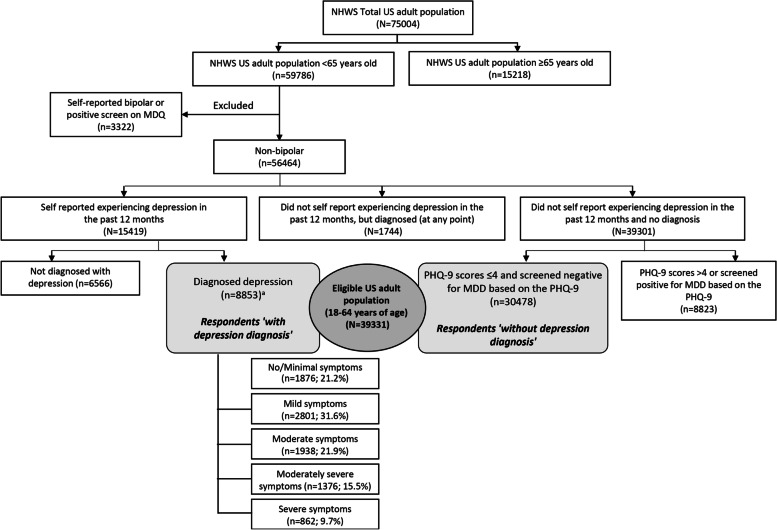
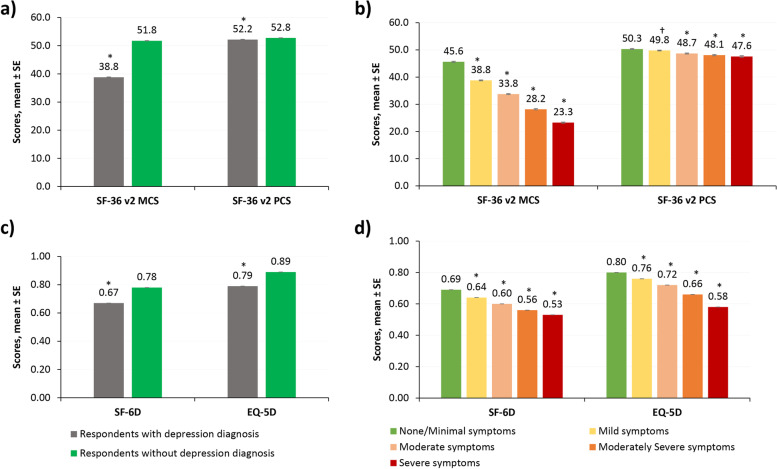
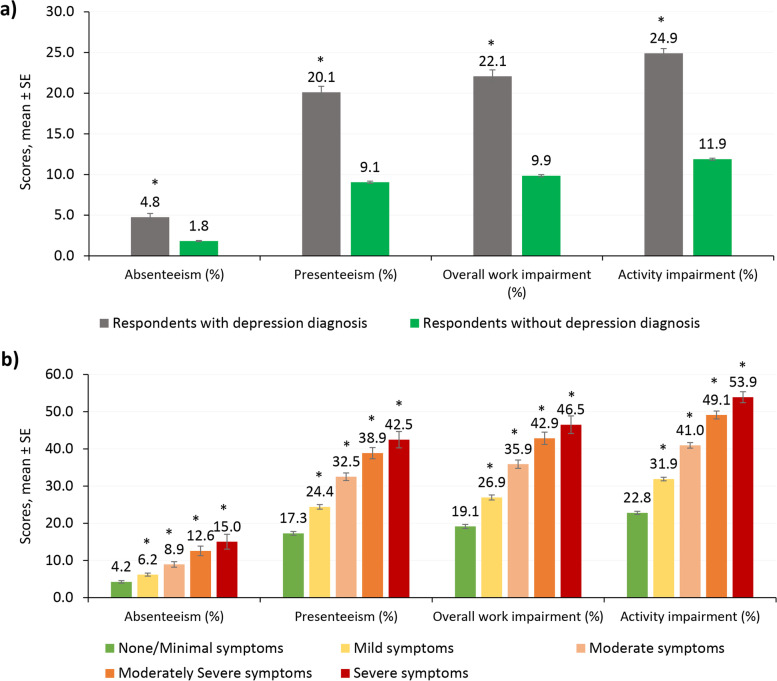
Background: Depression (major depressive disorder [MDD]) affects the functioning of patients in many facets of life. Very few large-scale studies to date have compared health and economic related outcomes of those with versus without depression, and across various depression severity groups. We aimed to evaluate humanistic and economic burden in respondents with and without depression diagnosis, and across symptom severity groups. Methods: Data from the 2017 US National Health and Wellness Survey (NHWS) were utilized. Of the adult respondents ( N = 75,004), 59,786 were < 65 years old. Respondents not meeting eligibility criteria were excluded (e.g., those self-reporting bipolar disorder or experiencing depression in past 12 months but no depression diagnosis). Overall, data from 39,331 eligible respondents (aged 18–64 years) were analyzed; and comprised respondents ‘with depression diagnosis’ ( n = 8853; self-reporting physician diagnosis of depression and experiencing depression in past 12 months) and respondents ‘without depression diagnosis’ ( n = 30,478; no self-reported physician diagnosis of depression and not experiencing depression). Respondents with depression were further examined across depression severity based on Patient Health Questionnaire-9 (PHQ-9). Outcome measures included health-related quality-of-life (HRQoL; Medical Outcomes Study 36-item Short Form [SF-36v2]: mental and physical component summary [MCS and PCS]; Short-Form 6 Dimensions [SF-6D]; and EuroQol 5 Dimensions [EQ-5D]), work productivity and activity impairment (WPAI), and health resource utilization (HRU). Multivariate analysis was performed to examine group differences after adjusting covariates. Results: Respondents with depression diagnosis reported significantly higher rates of diagnosed anxiety and sleep problems versus those without depression (for both; P < 0.001). Adjusted MCS, PCS, SF-6D, and EQ-5D scores were significantly lower in respondents with depression versus those without depression (all P < 0.001). Consistently, respondents with depression reported higher absenteeism, presenteeism, and overall WPAI, as well as greater number of provider visits, emergency room visits, and hospitalizations compared with those without depression (all P < 0.001). Further, burden of each outcome increased with an increase in disease severity. Conclusions: Diagnosed depression was associated with lower health-related quality-of-life and work productivity, and higher healthcare utilization than those without depression, and burden increased with an increase in symptom severity. The results show the burden of depression remains high even among those experiencing minimal symptoms.
Overview
The claims and statistics of this paper haven’t been checked yet.
Free: it reads the open-access text and checks the first 5 claims that cite a source we can check. Create a free account to check every claim.
Integrity signals
Registry
Cites
Statistics
Figures
Verification
Claims the paper makes
The claims and statistics of this paper haven’t been checked yet.
Free: it reads the open-access text and checks the first 5 claims that cite a source we can check. Create a free account to check every claim.
Claims other papers make about this one
Each is checked against this paper’s own text: does it say what the citing paper says it does?
The source backs part of the claim, not all of it — or backs it for a different population, condition or comparison.
In the citing paper
“one of the key differentiators of the current study from previous estimations of the economic burden of MDD [8,33,34] was the consideration of household-related costs.”
From The Economic Burden of Adults with Major Depressive Disorder in the United States (2019) (2023) · cites this paper as [34]
Experimental — accuracy not yet measured
Self-check
Percentages, sums and reported differences re-computed from the paper’s own numbers.
The self-check needs the paper’s full text.
Citations
Cites
Diagnostic and Statistical Manual of Mental Disorders
American Psychiatric Association (2013) · doi:10.1176/appi.books.9780890425596 · Cited by 116,369
Charlson, M. E., Pompei, P., Ales, K. L., & MacKenzie, C. R. (1987) · Journal of Chronic Diseases · doi:10.1016/0021-9681(87)90171-8 · Cited by 49,742
The PHQ-9: Validity of a brief depression severity measure
Kroenke, K., Spitzer, R. L., & Williams, J. B. W. (2001) · Journal of General Internal Medicine · doi:10.1046/j.1525-1497.2001.016009606.x · Cited by 44,910
A Brief Measure for Assessing Generalized Anxiety Disorder: The GAD-7
Spitzer, R. L., Kroenke, K., Williams, J. B. W., & Löwe, B. (2006) · Archives of Internal Medicine · doi:10.1001/archinte.166.10.1092 · Cited by 31,765
Development and preliminary testing of the new five-level version of EQ-5D (EQ-5D-5L)
Herdman, M., Gudex, C., Lloyd, A., Janssen, M., Kind, P., Parkin, D., Bonsel, G., & Badia, X. (2011) · Quality of Life Research · doi:10.1007/s11136-011-9903-x · Cited by 9,795 · cited 1×
“The most recent version with 5-point rating scales for each dimension was used in this study [22].”
MethodThe PHQ-9: A New Depression Diagnostic and Severity Measure
Kroenke, K., & Spitzer, R. L. (2002) · Psychiatric Annals · doi:10.3928/0048-5713-20020901-06 · Cited by 5,898 · cited 1×
“Respondents without depression diagnosis: those who had no selfreported physician diagnosis of depression, reported not experiencing depression in the past 12 months, and had PHQ-9 scores ≤ 4 [17] (Fig.”
Rush, A. J., Trivedi, M. H., Wisniewski, S. R., Nierenberg, A. A., Stewart, J. W., Warden, D., Niederehe, G., Thase, M. E., Lavori, P. W., Lebowitz, B. D., et al. (2006) · American Journal of Psychiatry · doi:10.1176/ajp.2006.163.11.1905 · Cited by 5,643 · cited 1×
“Moreover, another analysis of the STAR*D trial data reported a decrease in both response and remission rates with each step of treatment [10].”
BackgroundSantomauro, D. F., Mantilla Herrera, A. M., Shadid, J., Zheng, P., Ashbaugh, C., Pigott, D. M., Abbafati, C., Adolph, C., Amlag, J. O., Aravkin, A. Y., et al. (2021) · The Lancet · doi:10.1016/s0140-6736(21)02143-7 · Cited by 5,444
Impact of COVID-19 pandemic on mental health in the general population: a systematic review
Xiong, J., Lipsitz, O., Nasri, F., Lui, L. M. W., Gill, H., Phan, L., Chen-Li, D., Iacobucci, M., Ho, R., Majeed, A., et al. (2020) · Journal of Affective Disorders · doi:10.1016/j.jad.2020.08.001 · Cited by 5,204
The Validity and Reproducibility of a Work Productivity and Activity Impairment Instrument
Reilly, M. C., Zbrozek, A. S., & Dukes, E. M. (1993) · PharmacoEconomics · doi:10.2165/00019053-199304050-00006 · Cited by 3,071
Research works printed but not linked: 1
- Ware J Kosinski M Bjorner J Turner-Bowker D Gandek B Maruish M User’s manual for the SF36v2 Health Survey 2007 2 Lincoln, RI Quality Metric Incorporated
Cited by
The Economic Burden of Adults with Major Depressive Disorder in the United States (2019)
Greenberg, P., Chitnis, A., Louie, D., Suthoff, E., Chen, S.-Y., Maitland, J., Gagnon-Sanschagrin, P., Fournier, A.-A., & Kessler, R. C. (2023) · Advances in Therapy · doi:10.1007/s12325-023-02622-x · Cited by 223
“Indeed, one of the key differentiators of the current study from previous estimations of the economic burden of MDD [8, 33, 34] was the consideration of household-related costs.”
BackgroundSelf-citationDigital mental health interventions for the treatment of depression: A multiverse meta-analysis
Plessen, C. Y., Panagiotopoulou, O. M., Tong, L., Cuijpers, P., & Karyotaki, E. (2025) · Journal of Affective Disorders · doi:10.1016/j.jad.2024.10.018 · Cited by 53
Wáng, Q., Huang, X., Liu, M., Wang, C., Sun, Z., Huang, C., & Tang, S. (2024) · Aging & Mental Health · doi:10.1080/13607863.2024.2367044 · Cited by 56
“…often associated with several negative outcomes such as cardiovascular disease, cognitive impairment, disability and mortality, leading to high costs, and society burden (Chodavadia et al., 2023; Holtfreter et al., 2017; Jain et al., 2022; Wicke et al., 2022; Wu et al., 2017; Zhang et al., 2018).”
Depression and cardiovascular disease: mind the gap in the guidelines
Armon, D. B., Buhayer, A., Miteva, K., Meinlschmidt, G., Dobretz, K., Zuccarella‐Hackl, C., Appenzeller‐Herzog, C., Mach, F., & Battegay, E. J. (2025) · European Heart Journal · doi:10.1093/eurheartj/ehaf479 · Cited by 32
Niu, Y., Sun, Y., Xie, Y., & Yu, S. (2025) · BMC Geriatrics · doi:10.1186/s12877-024-05633-7 · Cited by 23
“Respondents with a diagnosis of depression reported significantly higher rates of diagnosed anxiety and sleep problems than those without depression [18].”
Ma, J., Zhou, H., Fu, Q., & Lü, G. (2023) · BMC Public Health · doi:10.1186/s12889-023-15201-0 · Cited by 20
“The results show that the burden of depression remains high even among those experiencing minimal symptoms [20].”
BackgroundCulpepper, L., Martin, A., Nabulsi, N. A., & Parikh, M. (2024) · Advances in Therapy · doi:10.1007/s12325-024-02817-w · Cited by 21
“For example, it has been observed that patients with MDD commonly experience significant impairments in HRQoL, which worsens with increased disease severity [4, 7, 35, 36].”
InfluentialYu, Q., Xue, F., Wik, S. L., Gao, M., Adebisi, Y. A., Lucero‐Prisno, D. E., Zhong, C. C., Wong, M. C. S., Huang, J., & Global Health Focus Epidemiology Group (2025) · Psychotherapy and Psychosomatics · doi:10.1159/000547927 · Cited by 19
“MDD is strongly associated with persistent sadness, loss of interest in activities, and a range of somatic symptoms, which significantly interfere with daily responsibilities and social relationships [3, 4].”
Shah, A. D., Laternser, C., Tatachar, P., & Duong, P. H. (2024) · International Journal of Environmental Research and Public Health · doi:10.3390/ijerph21101306 · Cited by 19
“This study only scratches the surface of a deeper issue: the long-term effects of”
BackgroundAguilar‐Raab, C., Winter, F., Warth, M., Stoffel, M., Moessner, M., Hernández, C., Pace, T. W. W., Harrison, T., Negi, L. T., Jarczok, M. N., et al. (2023) · Journal of Affective Disorders · doi:10.1016/j.jad.2023.08.136 · Cited by 16
Fei, Y., Yu, H., Liu, J., & Gong, S. (2025) · Annals of General Psychiatry · doi:10.1186/s12991-025-00560-2 · Cited by 12
“It also interferes with the older adults’ normal life, resulting in high medical costs and a significant social burden [8, 9].”
Clinical profile, prevalence, and burden of chronic spontaneous urticaria in the United States
Soong, W., Patil, D., Rodrigues, J., Kohli, R. K., Krupsky, K. L., Gupta, S., Balkaran, B. L., & Balp, M. M. (2025) · World Allergy Organization Journal · doi:10.1016/j.waojou.2025.101081 · Cited by 18
Self-citationPractical pathway for the management of depression in the workplace: a Canadian perspective
Chokka, P. R., Bender, A., Brennan, S., Ahmed, G., Corbière, M., Dozois, D. J. A., Habert, J., Harrison, J., Katzman, M. A., McIntyre, R. S., et al. (2023) · Frontiers in Psychiatry · doi:10.3389/fpsyt.2023.1207653 · Cited by 16
Ma, Y., Zhou, X., Zhang, F., Huang, C.-Y., Yang, H., Chen, W., & Tao, X. (2024) · Frontiers in Pharmacology · doi:10.3389/fphar.2024.1313871 · Cited by 10
“Another cross-sectional survey analysis conducted in USA also pointed that individuals with depression diagnosis have substantial humanistic and economic burden (Jain et al., 2022).”
BackgroundRahman, M., Khan, M., Fattah, T., Tasnim, Z., Das, P. R., Prattay, K. M. R., Islam, M. S., & Islam, M. R. (2025) · BMC Psychiatry · doi:10.1186/s12888-025-07500-0 · Cited by 10
“Individuals diagnosed with depression exhibited markedly elevated rates of diagnosed anxiety and sleep disturbances compared to those without depression [11].”
Abdoli, E., Rezaie, E., Mirghafourvand, M., Payahoo, L., Naseri, E., & Ghanbari-Homaie, S. (2024) · Scientific Reports · doi:10.1038/s41598-024-74804-8 · Cited by 11
“Depression decreases quality of life and work productivity while increasing health and medical care expenditure 19 .”
BackgroundDou, L., Zheng, Y., Feng, J., Huang, Z., Qin, F., Gao, M., & Li, S. (2025) · International Journal of COPD · doi:10.2147/copd.s524028 · Cited by 7
“24 Moreover, the difference in PCS between the COPD group and the control group was higher than the difference in MCS between the two groups, indicating that COPD generally impacts physical status more than mental status.”
Molecular Mechanisms of Depression: The Interplay Between Genes and Receptors
Oatu, A., Trifu, S. C., & Coman, E. (2025) · International Journal of Molecular Sciences · doi:10.3390/ijms262311325 · Cited by 10
Bailey, R. K., Clemens, K. M., Portela, B., Bowrey, H. E., Pfeiffer, S. N., Geonnotti, G., Riley, A., Sminchak, J., Kevo, S. L., & Naranjo, R. R. (2024) · Psychiatry Research Communications · doi:10.1016/j.psycom.2024.100200 · Cited by 7
McIntyre, R. S., Parikh, M., Ta, J. T., Waraich, S., Cohen-Stavi, C. J., Marci, C. D., & Nabulsi, N. A. (2025) · Journal of Medical Economics · doi:10.1080/13696998.2025.2513766 · Cited by 6
“…it is possible that the reductions in depression severity during cariprazine treatment observed in the present study may be linked to improvements in other outcomes, as increased depression severity is known to be associated with higher healthcare utilization and lower work productivity 47 .”
Adaptive Hyperactivity and Biomarker Exploration: Insights from Elders in the Blue Zone of Sardinia
Scano, A., Orrù, G., Kalcev, G., Cossu, G., Tusconi, M., Spada, M., Atzori, M., Ferreli, C., Cabitza, F., Primavera, D., et al. (2024) · Journal of Clinical Medicine · doi:10.3390/jcm13216451 · Cited by 6
Ikawa, H., Takeda, Y., Osawa, R., Sato, A., Mizuno, H., & Noda, Y. (2024) · Journal of Clinical Medicine · doi:10.3390/jcm13020399 · Cited by 4
“Major depressive disorder (MDD) is a common mental disorder with a significant prevalence and burden worldwide [1,2].”
BackgroundMasand, P. S., Clayton, A. H., Parikh, M., Laliberté, F., Germain, G., Mahendran, M., Martínez, C., & Nabulsi, N. A. (2025) · Journal of Medical Economics · doi:10.1080/13696998.2025.2457872 · Cited by 3
“Adults with MDD have a significantly lower quality of life, higher HRU, and more severe functional impairment (e.g. in the workplace) than those without MDD 50 .”
Takaesu, Y., Shiroma, A., Nosaka, T., & Maruyama, H. (2025) · Neuropsychopharmacology Reports · doi:10.1002/npr2.70012 · Cited by 3
“This finding is consistent with previous reports that reduced work productivity is associated with increased depressive symptoms among patients with depression [40] and bipolar disorder [7] in National Health and Wellness Survey patient databases.”
Clayton, A. H., Parikh, M., Yee, T., Mercer, D., Haiyan, S., Cummings, N., Rava, A., Hayes, O., & Nabulsi, N. A. (2025) · Current Medical Research and Opinion · doi:10.1080/03007995.2025.2465617 · Cited by 3
Herr, K. J., Berk, M., Huang, W., Kato, T., Lee, J. G., Ng, C. G., Wang, Z., Webb, T., Kasahara‐Kiritani, M., & Vandervoort, L. (2025) · Neuropsychopharmacology Reports · doi:10.1002/npr2.70007 · Cited by 4
“Also, MDD contributes to direct and indirect costs associated with health-care/ work productivity [44, 45], especially in the post-COVID era [7].”
Bajaj, N., Kumar, N. K., Kumar, R., Patil, V., & Sharma, A. (2024) · Indian Journal of Psychiatry · doi:10.4103/indianjpsychiatry.indianjpsychiatry_161_24 · Cited by 2
Liu, D., Qiu, L., Han, L., Wang, Y., Wang, F., Liu, X., & Wu, J. (2024) · BMC Public Health · doi:10.1186/s12889-024-20939-2 · Cited by 4
Nasirpour, N., Esmailzadehha, N., Hajebi, A., Savari, E., Ghanbari, B., & Motevalian, S. A. (2023) · BMC Psychiatry · doi:10.1186/s12888-023-05438-9 · Cited by 2
“The Global Burden of Disease study from 1990 to 2017 found that the number of incident cases of MDD increased by 49.29% from 162 million to 241 million worldwide [2].”
BackgroundInfluentialDemocracy Therapy: Lessons from ThriveNYC
Belkin, G. S. (2023) · Daedalus · doi:10.1162/daed_a_02034 · Cited by 2
Linda, L., Mutema, A. B., Babirye, S. R., Nabbumba, C., Chong, A., Gaunt, T. R., Meng, X., Kuchenbaecker, K. B., Jjingo, D., Kinyanda, E., et al. (2025) · Research Square · doi:10.21203/rs.3.rs-5828682/v1 · Cited by 2
Álvarez-García, H. B., & Osma, J. (2025) · Journal of Basic and Applied Psychology Research · doi:10.29057/jbapr.v6i12.13387 · Cited by 1
The impact of grandchild caregiving on depression among grandparents: a scoping review
Hu, J., Zhang, N., & Kitcharoen, P. (2025) · Frontiers in Public Health · doi:10.3389/fpubh.2025.1696678 · Cited by 3
Nöhles, V. B., Bermpohl, F., Schoofs, N., Bathe-Peters, R., Hilpert, N., Dafsari, F. S., Reif-Leonhard, C., Reif, A., Schillo, S., Arshad, R. S., et al. (2025) · Depression and Anxiety · doi:10.1155/da/4470169 · Cited by 4
“Individuals with MDD often exhibit signi fi cant functional impairment, including elevated rates of sick leave, diminished work productivity, and impaired daily activity [4].”
Masand, P. S., Clayton, A. H., Parikh, M., Haile, F., Germain, G., Ripley, S., Ma, S., Laliberté, F., & Nabulsi, N. A. (2025) · Journal of Medical Economics · doi:10.1080/13696998.2025.2587412 · Cited by 1
“About 90% of patients initiating ADT change treatments at least once 43,44 .”
Maruf, S. A., Rahman, H., Azmin, M. S., Faria, T. A., Rashid, M. A. M., Billah, M. M., Siddique, N. S., & Khan, M. B. (2026) · medRxiv · doi:10.64898/2026.09.12.26362706 · Cited by 1
Ayub, A., Rahim, T., Bahadar, S., & Saleem, M. S. (2023) · Pakistan Journal of Health Sciences · doi:10.54393/pjhs.v4i12.1189
Ching, J., Duff, S., & Hernandez, J. (2024) · medRxiv · doi:10.1101/2024.06.05.24306788 · Cited by 1
Cost-per-remitter for esketamine nasal spray versus quetiapine for treatment-resistant depression
Clemens, K., Teeple, A., Rive, B., Kirson, N. Y., Desai, U. S., Doran, J., Eid, D., Qu, A., Bowrey, H. E., & Joshi, K. (2025) · Journal of Comparative Effectiveness Research · doi:10.57264/cer-2024-0092
Masand, P. S., Nabulsi, N. A., Laliberté, F., Germain, G., Klimek, J., Kerolous, M., Wade, S. W., & Parikh, M. (2025) · Journal of Affective Disorders · doi:10.1016/j.jad.2025.119787
Watanabe, K., Sumiyoshi, T., Kato, M., Kikuchi, T., Moriguchi, Y., Åström, D. O., & Christensen, M. C. (2025) · Journal of Affective Disorders Reports · doi:10.1016/j.jadr.2025.100955 · Cited by 2
PHYSICAL ACTIVITY IN PSYCHIATRY: MECHANISMS AND EFFICACY IN THE INTEGRATED TREATMENT OF DEPRESSION
Zaleszczyk, A., Oświeczyńska, K., Kasprzak, A., & Jędrzejewska-Rzezak, P. (2025) · International Journal of Innovative Technologies in Social Science · doi:10.31435/ijitss.3(47).2025.3660
Kobyakova, О. S., Kanev, A. F., Kurakova, N. G., & Леонидовна, К. Р. (2025) · Public Health · doi:10.21045/2782-1676-2025-5-4-45-65
Nasirpour, N., Esmailzadehha, N., Hajebi, A., Savari, E., Ghanbari, B., & Motevalian, S. A. (2023) · Figshare · doi:10.6084/m9.figshare.24804350
Xia, M., Duan, J., Chen, N., Zhou, W., Zhang, N., Feng, M., Sun, Y., & Luan, Y. (2026) · Drug Design Development and Therapy · doi:10.2147/dddt.s580802
Cai, X., Zhang, S., Zhao, Z., Lan, T., Mei, L., Dai, Q., & Jin, Y. (2026) · Frontiers in Nutrition · doi:10.3389/fnut.2026.1749859
“Depression is a debilitating condition that profoundly constrains psychosocial functioning, degrades overall quality of life, and imposes a substantial humanistic and economic burden on global health systems (1, 2).”
The Effect of Anxiety and Depression on Outcomes of Idiopathic Adhesive Capsulitis
Merten, E. S., Johnson, A. H., Brennan, J. C., Peterman, M. A., York, J. J., Turcotte, J. J., & Redziniak, D. E. (2026) · JBJS Open Access · doi:10.2106/jbjs.oa.26.00031
Omisore, T., Teeling, S. P., & Frawley, T. (2026) · International Journal of Nursing Studies Advances · doi:10.1016/j.ijnsa.2026.100618
Jiang, Z., Cai, X., Tang, F., Zhao, Z., & Lin, H. (2026) · European Archives of Psychiatry and Clinical Neuroscience · doi:10.1007/s00406-026-02311-0
“This increased morbidity may also impose a substantial economic burden, as stud - ies have shown that comorbid depression can double total healthcare expenditure [9 , 10].”
Vásquez, M. R. S., Alvarado-García, P. A. A., Jara-Aguilar, R., Gavídia-Valencia, J. G., Ruiz-Reyes, S. G., & Penadillos, R. A. R. (2026) · Molecules · doi:10.3390/molecules31132378
“…hinder social functioning, academic and occupational performance, and overall quality of life, resulting in considerable economic losses due to diminished productivity and substantial treatment gaps, as access to effective, high-quality mental health care remains insufficient in many areas [3,4].”
Khatib, R., Blair, C., McCue, M., Fehnert, B., King, J., Zaki, L. A. M., Chrones, L., Roy, A., Martin, M., DONOVAN, R., et al. (2026) · JMIR Formative Research · doi:10.2196/93024
“With an overall prevalence of 8.3% among adults in 2021, major depressive disorder (MDD) is one of the most common mental disorders in the United States, causing a high socioeconomic burden and disrupting daily activities as well as quality of life [1-3].”
InfluentialChen, Y., Xiao, N., Zhou, Q., Qu, J., Sun, J., & Zhao, X. (2026) · Psychiatry Research · doi:10.1016/j.psychres.2026.117455
Citrome, L., Zhao, Y., Zeni, C. M., Princic, N., Richards, M., Alter, S. P., & Cutler, A. J. (2026) · Journal of Medical Economics · doi:10.1080/13696998.2026.2746279
Metadata
- Authors
- Jain, S., Gupta, S., Li, V. W., Suthoff, E., & Arnaud, A.
- Affiliations
- The University of Texas at Austin (US)
- Sage Therapeutics (United States) (US)
- Corresponding author
- Gupta, Shaloo
- Venue
- BMC Psychiatry
- Published
- 2022-08-11
- Volume
- 22
- Issue
- 1
- Pages
- 542-542
- ISSN
- 1471-244X (ISSN-L)
- PMC
- PMC9367058
- OpenAlex
- W4291020989
- Cited by
- 53
- References
- 42
- Citations by year
- 2026: 10 · 2025: 23 · 2024: 12 · 2023: 8
- FWCI
- 10.15
- Type
- journal article
- Language
- en
- Open access
- gold
- doi.org
- Licence
- cc-by
- creativecommons.org/licenses/by/4.0 (tdm)
- creativecommons.org/licenses/by/4.0 (vor)
- Locations
- BMC Psychiatry (publishedVersion, cc-by)
- PubMed Central (publishedVersion, cc-by)
- PubMed (publishedVersion)
- DOAJ (DOAJ: Directory of Open Access Journals) (submittedVersion, cc-by-sa)
- Funders
- Biogen
- Sage Therapeutics
- Topics
- Health Sciences › Medicine › Psychiatry and Mental health › Mental Health Treatment and Access
- Social Sciences › Economics, Econometrics and Finance › Economics and Econometrics › Health Systems, Economic Evaluations, Quality of Life
- Health Sciences › Medicine › Pharmacology (medical) › Treatment of Major Depression
- Keywords
- depression, economic burden, humanistic burden, health-related quality of life, labor productivity, activity impairment, health resource utilization, depression severity, anxiety, sleep disorders, absenteeism, presenteeism, emergency department visits, hospitalization, United States, National Health and Wellness Survey, PHQ-9, SF-36, EQ-5D, SF-6D
- MeSH terms
- Financial Stress, Adult, Aged, Cross-Sectional Studies, Major Depressive Disorder, Health Surveys, Humans, Quality of Life, Surveys and Questionnaires, United States, Cost of Illness
About these checks
Registry, retraction, Cites and statistics results are computed, not judged, with one exception: a printed reference that no index lists is read once by a model before it counts as a citation error. Claims are extracted by a model and kept only when their quote appears verbatim in the text; each cited source is then checked, with a model’s help, for whether it says what the claim relies on. Those verdicts can be wrong — read the claim’s quote and the cited source before relying on one.
Statistics and arithmetic are recomputed, not judged.
Confidence bands are shown only for fields calibrated on our annotated test set. None is calibrated yet, so no band is shown.
What counts as a claim ›How we measure confidence ›How we check this ›
Are you an author, or do you see a problem with this page? Request a review
Data sources
Bibliographic data: Semantic Scholar, OpenAlex, Crossref.
Contains information from the Semantic Scholar Academic Graph Datasets, made available under the ODC Attribution License (ODC-BY 1.0).
Semantic Scholar’s data is described in: Kinney, R., et al. (2023). The Semantic Scholar Open Data Platform. arXiv:2301.10140.
