

Humanistic and economic burden associated with depression in the United States: a cross-sectional survey analysis
Open accessThe DOI matches its Crossref record; 44 of the 44 references it cites were found in a registry or an index.
Abstract
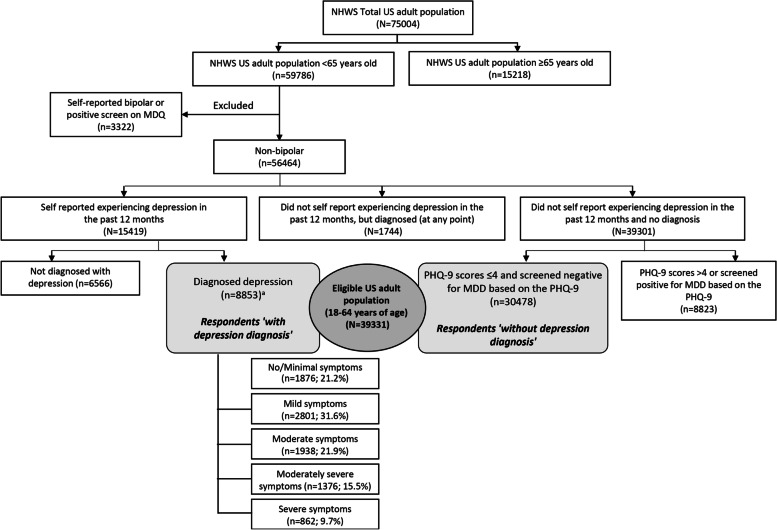
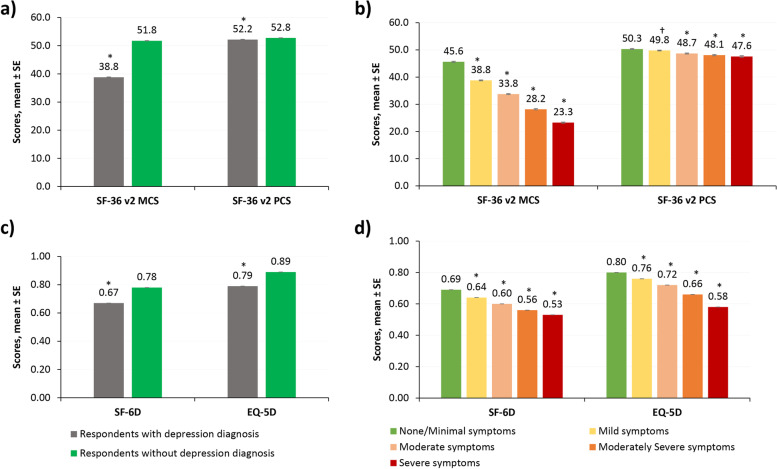
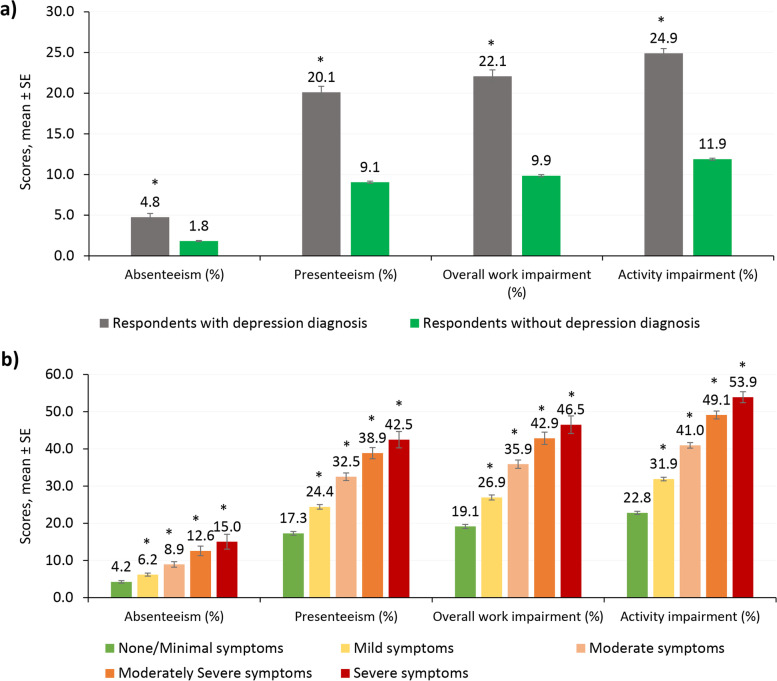
Background: Depression (major depressive disorder [MDD]) affects the functioning of patients in many facets of life. Very few large-scale studies to date have compared health and economic related outcomes of those with versus without depression, and across various depression severity groups. We aimed to evaluate humanistic and economic burden in respondents with and without depression diagnosis, and across symptom severity groups. Methods: Data from the 2017 US National Health and Wellness Survey (NHWS) were utilized. Of the adult respondents ( N = 75,004), 59,786 were < 65 years old. Respondents not meeting eligibility criteria were excluded (e.g., those self-reporting bipolar disorder or experiencing depression in past 12 months but no depression diagnosis). Overall, data from 39,331 eligible respondents (aged 18–64 years) were analyzed; and comprised respondents ‘with depression diagnosis’ ( n = 8853; self-reporting physician diagnosis of depression and experiencing depression in past 12 months) and respondents ‘without depression diagnosis’ ( n = 30,478; no self-reported physician diagnosis of depression and not experiencing depression). Respondents with depression were further examined across depression severity based on Patient Health Questionnaire-9 (PHQ-9). Outcome measures included health-related quality-of-life (HRQoL; Medical Outcomes Study 36-item Short Form [SF-36v2]: mental and physical component summary [MCS and PCS]; Short-Form 6 Dimensions [SF-6D]; and EuroQol 5 Dimensions [EQ-5D]), work productivity and activity impairment (WPAI), and health resource utilization (HRU). Multivariate analysis was performed to examine group differences after adjusting covariates. Results: Respondents with depression diagnosis reported significantly higher rates of diagnosed anxiety and sleep problems versus those without depression (for both; P < 0.001). Adjusted MCS, PCS, SF-6D, and EQ-5D scores were significantly lower in respondents with depression versus those without depression (all P < 0.001). Consistently, respondents with depression reported higher absenteeism, presenteeism, and overall WPAI, as well as greater number of provider visits, emergency room visits, and hospitalizations compared with those without depression (all P < 0.001). Further, burden of each outcome increased with an increase in disease severity. Conclusions: Diagnosed depression was associated with lower health-related quality-of-life and work productivity, and higher healthcare utilization than those without depression, and burden increased with an increase in symptom severity. The results show the burden of depression remains high even among those experiencing minimal symptoms.
Overview
The claims and statistics of this paper haven’t been checked yet.
Free: it reads the open-access text and checks the first 5 claims that cite a source we can check. Create a free account to check every claim.
Integrity signals
Registry
Cites
Statistics
Figures
Verification
Claims the paper makes
The claims and statistics of this paper haven’t been checked yet.
Free: it reads the open-access text and checks the first 5 claims that cite a source we can check. Create a free account to check every claim.
Claims other papers make about this one
Each is checked against this paper’s own text: does it say what the citing paper says it does?
The source backs part of the claim, not all of it — or backs it for a different population, condition or comparison.
In the citing paper
“one of the key differentiators of the current study from previous estimations of the economic burden of MDD [8,33,34] was the consideration of household-related costs.”
From The Economic Burden of Adults with Major Depressive Disorder in the United States (2019) (2023) · cites this paper as [34]
Experimental — accuracy not yet measured
Self-check
Percentages, sums and reported differences re-computed from the paper’s own numbers.
The self-check needs the paper’s full text.
Citations
Cites
Diagnostic and Statistical Manual of Mental Disorders
American Psychiatric Association (2013) · doi:10.1176/appi.books.9780890425596 · Cited by 116,369
Charlson, M. E., Pompei, P., Ales, K. L., & MacKenzie, C. R. (1987) · Journal of Chronic Diseases · doi:10.1016/0021-9681(87)90171-8 · Cited by 49,742
The PHQ-9: Validity of a brief depression severity measure
Kroenke, K., Spitzer, R. L., & Williams, J. B. W. (2001) · Journal of General Internal Medicine · doi:10.1046/j.1525-1497.2001.016009606.x · Cited by 44,910
A Brief Measure for Assessing Generalized Anxiety Disorder: The GAD-7
Spitzer, R. L., Kroenke, K., Williams, J. B. W., & Löwe, B. (2006) · Archives of Internal Medicine · doi:10.1001/archinte.166.10.1092 · Cited by 31,765
Development and preliminary testing of the new five-level version of EQ-5D (EQ-5D-5L)
Herdman, M., Gudex, C., Lloyd, A., Janssen, M., Kind, P., Parkin, D., Bonsel, G., & Badia, X. (2011) · Quality of Life Research · doi:10.1007/s11136-011-9903-x · Cited by 9,795 · cited 1×
“The most recent version with 5-point rating scales for each dimension was used in this study [22].”
MethodThe PHQ-9: A New Depression Diagnostic and Severity Measure
Kroenke, K., & Spitzer, R. L. (2002) · Psychiatric Annals · doi:10.3928/0048-5713-20020901-06 · Cited by 5,898 · cited 1×
“Respondents without depression diagnosis: those who had no selfreported physician diagnosis of depression, reported not experiencing depression in the past 12 months, and had PHQ-9 scores ≤ 4 [17] (Fig.”
Rush, A. J., Trivedi, M. H., Wisniewski, S. R., Nierenberg, A. A., Stewart, J. W., Warden, D., Niederehe, G., Thase, M. E., Lavori, P. W., Lebowitz, B. D., et al. (2006) · American Journal of Psychiatry · doi:10.1176/ajp.2006.163.11.1905 · Cited by 5,643 · cited 1×
“Moreover, another analysis of the STAR*D trial data reported a decrease in both response and remission rates with each step of treatment [10].”
BackgroundSantomauro, D. F., Mantilla Herrera, A. M., Shadid, J., Zheng, P., Ashbaugh, C., Pigott, D. M., Abbafati, C., Adolph, C., Amlag, J. O., Aravkin, A. Y., et al. (2021) · The Lancet · doi:10.1016/s0140-6736(21)02143-7 · Cited by 5,444
Impact of COVID-19 pandemic on mental health in the general population: a systematic review
Xiong, J., Lipsitz, O., Nasri, F., Lui, L. M. W., Gill, H., Phan, L., Chen-Li, D., Iacobucci, M., Ho, R., Majeed, A., et al. (2020) · Journal of Affective Disorders · doi:10.1016/j.jad.2020.08.001 · Cited by 5,204
The Validity and Reproducibility of a Work Productivity and Activity Impairment Instrument
Reilly, M. C., Zbrozek, A. S., & Dukes, E. M. (1993) · PharmacoEconomics · doi:10.2165/00019053-199304050-00006 · Cited by 3,071
Salk, R. H., Hyde, J. S., & Abramson, L. Y. (2017) · Psychological Bulletin · doi:10.1037/bul0000102 · Cited by 2,622 · cited 1×
“The sociodemographic characteristics of respondents with depression diagnosis correlated with previous studies in terms of high prevalence in women and high rates of comorbidities, most notably anxiety, compared to those without depression diagnosis [26, 27].”
ResultInterim scoring for the EQ-5D-5L: mapping the EQ-5D-5L to EQ-5D-3L value sets
van Hout, B., Janssen, M. F., Feng, Y.-S., Kohlmann, T., Busschbach, J., Golicki, D., Lloyd, A., Scalone, L., Kind, P., & Pickard, A. S. (2012) · Value in Health · doi:10.1016/j.jval.2012.02.008 · Cited by 2,153
Epidemiology of Adult DSM-5 Major Depressive Disorder and Its Specifiers in the United States
Hasin, D. S., Sarvet, A. L., Meyers, J. L., Saha, T. D., Ruan, W. J., Stohl, M., & Grant, B. F. (2018) · JAMA Psychiatry · doi:10.1001/jamapsychiatry.2017.4602 · Cited by 1,737
Liu, Q., He, H., Yang, J., Feng, X., Zhao, F., & Lyu, J. (2020) · Journal of Psychiatric Research · doi:10.1016/j.jpsychires.2019.08.002 · Cited by 1,452 · cited 1×
“29% from 162 to 241 million globally [3].”
BackgroundUser’s manual for the SF-12v2 health survey
Ware, J., Kosinski, M., Bowker, D. M., Gandek, B., Ware, J. E., & Turner‐Bowker, D. M. (2002) · Cited by 1,290
Validation of PHQ-2 and PHQ-9 to Screen for Major Depression in the Primary Care Population
Arroll, B., Goodyear-Smith, F., Crengle, S., Gunn, J., Kerse, N., Fishman, T., Falloon, K., & Hatcher, S. (2010) · The Annals of Family Medicine · doi:10.1370/afm.1139 · Cited by 1,279 · cited 1×
“Previously published studies stated that PHQ-9 can be considered for screening but PHQ-9 scores above cut-off should be interpreted with caution or should be coupled with other assessment tools for definitive diagnosis in patients with major depression [46, 47].”
MethodThe Economic Burden of Adults with Major Depressive Disorder in the United States (2010 and 2018)
Greenberg, P. E., Fournier, A.-A., Sisitsky, T., Simes, M., Berman, R., Koenigsberg, S. H., & Kessler, R. C. (2021) · PharmacoEconomics · doi:10.1007/s40273-021-01019-4 · Cited by 838
A comparison of the EQ‐5D and SF‐6D across seven patient groups
Brazier, J., Roberts, J., Tsuchiya, A., & Busschbach, J. (2004) · Health Economics · doi:10.1002/hec.866 · Cited by 797 · cited 8×
“EuroQol 5‐Dimension Health Questionnaire The EuroQol 5-Dimension Health Questionnaire (EQ-5D-5L) [21] consists of a descriptive system (EQ-5D) and a visual analogue scale (EQ VAS).”
BackgroundMethodInfluential(2018) · PubMed · Cited by 663
Tiller, J. W. G. (2013) · Medical Journal of Australia · doi:10.5694/mja12.10628 · Cited by 404
Evans-Lacko, S., & Knapp, M. (2016) · Social Psychiatry and Psychiatric Epidemiology · doi:10.1007/s00127-016-1278-4 · Cited by 390 · cited 1×
“Further, previous studies have shown that depression affects work productivity [11] and increases healthcare resource utilization (HRU), leading to higher direct and indirect costs with increasing severity of depression [12, 13].”
BackgroundSeverity of Depression and Magnitude of Productivity Loss
Beck, A., Crain, A. L., Solberg, L. I., Unutzer, J., Glasgow, R. E., Maciosek, M. V., & Whitebird, R. (2011) · The Annals of Family Medicine · doi:10.1370/afm.1260 · Cited by 290 · cited 3×
“reported that even minimal levels of depression symptoms were associated with loss of work productivity [13, 36].”
BackgroundKamenov, K., Twomey, C., Cabello, M., Prina, A. M., & Ayuso-Mateos, J. L. (2017) · Psychological Medicine · doi:10.1017/s0033291716002774 · Cited by 218
Restoring function in major depressive disorder: A systematic review
Sheehan, D. V., Nakagome, K., Asami, Y., Pappadopulos, E. A., & Boucher, M. (2017) · Journal of Affective Disorders · doi:10.1016/j.jad.2017.02.029 · Cited by 182
Frendl, D. M., & Ware, J. E. (2014) · Medical Care · doi:10.1097/mlr.000000000000010311 · Cited by 166
Woo, J., Kim, W. B., Hwang, T.-Y., Frick, K. D., Choi, B. H., Seo, Y.-J., Kang, E.-H., Kim, S. J., Ham, B., Lee, J., et al. (2011) · Value in Health · doi:10.1016/j.jval.2010.11.006 · Cited by 147
Tiller, J. W. G. (2012) · The Medical Journal of Australia · doi:10.5694/mjao12.10628 · Cited by 143
IsHak, W. W., Mirocha, J., James, D., Tobia, G., Vilhauer, J., Fakhry, H., Pi, S., Hanson, E., Nashawati, R., Peselow, E. D., et al. (2015) · Acta Psychiatrica Scandinavica · doi:10.1111/acps.12301 · Cited by 140
IsHak, W. W., Balayan, K., Bresee, C. J., Greenberg, J. M., Fakhry, H., Christensen, S., & Rapaport, M. H. (2012) · Quality of Life Research · doi:10.1007/s11136-012-0187-6 · Cited by 115
Saragoussi, D., Christensen, M. C., Hammer-Helmich, L., Rive, B., Touya, M., & Haro, J. M. (2018) · Neuropsychiatric Disease and Treatment · doi:10.2147/ndt.s159276 · Cited by 110
Oluboka, O. J., Katzman, M. A., Habert, J., McIntosh, D., MacQueen, G. M., Milev, R. V., McIntyre, R. S., & Blier, P. (2018) · International Journal of Neuropsychopharmacology · doi:10.1093/ijnp/pyx081 · Cited by 104
ten Doesschate, M. C., Koeter, M. W. J., Bockting, C. L. H., & Schene, A. H. (2010) · Journal of Affective Disorders · doi:10.1016/j.jad.2009.04.026 · Cited by 91
Kim, J. M., Chalem, Y., di Nicola, S., Hong, J. P., Won, S. H., & Milea, D. (2016) · Psychiatry Research · doi:10.1016/j.psychres.2016.01.022 · Cited by 83
The Impact of Residual Symptoms in Major Depression
Israel, J. A. (2010) · Pharmaceuticals · doi:10.3390/ph3082426 · Cited by 67
Armbrecht, E. S., Shah, A. M., Schepman, P. B., Shah, R., Pappadopulos, E. A., Chambers, R. B., Stephens, J., Haider, S., & McIntyre, R. S. (2020) · Journal of Medical Economics · doi:10.1080/13696998.2020.1776297 · Cited by 62
The Impact of Psychotherapy, Pharmacotherapy, and Their Combination on Quality of Life in Depression
IsHak, W. W., Ha, K., Kapitanski, N., Bagot, K., Fathy, H., Swanson, B., Vilhauer, J., Balayan, K., Bolotaulo, N. I., & Rapaport, M. H. (2011) · Harvard Review of Psychiatry · doi:10.3109/10673229.2011.630828 · Cited by 57
Xiao, L., Feng, L., Zhu, X., Feng, Y., Wu, W., Ungvari, G. S., Ng, C. H., Xiang, Y., & Wang, G. (2018) · Psychiatry Research · doi:10.1016/j.psychres.2018.01.020 · Cited by 55
The effect of depression treatment on work productivity.
Beck, A. L., Crain, L. A., Solberg, L. I., Unützer, J., Maciosek, M. V., Whitebird, R. R., & Rossom, R. C. (2014) · PubMed · Cited by 49
Prevalence, awareness, and burden of major depressive disorder in urban China
Gupta, S., Goren, A., Dong, P., & Liu, D. (2016) · Expert Review of Pharmacoeconomics & Outcomes Research · doi:10.1586/14737167.2016.1102062 · Cited by 47
Self-citationAsami, Y., Goren, A., & Okumura, Y. (2015) · Journal of Occupational & Environmental Medicine · doi:10.1097/jom.0000000000000310 · Cited by 45
Yamabe, K., Liebert, R., Flores, N., & Pashos, C. L. (2019) · ClinicoEconomics and Outcomes Research · doi:10.2147/ceor.s179901 · Cited by 27
The PHQ-9 works well as a screening but not diagnostic instrument for depressive disorder
Reynolds, W. M. (2010) · Evidence-Based Mental Health · doi:10.1136/ebmh.13.3.96 · Cited by 15
Remission and functioning in major depressive disorder.
Romera, I., Pérez, V., & Gilaberte, I. (2013) · Actas Españolas de Psiquiatría · Cited by 14
Redefining Therapeutic Outcomes of Depression Treatment
Slofstra, C., Booij, S. H., Hoenders, R. H. J., & Castelein, S. (2019) · Journal for Person-Oriented Research · doi:10.17505/jpor.2019.10 · Cited by 10
Research works printed but not linked: 1
- Ware J Kosinski M Bjorner J Turner-Bowker D Gandek B Maruish M User’s manual for the SF36v2 Health Survey 2007 2 Lincoln, RI Quality Metric Incorporated
Cited by
The Economic Burden of Adults with Major Depressive Disorder in the United States (2019)
Greenberg, P., Chitnis, A., Louie, D., Suthoff, E., Chen, S.-Y., Maitland, J., Gagnon-Sanschagrin, P., Fournier, A.-A., & Kessler, R. C. (2023) · Advances in Therapy · doi:10.1007/s12325-023-02622-x · Cited by 223
“Indeed, one of the key differentiators of the current study from previous estimations of the economic burden of MDD [8, 33, 34] was the consideration of household-related costs.”
BackgroundSelf-citationDigital mental health interventions for the treatment of depression: A multiverse meta-analysis
Plessen, C. Y., Panagiotopoulou, O. M., Tong, L., Cuijpers, P., & Karyotaki, E. (2025) · Journal of Affective Disorders · doi:10.1016/j.jad.2024.10.018 · Cited by 53
Wáng, Q., Huang, X., Liu, M., Wang, C., Sun, Z., Huang, C., & Tang, S. (2024) · Aging & Mental Health · doi:10.1080/13607863.2024.2367044 · Cited by 56
“…often associated with several negative outcomes such as cardiovascular disease, cognitive impairment, disability and mortality, leading to high costs, and society burden (Chodavadia et al., 2023; Holtfreter et al., 2017; Jain et al., 2022; Wicke et al., 2022; Wu et al., 2017; Zhang et al., 2018).”
Depression and cardiovascular disease: mind the gap in the guidelines
Armon, D. B., Buhayer, A., Miteva, K., Meinlschmidt, G., Dobretz, K., Zuccarella‐Hackl, C., Appenzeller‐Herzog, C., Mach, F., & Battegay, E. J. (2025) · European Heart Journal · doi:10.1093/eurheartj/ehaf479 · Cited by 32
Niu, Y., Sun, Y., Xie, Y., & Yu, S. (2025) · BMC Geriatrics · doi:10.1186/s12877-024-05633-7 · Cited by 23
“Respondents with a diagnosis of depression reported significantly higher rates of diagnosed anxiety and sleep problems than those without depression [18].”
Metadata
- Authors
- Jain, S., Gupta, S., Li, V. W., Suthoff, E., & Arnaud, A.
- Affiliations
- The University of Texas at Austin (US)
- Sage Therapeutics (United States) (US)
- Corresponding author
- Gupta, Shaloo
- Venue
- BMC Psychiatry
- Published
- 2022-08-11
- Volume
- 22
- Issue
- 1
- Pages
- 542-542
- ISSN
- 1471-244X (ISSN-L)
- PMC
- PMC9367058
- OpenAlex
- W4291020989
- Cited by
- 53
- References
- 42
- Citations by year
- 2026: 10 · 2025: 23 · 2024: 12 · 2023: 8
- FWCI
- 10.15
- Type
- journal article
- Language
- en
- Open access
- gold
- doi.org
- Licence
- cc-by
- creativecommons.org/licenses/by/4.0 (tdm)
- creativecommons.org/licenses/by/4.0 (vor)
- Locations
- BMC Psychiatry (publishedVersion, cc-by)
- PubMed Central (publishedVersion, cc-by)
- PubMed (publishedVersion)
- DOAJ (DOAJ: Directory of Open Access Journals) (submittedVersion, cc-by-sa)
- Funders
- Biogen
- Sage Therapeutics
- Topics
- Health Sciences › Medicine › Psychiatry and Mental health › Mental Health Treatment and Access
- Social Sciences › Economics, Econometrics and Finance › Economics and Econometrics › Health Systems, Economic Evaluations, Quality of Life
- Health Sciences › Medicine › Pharmacology (medical) › Treatment of Major Depression
- Keywords
- depression, economic burden, humanistic burden, health-related quality of life, labor productivity, activity impairment, health resource utilization, depression severity, anxiety, sleep disorders, absenteeism, presenteeism, emergency department visits, hospitalization, United States, National Health and Wellness Survey, PHQ-9, SF-36, EQ-5D, SF-6D
- MeSH terms
- Financial Stress, Adult, Aged, Cross-Sectional Studies, Major Depressive Disorder, Health Surveys, Humans, Quality of Life, Surveys and Questionnaires, United States, Cost of Illness
About these checks
Registry, retraction, Cites and statistics results are computed, not judged, with one exception: a printed reference that no index lists is read once by a model before it counts as a citation error. Claims are extracted by a model and kept only when their quote appears verbatim in the text; each cited source is then checked, with a model’s help, for whether it says what the claim relies on. Those verdicts can be wrong — read the claim’s quote and the cited source before relying on one.
Statistics and arithmetic are recomputed, not judged.
Confidence bands are shown only for fields calibrated on our annotated test set. None is calibrated yet, so no band is shown.
What counts as a claim ›How we measure confidence ›How we check this ›
Are you an author, or do you see a problem with this page? Request a review
Data sources
Bibliographic data: Semantic Scholar, OpenAlex, Crossref.
Contains information from the Semantic Scholar Academic Graph Datasets, made available under the ODC Attribution License (ODC-BY 1.0).
Semantic Scholar’s data is described in: Kinney, R., et al. (2023). The Semantic Scholar Open Data Platform. arXiv:2301.10140.
