

Design of an RCT on cost-effectiveness of group schema therapy versus individual schema therapy for patients with Cluster-C personality disorder: the QUEST-CLC study protocol
Open accessThe DOI matches its Crossref record; 59 of the 60 references it cites were found in a registry or an index.
Abstract
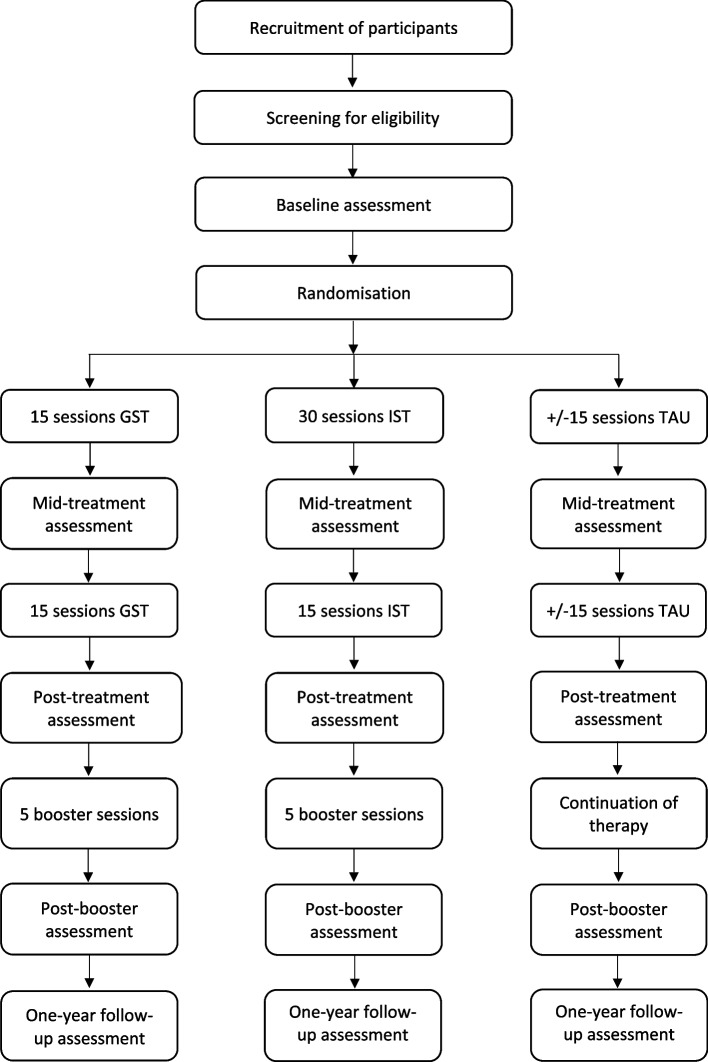
Background: Given the high prevalence of Cluster-C Personality Disorders (PDs) in clinical populations, disease burden, high societal costs and poor prognosis of comorbid disorders, a major gain in health care can be achieved if Cluster-C PDs are adequately treated. The only controlled cost-effectiveness study published so far found Individual Schema Therapy (IST) to be superior to Treatment as Usual (TAU). Group ST (GST) might improve cost-effectiveness as larger numbers can be treated in (>50%) less time compared to IST. However, to date there is no RCT supporting its (cost-) effectiveness. The overall aim of this study is to assess the evidence for GST for Cluster-C PDs and to improve treatment allocation for individual patients. Three main questions are addressed: 1) Is GST for Cluster-C PDs (cost-)effective compared to TAU? 2) Is GST for Cluster-C PDs (cost-) effective compared to IST? 3) Which patient-characteristics predict better response to GST, IST, or TAU? Methods: In a multicenter RCT, the treatment conditions GST, IST, and TAU are compared in 378 Cluster-C PD patients within 10 sites. GST and IST follow treatment protocols and are completed within 1 year. TAU is the optimal alternative treatment available at the site according to regular procedures. Severity of the Cluster-C PD is the primary outcome, assessed with clinical interviews by independent raters blind for treatment. Functioning and wellbeing are important secondary outcomes. Assessments take place at week 0 (baseline), 17 (mid-GST), 34 (post-GST), 51 (post-booster sessions of GST), and 2 years (FU). Patient characteristics predicting better response to a specific treatment are studied, e.g., childhood trauma, autistic features, and introversion. A tool supporting patients and clinicians in matching treatment to patient will be developed. An economic evaluation investigates the cost-effectiveness and cost-utility from a societal perspective. A process evaluation by qualitative methods explores experiences of participants, loved ones and therapists regarding recovery, quality of life, and improving treatment. Discussion: This study will determine the (cost-)effectiveness of treatments for Cluster-C PDs regarding treatment type as well as optimal matching of patient to treatment and deliver insight into which aspects help Cluster-C-PD patients recover and create a fulfilling life. Trial registration: Dutch Trial Register: NL9209. Registered on 28-01-2021,
Overview
The claims and statistics of this paper haven’t been checked yet.
Free: it reads the open-access text and checks the first 5 claims that cite a source we can check. Create a free account to check every claim.
Integrity signals
Registry
Cites
Statistics
Figures
Verification
Claims the paper makes
The claims and statistics of this paper haven’t been checked yet.
Free: it reads the open-access text and checks the first 5 claims that cite a source we can check. Create a free account to check every claim.
Claims other papers make about this one
Each is checked against this paper’s own text: does it say what the citing paper says it does?
The cited source says what the claim attributes to it.
In the citing paper
“These interviews have excellent interrater agreement (ICC>.90) and internal consistency (Cronbach a>.90) [44].”
Self-check
Percentages, sums and reported differences re-computed from the paper’s own numbers.
The self-check needs the paper’s full text.
Citations
Cites
Using thematic analysis in psychology
Braun, V., & Clarke, V. (2006) · Qualitative Research in Psychology · doi:10.1191/1478088706qp063oa · Cited by 194,414
Lincoln, Y. S., Guba, E. G., & Pilotta, J. J. (1985) · International Journal of Intercultural Relations · doi:10.1016/0147-1767(85)90062-8 · Cited by 45,787
Society and the Adolescent Self-Image
Rosenberg, M. (1965) · doi:10.1515/9781400876136 · Cited by 30,126
EuroQol: a new facility for the measurement of health-related quality of life
(1990) · Health Policy · doi:10.1016/0168-8510(90)90421-9 · Cited by 15,736
Methods for the Economic Evaluation of Health Care Programmes
Drummond, M. E., Sculpher, M. J., Torrance, G. W., O’Brien, B. J., & Stoddart, G. L. (2005) · doi:10.1093/oso/9780198529446.001.0001 · Cited by 13,648
The brief symptom inventory: an introductory report.
Derogatis, L. R., & Melisaratos, N. (1983) · Psychological Medicine · doi:10.1017/s0033291700048017 · Cited by 6,650
Baron-Cohen, S., Wheelwright, S., Skinner, R., Martin, J., & Clubley, E. (2001) · Journal of Autism and Developmental Disorders · doi:10.1023/a:1005653411471 · Cited by 6,450 · cited 1×
“Autism Characteristics The Dutch Autism-Spectrum Quotient-10 (AQ-10 [55]; is used to measure autism characteristics.”
MethodDevelopment and validation of a brief screening version of the Childhood Trauma Questionnaire
Bernstein, D. P., Stein, J. A., Newcomb, M. D., Walker, E., Pogge, D., Ahluvalia, T., Stokes, J., Handelsman, L., Medrano, M., Desmond, D., et al. (2003) · Child Abuse & Neglect · doi:10.1016/s0145-2134(02)00541-0 · Cited by 6,419
Qualitative Content Analysis in Practice
Schreier, M. (2012) · doi:10.4135/9781529682571 · Cited by 5,801
(2010) · Virtual Defense Library (Ministerio de Defensa) · Cited by 1,530
Schema Therapy: a Practitioner's Guide
Simeon, D. (2004) · Journal of Psychosomatic Research · doi:10.1016/s0022-3999(03)00529-4 · Cited by 1,274
Dutch Tariff for the Five-Level Version of EQ-5D
M. Versteegh, M., M. Vermeulen, K., M. A. A. Evers, S., de Wit, G. A., Prenger, R., & A. Stolk, E. (2016) · Value in Health · doi:10.1016/j.jval.2016.01.003 · Cited by 1,113 · cited 1×
“The outcome for the CUA is Quality Adjusted Life Year’s (QALY’s), based on the EQ-5D-5L utility scores [46], and the MHQoL-7D [45] for a full description see above) primarily on Dutch utilities [63].”
MethodManca, A., Hawkins, N., & Sculpher, M. J. (2005) · Health Economics · doi:10.1002/hec.944 · Cited by 1,024
Allison, C., Auyeung, B., & Baron-Cohen, S. (2012) · Journal of the American Academy of Child & Adolescent Psychiatry · doi:10.1016/j.jaac.2011.11.003 · Cited by 1,016
Prevalence and correlates of personality disorder in Great Britain
Coid, J., Yang, M., Tyrer, P., Roberts, A., & Ullrich, S. (2006) · British Journal of Psychiatry · doi:10.1192/bjp.188.5.423 · Cited by 901
Briggs, A. H., Wonderling, D. E., & Mooney, C. Z. (1997) · Health Economics · doi:10.1002/(sici)1099-1050(199707)6:4<327::aid-hec282>3.0.co;2-w · Cited by 882
The SAGE Handbook of Qualitative Data Collection
Flick, U. (2018) · SAGE Publications Ltd eBooks · doi:10.4135/9781526416070 · Cited by 864
Measuring happiness with a single-item scale
Abdel-Khalek, A. M. (2006) · Social Behavior and Personality: an international journal · doi:10.2224/sbp.2006.34.2.139 · Cited by 808 · cited 1×
“Happiness Question General happiness in the months prior to assessment is measured with a single item [48].”
MethodDeRubeis, R. J., Cohen, Z. D., Forand, N. R., Fournier, J. C., Gelfand, L. A., & Lorenzo-Luaces, L. (2014) · PLoS ONE · doi:10.1371/journal.pone.0083875 · Cited by 509 · cited 3×
“To derive a tool that informs future patients and therapists what treatment is likely to be most efficacious for the specific patient (personalized care), we currently plan to use the Personalized Advantage Index (PAI) procedure developed by DeRubeis [61].”
MethodBamelis, L. L. M., Evers, S. M. A. A., Spinhoven, P., & Arntz, A. (2014) · American Journal of Psychiatry · doi:10.1176/appi.ajp.2013.12040518 · Cited by 497
Self-citationPrevalence and correlates of personality disorders in a community sample
Samuels, J., Eaton, W. W., Bienvenu, O. J., Brown, C. H., Costa, P. T., & Nestadt, G. (2002) · British Journal of Psychiatry · doi:10.1192/bjp.180.6.536 · Cited by 442
The Oxford Handbook of Personality Disorders
(2012) · Oxford University Press eBooks · doi:10.1093/oxfordhb/9780199735013.001.0001 · Cited by 441
Farrell, J. M., Shaw, I. A., & Webber, M. A. (2009) · Journal of Behavior Therapy and Experimental Psychiatry · doi:10.1016/j.jbtep.2009.01.002 · Cited by 428
The Economic Burden of Personality Disorders in Mental Health Care
Soeteman, D. I., Hakkaart-van Roijen, L., Verheul, R., & Busschbach, J. J. V. (2008) · The Journal of Clinical Psychiatry · doi:10.4088/jcp.v69n0212 · Cited by 417 · cited 1×
“The latter is reflected in the fact that PDs are related to high economic costs in comparison to for instance depression or generalized anxiety disorder [8].”
BackgroundBouwmans, C., De Jong, K., Timman, R., Zijlstra-Vlasveld, M., Van der Feltz-Cornelis, C., Tan, S. S., & Hakkaart-van Roijen, L. (2013) · BMC Health Services Research · doi:10.1186/1472-6963-13-217 · Cited by 401 · cited 2×
“For this study we have developed a cost interview especially designed for this group, based on existing questionnaires, such as the de Trimbos/iMTA questionnaire for Costs associated with Psychiatric Illness (TIC-P) [64].”
MethodSvartberg, M., Stiles, T. C., & Seltzer, M. H. (2004) · American Journal of Psychiatry · doi:10.1176/appi.ajp.161.5.810 · Cited by 398
Volkert, J., Gablonski, T.-C., & Rabung, S. (2018) · The British Journal of Psychiatry · doi:10.1192/bjp.2018.202 · Cited by 346
Winsper, C., Bilgin, A., Thompson, A., Marwaha, S., Chanen, A. M., Singh, S. P., Wang, A., & Furtado, V. (2020) · The British Journal of Psychiatry · doi:10.1192/bjp.2019.166 · Cited by 346
[The Dutch Reading Test for Adults: a measure of premorbid intelligence level].
Schmand, B. A., Bakker, D. J., Saan, R. J., & Louman, J. (1991) · PubMed · Cited by 335
Thombs, B. D., Bernstein, D. P., Lobbestael, J., & Arntz, A. (2009) · Child Abuse & Neglect · doi:10.1016/j.chiabu.2009.03.001 · Cited by 313 · cited 1×
“87 for the separate scales) and showed a good convergent validity with scores on a semi-structured interview for childhood trauma [59].”
BackgroundSelf-citationYoung Schema Questionnaire--Short Form
Young, J. E. (2018) · PsycTESTS Dataset · doi:10.1037/t12644-000 · Cited by 269
Initial Validation of the SLEEP-50 Questionnaire
Spoormaker, V. I., Verbeek, I., van den Bout, J., & Klip, E. C. (2005) · Behavioral Sleep Medicine · doi:10.1207/s15402010bsm0304_4 · Cited by 229
Psychometric Properties of the Dutch Rosenberg Self-Esteem Scale
Franck, E., De Raedt, R., Barbez, C., & Rosseel, Y. (2008) · Psychologica Belgica · doi:10.5334/pb-48-1-25 · Cited by 227
Huibers, M. J. H., Cohen, Z. D., Lemmens, L. H. J. M., Arntz, A., Peeters, F. P. M. L., Cuijpers, P., & DeRubeis, R. J. (2015) · PLOS ONE · doi:10.1371/journal.pone.0140771 · Cited by 215
Self-citationSchema Therapy for Personality Disorders—A Review
Jacob, G. A., & Arntz, A. (2013) · International Journal of Cognitive Therapy · doi:10.1521/ijct.2013.6.2.171 · Cited by 181 · cited 1×
“Furthermore, group therapy can induce vicarious learning and offer in vivo opportunities to practice with setting boundaries and expressing one’s needs in a healthy way [16].”
BackgroundSelf-citationBrief Report: An Evaluation of the AQ-10 as a Brief Screening Instrument for ASD in Adults
Booth, T., Murray, A. L., McKenzie, K., Kuenssberg, R., O’Donnell, M., & Burnett, H. (2013) · Journal of Autism and Developmental Disorders · doi:10.1007/s10803-013-1844-5 · Cited by 171
Baranoff, J. A., Oei, T. P. S., Cho, S., & Kwon, S. (2006) · Journal of Affective Disorders · doi:10.1016/j.jad.2006.03.003 · Cited by 158
Beliefs in personality disorders: a test with the Personality Disorder Belief Questionnaire
Arntz, A. R., Dreessen, L., Schouten, E. G. W., & Weertman, A. (2003) · Behaviour Research and Therapy · doi:10.1016/j.brat.2003.08.004 · Cited by 116
Self-citationArntz, A., Jacob, G. A., Lee, C. W., Brand-de Wilde, O. M., Fassbinder, E., Harper, R. P., Lavender, A., Lockwood, G., Malogiannis, I. A., Ruths, F. A., et al. (2022) · JAMA Psychiatry · doi:10.1001/jamapsychiatry.2022.0010 · Cited by 114
Self-citationExtended Schema Mode Conceptualizations for Specific Personality Disorders: An Empirical Study
Bamelis, L. L. M., Renner, F., Heidkamp, D., & Arntz, A. (2011) · Journal of Personality Disorders · doi:10.1521/pedi.2011.25.1.41 · Cited by 113 · cited 2×
“The SMI-2 has shown good internal consistency [51].”
BackgroundMethodSelf-citationvan Krugten, F. C. W., Busschbach, J. J. V., Versteegh, M., Roijen, L. H., & Brouwer, W. B. F. (2021) · Quality of Life Research · doi:10.1007/s11136-021-02935-w · Cited by 101
Short-term group schema therapy for mixed personality disorders: a pilot study
Skewes, S. A., Samson, R. A., Simpson, S. G., & van Vreeswijk, M. (2015) · Frontiers in Psychology · doi:10.3389/fpsyg.2014.01592 · Cited by 70 · cited 1×
“First, a modest pilot study of a GST-protocol including 8 patients with mixed personality disorders (6 patients with avoidant PD and 2 with borderline PD) showed significant decline in avoidant PD symptom severity at follow-up [21].”
BackgroundFarrell, J. M., Reiss, N., & Shaw, I. A. (2014) · doi:10.1002/9781118510018 · Cited by 69
Chen, H., Cohen, P., Crawford, T. N., Kasen, S., Johnson, J. G., & Berenson, K. (2006) · Journal of Personality Disorders · doi:10.1521/pedi.2006.20.5.510 · Cited by 65
Schema Therapy for Cluster C Personality Disorders
Arntz, A. (2012) · The Wiley‐Blackwell Handbook of Schema Therapy · doi:10.1002/9781119962830.ch30 · Cited by 62 · cited 2×
“Frameworks and specific schema mode models are available for Cluster-C PDs, showing the most common schema modes for avoidant, dependent and obsessive-compulsive PD, and the associated recommended treatment strategy [15].”
BackgroundMethodSelf-citationREM sleep and memory reorganization: Potential relevance for psychiatry and psychotherapy
Landmann, N., Kühn, M., Maier, J.-G., Spiegelhalder, K., Baglioni, C., Frase, L., Riemann, D. W., Sterr, A., & Nissen, C. (2015) · Neurobiology of Learning and Memory · doi:10.1016/j.nlm.2015.01.004 · Cited by 60
Olssøn, I., & Dahl, A. A. (2011) · Comprehensive Psychiatry · doi:10.1016/j.comppsych.2011.10.007 · Cited by 56
Faßbinder, E., Schütze, M., Kranich, A., Sipos, V., Hohagen, F., Shaw, I. A., Farrell, J. M., Arntz, A. R., & Schweiger, U. (2016) · Frontiers in Psychology · doi:10.3389/fpsyg.2016.01851 · Cited by 45
Self-citationBaljé, A., Greeven, A., van Giezen, A., Korrelboom, K., Arntz, A., & Spinhoven, P. (2016) · Trials · doi:10.1186/s13063-016-1605-9 · Cited by 39 · cited 1×
“Group schema therapy GST consists of a one-year protocol [29] based on the Farrell & Shaw model [30] which was successfully piloted in 138 Cluster-C PD patients (see also [31] for preceding version of the protocol).”
MethodSelf-citationContinuous versus Intermittent Data Collection of Health Care Utilization
Hendriks, M. R., Al, M., Bleijlevens, M. H. C., van Haastregt, J. C. M., Crebolder, H. F. J. M., van Eijk, J. T. M., & Evers, S. (2013) · Medical Decision Making · doi:10.1177/0272989x13482045 · Cited by 39
Self-citationBamelis, L. L. M., Arntz, A., Wetzelaer, P., Verdoorn, R., & Evers, S. M. A. A. (2015) · The Journal of Clinical Psychiatry · doi:10.4088/jcp.14m09412 · Cited by 35
Self-citationBachrach, N., & Arntz, A. R. (2021) · Journal of Clinical Psychology · doi:10.1002/jclp.23118 · Cited by 35
Self-citationde Klerk, N., Abma, T. A., Bamelis, L. L. M., & Arntz, A. (2017) · Behavioural and Cognitive Psychotherapy · doi:10.1017/s1352465816000357 · Cited by 34
Self-citationBamelis, L. L., Evers, S. M., & Arntz, A. (2012) · BMC Public Health · doi:10.1186/1471-2458-12-75 · Cited by 33 · cited 1×
“Moreover, STtherapists’ perspectives about treatment will be used to further improve treatment protocols (as was done in the pilot study [24, 25]).”
MethodSelf-citationLong, D., Polinder, S., Bonsel, G. J., & Haagsma, J. A. (2021) · Quality of Life Research · doi:10.1007/s11136-021-02893-3 · Cited by 32
(2018) · PubMed · Cited by 13
The Development and Psychometric Evaluation of the Group Schema Therapy Rating Scale – Revised
Bastick, E., Bot, S., Verhagen, S. J. W., Zarbock, G., Farrell, J. M., Wilde, O. B.-D., Arntz, A. R., & Lee, C. W. (2018) · Behavioural and Cognitive Psychotherapy · doi:10.1017/s1352465817000741 · Cited by 6
Self-citationKortdurende schemagroepstherapie
van Vreeswijk, M., & Broersen, J. (2013) · Bohn Stafleu van Loghum eBooks · doi:10.1007/978-90-313-9865-2 · Cited by 4
Sheikh, K. (2017) · Scientific American Mind · doi:10.1038/scientificamericanmind0317-10b · Cited by 1
Research works printed but not linked: 10
- Young JE. Cognitive therapy for personality disorders: A schematic-focused approach. Sarasota: Professional Resource Exchange; 1990.
- Arntz A. Group Schema Therapy for Borderline PD. Report to ZONMW: University of Amsterdam; 2017.
- American Psychiatric Association. SCID-5-P Gestructureerd klinisch interview voor DSM-5 Persoonlijkheidsstoornissen. In: Nederlandse vertaling van Structured Clinical Interview for DSM-5® Personality Disorders (SCID-5-PD). Amsterdam: Boom; 2017.
- Arntz A, Jacob GA, Lee CW, Brand-de Wilde OM, Fassbinder E, Harper RP, et al. Effectiveness of predominantly group schema therapy and combined individual schema therapy for borderline personality disorder, a randomized clinical trial. JAMA Psychiatry. 2022;79:287-99. PMC8892362 35234828 · DOI · Paper page
- Tese S. Psychometric evaluation of the DPDSI. Thesis RINO Groep 2019.
- Verheul H. Psychometric evaluation of the OCPDSI. Thesis RINO Groep. 2020.
- Dreessen L, Arntz A. The personality disorder beliefs questionnaire (short version). Maastricht: author; 1995.
- Miskimins RW, Braucht GN. Description of the self: Rocky Mountain Behavioral Science Institute; 1971.
- de Beurs E, Zitman FG. De Brief Symptom Inventory (BSI): The reliability and validity of a brief alternative of the SCL-90. Maandblad Geestelijke Volksgezondheid. 2006;61:120–37.
- Schmand B, Bakker D, Saan R, Louman J. De Nederlandse Leestest voor Volwassenen: een maat voor het premorbide intelligentieniveau. Gerontologie en Geriatrie. 1991;22:15–9. 1877068
Cited by
Group schema therapy for cluster‐C personality disorders: A multicentre open pilot study
Wibbelink, C. J. M., Venhuizen, A. S. M., Grasman, R. P. P. P., Bachrach, N., van den Hengel, C., Hudepohl, S., Kunst, L. E., de Lange, H., Louter, M. A., Matthijssen, S. J. M. A., et al. (2023) · Clinical Psychology & Psychotherapy · doi:10.1002/cpp.2903 · Cited by 25
Self-citationTracy, M., Penney, E. S., & Norton, A. R. (2024) · Psychotherapy Research · doi:10.1080/10503307.2024.2361451 · Cited by 21
Wibbelink, C. J. M., Arntz, A. R., Kamphuis, J. H., Groot, I. Z., Sinnaeve, R., & Evers, S. (2025) · Journal of Clinical Psychology · doi:10.1002/jclp.70000 · Cited by 15
Self-citationvan den End, A., Beekman, A. T. F., Dekker, J., Aarts, I., Snoek, A., Blankers, M., Vriend, C., van den Heuvel, O. A., & Thomaes, K. (2024) · European Journal of Psychotraumatology · doi:10.1080/20008066.2024.2382652 · Cited by 14
Daniëls, M., Van, H. L., van den Heuvel, B., Dekker, J. J. M., Peen, J., Bosmans, J., Arntz, A., & Huibers, M. J. H. (2023) · Trials · doi:10.1186/s13063-023-07136-z · Cited by 9
“[44] for a description of the calculations per interview).”
BackgroundSelf-citation
Metadata
- Authors
- Groot, I. Z., Venhuizen, A.-S. S. M., Bachrach, N., Walhout, S., de Moor, B., Nikkels, K., Dalmeijer, S., Maarschalkerweerd, M., van Aalderen, J. R., de Lange, H., Wichers, R., Hollander, A. P., Evers, S. M. A. A., Grasman, R. P. P. P., & Arntz, A.
- Affiliations
- University of Amsterdam (NL)
- Tilburg University (NL)
- GGZ Oost Brabant (NL)
- PsyQ (NL)
- Maastricht University (NL)
- Corresponding author
- Groot, Iuno Z.
- ORCID
- Venue
- BMC Psychiatry
- Published
- 2022-10-08
- Volume
- 22
- Issue
- 1
- Pages
- 637-637
- ISSN
- 1471-244X (ISSN-L)
- PMC
- PMC9548126
- OpenAlex
- W4303684363
- Cited by
- 18
- References
- 60
- Citations by year
- 2026: 2 · 2025: 3 · 2024: 9 · 2023: 4
- FWCI
- 3.65
- Type
- journal article
- Language
- en
- Update notices
- correction (2024-12-31)
- Open access
- gold
- doi.org
- Licence
- cc-by
- creativecommons.org/licenses/by/4.0 (tdm)
- creativecommons.org/licenses/by/4.0 (vor)
- Locations
- BMC Psychiatry (publishedVersion, cc-by)
- PubMed Central (publishedVersion, cc-by)
- Research portal (Tilburg University) (publishedVersion)
- PubMed (publishedVersion)
- Research Publications (Maastricht University) (publishedVersion, cc-by)
- Research Publications (Maastricht University) (publishedVersion, other-oa)
- Research portal (Tilburg University) (submittedVersion, cc-by)
- Data Archiving and Networked Services (DANS) (submittedVersion, cc-by)
- UvA-DARE (University of Amsterdam) (submittedVersion, cc-by)
- DOAJ (DOAJ: Directory of Open Access Journals) (submittedVersion, cc-by-sa)
- Data Archiving and Networked Services (DANS) (submittedVersion, other-oa)
- Funders
- Nederlandse Organisatie voor Wetenschappelijk Onderzoek (60-63600-98-911)
- Topics
- Social Sciences › Psychology › Clinical Psychology › Personality Disorders and Psychopathology
- Social Sciences › Psychology › Clinical Psychology › Psychotherapy Techniques and Applications
- Social Sciences › Psychology › Clinical Psychology › Obsessive-Compulsive Spectrum Disorders
- Keywords
- group schema therapy, cluster C personality disorders, cost-effectiveness, treatment allocation, treatment response prediction, childhood trauma, autistic traits, introversion, treatment matching, process evaluation, quality of life, economic evaluation, cost-utility analysis, booster sessions, treatment as usual comparison
- MeSH terms
- Schema Therapy, Cost-Benefit Analysis, Humans, Personality Disorders, Psychotherapy, Group, Quality of Life, Multicenter Studies as Topic, Treatment Outcome
About these checks
Registry, retraction, Cites and statistics results are computed, not judged, with one exception: a printed reference that no index lists is read once by a model before it counts as a citation error. Claims are extracted by a model and kept only when their quote appears verbatim in the text; each cited source is then checked, with a model’s help, for whether it says what the claim relies on. Those verdicts can be wrong — read the claim’s quote and the cited source before relying on one.
Statistics and arithmetic are recomputed, not judged.
Confidence bands are shown only for fields calibrated on our annotated test set. None is calibrated yet, so no band is shown.
What counts as a claim ›How we measure confidence ›How we check this ›
Are you an author, or do you see a problem with this page? Request a review
Data sources
Bibliographic data: Semantic Scholar, OpenAlex, Crossref.
Contains information from the Semantic Scholar Academic Graph Datasets, made available under the ODC Attribution License (ODC-BY 1.0).
Semantic Scholar’s data is described in: Kinney, R., et al. (2023). The Semantic Scholar Open Data Platform. arXiv:2301.10140.
